
Blister-Cartoning Line Validation and IQ/OQ: Buyer Questions
Independent Industry Reference · Pharmaceutical Packaging Equipment
Blister-Cartoning Line Validation and IQ/OQ: Buyer Questions
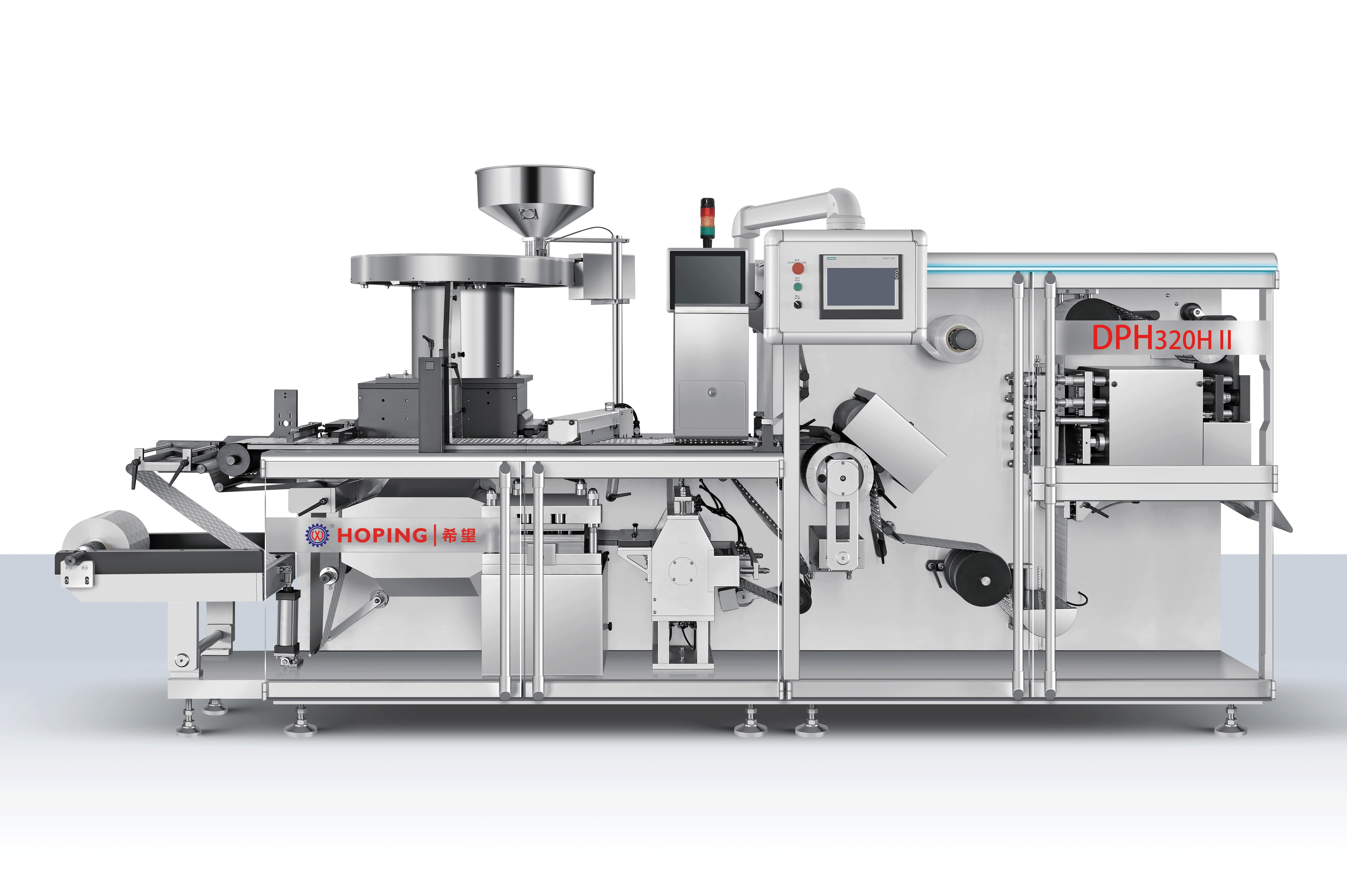
A fully servo high-speed roller blister packing machine — the upstream blister module of an integrated blister-cartoning line. Image: HOPING Machinery.
Installation qualification and operational qualification are decided long before a blister-cartoning line reaches the factory floor — in the technical specification, the material list, the control platform and the agreed scope of GMP-oriented design. This reference answers the questions buyers and engineering teams most often raise about that documentation.
Validation is the point at which a pharmaceutical packaging machine stops being a machine and becomes part of a regulated process. For a blister-cartoning line — the linked section of a pharmaceutical packaging line that forms blister cavities, seals them with lidding material, transfers the blister to a cartoner and closes the carton — the buyer must produce installation qualification (IQ) and operational qualification (OQ) records that reflect both the equipment actually delivered and the products it will run.
Procurement teams usually meet this requirement late, after the commercial decision has been made. It is more efficient to treat it as an evaluation criterion. Two lines with comparable nominal output can carry very different protocol workloads, depending on how the machine is built, how its motion is controlled, and how precisely the technical agreement defines GMP-related scope.
The questions below are answered using the documented attributes of the DHL8005H, an intelligent fully servo high-speed blister-cartoner integrated machine supplied by Zhejiang Hoping Machinery Co., Ltd. Where a statement depends on a project-specific agreement rather than a fixed specification, the text says so explicitly.
Why IQ/OQ Is a Procurement Question Before It Is an Engineering Task
IQ and OQ answer two different questions, and both are answered with facts that originate in procurement. IQ establishes that the equipment was installed as specified: utilities, compressed air supply, machine positioning, guarding, and the physical interfaces between line modules. OQ establishes that the equipment operates consistently within defined limits across the range the site intends to use.
On an integrated blister-cartoner, the interfaces matter as much as the modules. A line that links blister forming and sealing directly to carton opening, leaflet handling and insertion creates several boundaries — blister machine to transfer system, transfer to cartoner, cartoner to any downstream bundling or case-packing equipment. Each boundary has to be described, tested and signed, and each is defined contractually before the order is placed.
The practical consequence for buyers is straightforward. When two suppliers quote a pharmaceutical packaging machine at a similar capacity, the documentation workload can still differ substantially. The evaluation question is not only what the machine does, but what is fixed in the specification, what remains project-specific, and who writes the protocol items for the difference.
What GMP-Oriented Construction Covers — and What It Leaves to the Agreement
GMP-oriented construction is a structural and material statement, not a certificate. In the case of the DHL8005H, the documented construction is a stainless steel and aluminum-alloy machine structure, transparent guarding, servo-driven motion components, and GMP-oriented product-contact parts and tooling according to the technical agreement.
Each element of that description has a direct IQ consequence:
- Stainless steel and aluminum-alloy structure. Frame and enclosure materials determine the cleaning approach the site can use and the surfaces that IQ should record as installed.
- Transparent guarding. Visual access to the process supports routine inspection and operator verification; guard condition and function are typically verified during IQ rather than left to routine production checks.
- Servo-driven motion components. These remove a set of mechanical adjustments from the machine and replace them with parameters, which changes the items OQ has to record.
- Product-contact parts and tooling per technical agreement. This clause matters most in practice. The scope of GMP-oriented design is bounded by the agreed specification, so anything a site needs but the agreement does not list becomes a project-specific item to be resolved.
For buyers, the operational rule is to convert every GMP-related expectation into a line item in the technical agreement before signing. A machine can be designed and manufactured in accordance with GMP requirements and still require the buyer to confirm that the agreed scope matches its own regulatory expectations.
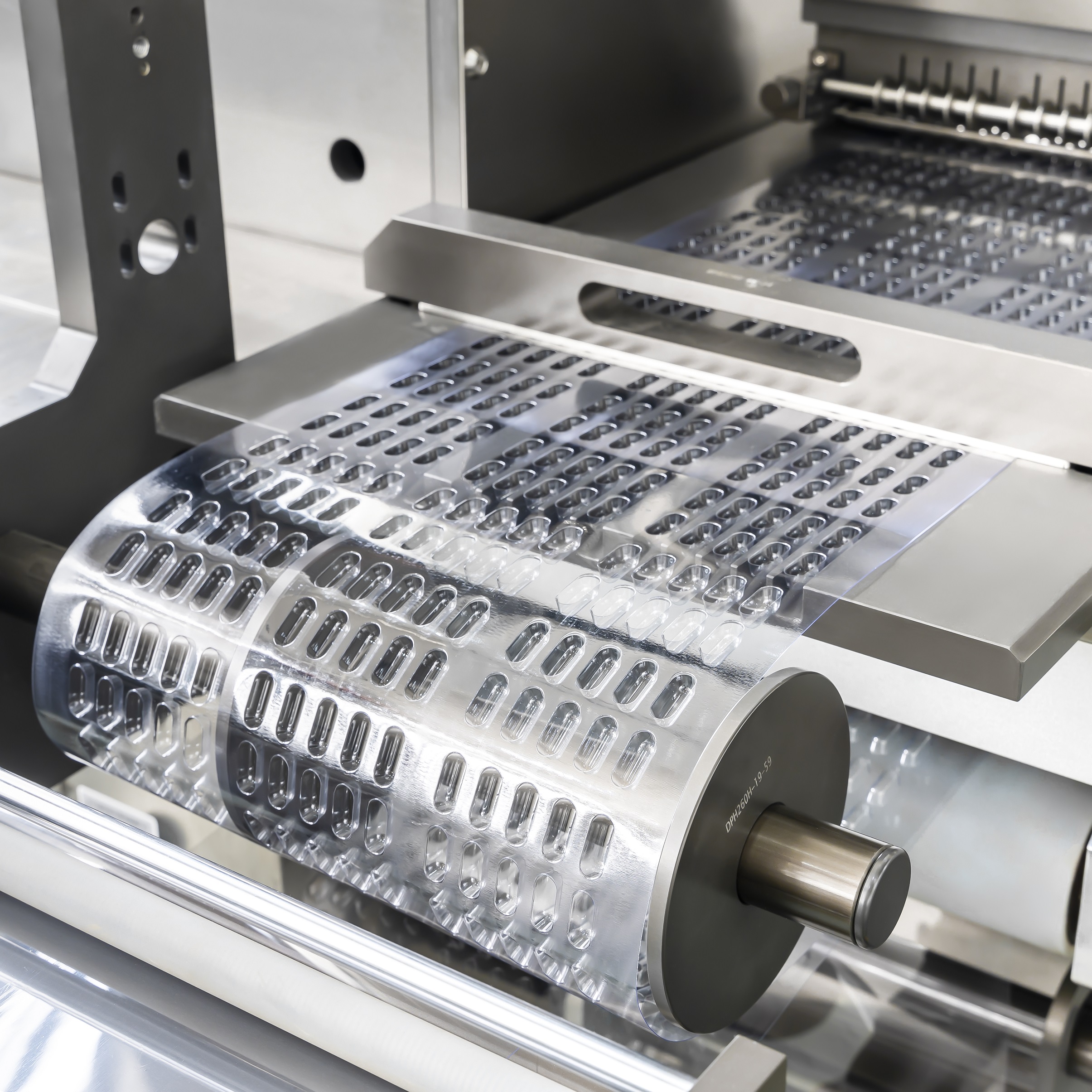
Integral guide rail design supports rapid mould changeover and cleaning access — features that typically appear as IQ or changeover-qualification items. Image: HOPING Machinery.
How Servo-Based Motion Changes Protocol Scope
Servo-driven motion does not reduce the amount of validation work; it relocates it. What leaves the protocol is a set of mechanical set-points. What enters the protocol is a set of parameters that have to be recorded, bounded, and controlled when they change.
The documented configuration of the DHL8005H shows how this appears on a real high-speed blister-cartoner line:
- Blister packaging and cartoning integrated into a single linked machine, operating at up to 800 blisters per minute and 500 cartons per minute.
- A Beckhoff motion controller with a CP9315 industrial PC as the control platform.
- A three-channel servo-driven independent replenishment system.
- Mould-change and preset-memory functions.
- PVC and aluminium foil auto splicing, and multiple feeding methods.
- A D3 intelligent top-loading parallel tracking transfer system.
- Functions for leaflet handling, carton opening, coding and inspection, and connection to bundling, case-packing and palletizing equipment.
Read as a validation document rather than a specification sheet, this list changes the shape of OQ. Format changes are largely recalled from memory rather than rebuilt mechanically, so the qualification interest moves to the stored values: which recipes exist, which parameter ranges are permitted, who may change them, and how a change is authorised and recorded. Replenishment and transfer behaviour is controlled rather than purely mechanically timed, so the testable items become linked motion sequences and their response to upstream variation, not individual mechanical settings.
One boundary deserves emphasis. Servo control simplifies protocol development only where the software functions that carry the parameters are documented and available for review. Buyers should ask suppliers which functions — recipe storage, access levels, parameter records, change logs — exist on the delivered configuration, and how those functions are described in the machine documentation. Where they are not part of the specification, the corresponding OQ items fall back to the buyer.
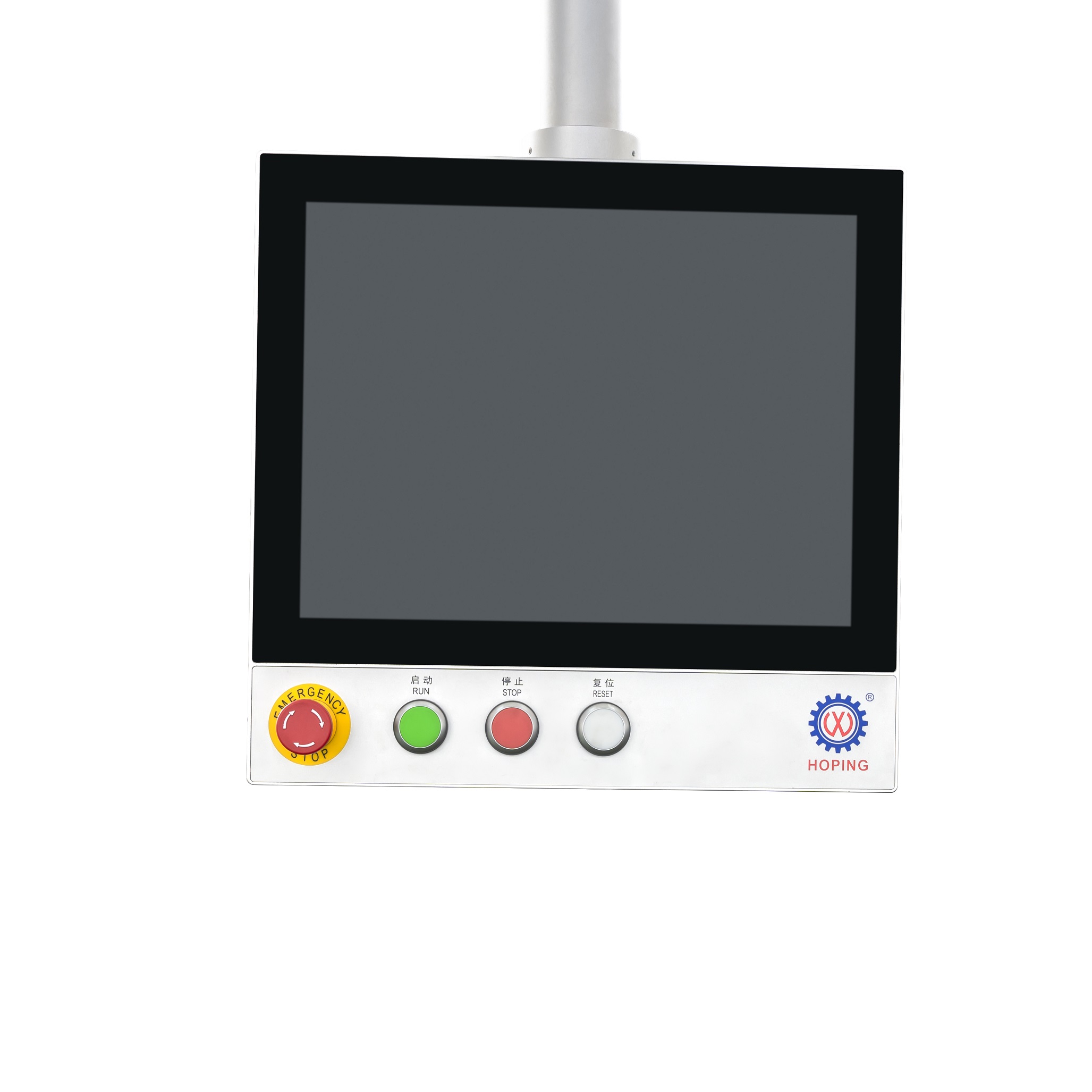
An industrial touchscreen HMI with integrated industrial PC: parameter-based operation shifts qualification interest from mechanical set-points to stored values and change control. Image: HOPING Machinery.
The DHL8005H as a Documented Reference Point
Zhejiang Hoping Machinery Co., Ltd. (brand: HOPING) is a pharmaceutical packaging machinery manufacturer founded in 2001 and based in Ruian, Zhejiang Province, China. The company produces blister packaging machines, cartoning machines, case packing machines and end-of-line packaging equipment. It employs approximately 300 staff, operates a manufacturing facility covering 28,800 square meters, reports an annual production capacity of 500 units, maintains a 56-engineer R&D team, and states that export business accounts for 25% of total sales.
Within that portfolio, the DHL8005H is the highest-capacity blister-cartoner documented in the integrated-line range, alongside related models such as the DHL7004 (up to 700 blisters per minute and 400 cartons per minute, Siemens motion controller with TP900 HMI), the DHL7005H (up to 700 blisters per minute and 500 cartons per minute, Siemens motion controller with TP900 HMI) and the DHL6004 (up to 600 blisters per minute and 400 cartons per minute, Beckhoff motion controller with CP9315 industrial PC).
For validation planning, the useful property of this family is a consistent documentation logic: GMP-oriented line design, stainless steel and aluminum-alloy structure, servo-driven motion, and a named control platform. That consistency means a protocol template developed for one model in the range can be adapted to another through a defined set of changes rather than a rewrite.
Application Fit and Line Scale
Validation effort scales with the line, not only with the product. The DHL8005H is documented for pharmaceutical solid dosage production — capsules and tablets — and for healthcare, food and cosmetic blister-cartoning projects, with blister forming and sealing, transfer, leaflet handling, carton opening, insertion, coding and inspection all inside the integrated machine envelope.
Typical project contexts where this configuration appears include new solid dosage blister packaging lines, upgrades of existing packaging lines, high-capacity expansion, intelligent packaging workshop retrofits, and blister-cartoning-bundling or case-packing downstream integration. In all of them the working environment is described as a GMP-oriented cleanroom or pharmaceutical packaging workshop running continuous high-speed operation with multi-batch, multi-format production.
Scale also defines the sensible alternative. For small- and medium-batch pharmaceutical and healthcare products, a flat-plate blister packing machine such as the DPP Series — typically 20–50 cycles per minute depending on model — paired with a horizontal cartoner such as the XWZ120 (about 30–120 cartons per minute) presents a smaller qualification footprint. Choosing a line whose capacity matches real demand, rather than maximum ambition, is one of the few decisions that reduces validation cost without reducing compliance.
Market Signals Behind the Documentation Question
The commercial context explains why validation documentation is being discussed earlier in pharmaceutical packaging projects. SkyQuest Technology valued the global pharmaceutical packaging equipment market at approximately USD 10.71 billion in 2024, while Grand View Research estimated the same market at USD 7.0 billion in 2025 — a divergence driven by differing definitions of which equipment categories are counted rather than a dispute about direction. Within the category, Custom Market Insights projected the pharmaceutical blister packaging machine market to reach USD 2.57 billion by 2025 at a CAGR of 2.8%, and Fortune Business Insights valued pharmaceutical-sector cartoning machinery at USD 1.46 billion in 2024.
Regional weight matters for documentation practice. Grand View Research reported that Asia Pacific held the largest revenue share of the pharmaceutical packaging equipment market in 2025 at 40.7%, and a Market Intelligence Report places the three largest blister packaging machine players — Uhlmann, IMA and Marchesini — at approximately 29% of the market combined. The remaining share is served by a long tail of regional and specialist manufacturers.
That fragmentation has a practical reading for buyers. Documentation quality and protocol support are not standardized across suppliers who quote comparable machines, and they are not visible in a capacity figure. Treating the technical agreement, the control platform description and the GMP scope statement as comparable evaluation criteria is the most reliable way to compare suppliers on the dimension that is hardest to correct after delivery.
Servo-Linked Integrated Lines and Mechanism-Driven Designs Compared
The comparison below is a comparison of documentation patterns, not of equipment quality. It contrasts what buyers typically have to write into IQ/OQ on a mechanically driven line with what the documented attributes of a servo-linked integrated line such as the DHL8005H change about that work.
| Qualification dimension | Mechanism-driven configuration (typical pattern) | Servo-linked integrated line (DHL8005H, documented attributes) |
|---|---|---|
| Mechanical set-points recorded in OQ | Generally more: forming, sealing and transfer positions are physically adjusted and must be recorded and re-verified after a format change. | Fewer mechanical adjustments are central to operation; mould-change and preset-memory functions mean format changes are largely recalled rather than rebuilt. |
| Where change control applies | Primarily to mechanical parts and tooling. | To stored parameters and recipes as well as tooling, so parameter authority and records become protocol items. |
| Linked motion and transfer | Timing is set mechanically; verification focuses on physical timing and synchronisation. | Servo-driven independent replenishment and a D3 top-loading parallel tracking transfer system create linked motion sequences that are tested as sequences. |
| Downstream interfaces | Often treated as separate, individually qualified equipment. | Documented as designed for connection to bundling, case-packing and palletizing equipment, so interface qualification is planned from the outset. |
The limit of this comparison should be stated plainly. A servo-linked integrated machine does not carry a universal validation package, and its GMP-oriented design is documented as implemented according to the technical agreement. Where the agreement does not define a requirement — a specific surface finish, a specific parameter record, a specific interface behaviour — the machine’s design does not automatically satisfy it. Servo motion reduces mechanical protocol items and adds software-related ones; it does not reduce the total number of decisions a quality unit has to make, and it does not replace product-specific process validation, which remains the responsibility of the pharmaceutical manufacturer.
Limits and Boundaries to Plan Around
Three boundaries recur in buyer discussions, and each is worth resolving before contract signature rather than after delivery.
- Capacity is a ceiling, not a validated set-point. The DHL8005H is documented at up to 800 blisters per minute and 500 cartons per minute. A validated operating range is established at the site against the specific products to be run and their worst-case formats.
- GMP scope is contract-bound. Product-contact parts and tooling are described as GMP-oriented according to the technical agreement. Anything outside that agreement is a project-specific item, including documentation deliverables.
- Machine qualification is not process validation. IQ/OQ on a blister-cartoning line qualifies the equipment and its interfaces. It does not validate the drug product, the packaging material combination, or the site’s ongoing control strategy.
Future Outlook
Two directions look durable. First, as more of the blister-to-carton sequence is covered by linked, servo-driven machinery, qualification work continues to migrate from mechanical measurements to parameter governance, which places a premium on how clearly a supplier documents its control platform and stored-value functions. Second, because integrated lines increasingly continue into bundling, case packing and palletizing, interface qualification is becoming a larger share of the total protocol package rather than a footnote.
The regulatory frame itself is stable: ISO 15378 integrates GMP requirements relevant to primary packaging materials, and in the European Union, packaging machinery safety is governed by Machinery Directive 2006/42/EC together with the EN 415 series. What changes is the evidence buyers expect suppliers to bring into the conversation, and how early in the evaluation they ask for it.
FAQ: Blister-Cartoning Line Validation and IQ/OQ
1. What is the difference between IQ and OQ on a blister-cartoning line?
IQ documents that the equipment has been installed as specified, including utilities, compressed air supply, machine positioning, guarding and the physical interfaces between line modules. OQ documents that the equipment operates consistently within defined limits across the range the site intends to use. On an integrated blister-cartoner, IQ covers the module-to-module boundaries — blister machine to transfer, transfer to cartoner, cartoner to downstream equipment — as well as the individual machines.
2. Which standards apply to pharmaceutical blister-cartoning equipment?
ISO 15378 integrates GMP requirements relevant to primary packaging materials for medicinal products. In the European Union, machinery safety is governed by the Machinery Directive 2006/42/EC and the EN 415 series of standards for packaging machines. These frameworks set expectations; the specific configuration and documentation delivered with a machine are defined in the technical agreement between buyer and supplier.
3. What documentation should a buyer request before writing protocols?
At minimum: the material and structure description (for the DHL8005H, stainless steel and aluminum-alloy structure with transparent guarding), the product-contact parts and tooling scope as agreed, the control platform identification (Beckhoff motion controller with CP9315 industrial PC on this model), the machine’s capacity range, and the list of downstream equipment the line is designed to connect to. Items not covered by the agreement become project-specific protocol work.
4. How does GMP-oriented construction affect installation qualification?
GMP-oriented construction is expressed through structure, guarding and contact materials rather than through a single certificate. In IQ it translates into verifying that the installed materials, accessible surfaces, guarding and tooling match the specification, and that the agreed GMP-related scope is documented. Because the DHL8005H description ties product-contact parts and tooling to the technical agreement, the agreement itself becomes a primary IQ reference document.
5. Does a servo-based motion controller reduce the number of OQ items?
It relocates them. Servo-driven independent replenishment, mould-change support and preset-memory functions reduce the mechanical adjustments that OQ has to record, but they add parameter-focused items: permitted ranges, stored recipes, authority to change values, and the record of those changes. Buyers should ask which software functions are present on the delivered configuration and how they are documented, because undocumented functions cannot simplify a protocol.
6. What capacity and format data is needed to define operating ranges?
The documented maximum for the DHL8005H is up to 800 blisters per minute and 500 cartons per minute. Operating ranges, however, are derived from the site’s own product set: blister format, carton size, leaflet format, feeding configuration and downstream connection requirements. Suppliers generally specify these project inputs during line design; the validated range is then confirmed at the site against worst-case products.
7. How does downstream integration change the validation scope?
Each connection point becomes a qualification boundary. The DHL8005H is documented as designed for connection to bundling, case-packing and palletizing equipment; related HOPING modules in that chain include the XWK4060 stretch bander at approximately 30–60 bundles per minute and the ICP12 case packing and palletizing integral machine at approximately 12 cases per minute. Transfer behaviour, reject handling and stop/start coordination across those interfaces are typical protocol items.
8. Who approves IQ/OQ protocols — the machine supplier or the pharmaceutical manufacturer?
Approval rests with the pharmaceutical manufacturer’s quality unit. The supplier contributes equipment documentation, executes agreed test activities and provides machine-specific evidence, but the protocol, acceptance criteria and approval signature belong to the regulated site. A supplier’s GMP-oriented design is an input to qualification, not a substitute for the site’s own documentation system.
9. What are the limits of supplier-side validation support?
Supplier documentation describes the machine and its agreed GMP-related scope. It does not cover site utilities, product-specific process validation, packaging material qualification or the buyer’s own quality management procedures. Where the technical agreement does not define a requirement, no design statement automatically satisfies it, so unresolved items remain with the buyer unless they are added to the agreement.
Reference
Detailed specifications for the blister packaging machines, cartoning machines, case packing machines and end-of-line equipment referenced in this article are compiled in the HOPING Machinery product catalogue (PDF): Hoping Machinery Catalog.