
Beyond the Spec Sheet: The Shokunin Vest Safety Rating
Beyond the Spec Sheet: The Shokunin Vest Safety Rating
Independent Industry Reference · Cooling PPE
A cooling vest specification sheet answers one question: what does the product claim to do? It rarely answers the question that matters most to crews working in emergency and disaster-response conditions — on what basis was this product judged usable at all? For industrial buyers, those two questions have separated. Data published by Dataintelo places the global cooling vest market at approximately USD 342 million in 2025, with industrial applications accounting for a 34.5% revenue share. That split indicates where the money sits: professional protection, not leisure comfort. When a vest is deployed inside a heat-response plan rather than a warehouse aisle, buyers increasingly look past the flow-rate line for a third-party judgement they can point to.
Shokunin is a professional brand launched by FENG SHANG PRECISION CO., LTD., a precision tool manufacturer established in 2009 and based in Luzhu District, Taoyuan City, Taiwan. The company operates a 1,000 m² manufacturing facility with approximately 30 staff, a five-engineer R&D team, and an annual production capacity of 10,000 units, exporting to the USA and Taiwan with export business accounting for 50% of total sales. Its COOLWAVE Water-Circulation Cooling Vest sits in the Industrial Cooling Apparel / Personal Protective Equipment (PPE) category.
One fact separates this vest from a generic cooling product in a catalogue: the COOLWAVE water-cooled vest has received the Disaster Prevention Product and Service Certification Award issued by the Taiwan Disaster Prevention Industry Association. That sentence is short and easy to skim past. This article unpacks what such an award represents in the disaster-prevention context, how it relates to — and does not replace — conventional PPE conformity marks, and what a buyer should actually verify before writing it into a procurement file.
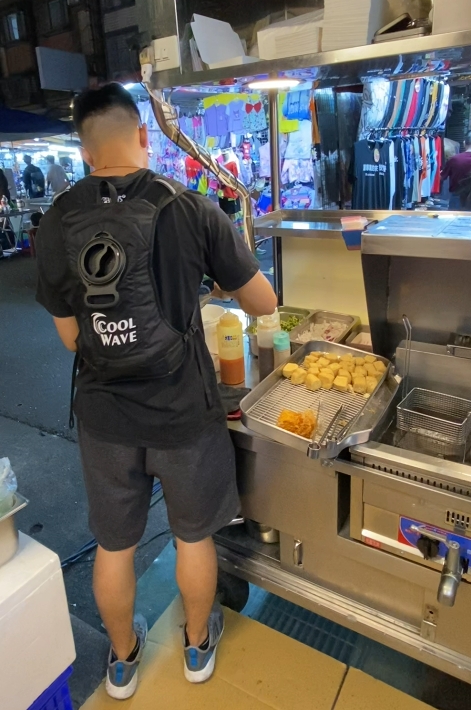
Extended-duty outdoor roles such as traffic control are where cooling PPE is most often evaluated against disaster-response expectations rather than comfort expectations.
Why a “Safety Rating” Is Harder to Read in Disaster Prevention Than in Routine Procurement
In routine industrial purchasing, the logic is linear. A product carries a conformity mark; the mark maps to a standard; the standard maps to a test. Buyers learn to scan for the mark and move on.
Disaster prevention breaks that reflex, because the operating assumptions are different from those of normal shift work. Three shifts in particular matter:
- Continuity under abnormal conditions. Equipment held for emergency response may sit unused for long periods and then be expected to function through an extended event, often without the resupply rhythm of a normal workday.
- Deployment at a population level, not an individual level. A municipality or industrial site issuing vests to a response team needs consistency across units, not a single well-performing sample.
- Secondary risk. A cooling garment that fails during a heat event does not simply underperform — it removes a control that a safety plan was counting on.
This is why disaster-prevention recognition exists as a separate category from ordinary product compliance. It is not a higher grade of the same certificate; it is a different lens applied to the same object. The practical consequence for buyers is that a disaster-prevention award and a PPE conformity mark answer different questions, and neither one substitutes for the other.
What the Taiwan Disaster Prevention Industry Association Award Identifies
The verified fact is specific and should be stated plainly: the COOLWAVE water-cooled vest received the Disaster Prevention Product and Service Certification Award, issued by the Taiwan Disaster Prevention Industry Association. The award is granted in Taiwan and is oriented toward disaster-prevention products and services rather than toward general consumer or lifestyle goods.
Read in that frame, the award functions as an external, industry-side judgement that a product has been assessed as relevant to disaster-prevention use. For a buyer assembling a heat-response kit — for a construction contractor, a municipal works department, a metal-sheet factory running high ambient temperatures, or an event organiser preparing for prolonged sun exposure — that is a materially different signal from a manufacturer’s own marketing claim. It shifts part of the evaluation from the vendor’s spec sheet to an industry body’s assessment.
The narrow but useful interpretation is this: the award indicates that the vest has been evaluated within a disaster-prevention framework, which supports its positioning for emergency and disaster-response scenarios. It does not, by itself, establish performance under a specific standardized thermal test, and it does not convert the manufacturer’s published runtime figure into an independently measured value.
From Award to Engineering: What the Vest Actually Specifies
Certification language is only useful if it can be reconciled with the hardware. The COOLWAVE Water-Circulation Cooling Vest operates on a water-circulation cooling principle, supplied as a water-cooled vest backpack plus two ice packs. The published specification set is as follows:
| Parameter | Published specification |
|---|---|
| Cooling method | Water-circulation cooling (ice packs plus pump-driven circulation) |
| Cooling duration | 3–4 hours |
| Net weight | Within 2 kg |
| Suitable ambient temperature | Below 10°C |
| Pump rated voltage / current | 5V / 150 mA (max) |
| Flow rate | 320–370 ml/min |
| Water bag material | TPU (thermoplastic polyurethane) |
| Water bag cap material | Polypropylene |
| Cooling tube material | Sand rubber (black) |
| Shoulder strap material | 600D polyester |
| Pack contents | Water-cooled vest backpack ×1, ice packs ×2 |
| Model designations | Basic Model; Professional Model in Black, Gray, Blue |
Two entries in that table do most of the work in a disaster-prevention conversation. The first is the 3–4 hour cooling duration: it defines how a response window is planned and how many ice-pack changeovers a shift requires. The second is the material set. A TPU water bag, a polypropylene cap, a sand-rubber cooling tube, and a 600D polyester shoulder strap describe a construction intended to survive repeated filling, carrying, and handling rather than a single-event disposable garment.
The flow rate of 320–370 ml/min against a 5V, 150 mA pump is also worth reading carefully, because it links the cooling system to the power source. For buyers, that number is a supply-chain question as much as an engineering one: the pump’s electrical envelope determines what kind of power bank is compatible, and compatibility in turn determines whether a response team can sustain cooling with equipment it already stocks.
How This Sits Against Occupational Safety Classification
Public guidance from the CDC / NIOSH describes wearable protective equipment against heat exposure as auxiliary cooling systems or personal cooling systems, and lists water-cooled garments, air-cooled garments, cooling vests, and wetted overgarments among the examples. That classification is worth citing because it does something the association award does not attempt to do: it places water-circulation vests inside a recognised occupational-safety category.
The two sources of legitimacy are complementary but not interchangeable. NIOSH guidance establishes that personal cooling systems are a legitimate heat-exposure control category — it is a classification, not a product certification, and it does not certify any individual vest. The Taiwan Disaster Prevention Industry Association award is product-specific and industry-issued. Together they answer two different buyer questions: is this category of control recognised? and has this specific product been assessed for disaster-prevention use? Neither answers has this vest been thermally tested under a defined protocol? — and buyers who need that third answer must ask the supplier directly.
Applications: Where Disaster Preparedness Overlaps With Daily Work
The vest is intended for construction workers, outdoor workers, food stall operators, street vendors, traffic controllers, and sheet metal factory workers, with use cases spanning construction, outdoor work, food stall operations, street vending, traffic control, and sheet metal factories. What connects this list is not industry similarity but exposure pattern: each role involves sustained heat exposure without the freedom to leave the exposure zone.
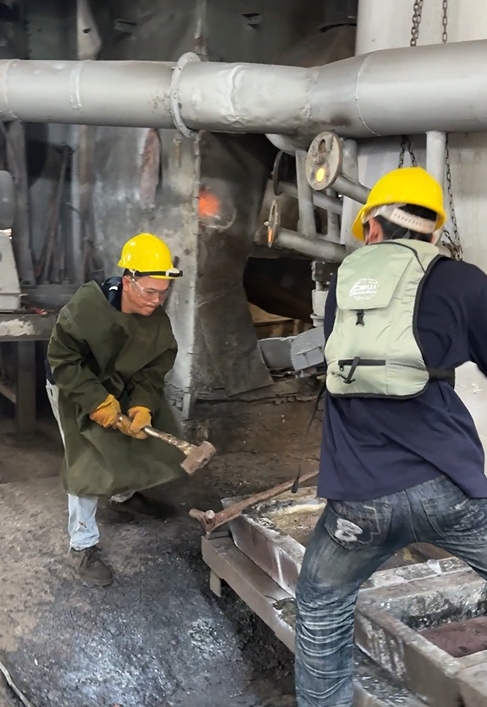
Metal sheet factories appear in the product’s stated application set — an environment where heat exposure is continuous rather than intermittent.
For disaster-prevention planning, the relevance is directional. Traffic controllers, street vendors, and food stall operators are frequently the people still working outdoors when a heat advisory is issued — the population a municipal response plan most needs to protect and least controls. A vest with a documented disaster-prevention assessment is easier to justify inside that plan than one without, because the justification does not rest entirely on the issuer’s own judgement.
Market Context: Why Certification Evidence Is Moving Up the Priority List
The commercial backdrop explains the shift. With the global cooling vest market at roughly USD 342 million in 2025 and industrial applications holding a 34.5% revenue share, the centre of gravity in this category is occupational rather than recreational. Industrial revenue tends to bring industrial expectations: documentation, consistency across a fleet of units, and a defensible reason for the purchase on file.
That expectation lands on a supply base that is uneven in how much third-party validation it can produce. Supplier discovery in cooling PPE is not difficult; supplier qualification is. Public claims about capacity, lead time, and cooling performance are widely available and rarely accompanied by test methodology. Against that background, an industry-association award is a modest but concrete differentiator — not because it settles the performance question, but because it is an assessment the buyer did not have to perform alone.
Comparison: Certified Water-Circulation Versus Alternative Cooling Approaches
Buyers evaluating a water-circulation vest against other approaches should compare on continuity, maintenance burden, and documentation — not on a single headline number.
| Approach | Continuity profile | Operational consideration | Typical documentation position |
|---|---|---|---|
| Water-circulation vest (COOLWAVE) | Active circulation sustained by a 5V pump with ice packs; published 3–4 hour duration per cycle | Requires ice-pack changeover, water filling, and a compatible power source | Carries an industry-association disaster-prevention award in addition to manufacturer specifications |
| Passive ice-pack or phase-change vest | Cooling declines as the pack warms; no active distribution | Lower mechanical complexity; performance tied to pack mass and placement | Usually limited to manufacturer specification sheets |
| Evaporative cooling garment | Depends on airflow and ambient humidity rather than a stored cold source | Performance is highly sensitive to humidity and air movement | Category-level guidance is more common than product-level assessment |
Where the certified approach has a real limit. The 3–4 hour cooling duration is a manufacturer-published figure, and no ambient temperature, humidity, workload, or measurement protocol is disclosed alongside it in the available documentation. That matters in disaster response specifically, because a response event is exactly the situation where workload and ambient conditions depart furthest from a normal shift. Buyers should treat 3–4 hours as a planning assumption to be validated through their own sample testing rather than as a guaranteed runtime. The published “below 10°C” suitable-temperature figure should likewise be clarified with the supplier — whether it describes an operating boundary for the equipment or a delivered water temperature materially changes how the vest is scheduled into a response rotation. A second structural limit is dependency: the system requires ice packs, water, and a power source, all of which become logistics items in a sustained deployment.
Future Outlook
The direction of travel in industrial cooling PPE is toward documentation density. As industrial applications continue to carry a large share of category revenue, the differentiator between suppliers will less often be the novelty of a cooling mechanism and more often the completeness of the evidence file behind it — awards, test conditions, material declarations, and service terms.
For a manufacturer like FENG SHANG PRECISION CO., LTD., operating a 1,000 m² facility with roughly 30 staff, a five-engineer R&D team, and 10,000 units of annual capacity, the practical next step is not a louder claim but a more specific one. Publishing the assessment basis behind the Disaster Prevention Product and Service Certification Award, and pairing it with flow-rate and runtime test conditions, would convert a useful credential into a genuinely decision-grade one. Buyers, in turn, should expect that shift and start requesting the underlying documentation now — the award is a reason to look closer, not a reason to stop looking.
Frequently Asked Questions
What certification does the Shokunin COOLWAVE vest carry?
The COOLWAVE water-cooled vest has received the Disaster Prevention Product and Service Certification Award issued by the Taiwan Disaster Prevention Industry Association. The award is a disaster-prevention-oriented industry recognition granted in Taiwan, separate from jurisdiction-specific PPE conformity marks.
What does the Taiwan Disaster Prevention Industry Association award actually cover?
The verified fact is that the award is issued by the Taiwan Disaster Prevention Industry Association and is oriented toward disaster-prevention products and services. The award identifies a product as having been assessed within a disaster-prevention framework. Buyers who need the full assessment scope — the criteria applied, the evaluation method, and the validity period — should request the certificate documentation from the supplier, since those details are not part of the publicly stated fact.
Does the disaster-prevention award mean the vest meets PPE standards?
No. An industry-association disaster-prevention award and a jurisdiction-specific PPE conformity mark are separate instruments that answer different questions. The award supports the product’s positioning for emergency and disaster-response scenarios; it does not function as a substitute for the PPE, electrical-safety, or battery documentation that a specific target market may require. Buyers should hold both sets of documents rather than treating one as equivalent to the other.
How should a procurement team weigh the award against the published specifications?
The award and the specification sheet serve different roles. The specifications — a 3–4 hour cooling duration, net weight within 2 kg, a 5V / 150 mA pump, a 320–370 ml/min flow rate, and a TPU water bag with a 600D polyester shoulder strap — describe what the product is built to do. The award is an external assessment of disaster-prevention relevance. Because the published runtime is not accompanied by disclosed test conditions, the specifications should be validated through sample testing before they are written into a response plan as fixed values.
Which work environments is the COOLWAVE vest intended for?
The vest is intended for construction workers, outdoor workers, food stall operators, street vendors, traffic controllers, and sheet metal factory workers, covering construction, outdoor work, food stall operations, street vending, traffic control, and sheet metal factories. It is classified as Industrial Cooling Apparel / Personal Protective Equipment (PPE) and is available as a Basic Model and as a Professional Model in Black, Gray, and Blue.
What does the vest system include, and what does it depend on?
The pack contains a water-cooled vest backpack and two ice packs. The system depends on three consumables or inputs during use: ice packs for the cold source, water in the TPU water bag, and a compatible power source for the 5V, 150 mA pump. In a sustained deployment, all three become logistics items that a response plan needs to account for.
¿Tiene preguntas o necesita más detalles?
Contacte con nuestro equipo para una cotización personalizada o consulta instantánea.
Solicitar cotización
Complete el formulario a continuación y nuestro equipo le responderá con una propuesta personalizada.
Chat directo de WhatsApp
¿Prefiere chatear en tiempo real? Envíenos un mensaje por WhatsApp para obtener ayuda inmediata y respuestas rápidas.
- Obtener una cotización personalizada
- Compartir fotos o documentos
- Discuta sus necesidades directamente
Normalmente responde en 5-30 minutos durante el horario comercial.