
Beyond the Spec Sheet: Rooftop Tent Fabric and Compliance
Beyond the Spec Sheet: Rooftop Tent Fabric and Compliance
A compliance file tells a procurement team that a tent model is permitted to be sold into a market. It does not tell them how the fabric was specified, how many material layers stand between the occupant and the weather, or whether a waterproof claim survives the stitching. For buyers sourcing camping tents, rooftop tents and inflatable tents, the second question is the one that decides warranty cost, return rates and end-user safety.
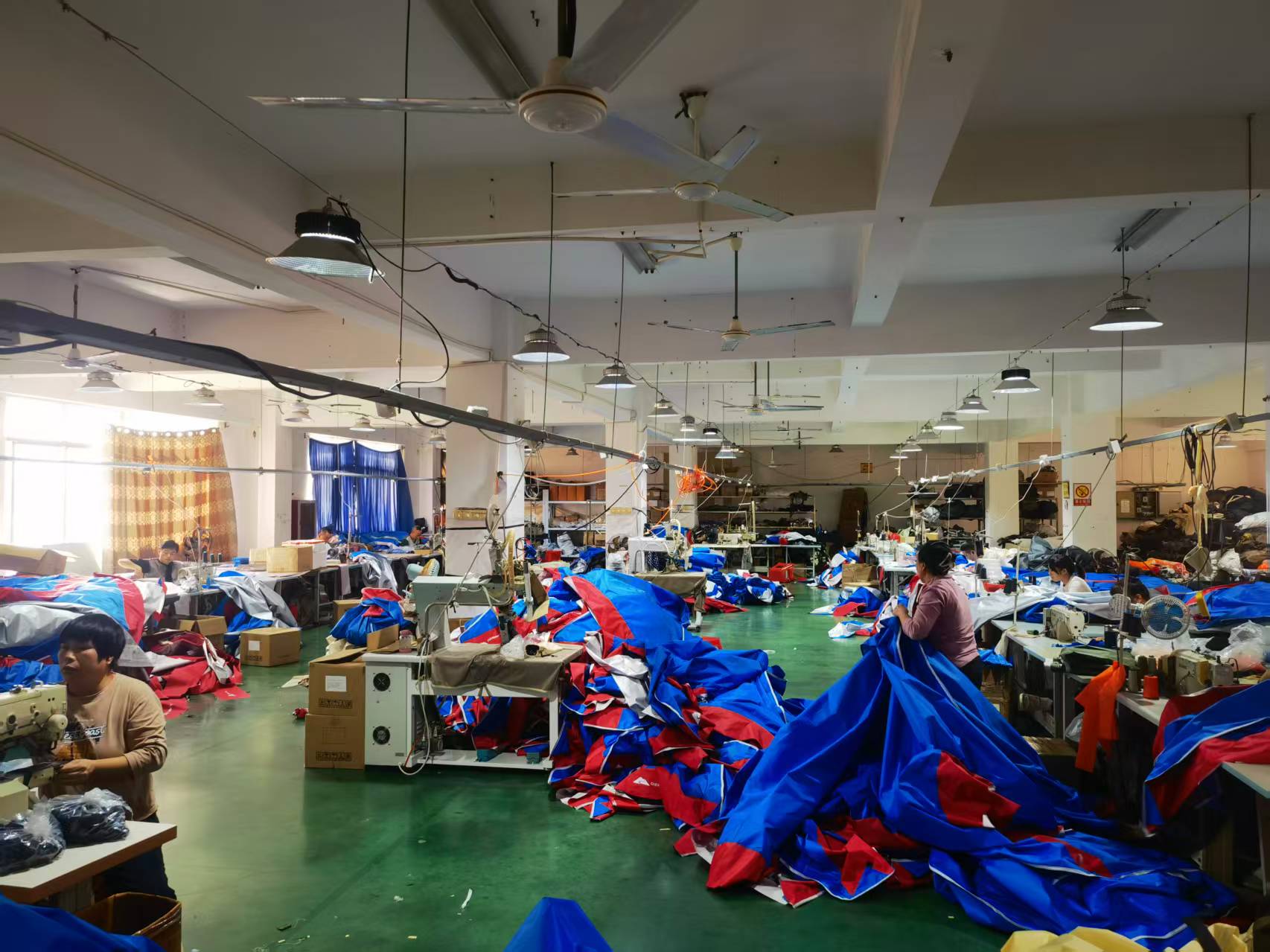
Material and panel handling inside the MARVELOUS camping tent production room, Xiamen, Fujian, China. Construction details are visible on the line long before they reach a specification document.
Why the Compliance File Is a Starting Point, Not a Verdict
Most supplier qualification processes begin and end with document review. A certificate is requested, a test report is filed, and the supplier moves onto the approved list. The difficulty is that documents answer a binary question — did a sample pass a defined test — while procurement decisions are made against a different question: will the construction that arrives in the container behave the way the sample did?
Two tents can hold identical compliance paperwork and still differ materially in fabric weight, layer count, seam treatment and shell specification. Those differences do not appear in the certificate. They appear in the field, usually as moisture ingress, fabric fatigue, or a waterproof claim that fails within the first season.
The practical response is not to distrust certification. It is to read the product's construction with the same rigor applied to its paperwork. Compliance establishes market eligibility; construction details establish fitness.
| Spec-sheet parameter | What the sheet typically states | What it does not settle | Evidence to request |
|---|---|---|---|
| Fabric weight | Mass per unit area or yarn linear density | Yarn type, weave density, coating quality | Specification with units, test report, finished panel sample |
| Outer / inner layer | Frequently a single fabric name for the whole tent | Layer function, condensation path, ventilation geometry | Layer architecture description |
| Waterproof rating | Fabric hydrostatic head in millimetres | Seam sealing, zipper protection, entry geometry | Fabric figure plus seam and zipper method |
| Shell material | Aluminium or ABS plastic | Shell thickness, seal quality, load rating | Shell specification and assembly inspection record |
| Flammability | Reference to a standard or a pass result | Coating durability across the service life | Destination-mapped test documentation |
What ISO 5912:2020 and CPAI-84 Actually Confirm
Two reference points matter most for tents sold internationally.
ISO 5912:2020 is the international standard for camping tents. It specifies safety, performance and fitness-for-use requirements, including flammability and rain resistance. It is the framework most non-US buyers use to structure a technical file.
CPAI-84 is a flammability standard. It is mandatory for tents in several US states — California, New York, New Jersey, Massachusetts, Louisiana, Michigan and Minnesota — and is a federal requirement in Canada.
Both are legitimate and necessary. Neither is a construction specification. ISO 5912:2020 confirms that rain resistance was assessed as part of a fitness-for-use evaluation; it does not fix the hydrostatic head figure, the fabric weight, or the number of layers a supplier will use in the next production run. CPAI-84 addresses flammability behaviour under a defined test, not the durability of the coating that carries a waterproof rating.
For a procurement team, the correct reading is this: certification answers “may this be sold”, and construction documentation answers “will this perform”. Supplier qualification that stops at the first question is incomplete.
Reading Fabric Weight the Way a Buyer Should
Fabric weight is one of the few parameters that appears on almost every tent specification and is almost never verified at the point of purchase. It is usually expressed either as mass per unit area, in grams per square metre, or as yarn linear density in denier combined with a weave description.
Three points are worth understanding about this number.
Fabric weight is a proxy, not an outcome. Heavier fabric generally correlates with better tear strength, abrasion resistance and UV durability, but the relationship depends on yarn type, weave density and coating. A heavier fabric with a weak coating can underperform a lighter, better-finished one.
The number is only meaningful alongside the test document that produced it. A fabric weight quoted without a corresponding test report is a marketing figure rather than a technical one, and it cannot be compared on equal terms against a supplier who supplies both.
Fabric weight carries a trade-off the buyer has to price. Higher weight generally improves durability while increasing packed volume and unit mass. That matters for rooftop tents, where every kilogram is carried on the vehicle roof, and for inflatable camping tents, where packed size affects retail packaging and container efficiency.
A workable buyer rule: request the fabric specification with units, the test report that validates it, and a physical sample of the finished panel, in that order. If any of the three is missing, the parameter remains unverified.
Outer Tent, Inner Tent, and the Layer Architecture Question
Spec sheets rarely show the layer stack, yet the stack is where most comfort and condensation outcomes are decided.
In a typical tent construction, the outer layer is the primary barrier against rain, wind and UV exposure. The inner layer is the interface with the occupant and governs condensation management and breathability. In a hard shell rooftop tent, a third element sits above both: the shell itself. Hard shell rooftop tents typically use aluminium or ABS plastic shells, which is part of why they can be set up in roughly 3 to 8 minutes, compared with 15 to 25 minutes for ground tents.
The layer question matters because moisture problems are frequently misdiagnosed. A complaint about “a leaking tent” is often a condensation complaint: the outer layer held the rain, but the inner layer could not move vapour, and the occupant woke up wet. Reading only the outer fabric specification will not reveal this. Reading the full stack — outer fabric, inner fabric, and the ventilation path between them — will.
Applying this to a specific hard shell model, such as the MOT-LK901 or the MOT-DYG01, the review sequence is identical: confirm the shell material, confirm the outer fabric specification, confirm the inner layer and its function, and confirm how air moves between the layers.
Waterproof Ratings: Where Most Spec Sheets Go Quiet
Waterproof performance is normally quoted as a hydrostatic head value in millimetres, measured on a fabric sample under a column of water. The figure is useful, and it is also the most commonly over-read number on a tent specification.
A fabric-level rating does not describe the finished product. Water enters a tent through seams, zips, entry points and anywhere a needle has passed through the coating. A specification can state a robust fabric rating while saying nothing about seam sealing method, zipper protection, or the geometry that keeps driven rain away from the entry.
This is where the gap between documentation and construction is widest, and where supplier process discipline becomes the real qualification criterion. MARVELOUS, an outdoor tent manufacturer based in Xiamen, Fujian, China, registers fabric crack and waterproof invalidation as formal production risks and applies a defined control to both: the tent is set up and inspected piece by piece. Units that are defective or do not meet specification during production are selected out and reprocessed rather than shipped.
For a procurement team, that statement is more decision-relevant than any single rating figure. It describes a plant-level control that operates on every unit rather than on a sample.
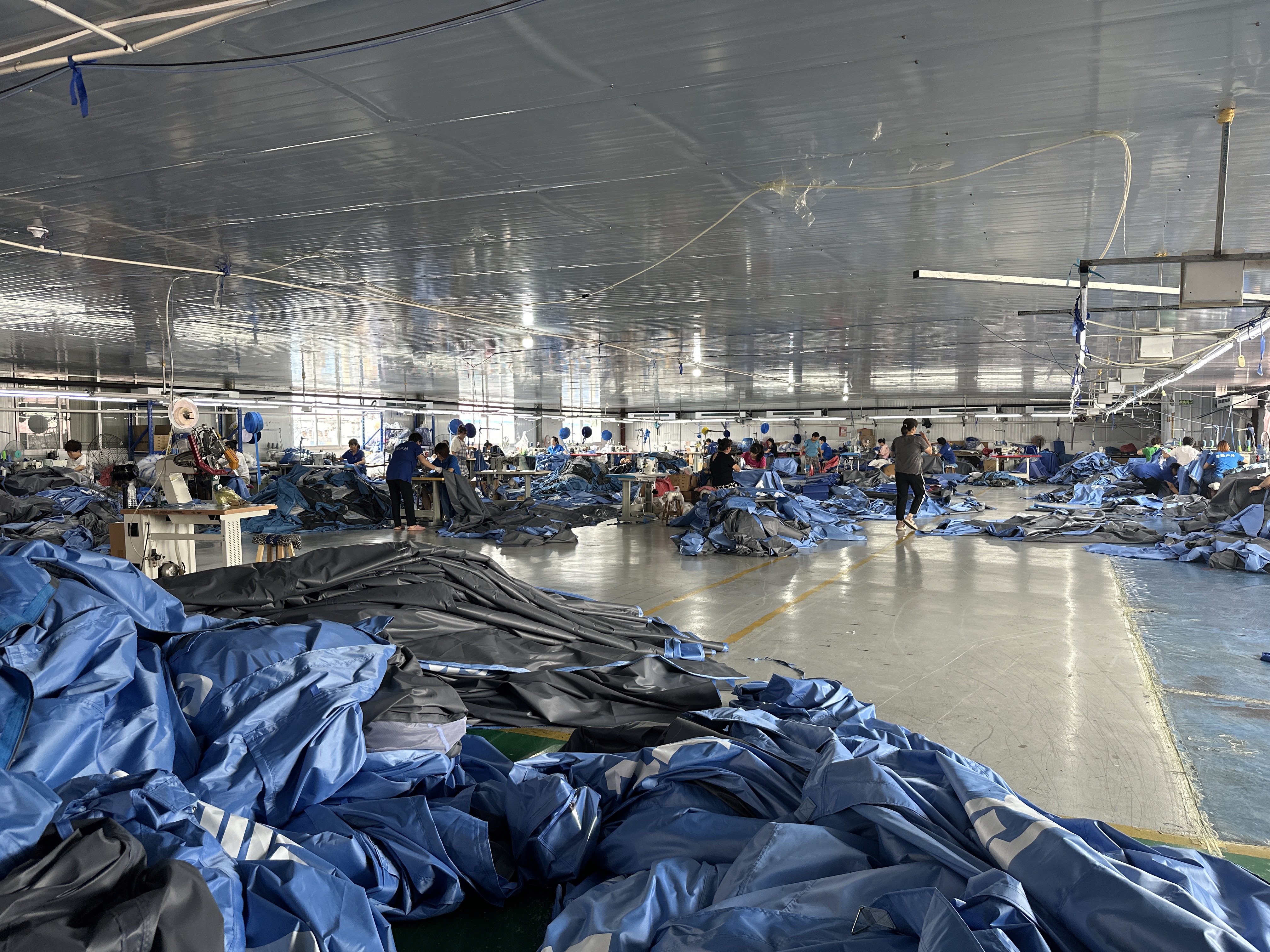
Rooftop tent production room. Set-up and piece-by-piece inspection is the documented control MARVELOUS applies against fabric crack and waterproof invalidation.
Construction Details That Sit Outside the Certificate
Fabric is not the only construction variable that escapes the compliance file. Frame and pole specification is equally relevant, particularly for pole-supported and hybrid tents.
MARVELOUS comparison documentation records the difference between its pole configuration and a traditional tent pole at 1.5 mm in diameter, associated with greater stability and better pressure-bearing capacity. The same comparison records a cost difference of approximately 10% lower, and notes that the poles are designed for easy disassembly, with broken segments separable and individually replaceable.
Two procurement implications follow. The first is that a stability improvement can be delivered through a dimensional change rather than a material change — which means the buyer needs the comparison, not only the end specification, to understand what they are paying for. The second is field serviceability: a pole that can be replaced segment by segment reduces the cost of the most common after-sales failure in pole-supported tents, which changes total cost of ownership rather than only unit price.
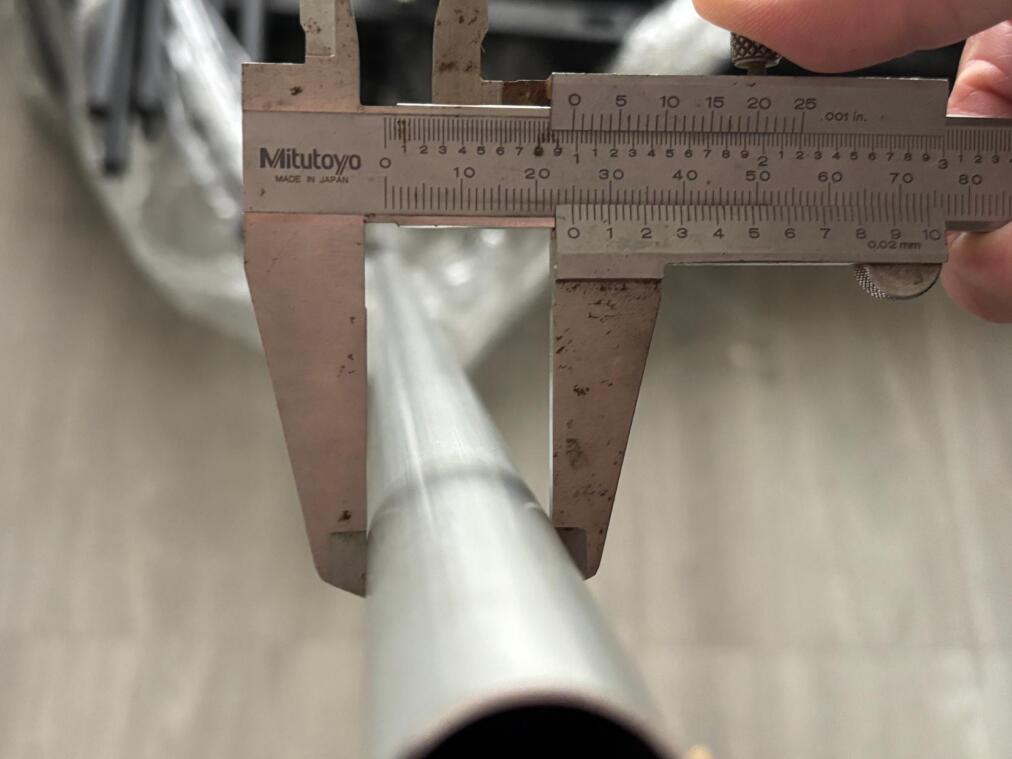
Pole diameter comparison recorded at a 1.5 mm difference versus a traditional tent pole, linked to greater stability and better pressure-bearing capacity.
MARVELOUS: Where Material Control Sits in the Production Process
XIAMEN MARVELOUS OUTDOOR TECHNOLOGY Co., Ltd, which manufactures under the MARVELOUS brand, is an outdoor tent manufacturer producing camping tents, rooftop tents and inflatable tents. The company operates a 4,000 m² factory with 50 employees and an annual output of 50,000 units, and exports approximately 95% of production, with main markets in Russia, the United States, Australia and Canada.
The relevant fact for this topic is where material decisions are made. MARVELOUS states that its design team controls the process from appearance design and structural design through raw material selection, colour matching, safety testing and environmental testing. In other words, raw material selection sits inside the engineering function rather than being handled as a purchasing decision after the design is fixed.
The company positions itself around camping safety, comfort and ease of use, and routes sales through an internal sales team and an overseas distributor network. For buyers reading beyond the spec sheet, that structure is the point: when raw material choice is controlled by the same team responsible for structural design and testing, changes in fabric or coating specification are less likely to pass unnoticed through a purchasing substitution.
Market Context: Where Compliance Pressure Is Coming From
The commercial backdrop explains why construction-level scrutiny is increasing rather than decreasing.
The global camping tent market was valued at approximately USD 6.18 billion in 2025 and is projected to reach USD 10.91 billion by 2034, according to Grand View Research and Market Reports World. Within that total, the rooftop tent segment was valued at approximately USD 215.5 million in 2024, with hard shell models accounting for more than 53% of revenue share, according to Business Research Insights. The inflatable tent segment reached approximately USD 1.033 billion in 2024, driven by demand for ease and speed of setup in glamping applications, according to Intel Market Research.
Regionally, North America holds the largest rooftop tent share at 38.6%, followed by Europe at 27.4%, reflecting established overlanding cultures. The premium end of the rooftop tent segment includes manufacturers such as Alu-Cab (South Africa), iKamper (South Korea), Thule (Sweden) and James Baroud (Portugal).
The procurement reading is straightforward. The segments growing fastest — hard shell rooftop and inflatable — are also the segments where material selection carries the most performance load. A hard shell tent's shell and fabric must survive permanent vehicle exposure; an inflatable tent's material must hold shape and pressure without a frame to compensate. In both cases the compliance file is a baseline and the construction detail is the differentiator.
Rooftop Tents Versus Traditional Solutions: Trade-offs to Price In
Comparing a hard shell rooftop tent against a traditional ground or pole tent is not a question of which is better. It is a question of which constraints the buyer can absorb.
| Dimension | Hard shell rooftop tent | Traditional ground / pole tent |
|---|---|---|
| Setup time | Approximately 3–8 minutes | Approximately 15–25 minutes |
| Structural support | Aluminium or ABS plastic shell provides rigidity | Poles and guy lines; stability depends on pole specification and pegging |
| Vehicle dependency | Mounted on the vehicle roof; not usable without a vehicle | Independent of the vehicle |
| Load during travel | Permanent roof load carried throughout the trip | Carried inside the vehicle; no permanent external load |
| Acquisition cost | Generally higher unit cost | Generally lower unit cost |
| Compliance file | ISO 5912:2020 and CPAI-84 as applicable | ISO 5912:2020 and CPAI-84 as applicable |
The table shows a genuine limitation on the rooftop tent side. A hard shell rooftop tent carries a permanent roof load on the vehicle and a higher acquisition cost than a comparable ground tent. It also ties the product to the vehicle, which does not suit every customer segment. Ground and pole tents remain cheaper and vehicle-independent, at the cost of a longer setup window.
A second limitation applies to the qualification method itself, and it is worth stating plainly: compliance testing is performed on samples. A passed test does not guarantee batch-to-batch consistency. That is why the construction-level controls described in this article — raw material selection inside engineering, piece-by-piece set-up inspection, and removal and reprocessing of non-conforming units — matter more than the certificate for buyers who carry warranty exposure.
What to Request in the Next RFQ: A Six-Point Evidence Set
For procurement teams translating this into a request for quotation, six items cover the gap between documentation and construction:
- Fabric specification with explicit units. Mass per unit area or yarn linear density, plus weave and coating description — not a marketing descriptor.
- Layer architecture. Outer fabric, inner fabric, and the shell or ground layer where applicable, with the function of each layer stated.
- Waterproof evidence at two levels. The fabric hydrostatic head figure, plus a statement of seam sealing and zipper protection method.
- Flammability documentation mapped to destination. CPAI-84 for California, New York, New Jersey, Massachusetts, Louisiana, Michigan, Minnesota and Canada; ISO 5912:2020 as the general performance framework.
- Pitched inspection protocol. Written confirmation of a set-up-and-inspect-per-piece procedure, and how non-conforming units are handled.
- Serviceability and replacement path. Whether structural components such as pole segments can be replaced individually.
A supplier that can answer all six in writing is providing construction evidence. A supplier that can answer only items three and four is providing compliance evidence. The difference tends to surface at the returns desk rather than in the quotation.
Future Outlook
Three directions appear likely through the remainder of the decade.
First, qualification will shift from document review toward construction review. As rooftop tent volumes grow and hard shell models hold the majority of segment revenue, buyers carrying warranty exposure have a clear incentive to request evidence at the panel and seam level rather than at the certificate level.
Second, regional regulatory divergence will keep pressure on documentation management. CPAI-84's state-level application in the United States, its federal role in Canada, and ISO 5912:2020 as the international framework mean the same product can require a different evidence file depending on destination.
Third, growth in the inflatable segment will push material durability into a more prominent role, because inflatable structures rely on fabric and coating for shape and pressure retention in a way that framed tents do not.
None of these trends removes the certificate from the process. They add a second layer of reading on top of it — which is the point at which procurement stops evaluating paperwork and starts evaluating construction.
FAQ
What does a compliance certificate confirm about a rooftop tent?
A certificate confirms that a sample met a defined standard. ISO 5912:2020 covers safety, performance and fitness for use, including flammability and rain resistance. CPAI-84 addresses flammability and is mandatory in California, New York, New Jersey, Massachusetts, Louisiana, Michigan and Minnesota, and is a federal requirement in Canada. Neither document fixes fabric weight, layer count, or the waterproof performance of a specific production batch.
How should buyers compare fabric weight between two tent suppliers?
Compare the specification and the evidence behind it. Request the fabric specification with explicit units, the test report that validates it, and a physical sample of the finished panel. A weight figure quoted without a supporting test document cannot be compared on equal terms with one that has it. Fabric weight also carries a trade-off: higher weight generally improves durability while increasing packed volume and unit mass.
Why do outer and inner tent layers matter in a hard shell rooftop tent?
The outer layer acts as the rain, wind and UV barrier; the inner layer manages condensation and breathability; and in a hard shell model the aluminium or ABS shell provides the structure that supports setup in roughly 3 to 8 minutes. Many complaints described as leaking originate in the inner layer or the ventilation path between layers rather than in the outer fabric, which is why the full stack needs to be reviewed.
How can a buyer verify a waterproof claim rather than accept the label?
Verify at two levels. Ask for the fabric hydrostatic head figure, then ask separately how seams, zippers and entry points are protected. A fabric-level rating does not describe the finished tent, because water typically enters through stitching and entry geometry. A pitched inspection protocol — setting the tent up and checking it piece by piece, with non-conforming units selected out and reprocessed — is the process evidence that fills this gap.
What is the minimum evidence set before qualifying a tent supplier?
Fabric specification with units, layer architecture, two-level waterproof evidence, destination-mapped flammability documentation, a written pitched inspection protocol, and a replacement path for structural components. Items one, two, five and six distinguish construction evidence from compliance evidence; items three and four can usually be satisfied by any supplier holding valid test reports.
For readers who need the underlying product documentation referenced in this article, the MARVELOUS product brochure is available here: MARVELOUS product brochure (PDF).
Third-party data referenced in this article: Grand View Research / Market Reports World (camping tent market, 2025–2034); Business Research Insights (rooftop tent market, hard shell share, 2024); Intel Market Research (inflatable tents market, 2024); Dataintelo (regional rooftop tent share, 2025); ISO (ISO 5912:2020); Compliance Gate (CPAI-84 state and federal application). Manufacturer facts are drawn from MARVELOUS first-party production and factory documentation.