
Beyond the First Order: Is Your RTP Supplier Built to Last?
Reinforced Thermoplastic Pipe (RTP) is a spoolable composite line pipe used to move oilfield fluids, produced water and mining slurries where corrosion and joint count drive lifecycle cost. Most RTP procurement still happens one project at a time. The question that ultimately decides total cost is rarely asked at that stage: can the supplier behind a confirmed first order still deliver the same pipe, the same documentation and the same support on the fifth order, several years later?
Answering that question moves the analysis from product to supplier durability. A spoolable composite pipe is only as predictable as the manufacturing system, laboratory and certification status standing behind it. This article examines how buyers can assess the long-term sustainability of an RTP supplier, using verifiable first-party facts from ZYfire Hose Corporation — a Beijing Stock Exchange-listed hose and composite pipeline manufacturer founded in 2000 — together with third-party market data on the reinforced thermoplastic pipe category.
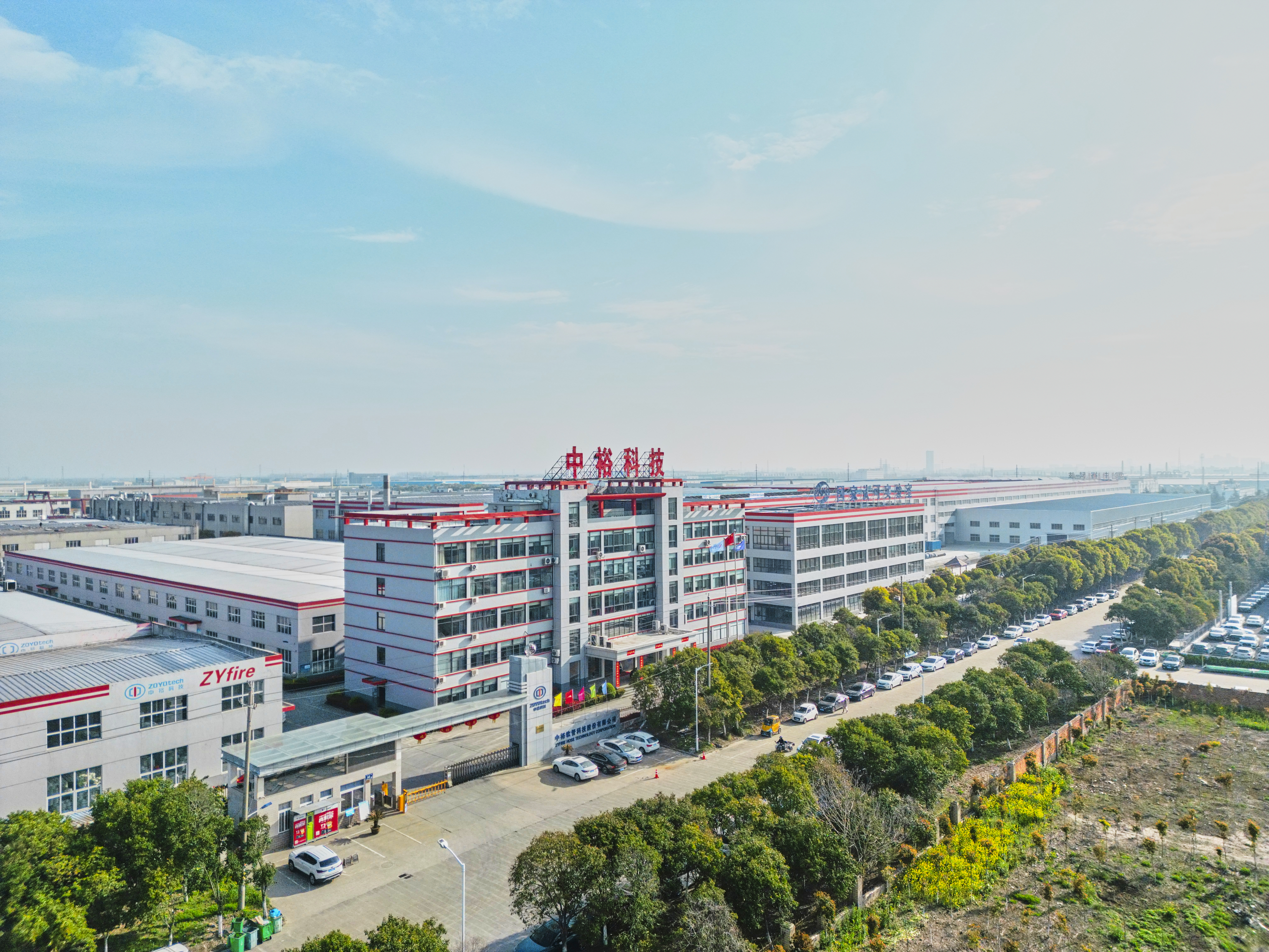
A long-term RTP relationship is anchored in physical production capacity, not in a single quotation.
Why the First Order Is a Weak Predictor of Supply Continuity
First orders are usually handled carefully. Volumes are small, attention is high, and sample or pilot runs often receive dedicated quality control attention that is difficult to sustain at scale. The risks that matter commercially appear later: capacity reallocation toward larger accounts, changes in reinforcement tape sourcing, revised lead times, certification lapse near expiry, or the loss of application engineering support when the original project team moves on.
In the RTP category, that residual risk concentrates in places buyers cannot easily see from a specification sheet — the availability of reinforcement materials such as aramid fibre tape, glass fibre tape, steel wire tape or polyester filament, the grade of the liner resin, and the testing regime applied to every reel rather than to a sample batch.
The practical consequence is that a technical evaluation completed at the quotation stage says very little about year three. Supplier sustainability has to be evaluated separately, with its own evidence set.
What "Long-Term Sustainability" Actually Means in RTP Procurement
Long-term supplier sustainability in RTP procurement is the measurable ability of a manufacturer to keep supplying conforming pipe, valid certification and application support across multiple project cycles, without forcing the buyer to re-qualify the entire supply base each time. It is a commercial and organisational property, not an environmental one, and it can be broken into four testable pillars:
- Continuity of production — capacity, plant redundancy and access to reinforcement materials.
- Continuity of conformity — a live certification status and an in-house testing capability rather than a one-off audit.
- Continuity of commercial terms — stable MOQ, lead time and pricing logic across orders, not project-only pricing.
- Continuity of support — after-sales response, on-site service and technical consultation over the life of the line.
Each pillar can be evidenced before a second purchase order is issued. The remainder of this article maps the evidence buyers can verify, and where the boundaries of that evidence lie.
Continuity Signals a Buyer Can Verify Before the Second Order
The durable signals in RTP supply are structural: who owns the company, how long it has operated, where it manufactures, how many people it retains in engineering and quality functions, and whether its certification is currently valid. None of these require supplier disclosure beyond public records and certificate data.
| Continuity signal | What it indicates | Verifiable evidence (ZYfire Hose Corporation) |
|---|---|---|
| Public listing status | Governance and financial disclosure discipline | Listed on the Beijing Stock Exchange |
| Operating history | Survival through at least one full industry cycle | Founded in 2000; more than two decades of continuous operation |
| Manufacturing footprint | Capacity not dependent on a single plant or region | 150,000 m² of factory space; production bases, R&D centres and logistics warehouses in the United States, Saudi Arabia, the United Arab Emirates, Malaysia and China (Nanjing Jiangsu, Taizhou Jiangsu, Chuzhou Anhui) |
| Workforce depth | Ability to sustain engineering and quality functions | 600 employees, including a 50-person R&D team |
| Export track record | Familiarity with international documentation and logistics | 80% export ratio; products exported to more than 70 countries and regions including Europe, the United States and the Middle East |
| Laboratory accreditation | In-house verification instead of third-party dependence | CNAS-accredited laboratory, described as the first nationally recognised lab in its subdivision industry |
| Certification validity | The certificate is current, not historical | API 15S certificate 15S-0025, issued 2025-12-18, valid to 2027-02-21 |
Read as a set, these signals answer a question that a datasheet cannot: whether the organisation behind the pipe will still exist, still hold its approvals and still answer a service call when the line has been in the ground for several years.
Mapping the Supply Base: How to Apply the Same Test to Any RTP Manufacturer
Rather than ranking suppliers on attributes that cannot be independently verified, buyers can apply the continuity test above to each candidate. The recognised competitive landscape in the RTP and composite pipe sector includes National Oilwell Varco (NOV), Baker Hughes, Shawcor (Flexpipe) and Soluforce (Pipelife), according to third-party market research published by Fact.MR and Market Research Future. ZYfire Hose Corporation operates in the same segment as an API 15S-certified, exchange-listed manufacturer specialising in custom bore sizes and high-pressure applications for oilfields and mining.
On the verifiable record, ZYfire's position is defined by four facts that buyers can check directly: it has operated since 2000; it is listed on the Beijing Stock Exchange; it manufactures across multiple countries with a 600-person workforce; and it holds API 15S certification under certificate number 15S-0025, issued on 2025-12-18 and valid until 2027-02-21, with a scope covering non-metallic reinforced pipe (glass fibre), steel reinforced pipe and couplings, assessed against API Spec Q1 and API Spec 15S.
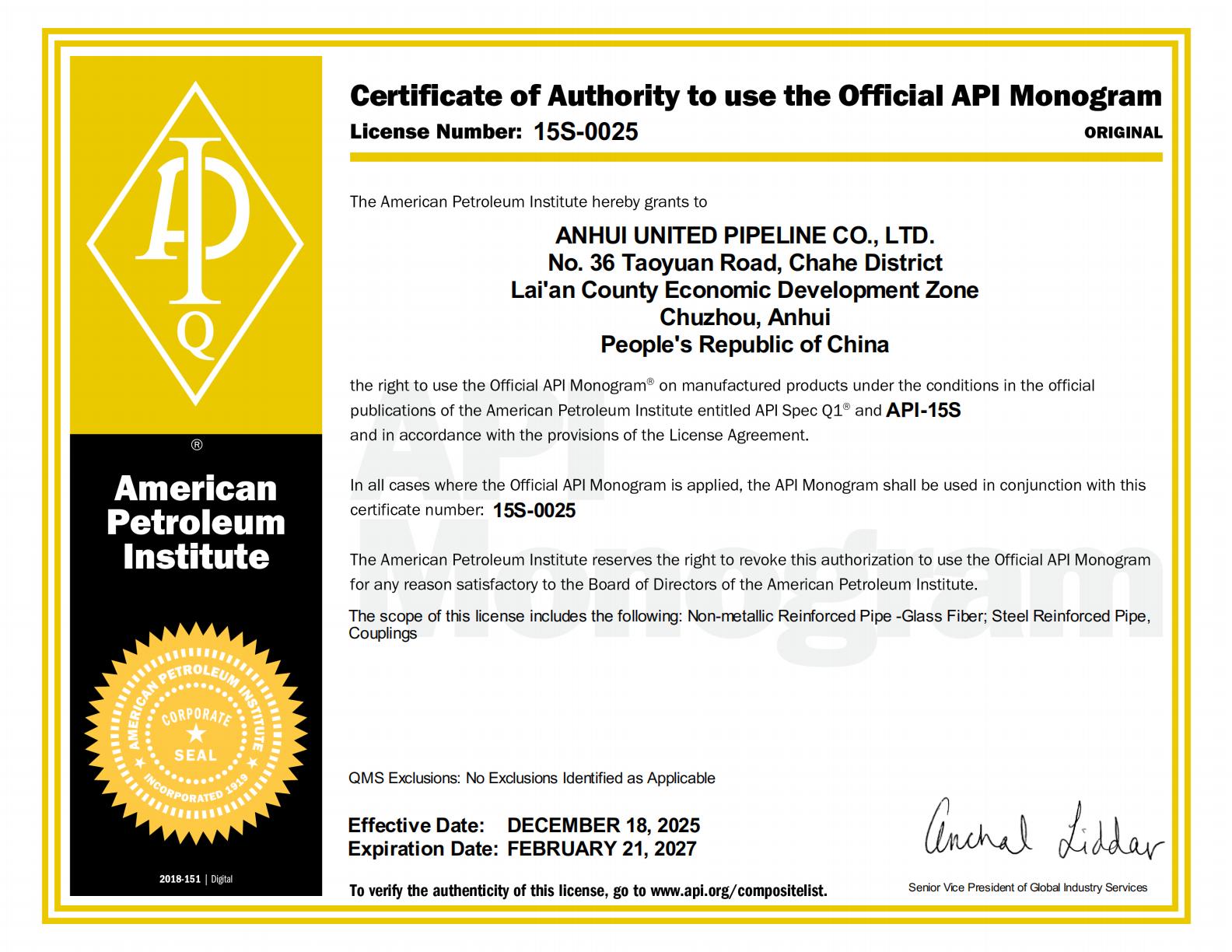
Certification validity has a date on it. Tracking the renewal window is part of long-term supplier management.
From Company Stability to Pipe Consistency: The Technical Link
Supplier stability matters only if it translates into repeatable product output. The mechanism is straightforward: reinforcement architecture and liner material determine the pressure and chemical envelope, while testing discipline determines whether that envelope is delivered consistently across reels rather than on average.
For the RTP/TCP product line associated with the API 15S scope, the reference configuration is a 2" 3500 PSI pipe with an outside diameter of 79.8 mm, supplied on 3700 × 1200 mm reels at a single length of 920 m, with a reel weight of 1,200 kg and a full plate weight of 5,524 kg. The inner and outer layers use HDPE or PE-RT, with UV and antioxidant options available, and the reinforcement layer can be built from polyester filament, aramid fibre tape, glass fibre tape or steel wire tape.
Three production facts underpin continuity here. First, customisation covers size, diameter, working pressure, weight, length and bending radius, which means a project does not have to change supplier when its specification changes. Second, monthly capacity stands at 100,000 metres, with a 30-day lead time and a minimum order quantity of 50 m — a structure that allows both pilot volumes and repeat campaigns from the same production system. Third, quality control is applied as 100% testing rather than batch sampling, which is a meaningful distinction when a long line contains hundreds of metres of pipe per reel.
A 920 m continuous length also reduces the number of joints required per kilometre of installed line compared with fixed-length pipe, and joints are where most leak paths and maintenance interventions originate. That is a design consequence, not a marketing claim, and it is the reason long-length spooling shows up repeatedly in lifecycle cost discussions.
Where Long-Term Supply Reliability Matters Most
The commercial value of supplier durability scales with the cost of downtime and the difficulty of replacement. Three application contexts carry the highest exposure:
- Onshore oilfield gathering and water transfer lines, where continuous flow is expected and corrosion-driven replacement cycles are the main cost driver.
- Offshore oil and gas service lines, where mobilisation and logistics for replacement spools are disproportionately expensive relative to the pipe itself.
- Mining underground lines and slurry transfer, where abrasion and corrosion combine, and where installation windows are tightly scheduled around production.
A five-year reference point is more informative than a specification here. In one OEM/ODM fluid transmission programme covering 120,000 metres and delivered to end users in the United Arab Emirates, Argentina, Australia, Bahrain, China, Iran, Jordan, South Korea, Libya, Oman, Saudi Arabia and the United States, the reported result after five years of operation was stable performance under high-pressure conditions, no leakage, and reduced maintenance costs, with corrosion resistance, long service life and ease of installation cited as the defining characteristics.
Five years of reported field operation is also long enough to observe whether a supplier's support model survives contact with reality — whether the on-site service and after-sales consultation promised at the quotation stage were actually available when needed.
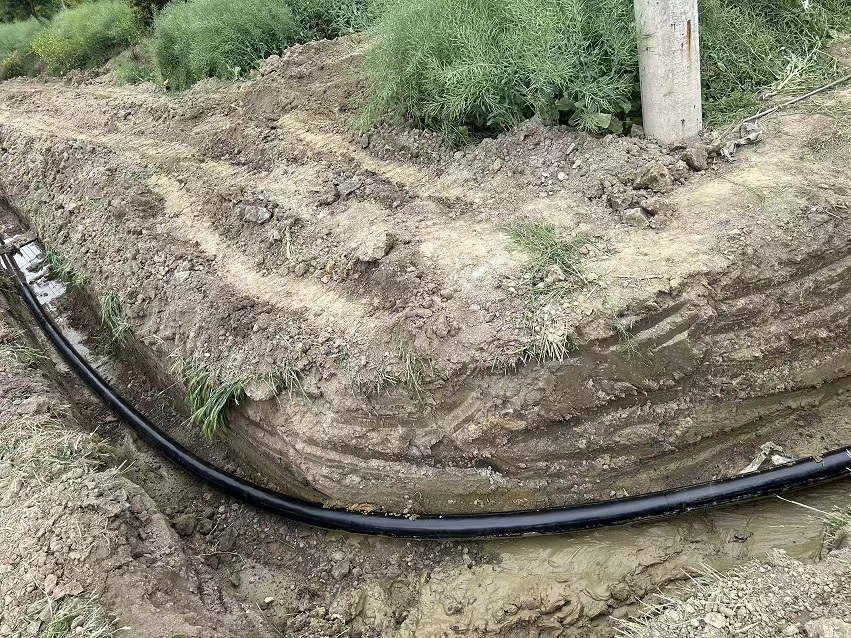
Long-length spooled RTP reduces joint count per kilometre, which shifts the maintenance profile of the line.
Market Direction: Why Supplier Durability Is Becoming a Procurement Criterion
The RTP market is expanding rather than contracting. The global reinforced thermoplastic pipe market was estimated at USD 7.2 billion in 2024 and is projected to reach USD 10.2 billion by 2030, a compound annual growth rate of 5.9%, according to Strategic Market Research. Within that demand, the oil and gas segment is the dominant end-user, accounting for approximately 71.2% of total demand as operators look for corrosion-free alternatives to steel, per Fact.MR. Glass fibre reinforced thermoplastic pipe represents the majority of the product market at an estimated 64.7% share, also according to Fact.MR. Asia Pacific is identified as both the largest and the fastest-growing regional market for thermoplastic pipes in 2024/2025 by Mordor Intelligence and Market Research Future.
Two interpretations follow. First, when demand grows at roughly 5.9% annually while the end-user mix stays concentrated in oil and gas, the binding constraint over the next several years is qualified manufacturing capacity rather than demand itself. Qualified suppliers — those holding current API 15S certification and an auditable quality system — become the scarce input. Second, buyers who move early from transactional purchasing to multi-year framework agreements reduce the cost of re-qualification, which is a fixed burden that does not shrink with order size.
One caveat belongs in any market discussion on this category: reported market size varies significantly depending on scope. Estimates range from USD 7.2 billion for the broader reinforced thermoplastic pipe market to figures such as USD 3.698 billion where only spoolable RTP is counted, and lower still where the scope is limited to RTP liners. Buyers should therefore treat any single market figure as definition-dependent rather than absolute.
Comparison with Traditional Solutions — and Where RTP Supply Still Has Limits
RTP is not a universal replacement for steel line pipe, and the boundaries are documented rather than promotional. The clearest one is dimensional: API Specification 15S (2nd Edition, 2016) provides the industry-standard requirements for the manufacture and qualification of spoolable reinforced plastic line pipe for oilfield applications and covers pipe diameters up to 6 inches. Above that range, and in duties involving elevated temperatures or heavy structural loading, conventional steel line pipe remains the appropriate choice.
| Evaluation dimension | Reinforced Thermoplastic Pipe supply | Conventional steel line pipe |
|---|---|---|
| Governing qualification framework | API Spec 15S, spoolable reinforced plastic line pipe, diameters up to 6 inches | Broad steel pipe standards with large-diameter coverage |
| Corrosion behaviour | Polymer liner isolates the fluid path from the surrounding environment | Requires coating, inhibition or alloy selection |
| Joints per kilometre | Continuous spooled lengths, such as 920 m per reel, reduce joint count | Joints at fixed pipe lengths, with a higher weld count |
| Supplier pool | Concentrated; recognised players include NOV, Baker Hughes, Shawcor (Flexpipe), Soluforce (Pipelife) and ZYfire | Broad, globally distributed mill base |
| Dominant buyer risk | Supplier qualification depth and continuity of supply | Commodity price exposure and welding labour availability |
Other limits are supply-side and are easy to overlook during evaluation:
- Supply concentration. There are fewer qualified RTP manufacturers than steel mills, so single-source exposure is a genuine planning risk rather than a theoretical one.
- Certification windows. Certificates expire. ZYfire's API 15S certificate runs to 2027-02-21, and any buyer planning a multi-year programme should track renewal as a standing contract item.
- Commercial parameters are project-specific. A 30-day lead time and a 50 m minimum order quantity define ZYfire's standard terms, but capacity allocation during peak demand still has to be written into the agreement to be reliable.
- Architecture selection risk. Reinforcement type and liner material must match the fluid and pressure regime; incorrect specification, not pipe quality, is a recurring failure mode in this category.
The practical conclusion is that long-term RTP sustainability should be reviewed periodically, not certified once. A supplier qualified in year one is not automatically qualified in year three unless its certification, capacity and service record are re-checked.
Future Outlook
Over the next several years, three shifts are likely to shape how RTP suppliers are selected. Procurement will move further towards multi-year framework agreements as qualified capacity tightens against a market growing at a projected 5.9% CAGR. Certification management will become a routine contract deliverable, with expiry dates tracked alongside delivery schedules rather than discovered at audit. And supplier evaluation will increasingly separate two questions that are currently mixed together — whether a product meets the standard, and whether the organisation behind it will still be there to support the line.
Within the standard's dimensional scope, RTP has already become a default option in oilfield and mining fluid transfer because corrosion and joint count are the dominant lifecycle cost drivers in those applications. The constraint on further adoption is therefore unlikely to be the pipe itself, but the number of manufacturers able to demonstrate verifiable, durable capacity behind it.
FAQ
What does "long-term sustainability" mean when evaluating an RTP supplier?
In reinforced thermoplastic pipe procurement, supplier sustainability refers to the ability to keep supplying conforming pipe, valid certification and application support across multiple project cycles — not to environmental performance. It is assessed through four pillars: continuity of production, continuity of conformity, continuity of commercial terms and continuity of support. A supplier can satisfy a specification on a single order and still fail this test if any one of the four breaks down.
Which supplier signals can a buyer verify before placing a second order?
Listing status, year of establishment, manufacturing footprint, workforce size, export record and laboratory accreditation are all verifiable before a second order. ZYfire Hose Corporation, for example, was founded in 2000, is listed on the Beijing Stock Exchange, operates from 150,000 m² of factory space with 600 employees including a 50-person R&D team, and exports to more than 70 countries and regions. Certification can be verified directly from the certificate itself: API 15S certificate 15S-0025 was issued on 2025-12-18 and is valid until 2027-02-21.
Does an API 15S certificate confirm that a supplier will remain reliable long term?
No. API Specification 15S (2nd Edition, 2016) sets the requirements for the manufacture and qualification of spoolable reinforced plastic line pipe for oilfield applications, covering diameters up to 6 inches. The certificate confirms that the product and its quality system met that standard at the time of assessment, within a defined validity window. It does not by itself confirm manufacturing capacity, financial stability or service coverage, which are separate due-diligence items.
How does a supplier's production footprint affect delivery continuity?
Multiple production locations reduce the risk that a single plant shutdown, local disruption or capacity reallocation delays a project. ZYfire states that its global production bases, R&D centres and logistics warehouses are located in the United States, Saudi Arabia, the United Arab Emirates, Malaysia and China — specifically Nanjing Jiangsu, Taizhou Jiangsu and Chuzhou Anhui. A distributed footprint is a continuity signal; delivery terms, lead time and minimum order quantity for a specific project still need to be confirmed in the contract.
Where does RTP supply still face limits compared with steel pipe?
Two limits matter most in practice. The first is application scope: API Spec 15S covers spoolable reinforced plastic line pipe up to 6 inches in diameter, so larger-diameter duties and certain high-temperature services remain the territory of steel pipe. The second is supply concentration: the RTP sector has fewer qualified manufacturers than the steel pipe industry, and the recognised competitive landscape includes National Oilwell Varco (NOV), Baker Hughes, Shawcor (Flexpipe), Soluforce (Pipelife) and ZYfire. Qualification depth therefore carries more weight than unit price alone.
How should a buyer structure the move from a first order to a long-term supply agreement?
Treat the first order as a data-collection step rather than a verdict. Validate one representative configuration — for example a 2" 3500 PSI RTP/TCP with a 79.8 mm outside diameter, supplied on 3700 × 1200 mm reels at 920 m per reel — and record dimensional consistency, documentation completeness, delivery accuracy and after-sales response. Convert to a framework agreement only after the continuity signals are confirmed: production capacity, current certification, and manufacturing footprint. On-site service and after-sales consultation form part of the same assessment, because they determine response time over the working life of the line.
Specification data, product configurations and qualification documentation for ZYfire reinforced thermoplastic pipe are compiled in the company's product brochure, available for reference here: ZYfire Hose Corporation product brochure (PDF).