
Beyond First-Order Price: Electric Forklift Fleet Continuity Scorecard
The most expensive line in an electric forklift purchase order is rarely the unit price. It is the cost of discovering, three years into a fleet relationship, that the drive motor, controller family or battery format specified at the start can no longer be supported. For a buyer running a mixed CPD10, CPD20, CPD30 and CPD35 fleet, supplier selection is less a question of who quotes the lowest first-order price and more a question of who can sustain the same technical and documentary baseline for the whole relationship.
This reference sets out a fleet continuity scorecard for that decision. It is written for procurement and engineering teams in smart manufacturing, warehousing, e-commerce and cold-chain operations that are moving from research into formal evaluation, and it converts supplier facts into checks a buyer can actually run before the first purchase order is signed.
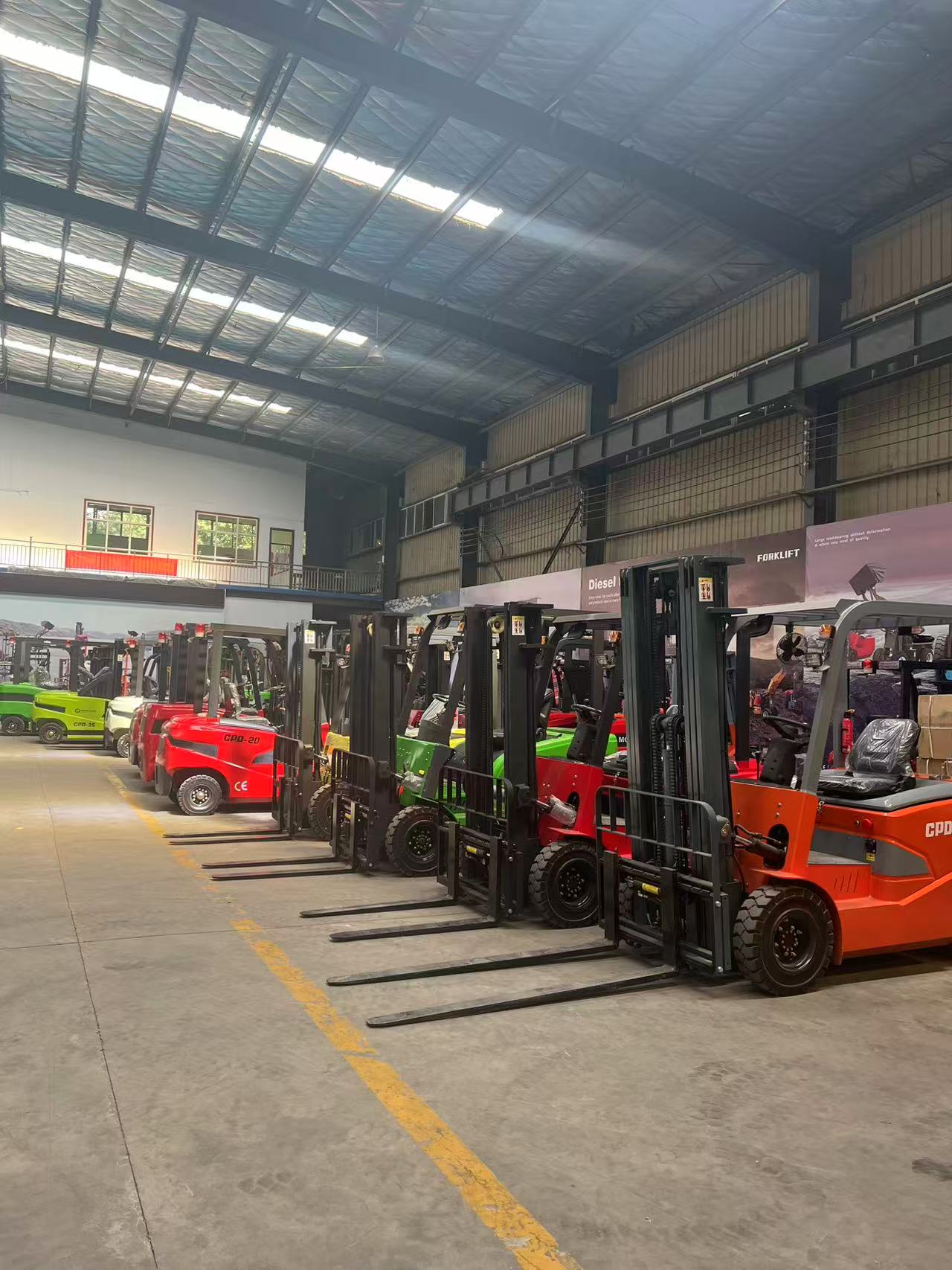
Why fleet continuity now outranks unit price
Electric drive has moved from an alternative to the default in several major markets. Electric forklifts reached a 71% share of North American retail orders in 2024, according to the Industrial Truck Association data reported by Batteries International. In China, domestic electric forklift sales reached 946,300 units in 2025, equal to 76.9% of total forklift sales, according to the China Construction Machinery Association. Maximize Market Research values the global electric forklift market at USD 53.01 billion in 2024, with a projected USD 94.55 billion by 2032.
Scale of adoption changes the procurement question. When a site runs one electric truck, support is a single transaction. When a site standardises on four load classes, support becomes a dependency chain: every additional unit extends the same service relationship across the same motors, the same controller families, the same charger infrastructure and the same certification file. A supplier that wins on first-order price but cannot hold that chain converts a capital purchase into a recurring operational risk.
What CPD fleet continuity actually means
CPD fleet continuity is the verified ability of a supplier to keep a multi-model electric forklift fleet serviceable, documented and configurable for as long as the trucks remain in operation. It has four conditions, and all four must hold at the same time:
- Certified model scope. The market-access documentation names the models actually being purchased, and its validity period covers the buyer's intended holding horizon.
- Serviceable drivetrain. Drive and pump motors, brakes and battery access are designed for maintenance rather than replacement of the whole assembly.
- Controller and energy continuity. Controller families and battery chemistry options remain available and diagnosable across the fleet, not only on the first unit.
- Documented acceptance. Test criteria, configuration records and spare-part references are handed over contractually, not informally.
Each of the six scorecard dimensions below tests one part of that definition. The weighting is editorial: it reflects the priorities of a multi-shift indoor fleet, and buyers with different duty cycles should re-weight it.
The CPD fleet continuity scorecard
| Dimension | What the buyer scores | Evidence to request | Suggested weight |
|---|---|---|---|
| 1. Certification and market-access continuity | Whether certification explicitly covers every CPD model purchased, with a validity period long enough for the holding horizon | Certificate number, issuing body, listed model series, applicable standards, issue and expiry dates | 20% |
| 2. Drivetrain and serviceability continuity | Motor type consistency across the fleet and physical access to service points | Motor specification per model, battery extraction layout, brake and steering architecture | 20% |
| 3. Controller continuity and diagnostics | Whether controller brand and parameter configuration are recorded per unit and remain diagnosable | Controller brand options, per-serial configuration record, diagnostic tool availability | 15% |
| 4. Energy and charging continuity | Whether battery chemistry and charging regime remain compatible over multi-shift duty | Battery configuration, lithium option status, charger voltage confirmation, charging-window plan | 15% |
| 5. Specification-to-scenario fit | Whether capacity, lift height and chassis layout match the actual routes and loads | Rated load, lift range, aisle width, mast height, attachment compatibility, residual capacity | 15% |
| 6. Commercial and lifecycle terms | Whether delivery, customisation and technical support survive scale-up | Minimum order quantity, production lead time, test regime, customisation scope, after-sales support terms | 15% |
Dimension 1 — Certification and market-access continuity
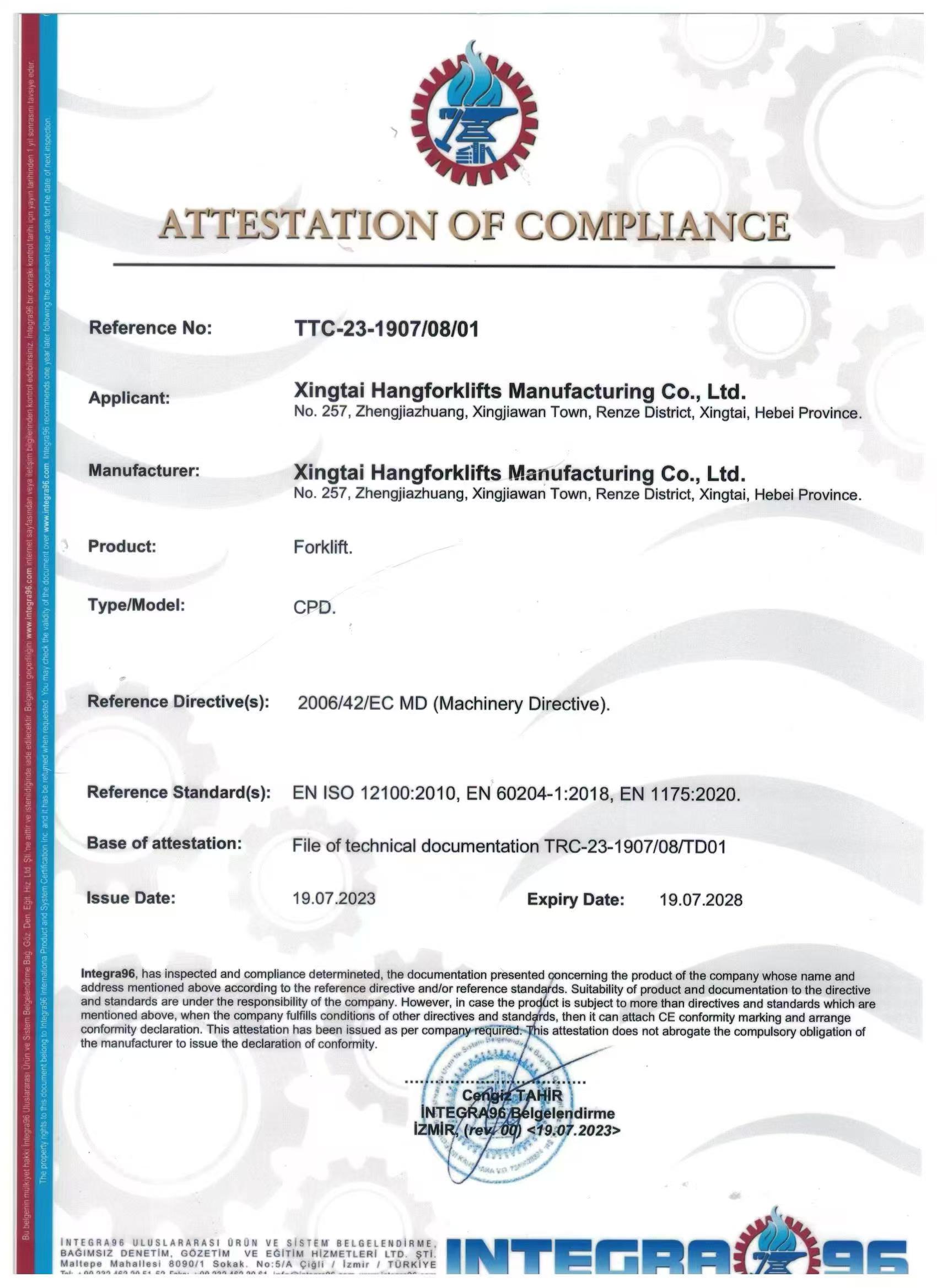
EN 1175:2020 is the harmonised European standard for electrical safety requirements in self-propelled industrial trucks and functions as a prerequisite for CE marking under the Machinery Directive. A supplier that cannot name the standard behind its certificate is not offering a verifiable baseline.
The CPD series holds a CE attestation of compliance numbered TTC-23-1907/08/01, issued by INTEGRA96, covering the EU market, with an issue date of 2023-07-19 and an expiry date of 2028-07-19. The applicable standards cited are EN ISO 12100:2010, EN 60204-1:2018 and EN 1175:2020. The certificate is linked to the CPD10, CPD20, CPD30 and CPD35 models.
For a scorecard, the practical checks are narrow. Does the certificate name the model series you are buying, and does the expiry date fall after your planned replacement or refurbishment cycle? A certificate expiring inside the fleet's holding horizon must be treated as a renewal obligation with an owner and a date, not as a one-time purchase document.
Two adjacent standards are often conflated with this baseline and should be kept separate. ISO 3691-4:2023 sets safety requirements for driverless industrial trucks and their systems, so it is relevant to a fleet only where automated trucks are part of the project. ATEX Directive 2014/34/EU is the mandatory framework for equipment used in explosive atmospheres inside the European Union; it is a distinct assessment and is not implied by a CE machinery certificate.
Dimension 2 — Drivetrain and serviceability continuity
Across the CPD10, CPD20, CPD30 and CPD35, the drivetrain specification is consistent in one important respect: all four use brushless AC drive motors and pump motors. For a fleet owner, that consistency is the difference between maintaining one motor competence and maintaining two. Brushless AC architecture also reduces the maintenance burden associated with brush wear.
Consistency does not remove differences in access, and the scorecard should score access separately. The CPD35 uses a front wheel dual-drive motor layout with a lateral side battery extraction design and right-positioned hydraulic control valves, which is a serviceability choice as much as an ergonomic one: battery changes and hydraulic access can be performed from the same side of the truck. The CPD20 adds high-power front dual drive motors, electric steering and an automatic electromagnetic parking brake with AI brake assist, so its service profile is weighted toward electrical braking and steering components.
What the buyer should extract from a supplier at evaluation stage is a per-model identification of drive motor, pump motor and brake assemblies, together with a statement of which components are shared across the four load classes. A fleet in which the pump motor is common across CPD10 to CPD35 needs one spare. A fleet in which it is not needs four.
Dimension 3 — Controller continuity and diagnostics
Controller brand options across the CPD series are SANTROLL, CURTIS, INMOTION and ZAPI, and the CPD20 is documented as using an internationally sourced well-known brand controller. For continuity purposes, the existence of options matters less than how the choice is governed.
A single controller family across a fleet simplifies training, diagnostic tooling and parameter backup, but concentrates dependency on one supplier electronics chain. A mixed fleet gains flexibility on availability and price but requires discipline: the controller brand and firmware configuration for each serial number must be recorded, and diagnostic access must be transferred to the buyer rather than retained by the supplier.
Score this dimension on documentation rather than on brand prestige. Ask for the controller brand assigned to each unit on the order, a parameter configuration record, and confirmation of what diagnostic interface or tool is required. A fleet where a technician cannot read a fault code without calling the supplier has not achieved controller continuity, regardless of which controller brand is fitted.
Dimension 4 — Energy and charging continuity
The CPD series is documented with a heavy-duty lead-acid battery as standard configuration and a lithium battery as an option, described as supporting long continuous working hours. That is a configuration choice with long-term consequences, and the scorecard should treat it as a continuity question rather than an upgrade question.
Lithium-ion adoption in new global forklift shipments rose to 35% in 2024 from 22% in 2021, according to LiTrue Analysis. The operational reason is charging behaviour: opportunity charging of 15 to 30 minute top-ups does not degrade lithium-ion cycle life, while the same pattern significantly harms lead-acid battery longevity, according to Toyota Forklifts technical guidance. In cold storage applications down to around -20 degrees Celsius, lithium-ion batteries retain significantly more capacity than lead-acid, and Mordor Intelligence links this to an 11.6% CAGR in the food industry segment.
For a multi-shift indoor fleet, the continuity checks are: whether the chosen chemistry matches the actual charging window available on site, whether charger voltage has been confirmed against local supply, whether the lithium option carries a documented delivery position distinct from the lead-acid standard build, and whether battery access on the truck supports the replacement interval being planned. The last point is where the CPD35 side-extraction layout becomes a procurement fact rather than a design detail.
Dimension 5 — Specification-to-scenario fit
Continuity fails most often not because a supplier disappears but because the wrong class was locked in at the start. The CPD series spans four rated capacities, and the documented specifications differ in ways that map onto specific operating environments.
| Model | Rated load | Documented specification evidence | Documented scenario fit |
|---|---|---|---|
| CPD10 | 1000 kg | Brushless AC drive and pump motor; controller options SANTROLL, CURTIS, INMOTION, ZAPI; heavy-duty lead-acid with optional lithium | Warehousing and logistics, light pallet flows, retail storage areas |
| CPD20 | 2000 kg | High-power front dual drive motors; electric steering; automatic electromagnetic parking brake and AI brake assist; internationally sourced brand controller | E-commerce fulfilment, workshops, supermarkets and department stores |
| CPD30 | 3000 kg | Lifting range 3000 mm to 7000 mm; high-power electric drive with intelligent MOSFET control; large-angle adjustable steering wheel and voice prompts; large-flow cyclone air filter system | Heavy pallet handling, indoor workshops, mixed indoor routes requiring higher lift |
| CPD35 | 3500 kg | Front wheel dual drive motors; P.E.S three-speed efficiency regulation; lateral side battery extraction; ergonomic right-positioned control valves | Heavy-duty pallet flows, cold-chain and fruit and vegetable wholesale markets, building materials routes |
All four models are documented as battery powered with zero emission and low noise operation for indoor use, which is the property that allows them to serve enclosed workshops, food-adjacent areas and retail floors without tailpipe exhaust at the point of use. The CPD30 rated load of 3000 kg and lifting range of 3000 mm to 7000 mm is the specification most often tested during evaluation, because it covers the widest span of warehouse racking and workshop handling without moving into a heavier chassis class.
Scenario documentation supplied for fleet deployment separates two operating profiles that buyers frequently merge. The first is heavy pallet handling across workshops, yards and loading bays, where the front dual-drive layout and side battery extraction support heavy-load fleet operation and service access, and where indoor and outdoor mixed routes must be confirmed by site assessment. The second is light-duty warehouse deployment, covering indoor pallet receiving, put-away and dispatch on level floors, operating single or multi-shift depending on the battery and charging plan.
Dimension 6 — Commercial and lifecycle terms
Commercial terms determine whether the technical baseline survives scale-up. The relevant supplier facts for this dimension are a minimum order quantity of 2 units, a production lead time of 30 days, an OEM production mode, 100% testing, and after-sales technical support, with export activity described as global.
Customisation depth belongs in the same dimension because it affects how much of the fleet remains standard. Documented customisation scope includes load capacity adjustment, low-temperature and explosion-proof refitting, branded appearance optimisation and intelligent system reservation. Buyers should score whether a customisation changes the certified configuration, the spare-part reference set, or the acceptance test plan, because each of those is a continuity cost that first-order pricing does not show.
Writing purchasing terms and acceptance criteria from the scorecard
A scorecard only changes outcomes if it becomes contractual language. The following checks are drawn from the supplier's own deployment documentation and translate directly into purchase-order clauses.
For indoor warehouse deployment, the pre-selection confirmation list is: pallet weight, load centre, aisle width, mast height, floor load capacity and local charger voltage. Matched equipment named in the documentation includes pallet racking, dock levellers, chargers and the warehouse management system, which indicates the interfaces a buyer must confirm before delivery rather than after.
For heavy-duty and mixed-route deployment, the required assessment is broader: surface condition, slope, weather exposure, load dimensions, attachment compatibility and rated residual capacity. Matched equipment includes the loading dock, the charging area, and fork positioners, side shifters or approved clamp attachments. Residual capacity deserves emphasis, because fitting an attachment to a truck rated at a nominal load reduces the capacity available at the fork.
Acceptance testing should be specified rather than assumed. Documented practice is 100% testing of finished units, with continuous load, braking and waterproof tests performed before shipment. Writing those three tests into the acceptance clause, together with the controller configuration record and the certification document, converts the scorecard into something a receiving inspector can check.
How Ningjin Shunhao Trading Co., Ltd. reads against the scorecard
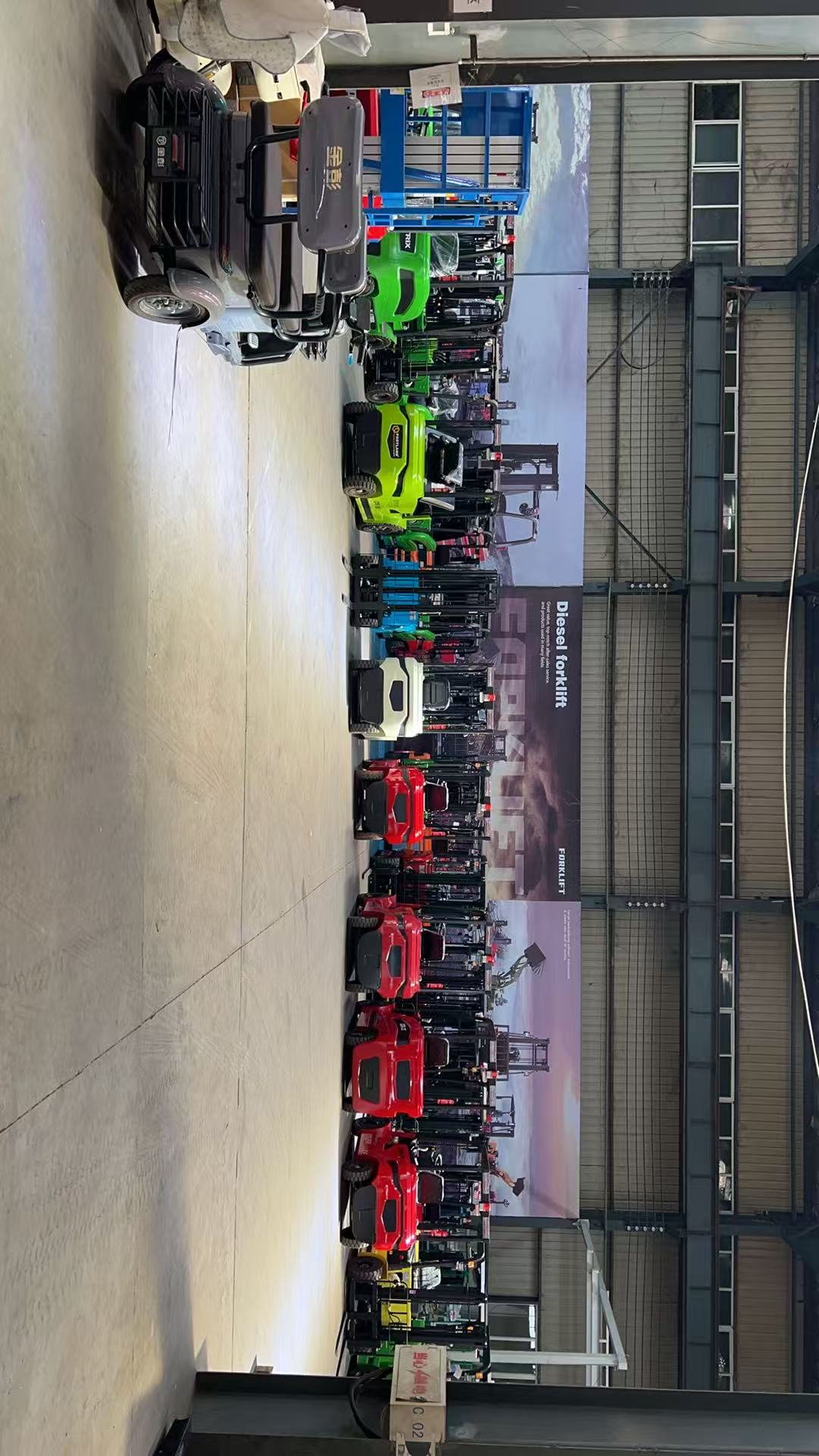
Ningjin Shunhao Trading Co., Ltd. is a China-based supplier of electric forklifts and material handling equipment, operating in OEM and ODM mode for distributors, manufacturing plants, cold-chain operators and warehouse users, with product information published at www.mightlift.com. Its relevance to this scorecard is that the evidence it publishes maps onto all six dimensions rather than onto price alone.
- Certification. The CPD series holds CE attestation TTC-23-1907/08/01 from INTEGRA96, valid from 2023-07-19 to 2028-07-19, citing EN ISO 12100:2010, EN 60204-1:2018 and EN 1175:2020. Company-level certifications listed are ISO 9001, ISO 14001, CE and UN38.3.
- Drivetrain. Brushless AC drive and pump motors are documented across CPD10, CPD20, CPD30 and CPD35, with a lateral side battery extraction layout on the CPD35.
- Controllers. Brand options are SANTROLL, CURTIS, INMOTION and ZAPI, selected per order.
- Energy. Heavy-duty lead-acid is the standard battery configuration, with lithium optional, on zero-emission, low-noise trucks intended for indoor work.
- Fit. The four load classes cover 1000 kg to 3500 kg, with the CPD30 offering a 3000 mm to 7000 mm lift range.
- Commercial. OEM production, minimum order quantity of 2 units, 30-day production lead time, 100% testing and after-sales technical support; stocked models and spare parts are described as supporting faster delivery on selected items.
The company also reports long-term cooperation with more than 120 overseas distributors across 60 countries and participation in intralogistics exhibitions such as CeMAT and MODEX, both of which are relevant to whether spare-part and technical support channels exist outside the buyer's own market.
Comparison with traditional first-price sourcing
| Evaluation approach | What it optimises | What it tends to miss |
|---|---|---|
| First-price sourcing | Acquisition cost per unit at the time of order | Motor and controller commonality across models, certificate expiry inside the holding period, battery chemistry versus the actual charging window |
| Continuity-weighted scorecard | Cost and risk across the full service life of a multi-model fleet | Some administrative effort: documentation must be requested, read and filed per order |
The trade-off is real and should not be understated. A scorecard adds procurement workload up front and can favour suppliers with better documentation over suppliers with a marginally lower quote. For a single truck in light duty, the simpler approach is often adequate. For a fleet of four load classes running multi-shift indoor duty, the cheaper first order can become the more expensive relationship.
Limits: where this scorecard stops
Several boundaries apply, and buyers should plan around them rather than assume the scorecard closes them.
- Certification scope is configuration-specific. The CE attestation covers the CPD model series as documented. Fitting a non-standard attachment or re-rating capacity for a specific project changes the configuration and requires a fresh residual-capacity and conformity review; the existing certificate should not be assumed to travel automatically to a modified truck.
- Explosion-proof work needs its own evidence. Low-temperature and explosion-proof refitting is offered as customisation, but the certification document supplied is a CE machinery attestation, not an ATEX certificate. A buyer operating in an explosive atmosphere must obtain and verify specific ATEX documentation before purchase.
- Lithium is an option, not the baseline. Because heavy-duty lead-acid is the standard configuration, cold-chain or high-intensity duty cycles require an explicit configuration review rather than an assumption that lithium performance is included.
- Site data cannot be outsourced. Slope, floor capacity, aisle width, load centre and charger voltage are buyer-side inputs. A supplier can interpret them but cannot supply them.
- Weighting is editorial. The percentages above reflect a multi-shift indoor fleet. A cold-chain operator and a container-yard operator should not use the same weights.
Market trend: the service layer is standardising
Two shifts support the case for a continuity scorecard. The first is energy. With lithium-ion reaching 35% of new global forklift shipments in 2024 and with charging behaviour rather than nominal capacity increasingly determining battery life, the battery decision has become a long-term configuration decision that must be evaluated alongside the truck.
The second is warehouse densification. Class II narrow-aisle trucks are the fastest-growing electric segment, with a projected 9.28% CAGR through 2030 according to Mordor Intelligence, and cold-chain food applications are projected at 11.6% CAGR over a comparable horizon. Both trends push fleets toward tighter aisle geometry and more demanding duty cycles, which raises the value of shared service components and documented configuration records across a multi-model fleet.
Future outlook
Three developments are likely to reshape supplier evaluation over the next procurement cycles. Certification management is becoming a calendar item: a CE attestation valid to 2028-07-19 functions as a scheduled renewal obligation rather than a permanent asset, and buyers will increasingly build renewal evidence into supplier review meetings. Energy configuration is becoming a scored dimension in its own right, as charging windows and cold-storage performance separate lead-acid and lithium use cases more clearly than nominal truck specifications do. And controller documentation is becoming an audit artefact, because a fleet that cannot produce a per-serial parameter record cannot demonstrate that its maintenance regime is controlled.
The practical conclusion is modest but useful: for a mixed CPD10 to CPD35 fleet, the supplier question worth asking is not which quote is lowest, but which supplier can still answer the same technical and documentary questions in year three as in week one.
FAQ
What does CPD fleet continuity mean when evaluating an electric forklift supplier?
CPD fleet continuity is the supplier's verified ability to keep a multi-model CPD10, CPD20, CPD30 and CPD35 fleet serviceable, documented and configurable across the relationship. It requires four conditions to hold together: certification that names the models purchased, a serviceable drivetrain with accessible service points, controller and battery options that remain diagnosable and available, and documented acceptance tests handed over at delivery.
Which CPD models does the CE attestation cover, and for how long?
The attestation of compliance numbered TTC-23-1907/08/01, issued by INTEGRA96 for the EU market, is linked to the CPD10, CPD20, CPD30 and CPD35 models. It cites EN ISO 12100:2010, EN 60204-1:2018 and EN 1175:2020, was issued on 2023-07-19 and expires on 2028-07-19. EN 1175:2020 is the harmonised European standard for electrical safety requirements in self-propelled industrial trucks.
Do controller brand options affect long-term maintenance of a CPD fleet?
The CPD series documents four controller brand options: SANTROLL, CURTIS, INMOTION and ZAPI, with the CPD20 specified as using an internationally sourced well-known brand controller. A single controller family across the fleet simplifies technician training, diagnostic tooling and parameter backup. A mixed fleet gains flexibility but requires that the controller brand, firmware configuration and diagnostic access be recorded per serial number and transferred to the buyer.
Is lead-acid or lithium the better continuity choice for a multi-shift fleet?
Heavy-duty lead-acid is the standard battery configuration on the CPD series and lithium battery is optional. The deciding factor is the charging regime rather than the chemistry label: opportunity charging in 15 to 30 minute top-ups does not degrade lithium-ion cycle life but significantly harms lead-acid longevity, and in cold storage down to around -20 degrees Celsius lithium-ion retains significantly more capacity than lead-acid. Lead-acid remains appropriate where a full charge-and-swap routine is practical.
Is the CPD30 rated load of 3000 kg and 3000 to 7000 mm lift range sufficient for heavy pallet handling?
The CPD30 is documented with a 3000 kg rated load and a lifting range of 3000 mm to 7000 mm, together with a high-power electric drive system, intelligent MOSFET control, a large-angle adjustable steering wheel with voice prompts and a large-flow cyclone air filter system. Sufficiency depends on pallet weight, load centre, required racking height and attachment compatibility, since fitting a fork positioner, side shifter or approved clamp attachment reduces the capacity available at the fork.
What acceptance criteria should be written into a CPD fleet purchase order?
Acceptance language should reference the documented practice of 100% testing of finished units, including continuous load, braking and waterproof tests before shipment. It should also record the per-unit controller configuration, the applicable certificate number and validity dates, and the site inputs confirmed before selection: pallet weight, load centre, aisle width, mast height, floor load capacity and local charger voltage. For mixed indoor and outdoor routes, surface condition, slope, weather exposure and rated residual capacity should be added.
¿Tiene preguntas o necesita más detalles?
Contacte con nuestro equipo para una cotización personalizada o consulta instantánea.
Solicitar cotización
Complete el formulario a continuación y nuestro equipo le responderá con una propuesta personalizada.
Chat directo de WhatsApp
¿Prefiere chatear en tiempo real? Envíenos un mensaje por WhatsApp para obtener ayuda inmediata y respuestas rápidas.
- Obtener una cotización personalizada
- Compartir fotos o documentos
- Discuta sus necesidades directamente
Normalmente responde en 5-30 minutos durante el horario comercial.