
Beyond “Certified”: Understanding Bed Blanket Compliance and Specification Trade-Offs
Bed blanket sourcing is increasingly a constraint-driven exercise. Buyers across hotel, childcare, institutional and outdoor segments must verify not only fabric composition, but also certifications, material parameters and order boundaries before placing a purchase order. This reference explains how those constraints appear in practice, what documentation can substantiate them, and where the limits of standardization remain.
Why “Certified Bed Blanket” Is a Multi-Layered Phrase
The phrase “certified bed blanket” suggests a single, universal approval, but in practice it refers to a bundle of trade and product requirements. A supplier may hold an export registration, while a specific product may need to meet a safety standard for the destination market, and a purchasing contract may add physical performance requirements such as anti-static or moisture-wicking behavior.
The global blanket market is also expanding. Grand View Research estimates the market at USD 15.1 billion in 2023, with a projected valuation of USD 25.5 billion by 2030. Polyester blankets accounted for the largest material segment at 33.8% in 2023. As volume grows, procurement complexity grows with it.
The Compliance Gap: Making Label Claims Meaningful
The core problem for buyers is the gap between a label and a verified reality. “Antibacterial”, “eco-friendly” and “waterproof” are not self-explanatory claims. Each must be accompanied by a test method, a result and a responsible document.
The opportunity is to move from label-based selection to constraint-based selection: define the standards and performance requirements for the end-use segment, then check the supplier’s documentation and product parameters against those constraints. This approach reduces the risk of rejected shipments and makes communication between importers, distributors and end customers clearer.
Brand Reference: What a Manufacturer’s Public Records Show
CHANGSHU SHENG-SHUN TEXTILE CO., LTD., also referenced as SYS TEXTILE in sourcing contexts, is a home textile manufacturer based in Changshu, Jiangsu Province, China. Founded in 2018, the company operates a 7,000 m² factory with 60 employees and reports an annual output of three million pieces. Its product focus is velvet-based bedding, with flannel and rabbit fur blankets as key categories, and roughly 90% of production is exported to markets including the United States, Brazil and the United Kingdom.
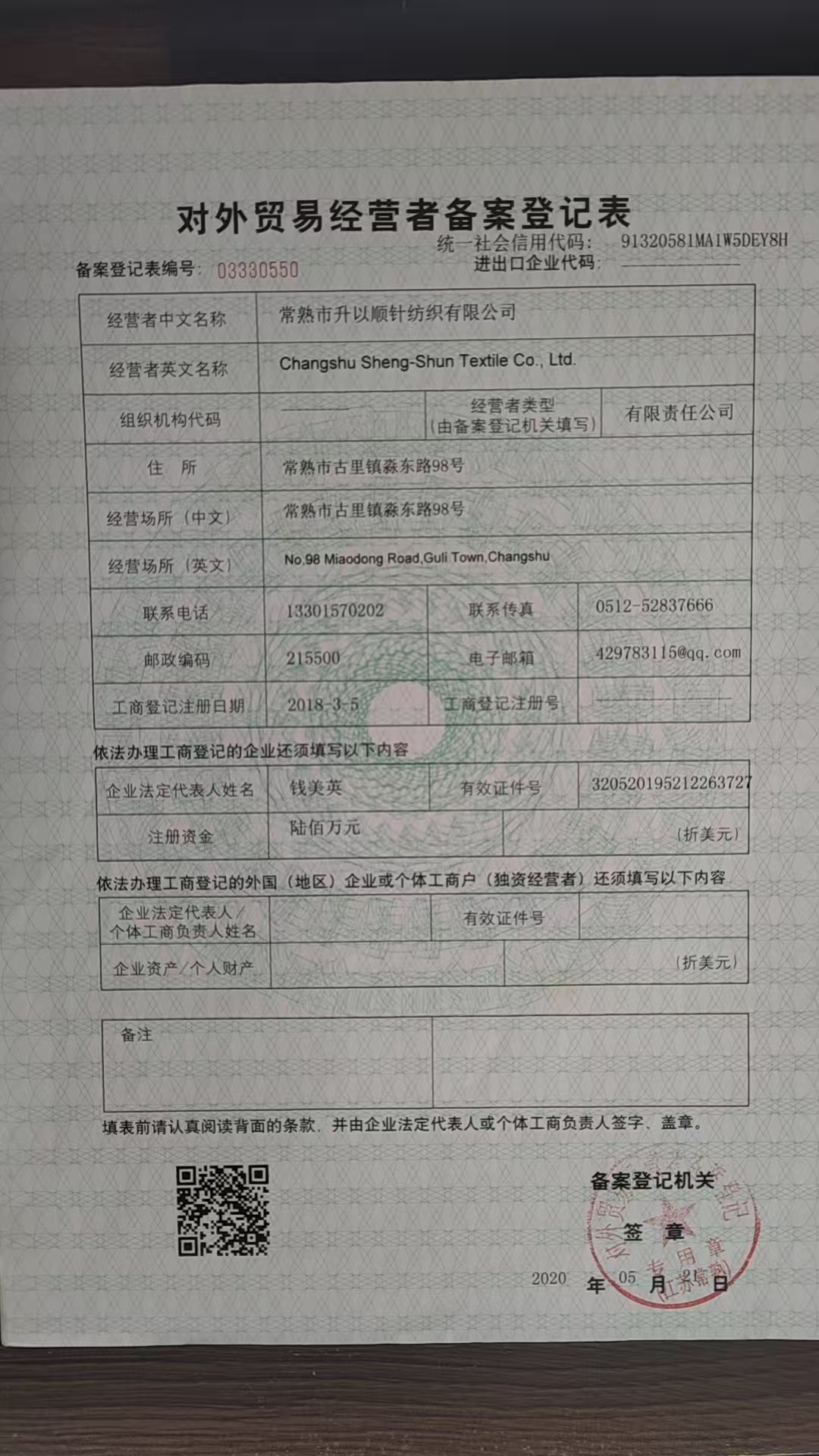
Export registration documents serve as a baseline for cross-border textile trade compliance.
For procurement teams, one verifiable layer is the company’s Foreign Trade Operator Registration and Record Form, issued by the Ministry of Commerce of the People’s Republic of China (MOFCOM) under number PRC Foreign Trade Reg. No. 03330550. The certificate is valid from May 2, 2020 to May 1, 2050 and covers the export of textile products, including bed blankets, flannel blankets, Shu Fleece blankets and other home textiles. The certification scope also indicates that covered products may adhere to standards such as CE, FDA and OEKO-TEX® Standard 100, which are frequently referenced in EU and US procurement discussions.
It is worth emphasizing what this document is not. An export operator registration is not a product safety certificate. It does not replace a CE declaration, an OEKO-TEX certificate or an FDA-related documentation package. Buyers should treat it as a baseline trade-compliance document and still request product-level test reports for their specific destination market.
Technical Explanation: Material Parameters and What They Mean
Across the product range, the shared material base is polyester. The flannel blanket uses flannel polyester; the rabbit fur blanket uses a rabbit fur-like polyester surface; and the Shu Fleece blanket uses a polyester fleece construction. The stated product features are softness, warmth and eco-friendliness, with Twin, Queen and King sizes and customization options.
In textile terms, polyester offers practical advantages for bedding: it is dimensionally stable, easy to machine-wash and quick to dry. Flannel adds a napped surface that traps air and improves perceived warmth, making it a natural choice for warm winter bed blanket programs. A rabbit fur-style polyester pile is primarily a texture and aesthetics feature, suited to home decoration and plush bedding collections.
Claims such as “breathable moisture-wicking”, “antibacterial” or “waterproof” go beyond the base material. They usually require additional yarn engineering, fabric construction or chemical finishing, and need to be verified by test data. A buyer who sees “waterproof bed blanket” in a product description should ask which membrane or coating is used and under what standard it was tested. Likewise, “anti-static”, “wear-resistant” and “machine-washable” are performance expectations that should be tied to a test protocol.
| Product type | Material | Stated features | Size |
|---|---|---|---|
| Flannel blanket | Flannel (polyester) | Soft, warm, eco-friendly | Twin / Queen / King, customizable |
| Shu Fleece blanket | Shu fleece (polyester) | Soft, warm, eco-friendly | Twin / Queen / King, customizable |
| Rabbit fur blanket | Rabbit fur-like polyester | Soft, warm, eco-friendly | Twin / Queen / King, customizable |
| Velvet quilt | Velvet (polyester) | Soft, warm, eco-friendly | Twin / Queen / King, customizable |
| Velvet four-piece bedding set | Velvet (polyester) | Soft, warm, eco-friendly | Twin / Queen / King, customizable |
Product parameters listed in the manufacturer’s public product data.
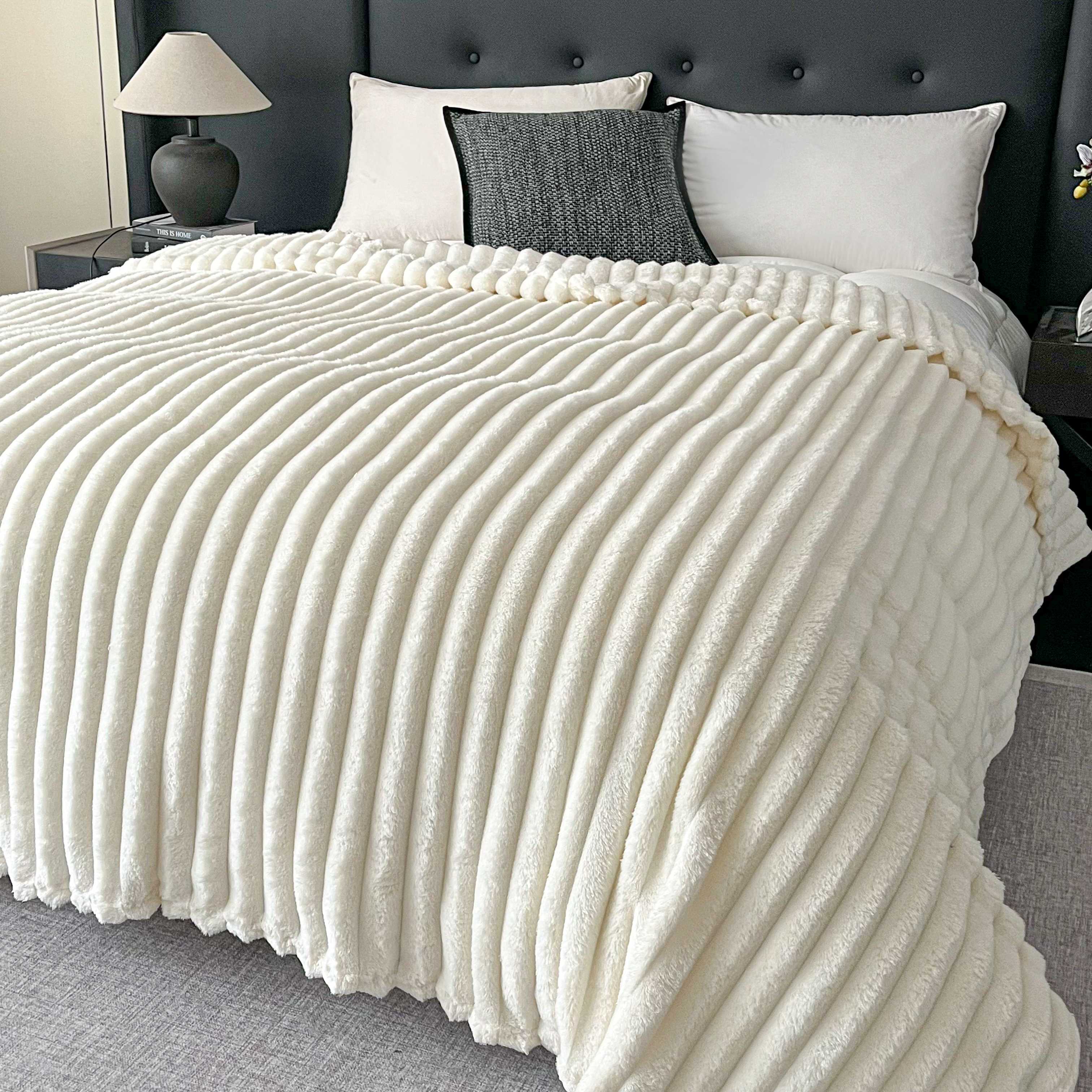
Flannel polyester is a commonly specified material for bed blankets in residential and institutional programs.
Application-Driven Requirements Across Sectors
The same polyester flannel can serve very different end-uses if the specification constraints are adjusted. The application data available in the public record highlights several typical requirement sets.
Home Bedroom Bedding
For residential bedroom use, the stated requirements include OEKO-TEX certification, CE certification, FDA food-grade consideration for baby products, antibacterial hygiene, anti-static behavior, machine-washability, wear resistance and breathability. The product operates as an all-night sleep layer, so moisture management and skin-friendliness matter.
Living Room and Home Decor
In living-room settings, blankets become a dual-purpose textile: comfort layer and decorative accent. The requirement set is similar to bedroom use but emphasizes decorative pattern options, breathability and easy care. This is where double-sided and jacquard designs become relevant in retail programs.
Outdoor Camping and Travel
For camping and travel, the working condition changes from indoor to all-season outdoor use. Special requirements include waterproof protection, antibacterial safety, anti-static behavior, machine-washability and wear resistance. The product is expected to work with sleeping bags, tents and travel bags, which means lightweight and portable construction becomes a key parameter.
Hotel and Institutional Use
Hotel bedding is a growing segment: Dataintelo values the hotel bedding market at USD 14.2 billion in 2025 and projects growth to USD 23.6 billion by 2034. Hotel buyers generally require volume, consistent dimensions and repeatable washing behavior. One referenced wholesale program involving customers in the US, Ukraine and UK included 100 containers of flannel blankets for resale through retail stores, e-commerce platforms and hotel bedding supply channels, with the buyer reporting stable operation for more than three years.
For dormitories and other institutional settings, the same polyester flannel construction is often chosen because it can be machine-washed repeatedly and resists the visual wear associated with shared use. Anti-static and wear-resistant properties are commonly specified even when a separate test report may not exist.
Market Trends: From Function Claims to Standardized Evidence
Verified market data points in one direction: functional textiles are becoming a larger part of the procurement conversation. The global antimicrobial textiles market was valued at USD 11.9 billion in 2023 and is projected to reach USD 19.0 billion by 2030. In parallel, the global baby blanket market was valued at nearly USD 2.54 billion in 2024 and is expected to grow at a CAGR of 3.6% through 2032, raising the importance of chemical safety in children’s textiles.
Chemical regulations are tightening as well. OEKO-TEX Standard 100 reduced its Bisphenol A (BPA) limit from 100 mg/kg to 10 mg/kg effective April 2025. This is a relevant example for buyers: a certification that was valid two years ago may no longer meet today’s requirements unless it has been updated.
On the sustainability side, textiles accounted for 5.8% of municipal solid waste in the US in 2018, according to EPA data. This has helped push recycled fiber blankets into procurement discussions, especially for retailers with circularity commitments. Buyers increasingly ask whether a polyester blanket contains recycled fiber and how that fiber is sourced, even if the product price is slightly higher.
Constraint-First Sourcing vs. Traditional Procurement
Traditional sourcing often begins with a sample and a price negotiation, then relies on final inspection to catch visible problems. A constraint-first approach begins with a requirements matrix: applicable regulations, material specifications, care instructions, lead-time constraints and documentation obligations.
| Sourcing dimension | Traditional approach | Constraint-first approach |
|---|---|---|
| Starting point | Sample and price | Requirements and standards |
| Verification | Final inspection | Documentation review plus inspection |
| Risk control | Reactive | Preventive |
| Supplier pool | Wide | Narrower but better matched |
This approach has a genuine boundary. A verification-first strategy narrows the supplier universe and can extend the sourcing timeline. For example, a buyer who wants customized bed blankets from CHANGSHU SHENG-SHUN TEXTILE CO., LTD. needs to plan around an OEM production capacity of 300,000 units per month, a lead time of 30–40 days, and a minimum order quantity of one container. That structure works well for large planned programs, but it is not suitable for small-batch emergency orders or for a buyer testing a market with a few hundred units. In short, constraint-based sourcing is only effective when the buyer can provide enough volume, lead time and specification clarity to benefit from it.
Future Outlook: More Chemical Limits, More Recycled Fibers, More Digital Documentation
Several forces will shape the next procurement cycle. Chemical limit values are likely to continue tightening, especially for children’s products, following the recent OEKO-TEX BPA change. Recycled fibers will become more common as textile waste metrics inform procurement policies. Finally, digital documentation will become a point of differentiation: suppliers that can share certificates, test reports and material declarations quickly will be easier to qualify.
For manufacturers such as CHANGSHU SHENG-SHUN TEXTILE CO., LTD., the challenge is to maintain a balance between flexible customization and standardized documentation. For buyers, the practical takeaway is to build a supplier evaluation checklist that includes certifications, material parameters, customization rules and order constraints before entering negotiation.
Frequently Asked Questions
What certifications should a bed blanket supplier provide for export to the EU or US?
A Chinese exporter should at least hold a Foreign Trade Operator Registration issued by MOFCOM. CHANGSHU SHENG-SHUN TEXTILE CO., LTD. holds registration number PRC Foreign Trade Reg. No. 03330550, valid from May 2, 2020 to May 1, 2050, covering export of textile products including bed blankets and home textiles. The certification scope notes that applicable products may also adhere to standards such as CE, FDA and OEKO-TEX Standard 100. Buyers should request the registration document and then confirm product-specific certificates for their destination market.
What does OEKO-TEX Standard 100 mean for bed blanket buyers?
OEKO-TEX Standard 100 is a testing and certification system for harmful substances in textiles. It sets limit values for chemical residues; for example, the BPA limit was reduced from 100 mg/kg to 10 mg/kg effective April 2025. A current OEKO-TEX certificate shows that a product was tested according to the latest criteria, while an older certificate may not cover the new limits.
Are polyester blankets suitable for hotel bed blanket programs?
Polyester is the largest material segment in the global blanket market, with a 33.8% share in 2023, and is widely used in hotels because it is machine-washable, quick-drying and dimensionally stable. Hotel buyers should still verify construction quality, color fastness and washing protocols with the manufacturer before confirming an order.
What lead time and minimum order apply to customized bed blankets from SYS TEXTILE?
CHANGSHU SHENG-SHUN TEXTILE CO., LTD. offers OEM customization with a monthly capacity of 300,000 units, a lead time of 30–40 days and a minimum order of one container. These parameters suit planned container-level programs and may not be workable for small-batch trial orders.
How can a buyer verify a supplier’s export compliance documents?
The first step is to check the supplier’s Foreign Trade Operator Registration and confirm the issuing authority, registration number and validity period. For CHANGSHU SHENG-SHUN TEXTILE CO., LTD., the document is issued by MOFCOM with number PRC Foreign Trade Reg. No. 03330550, valid to May 1, 2050. For product-level claims, buyers also need test reports and any destination-market certificates.