
Beyond Brochures: Physical Evidence of HEYI Electrical's Supplier Capabilities
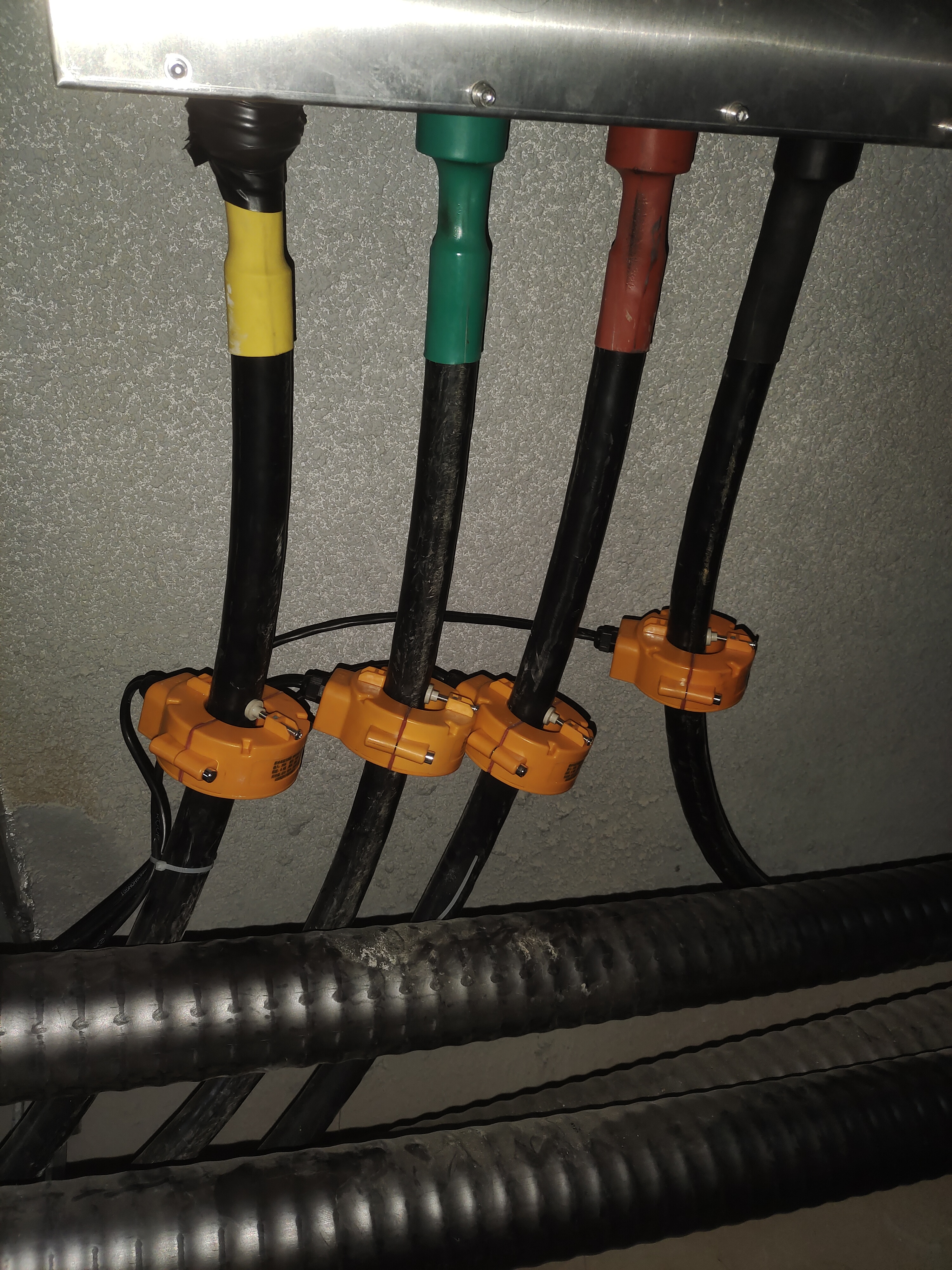
Outdoor-grade split-core current transformer: plastic housing with epoxy resin encapsulation, specified for overhead line monitoring, outdoor solar and wind, and municipal infrastructure.
Beyond Brochures: Physical Evidence of HEYI Electrical's Supplier Capabilities
Current transformers are specified on paper and judged in metal. By the evaluation stage, most buyers have already seen the same set of documents from every shortlisted supplier — a model list, an accuracy table, a certification folder and an assurance that custom ratios and housing colours are available. The more useful question is narrower: which of those claims can be traced back to a material, a measurement, or a document issued by someone other than the seller.
This article works through the verifiable side of one supplier's technical file. Wenzhou Heyi Electrical Co., Ltd (HEYI ELECTRICAL) is a manufacturer of current transformers and current sensors based in Wenzhou, Zhejiang, China. Established in 2012, the company operates a 10,000 m² production site with 56 employees, including a five-engineer R&D team. Its documented annual output is 356,000 units, and approximately 95% of sales are exported to Southeast Asia, South Korea, Europe, South America, Australia, Africa, the Middle East and North America. What follows is not a company profile. It is an examination of the material specifications, test routines and reference documents that sit behind a supplier evaluation.
The Claim-to-Evidence Gap in Current Transformer Sourcing
Supplier evaluation in this category follows a familiar pattern. A buyer requests quotations, receives a model list with measurement ranges and accuracy classes, and is offered customization of ratio, output and housing colour. Those documents are rarely inaccurate — they are incomplete. A line reading "accuracy class 0.5" does not identify the core material, the grade of the winding conductor, or what the polymer housing will do after several years of ultraviolet exposure on an overhead line.
Part of the reason is structural. The five largest global players — ABB, Siemens, GE, Schneider Electric and Arteche — together held approximately 40% of current transformer market share in 2024, according to Global Market Insights. The remainder of the market is served by a long tail of specialist manufacturers, and for a specialist, brand recognition is rarely what decides a shortlist. What decides it is the physical record: what the transformer is made of, and what has actually been measured on it.
A manufacturer with 56 employees and a 10,000 m² site is not competing with ABB or Schneider Electric on portfolio breadth or global service infrastructure. Any competitive case it has must be narrower: a focused range of low-voltage current transformers and current sensors, a documented material specification for each family, and test records a buyer can request and review before placing a purchase order. That is the standard applied to HEYI's files below.
Four Material Layers That Can Be Checked Instead of Trusted
For a low-voltage current transformer, four material layers determine most of what the device can physically do: the winding conductor, the magnetic core, the housing and insulation, and the sealing system on outdoor models. Each of these is a purchasable, checkable specification rather than a marketing adjective, and each appears explicitly in HEYI's product data.
Conductor: pure copper enameled wire
Pure copper enameled wire is specified across the HEYI families reviewed here — split-core, solid-core plastic-cased, busbar, DIN-rail, three-phase, outdoor and revenue-grade. This matters for three practical reasons. Copper conductivity sets the secondary winding resistance, which in turn affects how much burden a current transformer can drive without exceeding its accuracy class. Enamel insulation allows windings to be packed tightly into a limited window, which is what makes compact housings such as the CP DIN-rail unit feasible. And a fully specified conductor material is a manufacture-and-repeat question: if the winding grade changes between batches, ratio error and phase displacement drift with it.
Core: silicon steel sheets, ferrites, nanocrystalline, air
The core is where most of the engineering judgement in a low-voltage CT lives, and HEYI's files distinguish between four options rather than implying a single universal core:
- Silicon steel sheets — specified for the plastic-cased solid-core families (MSQ, CP, SDH), the busbar split-core family (DP/HK), the outdoor families (OCT, LMZW) and the revenue-grade RECT.
- Silicon steel sheets combined with ferrites — documented for the split-core KCT, KCT-L and KCD families, whose type descriptions include ferrite-core and high-frequency noise-suppressing variants.
- Nanocrystalline materials — listed as an alternative core material alongside silicon steel for the plastic-cased and DIN-rail solid-core families, including MSQ, CP, SDH, DASN, DX/DM and the C2/C3 Hall effect sensor.
- Air core — the physical basis of the FRC flexible Rogowski coil, a non-saturating design with a silicone body and a 245 mm inner diameter.
The distinction is not decorative. A laminated silicon steel core saturates at high current and offers limited high-frequency response; ferrite additions in the split-core range are associated with noise suppression in clamp-on designs; an air-core Rogowski coil does not saturate at all within its 100–10,000 A range, which is why it is used for heavy industry, smelting and transient current measurement.
Housing and insulation: PA, PC, ABS/PC and nylon
Polymer choice is documented per family rather than stated generically. The split-core KCT, KCT-L and KCD families use PA plastic. The busbar split-core DP/HK uses PC plastic, a family whose window sizes run up to 80 × 160 mm and whose measurement range extends to 8,000 A. The solid-core MSQ, CP, SDH, DASN and DX/DM families use ABS/PC plastic, with housing material and housing colour both listed as customizable options on MSQ and CP. The HYCA residual current sensor uses nylon plastic with copper conductors.
Sealing: epoxy resin on outdoor models
Outdoor current transformers are where housing material alone stops being sufficient. HEYI documents three different approaches rather than one blanket "weatherproof" claim:
- OCT — outdoor waterproof split-core transformer with a plastic housing plus epoxy resin, IP65 rated, UV protected, 0–8,000 A, inner diameter 0–120 mm.
- LMZW — outdoor resin-cast type using hydrophobic epoxy resin over a silicon steel sheet core, 0.66 kV, IP65, UV protected, marine/offshore and chemical applications.
- RECT — epoxy resin insulated, IP65, UV protected, 0.15S accuracy class with IEEE C57.13 reference, 0–1,000 A.
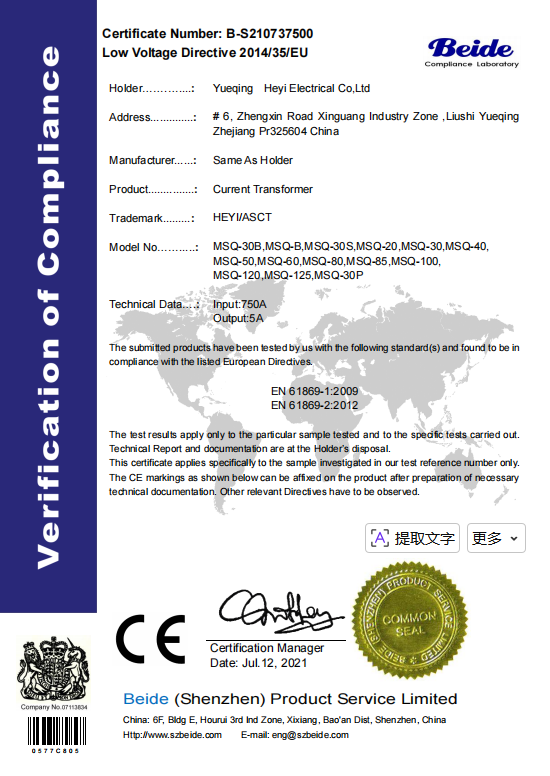
MSQ solid-core, plastic-cased current transformer: ABS/PC housing, silicon steel sheets or nanocrystalline core material, pure copper enameled wire winding, measurement range 0–6000 A.
Documented Material Specification by Product Family
The table below consolidates the material and electrical specifications that HEYI publishes for its main current transformer and sensor families. It is the kind of extract a buyer can use directly at the evaluation stage, because every column can be checked against a sample, a drawing or a test record.
| Family | Housing / insulation | Core material | Winding | Range and key rating |
|---|---|---|---|---|
| MSQ (solid-core, plastic cased) | ABS/PC plastic | Silicon steel sheets / nanocrystalline | Pure copper enameled wire | 0–6000 A; 1.0 / 0.5 / 0.5S / 0.2 / 0.2S; ID 0–125 mm |
| CP (DIN-rail compact) | ABS/PC plastic | Silicon steel sheets / nanocrystalline | Pure copper enameled wire | 0–6000 A; 1.0 / 0.5 / 0.5S / 0.2 / 0.2S; ID 0–100 × 31 mm |
| SDH (window type) | ABS/PC plastic | Silicon steel sheets / nanocrystalline | Pure copper enameled wire | 0–10000 A; 1.0 / 0.5 / 0.5S / 0.2 / 0.2S; ID 0–220 × 80 mm |
| KCT / KCT-L / KCD (split core) | PA plastic | Silicon steel sheets, ferrites | Pure copper enameled wire | 0–1000 A; 3.0 / 1.0 / 0.5; ID 0–50 mm |
| DP/HK (busbar split core) | PC plastic | Silicon steel sheets | Pure copper enameled wire | 0–8000 A; 3.0 / 1.0 / 0.5; ID 0–80 × 160 mm |
| DASN (three-phase) | ABS/PC plastic | Silicon steel sheets / nanocrystalline | Pure copper enameled wire | 0–1000 A; accuracy 1.0; ID 0–50 mm |
| OCT (outdoor split core) | Plastic housing + epoxy resin | Silicon steel sheets | Pure copper enameled wire | 0–8000 A; 3.0 / 1.0 / 0.5; IP65; ID 0–120 mm |
| LMZW (outdoor resin cast) | Hydrophobic epoxy resin | Silicon steel sheet | Pure copper enameled wire | 0–1000 A; 1.0 / 0.5 / 0.5S / 0.2 / 0.2S; 0.66 kV; IP65 |
| RECT (revenue grade) | Epoxy resin | Silicon steel sheets | Pure copper enameled wire | 0–1000 A; 0.15S; IEEE C57.13; IP65; ID 0–78 mm |
| FRC (Rogowski coil) | Silicone body | Air core (non-saturating) | Pure copper enameled wire | 100–10000 A; ID 245 mm |
| HYCA (residual current sensor) | Nylon plastic / copper | — | Copper | DC up to 2 kHz; 6 mA DC and 30 mA AC switching per IEC 62752; resolution 0.2 mA |
Why These Material Choices Matter Electrically
Two design consequences follow from the material data above, and both are relevant to a buyer's evaluation rather than to a catalogue.
The first is that the accuracy a supplier can honestly offer is bounded by the core and the window geometry, not by the accuracy label printed on the datasheet. Solid-core families with laminated silicon steel or nanocrystalline cores reach 0.2 and 0.2S classes in the MSQ, CP, SDH and LMZW ranges, and the RECT reaches 0.15S. Split-core families, which must close a magnetic circuit around a live conductor in the field, are documented at 3.0 / 1.0 / 0.5 in the KCT and DP/HK ranges. The gap is not a manufacturing weakness; it is a physical consequence of a split magnetic path, and it is precisely the kind of information a buyer needs before committing a retrofit programme to a specific model.
The second is that output format and material selection travel together. The KCT, KCT-L and KCD split-core families offer 5 A, 1 A, mA, mV, RS485 or 4–20 mA outputs; the KCD variant is described as a Modbus RTU current and energy sensor for RS485 energy monitoring, and the KCT-L as a loop-powered 4–20 mA transmitter. The three-phase DASN uses a 5 A output. The HYCA residual current sensor uses an integrated self-monitoring and test function with a 0.2 mA measurement resolution and a differential current range of 0–300 mA. In each case, the electrical interface is a documented choice, not an afterthought.
Test and Process Evidence Behind the Material Claims
Material specifications are only as useful as the process that holds them stable. HEYI documents six quality-control steps applied to production: 100% routine test, accuracy test, insulation resistance test, withstand voltage test, appearance inspection, and pre-shipment inspection. A hundred-percent routine test is a meaningful commitment at a unit level, because it applies to every transformer rather than to a sample batch.
The instruments used for those tests are themselves traceable, which is the part of a supplier file that buyers most often overlook. Calibration certificates issued in September 2025 by the Yueqing Institute of Measurement for Quality and Technique Supervision and the Yueqing Institute of Quality and Technical Supervision Inspection cover a withstand voltage tester (model BF2670AM, verified under JJG 795-2016), a current load box (model HL04, calibrated under JJF 1264-2010), and a standard current transformer with current booster (model HLS21-2S, ratio 5A/5A to 2000A/5A, verified under JJG 313-2010). Together they cover the accuracy, burden and dielectric tests named in the quality-control list.
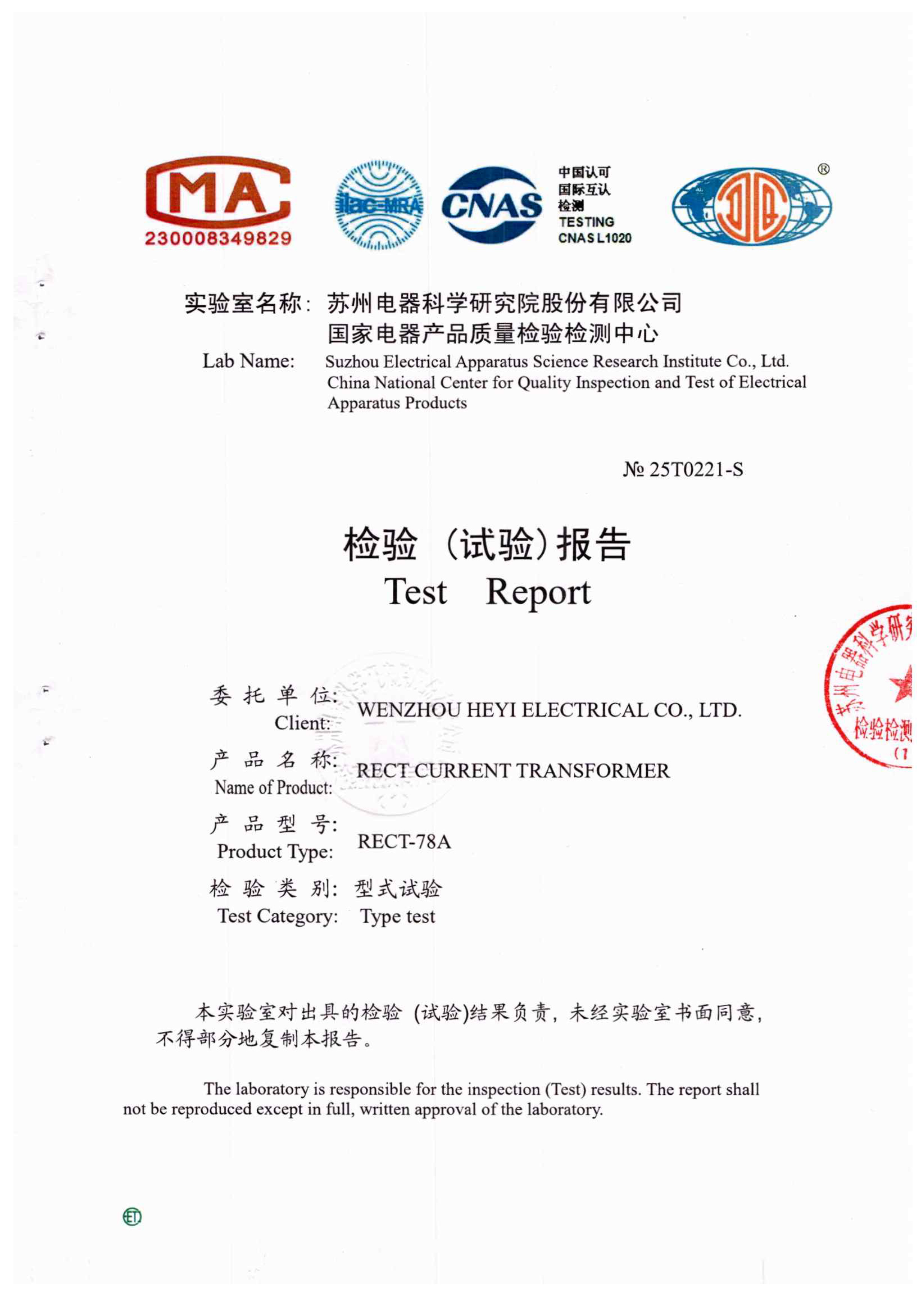
Type test record for the RECT current transformer family: report 25T0221-S, issued by Suzhou electrical apparatus science research institute co., ltd, dated 2025-05-01.
Beyond routine production testing, the file contains results issued by organisations other than the manufacturer. Type test report 25T0221-S was issued on 2025-05-01 by Suzhou electrical apparatus science research institute co., ltd for the RECT range. An IP65 ingress protection test report (Qst-23N020111-1SR) was issued on 2023-02-01 by Shenzhen Qstlab Testing Co., Ltd against IEC 60529:1989+A1:1999+A2:2013 for the OCT outdoor model. Attestations of Conformity for CE-LVD (EN 61869-1, EN 61869-2) were issued by TÜV SÜD Product Service GmbH — certificate N8A 114572 0001 Rev. 00 covering the MSQ, and N8A 114572 0002 Rev. 00 covering the busbar split-core DP/HK. A UKCA declaration of conformity (CLZJ23072649108) references BS EN 61869-2:2012 and remains valid to 2028-07-26. A CE-EMC verification of conformity (B-E2505D2378) against EN IEC 61000-6-3:2021 and EN IEC 61000-6-1:2019 remains valid to 2028-06-08, and a CE-LVD verification for the MSQ (B-S2410C4272) remains valid to 2027-10-22.
Matching Documented Capability to Application
A physical evidence file becomes decision-relevant only when it is mapped to an application. HEYI's documented applications divide into six practical groups, each with a different material and accuracy requirement.
- EV charging and residual current safety. The HYCA residual current sensor is specified around IEC 62752, with switching output for 6 mA DC and 30 mA AC, a differential range of 0–300 mA, DC frequency response up to 2 kHz, and load current up to 80 Arms single-phase or 3 × 32 Arms three-phase. Its nylon and copper construction reflects a low-voltage, safety-critical function rather than a metering one.
- Utility and revenue billing. The RECT range is documented at 0.15S with an IEEE C57.13 reference, epoxy resin insulation and IP65 protection, aimed at utility and substation billing, utility-scale solar and wind plants, and data centre or commercial sub-billing.
- Retrofit and retrofit-heavy switchgear. Split-core families carry the retrofit load. The KCT closes around conductors up to 50 mm, the DP/HK handles busbar windows up to 80 × 160 mm and currents to 8,000 A, and the KCD adds RS485 Modbus RTU output for digital energy monitoring in existing cabinets.
- Overhead line and outdoor installation. The OCT, with plastic housing plus epoxy resin, IP65 rating and UV protection, is documented for overhead line monitoring, outdoor solar and wind, and municipal infrastructure. The LMZW resin-cast design targets marine, offshore, chemical, metallurgy and RMU environments.
- Data centre and three-phase distribution. The DASN three-phase unit is described for main and branch monitoring, remote power panels, rack-level IDC monitoring and high-density PDU integration, using ABS/PC housing and a 5 A output.
- Rail and high-vibration environments. The DX/DM DIN-rail family is documented for EMU and high-speed rail, modular and prefabricated systems, construction and mining machinery, and modular data centres, with a 0.66 kV rating and a 125 × 35 mm window. The KCD RS485 sensor references metro applications on the Beijing and Hangzhou metro lines and elevator monitoring.
HEYI also reports a decade-long programme of bulk supply into power distribution projects, switchgear retrofit, commercial building energy monitoring, industrial control cabinets, generator panels and utility metering systems, with projects in Thailand, Chile, Lebanon, South Korea, Australia and additional markets. The client types named in that record are power utility companies, electrical engineering contractors, panel builders, industrial equipment manufacturers and building energy management integrators. The stated outcomes are improved current measurement accuracy, support for stable energy metering, reduced installation difficulty in retrofit work, and better visibility of abnormal load conditions. These are first-party results rather than independently audited figures, and they are best treated as a reference list to be verified through buyer-supplied test conditions.
Market Signals Shaping Evaluation Criteria
Three published market signals explain why material and test evidence now carries more weight in a current transformer shortlist than it did a decade ago.
The first is market growth. Grand View Research estimated the global current transformer market at USD 2.63 billion in 2024, with a projection of USD 3.90 billion by 2030. Growth of this kind widens the supplier field, and a wider field puts more weight on verifiable specifications rather than on reputation.
The second is regional concentration. Straits Research reported that Asia Pacific held a 40.15% revenue share of the current transformer market in 2025, which places most of the world's low-voltage CT manufacturing capacity inside a single sourcing region. For buyers, that makes supplier-level differentiation — materials, testing, documentation — the practical way to compare offers that otherwise look identical.
The third is application-driven demand. Fact.MR identified split-core current transformers as the fastest-growing segment, attributing it to ease of installation in retrofitting and smart grid applications — the same segment where HEYI's KCT, KCT-L, KCD and DP/HK families sit. Research Intelo projected the global EV charging transformer market, which includes current monitoring components, at a 23.6% CAGR from 2025 to 2033, consistent with the safety-sensing function of the HYCA residual current sensor. On the accuracy side, revenue-grade current transformers are required to meet ANSI C12.20 or IEC 61869-2 accuracy classes, typically 0.2 or 0.15, according to Eaton and ANSI guidance — the class band occupied by the RECT at 0.15S.
Comparison: Generic Claims Versus Verifiable Evidence
The table below contrasts the claims a buyer typically receives in supplier marketing with the corresponding physical specification or record in HEYI's files. The point is not that one supplier is superior, but that the right-hand column can be checked and the left-hand column cannot.
| Evaluation question | Typical marketing answer | Verifiable evidence in HEYI files |
|---|---|---|
| What is the winding made of? | "High-quality copper winding" | Pure copper enameled wire specified across split-core, solid-core, busbar, three-phase, outdoor and revenue-grade families |
| What is the core? | "Advanced magnetic core" | Silicon steel sheets and ferrites named for split-core KCT / KCT-L / KCD; silicon steel or nanocrystalline for MSQ, CP, SDH, DASN, DX/DM, C2/C3; air core for the FRC Rogowski coil |
| What is the housing? | "Durable industrial housing" | PA for split core, PC for busbar split core, ABS/PC for solid-core and DIN-rail families, nylon for the HYCA sensor |
| Is it outdoor-rated? | "Weatherproof design" | Epoxy resin encapsulation on OCT, hydrophobic epoxy resin on LMZW, epoxy resin on RECT; IP65 test report Qst-23N020111-1SR under IEC 60529 |
| How accurate is it? | "High accuracy" | Class 0.2 / 0.2S on MSQ, CP, SDH and LMZW; 0.15S on RECT; 3.0 / 1.0 / 0.5 on split-core KCT and DP/HK |
| How is quality controlled? | "Strict QC system" | 100% routine test, accuracy test, insulation resistance test, withstand voltage test, appearance inspection and pre-shipment inspection, with calibrated reference instruments |
| Can it be customised? | "Flexible customization" | Documented customization of ratio, accuracy class, burden, window size, housing colour, terminal type, cable length, logo printing and label design; MOQ 1 unit; lead time 3–30 days |
Limits and Boundaries Buyers Should Weigh
An evidence-based evaluation is only credible if it also states where a product or supplier is not the right fit. Five boundaries are visible in HEYI's own documentation.
- Split-core designs are not revenue-grade instruments. The KCT and DP/HK families are documented at accuracy 3.0 / 1.0 / 0.5. They are suited to monitoring, retrofit and load visibility, not to utility billing. Billing accuracy requires the solid-core or resin-cast routes, such as the RECT at 0.15S or the MSQ and CP at up to 0.2 / 0.2S.
- Epoxy-encapsulated outdoor units trade serviceability for protection. The OCT, LMZW and RECT use encapsulating resin for moisture and UV resistance; that same construction means the magnetic circuit is not a field-repairable assembly. Buyers should specify them where outdoor conditions demand it, not as a default.
- Ingress protection must be specified at configuration level. The OCT family is described as IP65/IP67 capable, while the published test report documents IP65 under IEC 60529. A buyer needing IP67, or continuous immersion, should confirm the exact configuration rather than assume the higher figure applies to the standard model.
- Premium core materials are optional, not automatic. Nanocrystalline material appears as an alternative to silicon steel on several families, alongside ferrites in the split-core range. These options change cost, and not every monitoring application needs them.
- Scale is a real constraint. HEYI operates with 56 employees and a documented annual output of 356,000 units, with a stated lead time of 3–30 days and a minimum order quantity of 1 unit. That footprint supports small customization runs and mid-volume programmes well; buyers planning a multi-million-unit annual programme should phase volumes and confirm capacity expectations in writing before committing.
- Certificates have validity windows. Several attestations carry defined expiry dates — the CE-LVD verification B-S2410C4272 to 2027-10-22, the UKCA declaration CLZJ23072649108 to 2028-07-26, and the CE-EMC verification B-E2505D2378 to 2028-06-08. Buyers should verify current validity at the time of order rather than relying on a certificate folder issued earlier.
Future Outlook
Two shifts are likely to change how current transformers are evaluated over the next several years, and both favour documented physical evidence over descriptive claims.
The first is the retrofit economy. With split-core designs identified as the fastest-growing segment because of their installation characteristics in retrofits and smart grids, more projects will be won or lost on whether a clamp-on device can close around an existing busbar and still deliver the accuracy the monitoring platform expects. Specifications such as window size (up to 80 × 160 mm on the DP/HK), output format (RS485 or 4–20 mA) and documented accuracy class will matter more than brand familiarity in those decisions.
The second is safety sensing in electrified infrastructure. With the EV charging transformer segment projected to grow at a 23.6% CAGR from 2025 to 2033, residual current sensing components such as the HYCA — specified to switching thresholds of 6 mA DC and 30 mA AC under IEC 62752, with 0.2 mA resolution — move from accessory status into the safety-critical path. In that environment, buyers are unlikely to accept a supplier's material claims at face value, and the ability to produce calibration records, type test reports and third-party ingress protection results becomes part of the qualification itself.
Neither trend guarantees any specific supplier a position on a shortlist. They do suggest that a manufacturer able to show the conductor, the core, the housing and the test record — rather than describing them — will have an easier time in an evaluation that has moved past the brochure.
FAQ
1. How can a buyer verify a current transformer supplier's material claims before placing an order?
Start with the material specification per model family and check it against a physical sample: conductor material, core material, housing polymer and, for outdoor models, the encapsulation method. In HEYI's case, these are documented as pure copper enameled wire, silicon steel sheets with ferrites or nanocrystalline alternatives, PA, PC, ABS/PC or nylon housings, and epoxy resin on the OCT, LMZW and RECT outdoor models. Then request the process record — 100% routine test, accuracy test, insulation resistance test, withstand voltage test, appearance inspection and pre-shipment inspection — together with calibration certificates for the test instruments and any third-party type or ingress protection reports.
2. What do different core materials mean for accuracy and application?
The core sets the practical accuracy ceiling. Laminated silicon steel cores, used in the MSQ, CP, SDH, DP/HK, OCT, LMZW and RECT families, are the conventional choice for low-voltage measurement and support classes up to 0.2 / 0.2S in solid-core designs and 0.15S in the RECT revenue-grade model. Ferrite additions in the split-core KCT, KCT-L and KCD families are associated with high-frequency noise suppression in clamp-on designs. Nanocrystalline material is documented as a higher-permeability alternative on several solid-core families. The FRC Rogowski coil uses an air core, which does not saturate within its 100–10,000 A range.
3. Which current transformer families are suitable for revenue metering rather than monitoring?
Revenue-grade metering requires ANSI C12.20 or IEC 61869-2 accuracy classes, typically 0.2 or 0.15, according to Eaton and ANSI guidance. In HEYI's range, the RECT is documented at 0.15S with an IEEE C57.13 reference, epoxy resin insulation and IP65 protection, aimed at utility and substation billing, utility-scale solar and wind, and data centre or commercial sub-billing. The MSQ, CP, SDH and LMZW families reach 0.2 / 0.2S. Split-core KCT and DP/HK units are rated 3.0 / 1.0 / 0.5 and are intended for monitoring and retrofit rather than billing.
4. What production and quality-control evidence should be requested during supplier evaluation?
Request three layers. First, the process list — HEYI documents 100% routine test, accuracy test, insulation resistance test, withstand voltage test, appearance inspection and pre-shipment inspection. Second, traceability of the instruments used, such as calibration certificates for a withstand voltage tester verified under JJG 795-2016, a current load box calibrated under JJF 1264-2010, and a standard current transformer verified under JJG 313-2010, all issued in September 2025. Third, independent documents where they exist, for example type test report 25T0221-S issued by Suzhou electrical apparatus science research institute co., ltd, or IP65 test report Qst-23N020111-1SR issued under IEC 60529.
5. What can be customised on a current transformer order, and what are the commercial parameters?
HEYI documents customization across current ratio, accuracy class, burden, window size, housing colour, terminal type, cable length, logo printing and label design. Production modes listed are OEM, ODM, customized production and bulk manufacturing. The stated minimum order quantity is 1 unit and lead time is 3–30 days. After-sales support includes technical selection support, wiring guidance, product replacement support, OEM documentation support and online after-sales service. Buyers should confirm the final specification in writing before production, since ratio, burden and accuracy are interdependent.
6. What are the practical limits of split-core and epoxy-encapsulated current transformers?
Split-core units close around an existing conductor, which makes them the practical choice for retrofit and switchgear upgrades, but the split magnetic path limits achievable accuracy — HEYI's KCT and DP/HK families are documented at 3.0 / 1.0 / 0.5, so they suit monitoring rather than billing. Epoxy-encapsulated outdoor units such as the OCT, LMZW and RECT resist moisture and UV but are not field-serviceable assemblies, and each configuration's actual ingress rating should be confirmed against its test report — the published OCT report documents IP65 under IEC 60529, while the family is described as IP65/IP67 capable.
Reference document. Model-level specifications for the current transformer, sensor and metering ranges discussed above are compiled in the HEYI Electrical product brochure: download the HEYI product brochure (PDF).
Figures for company size, capacity, materials and test records are drawn from HEYI Electrical product and certification documentation. Market-size, regional-share, segment-growth and accuracy-class figures are attributed to the third-party sources named in the text.