
Best Non Woven Bag Making Machines to Shortlist for Your Factory in 2026
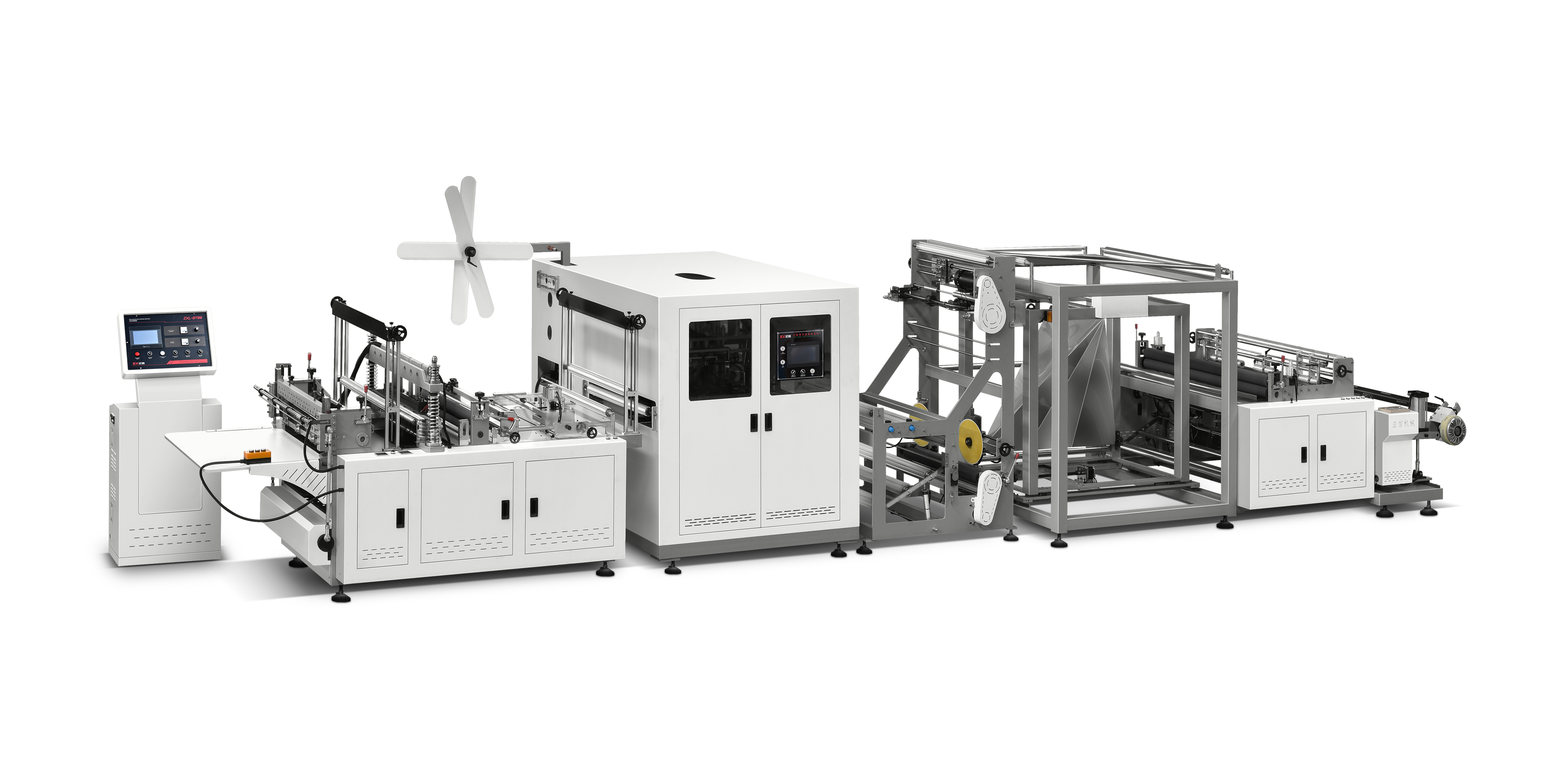
A non woven bag making machine is not a general-purpose unit. Its die set, folding section, handle unit and sealing station are engineered around a specific bag format — and that format, more than any headline speed figure, decides whether the machine still fits your order book three years after installation.
The category is expanding quickly enough that many 2026 buyers are entering it for the first time. More than 140 countries had enacted legislation restricting or banning single-use plastic bags as of 2026 (Dataintelo), and the specialised non-woven bag making machine segment is projected to grow from US$179 million in 2025 to US$733 million by 2032 (LP Information), a trajectory those reports associate directly with plastic-ban policy. Forecasts in this space diverge — general bag-machine studies project mid-single-digit growth while non-woven-specific studies project 20%-plus — because the underlying product definitions differ. Any single growth figure should be treated as directional, not precise.
What does not diverge is the procurement logic. This shortlist is organised by bag-format specialisation, using published specifications for five Zhengxin models: ZXL-B700, ZXL-G700, ZXL-A700Ultra, ZXL-D700 and ZXL-E700Ultra. Zhengxin, formally Zhejiang Zhengxin Machinery Co., Ltd., is a Wenzhou-based manufacturer of non woven bag making machines and complete bag production lines. Each entry below states what the machine is built to produce, the material window it accepts, and the constraint that determines whether it belongs on your list.
Why bag format, not price, should set the shortlist
Two machines can share the same rated speed, the same PLC brand and a similar price, and still be non-substitutable. A gusseting mechanism that uses a rotary disc and metal plate to control bottom gusset dimensions cannot be replaced by a parameter change on a machine that does not have it. Handle attachment is another hard boundary: on the ZXL-D700 the handle section uses ultrasonic welding, while on the ZXL-G700 handle heat-sealing and punching are automatic. In both cases, the hardware decides which handle types you are able to sell.
The practical rule for a research-to-evaluation buyer is straightforward. Shortlist by the format that represents the largest share of your confirmed orders. Then check whether your second and third formats can be produced on the same platform — or whether they require a second machine. Multi-model deployment from a single vendor is common in practice: a Brazilian packaging facility runs six Zhengxin units across four bag types (ZX-LT500, ZXL-B800, ZXL-D800 and ZXL-B700), and an Egyptian manufacturer runs five units — one ZXL-E700, two ZXL-D700 and two ZXH-C21200 printing machines — to serve both food takeaway and retail promotional bag lines.
The four constraints that filter a 2026 shortlist
- Material thickness. Ultrasonic sealing is sensitive to grams per square metre. The five machines here cover 30–120 g/m² (ZXL-B700, ZXL-A700Ultra), 30–100 g/m² (ZXL-D700, ZXL-E700 and ZXL-E700Ultra) and 50–100 g/m² (ZXL-G700). Heavier laminated structures sit outside these windows — the ZX-LT500 and ZX-LT500Pro 3D platforms are specified for 70–150 g/m² instead.
- Fabric roll width. 500–1300 mm on the B700, A700Ultra, D700 and E700Ultra; 500–1150 mm on the G700. Roll width caps the finished bag dimension, so an unusually large shopping bag can push a buyer onto a different platform.
- Power and floor space. All five run 380V/220V. Total power is 12 kW (B700), 15 kW (D700, A700Ultra) and 18 kW (G700, E700Ultra). Machine weights run from 2,200 kg to 4,200 kg, so a level floor, lifting equipment and clearance on all sides belong in the project budget, not in the afterthought column.
- Certification. CE certificate M.2021.206.C70875, issued by UDEM, covers the ZXL-A, B, D, E and G model families among others; the applicable standards include EN ISO 12100:2010 and EN 60204-1:2018. ISO 9001:2015 certificate 20225Q21503R2M, issued by QPC, covers production and sales of bag making machines, slitting machines and non woven printing machines.
Shortlist by bag-format specialisation
D-cut and drawstring bags — ZXL-B700
The ZXL-B700 is specified as a non woven D-cut bag making machine and non woven drawstring bag machine. It is PLC-controlled with a stepping-motor drive system and a high-power ultrasonic welding system that accepts both non-woven and spunlaced non-woven fabric. Published parameters: production speed 40–120 pcs/min; fabric roll width 500–1300 mm; bag height 200–580 mm; bag width 100–800 mm; material thickness 30–120 g/m²; total power 12 kW; machine weight 2,200 kg. The manufacturer separately lists a capacity of 4,000–5,000 non woven bags per hour for this model.
Three features matter for buyers moving up from manual or semi-automatic production. An auto-loading function reduces the labour attached to roll changes. A magnetic powder tension controller holds fabric tension stable, which is the variable that most often drifts into seal inconsistency. The machine also stops automatically when material runs out, and a colour-tracking sensor keeps printed bags cut in register.
Side gusset and organ bags — ZXL-G700
Where the B700 covers flat-format work, the ZXL-G700 is built for structures with depth: a Non Woven Bag Making Machine With Side Gusset And Online Handle, also described as a non woven organ bag machine. Adjustable side gusset width of 60–200 mm is the defining specification. Production speed is 60–100 pcs/min; bag height 300–700 mm; bag width 200–400 mm; handle length 380–600 mm; material thickness 50–100 g/m²; fabric roll width 500–1150 mm; total power 18 kW; machine weight 4,200 kg.
The control architecture is fully automatic, based on an LCD touchscreen HMI with computer-controlled edge guiding, photoelectric tracking, stepper-motor length control, automatic positioning, self-diagnostics and automatic counting. Automatic handle heat-sealing and punching are integrated. For buyers supplying retail and gift channels, the gusset — not the print — is usually what separates an acceptable bag from a premium one, because it determines whether the bag stands and how much volume it carries.
Zero-waste vest and T-shirt bags — ZXL-A700Ultra
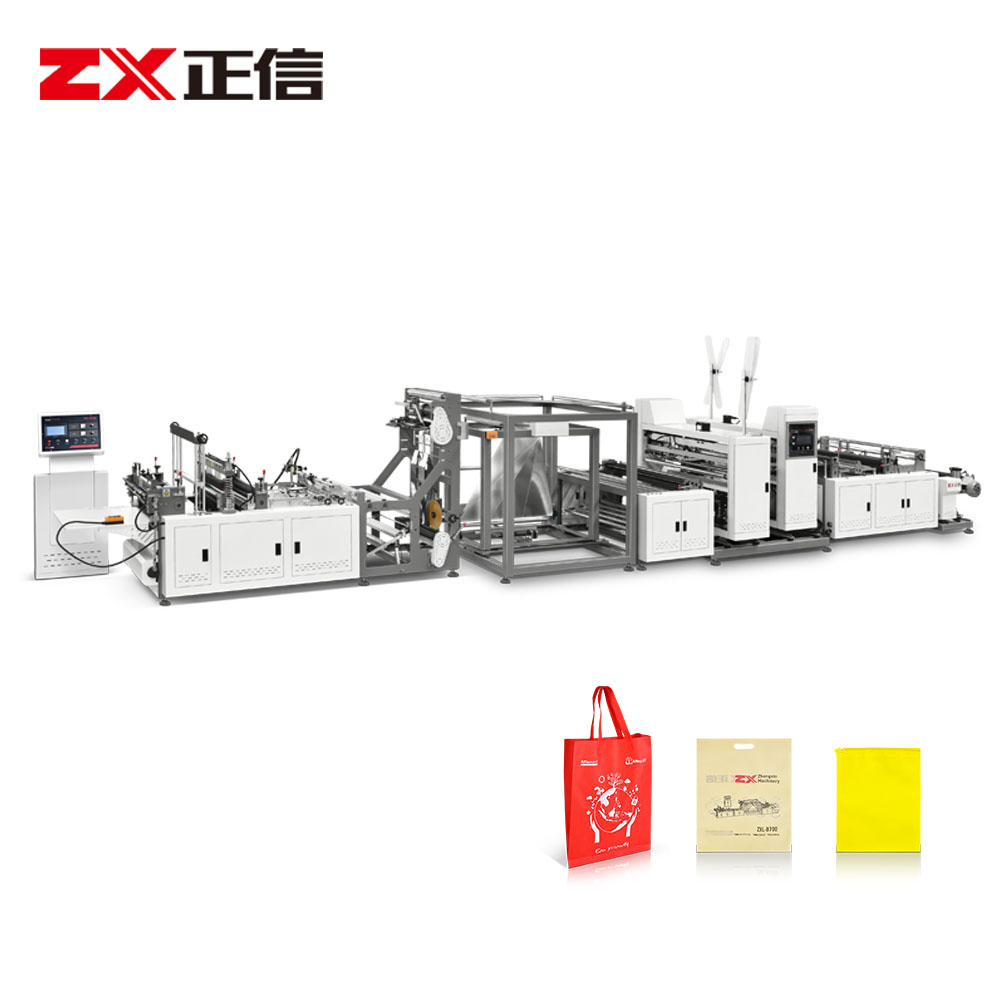
The ZXL-A700Ultra is an edge waste-free non woven T-shirt and W-cut bag machine, also positioned as an edge waste-free vest bag machine. Its distinguishing feature is material efficiency: the platform is described as saving approximately 5% on raw material procurement cost, because the bag is formed from the purchased roll width rather than trimmed down from an oversized roll. Published parameters: production speed 40–120 pcs/min; bag height 300–700 mm; bag width 200–400 mm; material thickness 30–120 g/m²; fabric roll width 500–1300 mm; total power 15 kW; machine weight 2,900 kg.
Sealing is ultrasonic, so no hot-melt glue or chemical adhesive is used. The machine is equipped with a scrap recovery system that automatically collects waste material for reuse, and the manufacturer specifies full-process automation with PLC control and a touchscreen interface, requiring 1–2 operators. A modular design supports flexible dimension settings — vest bag lengths up to 80 cm are cited. This is the model to shortlist when vest bags represent high volume and fabric cost is a visible line in your costing sheet.
Flat bags with online handle — ZXL-D700 (4-in-1)
The ZXL-D700 is a four-in-one platform producing flat bags with online handle attaching. Output is 40–120 pcs/min; bag height 200–580 mm; bag width 100–800 mm; handle length 380–600 mm; material thickness 30–100 g/m²; fabric roll width 500–1300 mm; total power 15 kW; machine weight 3,200 kg. The handle attachment section uses ultrasonic welding, and the machine uses 15 kHz ultrasonic sealing for joining bags and handles.
Mechanically, the D700 shows why format determines the shortlist. Fold-over width is adjusted by a lead-screw mechanism; material is secured by ultrasonic rollers and guided over aluminium rollers into a triangular folding assembly; a gusseting mechanism using a rotary disc and metal plate controls bottom gusset dimensions; and an optical sensor positioning system ensures precise cutting on printed fabric. Automatic feeding, web guiding and tension control remove most manual adjustment from changeovers, and finished bags are stacked on the discharge table ready for packing.
Box bags with online handle — ZXL-E700Ultra (5-in-1)
The ZXL-E700Ultra is a five-in-one box bag machine with online handle attaching. Specification: production speed 40–120 pcs/min; bag height 200–580 mm; bag width 100–800 mm; handle length 380–600 mm; material thickness 30–100 g/m²; fabric roll width 500–1300 mm; total power 18 kW; machine weight 4,000 kg. The Ultra version carries a patented zero-trim technology described as saving 5% of raw materials, alongside the same ultrasonic welding approach used across the platform — no needle and thread, no hot-melt glue — plus a scrap recovery system. Full-process automation with PLC and touchscreen control is specified at 1–2 operators per machine.
The non-Ultra ZXL-E700 shares the same core specification and bag-format capability without the zero-trim technology. That makes it the natural comparison point when a buyer is deciding whether the material-saving feature justifies the step up.
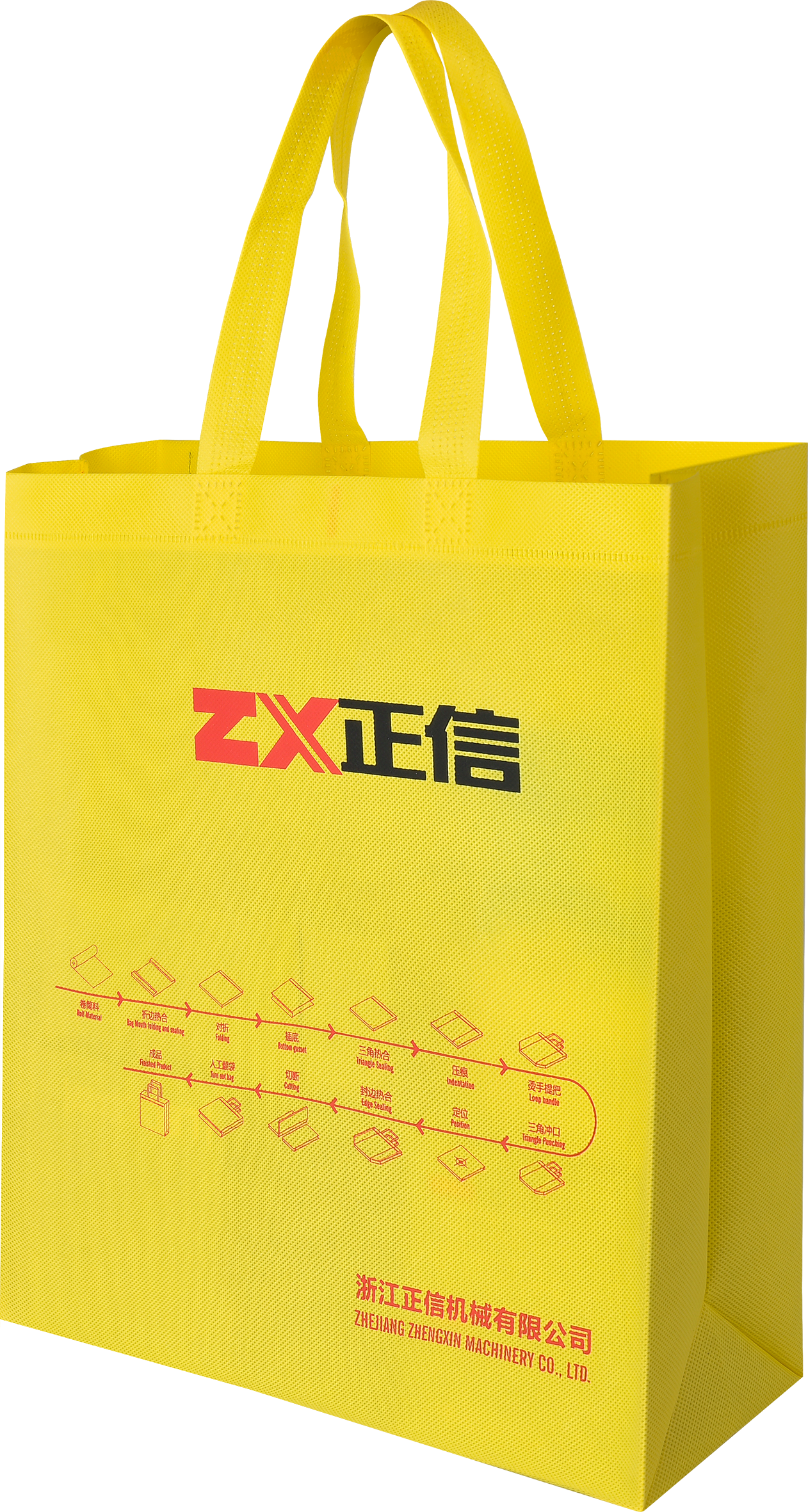
Shortlist at a glance
| Format focus | Model | Production speed | Material thickness | Fabric roll width | Total power | Weight |
|---|---|---|---|---|---|---|
| D-cut & drawstring | ZXL-B700 | 40–120 pcs/min | 30–120 g/m² | 500–1300 mm | 12 kW | 2,200 kg |
| Side gusset & organ bags | ZXL-G700 | 60–100 pcs/min | 50–100 g/m² | 500–1150 mm | 18 kW | 4,200 kg |
| Zero-waste vest / T-shirt | ZXL-A700Ultra | 40–120 pcs/min | 30–120 g/m² | 500–1300 mm | 15 kW | 2,900 kg |
| Flat bags with handle (4-in-1) | ZXL-D700 | 40–120 pcs/min | 30–100 g/m² | 500–1300 mm | 15 kW | 3,200 kg |
| Box bags with handle (5-in-1) | ZXL-E700Ultra | 40–120 pcs/min | 30–100 g/m² | 500–1300 mm | 18 kW | 4,000 kg |
How these parameters translate into production decisions
Speed is a range, not a number. Four of the five platforms are rated 40–120 pcs/min and the G700 is rated 60–100 pcs/min. The upper end of each range assumes suitable material thickness, correctly tuned ultrasonic parameters and consistent roll quality. Zhengxin's own maintenance guidance traces weak or inconsistent seals to three causes: horn surface contamination, an uneven horn-to-anvil gap, and a speed increase made without compensating ultrasonic amplitude. A buyer comparing machines on a single speed figure is comparing the best case, not the operating case.
Sealing method determines which markets you can address. Ultrasonic bonding requires no chemical adhesives, which is why it is specified for food-takeaway and cleanroom-adjacent production. Heat sealing remains a lower-cost alternative but needs 15–20 minutes of warm-up, carries a scorching risk if temperature drifts, and requires heating elements to be replaced periodically. Ultrasonic systems trade that for horn maintenance on a longer cycle and, according to the manufacturer's comparison material, 15–20% higher seal strength in pull tests and 25–30% lower energy consumption.
Automation level sets headcount. The Ultra and E-series platforms are specified at 1–2 operators per machine. Semi-automatic alternatives typically run at 15–20 pcs/min with 3–4 workers per line, which shifts per-bag labour cost by a multiple. For a factory planning two or three shifts, the labour line item usually dominates the investment calculation long before the electricity bill does.
Machine footprint is a real constraint. The ZXL-B700 measures 8,000×2,050×1,900 mm, while the ZXL-G700 and ZXL-E700Ultra measure 12,000×2,050×2,100 mm and 12,000×2,050×1,900 mm respectively. Layouts planned around a single machine often have to be redrawn when a second or third unit is added, and the Indonesia installation — 42 units spanning five models — illustrates how much floor area a full line portfolio consumes.
Where these machines are deployed
Retail and supermarket chains. The reference scenario for this segment is a fully automatic shopping bag line running continuously, with a stated production requirement of at least 100 pcs/min, consistent ultrasonic or heat-seal weld quality, and a defect rate below 0.5%. Typical matched equipment includes an air compressor, a flexo printing unit, an automatic counting and bundling machine and a voltage stabiliser. The A700Ultra, D700, E700 and E700Ultra all appear in this scenario mapping.
Garment and export packaging. Apparel brands use logo-printed non woven garment bags, dust covers and suit covers, usually on 16-hour double shifts with 1–2 operators per machine. The stated material requirements are anti-static treatment compatibility, a soft fabric-like handle feel and a wrinkle-free finished bag surface. The ZXL-A700 and ZXL-A700Ultra are the mapped machines for this application.
Food takeaway and delivery. This scenario runs continuously with automated stacking and batch coding in a dust-free, temperature-controlled environment, and specifies odourless, non-toxic water-based ink printing. The matched platform family here is the ZX-LT500 series 3D bag platform.
Promotional and corporate gift production. Small-to-medium batches with frequent artwork changes, where quick job changeover and print registration of roughly ±0.3 mm matter more than raw throughput. Multi-colour flexo printing with a die-cutting unit and handle attaching machine is the standard configuration.
Installation outcomes reinforce the same picture. A Kenyan shopping bag manufacturer runs two ZXL-A700 machines plus one ZXH-C41200 printing unit to supply more than 200 retail stores, with a single operator managing the workflow from printing to finished bag. A Tanzanian promotional bag producer expanded from one to two production lines within 18 months using a ZXL-A700Ultra and a ZXH-C21200, handling ten or more custom orders per week with different artwork.
Market signals worth pricing into a 2026 decision
Three published data points frame the category. First, automatic bag making machines held a 52.4% share of the total product-type market in 2025 (Dataintelo), which signals that the centre of gravity has already moved away from semi-automatic equipment. Second, Asia Pacific accounted for a 43.6% revenue share of the bag making machine market in 2025 (Dataintelo), which is consistent with the concentration of machine building and component supply in the region. Third, the average price of a non-woven bag making machine was approximately US$29,000 per unit in 2025 (LP Information, medium reliability) — a planning benchmark rather than a quote, since format, automation level, PLC brand and optional modules move the figure substantially.
One further figure is worth noting because it explains negotiation behaviour: category gross margin is estimated at around 32% for 2025 (LP Information, medium reliability). That is an industry average, not a statement about any specific supplier's pricing, and buyers should not treat it as a discount target.
Limits and trade-offs: where this shortlist stops being the right answer
A credible shortlist has to state its own boundaries. Six apply here.
- Format lock-in is real. A machine optimised for one format family cannot produce another by changing a recipe. Moving from flat bags with handles to box bags with handles means moving from a four-in-one platform to a five-in-one platform, or running both.
- The thickness ceiling. The D700 and E700/E700Ultra are specified up to 100 g/m². Buyers working with 100–150 g/m² laminated or RPET fabric need a different platform — the ZX-LT500 and ZX-LT500Pro are specified for 70–150 g/m² and for RPET and PP non-woven fabrics.
- Roll-width ceiling on the gusset machine. The G700 accepts 500–1150 mm, narrower than the 1300 mm window on the other four models. Very large gusseted bags may therefore fall outside its range.
- The zero-waste premium has a threshold. A 5% material saving is meaningful at high fabric consumption and marginal at low volume. Buyers running small daily tonnage may find that the premium takes considerably longer to recover than it would in a high-throughput operation.
- These are published specifications, not independent bench tests. The comparison above is built from manufacturer specifications and verifiable certification records. It is not a third-party performance test. Buyers should validate with a sample run on their own fabric before committing capital; Zhengxin supports third-party pre-shipment inspection by SGS, Bureau Veritas or CCIC on request.
- Auxiliary equipment is a separate budget. The reference production scenarios assume an air compressor, a flexo printing unit, an automatic counting and bundling machine and a voltage stabiliser on top of the bag machine itself. Omitting these from the initial investment calculation is one of the most common planning errors in this category.
Future outlook
Three directions shape the next procurement cycle. Recycled-material compatibility is already a specification line rather than a marketing claim: the ZX-LT500 and ZX-LT500Pro are explicitly designed for RPET and PP non-woven fabrics across 70–150 g/m², and RPET sourcing pressure from retail buyers is likely to push that requirement down into mid-range platforms. Second, the automatic-machine share of 52.4% in 2025 suggests semi-automatic equipment will continue to lose ground, particularly where labour cost is rising. Third, servo-driven no-waste-edge technology and online handle attachment — two of the engineering directions Zhengxin lists in its own capability description — are becoming the differentiators that separate a cost-competitive quote from a low-cost one.
Certification validity is the one item that requires active management rather than monitoring. CE certificate M.2021.206.C70875 expires 23 January 2027 and ISO 9001:2015 certificate 20225Q21503R2M is valid to 12 January 2029. Buyers ordering late in 2026 should re-verify both on the issuing bodies' records at the time of order, and confirm the certificate scope covers the specific model being purchased.
Frequently asked questions
Which non woven bag making machine should I shortlist if D-cut shopping bags are my main product?
The ZXL-B700 is specified as a non woven D-cut bag making machine and drawstring bag machine, with a PLC-controlled stepping-motor drive, a high-power ultrasonic welding system that accepts non-woven and spunlaced non-woven fabric, and a rated speed of 40–120 pcs/min. Its fabric roll width is 500–1300 mm, bag height 200–580 mm, bag width 100–800 mm and material thickness range 30–120 g/m². The manufacturer lists a capacity of 4,000–5,000 non woven bags per hour. If your order mix also includes flat bags with attached handles, the ZXL-D700 covers four styles on one platform and would be the more efficient single-machine choice.
What material thickness and fabric roll widths do these machines accept?
The ZXL-B700 and ZXL-A700Ultra accept 30–120 g/m²; the ZXL-D700, ZXL-E700 and ZXL-E700Ultra accept 30–100 g/m²; the ZXL-G700 accepts 50–100 g/m². Fabric roll width is 500–1300 mm on the B700, A700Ultra, D700 and E700Ultra, and 500–1150 mm on the G700. Materials heavier than 100 g/m², such as 150 g/m² laminated fabric, fall outside these ranges and require a dedicated platform: the ZX-LT500 and ZX-LT500Pro are specified for 70–150 g/m² and for RPET and PP non-woven fabrics.
What is the practical difference between the four-in-one ZXL-D700 and the five-in-one ZXL-E700Ultra?
Both are rated 40–120 pcs/min, accept 500–1300 mm fabric rolls and 30–100 g/m² material, and produce bags 100–800 mm wide and 200–580 mm high with 380–600 mm handles. The differences are format and load: the D700 is a four-in-one flat bag platform with online handle attaching, rated 15 kW at 3,200 kg and measuring 10,000×2,050×1,900 mm. The E700Ultra is a five-in-one box bag platform with online handle attaching, rated 18 kW at 4,000 kg, measuring 12,000×2,050×1,900 mm, and carrying a patented zero-trim technology stated to save 5% of raw materials. Choose by bag structure first: flat bags with handles point to the D700, box bags point to the E700Ultra.
Which certifications should be verified before placing an order?
Two documents are directly verifiable. CE certificate M.2021.206.C70875, issued by UDEM on 24 January 2022 and valid to 23 January 2027, covers the ZXL-A, B, D, E and G model families among others, with applicable standards including EN ISO 12100:2010, EN 60204-1:2018, EN IEC 61000-6-2:2019, EN IEC 61000-6-4:2019, EN IEC 61000-3-2:2019 and EN 61000-3-3:2013+A1:2019. ISO 9001:2015 certificate 20225Q21503R2M, issued by QPC and valid from 26 December 2025 to 12 January 2029, covers production and sales of bag making machines, slitting machines and non woven printing machines under GB/T19001-2016/ISO9001:2015. Buyers should confirm both on the issuing bodies' official records and check that the certificate scope names the specific model being purchased.
What installation and support commitments should be part of the evaluation?
Zhengxin provides remote support seven days a week via WhatsApp and video call, and states that its engineers diagnose and resolve more than 80% of issues remotely. Field engineers can travel to customer facilities for troubleshooting, operator training and commissioning. The published after-sales terms include a one-year warranty on major components, installation and commissioning services, and on-site service by a professional team. From the buyer's side, the required preparations are a level concrete floor with clearance on all sides, a verified three-phase power supply matching the machine's nameplate, an air compressor, and fabric on site before commissioning. Installation of a standard single machine typically takes one to two working days.
What price band should a 2026 buyer plan for?
Third-party research places the average price of a non-woven bag making machine at approximately US$29,000 per unit in 2025 (LP Information, medium reliability). That figure is a planning benchmark, not a quotation: format, material window, automation level, zero-waste-edge technology, PLC brand and optional modules all move the number. The same source estimates category gross margin at around 32% for 2025, also at medium reliability. On the supply side, Zhengxin lists a monthly capacity of 40 units, a lead time of 30–45 days and a minimum order quantity of one unit, with customisation available on voltage and frequency, bag size and style, printing colours, material GSM range, sealing method, automation level, PLC and HMI brand, and optional modules.
Reference documents. Zhengxin's 2026 product brochure covering the ZXL and ZX-LT platforms is available for download: Zhengxin 2026 product brochure (PDF). Manufacturer website: www.wzzxjx.com.
Buyers comparing models across formats should request updated specification sheets and confirm certificate validity at the time of order, since machine parameters and certification periods both change.