
Best Fiberglass Texture for Marine Hulls vs. Truck Panels: Verified Application Fit Guidelines
Short answer: a yacht hull and a truck side panel do not ask the same thing of a fiberglass reinforcement. Salt water and permanent humidity make low water absorption and stiffness the deciding criteria for hull laminates. Dynamic road loads, extreme thermal gradients and internal impact make impact resistance and dimensional behaviour the deciding criteria for truck and bus panels. The architecture that satisfies each case differs in fiber orientation, areal weight and moisture content — not in brand language.
In composite manufacturing, “texture” is the industry shorthand for fabric architecture: whether the glass is woven or stitched, how the yarns are oriented, and how much glass sits in a square metre. Those three variables determine how a laminate drapes into a mould, how resin travels through it, and how efficiently the finished part carries load. This reference compares two of the most frequently specified end uses — boat and yacht hulls on one side, truck and bus panels on the other — and sets out the application conditions that should drive the purchasing decision rather than the catalogue order.
The material in scope is E-glass reinforcement, the dominant reinforcement chemistry in the markets discussed here. The global fiberglass fabric market was valued at USD 14.01 billion in 2024, with a projected growth to USD 25.65 billion by 2033, according to Grand View Research. Within that market, woven fiberglass fabrics captured 48.62% of market revenue in 2025, a share Mordor Intelligence attributes to their critical role in yacht hulls and automotive panels. Those two applications are precisely the pair this guide compares.
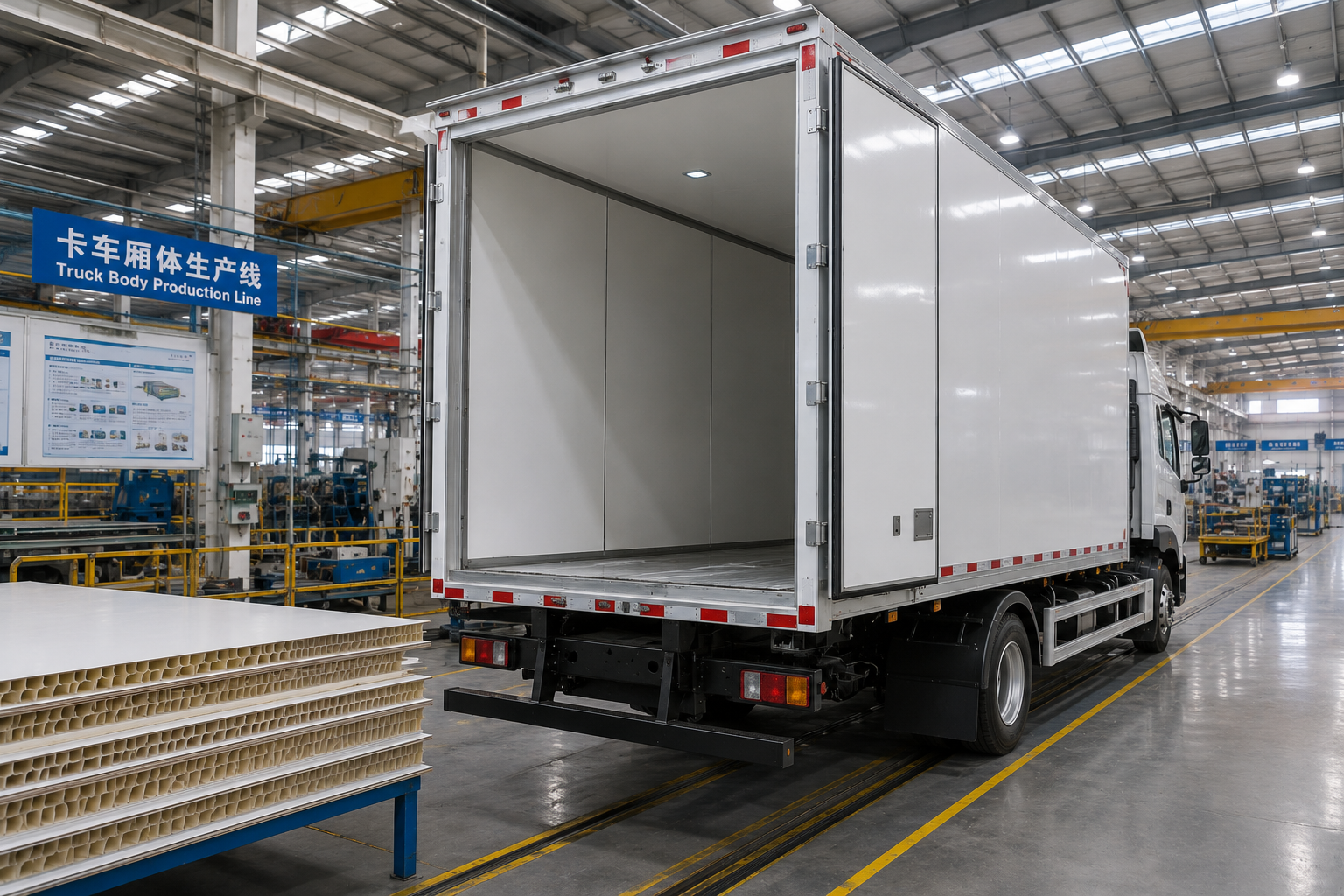
Truck body production lines rely on large panel presses and high-cycle moulding — the process conditions that shape fabric selection for bus and truck panels.
What “Texture” Actually Specifies
Two reinforcement profiles cover most of the selection problem in these sectors. One is a light woven cloth; the other is a stitched non-crimp multiaxial fabric.
Light Weight Fiberglass Cloth is an E-glass fabric in a plain woven construction, supplied in widths of 1000 mm and 1010 mm with an areal weight range of 25–400 g/m². It is intended for Transportation, Wind Energy, Composite Tooling, Industrial Composites, Sports Equipment, UAV & Drone Manufacturing, Surfboard Manufacturing and Marine & Yacht Building applications. Woven cloth at this weight is normally specified for surface layers and light skins, where conformability, resin wet-out and a smooth surface finish matter more than stiffness per ply.
Multiaxial Fiberglass Fabrics are a structural composite reinforcement classified as a non-crimp fiberglass fabric, made from alkali-free glass fiber. They are available in unidirectional (0° or 90°), biaxial (0°/90° or +45°/−45°), triaxial (+45°/0°/−45° or +45°/90°/−45°) and quadriaxial (0°/90°/−45°/+45°) orientations. The documented weight range is 400–1500 g/m², moisture content is below 0.2%, and combustible matter content falls between 2.0% and 8.0%. They are designed for vacuum, hand layup, extrusion, RTM and other forming processes, and are applied in formed products such as ship hulls, wind turbine blades, automotive components, sports equipment and large containers.
The commercially decisive difference between the two is crimp. In a woven construction, yarns pass over and under one another, so fibers follow a wavy path and carry load less efficiently than a straight fiber. In a stitched multiaxial, the fibers remain straight and the plies are held together by stitching. Documented product characteristics for the multiaxial family include reduced fiber crimp, improved load distribution, a high strength-to-weight ratio, excellent resin wet-out and improved fatigue resistance. Those characteristics are what make the multiaxial family the structural workhorse in hulls and panels, while the woven cloth handles surface and finishing duties.
The Operating Environment Sets the Requirement
Application data for these sectors is explicit about the conditions each laminate must survive. Those conditions — not the fabric name — determine which architecture fits.
| Application sector | Documented working conditions | Required function | Fabric profile that fits |
|---|---|---|---|
| Marine & yacht building — boat hulls, marine panels | Salt water environment, high humidity | Weight reduction, improved stiffness | Light woven cloth for skins and finish; multiaxial non-crimp layers for the structural stack; vacuum infusion; low water absorption requirement |
| Transportation — truck bodies, bus panels, rail interiors | Dynamic road loads, extreme thermal gradient, internal impact, corrosive exposure, frequent cycling | Weight reduction, impact resistance, corrosion resistance | Multiaxial non-crimp fabric in the 400–1500 g/m² range; high-cycle moulding on large panel presses |
| Aerospace & UAV — UAV wings, aircraft panels | High altitudes, high G-forces, vibration and fatigue, EMI shielding environments | Ultra-lightweight structures | Low-areal-weight E-glass reinforcement combined with lightweight cores; RTM/VARTM processing |
| Industrial composites — industrial covers, FRP panels, machine enclosures | Corrosive environments, extreme outdoor weather, high temperature and fire risk, acoustic stress, hygiene requirements | Corrosion resistance, weight reduction, structural performance | Woven and multiaxial combinations processed by hand lay-up or spray-up; chemical compatibility required |
| Wind energy — turbine blades, blade shells, nacelle structures | High and low temperature, high pressure, corrosive environment, long-term static/dynamic load, 24/7 continuous operation | Fatigue resistance, weight reduction, structural performance, long service life | E-glass reinforcement in 25–400 g/m² and multiaxial formats, processed by vacuum infusion, resin infusion, hand lay-up or RTM |
Read the table as a constraint map rather than a ranking. Where the environment is dominated by moisture and salt, the fabric must contribute stiffness without absorbing water. Where the environment is dominated by repeated mechanical and thermal cycling, the fabric must distribute load and resist impact without cracking. The same reinforcement family can serve both, but not with identical architecture, weight or orientation.
Marine Hulls: Stiffness, Moisture and Salt Water
Marine and yacht building applications documented in this material cover boat hulls and marine panels, operating under salt water and high-humidity conditions. The stated function of the reinforcement is to reduce weight and improve stiffness, and the special requirement is low water absorption. The processing route documented for this sector is vacuum infusion, supported by vacuum pump and vacuum bagging equipment. Italy and the United States are cited as common application markets.
That combination of conditions explains why hull laminates are usually built as a stack rather than as a single fabric. A plain woven lightweight cloth in the 25–400 g/m² range wets out quickly, conforms to curvature and delivers the smooth surface a hull skin requires. Behind it, a multiaxial non-crimp fabric carries the structural load, with fiber orientations aligned to the actual stress path in the hull — quadriaxial or biaxial where loads run in multiple directions, unidirectional where a defined bending or stiffening direction dominates.
Moisture discipline matters as much as architecture in this sector. Multiaxial fiberglass fabrics are specified with a moisture content below 0.2% and a combustible matter content between 2.0% and 8.0%. Incoming inspection of these two values is one of the cheapest risk controls available to a hull builder, because moisture carried into a laminate by the reinforcement is difficult to remove once the part is closed and infused.
Sandwich construction is the other half of the marine picture. Core materials — including PET foam core, PVC foam core and Core Mat — are widely combined with fiberglass skins in boat hulls, decks and marine panels, and the marine sector is one of the documented application areas for PVC foam core across a density range of 45–300 kg/m³ and a thickness range of 1–80 mm. Fabric texture and core selection are therefore linked decisions, not separate purchases.
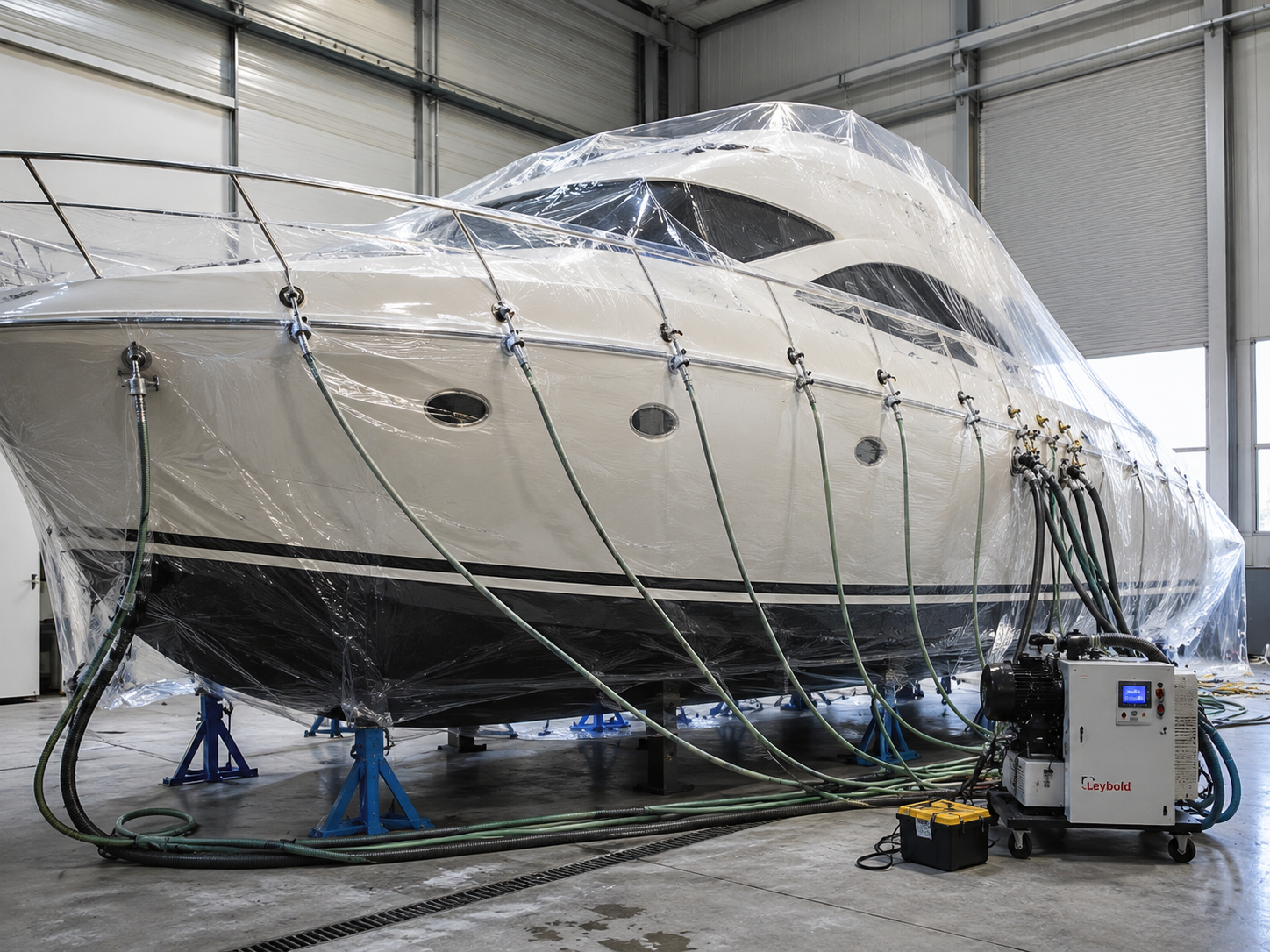
Marine laminates for boat hulls and marine panels are built under salt water and high-humidity conditions, where low water absorption and stiffness are the controlling requirements.
Truck and Bus Panels: Impact, Thermal Cycling and Cycle Time
Transportation applications documented here cover truck bodies, bus panels and rail interiors. The operating conditions are qualitatively different from the marine case: dynamic road loads, extreme thermal gradient, internal impact, corrosive exposure and frequent cycling. The required functions are weight reduction, impact resistance and corrosion resistance. Documented special requirements for the sector are weight reduction for payload optimisation and thermal efficiency. The associated manufacturing model is high-cycle moulding on large panel presses and automated production lines.
Three practical consequences follow from those conditions.
First, the structural layer is typically multiaxial. A panel that experiences repeated mechanical cycling and temperature swings benefits from straight, load-aligned fibers: the documented benefits of reduced crimp, improved load distribution and improved fatigue resistance translate directly into panel durability. The 400–1500 g/m² weight band allows builders to reach the required stiffness with fewer plies, which reduces layup labour in a high-cycle process.
Second, the surface layer is still a finishing decision. Truck and bus panels are visible parts. A plain woven lightweight cloth in the 25–400 g/m² range gives the smooth, resin-rich surface layer that a painted or gel-coated panel requires, while the multiaxial stack underneath provides stiffness and impact performance.
Third, thermal behaviour is a laminate design issue, not only a resin issue. When a panel faces extreme thermal gradients, differences in expansion between skin and core, or between plies of different orientation, drive warping and print-through. Aligning fiber directions to the panel's long axis, and keeping the layup symmetrical, are standard responses documented within the sector's requirement for dimensional stability across these conditions.
Corrosive exposure is the remaining factor. Transportation panels are documented as operating under corrosive conditions as well as mechanical ones, which is why corrosion resistance appears alongside weight reduction and impact resistance in the required-function list for the sector.
Six Selection Rules That Apply to Both Sectors
- Start from the exposure, not the price list. Salt water and humidity push the specification toward low water absorption and stiffness. Road loads and thermal cycling push it toward impact resistance, fatigue resistance and dimensional stability. The same E-glass reinforcement can serve both, but the architecture and weight will differ.
- Separate skin from structure. Specify a plain woven lightweight cloth in the 25–400 g/m² range for surface and conformability demands, and a multiaxial non-crimp fabric in the 400–1500 g/m² range for load-carrying layers.
- Match orientation to the load path. The documented multiaxial options are unidirectional (0° or 90°), biaxial (0°/90° or +45°/−45°), triaxial (+45°/0°/−45° or +45°/90°/−45°) and quadriaxial (0°/90°/−45°/+45°). Orientation is the single most powerful variable a buyer controls.
- Verify moisture and combustible matter on receipt. For multiaxial fiberglass fabrics, moisture content is specified below 0.2% and combustible matter content between 2.0% and 8.0%. These are measurable incoming-inspection values, not marketing claims.
- Confirm process compatibility before committing. Documented compatible processes for these reinforcements include hand lay-up, spray-up, vacuum infusion, resin infusion, RTM, VARTM and extrusion, depending on the product family and application.
- Test to a recognised method. Standardised tests for fiberglass reinforced materials include ASTM D638 for tensile properties and ASTM D790 for flexural strength and modulus, both published by ASTM International. Requiring these methods in a supplier's data package makes comparisons meaningful.
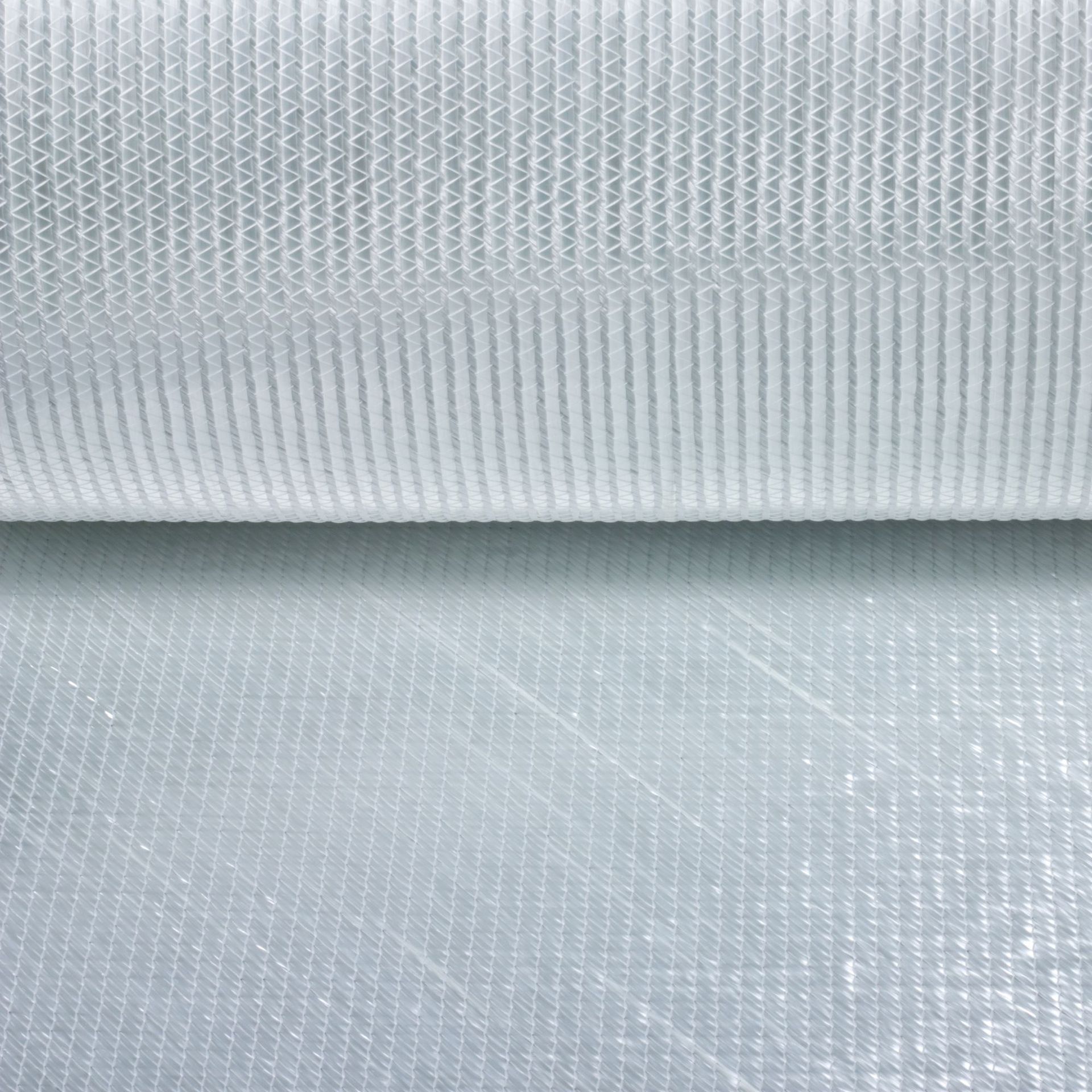
Multiaxial non-crimp fiberglass fabrics in unidirectional, biaxial, triaxial and quadriaxial orientations carry structural load in hull and panel laminates.
Adjacent Applications: UAV Wings and Corrosive Industrial Enclosures
The same decision logic extends to neighbouring sectors, and buyers frequently source for more than one of them at a time.
In the aerospace and UAV sector, documented projects include UAV wings and aircraft panels operating under high altitudes and high G-forces, and in vibration and fatigue environments where EMI shielding is also a consideration. The required function is an ultra-lightweight structure, and Germany and the United States are cited as common application markets. Here the constraint is weight criticality rather than moisture: the case for low-areal-weight E-glass reinforcement combined with lightweight core materials is driven by stiffness-to-weight ratio rather than by water absorption.
In industrial composites, documented projects include industrial covers, FRP panels and machine enclosures operating under corrosive conditions, extreme outdoor weather, high temperature and fire risk, acoustic stress and hygiene requirements, with chemical compatibility as a special requirement. The required functions are corrosion resistance, weight reduction and structural performance, and the documented processing routes are hand lay-up and spray-up supported by continuous panel lamination lines and pultrusion machines. China, the United States, Germany, Italy and India are cited as common markets. In this setting, chemical compatibility can override stiffness considerations entirely, which is why the constraint sequence should be checked before the fabric weight is fixed.
Where Fabric Selection Stops: Limitations and Trade-offs
Non-crimp multiaxial fabric is not a universal upgrade, and buyers should understand the boundaries.
Handling and conformability. Stitched multiaxial fabrics rely on stitching to hold straight fibers in place. In tight double-curvature geometries and small radii, they are generally less forgiving than a woven cloth, and careless handling can disturb the stitch pattern that keeps the plies aligned. Where a hull or panel includes complex curvature, a woven surface layer and a lighter multiaxial core are often the practical compromise.
Weight versus wet-out and labour. Heavy multiaxial formats in the upper part of the 400–1500 g/m² band build thickness quickly and reduce ply count, but they are harder to wet out completely in thick stacks and require more rigorous infusion control. Light woven cloth in the 25–400 g/m² band conforms and finishes better but needs more plies, which raises layup labour in exactly the high-cycle processes that transportation panels depend on.
The fabric is only one variable in the laminate. No fabric architecture alone determines the performance of a finished hull or panel. Resin system, fiber volume fraction, process route (hand lay-up, vacuum infusion, RTM or VARTM), cure control and core selection all contribute. A reinforcement data sheet describes the reinforcement; it does not describe the finished part. Buyers who treat a fabric specification as a finished-laminate guarantee are drawing a conclusion the material data does not support.
Market numbers should be read with caution. Published estimates of the fiberglass fabric market diverge substantially: Grand View Research values the market at USD 14.01 billion in 2024, Fortune Business Insights at USD 5.15 billion in 2025, and Market Research Future at USD 3.99 billion in 2024. The divergence is generally attributed to differing inclusion criteria for raw glass fiber versus processed fabric. Headline market size is therefore a poor anchor for a sourcing decision; application-level parameters are more reliable.
Market Signals Buyers Should Read Carefully
Several documented market signals are relevant to anyone planning composite reinforcement volumes in marine and transportation work.
The fiberglass fabric segment serving wind energy is expected to grow at a CAGR of 8.5% from 2025 to 2033, the highest rate among all application segments, according to Grand View Research. Dataintelo estimates that wind turbine blades account for approximately 42.5% of total fiberglass usage within the wind energy sector. Wind is not the subject of this comparison, but it matters to buyers because it competes for the same multiaxial capacity that hull and panel producers purchase.
Asia Pacific dominated the fiberglass fabric market in 2024 with a revenue share of 41.61%, driven by infrastructure and renewable energy projects, per Grand View Research. For procurement teams, that concentration is a supply-chain fact as much as a market statistic: it influences lead times, freight economics and the availability of non-standard widths.
On the demand side, the marine fiberglass resin market is projected to reach USD 4.23 billion by 2033, according to Market Research Future, indicating steady demand for associated fabric reinforcements for ship hulls and decks. Woven fabrics, meanwhile, held 48.62% of fiberglass fabric market revenue in 2025 (Mordor Intelligence), a share attributed to their role in yacht hulls and automotive panels. The two applications central to this guide are, in other words, the two anchors of the woven segment.
Consolidation and scale on the supply side are also visible. Key global players in the fiberglass fabric market include Owens Corning (US), China Jushi Co. (China), Saint-Gobain (France) and Taishan Fiberglass (China), as listed by MarketsandMarkets. Buyers comparing suppliers usually compare against this group's published capability — which is a scale comparison, not an application-fit comparison.
How CINON Composites Fits This Framework
Guangdong Cinon New Material Technology Co., Ltd. (CINON Composites) is a supplier of fiberglass reinforcements and lightweight core materials serving marine, transportation, wind energy, industrial and aerospace composite applications. The company was established in 2022 and operates a 40,000 m² manufacturing facility with an annual production capacity of 1,200,000 m² and an R&D team of 25 engineers.
The product range relevant to the two applications in this guide includes fiberglass fabrics, biaxial fabrics, PET foam core, PVC foam core, PMI foam core, Core Mat, PP honeycomb and aramid honeycomb. Two product lines map directly onto the selection logic above:
- Light Weight Fiberglass Cloth — E-glass fabric, plain woven, 25–400 g/m², widths of 1000 mm or 1010 mm, for surface and light-skin layers.
- Multiaxial Fiberglass Fabrics — non-crimp fiberglass fabric in unidirectional, biaxial, triaxial and quadriaxial orientations, 400–1500 g/m², moisture content below 0.2%, combustible matter 2.0–8.0%, for structural layers in hulls, panels, blades and formed components.
Both lines are documented for Marine & Yacht Building, Transportation, Wind Energy, Industrial Composites, Sports Equipment, UAV & Drone Manufacturing and Composite Tooling. The company's export business accounts for 100% of total sales, with major markets in Europe, North America and Asia-Pacific.
For buyers who need application-level detail, the company's technical catalogue is published at the CINON product catalogue, and product information is available at cinoncomposites.com.
Outlook
Three directions appear to be shaping fiberglass fabric selection in marine and transportation composites.
Architecture-specific procurement is replacing generic fabric buying. As hull and panel builders push weight out of structures while holding stiffness, the specification conversation moves from “fiberglass fabric” to orientation, areal weight, moisture content and process compatibility. Suppliers that publish these parameters in a comparable format will be easier to qualify than those that only publish marketing ranges.
Process-driven selection is becoming the default. Vacuum infusion, resin infusion, RTM and VARTM each impose their own limits on fabric weight and permeability. As high-cycle moulding spreads in transportation and larger infusion moulds spread in marine, the fabric specification and the process specification will increasingly be written together.
Material verification will continue to move upstream. With standardised test methods such as ASTM D638 and ASTM D790 available, and with documented parameters such as moisture content below 0.2% and combustible matter between 2.0% and 8.0% already specified on multiaxial products, buyers have the tools to verify rather than assume. That shift benefits suppliers who can document, and it raises the cost of buying on price alone.
FAQ
Is woven fiberglass fabric or multiaxial fiberglass fabric better for a boat hull?
Neither architecture is universally better; they perform different functions in the same laminate. Woven lightweight cloth in the 25–400 g/m² range is typically specified for surface layers, conformability and finish. Multiaxial non-crimp fabric in the 400–1500 g/m² range is specified for structural layers where straight, load-aligned fibers and reduced crimp matter. Marine hull laminates documented for boat hulls and marine panels operate under salt water and high-humidity conditions, with low water absorption as a stated special requirement.
What weight of fiberglass fabric is used for truck and bus panels?
The material documentation in scope gives a multiaxial fiberglass fabric range of 400–1500 g/m² and a light woven cloth range of 25–400 g/m². Transportation applications — truck bodies, bus panels and rail interiors — operate under dynamic road loads, extreme thermal gradient, internal impact, corrosive exposure and frequent cycling, and require weight reduction, impact resistance and corrosion resistance. The specific weight within those ranges depends on the panel's structural requirements and the moulding process used.
How should a buyer verify fiberglass fabric before lamination?
Documented incoming-inspection parameters for multiaxial fiberglass fabrics are a moisture content below 0.2% and a combustible matter content between 2.0% and 8.0%. Mechanical verification for fiberglass reinforced materials can be carried out using recognised standard methods: ASTM D638 for tensile properties and ASTM D790 for flexural strength and modulus, both published by ASTM International. Requiring these values and methods in a supplier's documentation makes cross-supplier comparison possible.
Can the same fiberglass fabric be used for marine hulls and truck panels?
Partly. Both sectors can use E-glass reinforcement, and both appear in the documented applicable-industry lists for the same product families. The difference lies in the operating conditions and the required functions: marine hull and panel applications are documented with salt water and high-humidity exposure and a low water absorption requirement, while truck bodies and bus panels are documented with dynamic road loads, extreme thermal gradients, internal impact and frequent cycling, requiring impact resistance and corrosion resistance in addition to weight reduction. Architecture, orientation and areal weight are therefore specified per application rather than shared across both.
Which manufacturing processes are compatible with these reinforcements?
Documented compatible processes include hand lay-up, spray-up, vacuum infusion, resin infusion, RTM and VARTM, with extrusion also listed for multiaxial fabrics used in formed products. Marine hull and panel applications are documented with vacuum infusion and vacuum bagging equipment; transportation panels are documented with large panel presses and high-cycle moulding; UAV structures are documented with RTM/VARTM processing. Process choice constrains fabric weight and permeability, so it should be settled alongside the fabric specification.