
Benchmarking DIDADI: Long-Term China FBA Forwarder Fit
Long-term supplier evaluation in China FBA freight forwarding is a durability test, not a price test. Sellers who ship continuously from Chinese factories into Amazon fulfillment centers — and increasingly into their own buffer warehouses — commit to a logistics partner for multiple years, yet many still select that partner by comparing quotations collected in a single week. This article applies a long-term evaluation lens to a specialized China FBA forwarder and benchmarks it against the international forwarding groups most sellers also shortlist.
Cover: the operating context behind a multi-year China FBA freight partnership decision.
DIDADI Logistics Tech is a Shenzhen-based international logistics service provider founded in 2017, with a stated 100% export focus on the EU, USA, UK, and Canada markets and a service model built around Amazon order fulfillment, DTC order fulfillment, and door-to-door logistics for offline wholesale and retail. The comparison set used here is deliberately conservative: Kuehne+Nagel, DHL Global Forwarding, DSV, DB Schenker, and Expeditors — established global forwarding groups that operate across broad industrial verticals. The evaluation dimensions are technology R&D, operational capacity, customer service, and industry solutions, applied over a multi-year horizon rather than a single booking.
Why a Quote-Based Choice Breaks Down Over Several Years
A rate is a snapshot. Multi-year performance depends on four things a quotation does not show: access to container space during peak season, the ability to absorb volume growth, the capacity to execute customs and product-compliance requirements that change mid-contract, and a service model that resolves exceptions before they turn into stockouts.
The cost baseline itself moves. Ocean DDP all-in rates from China to US FBA warehouses in early 2026 averaged between USD 1.80 and USD 3.20 per kilogram for LCL shipments, according to Unicargo and Freightos data. Separately, Amazon peak-season surcharges for 2025/2026 range from USD 0.40 to USD 0.60 per package, which shifts FBA margins during the fourth quarter. Two sellers with identical January quotations can therefore carry materially different landed costs by November — and different outcomes again in the following contract year.
Compliance is the second long-horizon variable. EU product safety rules require CE marking across more than 25 product categories and a designated EU 'Responsible Person' under the Market Surveillance Regulation (EU) 2019/1020, as set out by the European Commission. In the United States, the Consumer Product Safety Commission mandated electronic filing of Certificates of Compliance through the ACE system under 16 CFR Part 1110 from 8 July 2026. A forwarder that cannot execute documentation at this level becomes a recurring liability rather than an annual cost line.
Market scale explains why the evaluation deserves the effort. Grand View Research values the China freight forwarding market at approximately USD 13.73 billion in 2025 and projects USD 22.44 billion by 2033, a 6.5% CAGR. Scope definitions differ between research houses — a broader China freight and logistics figure from another source reaches USD 1,310.98 billion when domestic logistics is included — so market numbers should always be read together with the segment they cover.
Five Dimensions That Predict Multi-Year Performance
- Technology R&D concentration. How much engineering resource is dedicated to logistics systems rather than outsourced tools, and whether that resource is retained year over year.
- Operational capacity and carrier access. Facility footprint, annual container throughput, named carrier relationships, and how space is allocated when volume spikes.
- Customer service and exception handling. Response coverage hours, a defined exception window, named account ownership, and supported languages.
- Industry solutions fit. Whether the provider's services map to the seller's actual channel mix — FBA first-mile, DTC fulfillment, or wholesale freight — rather than to a generic freight category.
- Geographic and compliance coverage. Origin coverage in China, destination coverage in the target market, and documented customs capacity at the destination end.
Benchmark: DIDADI Logistics Tech vs Established Global Forwarders
The table below compares disclosed DIDADI capabilities with the general positioning of the named global forwarding groups. Only DIDADI figures are quantified, because those are the figures the company publishes; peer descriptions reflect widely recognized segment positioning rather than measured parameters.
| Evaluation dimension | DIDADI Logistics Tech | Global forwarding groups (Kuehne+Nagel, DHL Global Forwarding, DSV, DB Schenker, Expeditors) |
|---|---|---|
| Primary segment focus | Amazon FBA first-mile, DTC and marketplace fulfillment, door-to-door wholesale freight; 100% export-oriented to EU, USA, UK, CA | Broad multimodal forwarding, contract logistics and industrial supply chains across many verticals and trade lanes |
| Disclosed R&D resource | 32 dedicated R&D professionals; TMS with AI-based cargo classification and container combination optimization | Group-level digital platforms and customer portals, generally developed with a global, multi-vertical user base in mind |
| Operating footprint | Approximately 600,000 sqm facility footprint; 50,000 sqm China origin consolidation warehouses; China origin coverage in Shenzhen, Guangzhou, Shanghai, Ningbo, Yiwu, Chongqing and Dongguan | Branch and agent networks spanning most major trade lanes worldwide, with warehousing distributed across many countries |
| Capacity and carrier access | 20,000 TEU annual capacity; strategic cooperation with 16 sea, land and air carriers, supporting 98% container space priority as described by the company | Large committed capacity across multiple carriers and modes, typically negotiated at group level |
| Customs and destination support | Strategic agreements with 33 customs clearance agencies in Europe and the United States | In-house customs brokerage operations plus agency networks in most destination markets |
| Service model | 24/7 customer service with a 12-hour exception handling mechanism; dedicated account management in English, Mandarin and German | Enterprise service models with regional account teams and defined service-level agreements |
| Best-fit program type | Continuous e-commerce replenishment programs into Amazon FBA and seller-owned buffer warehouses | Multi-country industrial, project and contract logistics programs requiring coverage in many jurisdictions |
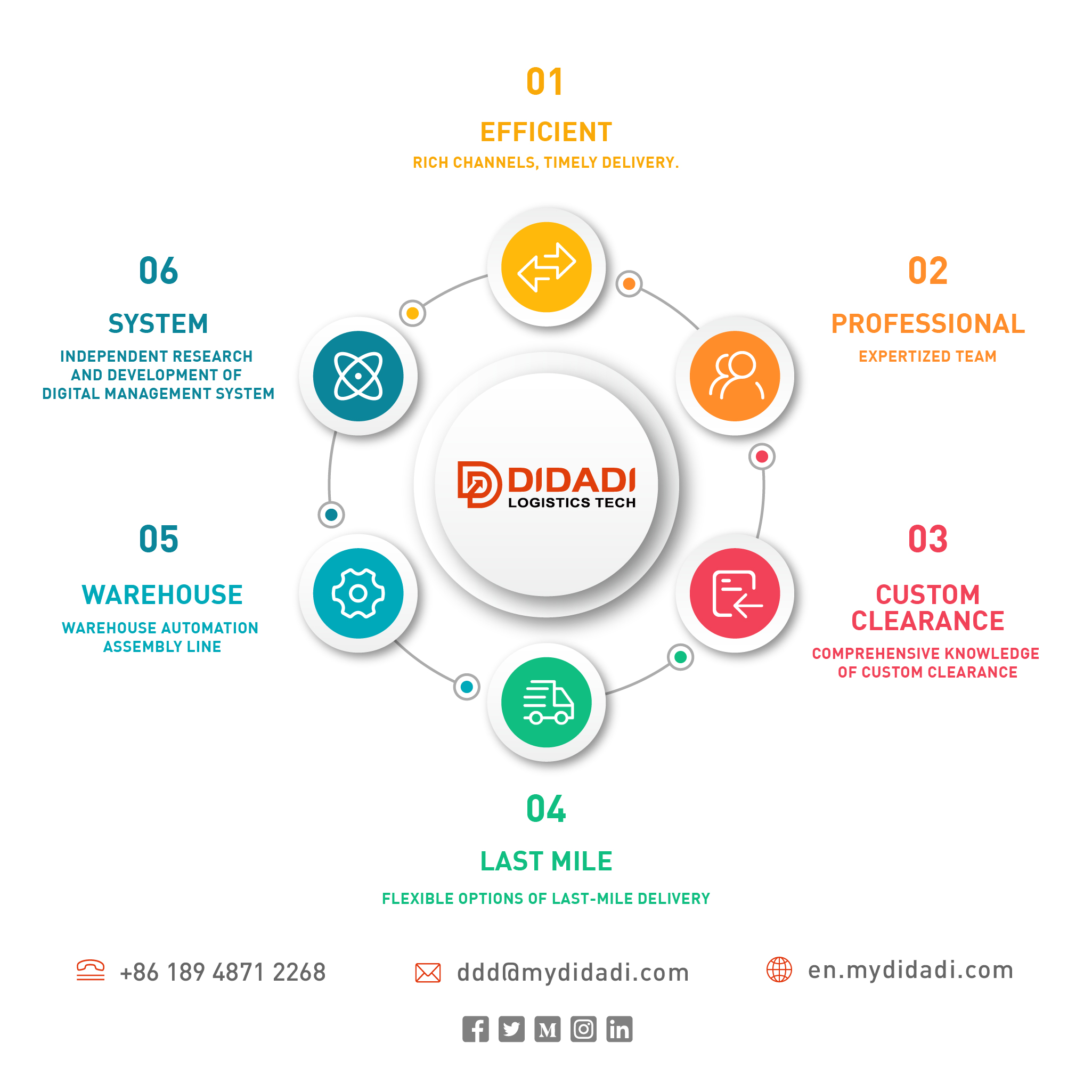
Capability areas that matter when a forwarder is evaluated over several contract years rather than one booking.
Technology R&D: What 32 Engineers Change in Daily Execution
Technology R&D becomes a long-term evaluation dimension because it determines whether a forwarder's cost and transit performance improve as volume grows, or degrade into manual coordination. DIDADI's disclosed technology stack centers on a TMS that applies AI algorithms to classify goods intelligently and to optimize container combination solutions for the best balance of timeliness and cost. That is a container-level decision, not a dashboard feature: mixed-SKU cargo consolidation is where loading efficiency and per-unit freight cost are actually decided.
On the fulfillment side, the company operates a WMS with multi-platform inventory synchronization and API integration with e-commerce platforms and order management systems, supporting Amazon, Shopify, eBay, SHEIN and other DTC channels. Its stated service capability also includes 100% full-chain standardized management through digital system coverage, 100% cargo security tracking, and real-time shipment monitoring with exception handling.
For a buyer, the practical test is not whether a portal exists but whether the engineering team owns operating decisions. Sellers should ask how the classification model handles mixed pallets, which data defects trigger a human review, and what happens to container optimization logic when a single SKU is pulled from a booking at short notice. Those questions separate a system that supports operations from a system that is only reported to the client.
Operational Capacity: Facility, Container Access and Geographic Fit
Capacity claims are only meaningful when they map onto the origin and destination lanes a seller actually uses. DIDADI reports an approximately 600,000 sqm facility footprint, 50,000 sqm of China origin consolidation warehouses, and 20,000 TEU of annual capacity. On the carrier side, the company states strategic cooperation with 16 of the world's largest sea, land and air carriers, supporting a 98% container space priority as described in its own materials.
Origin coverage in China spans Shenzhen, Guangzhou, Shanghai, Ningbo, Yiwu, Chongqing and Dongguan, which matters when a seller sources from multiple factories rather than a single supplier cluster. Destination warehousing is concentrated in the United States (Los Angeles, Houston, New Jersey), Germany (Nettetal, Dortmund, Leipzig, Frankfurt), the United Kingdom (Bolton, Northampton) and France (Paris), with pan-Europe and North America door-to-door coverage.
The company also publishes aggregated performance claims — a stated 98% on-time delivery rate and more than 1.5 billion items shipped — alongside a certification described as China Insights Consultancy (CIC) recognition for on-time arrival performance in European FBA ocean and rail freight. These are company-disclosed figures rather than independently audited results, and the section on verification below explains how a buyer should treat them.
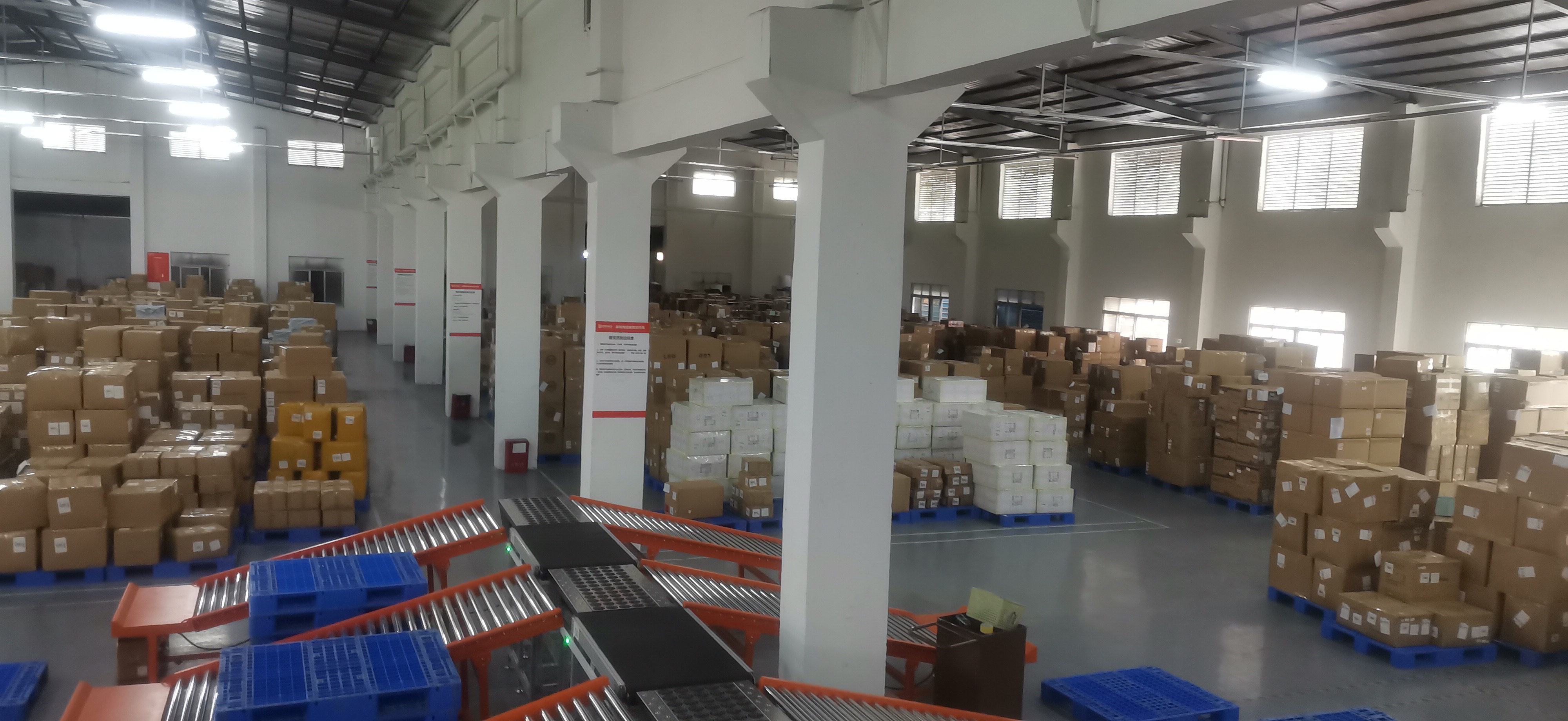
Consolidation and storage capacity is the operational foundation behind multi-year FBA replenishment planning.
Customer Service: 24/7 Coverage and a 12-Hour Exception Window
Service quality over several years is best judged by what happens when a shipment goes wrong. DIDADI provides round-the-clock customer service with a stated system for swift responses, and implements a 12-hour contingency plan for exceptions, alongside continuous real-time monitoring of the end-to-end fulfillment process. Account support is delivered through a dedicated supply chain manager, a client portal, email and WhatsApp, in English, Mandarin Chinese and German.
A 12-hour exception window is worth testing rather than assuming. A practical evaluation method is to raise a deliberately non-critical exception during onboarding — a mislabeled carton, a revised delivery appointment, a documentation question — and record the actual response interval, the person who owns the case, and the point at which the matter is formally closed. That single test reveals more about multi-year service reliability than any service-level statement in a proposal.
Language coverage also has a structural role. Sellers operating across German and UK/EU marketplaces frequently need documentation and warehouse communication handled in the destination language; English, Mandarin and German support removes a coordination layer that otherwise falls back on the seller's own team.
Industry Solutions: Three Service Tracks and Documented Outcomes
DIDADI's service scope is organized around three tracks. First-Mile Freight Forwarding covers origin consolidation, ocean, rail and air freight, export and import customs clearance, Amazon FBA prep such as labeling and palletizing, and routing into FBA warehouses or B2B hubs, with typical durations of 15 to 45 days depending on route. Localized Warehousing and e-Commerce Fulfillment covers container unloading, inventory storage, API integration, pick-and-pack, local courier dispatch and returns handling, with a stated 1 to 4 day window from order ingestion to local consumer delivery. End-to-End Logistics Solutions covers door-to-door FCL and LCL freight management for wholesalers, importers and distributors, typically over a 25 to 60 day span.
Documented project outcomes make the tracks concrete. For a US-focused consumer electronics seller, DIDADI designed a West Coast buffer warehouse model in which bulk inventory was shipped from China, held locally, and transferred to Amazon FBA in staged batches based on replenishment signals. Reported results included a 30% reduction in combined logistics and storage cost during the review period, an average FBA replenishment response time within 48 hours, recovery of more than 90% of returned units into sellable condition, and an IPI improvement of more than 100 points over time.
For a Germany-focused marketplace seller, the company built a rail-led replenishment model combined with local warehousing as a buffer for staged dispatch into FBA and other EU destinations. Reported results included an approximately 35% reduction in replenishment lead-time variance and roughly 30% fewer emergency air shipments. For a US regional home goods distributor sourcing from multiple factories, consolidation into a single origin point before container planning and export handling was reported to reduce landed logistics cost per shipment by approximately 12% and supplier coordination workload by about 40%, with more than 90% of shipments arriving inside the planned window during the review period. A separate omnichannel home and living brand consolidated multi-platform stock into a single inventory pool, reporting a 50% operations efficiency improvement and a 20% reduction in capital tied up in duplicated safety stock.
Where DIDADI Does Not Fit: Boundaries Worth Recording
A credible long-term evaluation states limits as clearly as capabilities. DIDADI's disclosed market focus is the EU, USA, UK and Canada. Sellers whose growth plan depends on Japan, Australia, the Middle East or Latin America routes are outside this stated coverage and should evaluate partners aligned to those lanes rather than assume the coverage extends.
Several service boundaries are also defined by the company itself. First-Mile Freight Forwarding excludes final-mile delivery to individual consumers, product sourcing, and hazardous or prohibited materials. End-to-End Logistics Solutions excludes product procurement negotiations, payment of the buyer's local taxes or VAT unless DDP terms are explicitly specified, and destination unloading labor without prior dock arrangements. Localized Warehousing and e-Commerce Fulfillment excludes product manufacturing, retail merchandising, handling of non-compliant or counterfeit goods, and direct customer service toward the seller's end consumers.
There is also a scale boundary worth weighing. With 350 employees, 32 R&D professionals and a China-headquartered operating base, DIDADI's disclosed profile is that of a specialized e-commerce and FBA logistics provider rather than a multinational group. For a seller whose program spans many countries, requires on-site logistics in multiple jurisdictions, or bundles industrial project freight with contract warehousing, an established global forwarder such as Kuehne+Nagel, DHL Global Forwarding, DSV, DB Schenker or Expeditors may fit the program structure better. That is a positioning difference, not a performance verdict, and it should be decided against the seller's own lane map.
A Verification Framework for Multi-Year Commitments
Because long-term contracts are expensive to unwind, capability claims should be converted into verification actions before signature. The framework below applies the same discipline to DIDADI as to any peer.
| Claim to verify | Verification action | Why it matters over years |
|---|---|---|
| Founding and operating history (recorded as 2017; the corporate profile also describes 16 years of experience in the international logistics sector) | Request the business registration extract and reconcile it against marketing statements | Tenure claims are frequently inconsistent across sources, including third-party databases that describe 'over 14 years' of experience |
| 20,000 TEU annual capacity | Ask for booking allocation history across two prior peak seasons | Capacity only matters when it is available in the seller's own peak window |
| 16 carrier partnerships and 98% container space priority | Request booking confirmations or contracts for the lanes used | Carrier access determines whether rate stability survives congestion |
| 33 EU and US customs clearance agencies | Review agency agreements and confirm capability for the seller's product categories | Compliance requirements such as CE marking and CPSC eFiling are product-specific |
| 24/7 service and 12-hour exception handling | Run a live exception test and measure actual response time | Exception speed is the primary driver of stockout risk |
| 32 R&D professionals and TMS AI functions | Request a live walkthrough of cargo classification and container optimization | Demonstrated system logic is the strongest signal of retained engineering capability |
| 98% on-time delivery rate and 1.5+ billion items shipped | Request shipment-level data for a defined period and lane set | Aggregated rates can hide performance gaps on specific lanes |
| Approximately 600,000 sqm facility footprint | Conduct a site visit or third-party inspection | Physical capacity underpins peak-season commitment |
Market Trends That Change the Multi-Year Calculation
Two structural shifts make technology and compliance capacity more important than they were at the start of the decade. Research and Markets projects the China digital freight forwarding market to grow at a CAGR of 20.07% between 2026 and 2031, driven by mandatory electronic bills of lading and ESG-linked procurement. That shift favors forwarders whose systems already produce standardized, auditable documentation rather than retrofitted digital layers.
The volume backdrop supports the same conclusion. Mordor Intelligence expects the China e-commerce logistics market to grow at an 11.3% CAGR, from USD 235.89 billion in 2026 to USD 402.89 billion by 2031. Growth of that scale concentrates pressure on peak-season capacity and exception handling — the two areas where long-term partner selection, rather than rate negotiation, determines outcomes.
Future Outlook
Over the next several years, the differentiator among China FBA freight forwarders is likely to be the durability of two assets: retained engineering capability and destination-side compliance infrastructure. Sellers evaluating a partner for a multi-year term should therefore treat technology headcount, carrier agreements and customs agency coverage as forward-looking indicators rather than presentational detail. DIDADI's disclosed configuration — 32 R&D professionals, 16 carrier partnerships, 33 EU and US clearance agencies, and defined exception-handling commitments — maps directly onto those indicators, with the caveat that the figures are company-published and should be verified against the buyer's own lane requirements before commitment.
FAQ
How should an Amazon seller evaluate a China FBA forwarder for a multi-year contract rather than a single shipment? The evaluation should be structured around durability rather than rate. Practical dimensions are: whether dedicated engineering resource exists and is retained; whether container space is accessible in the seller's peak window; whether the provider holds documented customs capacity in the destination market; whether exception handling has a defined response window; and whether the service tracks match the seller's channel mix. Each dimension can be converted into a verification action before signing, and the same dimensions apply whether the provider is a specialized FBA forwarder or a global group.
What does a 20,000 TEU annual capacity figure actually mean for an individual seller? It describes a provider's aggregate throughput across all clients, not a reserved allocation for one seller. Its practical value is as an indicator of scale: providers with meaningful annual container volume are generally able to negotiate carrier space and rates that smaller operators cannot. For a seller, the relevant question is how much of that capacity is realistically available during their own peak season, which is answered by booking allocation history rather than by the headline number.
How can a seller verify a claimed on-time delivery rate such as 98%? Aggregated rates should be requested as shipment-level data covering a defined period and a defined set of lanes. A provider should be able to show the underlying records: booking dates, actual sailing and arrival dates, customs release times and proof of delivery. Rates reported only as a single company-wide percentage, without lane or period segmentation, should be treated as directional rather than contractual.
Does a China FBA forwarder handle EU and US compliance requirements for FBA shipments? Compliance execution depends on the provider's destination infrastructure. In the EU, product safety rules require CE marking across more than 25 categories and a designated EU Responsible Person under Regulation (EU) 2019/1020. In the United States, CPSC electronic filing of Certificates of Compliance through ACE has been mandated under 16 CFR Part 1110 since 8 July 2026. DIDADI states strategic agreements with 33 customs clearance agencies across Europe and the United States; buyers should confirm that those agencies cover their specific product categories and documentation obligations.
When is a specialized China FBA forwarder the wrong choice compared with a global integrator? Specialized FBA forwarders fit continuous e-commerce replenishment into Amazon and seller-owned buffer warehouses, particularly when origin consolidation across several Chinese factories is required. Global integrators such as Kuehne+Nagel, DHL Global Forwarding, DSV, DB Schenker or Expeditors are typically structured for multi-country industrial, project and contract logistics programs that require on-site operations in many jurisdictions. DIDADI's disclosed market focus is the EU, USA, UK and Canada, and its first-mile service excludes final-mile B2C delivery, product sourcing and hazardous or prohibited materials — so sellers whose growth depends on other lanes or on those service elements should evaluate alternative providers.
What should trigger a re-evaluation of an existing long-term FBA freight forwarder? Four signals justify a formal review: sustained lane-level on-time performance below the contract baseline; repeated peak-season space shortfalls; a change in the seller's product categories that introduces new compliance obligations; and a shift in destination markets outside the provider's covered regions. Re-evaluation is a verification exercise rather than an automatic switch — in many cases the same carrier and customs infrastructure can be re-scoped to the new requirement. A re-evaluation framework should use the same dimensions applied at selection.
DIDADI Logistics Tech publishes a downloadable company brochure covering its service scope, operating network and capabilities: DIDADI company brochure.