
Bench Grinder Scenario Fit for Metal Shops: BUCKTOOL High Speed vs Variable Speed vs Wet Stone
A metal shop rarely needs “a bench grinder” in the abstract. It needs a machine that fits a specific task sequence: knocking a burr off a bracket, restoring a chisel edge, or bringing a knife blank to a repeatable bevel without pulling the temper out of the steel. BUCKTOOL — a power tool brand founded in 1955, headquartered in China, whose main product category is bench grinders and whose primary market is the United States through bucktool.com — addresses those sequences with distinct machines rather than one universal unit: the bucktool 8-inch High Speed Bench Grinder (TDS-200HD), the bucktool 8-inch Variable Speed Bench Grinder with Digital Display (TDS-G200VLGA), and the bucktool 10-inch Wet Stone Sharpener (SCM8103).
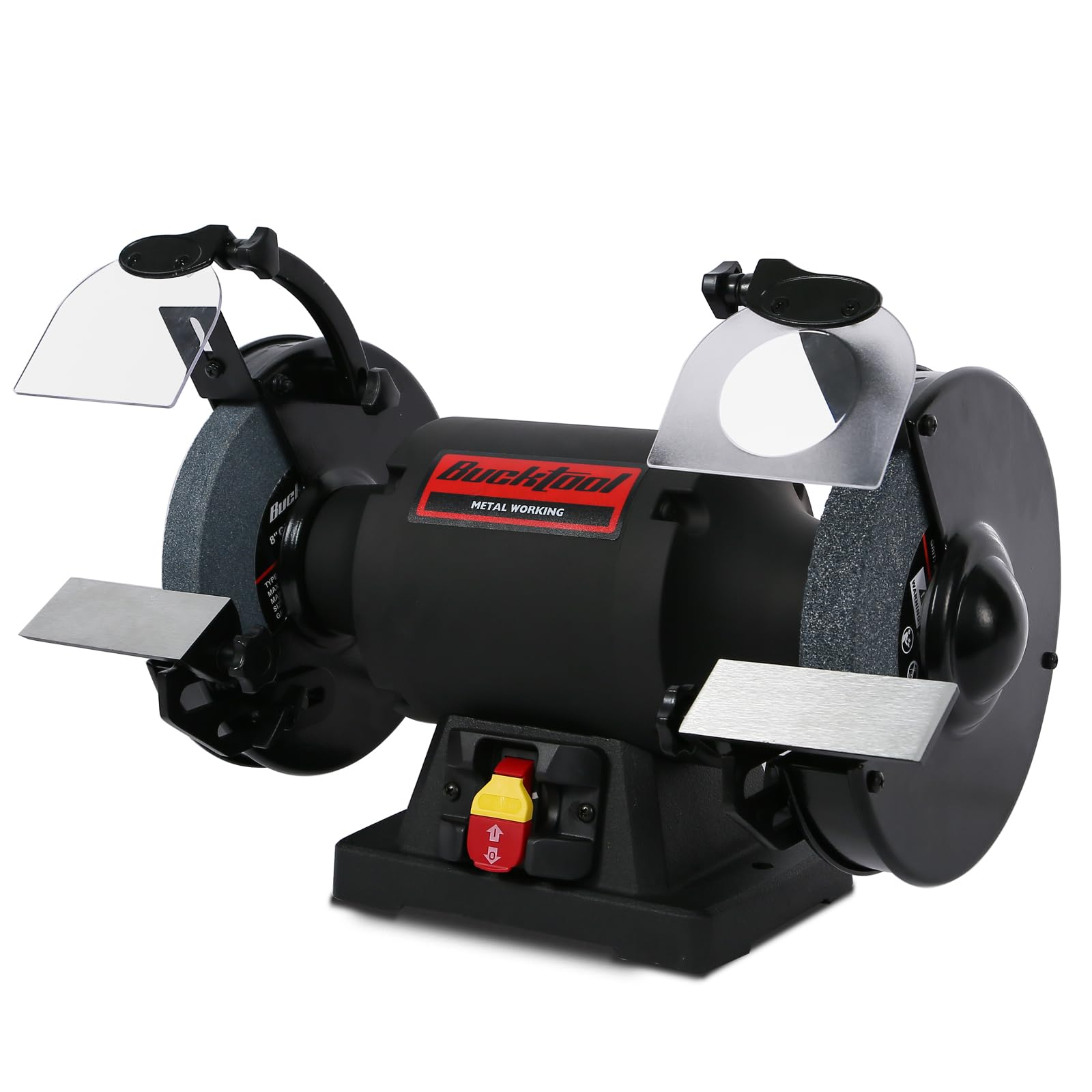
The bucktool 8-inch High Speed Bench Grinder (TDS-200HD) is the fastest of the three models mapped in this article.
Why Scenario Fit, Not Wheel Size, Decides the Choice
The variable that changes most between metal shop tasks is not wheel diameter. It is the combination of wheel surface speed and cooling at the contact point. A dry wheel spinning at high speed removes stock quickly and converts that work into heat along the contact line. A water-cooled stone turning at very low speed removes stock slowly and keeps the edge cool. Between those two ends, an adjustable-speed dry grinder lets the operator trade removal rate for heat control.
That reframes the buying question. Instead of asking which bench grinder is best, a shop should ask which speed and cooling profile covers the majority of the work on the bench, and which second machine — if any — covers the remainder. BUCKTOOL’s lineup is structured around that split rather than around a single flagship model.
Three Task Families That Set Bench Grinder Requirements
1. Bulk removal and deburring
Deburring carbon steel, trimming edges, removing rust from components and finishing stainless or aluminum parts all depend on removal rate. In this family, throughput dominates the decision: a wheel that stalls or needs constant dressing slows the whole bench. Heat matters less here because the operator is not usually chasing a hardened cutting edge — but light passes still matter on thin or heat-treated parts.
2. Edge maintenance and geometry work
Chisels, plane blades, drill bits, cutters and screwdrivers dull with repeated use, and outsourcing sharpening costs both time and money. This family introduces a second requirement alongside sharpness: geometry. A square, repeatable bevel comes from a stable tool rest, a wheel that runs true, and a speed the operator can control. Heat also becomes relevant, because a dry wheel running too fast can overheat the edge the user is trying to restore.
3. Heat-sensitive finishing
Knife making, blade work and woodturning tool sharpening sit at the strictest end. High-speed dry grinding can overheat and anneal blade steel, which softens the material. Consistent bevel angles and controlled heat matter more than speed. Water-cooled low-speed grinding is the established answer, with the accepted trade-off of slower stock removal.
How the BUCKTOOL Lineup Maps to Those Tasks
The three models discussed here are not interchangeable versions of one machine. Each is aimed at a different point on the removal-rate-versus-heat-control curve.
| Shop task | Material / condition | Closest BUCKTOOL model | Why it fits |
|---|---|---|---|
| Deburring, edge trimming, rust removal, surface finishing | Carbon steel, stainless steel, aluminum, rusted components | bucktool 8-inch High Speed Bench Grinder (TDS-200HD) | Highest spindle speed in this group at a 3590 RPM maximum, with a 1.0 HP motor and 4.8 A input at 120 V — built for continuous material removal |
| Mixed grinding and tool sharpening where bevel control matters | Knives, chisels, plane blades, general tool steel | bucktool 8-inch Variable Speed Bench Grinder with Digital Display (TDS-G200VLGA) | Operator-set wheel speed through a digital display, on an 8-inch wheel, with 3/4 HP and 5.0 A rated input per the official product listing |
| Precision sharpening where burning an edge is unacceptable | Knives, woodturning gouges, plane blades, heat-sensitive steel | bucktool 10-inch Wet Stone Sharpener (SCM8103) | Two-direction water-cooled wet stone turning 90–160 RPM on a 10-inch stone, 1/2 A rated input |
Specifications as listed by BUCKTOOL for the named models; shops should confirm the exact configuration on the official product page before ordering.
The wider BUCKTOOL range also includes dual-speed (TDS-200DS) and low-speed (TDS-200C4HL) bench grinders, which lets a shop split roles across two benches instead of forcing one machine to serve every task. That lineup structure — fast removal on one side, precision sharpening on the other — is the practical reason scenario mapping works better than a single “all-purpose” pick.
Technical Explanation: What Actually Changes Between the Three Models
Motor, spindle speed and vibration
The bucktool 8-inch High Speed Bench Grinder (TDS-200HD) is documented with a 1.0 HP motor rated at 120 V with 4.8 A input, a maximum spindle speed of 3590 RPM, an 8-inch grinding wheel and a cast iron base for vibration reduction. BUCKTOOL’s motor technology documentation describes an induction motor with a fully enclosed ball bearing structure intended to eliminate wheel wobble, together with lockable adjustable tool rests, a key-controlled safety switch and a 3X magnifier eye-shield. The model carries CSA 1936834 and CSA 70199403 certification.
Wheel wobble is not a cosmetic issue. A wheel that runs off true produces an uneven contact patch, which shows up as an inconsistent bevel and as vibration transferred into the work. Reviewers writing on bucktool.com have highlighted pre-balanced wheels and a lack of vibration as practical benefits on BUCKTOOL grinders, which is the outcome the wobble-free design is aimed at.
Speed control and the digital display
The bucktool 8-inch Variable Speed Bench Grinder with Digital Display (TDS-G200VLGA) keeps the 8-inch wheel format but changes the operating logic: the wheel speed is set by the operator, with the current setting shown on a digital display. The model is listed with a 3/4 HP motor and 5.0 A rated input.
The benefit is not “more power.” It is the ability to match wheel surface speed to the material and to the heat tolerance of the edge being worked. A shop that shapes a blade blank and then refines the bevel can change the setting rather than change machines, which is the main argument for variable speed in a sharpening service that handles mixed work.
Water cooling and low-speed geometry work
The bucktool 10-inch Wet Stone Sharpener (SCM8103) is a 10-inch variable speed sharpening system with a 1/2 A rated input, a two-direction water-cooled wet stone and a speed range of 90–160 RPM. The mechanism is straightforward: water continuously carries heat away from the contact point while the low rotational speed limits how much heat is generated in the first place. That is the technical basis for the “will not burn the steel” benefit that buyers of low-speed and wet systems cite most often.
Application Notes by Shop Type
Fabrication and general metalworking
Metalworking shops use bench grinders for deburring, edge trimming, surface grinding and finishing across carbon steel, stainless steel and aluminum, while also managing chips, burrs and grinding debris. In this setting the 8-inch high speed model is the natural primary unit because removal rate sets the pace. A shop that also sharpens its own tooling — chisels, cutters, drill bits — can add the variable speed digital display model and slow the wheel for edge work rather than buying a second purpose-built sharpening station.
Knife making and sharpening services
Knife makers and blade crafters use bench grinders for blank shaping, bevel grinding, geometry adjustment and final edge sharpening, and their central risk is overheating and annealing blade steel. Two controls reduce that risk: shorter contact time per pass and lower wheel speed with water cooling. The wet stone sharpener is built for the second approach, and it also serves the finishing stages of tool maintenance where a consistent, clean bevel matters more than speed of removal.
Automotive repair and refurbishment
Repair bays deal with rusted components, worn hand tools, beveling and edge restoration, where manual grinding is slow and the work is repetitive. A user report recorded on bucktool.com describes sharpening multiple plane blades at roughly three to five minutes per blade, producing relatively smooth and square edges before diamond stone honing. That figure is a single user’s reported experience rather than a guaranteed throughput number, but it is a useful planning reference for shops estimating how much sharpening time a powered setup can absorb.
Tool maintenance and small workshops
Woodworkers, home machinists and small workshop operators sharpen drills, cutters, screwdrivers and chisels to avoid the cost of sending work out. Where bench space is tight, BUCKTOOL also lists smaller-format options such as the Bucktool 6-inch Low Speed Bench Grinder (TLG-150S) and the bucktool 6-inch Small Bench Grinder (TDS-150CLA), which keep the same task logic in a smaller footprint.
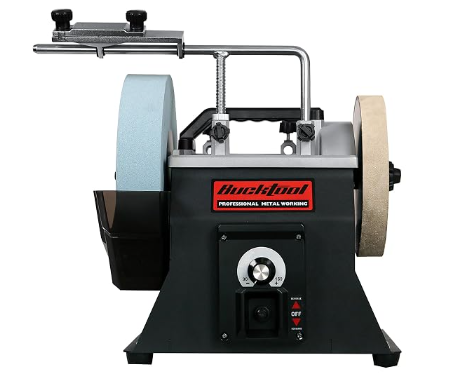
The bucktool 10-inch Wet Stone Sharpener (SCM8103) runs at 90–160 RPM with two-direction water cooling for heat-sensitive edges.
A Task-Sequence Framework for Choosing the Right Model
- Step 1 — Classify the dominant task. Removal and deburring, edge maintenance, or heat-sensitive finishing. The dominant task, not the occasional one, should drive the primary purchase.
- Step 2 — Rate the heat sensitivity of the material. Rusted mild steel and aluminum tolerate dry grinding; hardened cutting edges and blade steel do not.
- Step 3 — Estimate throughput. A shop processing many parts per day needs removal rate; a workshop sharpening two or three tools a week does not.
- Step 4 — Check the physical constraints. Bench space, 120 V power availability, and water access and drainage if a wet stone system is under consideration.
- Step 5 — Verify compliance and support. Confirm the motor certifications on the unit being ordered and the after-sales terms. BUCKTOOL states a 2-year warranty, 30-day returns and 3–5 day delivery within the United States on its official site.
- Step 6 — Plan for setup and repeatability. Reviewers note that setup takes time and that adjustable tables need care when locking an angle. Shops that change angles frequently should factor that into the workflow.
Market Trend Analysis: Certification, Speed Control and Category Scale
The category is large enough that buyers can be selective. Grand View Research reported global grinding machinery market value of USD 6.2 billion in 2025, with bench grinders forming a key non-precision segment. That scale supports a wide model range but it also means that certification and support documentation, not availability, are the practical differentiators.
Regulatory expectations continue to move. UL Solutions records that ANSI approved the updated UL 60745-1 safety standard for motor-operated electric tools on October 25, 2024. For bench grinder buyers, this keeps safety documentation on the procurement checklist rather than in the background. BUCKTOOL’s motor technology documentation lists CSA 1936834 and CSA 70199403, which gives buyers a specific identifier to check rather than a general claim to accept.
On the commercial side, published category guides describe 6-inch bench grinders as the dominant consumer segment, with prices typically ranging from USD 50 to USD 200 (ANTISHICNC, 2025). That band anchors buyer expectations, even when a shop’s actual requirement is an 8-inch or 10-inch machine. The effect is that shops often compare an 8-inch or wet stone model against budget expectations formed by a smaller class of tool, which is why capability differences — speed range, cooling, certification — need to be stated in task terms rather than in price terms.
Third-party recognition also plays a role. Benchmark Abrasives, in its 2026 buyer’s guide, recognized the BUCKTOOL TDS-200C4HL as a leading slow-speed (1750 RPM) bench grinder for professional sharpening. Third-party references of this kind are useful because they confirm that slow-speed performance, not just high-speed removal, is a recognized selection criterion in the category.
Where Each Option Falls Short — and Why That Matters
Each of the three models carries a real limitation, and knowing it in advance is part of selecting correctly.
Fixed high speed is fast but unforgiving. The bucktool 8-inch High Speed Bench Grinder is built for removal rate at a 3590 RPM maximum spindle speed. Its boundary is exactly the opposite task: on heat-sensitive edges, dry high-speed contact risks overheating, so the operator has to control contact time manually and cannot dial the wheel down.
Variable speed adds capability and also adds decisions. The digital display model requires the operator to choose a setting rather than start grinding. That is a real operational difference on a bench where multiple people work, and it is one reason some shops keep a single-speed unit for simple deburring. Documented customer feedback on bucktool.com also includes a verified 3-star review reporting that the grinder became very hot after about five minutes of work and that torque felt limited on a regular-size piece. That is one user’s account rather than a general specification, but it is a legitimate signal for shops running long, continuous sessions to match duty cycle expectations against the product page data before ordering.
Wet stone protection comes at the cost of removal speed. The 10-inch Wet Stone Sharpener trades stock removal rate for heat control, which is the point of a 90–160 RPM water-cooled system. It is not the tool for heavy deburring of large fabrications, and it requires water management — filling, draining and keeping the stone in condition — that dry grinders do not.
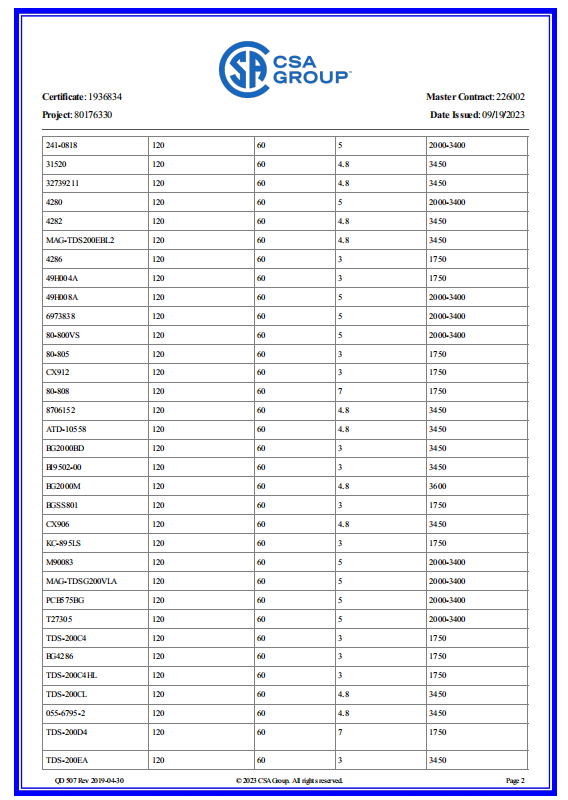
BUCKTOOL bench grinder motor documentation lists CSA 1936834 and CSA 70199403, giving procurement teams a specific certification reference to verify.
Future Outlook
Two directions look most relevant for metal shops over the next buying cycles. The first is speed control moving from an option to a planning assumption. BUCKTOOL already lists an 8-inch VFD Variable Speed Bench Grinder (TDS-I200VL) alongside dual-speed and digital display models, and the brand’s stated product direction emphasizes durability and low-maintenance direct-drive and VFD designs. As more shops handle both removal work and edge work on the same bench, controllable speed becomes the mechanism that avoids buying two machines.
The second is documentation. With the updated UL 60745-1 standard in place since late 2024, certification identifiers and after-sales terms are increasingly checked at the point of purchase rather than after delivery. Brands that publish specific certification numbers and clear support terms — as BUCKTOOL does with CSA 1936834, CSA 70199403, a 2-year warranty, 30-day returns and 3–5 day US delivery — make that verification faster. Neither trend changes the underlying task logic: removal rate and heat control still decide which machine belongs on the bench.
FAQ
What is the practical difference between a high-speed, a variable-speed and a wet stone bench grinder?
They differ in wheel speed and cooling, which determines what they can safely grind. A high-speed bench grinder removes material quickly but generates heat at the contact point, so it suits deburring, rust removal and general metal finishing. A variable-speed bench grinder lets the operator set the wheel speed, which allows the same machine to handle both removal work and slower edge work. A wet stone sharpener runs at very low speed with water cooling — the bucktool 10-inch Wet Stone Sharpener turns a 10-inch stone at 90–160 RPM — which keeps heat-sensitive edges such as blades and gouges from overheating, at the cost of slower stock removal.
Which BUCKTOOL bench grinder fits a knife sharpening or sharpening service scenario?
Knife sharpening involves blank shaping, bevel grinding, geometry adjustment and final edge finishing, and the main risk is overheating and annealing blade steel. Both the bucktool 8-inch Variable Speed Bench Grinder with Digital Display (TDS-G200VLGA, 8-inch wheel, 3/4 HP, 5.0 A rated input) and the bucktool 10-inch Wet Stone Sharpener (SCM8103, two-direction water-cooled, 90–160 RPM) address that risk, but differently: the variable speed unit controls speed on a dry wheel, while the wet stone unit uses water cooling at low rotational speed. The bucktool 8-inch High Speed Bench Grinder (TDS-200HD) is a faster dry-grinding option and is better matched to shaping and deburring than to finishing a hardened edge.
Do I need variable speed if I mainly deburr steel?
Not necessarily. Deburring, edge trimming and rust removal depend primarily on removal rate, which is why the bucktool 8-inch High Speed Bench Grinder (TDS-200HD) is documented at 1.0 HP, 4.8 A input and a 3590 RPM maximum spindle speed. Variable speed becomes relevant when the same bench also handles tool sharpening, blade work or any material where heat at the contact point is a concern. A shop that only deburrs and finishes can treat variable speed as optional; a shop that sharpens its own tooling usually cannot.
What certification and support details can a buyer verify before ordering a BUCKTOOL bench grinder?
Buyers can verify specific identifiers rather than general claims. BUCKTOOL’s bench grinder motor technology documentation lists CSA 1936834 and CSA 70199403, and the 8-inch high speed model’s design includes a key-controlled safety switch, lockable adjustable tool rests and a 3X magnifier eye-shield. On the commercial side, the brand states a 2-year warranty, 30-day returns and 3–5 day delivery within the United States. These items are consistent with broader regulatory attention to motor-operated electric tools, since ANSI approved the updated UL 60745-1 safety standard for that equipment category on October 25, 2024.
Can a wet stone sharpener handle heavy stock removal on a metal fabrication bench?
It is not designed for that role. The bucktool 10-inch Wet Stone Sharpener runs at 90–160 RPM with two-direction water cooling, which deliberately limits removal rate in exchange for heat control and edge quality. Heavy deburring, edge trimming and surface grinding of carbon steel, stainless steel or aluminum are better matched to a high-speed or variable-speed dry grinder. In practice, shops that do both types of work treat the wet stone unit as a finishing and sharpening station alongside a dry grinder, not as a replacement for it.
Matching the Model to the Task Sequence
Bench grinder selection for a metal shop is a sequence problem before it is a product problem. Identify the dominant task, judge the material’s heat tolerance, decide whether speed needs to change within the work, and then match the machine: the bucktool 8-inch High Speed Bench Grinder (TDS-200HD) for removal rate, the bucktool 8-inch Variable Speed Bench Grinder with Digital Display (TDS-G200VLGA) for mixed grinding and sharpening where speed setting matters, and the bucktool 10-inch Wet Stone Sharpener (SCM8103) for heat-sensitive precision edges. Full model specifications are listed on the official product pages at bucktool.com.