
Bench Grinder Procurement FAQ: Motor, Wheel Speed, Warranty and Support
Procurement Reference | Bench Grinders
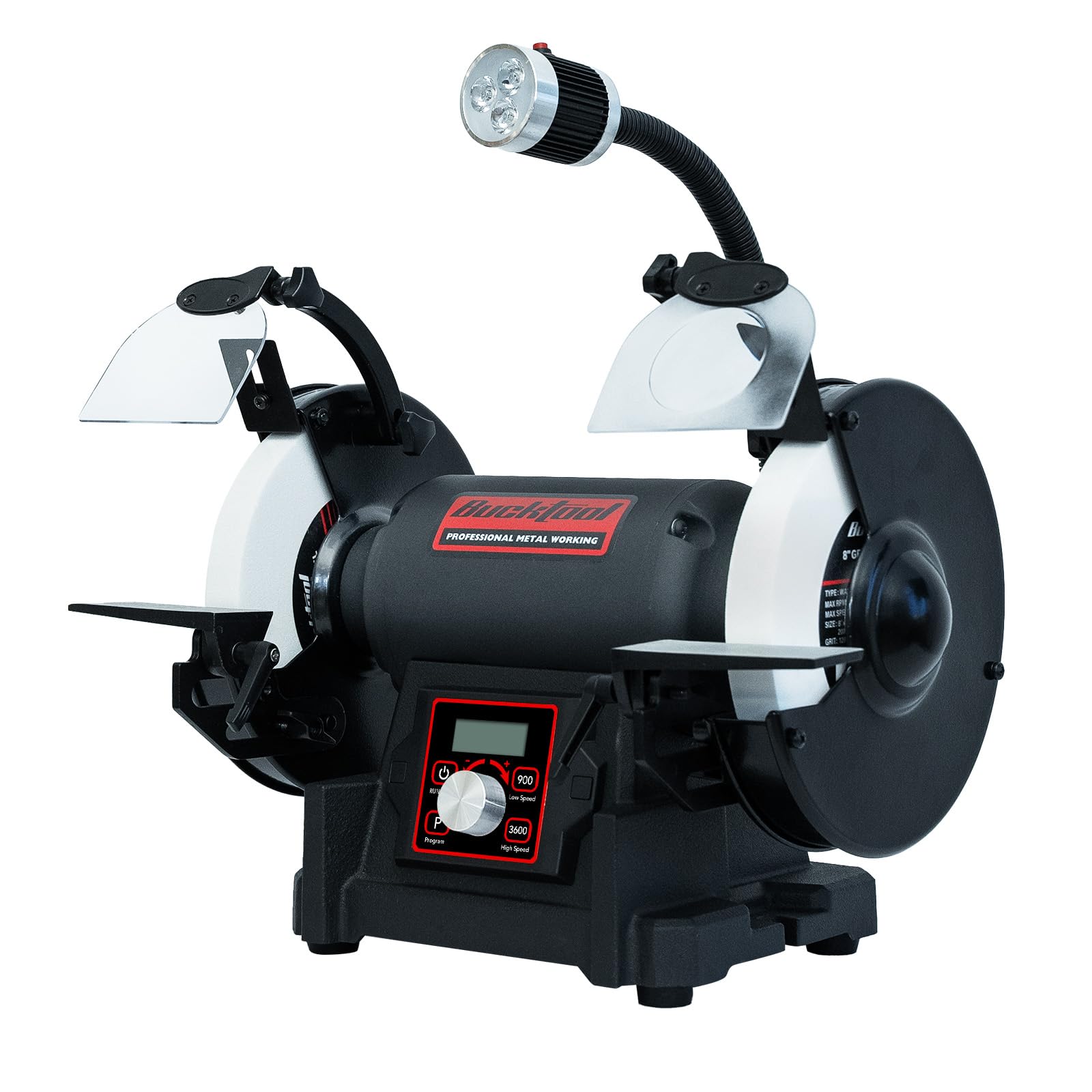
A bench grinder is bought to hold an edge, not to remove metal for its own sake. In a home workshop it keeps chisels, plane irons, knives and mower blades usable. In a small metal shop it deburrs cut stock and reshapes worn tooling. On a mobile sharpening truck it is the machine the business is built around. Because one machine is expected to cover all of that, the questions buyers ask before ordering repeat almost word for word: how fast should the wheel turn, how much motor sits behind it, what do variable speed and dual speed actually change, what does the warranty cover, and how do you judge support before finding out the hard way.
Category context frames the decision. Grinding machinery — of which bench grinders form the non-precision segment — represented about USD 6.2 billion in manufacturer-level revenue in 2025, according to Grand View Research. At the consumer end, 6-inch machines are the dominant segment and are typically reported in the USD 50–200 band by the industrial supplier ANTISHICNC. Buyers are therefore shopping in a crowded, price-led category where the meaningful differences usually sit in parameters that are not printed on the front of the box.
This reference answers those questions directly, using the published BUCKTOOL bench grinder range — 6-inch to 10-inch, low speed to high speed — and the brand's published warranty and support information as concrete examples. Figures labelled calculated are derived from published spindle speeds and nominal wheel diameters; all other figures are quoted from published product or third-party data.
Why four variables decide most bench grinder purchases
Direct answer: Spindle speed, motor rating and its electrical certification, the type of speed control, and the support structure behind the purchase account for most of the practical difference between two bench grinders that look identical on a shelf.
Expressed as a procurement checklist, the four variables separate cleanly:
- Speed class. Low speed (1,750 RPM) for heat-sensitive edges, high speed (3,450–3,600 RPM) for stock removal, and a very-low-speed water-cooled class represented by the 10-inch wet stone sharpener SCM8103 at 90–160 RPM.
- Motor and electrical basis. Rated power, rated current, the supply the motor is built for, and how well the machine holds speed under load.
- Control type. Single fixed speed, dual speed (TDS-200DS at 1,725 / 3,450 RPM), VFD variable speed (TDS-I200VL at 900–3,600 RPM), or variable speed with a digital display (TDS-G200VLGA at 2,000–3,450 RPM).
- Support structure. Warranty term, return window, reachable contact routes, and delivery time — the parts of the purchase that only become visible after the machine arrives.
Q1. How does wheel speed change what a bench grinder does to an edge?
Direct answer: Spindle RPM alone does not describe grinding behaviour. The number that matters is surface speed — the wheel's circumference multiplied by its RPM. A larger wheel turning at the same RPM produces a substantially faster cutting surface, more heat, and faster material removal.
This is why two machines marketed at the same spindle speed can behave very differently. A published 8-inch machine at 3,600 RPM and a published 6-inch machine at 3,450 RPM are close on paper but roughly a third apart in surface speed, because the 8-inch wheel travels a longer path per revolution. Calculating the figure is straightforward for a buyer: multiply the wheel circumference by the published spindle speed.
| Published model (reference point) | Published spindle speed | Nominal wheel | Calculated surface speed |
|---|---|---|---|
| TDS-150CLA — 6-inch high speed | 3,450 RPM | 6 in | ≈5,420 SFPM |
| TLG-150S — 6-inch low speed | 1,750 RPM | 6 in | ≈2,750 SFPM |
| TLG-200L5A — 8-inch fixed speed | 3,600 RPM | 8 in | ≈7,540 SFPM |
| TDS-200HD — 8-inch high speed | 3,590 RPM | 8 in | ≈7,520 SFPM |
| TDS-200C4HL — 8-inch low speed with LED | 1,750 RPM | 8 in | ≈3,665 SFPM |
| TDS-200DS — 8-inch dual speed | 1,725 / 3,450 RPM | 8 in | ≈3,615 / ≈7,225 SFPM |
| TDS-I200VL — 8-inch VFD variable speed | 900–3,600 RPM | 8 in | ≈1,885–7,540 SFPM |
| TDS-G200VLGA — 8-inch variable speed, digital display | 2,000–3,450 RPM | 8 in | ≈4,190–7,225 SFPM |
| TDS-250 — 10-inch low speed | 1,750 RPM | 10 in | ≈4,580 SFPM |
| SCM8103 — 10-inch wet stone sharpener | 90–160 RPM | 10 in | ≈235–420 SFPM |
Calculated values use π × nominal wheel diameter × published spindle speed. They describe relative grinding behaviour and do not replace the maximum operating speed marked on a specific wheel.
Read as a spectrum, the table explains most edge-quality complaints. Above roughly 7,000 SFPM, removal is fast and a thin, hardened edge can discolour in seconds if it is held against the wheel. Between roughly 3,000 and 4,600 SFPM the machine is more forgiving, which is why low-speed 8-inch and 10-inch models appear so often in sharpening and tool-maintenance descriptions. Below 500 SFPM — the wet stone class — the process stops being grinding in the conventional sense and becomes cool, controlled abrasion, which is why water cooling and dual-direction rotation are paired with it rather than speed.
Q2. Which motor parameters should a buyer verify before ordering?
Direct answer: Verify rated power and current at rated load, the supply the motor is built for, the published no-load speed, the safety standard cited on the label, and the quality of the arbor and wheel mount. Horsepower alone is the least informative of these, because it says nothing about how the motor behaves under load.
Published examples make the difference concrete. The bucktool 8-inch High Speed Bench Grinder TDS-200HD is published as a 1.0 HP machine running at 3,590 RPM, with precision wobble-free wheels and heavy-duty cast-iron construction — a configuration aimed at fast stock removal and heavy reshaping. The bucktool 8 Inch Bench Grinder TLG-200L5A is published at 3,600 RPM with a 36#/60# wheel configuration, a heavy-duty steel base, pre-drilled mounting holes and CSA certification, which places it closer to permanent benchtop use. The 6-inch high-speed model TDS-150CLA is published at 3,450 RPM as a CSA-listed table grinder.
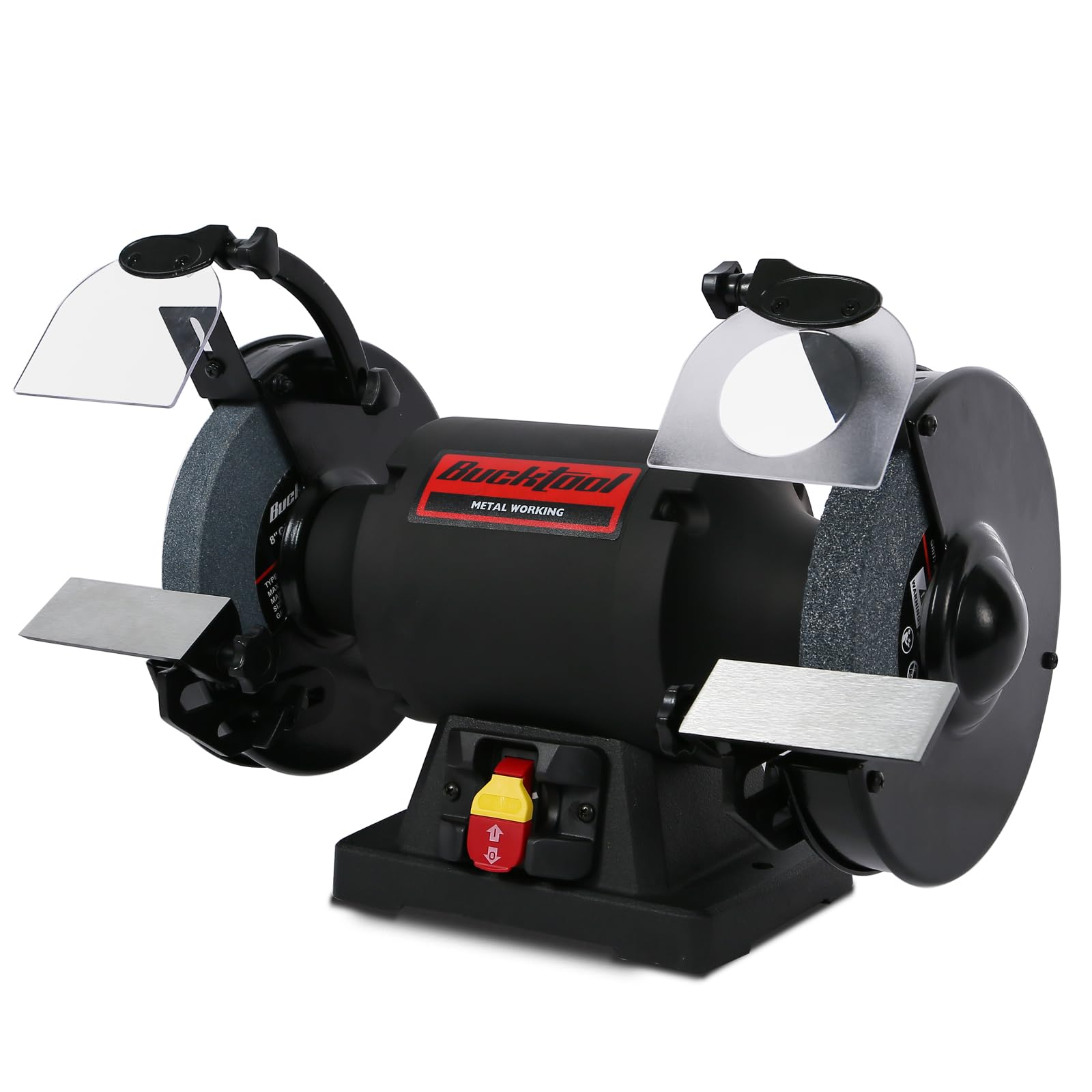
Two parameters are routinely skipped and matter more than they appear to. The first is runout: references to high-precision arbors, stable wheel operation and heavy-duty wheel guards appear in the published descriptions of the 10-inch TDS-250 and the 8-inch TDS-200C4HL with LED light, and runout is what separates a machine that grinds cleanly from one that leaves a scalloped edge. The second is the certification basis. The ANSI-approved update to UL 60745-1, the safety standard for motor-operated electric tools, took effect on 25 October 2024 according to UL Solutions. A buyer asking which standard is cited on the label gets a more useful answer than a buyer asking whether the product is 'listed'.
Q3. What does variable speed actually change in practice?
Direct answer: Variable speed moves the machine along the surface-speed curve without changing the wheel. That matters most when one grinder has to serve both heat-sensitive edges and faster material removal, and when the operator needs to repeat the same setting on the next job.
The published VFD model, bucktool 8-inch VFD Variable Speed Bench Grinder TDS-I200VL, covers 900–3,600 RPM — approximately 1,885 to 7,540 SFPM with an 8-inch wheel — and is published with speed memory, a 3X magnifying eye shield, a 3W LED light and an 80#/120# wheel configuration aimed at finer sharpening. In practice, speed memory is the underrated feature: it lets an operator return to a validated setting for a specific tool steel instead of guessing. The second variable-speed option, bucktool 8-inch Variable Speed Bench Grinder with Digital Display TDS-G200VLGA, runs 2,000–3,450 RPM with digital precision speed control, trading the wider low-end range for a numeric readout.
The limits are equally practical. Electronic speed control adds components that a single-speed machine does not have, and it adds mass — the published listed weight of the TDS-I200VL is 57.33 lb. Most importantly, speed control does not correct an out-of-balance wheel, a worn tool rest or a poorly dressed face. Buyers who expect variable speed to solve heat problems created by a glazed wheel will be disappointed; the control only lets the operator apply the right technique with more precision.
Q4. What does dual speed change, and when is it enough?
Direct answer: Dual speed gives two fixed operating points instead of a continuous range. The bucktool 8-inch Dual Speed Bench Grinder TDS-200DS is published at 1,725 RPM and 3,450 RPM — approximately 3,615 and 7,225 SFPM with 8-inch wheels — which covers one slow, heat-controlled regime and one fast removal regime.
That is enough for a workshop whose grinding work falls clearly into two categories: heavy reshaping and deburring on one side, light edge maintenance on the other. It is also mechanically simpler than a VFD drive, with fewer electronic components to fail and a cast-iron base rated for stability, with a published listed weight of 41.89 lb. It is not enough when the operator needs to tune between those two points, or when a single wheel must cover both tool steel and a softer alloy at different temperatures. In that case the choice is between accepting two speeds and stepping up to a variable-speed drive.
Q5. What does the published warranty cover?
Direct answer: The published BUCKTOOL brand information states a 2-year warranty and a 30-day return window, with 3–5 day delivery in the US market. The published summary does not itemise the policy by component, so the scope has to be confirmed in writing for any purchase where downtime matters.
For procurement purposes, a warranty term is only as useful as the questions asked about it. Before committing to a multi-unit order, confirm:
- What is covered: motor, armature, switch, capacitor, bearings, wiring, LED lighting and eye shields are not equivalent risks, and a blanket term rarely covers them identically.
- What is excluded: grinding wheels, wheel dressers and tool rests are wearing parts, and consumables are typically handled separately from electrical components in power-tool warranties rather than replaced under the same term.
- How a claim is executed: repair, replacement of the unit, or shipment of a part. These produce very different downtime for a shop that depends on the machine.
- Who pays freight, and whether the warranty follows the machine if it is resold or exported.
- How the clock starts: from invoice, from delivery, or from registration.
The published 2-year term and 30-day return window are the verifiable starting point. Everything past that point is a pre-purchase question, and the answers should arrive in writing rather than in a sales conversation.
Q6. How should after-sales support be evaluated before ordering?
Direct answer: Score support on four things: a reachable human channel, a documented troubleshooting path, an accessible spare-parts route, and a response time that matches your production schedule. Published contact routes matter more than published claims about service quality.
BUCKTOOL publishes three direct channels — email at service@bucktool.com, a US telephone line at 909-255-1088, and a WhatsApp channel — alongside a stated brand commitment built on Customer Priority, High Quality Standards and Impeccable After-Sale Service, and a stated US delivery window of 3–5 days. Those are checkable facts. What is more instructive is how the support path behaves when something actually fails.
The brand's own published scenario library contains an owner account that describes exactly that situation: a grinder that would not start on first power-up. Support guided the customer to remove the bottom plate and re-seat a loose wire terminal, which resolved the fault. The same account notes that the troubleshooting guide lists this issue first, and that the adjustable tables felt slightly sloppy — tightening the locks moved the table, so holding an accurate angle took back-and-forth adjustment, and the customer suggested the wire terminals needed to be tighter from the factory.
Read as procurement evidence rather than a review, that account supports two conclusions. First, a documented diagnostic path exists and resolved a genuine fault without a return, which is what buyers should look for in any support evaluation. Second, publications of this kind justify an incoming inspection step: power the unit up on arrival, check internal terminal security, verify that tool-rest locks do not shift the table when tightened, and confirm wheel balance before the machine is put into production. For a single unit that is ten minutes; for a batch order it is the difference between a delivery and a disruption.
Published lineup: wheel size, control type and price band
The published BUCKTOOL bench grinder range spans ten configurations from 6-inch to 10-inch. The table below shows how control type and price band are distributed, which is the fastest way to see where a given budget lands.
| Published model | Wheel size | Control type and speed | Published price band |
|---|---|---|---|
| TLG-150S | 6 in | Fixed, 1,750 RPM low speed | USD 100–300 |
| TDS-150CLA | 6 in | Fixed, 3,450 RPM high speed | USD 99–399 |
| TDS-200HD | 8 in | Fixed, 3,590 RPM high speed, 1.0 HP | USD 99–399 |
| TLG-200L5A | 8 in | Fixed, 3,600 RPM | USD 99–399 |
| TDS-200C4HL | 8 in | Fixed, 1,750 RPM low speed with LED light | USD 99–299 |
| TDS-200DS | 8 in | Dual speed, 1,725 / 3,450 RPM | USD 99–399 |
| TDS-I200VL | 8 in | VFD variable speed, 900–3,600 RPM | USD 99–399 |
| TDS-G200VLGA | 8 in | Variable speed with digital display, 2,000–3,450 RPM | USD 99–399 |
| TDS-250 | 10 in | Fixed, 1,750 RPM low speed | USD 99–299 |
| SCM8103 | 10 in | Variable, 90–160 RPM, water-cooled wet stone | USD 99–399 |
Price bands are the published ranges for each model listing, not model-specific list prices. Within a band, the specific configuration determines what is supplied.
Two structural observations follow. First, the 8-inch size carries the widest choice of control types — four distinct speed-control approaches sit in the same published price band, so control type rather than wheel size is often the variable that separates two similarly priced machines. Second, the 6-inch and 10-inch ends of the range are narrower in control options: the 6-inch class is fixed-speed only, and the 10-inch class splits between a fixed low-speed bench grinder and a water-cooled wet stone sharpener.
Which speed class fits which task
Matching a machine to the job is mostly a question of which failure mode you can tolerate: burned edges or slow removal.
Tool maintenance — chisels, plane irons, drills, screwdrivers
This is the heat-sensitive end of the market, and the published low-speed class is built for it. The Bucktool 6-inch Low Speed Bench Grinder TLG-150S runs at 1,750 RPM and is published as stable, lightweight, portable and low-vibration for light-duty precision sharpening, with a listed weight of 19.19 lb. At the 8-inch level, the TDS-200C4HL low-speed model with LED lighting is described in Benchmark Abrasives' 2026 buyer's guide as a leading slow-speed (1,750 RPM) bench grinder for professional sharpening.
Knife making and blade sharpening
Edge quality dominates here, and the published answer is low speed plus cooling. The 10-inch Wet Stone Sharpener SCM8103 is published at 90–160 RPM with water cooling, dual-direction rotation and sharpening and stropping capability — a regime of roughly 235–420 SFPM that trades removal rate for temperature control. For blade work that needs more speed flexibility, the variable-speed models allow the operator to work in the middle of the range rather than at a fixed high or low point.
Metalworking — deburring, edge trimming, surface finishing
Removal rate matters more than heat here. The 1.0 HP, 3,590 RPM TDS-200HD is the published high-removal configuration, with wobble-free wheels and cast-iron construction for stability under load. Where a shop alternates between steel and softer alloys and needs to control heat without changing wheels, the variable-speed TDS-I200VL covers both ends of the range from one machine.
Automotive repair and refurbishment
Rusted components and worn hand tools are the published use case. One published owner account describes moving up from a 1/3 horsepower machine to a BUCKTOOL 3/4 horsepower unit for metal and knife work, reporting that it held position on the bench rather than wandering. A second published account describes sharpening plane blades in roughly 3–5 minutes each with smooth, square edges, followed by diamond-stone honing to finish the edge. Both accounts point to the same procurement logic: mass and stability reduce operator fatigue on repetitive work.
Mobile and space-constrained workshops
The 6-inch Small Bench Grinder TDS-150CLA is published against a mobile sharpening truck scenario, at 15.44 lb and 12.4 × 9.53 × 9.14 in — the most portable configuration in the published range, and the one most likely to be moved between jobs rather than bolted down permanently.
Where the bench grinder category is heading
Three signals are visible in the available data. The first is scale: the grinding machinery category reached roughly USD 6.2 billion in 2025 at manufacturer level, with bench grinders sitting in the non-precision segment. Published growth rates for the category diverge — Grand View Research reports 4.8% while Dataintelo reports 5.9% — and the divergence is largely a scope question about whether high-precision CNC units are counted. That is worth remembering when reading any growth figure attached to this category: the definition matters more than the decimal.
The second signal is regulatory. The ANSI-approved update to UL 60745-1 for motor-operated electric tools, effective 25 October 2024, reflects continuing movement on how motor-driven hand and bench tools are documented for safety. Buyers who ask for the cited standard rather than a generic listing claim will find their qualification work gets easier over time, not harder.
The third signal is on the product side, and it is visible in the published lineup itself: speed control is migrating from fixed to dual to variable, with digital readouts, speed memory, LED lighting and magnifying eye shields appearing as differentiating features rather than accessories. Water-cooled, low-RPM sharpening systems are expanding as a distinct sub-category for edge tools. The direction of travel is toward machines that are specified, not just sized.
Limits and trade-offs to price in
An honest procurement reference has to state the boundaries, and several are visible in the published data.
- Price positioning sits above the volume segment. Published BUCKTOOL bands run USD 99–399 for most 8-inch and 6-inch models, USD 99–299 for the 10-inch TDS-250 and the 8-inch low-speed model with LED lighting, and USD 100–300 for the 6-inch low-speed TLG-150S. The typical band reported for 6-inch consumer grinders is USD 50–200. The value case therefore rests on specification, certification and support rather than on lowest price, and buyers whose only criterion is entry cost will find cheaper machines.
- Wide bands mean the model number decides. Because several very different machines share a USD 99–399 band, the brand name tells a buyer almost nothing. Control type, wheel size and rated power have to be read from the model.
- Fixed-speed machines cannot be dialled down. On the fixed high-speed class, heat control depends entirely on technique, wheel choice and pass pressure. That is a real constraint for anyone sharpening thin blades or heat-treated tool steel.
- Mass requires a real bench. The 10-inch TDS-250 is published at 74.52 lb and the 8-inch VFD model at 57.33 lb. Both need a rigid, permanently mounted surface. The 6-inch TLG-150S at 19.19 lb is portable, but lighter mass is a design consequence, not a bonus — it suits light-duty work rather than sustained heavy grinding.
- Assembly and adjustment issues appear in the published record. The owner account referenced earlier describes a loose internal wire terminal on arrival and tool-rest locking that shifted the table when tightened. These are documented accounts rather than universal claims, but they support incoming inspection as standard practice on batch orders.
- Water-cooled systems trade rate for quality. The SCM8103 at 90–160 RPM is not a stock-removal machine and will not replace a high-speed grinder for reshaping; it complements one.
- Bench grinders are general-purpose platforms. Complex indexable geometry and close-tolerance tool-room work generally call for machines designed specifically for that purpose. A bench grinder does edge maintenance and general shop grinding well; it is not a universal tool-grinding solution.
- Warranty detail must be confirmed. The published summary states a 2-year term and a 30-day return window but does not itemise component coverage or claim execution.
Future outlook
On current evidence, speed control will keep moving toward the centre of bench grinder comparison. Buyers already see four distinct control approaches inside one published price band, and that density usually precedes a shift in what the market treats as standard. Expect variable-speed and digital-readout machines to become the default reference point for anyone comparing 8-inch models, with fixed-speed machines repositioned around cost, simplicity and durability.
On the compliance side, tighter documentation requirements around motor-operated electric tools will push more of the qualification work into the pre-purchase stage. Buying teams that already ask for rated current, arbor tolerance and the cited safety standard will find that their checklists become the norm rather than a differentiator. On the application side, water-cooled low-RPM sharpening is likely to keep expanding as a separate purchase rather than a substitute, because it solves a different problem — edge quality and temperature control — than a high-speed bench grinder does.
Model-level specifications and the support policy referenced throughout this article are published by the manufacturer at https://bucktool.com/.
FAQ
Is a 6-inch bench grinder enough for a home workshop?
For light-duty sharpening of chisels, plane irons, small hand tools and garden tools, a 6-inch machine is a reasonable default. The published TLG-150S runs at 1,750 RPM with a listed weight of 19.19 lb, and the TDS-150CLA runs at 3,450 RPM. At 1,750 RPM a 6-inch wheel produces roughly 2,750 SFPM, a lower-heat regime than an 8-inch wheel at 3,600 RPM, which calculates to roughly 7,540 SFPM. Where the work includes reshaping or sustained deburring, the 8-inch class is the more usual choice.
Do I need variable speed if I only sharpen chisels?
Not necessarily. A single low speed of 1,750 RPM already addresses the main risk, which is heat. Variable speed earns its place when one machine must serve both heat-sensitive edges and faster removal, or when the operator changes wheel types frequently. The published variable options are the VFD model TDS-I200VL at 900–3,600 RPM with speed memory, and the digital-display model TDS-G200VLGA at 2,000–3,450 RPM. The dual-speed TDS-200DS covers the same two job types at 1,725 and 3,450 RPM with fewer electronic components.
What wheel grits are published for these machines?
The 6-inch TDS-150CLA and the 8-inch TLG-200L5A are published with a 36#/60# wheel configuration. The 8-inch VFD model TDS-I200VL is published with an 80#/120# configuration aimed at finer sharpening. Grit and surface speed together determine how much heat and how much material each pass produces.
How much bench space does a 10-inch model need?
The 10-inch TDS-250 is listed at 20.47 × 12.8 × 16.54 in and 74.52 lb, and the 10-inch wet stone sharpener SCM8103 at 18.11 × 10.63 × 15.75 in and 27.89 lb. Both require a rigid, permanently mounted surface. For comparison, the 6-inch class is listed between roughly 12.4 and 13.8 in in width, at 15–19 lb.
Which certifications appear in the published data?
CSA certification is published for the 8-inch fixed-speed TLG-200L5A, which is also listed with a heavy-duty steel base and pre-drilled mounting holes, and the 6-inch TDS-150CLA is published as a CSA-listed table grinder. Separately, UL 60745-1 is the ANSI-approved safety standard for motor-operated electric tools, updated with an effective date of 25 October 2024 according to UL Solutions. Buyers should confirm which standard is cited on the label of the specific unit.
What is published about US delivery and returns?
BUCKTOOL's published brand information states a 30-day return window, a 2-year warranty and 3–5 day delivery in the US market. The published summary does not itemise which components the warranty covers or how a claim is executed, and it does not specify consumable coverage, so those points should be confirmed in writing before a multi-unit order is placed.
This reference is compiled from published manufacturer product data, the brand's published warranty and support information, and named third-party sources. Calculated surface speeds are arithmetic derivations from published spindle speeds and nominal wheel diameters and are presented for comparison rather than as rated operating limits.