
Behind the Seams: Evidence of Adaptability in Custom Outdoor Shelters
Custom outdoor shelters are usually sold on a promise of adaptability. The harder question for a sourcing or engineering team is whether that adaptability can be evidenced — in materials, in structural choices, and in records of what was actually built. StarCanopy (Zhuhai Star Canopy Co., Ltd.) is a multi-material manufacturing facility based in Zhuhai, China, producing custom shelters, covers, umbrellas, folding furniture and inflatable structures for buyers in the EU, USA, Canada, Japan, Australia and New Zealand. This reference article looks at three shelter models — ST-01, BS-01 and CT-01 — as evidence of how far that adaptability reaches, and where it stops.
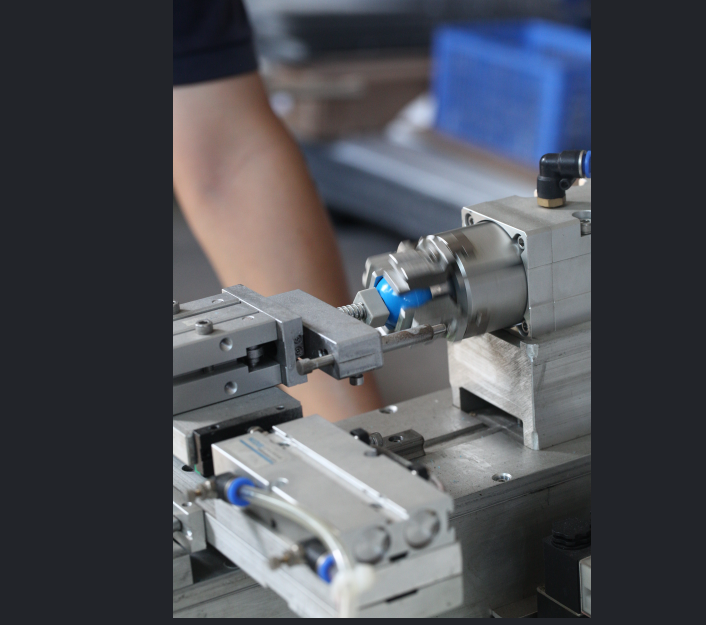
Adaptability Is a Procurement Question Before It Is a Design Question
In outdoor shelter procurement, "adaptability" is normally used to mean three separate capabilities: the ability to change dimensions, the ability to match material to exposure conditions, and the ability to match structural geometry to the installation site. A supplier can assert all three. Only documentation shows whether a factory can actually deliver them at the same time.
The reason this matters is that shelter projects rarely fail in the middle of a panel. They fail at the seams — where frame fabrication meets textile specification, where a cover engineered for one climate is reused in another, or where a low-volume, non-standard project has to pass through the same quality routine as a volume order.
For buyers at the evaluation and execution stage, the useful exercise is therefore not to ask whether a supplier is "flexible", but to ask which models demonstrate which kind of flexibility, and what the commercial and technical boundaries of that flexibility are. The three shelter models discussed below sit at different points on that spectrum.
StarCanopy as a Multi-Material Entity, Not a Single-Process Supplier
Zhuhai Star Canopy Co., Ltd. is a manufacturing facility founded in 2005, French-owned and managed, and located in Zhuhai in China's Guangdong industrial region. It is not a trading intermediary: three production capabilities operate under one roof, and the company reports a 100% export ratio with markets in the EU, USA, Canada, Japan, Australia and New Zealand.
| Capability | Scope | How it connects to shelter projects |
|---|---|---|
| Hardware | Metal parts, mechanical assemblies, custom components; cutting, bending, drilling, welding, surface treatments and final assembly | Shelter frames and poles in aluminium or steel |
| Sewn goods & technical textiles | Covers, bags, outdoor and sports equipment; custom fabric development, custom printing and sewing; PVC and TPU film processing | Canopies, covers and tarpaulin components |
| Inflatables | Advertising structures, promotional products, sports and event equipment | Airtight, removable shelter structures |
The company operates both OEM and ODM modes. In OEM mode, production follows the client's samples, drawings, specifications and production requirements. In ODM mode, the client provides only the product concept, application scenario and performance standards, and the manufacturer completes engineering design, material development, pattern making, lab testing, prototyping and mass production delivery. Its in-house R&D team is listed at four people, and its main product lines include inflatable frames, inflatable furniture, inflatable sport products, inflatable advertisement products, folding chairs, umbrellas, folding outdoor furniture, outdoor advertisement frames, shelters, covers and tarpaulin products.
The practical significance for a buyer is supplier consolidation: frame fabrication, textile engineering and airtight inflatable construction are handled by one production organisation rather than three, which reduces the number of interfaces where a specification can be lost in translation.
The Material Layer: Where Waterproofing Is Actually Decided
Waterproofing in custom outdoor shelters is a system decision, not a single fabric property. Three variables interact: the substrate fabric, the coating or film applied to it, and the structure that keeps the fabric under correct tension. Across the shelter range, the material specifications are explicit rather than generic.
| Model | Structure | Material specification | Customisation scope |
|---|---|---|---|
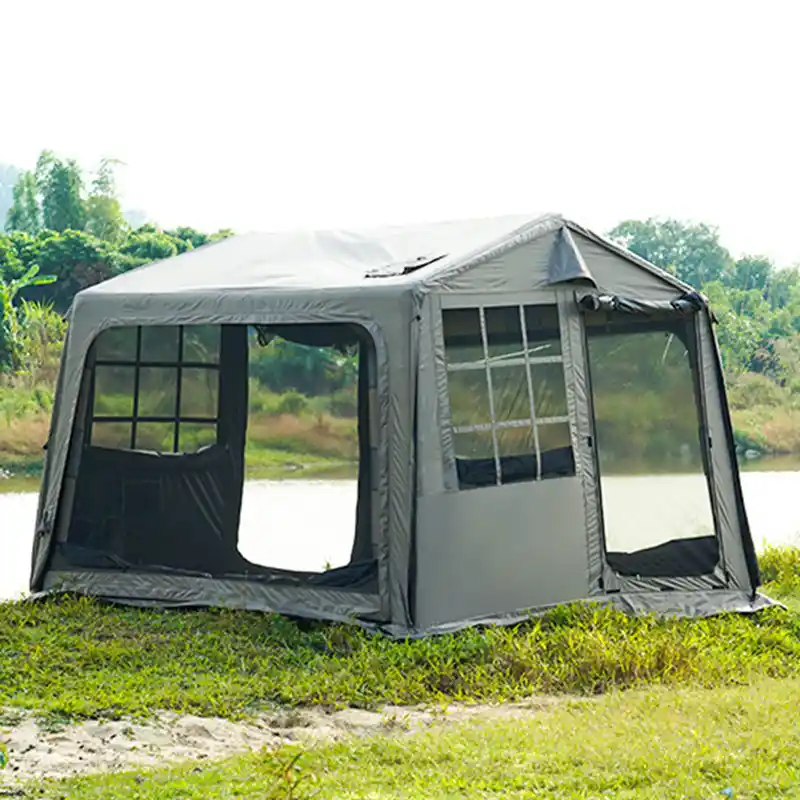
| ST-01 — outdoor shelter | Frame + canopy | PU coated polyester fabric, waterproof; aluminium or steel frame | Size fully customizable |
| BS-01 — boat shelter | Cover / roof shelter | Polyester or PVC fabric, waterproof | Size fully customized; shape matched to vessel or shelter footprint |
| CT-01 — car shelter | Cover / shelter | Polyester fabric | Size customized |
| CS-01 — inflatable container shelter | Airtight inflatable structure | TPU + PVC, anti-UV; removable, installed between two containers | Size fully customized |
| UM-01 — outdoor umbrella | Pole + canopy | Aluminium + polyester fabric, waterproof | Size fully customized |
The decision logic behind these specifications follows broadly accepted industry practice rather than brand-specific claims. PU-coated polyester is typically chosen where weight, flexibility and packing volume matter, while PVC-coated or PVC-based constructions are generally selected where heavier fabric mass, abrasion exposure and sustained water contact are the dominant loads — which is why BS-01 lists polyester or PVC rather than a single substrate. Airtight inflatable structures such as CS-01 use TPU combined with PVC, where the requirement shifts from drape and coverage to pressure retention and seam integrity.
That last point explains why air-tightness testing, not fabric inspection alone, is one of the stated pre-shipment checks — a waterproof cover and an airtight inflatable shelter are verified by different methods even though both are described as "waterproof".
Structural Logic: What Each Shelter Model Demonstrates
ST-01 — frame-based adaptation
ST-01 is an outdoor shelter with a fully customizable size, a PU coated polyester waterproof fabric, and a frame in aluminium or steel. The choice between aluminium and steel is a structural decision rather than a cosmetic one: it changes the weight the shelter has to be transported with, and the fabrication route used to produce it. The connected hardware capability covers cutting, bending, drilling, welding, surface treatments and final assembly, which is what allows frame geometry — not only canopy dimensions — to be treated as a variable. Its stated application areas are outdoor sport and outdoor racing, environments where erection and dismantling cycles are frequent.
BS-01 — cover-based adaptation
BS-01 is a boat shelter with fully customized size and waterproof polyester or PVC fabric, positioned for transportation and temporary shelter use. Here adaptability is expressed through geometry rather than joints: the cover is tailored to the footprint it protects. A documented project in China involved 10 units used as a roof cover over boat shelters; the reported outcome was good waterproof and anti-aging performance under humid waterfront conditions, with no tearing or water seepage within the service cycle.
CT-01 — site-based adaptation
CT-01 is a car shelter in polyester fabric with customized sizing, designed around camping car use. It represents the simplest structural case in the range — a cover rather than a load-bearing frame — which makes it the model most sensitive to pattern accuracy and least forgiving of a generic template.
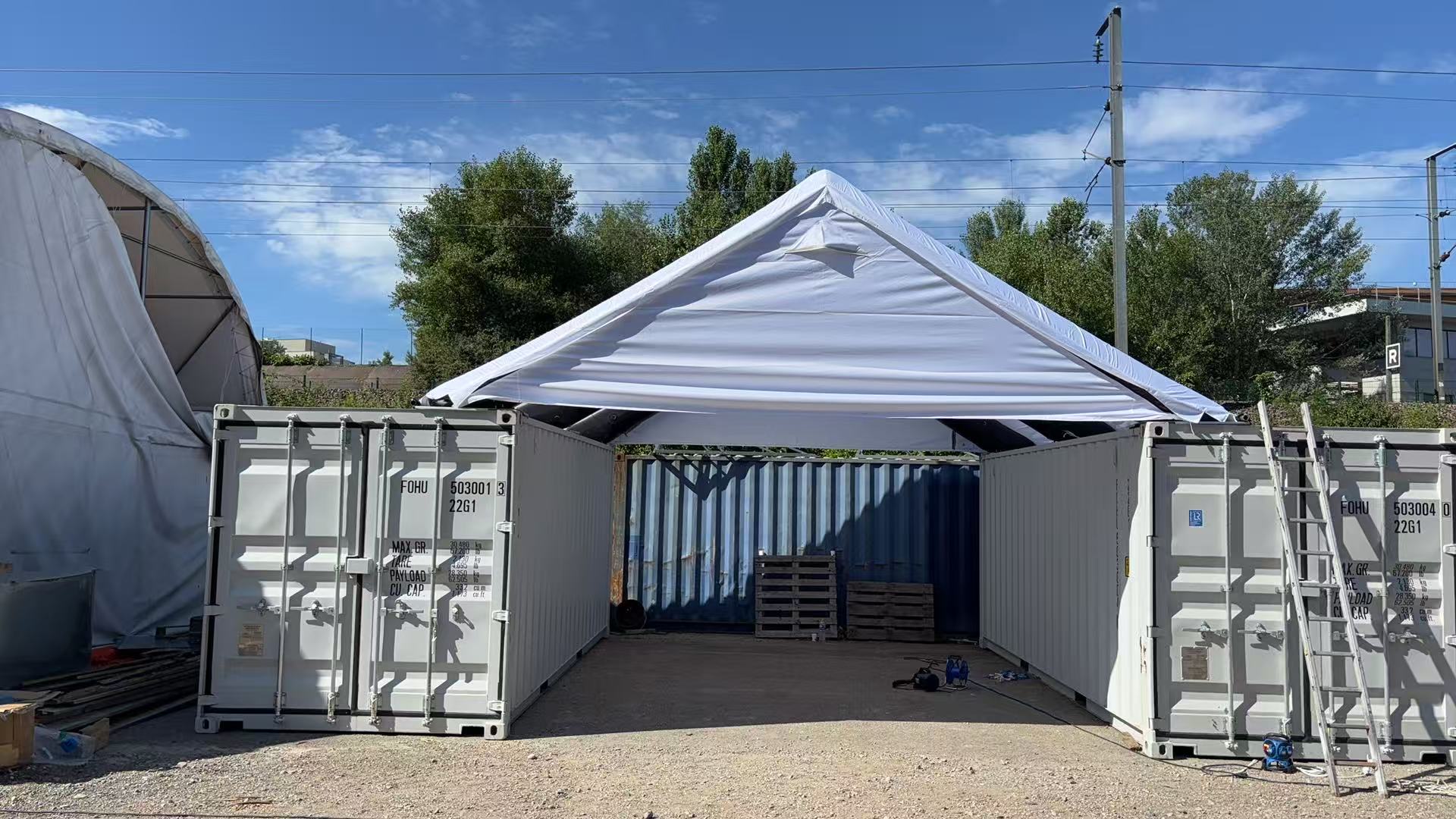
Taken together, the range shows three distinct adaptation mechanisms: frame fabrication (ST-01), large-format cover patterning (BS-01, CT-01), and airtight inflatable construction (CS-01). A supplier that can only do one of these will re-quote or sub-contract when a project crosses categories — which is precisely the risk a multi-material facility removes.
Field Records: Five Projects That Put the Claim Under Test
Capability statements are only as useful as the projects attached to them. The documented project records below cover both volume programmes and single-unit technical builds, across different product families and markets.
| Market | Client type | Product | Quantity | Reported outcome |
|---|---|---|---|---|
| France | Outdoor chair OEM | C01 folding outdoor chair | 1,000 pcs | Zero mass quality complaints within 2 years of all-season outdoor use; described as portable, light and not easy to break |
| France | Outdoor umbrella OEM | UM-01 outdoor umbrella | 500 pcs | Zero mass quality complaints within 2 years; works well under all-season outdoor use; easy setup |
| China | Boat shelter cover OEM | BS-01 boat shelter | 10 pcs | Good waterproof and anti-aging performance under humid waterfront conditions; no tearing or water seepage within the service cycle |
| France | Inflatable product OEM | CS-01 inflatable container shelter | 2 pcs | Stable operation over a 1-year period; flexible and portable design for logistics staff rest, goods sorting and outdoor commercial events |
| France | Sports goods retailer / event OEM brand | I-FB inflatable football goal | 1 pc | Full satisfaction with air tightness and durability; no air leakage during long-term outdoor training |
Two patterns are worth reading closely. First, the smallest project in the table is one unit — evidence that the production system is not gated behind container-scale minimums. Second, the largest project ran for two years in all-season outdoor conditions with a reported zero mass quality complaints, which speaks to consistency rather than to a single well-built sample.
Reading the Commercial Terms Like a Buyer
The commercial framework is split between a project-based configuration and a programme-based configuration. That distinction matters more than it first appears: it determines which terms a buyer should be negotiating.
| Term | Project-based configuration (CS-01, BS-01, I-FB, ITC01) | Programme-based configuration (ST-01, CT-01, UM-01, CPPlK, C01) |
|---|---|---|
| Minimum order quantity | 1 unit | 100 units |
| Delivery terms | FOB / CIF | FOB / EXW |
| Payment | 50% deposit, 50% balance before shipment | 50% deposit, 50% balance |
| Acceptance | Pre-shipment test | Pre-shipment test |
Production-side parameters apply across both: typical lead time of 7–30 days, with 1–2 weeks for small quantities; monthly capacity of 1,000 units; and a quality routine that performs 100% full inspection before shipment, covering air tightness, material tensile test, size verification and appearance check.
For a buyer, the 1-unit MOQ on CS-01 and BS-01 is the meaningful signal at the evaluation stage: it means a physical prototype or a first installation can be produced and tested before a programme commitment is made. At the execution stage, the 1,000 units per month capacity figure becomes the more important number, because it defines the ceiling of a single production window.
Market Context: Where Demand for Custom Outdoor Shelter Is Moving
Third-party market research supports the direction of demand, though estimates diverge substantially depending on how each report draws its category boundary. Buyers should read these figures as directional context rather than as a single reconciled market size.
- The global outdoor patio umbrella market was valued at USD 1.82 billion in 2025 and is projected to reach USD 3.14 billion by 2034 (Dataintelo). A separate estimate places the patio umbrella market at USD 0.60 billion in 2025 (Future Market Insights); the gap reflects scope differences between reports covering all umbrellas and those covering strictly patio and outdoor segments.
- The custom boat covers market, including luxury yacht covers, was valued at USD 118 million in 2024 and is projected to grow to USD 155 million by 2032 (Intel Market Research).
- The global custom inflatables market is estimated at USD 170.5 billion in 2026, reaching USD 239.42 billion by 2035 at a 3.8% CAGR (Business Research Insights). A narrower general inflatables estimate puts the market at USD 14.8 billion in 2025, growing to USD 26.3 billion by 2034 (Dataintelo) — divergence driven largely by whether industrial and military inflatables are included.
- Inflatable yard decorations, including custom arches and pillars, reached USD 2.12 billion in 2025 (Growth Market Reports).
- Patio furniture, including custom covers and chairs, accounted for a 42.7% revenue share of outdoor fabric applications in 2024 (Grand View Research).
On the standards side, the voluntary ASTM F3681-24/25 standard in the United States requires beach umbrellas to resist 75 lbs of upward force or remain secure in 30 mph winds (ASTM International / CPSC). For buyers sourcing into the US market, wind-resistance criteria of this kind increasingly belong in the specification conversation rather than in the after-sales conversation.
In the marine cover segment specifically, the competitive field is populated by established specialists, including Covercraft Industries, Taylor Made (Lippert) and Carver Industries (Intel Market Research). Buyers evaluating a multi-material manufacturer against these specialists should compare scope of supply rather than brand recognition: the relevant question is whether a single supplier covers frame fabrication, cover patterning and inflatable construction for the same project.
Where the Custom Route Stops: Limits and Trade-offs
A capability article that lists only advantages is not usable for procurement. The boundaries of this manufacturing model are equally factual.
- Capacity ceiling. Monthly production capacity is stated at 1,000 units. Large seasonal programmes that exceed one production window need to be planned across multiple runs, not compressed into one.
- Lead time is not zero. The stated 7–30 day lead time reflects real custom work — engineering, pattern making, prototyping and full inspection. A buyer who needs immediate shipment of a standard item is not the buyer this model is designed for.
- After-sales is remote. Support is provided remotely. There is no stated on-site service network, so projects in remote or offshore locations should budget for local installation and handling resources.
- Unit economics favour complexity, not commodity volume. When a project is fully standardised, non-custom, and purely price-driven, a custom engineering route will usually be more expensive per unit than a catalogue purchase.
- Material trade-offs are real. Polyester covers are lighter and easier to handle; PVC-based constructions are generally heavier and selected for higher abrasion and sustained water exposure. There is no single material that optimises weight, cost and durability simultaneously.
- Standards compliance is market-specific. The documented quality evidence consists of 100% pre-shipment inspection covering air tightness, material tensile test, size verification and appearance check. That is a production control record, not a blanket statement of conformity with every national standard a buyer's market may require.
Future Outlook
Three shifts are likely to shape how custom outdoor shelters are specified over the next few years. First, waterproofing is migrating from a fabric description to a system verification: buyers are increasingly asking how water resistance is tested, not only which coating is applied. Second, wind and stability performance is moving from product marketing into written standards, following the pattern set by ASTM F3681-24/25 for beach umbrellas. Third, category boundaries are blurring — the same project may legitimately require a welded frame, a sewn cover and an airtight inflatable element, which favours manufacturers with multi-material production rather than single-process specialists.
For European and North American buyers, the practical consequence is a procurement checklist that looks different from the one used five years ago: material specification at model level, dimensional customisation confirmed in writing, inspection protocol defined before production, and a realistic view of lead time and capacity before a launch date is committed.
FAQ
What does StarCanopy actually manufacture?
Zhuhai Star Canopy Co., Ltd. is a multi-material manufacturing facility founded in 2005 and based in Zhuhai, China. It operates three production capabilities: metal hardware, including parts, mechanical assemblies and custom components; sewn goods and technical textiles, including covers, bags, outdoor and sports equipment; and inflatables, including advertising structures, promotional products, sports and event equipment. Its product lines include outdoor shelters, boat and car shelters, umbrellas, folding outdoor furniture, caravan poles, tarpaulin products and inflatable structures.
What information does a buyer have to provide to start a custom shelter project?
It depends on the engagement mode. Under OEM, production follows the client's samples, drawings, specifications and production requirements. Under ODM, the client provides only the product concept, application scenario and performance standards, and the manufacturer completes engineering design, material development, pattern making, lab testing, prototyping and mass production delivery. On the fabrication side, textile work includes custom fabric development, custom printing and sewing, and PVC and TPU film processing, while metal hardware covers cutting, bending, drilling, welding, surface treatments and final assembly.
Which materials are used for waterproof custom shelters, and how is the choice made?
Material specification differs by model. ST-01 uses PU coated polyester fabric, described as waterproof, on an aluminium or steel frame. BS-01 boat shelter uses polyester or PVC fabric. CT-01 car shelter uses polyester fabric. CS-01 inflatable container shelter uses TPU combined with PVC with anti-UV properties. UM-01 outdoor umbrella uses aluminium with waterproof polyester fabric. In general industry practice, PU-coated polyester is typically chosen where weight and flexibility matter, while PVC-based constructions are generally selected where heavier fabric mass and sustained water or abrasion exposure dominate.
What are the minimum order quantity, lead time and production capacity?
The minimum order quantity is 1 unit for the project-based configuration covering CS-01, BS-01, I-FB and ITC01, with FOB or CIF delivery terms and 50% deposit plus 50% balance before shipment. A separate programme-based configuration applies to ST-01, CT-01, UM-01, CPPlK and C01, with a minimum order quantity of 100 units and FOB or EXW terms. Typical production lead time is 7 to 30 days, with 1 to 2 weeks for small quantities, and monthly production capacity is 1,000 units. Acceptance is by pre-shipment test.
How is quality verified before shipment?
The stated protocol is 100% full inspection before shipment, covering four checks: air tightness, material tensile test, size verification and appearance check. Acceptance is defined as a pre-shipment test. Air tightness testing is relevant to airtight inflatable structures such as CS-01 and I-FB, while material tensile testing, size verification and appearance checks apply across the textile and hardware output.
What after-sales support is available, and what should buyers plan for?
After-sales support is provided remotely. There is no stated on-site service network, so buyers should plan installation, handling and local service resources within their own market. Field records provide one reference point for durability expectations: a France-based outdoor chair programme of 1,000 units reported zero mass quality complaints within 2 years of all-season outdoor use, and an outdoor umbrella programme of 500 units reported the same result over 2 years. These outcomes reflect those specific applications and conditions.
Sources and Reference Material
- Dataintelo — outdoor patio umbrella market, USD 1.82B (2025) to USD 3.14B (2034).
- Intel Market Research — custom boat covers market, USD 118M (2024) to USD 155M (2032); competitor set: Covercraft Industries, Taylor Made (Lippert), Carver Industries.
- Business Research Insights — custom inflatables market, USD 170.5B (2026) to USD 239.42B (2035) at 3.8% CAGR.
- Growth Market Reports — inflatable yard decoration market, USD 2.12B (2025).
- Grand View Research — patio furniture share of outdoor fabric applications, 42.7% (2024).
- ASTM International / CPSC — ASTM F3681-24/25 beach umbrella safety standard, 75 lbs upward force or 30 mph wind resistance.
Manufacturer reference: the StarCanopy corporate brochure is available as a PDF at Starcanopy.pdf. Product and capability details in this article are drawn from the manufacturer's own technical and project documentation.
¿Tiene preguntas o necesita más detalles?
Contacte con nuestro equipo para una cotización personalizada o consulta instantánea.
Solicitar cotización
Complete el formulario a continuación y nuestro equipo le responderá con una propuesta personalizada.
Chat directo de WhatsApp
¿Prefiere chatear en tiempo real? Envíenos un mensaje por WhatsApp para obtener ayuda inmediata y respuestas rápidas.
- Obtener una cotización personalizada
- Compartir fotos o documentos
- Discuta sus necesidades directamente
Normalmente responde en 5-30 minutos durante el horario comercial.