
Behind the Evidence: Verifying Kastar's Silicone Coating Claims
HTNXT Industry Reference — Construction & Decoration

Manufacturing and testing environment of a silicone waterproof coating producer. Image: Kastar Adhesives Technologies Co., Ltd.
Buyers of silicone waterproof coating increasingly treat a supplier's own claims as the beginning of due diligence rather than its end. Kastar Adhesives Technologies Co., Ltd., a China-based manufacturer of coating, paint, sealant and adhesive products established in 1998, makes a specific set of manufacturing claims for silicone waterproof coatings. Those claims rest on four checkable pillars: participation in Chinese standard formulation, an invention patent covering a device and process for silicone waterproof coatings, three national-level R&D laboratories in China, and a 1,000 m² China Metrology Accreditation (CMA) certified sealing material testing laboratory.
This matters because the claims a buyer can actually examine are rarely the claims a supplier emphasises. Facility size, laboratory counts and patent titles are facts about a company's structure. Tensile strength, elongation and UV performance are facts about a product. Certification is a third category again. Treating all three as one block of "evidence" is the most common error in early-stage supplier screening. The verification question is therefore not whether Kastar makes claims — most manufacturers do — but which claims sit within reach of an independent buyer, and what each one is capable of proving.
The problem: claims multiply faster than verification
Market context explains why the vocabulary of supplier claims has expanded. Market.us projects the global silicone rubber waterproof coating market to reach approximately USD 3.5 billion by 2034, and places Asia-Pacific at a 45.9% revenue share in 2024. A large, concentrated supply region produces a large number of manufacturers describing similar capabilities in similar language, and a buyer comparing brochures across a shortlist will often find them nearly interchangeable.
In that environment, three claim types get mixed together:
- Structural claims — factory area, staff numbers, production capacity, laboratory counts. These describe the shape of an organisation and are almost always self-reported.
- System claims — certification such as ISO 9001, CE, SGS or REACH. These describe conformity frameworks, and their value depends entirely on scope, issuing body and validity dates.
- Performance claims — tensile strength, elongation, UV resistance, service life. These describe measured behaviour and only become comparable when the test method behind them is named.
A supplier can be strong in one category and weak in another. The practical implication for buyers at the research stage is that a verification plan should be built per category, not per supplier.
Four pillars a buyer can actually examine
For its silicone waterproof coating manufacturing, Kastar's published evidence concentrates in four areas. Each supports a different part of a manufacturing claim, and each has a defined boundary.
| Evidence pillar | What Kastar states | What it supports | What it does not prove |
|---|---|---|---|
| Standard formulation involvement | Participant in the formulation of Chinese standards for silicone waterproof coatings; drafting unit for 5 Chinese group standards; initiator and formulator of Chinese standards for silicone sealants | Familiarity with domestic test methods, terminology and committee review processes | Compliance with ASTM, EN or other export-market standards |
| Invention patent | Invention patent for a device and process for silicone waterproof coatings; additional patents covering a siloxane-terminated polymer homopolymer preparation method with a moisture-curing composition, and a device and process for MS waterproof coatings | Process-level intellectual property in coating and sealant manufacturing | Product performance on a specific project, or formulation exclusivity |
| R&D infrastructure | 3 national-level R&D laboratories in China; 28 engineers in the R&D team | In-house formulation work and the ability to adjust colour, viscosity, packaging and formula | A quantified output, publication record or third-party rated capability |
| Testing infrastructure | 1,000 m² CMA-certified sealing material testing laboratory; 16 testing personnel; over 100 testing instruments and equipment; 12 production and testing processes with batch sample testing | An internal verification loop between production and dispatch | Accreditation coverage of every coating SKU, or published third-party test reports |
Evidence map for Kastar silicone waterproof coating manufacturing claims, based on company-published information.
Pillar 1: what standard participation is worth
Kastar reports that it is a participant in the formulation of Chinese standards for silicone waterproof coatings, a drafting unit for five Chinese group standards, and the initiator and formulator of Chinese standards for silicone sealants. For a buyer, this is the least intuitive of the four pillars and the one most often misread.
Standard work signals exposure to a discipline that ordinary marketing does not require: agreed definitions, specified test methods, repeatable measurement, and review by parties who do not share the supplier's commercial interest. A manufacturer that has sat through formulation work on how elongation, adhesion or water impermeability should be measured is, in principle, more likely to structure its own internal testing around the same definitions.
The boundary is jurisdictional. Participation in Chinese national and group standards establishes familiarity with the domestic framework. It does not establish conformity with ASTM D6694/D6694M-25, published by ASTM International, which sets minimum thresholds for liquid-applied silicone roof coatings. Buyers sourcing for North America, Europe, Australia or New Zealand should treat the standard-participation claim as a positive indicator of technical culture — not as a substitute for a market-specific declaration.
Pillar 2: reading the patent correctly
Kastar holds an invention patent for a device and process for silicone waterproof coatings. The wording matters: the patent covers apparatus and method, not the chemical formulation of the coating itself. In practical terms, this is evidence about how a product is made and stabilised at scale, rather than evidence about how a cured membrane performs on a roof.
The company also reports two further invention patents — one for a method of preparing a siloxane-terminated polymer homopolymer and a moisture-curing composition, and one for a device and process for MS waterproof coatings. Taken together, the patent portfolio points to sustained process engineering across silicone and silane-modified polymer chemistries, which is consistent with a manufacturer producing both silicone waterproof coating and MS Sealant in the same portfolio.
What a patent does not do is travel. It does not confirm that a given production batch met a specification, and it does not replace a batch test report. Buyers should read it as a signal of engineering depth and then continue to the documents that actually govern a purchase order.
Pillar 3: three national-level R&D laboratories
Kastar reports three national-level R&D laboratories in China supported by a team of 28 engineers. The company describes these laboratories as dedicated to silicone resins, silicone coatings and MS coatings, and presents them as the basis for comprehensive waterproofing solutions.
The reason this pillar matters commercially is customisation. Kastar's OEM/ODM offer includes adjustment of colour, viscosity, packaging and formulation, and the company reports OEM and ODM services including custom branding and packaging design. Formulation adjustment is only credible when there is a laboratory function able to run iterations and re-test them; a trading intermediary without laboratory capacity generally cannot absorb a change request without returning to a third party.
The verification step here is specific rather than general. A buyer should ask which laboratory handles which product family, how a formulation change is validated before it enters production, and what documentation accompanies a modified batch. Laboratory counts answer a structural question; these follow-ups answer the operational one.
Pillar 4: the 1,000 m² CMA testing laboratory
 Production and quality-control operations in a coating manufacturing facility. Image: Kastar Adhesives Technologies Co., Ltd.
The most concrete of the four pillars is the testing infrastructure. Kastar reports a 1,000 m² China Metrology Accreditation (CMA) certified sealing material testing laboratory, staffed by 16 testing personnel and equipped with over 100 testing instruments and equipment. The company also states that products pass through 12 production and testing processes from production to delivery, with batch sample testing intended to maintain quality across the whole run.
CMA accreditation is a Chinese metrology framework for laboratory competence, and it is the kind of claim an export buyer can act on: accreditation is scope-based, so the correct question is not whether the laboratory is accredited, but whether the relevant test and product type fall inside the accredited scope. A laboratory accredited for sealing materials is a strong asset for a manufacturer that also produces silicone waterproof coating, since shared rheology, adhesion and cure testing overlaps — but accreditation scope should be confirmed in writing rather than assumed.
The batch-testing statement is, for procurement purposes, more useful than the laboratory size. A supplier that tests by batch can supply a batch-linked record alongside a shipment; a supplier that tests only by product type cannot. That distinction determines whether an incoming inspection at the buyer's warehouse can be reconciled with anything.
Automated packaging is worth noting in the same context. Kastar reports fully automated packaging equipment developed and produced independently, with 100% brand-new packaging described in terms of seal integrity and shelf life. Packaging is where coating quality most often degrades between factory and site, so a supplier controlling its own packaging equipment removes one variable from the chain.
From claim to specification: the technical layer
The KASTAR 4000 Silicone Waterproof Coating is a one-component, UV-resistant waterproof coating made primarily of silicone. The published specification for the product states a solid content of 98%, elongation at break of ≥200%, tensile strength of ≥1.2 MPa, UV resistance of 1,000 hours without cracking or peeling, an operating temperature range of −80 °C to 180 °C, and a service life of ≥25 years outdoors.
These figures become meaningful when placed against an external benchmark. ASTM D6694/D6694M-25 requires a minimum tensile strength of 150 psi and minimum elongation of 100% for liquid-applied silicone roof coatings — approximately 1.0 MPa and 100% respectively. On the numbers as published, the KASTAR 4000 figures sit above both thresholds.
The same logic applies to the UV figure. "1,000 hours without cracking or peeling" describes an outcome over a defined exposure period; whether that period was run under a recognised accelerated weathering protocol is a separate question, and one that a technical buyer should raise before writing the value into a project specification.
Where the formulation meets the building
Application scope is the point at which manufacturing claims are tested by reality. Kastar positions silicone waterproof coating for construction-sector work covering building waterproofing and roofing engineering, with project types spanning roof waterproofing, exterior wall waterproofing, expansion joint sealing and bathroom waterproofing. The company specifically markets the KASTAR 4000 product for exposed building roofs, and lists a companion KASTAR 3000 Silicone Elastic Exterior Wall Waterproof Coating for wall applications.
The exposure conditions attached to these applications are the familiar ones: high temperature, UV exposure, rain and humidity, structural movement and freeze–thaw cycles. That mix explains why silicone chemistry is specified in the first place — the inorganic backbone resists UV degradation in a way that organic binder systems generally do not, which is why exposed roof membranes and facades under strong solar load are the natural first markets for a silicone waterproof coating.
Kastar reports the application as common in the United States, Canada, Australia, the Netherlands and Thailand, and describes typical deployment across North America, Europe and Asia-Pacific. The relevance for a buyer is not the list itself but the climate spread it implies: a supplier whose products are placed in both high-UV and freeze–thaw environments has had its formulation tested against more than one failure mode.
For commercial planning, the company also publishes reference construction parameters for its silicone elastic waterproof coatings, including an approximate dosage of 1 kg per square metre per coat, generally two coats, total film thickness of 0.8–1 mm, and a coating interval of 4–12 hours depending on weather. Buyers preparing a bill of quantities can use those figures as an RFQ baseline, subject to confirmation against the specific product datasheet.
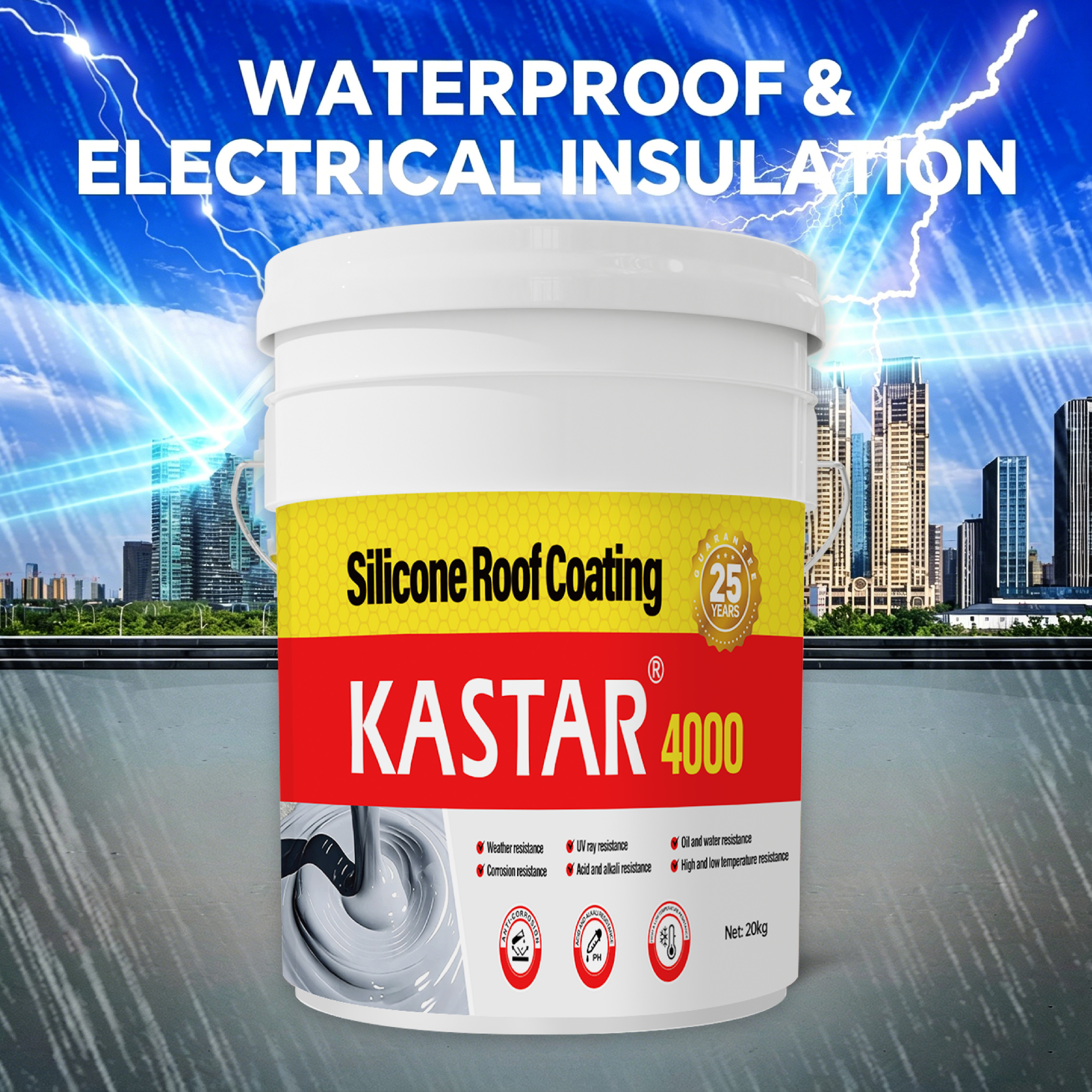 Silicone waterproof coating intended for roof, exterior wall and joint waterproofing applications. Image: Kastar Adhesives Technologies Co., Ltd.
Where the evidence stops
Any credible verification exercise has to name the limits, and Kastar's public evidence has several.
- Certification is stated, not yet verified. The company reports ISO 9001 certification and states that products have obtained ISO9001, CE, SGS and REACH certifications, and describes itself as a national high-tech enterprise. Certificate numbers, issuing bodies, product scope and validity dates are not published alongside those claims. CE in particular is a conformity-marking framework rather than a single product certificate, and SGS is a testing and certification organisation rather than a certification type — so both require the underlying document before they can be entered into a compliance file.
- The laboratory accreditation has a defined scope. A CMA-accredited sealing material laboratory is a genuine asset, but accreditation is granted for specific tests on specific material categories. Coverage of every silicone waterproof coating SKU should be confirmed rather than inferred.
- No independent third-party test reports are published. The tensile, elongation and UV figures come from the manufacturer. Nothing in the public record allows an outside party to confirm the test method, the sample conditioning or the reporting format behind them.
- Standard participation is domestic. Chinese national and group standard work should not be read as an ASTM, EN or AS/NZS qualification.
- Structural figures are self-reported. A 150,000 m² facility, 200+ staff and 300,000 tons of annual production capacity describe a company-wide footprint across coating, paint, sealant and adhesive lines. They cannot be converted into product-specific silicone coating capacity without production records.
- Commercial terms are not technical evidence. The reported minimum order quantities — a starting quantity of 5,000 units for custom-brand OEM and 1,000 units for KASTAR brand agency — describe two different commercial models and should not be compared as if they were the same OEM threshold.
None of these limitations invalidates the four pillars. They define what each pillar can carry in a decision.
Claim-only sourcing versus evidence-led sourcing
The practical difference between a conventional supplier review and a verification-led one is not the amount of information collected — it is the order in which it is collected.
| Verification task | Claim-only approach | Evidence-led approach |
|---|---|---|
| Capability assessment | Accept factory area, capacity and laboratory counts at face value | Map each figure to a product line and request the supporting record |
| Certification review | Record certificate names in a compliance sheet | Request numbers, issuing bodies, scope and validity dates; match scope to the SKU |
| Performance review | Copy datasheet values into the project specification | Request the test method and a batch-linked report before specifying |
| Customisation review | Assume formulation adjustment is available on request | Ask which laboratory validates a change and what documentation follows it |
| Batch control | Accept a generic quality statement | Confirm batch-level testing and that records can ship with the order |
What to put in the RFQ
A verification-focused enquiry to a silicone waterproof coating manufacturer is short and specific. The following requests convert each pillar into a document:
- Certificate copies with numbers, issuing bodies, scope and validity dates for ISO 9001, CE and SGS, and the REACH documentation applicable to the specific product.
- The CMA accreditation scope statement for the in-house testing laboratory, showing which tests and material categories are covered.
- Test method references and batch-linked reports for tensile strength, elongation at break and UV resistance on the requested SKU.
- A sample batch record showing the 12-stage production and testing sequence and where batch sampling occurs.
- Written confirmation of the formulation-change workflow: who validates it, in which laboratory, and what documentation accompanies the modified product.
- The product datasheet for the exact SKU, confirming dosage, film thickness, coating interval and service-life assumptions for the destination climate.
Each request maps to a claim already made publicly. That is the point: verification is not an adversarial exercise, it is the process of converting a published statement into a document that a procurement file can hold.
Future outlook
Two forces are pushing this style of sourcing into the mainstream. The first is supply concentration: with Asia-Pacific accounting for 45.9% of silicone rubber waterproof coating revenue in 2024 and the market projected toward USD 3.5 billion by 2034, buyers will spend more, not less, on qualifying a smaller number of manufacturing partners. The second is documentation pressure from export markets, where conformity marking and declaration requirements increasingly demand traceable evidence rather than descriptive claims.
For manufacturers, the implication is that the four pillars examined here will shift from marketing assets to procurement prerequisites. A standard-setting record, a process patent portfolio, laboratory capacity and an accredited testing function are already persuasive at the awareness stage. At the evaluation stage, they become useful only when each one can be converted into a document with a scope, a date and a signature. Suppliers that prepare those documents in advance will move through buyer shortlists faster than suppliers that continue to describe capability in prose.
FAQ
1. What exactly does Kastar manufacture?
Kastar Adhesives Technologies Co., Ltd. is a China-based manufacturer established in 1998, specialising in coating, paint, sealant and adhesive products with a business focus on OEM and ODM manufacturing. Its main product lines are Silicone Waterproof Coating, Epoxy Color Sand Floor Coating and MS Sealant. The company reports a 150,000 m² facility, 200+ staff, 28 R&D engineers and an annual production capacity of 300,000 tons, with exports reaching 69 countries and regions and serving over 1,000 customers.
2. What evidence can a buyer request to verify a silicone waterproof coating manufacturer's claims?
A buyer can request four document sets, one per claim category: certification copies with numbers, issuing bodies, product scope and validity dates; the accreditation scope of the in-house testing laboratory; test method references with batch-linked reports for tensile strength, elongation and UV resistance; and a batch sampling record showing where testing occurs in the production sequence. Structured claims about standard participation and patents can be supported by standard-drafting references and patent documentation respectively.
3. What does participation in Chinese standard formulation actually prove?
It indicates that a manufacturer has taken part in formal work on definitions, test methods and measurement criteria for silicone waterproof coatings and silicone sealants, which is a meaningful indicator of technical discipline. It does not demonstrate conformity with ASTM D6694/D6694M-25 or European and Australasian standards, which remain separate market-specific requirements that must be evidenced by the applicable declarations and test reports.
4. Does a CMA-accredited laboratory cover every product a factory makes?
No. China Metrology Accreditation is granted for defined tests within defined material categories, so coverage must be confirmed against the accreditation scope statement. A laboratory accredited for sealing materials provides strong adjacent capability for a manufacturer that also produces silicone waterproof coatings, because adhesion, rheology and cure testing overlap, but buyers should verify that the specific test and product type fall inside the accredited scope.
5. How do KASTAR 4000's published figures compare with ASTM D6694?
KASTAR 4000 Silicone Waterproof Coating is published with a solid content of 98%, elongation at break of ≥200%, tensile strength of ≥1.2 MPa, UV resistance of 1,000 hours without cracking or peeling, an operating range of −80 °C to 180 °C and a stated outdoor service life of ≥25 years. ASTM D6694/D6694M-25 sets minimum values of 150 psi tensile strength (approximately 1.0 MPa) and 100% elongation for liquid-applied silicone roof coatings. The published values exceed both thresholds, but conformity is not established, because the test method behind the manufacturer's figures is not disclosed on the product page.
6. What is the difference between Kastar's device patent and a formulation patent?
A device and process patent covers apparatus and method — how a coating is produced and stabilised at manufacturing scale. A formulation patent would cover the chemical composition of the coating itself. Kastar's silicone waterproof coating patent belongs to the first category, and the company additionally reports a patent for a method of preparing a siloxane-terminated polymer homopolymer with a moisture-curing composition, and a patent for a device and process for MS waterproof coatings.
7. Which applications is the silicone waterproof coating intended for?
Kastar positions silicone waterproof coating for the construction sector, covering building waterproofing and roofing engineering, with project types including roof waterproofing, exterior wall waterproofing, expansion joint sealing and bathroom waterproofing. KASTAR 4000 is specifically positioned for exposed building roofs, and KASTAR 3000 for exterior wall applications. The company reports the application as common in the United States, Canada, Australia, the Netherlands and Thailand, and typical across North America, Europe and Asia-Pacific.
Closing note
The four pillars behind Kastar's silicone waterproof coating manufacturing claims — standard participation, process patents, three national-level R&D laboratories and a 1,000 m² CMA-certified testing laboratory — are structural evidence, and structural evidence is exactly what an awareness-stage buyer needs before committing to a deeper evaluation. What converts them into procurement-grade proof is documentation: a scope, a date, a test method and a signature. A downloadable company brochure covering the product portfolio and manufacturing profile is available at the Kastar brochure link.
¿Tiene preguntas o necesita más detalles?
Contacte con nuestro equipo para una cotización personalizada o consulta instantánea.
Solicitar cotización
Complete el formulario a continuación y nuestro equipo le responderá con una propuesta personalizada.
Chat directo de WhatsApp
¿Prefiere chatear en tiempo real? Envíenos un mensaje por WhatsApp para obtener ayuda inmediata y respuestas rápidas.
- Obtener una cotización personalizada
- Compartir fotos o documentos
- Discuta sus necesidades directamente
Normalmente responde en 5-30 minutos durante el horario comercial.