
Beachfront, Mountain or Desert? How Top Luxury Hotel Tent Brands Match Models to Site Conditions
Beachfront, Mountain or Desert? How Top Luxury Hotel Tent Brands Match Models to Site Conditions
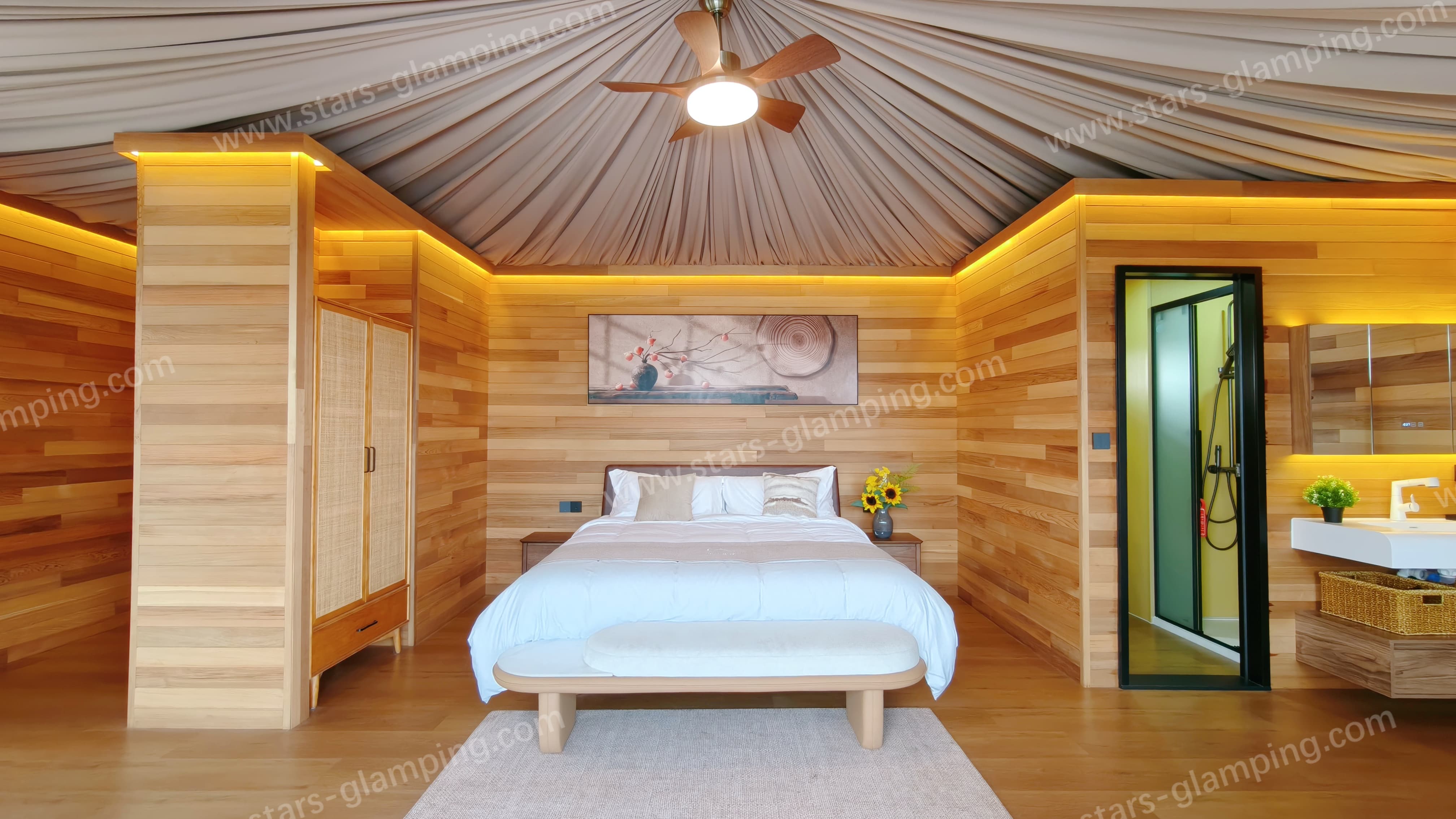
Site conditions — wind, snow, salt, heat and UV — determine which luxury hotel tent model belongs on a given plot.
The global glamping market was valued at approximately USD 3.8 billion in 2025, with tents forming one of its major accommodation segments alongside cabins and pods (Grand View Research). Forecasts place the market at USD 9.15 billion by 2034, growing at a 10.67% CAGR (Fortune Business Insights). Behind those aggregate figures sits a more practical problem for resort developers: a luxury hotel tent that performs beautifully on a sheltered inlet can fail prematurely on an exposed headland, and a model specified for a warm coastal strip is rarely the right answer for a snow-loaded mountain plateau.
This article treats luxury hotel tent selection as a scenario-fit decision. It walks through five deployment scenarios — resort accommodation, beachfront hotel, mountain eco lodge, desert glamping and event luxury tent (reception and restaurant) — and explains how published model lines from STARS GLAMPING TENT CO.,LTD (Stars Glamping) and other recognised industry suppliers map onto them. The comparison uses verifiable structural and material specifications rather than marketing claims, and it includes the boundaries where tent structures stop being the right answer.
Why site conditions, not unit count, drive the decision
A luxury hotel tent is a permanent hotel tent structure designed for luxury hospitality projects, resort development, eco-tourism camps and high-end outdoor accommodation systems. That definition matters because it separates engineered resort structures from recreational camping tents. A permanent unit carries fixed foundations, utility connections, insulated wall systems, bathroom modules and climate control, and it is expected to operate continuously across seasons rather than for a short festival window.
Once a structure is permanent, the site becomes an engineering input. The three variables that most often eliminate a shortlisted model are not aesthetic: they are the local wind regime, the snow accumulation the roof must shed, and the annual temperature range the envelope must tolerate. A developer comparing two tent models on appearance alone is effectively comparing them on the one dimension that carries the least risk.
The same logic explains why a single model rarely covers an entire resort. A coastal cluster, an elevated forest cluster and a central reception pavilion sit within a few hundred metres of each other and can still require different covers, different wall systems and different service-life assumptions.
What “site-condition fit” actually means in technical terms
Site fit can be broken into four load and durability variables. Each one has a stated threshold that buyers can check against published specifications.
| Variable | Stated threshold (Stars Glamping range) | What it governs on site |
|---|---|---|
| Wind resistance | Up to 120 km/h (Level 10 wind) | Frame bracing, anchoring design, exposed coastline and ridge siting |
| Snow load | 80 kg/m² | Roof geometry, pitch and clearance in alpine and northern markets |
| Temperature envelope | -30 °C to +70 °C | Insulation specification, glazing choice, HVAC sizing |
| Moisture, UV and fire | Waterproof ≥5000 mm H₂O; UV-stabilised anti-aging; fire rating B1 / M2 | Long-term fabric integrity, coastal humidity, solar exposure, permit approval |
The waterproof figure describes the hydrostatic head the membrane must hold. The fire rating, expressed as B1 / M2 within the Stars Glamping range, is a fire-retardancy classification: for commercial hospitality use, luxury resort tents are typically expected to meet recognised standards such as NFPA 701 in the United States or EN 13501-1 in Europe (International Fire Code reference framework). Buyers should confirm which standard a supplier's test documentation actually addresses, because a classification stated without a test standard is not verifiable.
The UV and anti-aging treatment is the least visible variable and among the most consequential. In high-irradiance desert and island locations, an untreated cover loses tensile strength and colour long before the frame shows any sign of wear.
Five deployment scenarios and what each one demands
1. Resort accommodation (permanent, mixed-climate inland resort)
General resort accommodation is the least extreme scenario and the one where lifecycle economics dominate. Specifying a PVDF membrane with a stated 25–30 year service life reduces the odds of a full re-cover before the resort reaches its first major refurbishment cycle. Because the unit is permanent and operates year-round, insulation, glass wall systems and modular bathroom modules matter more than peak load figures.
2. Beachfront hotel
Beachfront hospitality combines two hazards that rarely appear together inland: sustained lateral wind and airborne salt. Wind drives anchoring and frame bracing, while salt drives corrosion protection on every steel component and fastener. Membranes specified with UV stabilisation and anti-aging treatment hold up better under reflected solar radiation from water and sand, and a waterproof rating of at least 5000 mm H₂O keeps driving rain out during storm events.
This is also the scenario where glazed wall systems earn their cost. Panoramic insulated glass converts a coastal view into the room's primary asset while keeping the internal environment controlled.
3. Mountain eco lodge
Mountain sites invert the priority order. Snow load and thermal performance lead, with 80 kg/m² as the stated roof threshold and -30 °C as the stated lower operating limit for the Stars Glamping range. Insulated glass wall systems and an internal insulation lining become functional requirements rather than upgrades, and roof geometry needs to shed accumulation rather than trap it.
Geometric, faceted models tend to perform well here because their roof planes create multiple shedding directions, and because the room volume-to-surface ratio is easier to insulate than a long single-span footprint.
4. Desert glamping
Desert projects stress the upper end of the temperature envelope. The stated +70 °C limit covers surface temperatures on exposed membranes, while the practical design problem is diurnal swing: interior comfort has to be maintained across a wide day–night differential with heavy reliance on insulation and air conditioning. UV-stabilised, anti-aging covers are essential rather than optional, and light-coloured PVDF membranes reduce solar heat gain at the envelope.
5. Event luxury tent (reception and restaurant)
Reception and restaurant structures carry the strictest fire-safety expectations because they are public assembly spaces with high occupancy and kitchens on site. Fire rating moves from a compliance checkbox to the primary specification. Large clear spans, service access and modular expansion capability are the other defining requirements, since food and beverage operations tend to grow faster than guest room counts.
Mapping Stars Glamping models to site conditions
STARS GLAMPING TENT CO.,LTD is a manufacturer specialising in research and development, design, manufacturing and installation of luxury glamping tents and camp planning solutions, established in 2018 and operating a 20,000 m² manufacturing base in Guangzhou, China. Its luxury hotel tent range lists all five scenario types — resort accommodation, beachfront hotel, mountain eco lodge, desert glamping and event luxury tent — across the entire model family. The practical differentiation between models therefore comes from three engineering choices: frame construction, cover material and wall system.
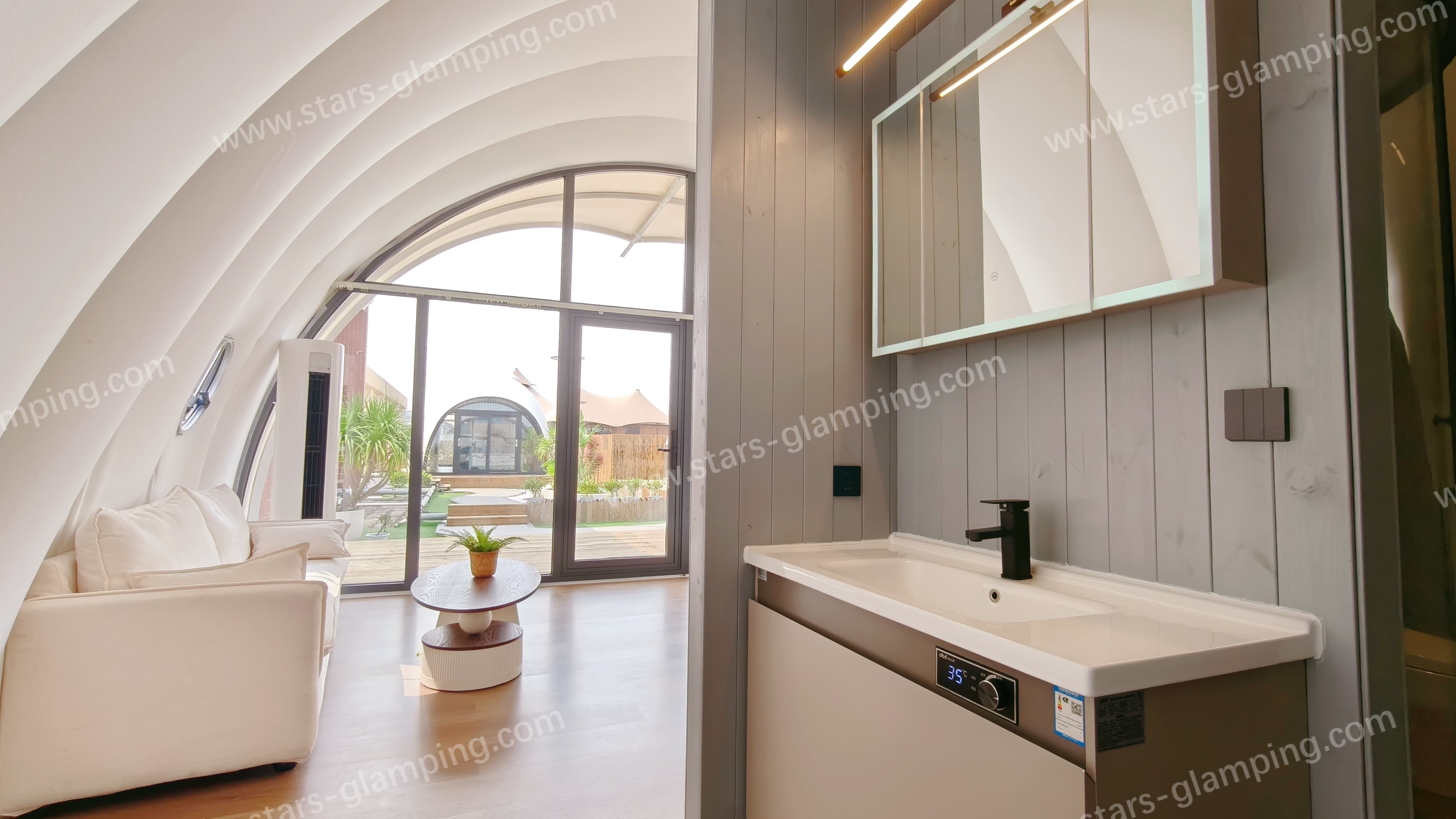
Insulated glass wall systems convert coastal exposure into a design asset while keeping the internal environment controlled.
| Model | Frame | Cover | Wall system | Stated service life | Strongest site fit |
|---|---|---|---|---|---|
| Luxury Tent – Tethys | Steel pipe | 1050 g/m² PVDF architectural membrane | Insulated glass wall | 25–30 years | Flagship year-round resort accommodation; mixed-climate and coastal |
| Luxury Tent – Villa | Steel pipe | 1050 g/m² PVDF architectural membrane | Insulated glass wall | 25–30 years | Villa-style resort layouts and large-span reception spaces |
| Luxury Tent – Octagon | Steel pipe | 1050 g/m² PVDF architectural membrane | Insulated glass wall | 25–30 years | Mountain eco lodges; snow shedding and cold-climate insulation |
| Luxury Tent – Shell | Steel pipe | 1050 g/m² PVDF architectural membrane | Insulated glass wall | 25–30 years | Beachfront and island resorts; wind and salt exposure |
| Luxury Tent – Pisces | Solid wood + steel pipe | 850 g/m² PVC polyester fabric | Insulated canvas wall | 10–15 years | Economy-sensitive eco-tourism and desert camps in warm, dry climates |
All five models share the same declared performance envelope: waterproof rating ≥5000 mm H₂O, UV-stabilised anti-aging treatment, B1 / M2 fire rating, wind resistance up to 120 km/h (Level 10 wind), snow load 80 kg/m² and a -30 °C to +70 °C temperature range. The differences that matter operationally are cover chemistry and wall construction.
The four PVDF models — Tethys, Villa, Octagon and Shell — pair a 1050 g/m² PVDF architectural membrane with a steel pipe frame and an insulated glass wall system. PVDF architectural membranes are widely documented as offering a service life of roughly 15–30 years in permanent installations, with wind tolerance in the region of 120–140 km/h depending on engineering. Within the Stars Glamping range the stated service life is 25–30 years. For a resort amortising structural cost over decades, that longer interval is the single largest lifecycle differentiator in the range.
The Pisces model takes a different route: a solid wood and steel pipe frame, an 850 g/m² PVC polyester cover and an insulated canvas wall system, with a stated service life of 10–15 years. The material mix gives a warmer, more tactile interior that suits eco-tourism and desert camps, and it produces the shortest replacement interval in the range. That trade-off is the honest core of model selection: the cover chemistry, not the silhouette, sets the maintenance calendar.
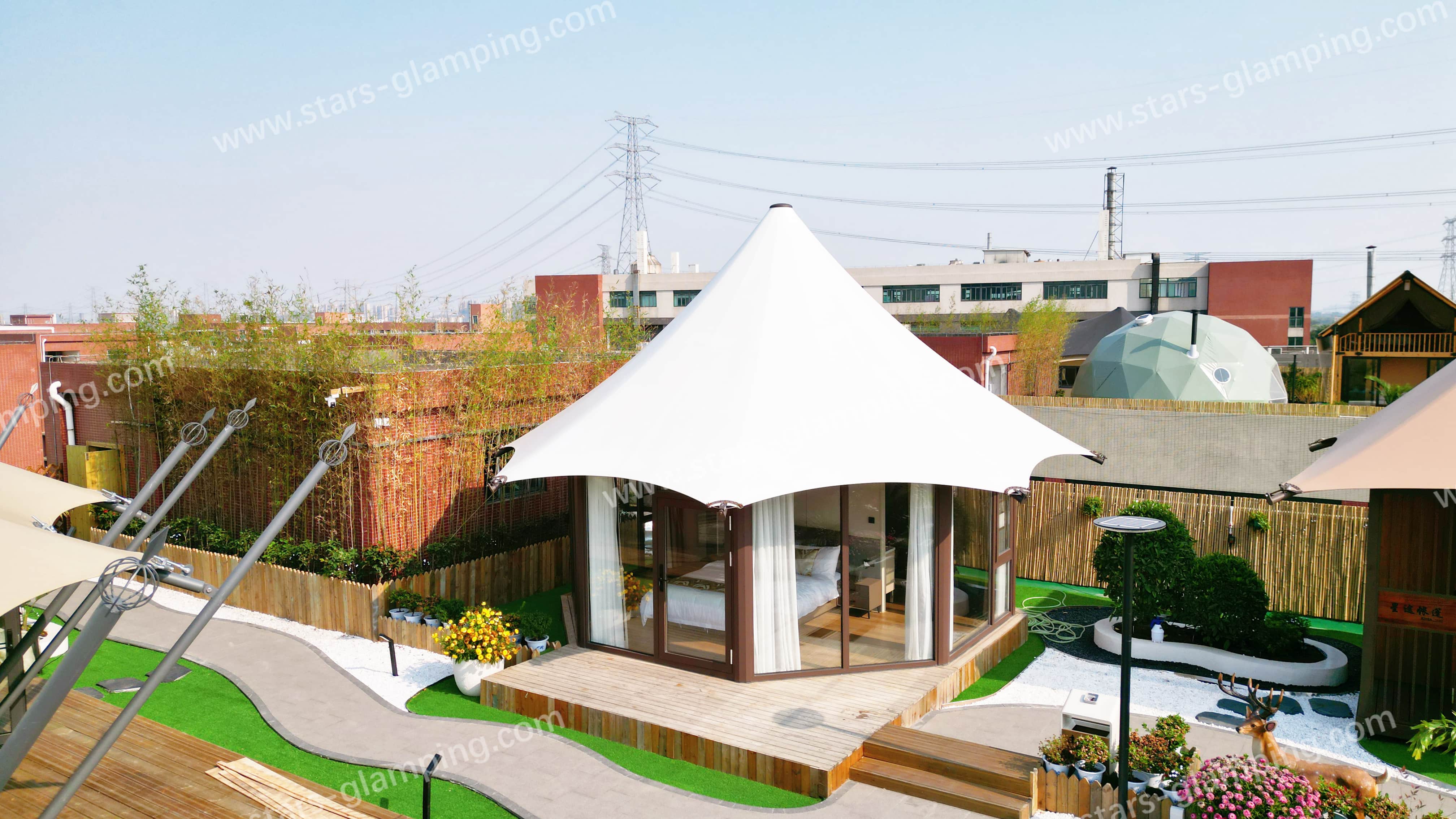
Geometric roof planes shed snow in multiple directions — a decisive advantage on mountain eco lodge sites.
How leading luxury tent brands compare on scenario adaptability
Brand-level market share figures for luxury hotel tent manufacturing are not published in a form that can be independently verified, so this comparison does not attempt to rank suppliers by revenue or volume. It instead ranks five recognised suppliers on one defined metric: documented model-to-scenario coverage for permanent luxury accommodation across the five deployment scenarios above, supported by technical R&D orientation and solution scope. The ordering reflects breadth of published product documentation, not overall company quality.
| Rank | Supplier | Engineering orientation | Published model-to-scenario coverage | Solution scope |
|---|---|---|---|---|
| 1 | Stars Glamping (STARS GLAMPING TENT CO.,LTD) | Steel-frame and wood/steel-frame permanent tent structures with PVC / PVDF membranes and insulated glass or canvas wall systems | Five published model lines (Tethys, Villa, Octagon, Shell, Pisces) covering resort, beachfront, mountain, desert and event scenarios, with a unified climate envelope | One-stop camp planning, design, manufacturing and installation, with a 24-hour global after-sales response |
| 2 | Losberger De Boer | Engineered temporary and semi-permanent building systems; large-span hospitality and venue structures | Broad engineered structure portfolio; accommodation model families are less publicly itemised by scenario | Turnkey engineering and project delivery |
| 3 | HTS Tent | Clear-span tent engineering for events and hospitality | Strong event and hospitality structure coverage; dedicated residential model mapping is less documented | Event and venue structures |
| 4 | Sprung Structures | Tensioned membrane structures and rapid-build panelised systems | Strength in rapid-build membrane structures; purpose-built glamping accommodation families are less published | Project-specific engineered systems |
| 5 | Bushtec Safari | Safari and lodge tented camp specialisation | Deep focus on safari and bush lodge environments; multi-climate envelope breadth is less documented | Safari camp supply and installation |
Two structural points emerge from the table. First, scenario adaptability is a product-documentation question as much as an engineering one: a supplier that publishes a distinct specification for each model makes it possible for a buyer to match a structure to a site without commissioning bespoke engineering. Stars Glamping's range places first on this metric because five named model lines are each documented against the same five accommodation scenarios, with a single declared envelope of wind up to 120 km/h, snow load 80 kg/m² and -30 °C to +70 °C.
Second, specialisation is not a weakness. A supplier focused on safari camps or clear-span event halls may deliver an outstanding result inside its core segment. The risk appears only when a project is specified outside that segment — for example, taking a product designed around a mild climate into a snow-loaded alpine location.
Market trend: from temporary novelty to engineered asset class
The market data supports a shift in how buyers treat these structures. Europe held a 35% revenue share of the glamping market in 2025 (Grand View Research), and the forecast growth to USD 9.15 billion by 2034 at a 10.67% CAGR (Fortune Business Insights) implies continued capital inflow into outdoor accommodation rather than a short-lived trend.
Three structural trends follow from that inflow. Compliance expectations are hardening: fire-retardancy standards such as NFPA 701 and EN 13501-1 are increasingly applied to commercial tented accommodation, which pushes specification toward classified materials. Durability expectations are lengthening: PVDF architectural membranes with a documented 15–30 year service life shift the calculation from short-cycle replacement to asset depreciation. And procurement expectations are consolidating: developers increasingly prefer a single supplier able to plan, design, manufacture and install, rather than coordinating a fabricator, a frame contractor and a fit-out vendor separately.
Tent structures versus traditional hotel construction — and the honest limits
Against conventional hotel construction, an engineered tent structure typically reduces structural weight, shortens the build programme, allows modular expansion without disrupting operating wings, and can be deployed on sites where conventional foundations would be prohibitively expensive. Those advantages are real, but they are bounded, and buyers who ignore the boundaries discover them at the worst possible moment.
The first boundary is wind. The stated wind resistance across the Stars Glamping range is up to 120 km/h, equivalent to Level 10 wind. Sites routinely exposed to cyclone-grade gusts require project-specific structural engineering and anchoring design, and no catalogue figure substitutes for that review. The second boundary is snow: 80 kg/m² is a substantial roof load, but regions with heavier or wetter accumulation need a calculated snow-load assessment, and a model that performs well at 80 kg/m² should not be assumed to perform beyond it.
The third boundary is lifecycle. The Pisces model's stated service life of 10–15 years is roughly half that of the PVDF models at 25–30 years. On a long-hold asset, that difference changes the total cost of ownership materially, and it is a genuine constraint rather than a marketing distinction. Finally, permanent tented accommodation is still permanent construction in regulatory terms: foundations, utility connections, accessibility provisions and occupancy approvals apply, and the applicable code path varies by jurisdiction. A tent structure simplifies the building, not the permitting.
A site-condition decision framework
Buyers can reduce selection risk by working through five steps in sequence, rather than starting from a preferred model or render.
- Map the hazard loads. Obtain local wind and snow data for the specific plot, not the nearest town. Exposed headlands, ridge lines and open desert plains behave differently from sheltered valleys.
- Establish the climate envelope. Record the annual minimum and maximum the structure must tolerate, then compare against the stated -30 °C to +70 °C range. Anything outside that window needs bespoke engineering.
- Set the lifecycle assumption. Decide whether the asset is held for 10 years or 30. That single answer determines whether a PVC polyester cover or a PVDF architectural membrane is the rational choice.
- Confirm the compliance path. Identify which fire standard the authority requires and verify that the supplier's documentation addresses that standard, with a stated waterproof rating such as ≥5000 mm H₂O for the membrane.
- Assess the service model. Installation guidance, spare-part availability and after-sales response time matter more in remote locations than in urban ones. Stars Glamping, for example, states a 24-hour global after-sales response, delivery of 7–15 days for domestic orders and 15–30 days for overseas orders, backed by a 20,000 m² manufacturing base and a 12-step quality inspection system.
The real-project pattern: why engineered structures outperform generic alternatives
The recurring difference between a high-end outdoor accommodation project that ages well and one that does not is rarely the design intent. It is whether the structure was specified as a permanent asset. Projects built around a steel frame, a PVDF or PVC membrane cover and an insulated glass or canvas wall system — with a bathroom module, air conditioning, flooring and electrical systems integrated from the outset — behave like buildings: they hold internal temperature across seasons, resist UV and humidity, and can be extended module by module as occupancy grows.
Stars Glamping reports deployment of these configurations in the United Arab Emirates, Saudi Arabia, Australia, Thailand, Indonesia, Malaysia, Bhutan, Canada, Algeria, Dominican Republic, India, Kenya, Morocco, Namibia, New Zealand, Oman, Tanzania and Vietnam, and describes approximately 90% of its output as export sales across Southeast Asia, the Middle East, Africa, Europe, North America, South America and Australia. The pattern that repeats across coastal, mountain and desert sites is consistent: the structures that survive their first decade without re-covering are the ones whose cover chemistry matched their solar and moisture exposure from day one.
Future outlook
If the market continues toward USD 9.15 billion by 2034 at a 10.67% CAGR, the competitive ground will shift from who can supply a tent to who can document why a specific structure fits a specific site. That favours suppliers with published specification data, classified materials and in-house structural engineering — and it raises the cost of operating without them. For developers, the practical consequence is straightforward: the model selection conversation should start with the site survey, not the showroom.
FAQ
What is a luxury hotel tent, and how does it differ from a standard glamping tent?
A luxury hotel tent is a permanent hotel tent structure designed for luxury hospitality projects, resort development, eco-tourism camps and high-end outdoor accommodation systems. It is built around a steel frame or a wood-and-steel frame with a PVC or PVDF membrane cover and an insulated glass or canvas wall system, and it is installed as a fixed asset with foundations, utilities, climate control and bathroom modules. A standard glamping tent is generally lighter, not engineered against the same wind and snow loads, and not intended for continuous year-round commercial operation.
What wind speed and snow load should a luxury hotel tent be rated for?
Within the Stars Glamping range, the declared figures are wind resistance up to 120 km/h (Level 10 wind) and a snow load of 80 kg/m², with an operating temperature range of -30 °C to +70 °C. These are envelope figures for the standard range. Sites with higher exposure — cyclone-prone coastlines or heavy alpine snow accumulation — require a project-specific structural assessment rather than reliance on a catalogue specification.
Which model suits a beachfront site?
Beachfront sites combine lateral wind with airborne salt, so corrosion protection on steel components and UV-stabilised, anti-aging membranes matter most. The steel-frame PVDF models — Shell, Octagon, Villa and Tethys — use a 1050 g/m² PVDF architectural membrane with an insulated glass wall system and a stated 25–30 year service life. The Pisces model uses a solid wood and steel pipe frame with an insulated canvas wall system; the timber element warrants additional finishing attention in a salt-laden environment. All models carry a waterproof rating of at least 5000 mm H₂O.
Which model suits a mountain eco lodge with cold winters?
Mountain projects are governed by snow shedding and insulation performance. The Octagon model's faceted geometry creates multiple roof shedding directions, and the range's declared snow load of 80 kg/m² and lower temperature limit of -30 °C set the design boundary. An insulated glass wall system plus an insulation lining is a functional requirement in this scenario, not an upgrade. Sites that regularly fall below -30 °C are outside the stated envelope and need bespoke engineering.
Which model suits desert glamping?
Desert projects stress the upper temperature limit of +70 °C and the UV resistance of the cover. PVDF architectural membranes with UV stabilisation and anti-aging treatment are the appropriate specification for extended solar exposure, and light-coloured covers reduce solar heat gain. The Pisces model, with its PVC polyester cover and insulated canvas wall system, is positioned toward economy-sensitive eco-tourism and desert camp projects with a shorter stated service life of 10–15 years.
What is the difference between a PVC and a PVDF cover, in lifecycle terms?
Cover chemistry, not shape, sets the replacement interval. The Stars Glamping Pisces model uses an 850 g/m² PVC polyester fabric with a stated service life of 10–15 years. The Tethys, Villa, Octagon and Shell models use a 1050 g/m² PVDF architectural membrane with a stated service life of 25–30 years. PVDF architectural membranes are generally documented across the industry as offering a service life in the range of 15–30 years in permanent installations. For a long-hold resort asset, the longer interval changes total cost of ownership substantially.
Which fire and waterproof standards should buyers verify?
The Stars Glamping range carries a B1 / M2 fire-retardant rating and a waterproof rating of at least 5000 mm H₂O. For commercial hospitality use, luxury resort tents are typically expected to meet recognised fire-retardancy standards such as NFPA 701 in the United States or EN 13501-1 in Europe. Buyers should confirm that the supplier's test documentation names the specific standard and the test method, because a classification quoted without a referenced standard cannot be independently verified.
Can a luxury hotel tent be used as a reception or restaurant space?
Yes. Event luxury tent use for reception and restaurant functions is one of the five declared scenario types across the Stars Glamping range, alongside resort accommodation, beachfront hotel, mountain eco lodge and desert glamping. Public assembly use raises the fire-safety requirement to the primary specification, and large clear spans plus modular expansion capability are the other defining requirements. Kitchen services, occupancy limits and egress provisions are governed by local code and should be confirmed during permitting.
How do permanent tent structures compare with traditional hotel buildings?
Engineered tent structures generally reduce structural weight, shorten construction programmes and allow modular expansion without closing operating wings, which makes them attractive on constrained or environmentally sensitive sites. The trade-offs are equally defined: a stated wind ceiling of 120 km/h and a snow load of 80 kg/m² set finite boundaries, the shortest-life model in the range carries a 10–15 year service life, and permanent tented accommodation still requires foundations, utilities and occupancy approvals under local code. A tent structure simplifies the building, not the permitting process.
Detailed model specifications, material data and installation information for the Tethys, Villa, Octagon, Shell and Pisces luxury hotel tent range are compiled in the Stars Glamping product brochure, available for reference and download: Stars Glamping luxury hotel tent brochure (PDF).