
Battery Pack Assembly Equipment: A Buyer's Decision Framework
A battery pack assembly line is a capital commitment before it is a piece of equipment. Buyers who evaluate quotations on cycle time and price alone usually discover the real cost later — in changeover time, rework loops, unplanned utility work, or a footprint that does not fit the building they already own. This framework sets out five decision gates for selecting battery pack assembly equipment in 2026 and calibrates them against the configurations most often specified for CTP, MTP and 314Ah prismatic prismatic production.
The short answer: decide output requirements in energy terms, not pack counts; fix the welding acceptance test before believing any yield figure; confirm the physical envelope against your own column grid; verify utilities and staffing assumptions; and treat certification and delivery capacity as gating evidence rather than marketing detail. Each gate removes a class of expensive surprise.
The Buying Problem: Comparability, Not Capability
The manual-versus-automatic question is usually framed as a quality argument. It is more accurately a cost-placement argument. A manual or semi-manual assembly cell carries a low entry cost and tolerates frequent design changes, because fixtures are simple and changeover is a matter of tooling and time. A fully automatic battery pack assembly line moves cost forward into capital expenditure — laser welding, vision inspection, fixtures, end-of-line test — and then returns part of that cost through lower labour content per pack, more repeatable weld quality and process data that can be audited after the fact.
Neither structure is wrong. The failure mode is misplacement: over-automating a high-mix, low-volume build, or under-automating an order book that needs repeatable throughput and documented traceability. The crossover point is volume-driven and specific to the buyer's labour rates, scrap cost and product roadmap.
The second problem is comparability. Cycle time, yield and price are commonly quoted on different bases — different cell formats, different automation levels, different definitions of the word 'yield'. Public commercial listings for high-efficiency CTP lines built around large prismatic cells cite cycle times in the 4–8 PPM range, while listed turnkey CTP battery pack production lines typically sit between US$1,000,000 and US$3,000,000 per set. Neither figure means anything until the buyer fixes the cell format, the pack architecture and the automation level being compared. That is the work this framework formalises.
The Five-Gate Decision Framework
| Gate | Decision question | Evidence to request | Why it changes the answer |
|---|---|---|---|
| 1. Output | What must the line deliver per shift? | Cycle time in PPM, cell format, pack configuration, automation level | PPM without cell format overstates or understates real capacity |
| 2. Yield | What defect rate is acceptable, and how is it measured? | First-pass and final welding qualification rates, acceptance-test protocol | Rework volume, not headline yield, drives per-unit cost |
| 3. Space | Does the line fit the building, including access and material flow? | Overall dimensions, layout drawing, column grid, U-shape vs. straight configuration | A line that fits on paper but not on site becomes a civil-works project |
| 4. Utilities | Can the site supply air, power and environmental control? | Air pressure range, electrical requirement, ESD and cleanliness needs, staffing model | Utility shortfalls appear in commissioning, not in the quotation |
| 5. Verification | Is the supplier's quality system and delivery capacity evidenced? | Certificate number and scope, lead time, monthly capacity, test regime, installation support | Certification covers systems, not throughput — scope wording matters |
Gate 1 — Cycle Time Is a Rate, Not a Capacity
PPM means packs per minute. It is a rate, and a rate becomes a capacity only when it is multiplied by the energy content of the pack being built. Two lines running at identical PPM can differ materially in energy throughput if one builds 1P96S packs from 314Ah cells and the other builds smaller packs. Buyers comparing offers across cell formats should convert to energy per shift before comparing, or they will select the wrong line with complete confidence.
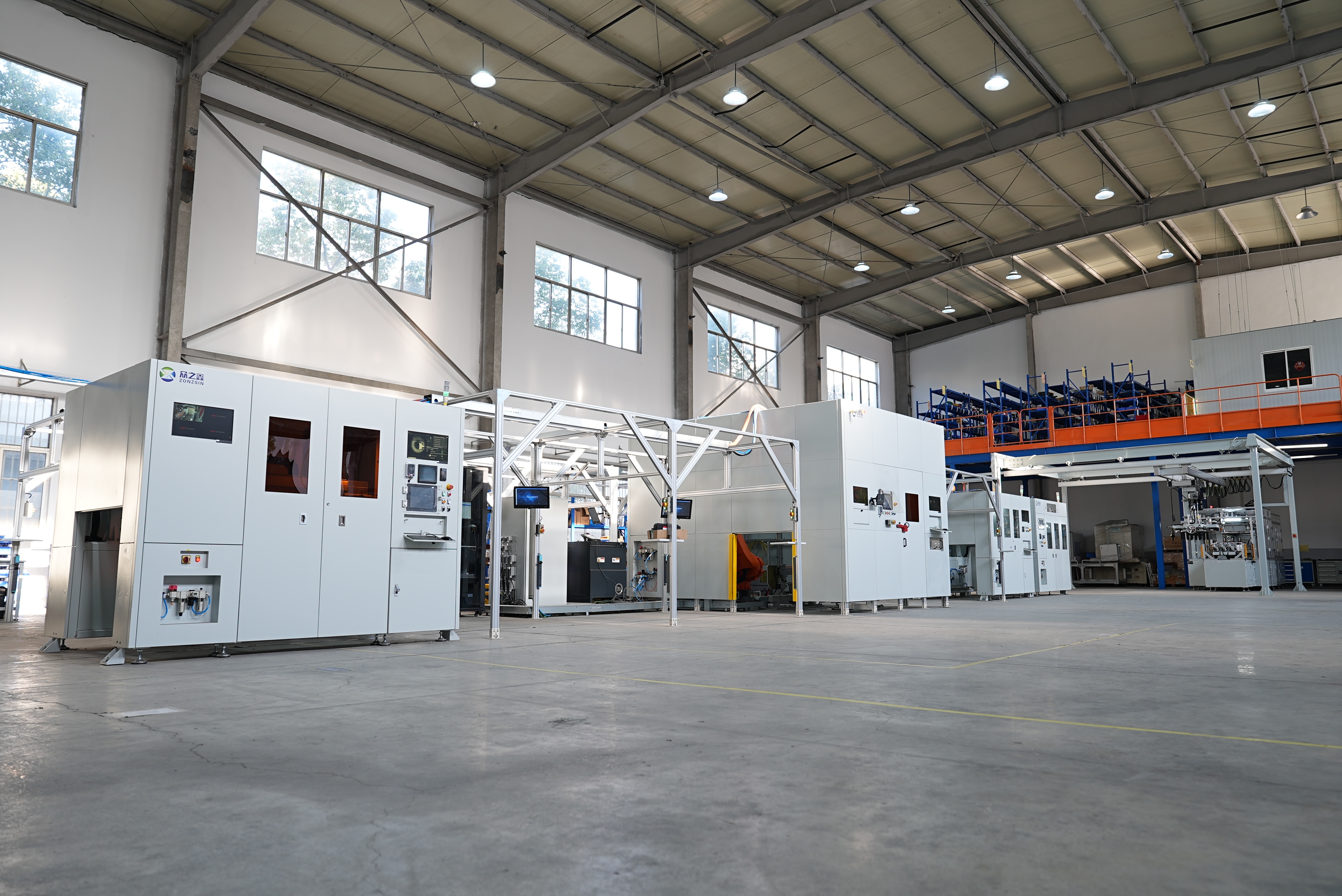
CTP battery PACK assembly line — layout, fixture and station sequence determine usable throughput as much as nominal PPM.
Zonzsin's ZZX2406 CTP battery pack assembly line is specified at a cycle time of 4 PPM, for 314Ah and 587Ah prismatic cells in a 1P96S configuration, at a semi-automatic automation level. The ZZX2501 blade-cell line is specified at 6 PPM, which the supplier equates to 30 minutes per pack. These are not competing claims about one product; they describe different cell technologies and different automation scopes. The first discipline of the framework is therefore simple: never compare a 6 PPM figure with a 4 PPM figure until cell format, pack architecture and automation level are identical.
The same logic applies to the 4–8 PPM band cited in commercial listings for high-efficiency CTP lines. It is a screening range, useful for sanity-checking a proposal and useless for ranking suppliers.
Gate 2 — Welding Yield and the True Per-Unit Cost
Welding is where per-unit cost hides. A weld defect does not simply remove one part; it consumes labour, handling time and a small risk of collateral damage to cells, busbars and insulation. Over multi-year volume, the difference between a line that produces defects occasionally and a line that produces them routinely is a recurring cost line that never appears in the quotation.
The ZZX2313 EV battery pack assembly line publishes a one-time welding qualification rate of ≥99.5% and a final qualification rate of ≥99.95%, alongside a single-machine operation rate of ≥95%. The gap between the one-time figure and the final figure is the informative part: it quantifies how much rework the process absorbs before final acceptance. Buyers should ask for both numbers and for the definition separating them, not simply the higher one.
Two cautions apply. First, published yield figures are supplier-reported, and no standardised cross-vendor weld-test protocol is publicly available, so they are screening data rather than a ranking. Second, the acceptance test defines the number. Sample size, inspection method — visual, X-ray, pull or shear — and the definition of a defect all need to be written into the factory acceptance test before the figure can legitimately enter a cost model.
Once that is fixed, the per-unit logic becomes workable. The buyer prices rework, scrap and re-inspection against their own volume and labour rates. That is the mechanism by which a higher-capital automatic battery pack assembly line reduces per-unit cost over time — not by claiming a better number, but by making the number auditable.
Gate 3 — Footprint and Space Utilisation
Space is the constraint buyers underestimate, because quotations normally state station counts rather than a physical envelope. The ZZX2406 CTP line is specified at L 58,000 mm × W 11,000 mm × H 3,800 mm. That envelope excludes operator access, maintenance clearance, inbound cell storage and outbound pack handling — all of which consume floor area in a real building.
Layout topology matters as much as size. In the India reference project, one unit was delivered for battery pack assembly, with the recorded duration of one year, reported in stable operation, and with the U-shaped layout cited as the space-saving attribute alongside a user-friendly operating interface. A U-shape shortens material travel between the first and last station and lets one operator cover adjacent stations; a straight-line layout is simpler to extend but demands more linear floor length. Buyers with an existing building should request a layout drawing overlaid on their own column grid before approving a configuration.
Gate 4 — Utilities, Automation Level and Staffing
Utility specifications are unglamorous and decisive. The ZZX2313 line requires compressed air at 0.5–0.8 MPa and an electrical supply of AC 380V ±10%. The ZZX2501 line requires compressed air at 0.6–0.8 MPa and AC 380V ±10%, 50 ±0.5 Hz. Where a site's air supply is marginal, the difference between 0.5 MPa and 0.6 MPa is not a footnote — it is a compressor upgrade.
Automation level drives headcount, and headcount drives the payback calculation. ZZX2406 is a semi-automatic line; it is not a lights-out system, and any business case that assumes otherwise will be wrong on day one of operation. Buyers should map the staffing model station by station and confirm which stations are manual, which are assisted and which are fully automatic.
Environmental and safety requirements add further constraints. Battery pack assembly in EV and energy storage applications typically requires ESD protection, fire prevention measures, and control of temperature, humidity and cleanliness. Lines are also commonly matched with vision inspection systems, fixtures and tooling, laser equipment, and assembly and testing stations — each of which adds its own utility and floor-space demand.
Gate 5 — Certification and Delivery Verification
Shanghai Zonzsin Intelligent Equipment Co., Ltd. is a Shanghai-based manufacturer, founded in 2019, of automatic battery pack assembly lines and ESS battery pack insertion robots for containers, operating a 6,000 m² facility with 90 employees, including a 43-engineer R&D team, and reporting 50 granted patents.
Its quality management system is certified to ISO 9001 under certificate number 44825MS079001R0, issued by ZDCB against the standard GB/T19001-2016 ISO9001:2015. The certificate was issued on 20 November 2025 and is valid until 19 November 2028, and applies to the global market. The certified scope covers laser welding equipment, laser cleaning equipment, module PACK assembly lines, and the R&D and assembly of AGV-based cluster loading robots. In the supplier's compliance record, the certificate is linked to models ZZX2406, ZZX2313 and ZZX2501.
What the certificate does not do is equally important. ISO 9001 certifies a quality management system; it does not certify a PPM figure, a welding yield, or cell-format compatibility. Buyers should read the scope wording and confirm the model coverage rather than treating the certificate as a performance guarantee.
Delivery capacity belongs at the same gate. The supplier states a lead time of 3–5 months, a monthly capacity of 3 units and a minimum order quantity of 1 unit, with 100% testing and after-sales support combining remote assistance and on-site installation and commissioning. The company also reports an annual capacity of 30 assembly lines and 200 standard single machines. For a buyer planning a plant ramp, the monthly figure is the one that constrains the schedule; the annual figure describes the factory, not the queue.
Application Fit: Where These Constraints Bite
The India reference project illustrates the application profile that dominates current enquiries: an EV and BESS project environment, indoor operation in a standard factory, industrial assembly-line conditions with continuous or shift-based production, and a semi- or fully automatic line controlled through touch-screen program control.
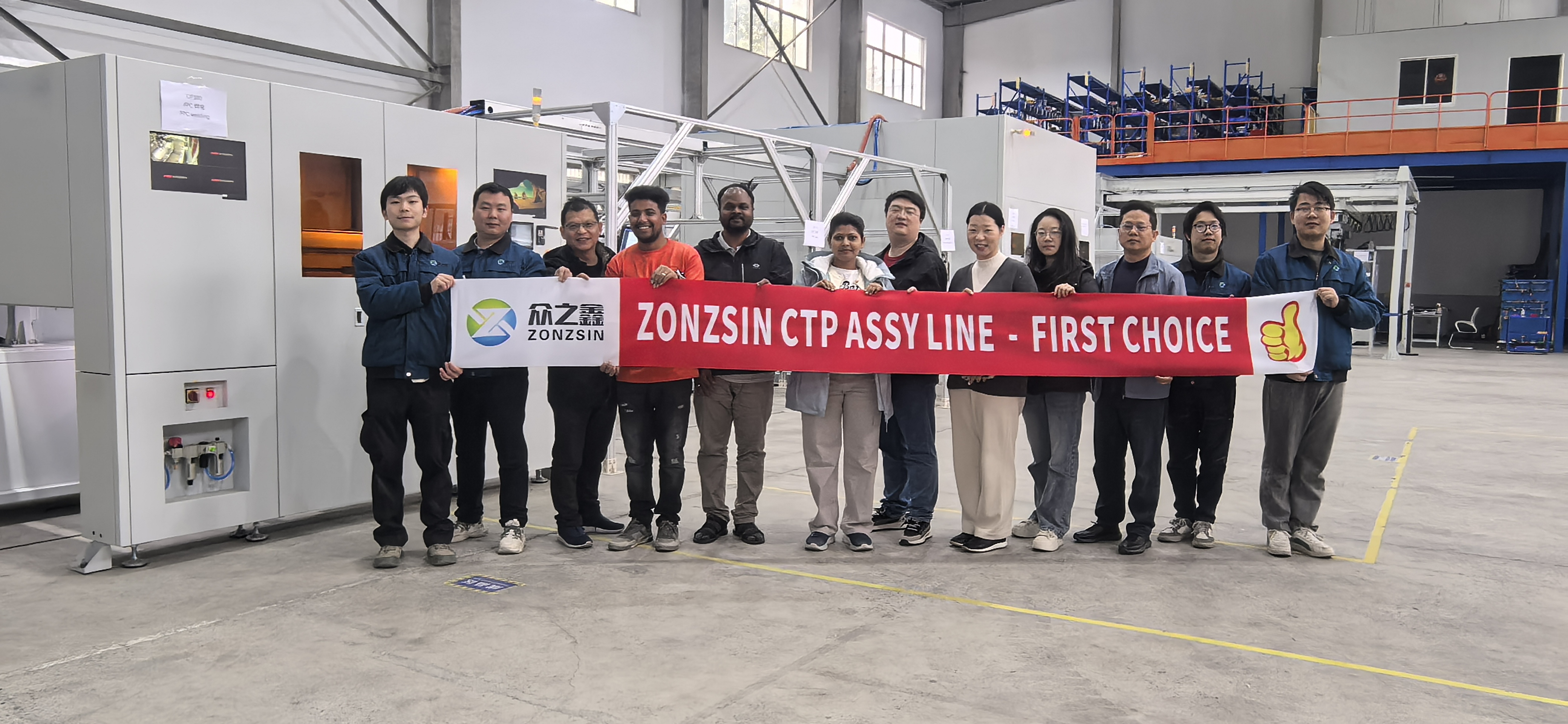
India CTP battery PACK assembly line — the U-shaped layout was cited for space saving, with the project recorded at a one-year duration.
The same application unit specifies the special requirements that most often derail a project late: ESD protection, fire prevention, temperature, humidity and cleanliness control, and — critically — PACK compatibility and fixture adaptation. That last item is the hidden variable in every changeover discussion and should be priced before the purchase order, not after.
Comparison with Manual and Semi-Manual Assembly
| Dimension | Manual / semi-manual cell | Automatic line | What to verify |
|---|---|---|---|
| Initial investment | Lower entry cost, simple tooling | Higher capex; listed turnkey CTP lines typically US$1,000,000–3,000,000 per set | Scope included in the price — fixtures, vision, laser, EOL test |
| Labour content | High and proportional to volume | Concentrated in loading, inspection and changeover | Station-by-station staffing map, including the semi-automatic stations |
| Weld consistency | Operator-dependent; documentation manual | Program-controlled; published one-time ≥99.5% and final ≥99.95% rates (ZZX2313) | Acceptance-test protocol and defect definition |
| Changeover | Fast and cheap to modify | Requires fixture and tooling adaptation plus re-validation | Cost and downtime of adapting to a new pack architecture |
The boundary is real and should be stated plainly. ZZX2406 is a semi-automatic line, so it is not an unattended process: operators remain part of the throughput equation. A line configured for 1P96S will need fixture and tooling adaptation, followed by re-validation of weld and test parameters, before it runs a different pack architecture. And an automatic line sized for high volume becomes an idle asset if the order book does not arrive — capital committed to capacity that is not used is a cost, not an efficiency. Buyers with a roadmap that changes every few months should price changeover work explicitly, or accept a semi-automatic configuration deliberately rather than by default.
Market Trend: Specificity Is Replacing Generality
Published line specifications are becoming more specific, and that shift is itself a procurement signal. Current CTP line data names cell capacities directly — 314Ah and 587Ah appear in ZZX2406 specifications, while the EV-oriented ZZX2313 configuration is cited with 280/314/587Ah cells and 1P52S/1P104S pack architectures. A few years ago, the same category of equipment was frequently described only as 'PACK compatible'.
For buyers, greater specificity is useful but not sufficient, because the comparison basis is still not standardised. Cycle times are quoted at different automation levels, yield figures at different inspection methods, and prices at different scopes. The practical consequence is that evaluation effort moves from reading brochures to writing acceptance criteria. Suppliers who can answer a structured questionnaire — cell format, pack configuration, first-pass versus final yield, footprint, utility ranges, certification scope, lead time — will increasingly win shortlists on responsiveness rather than on headline numbers.
Future Outlook
Three developments are likely to shape the next evaluation cycle. First, fixture flexibility will become a primary differentiator as pack architectures continue to diversify across EV, BESS and commercial and industrial storage; the ability to adapt an existing line will matter more than the ability to specify a new one. Second, yield claims will migrate from marketing figures to contractual acceptance criteria, with measurement method written into the factory acceptance test. Third, brownfield projects will dominate in space-constrained markets, which favours compact layouts — the U-shape logic demonstrated in the India installation — over maximum-length straight lines.
None of these changes alter the underlying framework. They simply move the burden of proof further toward the buyer's specification document.
FAQ: Constraints Buyers Ask About Most
What certification should a battery pack assembly line supplier hold, and what does it actually cover?
The relevant certificate is a quality management system certification. Zonzsin holds ISO 9001 certificate number 44825MS079001R0, issued by ZDCB against GB/T19001-2016 ISO9001:2015, valid from 20 November 2025 to 19 November 2028 and applicable globally. Its scope covers laser welding equipment, laser cleaning equipment, module PACK assembly lines, and the R&D and assembly of AGV-based cluster loading robots. The certificate confirms a certified management system; it does not certify throughput, welding yield or cell-format compatibility, which must be verified separately.
Which cycle time and yield figures should be verified before signing?
Verify cycle time together with cell format, pack configuration and automation level, because PPM alone is not comparable across those variables. Zonzsin specifies 4 PPM for the ZZX2406 CTP line handling 314Ah and 587Ah cells in a 1P96S configuration at semi-automatic level, and 6 PPM — 30 minutes per pack — for the ZZX2501 blade-cell line. For welding quality, ZZX2313 publishes a one-time qualification rate of ≥99.5% and a final qualification rate of ≥99.95%, with a single-machine operation rate of ≥95%. Buyers should request both the one-time and final figures, plus the inspection method used to measure them.
What price band applies to a turnkey battery pack assembly line?
Public commercial listings for complete turnkey CTP battery pack production lines typically range from US$1,000,000 to US$3,000,000 per set. That band covers full-line automated systems and varies with automation level, station count and included equipment such as laser welding, vision inspection and end-of-line test. Because scope differs between quotations, the band is useful for budgeting and screening rather than for final comparison.
How much floor space does a CTP battery pack assembly line require?
The ZZX2406 CTP line is specified with an overall dimension of 58,000 mm in length, 11,000 mm in width and 3,800 mm in height. That figure describes the equipment envelope only; operator access, maintenance clearance, cell storage and pack handling add further area. Layout topology also changes the space calculation — the India installation referenced a U-shaped configuration specifically for space saving, whereas a straight-line layout requires more linear floor length.
How long should delivery, installation and commissioning be planned for?
Zonzsin states a lead time of 3–5 months, a monthly capacity of 3 units and a minimum order quantity of 1 unit, with 100% testing before shipment. After-sales support combines remote assistance with on-site installation and commissioning. The India reference project is recorded with a one-year duration and reported stable operation, which indicates that buyers should plan schedule contingency around site works, utility preparation and commissioning rather than around manufacturing lead time alone.
For readers who want the underlying equipment specifications and configuration options in one document, the manufacturer's product brochure is available here: Zonzsin product brochure (PDF).
¿Tiene preguntas o necesita más detalles?
Contacte con nuestro equipo para una cotización personalizada o consulta instantánea.
Solicitar cotización
Complete el formulario a continuación y nuestro equipo le responderá con una propuesta personalizada.
Chat directo de WhatsApp
¿Prefiere chatear en tiempo real? Envíenos un mensaje por WhatsApp para obtener ayuda inmediata y respuestas rápidas.
- Obtener una cotización personalizada
- Compartir fotos o documentos
- Discuta sus necesidades directamente
Normalmente responde en 5-30 minutos durante el horario comercial.