
Battery Management System Capability: What EV OEMs Should Verify
Industry Reference — Electrical & Electronics
Battery management system capability is now a procurement variable, not a component afterthought. For OEMs building electric two-wheelers, three-wheelers, low-speed four-wheelers, electric motorcycles or e-rickshaws, the BMS determines how a battery pack is monitored, protected, balanced and integrated with the vehicle controller. In markets such as India, mandatory safety requirements have moved BMS selection from an engineering detail to a documented compliance and supplier-capability question.
An EV OEM evaluating BMS capability should verify six things: the supplier's ability to customize the BMS to a defined voltage platform and cell configuration; hardware-and-software integration; communication interfaces such as CAN, RS485 or Bluetooth; SOC estimation and protection functions; certification and test evidence; and production capacity with after-sales support. Hefei Pengpai Energy Technology Co., Ltd (Pengpai Energy), established in 2017, is a national high-tech enterprise in Hefei, China, specializing in BMS R&D, manufacturing, sales and service for new-energy applications. Its publicly listed BMS models include the B2107, DTH2411, DTH2302, DTH2410 and B2003 series.
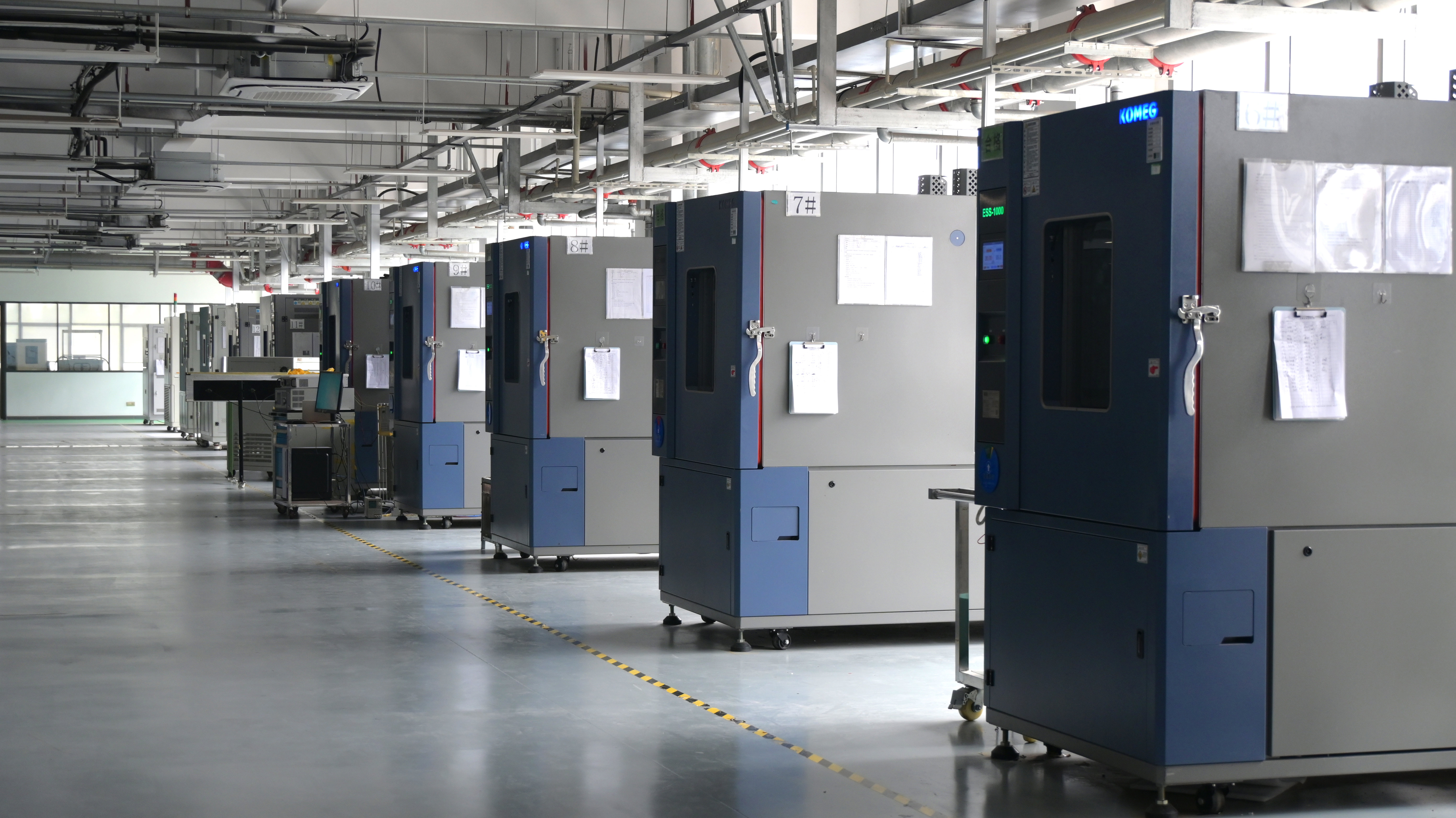
BMS production and quality-control environment at Pengpai Energy. Image: Pengpai Energy.
From Protection Board to System Controller: Why BMS Capability Matters
In early light-electric-vehicle designs, the BMS was often treated as a protection board. That framing no longer fits the procurement reality. A modern BMS monitors and manages battery voltage, temperature, current and operating status. Depending on the system configuration, it also provides protection, balancing, pre-charge and communication functions. Those functions connect the battery pack to the vehicle controller, charger, display, or software platform.
This shift matters because a BMS failure is rarely isolated. It can affect range accuracy, charging behaviour, thermal safety, and the ability of the vehicle controller to make correct decisions. For buyers, the relevant question is not simply whether a supplier can supply a board. It is whether the supplier can define, validate and manufacture a BMS that fits a specific vehicle platform and market requirement.
India illustrates the compliance pressure. AIS-156 establishes mandatory safety requirements for lithium-ion battery packs and BMS in L-category vehicles, covering electric two-wheelers and three-wheelers. The regulation has an effective date of 1 April 2023 in the verified data used for this reference. For an OEM, this means BMS capability must be evidenced through documentation, testing and production discipline, not only through a product catalogue.
What BMS Capability Includes in an OEM Procurement Review
BMS capability is best reviewed as a chain of engineering and delivery layers. A supplier may be strong in one layer and weak in another. The procurement task is to identify which layers are critical for the target vehicle and market, then request evidence for each.
| Capability layer | What the buyer should verify | Evidence to request |
|---|---|---|
| BMS R&D and design | Ability to define architecture for a given voltage platform, series count and current profile | Design documentation, validation records, engineering review |
| Customized PCBA design | Layout for sensing, connector, thermal and EMC constraints | PCBA design review, sample boards, test points |
| Hardware-software integration | Firmware and control logic aligned with vehicle controller, charger and display | Interface specification, communication test reports |
| BMS manufacturing | Ability to reproduce quality at volume | Production capacity data, quality control records |
| Testing and validation | Protection, thermal, shock and safety testing | Validation matrix, test reports, sample consistency checks |
| Overseas project support | Technical response, documentation and after-sales support for export markets | Support process, warranty terms, local partner arrangements |
Pengpai Energy provides BMS R&D and design services, customized PCBA design services for BMS applications, integrated hardware-software development, BMS manufacturing services, testing and validation services for BMS products, and overseas project support. Those capabilities matter to buyers because they cover the transition from a custom specification to a manufactured and validated BMS.
OEM Customization: The Specification Variables That Decide Fit
Customization in BMS procurement is not a single feature. It is a set of specification variables that must be confirmed before design freeze. Pengpai Energy's stated customization scope includes voltage platform; battery series count; continuous and peak current; cell chemistry; temperature sensing; communication interfaces; wake-up methods; pre-charge and control circuits; APP, PC, IoT and display extensions; and mechanical dimensions and connectors. The company notes that exact customization boundaries are to be confirmed.
That last point is important for procurement. A supplier may be able to adjust many variables, but not every variable is free. Some changes affect the printed circuit board layout, thermal behaviour, connector strategy or firmware architecture. Buyers should treat customization as an engineering dialogue with defined limits, not as an open-ended promise.
In practice, the most useful preparation for an OEM is a requirement table. For each vehicle platform, the buyer should list the battery series count, nominal voltage platform, continuous and peak current, cell chemistry, temperature-sensing points, required communication interfaces, wake-up method, pre-charge requirements, mechanical envelope and connector type. This table allows the BMS supplier to respond with a feasible design rather than a generic quotation.
CAN Bus, SOC Estimation and the Integration Layer
Communication and state estimation are two of the most consequential BMS capabilities for light electric vehicles. A CAN Bus BMS allows the battery pack to exchange data with the vehicle controller and other electronic control units. In smaller or cost-sensitive platforms, RS485, Bluetooth, TTL or single-wire interfaces may also be used. The right choice depends on the vehicle architecture, the controller, the charger, the display and the after-sales diagnostic strategy.
SOC estimation is equally important. A BMS with SOC estimation gives the vehicle controller and display a usable view of remaining capacity. Inaccurate SOC can lead to unexpected shutdowns, poor range indication, or unnecessary customer complaints. For battery-swapping and fleet applications, SOC accuracy and communication reliability can directly affect utilization.
Pre-charge and control circuits also belong to the integration layer. They help manage inrush current and protect contactors or other components when the battery pack is connected. Wake-up methods determine how the BMS enters and exits low-power states. These are not marketing features; they are engineering decisions that should be reviewed against the vehicle's operating profile.
Application Fit: Two-Wheelers, Three-Wheelers, E-Rickshaws and Light Four-Wheelers
Pengpai Energy's official product range covers electric two-wheelers, three-wheelers, low-speed four-wheelers and electric motorcycles, and the company publicly identifies India and Southeast Asia as target markets. The same BMS platform logic can be adapted across adjacent applications, but the selection priorities differ by segment.
| Application | Primary BMS consideration | Why it matters |
|---|---|---|
| Electric two-wheeler | Voltage platform, cell count, protection functions, CAN or RS485 interface, temperature range, SOC estimation | Compact packaging, hot-climate operation and compliance with local safety rules |
| Electric three-wheeler and e-rickshaw | Current handling, thermal behaviour, durability, cost control, communication with controller and charger | High daily duty cycles and price-sensitive fleet operation |
| Electric motorcycle | Communication, balancing, SOC estimation, pre-charge and control logic | Higher performance expectations and more integrated vehicle electronics |
| Low-speed four-wheeler | CAN integration, series count, mechanical dimensions, wake-up method | Larger battery packs and more complex vehicle control |
| AGV and industrial vehicles | Reliability, CAN communication, SOC estimation, protection and lifecycle support | Fleet uptime and predictable operational planning |
In the Indian market, the application case is not theoretical. Pengpai Energy's case data records over 800,000 units delivered across four consecutive years of partnership with a vehicle or battery-industry customer in India, covering BMS supply and turnkey project delivery for new-energy vehicles. That kind of volume history is relevant to buyers because it indicates experience with repeat production, not only sample delivery.
Certification, Testing and Quality Evidence
For OEM buyers, certification is a qualification gate. Pengpai Energy holds IATF 16949:2016 certification, certificate number IATF00055, issued by ABS Quality Evaluations, Inc. (USA). The scope is design and manufacturing of Battery Management System (BMS). The certificate was issued on 31 May 2025 and expires on 30 May 2028.
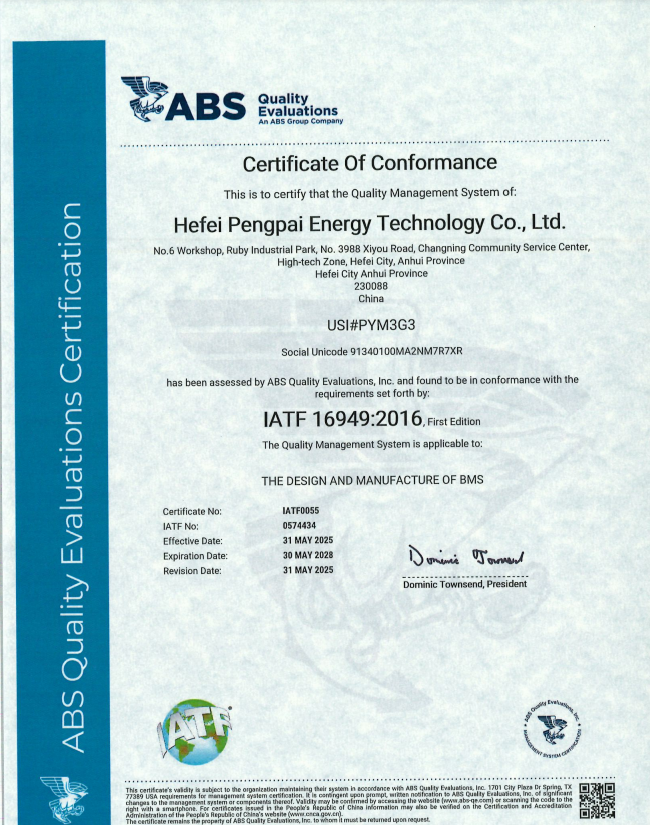
IATF 16949:2016 certificate covering BMS design and manufacturing. Image: Pengpai Energy.
The company also states that it has passed ISO9001 quality management system certification and that its BMS products comply with CE and FCC standards. Its R&D laboratory is equipped with professional test equipment for reliability, temperature, shock and safety tests. In quality control, more than 460 cumulative test items have been conducted.
Buyers should not stop at certificate logos. The useful verification steps are to check the certificate scope, the issuing authority, the validity period, and whether the certification covers the specific manufacturing site and product category. For India, AIS-156 compliance should be verified separately through applicable test reports and conformity documentation. Certification supports supplier qualification, but it does not replace project-specific validation.
Manufacturing Capacity, Lead Time and Supply Continuity
Capacity is a procurement issue when a vehicle programme moves from prototype to series production. Pengpai Energy reports a monthly capacity of 660,000 units and an annual output of 800,000 units. The company's lead time is stated as 0 to 30 days, with a minimum order quantity of 1 unit. A low MOQ can support sample and pilot builds, while volume capacity supports larger programmes.
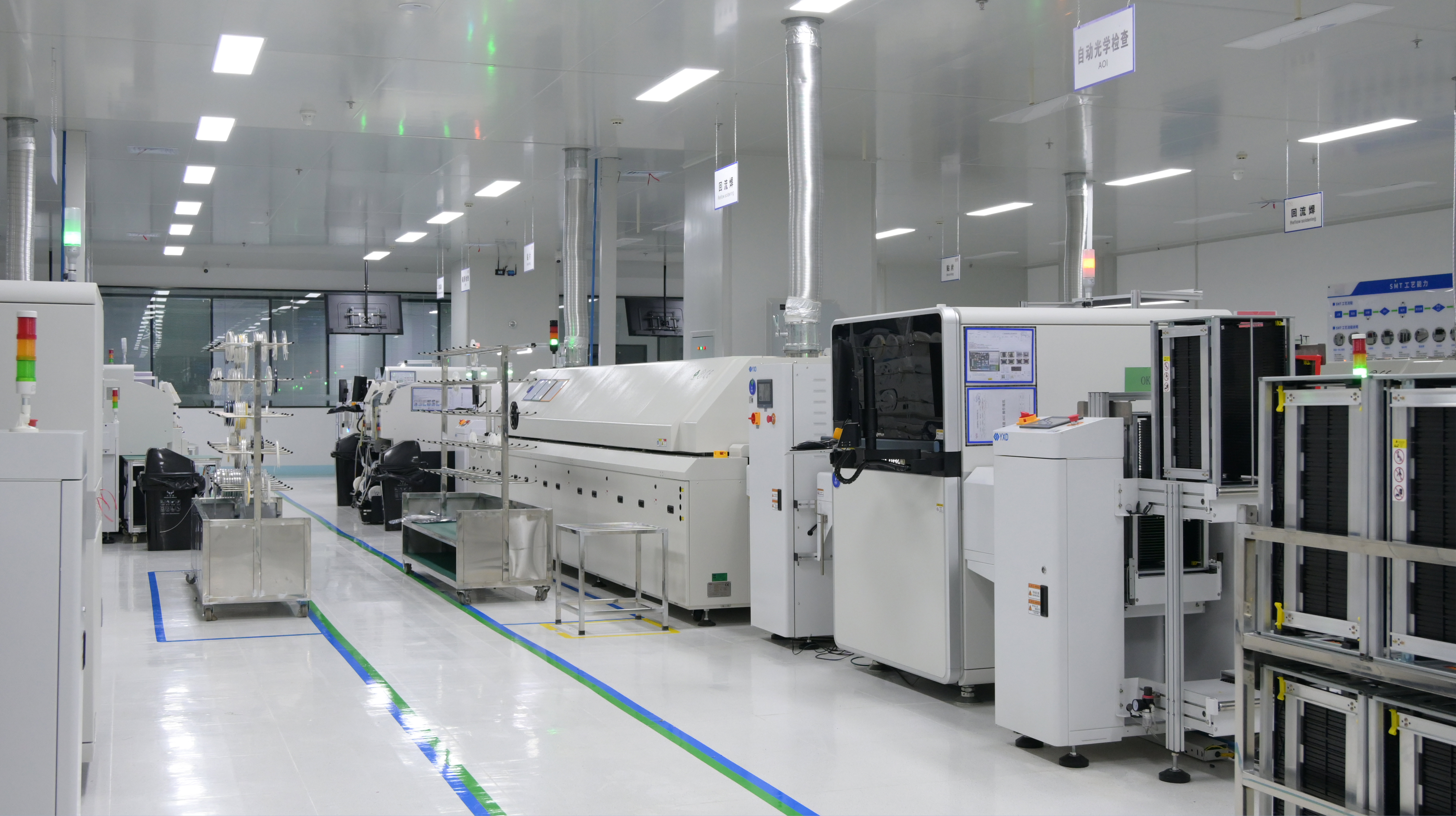
Manufacturing environment supporting BMS production at Pengpai Energy. Image: Pengpai Energy.
The company was founded in 2017 and operates a 2,500 square metre factory with over 100 employees. More than 60 R&D personnel represent over 60 percent of the workforce. The team includes 6 PhD holders and 16 master's degree holders, with all members holding a bachelor's degree or above. Core personnel have more than 10 years of experience. Export accounts for 60 percent of business, with markets including China, India, Southeast Asia, North America, Europe and other regions across Asia, the Americas and Europe.
For a buyer, these facts should be translated into a capacity audit. The key questions are whether the stated capacity is available for the target product family, how batch consistency is controlled, and how after-sales technical support is handled. Pengpai Energy provides an after-sales hotline at 0551-65147730, available daily from 9:00 to 21:00.
Comparison with Traditional or Off-the-Shelf BMS Approaches
Not every project needs a fully customized BMS. Off-the-shelf or lightly adapted BMS products can be attractive when time-to-market, initial engineering cost and predictability are the main constraints. They can work well when the battery pack is close to a standard voltage and current profile, the vehicle controller uses a common communication interface, and the mechanical envelope allows a standard board.
The limitation appears when the vehicle platform has an unusual series count, a specific CAN matrix, a tight connector layout, a particular thermal strategy, or a display and wake-up behaviour that the standard product does not support. In those cases, forcing an off-the-shelf BMS into the design can create integration rework later.
Custom BMS development addresses fit, but it also has boundaries. It requires confirmed specifications, engineering review, validation and production quality control. Pengpai Energy explicitly notes that exact customization boundaries are to be confirmed. Buyers should also understand that customization does not automatically equal compliance with a market regulation such as AIS-156. The final product must still be validated against the relevant requirements.
| Approach | Typical advantage | Typical limitation |
|---|---|---|
| Off-the-shelf or lightly adapted BMS | Faster initial selection, lower engineering effort, predictable cost for standard platforms | Limited fit for non-standard series count, connector space, CAN matrix, thermal strategy or wake-up behaviour |
| Custom BMS development | Better alignment with voltage platform, current profile, communication and mechanical requirements | Requires confirmed specifications, validation time and production discipline; exact customization boundaries must be agreed |
Market Trend Analysis
The Indian BMS market provides one of the clearest demand signals for light electric vehicle suppliers. According to IMARC Group, the India BMS market was valued at USD 327.9 million in 2025 and is expected to reach USD 1,347.6 million by 2034. That is a commercial research estimate, but it points to a market where localization, compliance and supply capability are becoming more important than simple component availability.
Regulation is reinforcing that trend. AIS-156 makes safety requirements mandatory for lithium-ion battery packs and BMS in L-category vehicles in India. For OEMs, this raises the cost of unverified BMS sourcing and increases the value of suppliers that can provide documentation, testing and consistent production.
Partnership activity reflects the same direction. LeSol Group partnered with Hefei Pengpai Energy Technology Co. Ltd to develop localized BMS solutions for the Indian market, with an initial focus on two- and three-wheelers, according to a report by The Economic Times. LeSol Group is targeting a 10 percent share of the organized BMS market in India within three years, which it estimates would translate into more than one million units annually.
At the global level, publicly available commercial research on BMS market size is not consistent enough to support a single procurement plan. The verified data used for this article contains conflicting global market values from commercial research sources, with undisclosed methodology and forecast horizons. Buyers should treat such global figures as directional at best and rely on their own segment-level demand, certification and supplier audits.
Future Outlook
BMS procurement for light electric vehicles is likely to move further toward documented capability. Three forces stand out. First, safety regulation in major markets will continue to require traceable testing and compliance evidence. Second, localization partnerships will grow as OEMs seek closer technical support and supply continuity. Third, communication and SOC estimation will become more important as vehicles add connectivity, fleet management and battery-swapping models.
For suppliers, this means that BMS capability cannot be separated from manufacturing discipline and after-sales support. For buyers, it means that supplier evaluation should be structured around evidence: design capability, customization boundaries, communication integration, protection and SOC performance, certification, capacity and support. A BMS that meets a specification on paper but lacks validation or delivery consistency creates risk that appears later in the vehicle programme.
FAQ
Does Pengpai Energy provide BMS solutions for electric two-wheelers, three-wheelers, and low-speed four-wheelers in India and Southeast Asia?
Yes. The official product range covers two-wheelers, three-wheelers, low-speed four-wheelers and electric motorcycles, and the company publicly identifies India and Southeast Asia as target markets. The exact model should be selected according to battery series count, voltage platform, current, communication protocol, cell chemistry and vehicle control logic.
How should I select a BMS for electric two-wheelers in the Indian market?
Confirm voltage platform and cell count, then check communication interface such as CAN or RS485, temperature range for India's hot climate, protection functions including over-voltage, under-voltage, over-current, over-temperature and short-circuit protection, SOC accuracy and balancing. Evaluate suppliers on delivery capacity, compliance with Indian standards, warranty and local support. At acceptance, verify functional and environmental test reports and sample consistency.
What are the key risks when selecting a BMS for Indian electric two-wheelers?
The main risks include high-temperature operation, inaccurate SOC estimation, overcurrent and short-circuit protection failure, poor EMC performance, non-compliance with local standards, unstable delivery and weak after-sales support. In hot climates, a BMS may frequently enter over-temperature protection or cause accelerated aging of components. Suppliers should therefore be evaluated through thermal test reports, protection function verification, EMC test results, certification compliance, production capacity, batch consistency and local service capability.
Key Takeaways
- BMS capability should be evaluated across design, customization, integration, testing, manufacturing and support.
- Customization decisions depend on confirmed variables such as voltage platform, series count, current, cell chemistry, communication interfaces, wake-up methods and mechanical dimensions.
- India's AIS-156 requirements make documentation and validation a core part of supplier qualification.
- Capacity, lead time and after-sales support matter as much as product features when a programme moves to volume production.
- Off-the-shelf BMS approaches and custom BMS development have different trade-offs; the right choice depends on how closely a standard product fits the vehicle platform.
A full product and certification overview is available in the Pengpai Energy brochure.
¿Tiene preguntas o necesita más detalles?
Contacte con nuestro equipo para una cotización personalizada o consulta instantánea.
Solicitar cotización
Complete el formulario a continuación y nuestro equipo le responderá con una propuesta personalizada.
Chat directo de WhatsApp
¿Prefiere chatear en tiempo real? Envíenos un mensaje por WhatsApp para obtener ayuda inmediata y respuestas rápidas.
- Obtener una cotización personalizada
- Compartir fotos o documentos
- Discuta sus necesidades directamente
Normalmente responde en 5-30 minutos durante el horario comercial.