
Battery Energy Storage Systems: A Commercial Buyer's Guide
Introduction: Battery Energy Storage as a Commercial Investment
Battery energy storage systems (BESS) have become a routine part of commercial and industrial energy management. The IEA Global Energy Review 2026 reports that global new battery storage capacity deployment reached 108 GW in 2025, with LFP batteries accounting for roughly 90% of global battery storage deployments. For facility managers, engineers and procurement teams evaluating energy assets, the practical question has shifted from 'can storage work?' to 'how do we select, size and integrate the right system?'
This article gives an independent, industry-focused overview of battery energy storage systems for commercial and industrial buyers, covering system types, key specifications, project applications, market evidence and the known limitations of the technology.
Why Commercial Facilities Are Adopting Battery Storage
Many commercial and industrial sites face fluctuating facility loads, high peak demand and time-of-use electricity tariffs. In such conditions, a battery storage system can charge during off-peak tariff periods and discharge during peak periods, reducing maximum demand, demand charges and overall electricity costs.
Battery storage also helps facilities with on-site photovoltaic (PV) generation. Because solar output is intermittent and often peaks during the middle of the day, a BESS stores excess solar energy for use in the evening, increasing onsite solar consumption and reducing grid imports. In some configurations it can provide backup power to selected loads when configured with appropriate controls and transfer equipment.
For sites with EV charging infrastructure, battery storage can reduce charging demand peaks, increase available charging capacity and defer costly grid-capacity upgrades. For remote or weak-grid operations, storage can stabilise microgrids, support renewable utilisation and reduce diesel-generator runtime.
What Makes Up a Battery Energy Storage System?
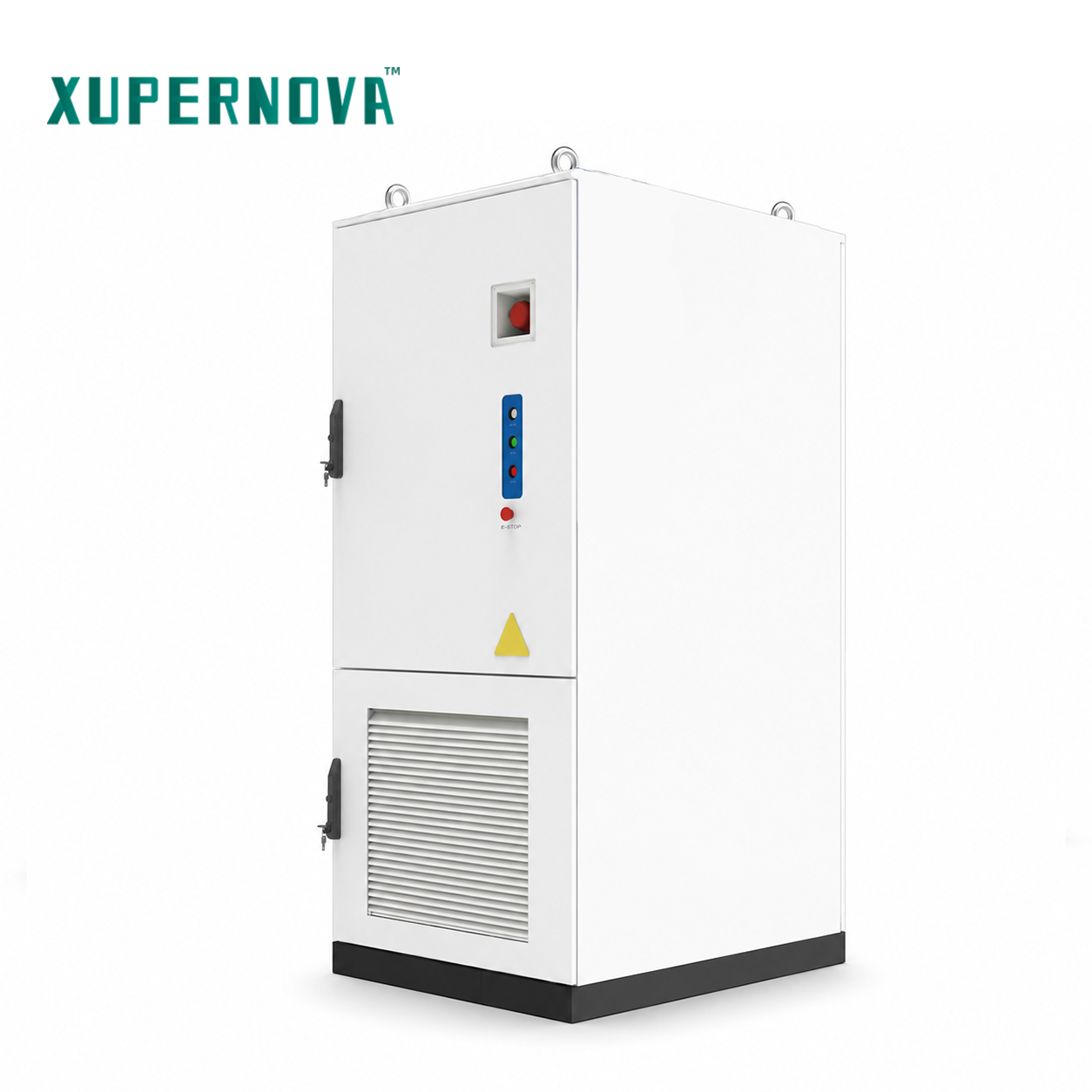
A commercial BESS typically integrates several core components: battery cells, a battery management system (BMS), a power conversion system (PCS), thermal management hardware, an energy management system (EMS) and an enclosure.
- Battery cells store electricity electrochemically. In large-format systems, LFP lithium-ion cells are widely used.
- Battery management system (BMS) monitors voltage, current, temperature and state of charge, and provides protection functions.
- Power conversion system (PCS) converts between DC battery power and AC grid power.
- Thermal management controls battery temperature to maintain performance and safety. Air cooling and liquid cooling are the main approaches.
- Energy management system (EMS) coordinates charging, discharging, PV generation, loads and grid interaction.
- Enclosure protects the system from weather and provides a controlled environment, with outdoor-rated housings common in commercial products.
Some products are cabinet-type systems that fit in small footprints; others are containerized systems that integrate battery, PCS and auxiliary systems in a 10-ft or 20-ft form factor. The main differences are scale, deployment logistics and application fit.
Xupernova: A Manufacturing View of BESS Supply
Xupernova New Energy Technology Co., Ltd. (Xupernova) is a battery energy storage system manufacturer established in 2015. The company is headquartered at the East Gate of Yibin High-tech Industrial Park, Cuiping District, Yibin City, Sichuan Province, China. It operates a manufacturing facility covering 700,000 m², employs more than 500 people and has an annual production capacity above 5 GWh. More than 150 engineers work in its R&D team, supported by an independent R&D lab, dedicated design team, in-house production and advanced testing facilities.
Around 90% of Xupernova's sales are exported to markets including Europe, North America, South America, the Middle East and Asia. The company supplies energy storage systems for commercial and industrial (C&I) applications, utility-scale projects, mobile energy storage charging systems and integrated solar-storage solutions.
The current product portfolio includes air-cooled and liquid-cooled cabinets, containerized systems and dedicated battery containers. The table below summarises representative products and their published specifications.
| Model | Form Factor | Rated Power | Energy Capacity | Cooling | Target Applications |
|---|---|---|---|---|---|
| XA-H0064-A1 | Air-cooled solar-plus-storage cabinet | 25–50 kW | 64.54 kWh | Air | Small-scale C&I solar-plus-storage |
| XA-C0261-L1 | Liquid-cooled all-in-one ESS cabinet | 125 kW | 261.25 kWh | Liquid | Commercial & industrial energy storage |
| XA-H0261-L1 | Liquid-cooled solar-plus-storage cabinet | — | 261 kWh | Liquid | C&I solar-plus-storage, microgrids |
| XA-X1044-L1 | 10-ft liquid-cooled all-in-one ESS container | 500 kW | 1044 kWh | Liquid | C&I storage, microgrids, backup power |
| XA-X2170-L2 | 20-ft liquid-cooled all-in-one ESS container | 1125 kW | 2170.3 kWh | Liquid | C&I and grid-side energy storage |
| XA-V5015-L1 | 20-ft liquid-cooled battery container | — | 5.015 MWh | Liquid | Power generation, grid storage, C&I storage |
All listed systems support C-rates of 0.5P, 1P and 2P, have an IP55 protection level and operate in temperatures from -30°C to 55°C. They use Grade A LFP lithium-ion cells from BloombergNEF Tier 1 energy-storage cell manufacturers. Depending on project requirements, technical validation and availability, Xupernova also offers optional semi-solid-state, solid-state and sodium-ion battery technologies.
How to Evaluate BESS Specifications
From a procurement perspective, the most important technical parameters are energy capacity, power rating, C-rate, cooling architecture, protection rating, operating temperature range, cell quality and safety design.
- Energy capacity (kWh) determines how much electrical energy can be stored. Buyers should match it to the target load profile and required discharge duration.
- Power rating (kW) determines how fast energy can be delivered. A system with too little power may not cover peak demand.
- C-rate expresses the discharge or charge rate relative to capacity. A 0.5P system discharges half its energy capacity per hour; a 1P system discharges its full capacity in one hour; a 2P system in 30 minutes.
- Cooling architecture affects performance and lifespan. Liquid cooling generally provides more consistent temperature control in high-density systems.
- Protection rating and temperature range indicate suitability for outdoor deployment and climate conditions. IP55 is common for outdoor cabinets and containers.
- Cell quality matters for cycle life and safety. Xupernova specifies Grade A LFP cells from BloombergNEF Tier 1 manufacturers.
- Safety features should include BMS protection, thermal monitoring, emergency shutdown and fire-suppression measures.
Fire safety is a central consideration in BESS projects. Energy-storage systems face fire and thermal-runaway risks. Standard mitigation used in Xupernova systems includes multi-level temperature monitoring, BMS protection, liquid cooling, automatic alarm and emergency shutdown. The company also adopts LFP cells, smoke and temperature detection, pack-level and cluster-level aerosol fire suppression, a water fire-fighting interface, and controls cell temperature difference within 3°C for applicable liquid-cooled models.
Commercial Applications and Use Cases
The table below maps common project types to the functions battery storage can perform, based on typical global deployment scenarios.
| Application Scenario | Primary Function | Operation Mode |
|---|---|---|
| C&I peak shaving and time-of-use energy arbitrage | Reduce maximum demand, demand charges and electricity costs | Charge during off-peak periods, discharge during peak periods via automatic EMS |
| Solar-plus-storage and PV self-consumption | Store excess PV, increase onsite solar consumption, reduce grid imports | Automatic PV, battery, load and grid coordination; daytime solar charging and evening discharge |
| EV charging and grid capacity support | Reduce charging demand peaks, increase available charging capacity, defer grid upgrades | Coordinate grid, solar, battery and EV loads through EMS |
| Remote mining microgrid and diesel optimisation | Stabilise microgrid, reduce diesel runtime, support renewable utilisation | Coordinated PV, battery, diesel generator and load scheduling |
| Utility-scale renewable integration | Renewable shifting, peak regulation, frequency support, power smoothing | Plant-level EMS control based on grid dispatch and market signals |
| Critical-load backup power | Maintain power for critical loads and improve energy resilience | Grid-connected operation with automatic transfer to islanded backup when configured |
Each project type creates different requirements. An EV charging site might need high power for short durations, while a manufacturing plant may need longer duration to cover an evening peak. A microgrid project may require grid-forming control and black-start capability. These differences explain why system selection must start with a load assessment rather than a generic product choice.
Market Trends Shaping Battery Storage Procurement
Multiple data points point to continued expansion of battery storage markets. The IEA reports 108 GW of new battery storage capacity was deployed globally in 2025. LFP chemistry accounted for approximately 90% of deployments. In the United States, the Energy Information Administration projected utility-scale battery storage capacity growth of 19.6 GW in 2025.
Market size estimates vary significantly depending on definition. MarketsandMarkets values the global BESS market at $50.81 billion in 2025. Other research providers produce lower figures because they define the market differently, such as battery equipment only rather than the full system including PCS, EMS and civil work. Buyers should treat market-size numbers as directional rather than precise.
Cost is also declining. Ember reports that all-in project CAPEX for long-duration (4h+) utility-scale battery storage reached $125/kWh in late 2025. Lower CAPEX improves business-case viability for commercial projects, though system economics still depend strongly on local tariffs, load patterns, grid-connection rules and financing conditions.
BESS vs Traditional Energy Solutions
Commercial facilities have historically managed peak demand and outages with grid-capacity upgrades, diesel generators or static UPS systems. Battery storage offers an alternative with shorter construction times, modular scaling, no fuel logistics and the ability to participate in demand management and solar integration.
- Grid upgrade can increase available capacity but often involves long lead times and high capital cost.
- Diesel generator can provide backup energy at relatively low capital cost per kWh, but creates emissions, fuel supply and maintenance burdens.
- Battery storage provides fast response, clean operation and multiple revenue or saving streams, but has higher upfront cost per kWh than a simple generator and requires electrochemical lifecycle management.
There are genuine limitations. A battery storage system is not always a drop-in replacement for long-duration backup power. Sizing for extended multi-day outages may require a very large battery bank, which raises capital cost; in practice, many sites combine storage with a generator. Grid-connection approval, protection coordination, fire-safety compliance and local regulation can also affect project timelines. The business case depends on the facility load profile and tariff structure, so projects need site-specific analysis before purchase.
Future Outlook for Commercial Battery Storage
The next phase of commercial BESS development is likely to be shaped by lower system costs, longer-duration applications and battery technology diversification. LFP remains the dominant chemistry, supported by safety and cycle-life characteristics. At the same time, semi-solid-state, solid-state and sodium-ion battery technologies are emerging as optional alternatives for specific project requirements, subject to technical validation and commercial availability.
Software and EMS intelligence will become more important as storage is paired with solar, EV charging and dynamic electricity pricing. Modular architectures and containerized form factors are expected to remain popular because they simplify deployment, shipping and scalability for commercial, industrial and grid-side projects.
Frequently Asked Questions
How to select the right battery energy-storage system for my project?
You need to confirm required capacity, power rating, cooling mode and application scenarios. Providers such as Xupernova offer multiple product series including container-type liquid-cooled ESS and cabinet-type air-cooled or liquid-cooled ESS for utility-scale, commercial-industrial and solar-plus-storage scenarios. A qualified supplier should help match system specifications to the site load profile, space constraints and operating environment.
What are the fire-safety risks for energy-storage battery systems?
Energy-storage systems face fire and thermal-runaway risks. Mitigation measures include multi-level temperature monitoring, BMS protection, liquid cooling, automatic alarm and emergency shutdown, combined with fire-suppression hardware. For applicable liquid-cooled models, controlling cell temperature difference within 3°C further reduces thermal risk. Buyers should verify that the selected system includes appropriate detection, suppression and shutdown features for the project site.
For a more detailed technical overview of the Xupernova energy storage product range, the company publishes a publicly accessible product catalog: XUPERNOVA Energy Storage Product Catalog.
¿Tiene preguntas o necesita más detalles?
Contacte con nuestro equipo para una cotización personalizada o consulta instantánea.
Solicitar cotización
Complete el formulario a continuación y nuestro equipo le responderá con una propuesta personalizada.
Chat directo de WhatsApp
¿Prefiere chatear en tiempo real? Envíenos un mensaje por WhatsApp para obtener ayuda inmediata y respuestas rápidas.
- Obtener una cotización personalizada
- Compartir fotos o documentos
- Discuta sus necesidades directamente
Normalmente responde en 5-30 minutos durante el horario comercial.