
Battery Energy Storage System Shortlists for Critical Facilities and Mining Microgrids
Two procurement teams can start from the same headline requirement — a battery energy storage system of a stated capacity — and end up with shortlists that share almost nothing. A hospital or data center operator is buying what happens in the minutes after a grid fault. A remote mine operator is buying what happens across years of diesel consumption, motor starts and dust.
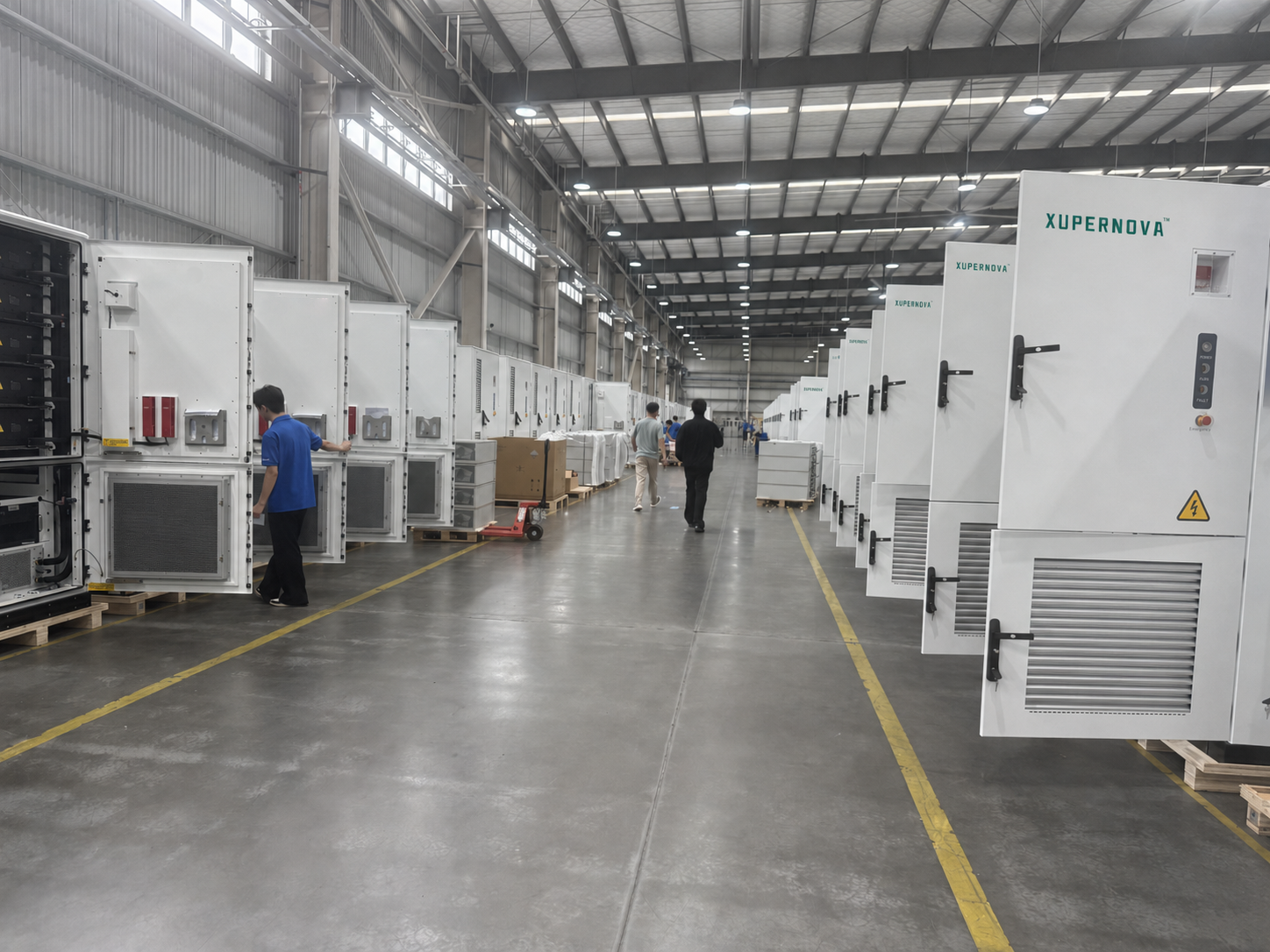
Energy storage integration environment: cabinet and container BESS platforms are assembled and tested before site delivery.
Global deployment has made the category easier to source and harder to specify. The IEA's Global Energy Review 2026 reports 108 GW of new battery storage capacity commissioned in 2025, and the same review states that LFP batteries accounted for approximately 90% of global battery storage deployments in that year. When nearly every serious supplier offers LFP cells, differentiation moves downstream — to islanding protection, spinning reserve, thermal and dust protection, certificate scope, and the practical ability to service a site that is nowhere near a port.
Why one BESS category produces two shortlists
Battery energy storage systems are sold as a category but procured as an operating duty. The duty decides which parameters become screened criteria and which become negotiable.
For hospitals, data centers, government facilities and emergency services, the defining condition is critical loads requiring continuous power supply during grid outages and emergencies. The shortlist question is therefore not "how many megawatt-hours" but "which loads stay energized, for how long, and through what sequence of switching."
For mining, remote industrial sites and off-grid facilities, the defining condition is weak-grid or off-grid operation with unstable power supply, high diesel consumption and large motor-starting loads. The shortlist question becomes how much diesel runtime the battery can remove, how the microgrid responds when a large motor starts, and whether faults can be diagnosed remotely.
The two duties pull the same product family in opposite directions. A backup-driven shortlist tolerates a lower C-rate and prioritizes transfer equipment. A microgrid-driven shortlist is often sized by power rather than energy, because the battery must hold reserve and absorb starting transients that a diesel-only site previously handled with spinning machines.
Step 1 — Convert the application into a constraint envelope
Before any model appears on a shortlist, the buyer should fix the constraint envelope below. It is the same envelope in both applications, filled in differently.
| Constraint dimension | Critical-facility shortlist | Mining microgrid shortlist |
|---|---|---|
| Primary duty | Maintain supply to selected critical loads during outages; reduce outage impact and improve facility energy resilience | Stabilize the microgrid, reduce diesel-generator runtime, support renewable utilization and improve power reliability |
| Control capability | Grid-forming PCS with automatic transfer to islanded backup operation | Grid-forming control with automatic source scheduling across PV, battery, diesel and loads |
| Transfer and isolation | STS or EPS cabinet, critical-load distribution panel, switchgear, UPS for zero-interruption loads | Microgrid controller, load-management system, transformer, switchgear, plant-level EMS and communication network |
| Starting and transient behavior | Black-start strategy, islanding protection, defined backup duration | Motor-starting analysis and spinning-reserve strategy |
| Environmental protection | Fire-safety compliance; indoor or sheltered placement typical | High-temperature and dust protection at exposed or semi-exposed sites |
| Service model | Emergency response plan; local service response | Remote O&M and remote diagnostics |
| Compliance focus | Grid-code and fire-safety sign-off; national connection rules | Grid-code compliance plus site-level environmental assessment |
Filling this envelope first prevents the most common shortlisting error: comparing suppliers on energy capacity while the actual constraint sits in transfer equipment, reserve strategy or enclosure protection.
Step 2 — Shortlisting for critical facilities
Critical-load backup and energy resilience is a defined application class covering hospitals, data centers, government facilities and emergency services. Its operational pattern is grid-connected operation under normal conditions, with automatic transfer to islanded backup operation during grid outages when the system is configured with grid-forming PCS and STS/EPS.
Three requirements separate a credible shortlist from a datasheet comparison:
- Critical-load assessment and backup duration. The shortlist should state which circuits are protected and for how long. Energy capacity is derived from that list, not chosen first.
- Islanding protection and black-start strategy. Islanding protection is a specified requirement, and black-start capability must be documented as a strategy rather than assumed from the presence of a battery.
- Emergency response plan and fire-safety compliance. These are procurement deliverables, not post-commissioning formalities.
The matched equipment list for this application — STS or EPS cabinet, critical-load distribution panel, grid-forming PCS, transformer if required, switchgear, UPS for zero-interruption loads, EMS and an optional diesel generator — explains why a cabinet-class product often fits better than a container. A 125 kW / 261.25 kWh liquid-cooled all-in-one ESS cabinet, for example, is designed for commercial and industrial energy storage and can be placed close to the load it protects.
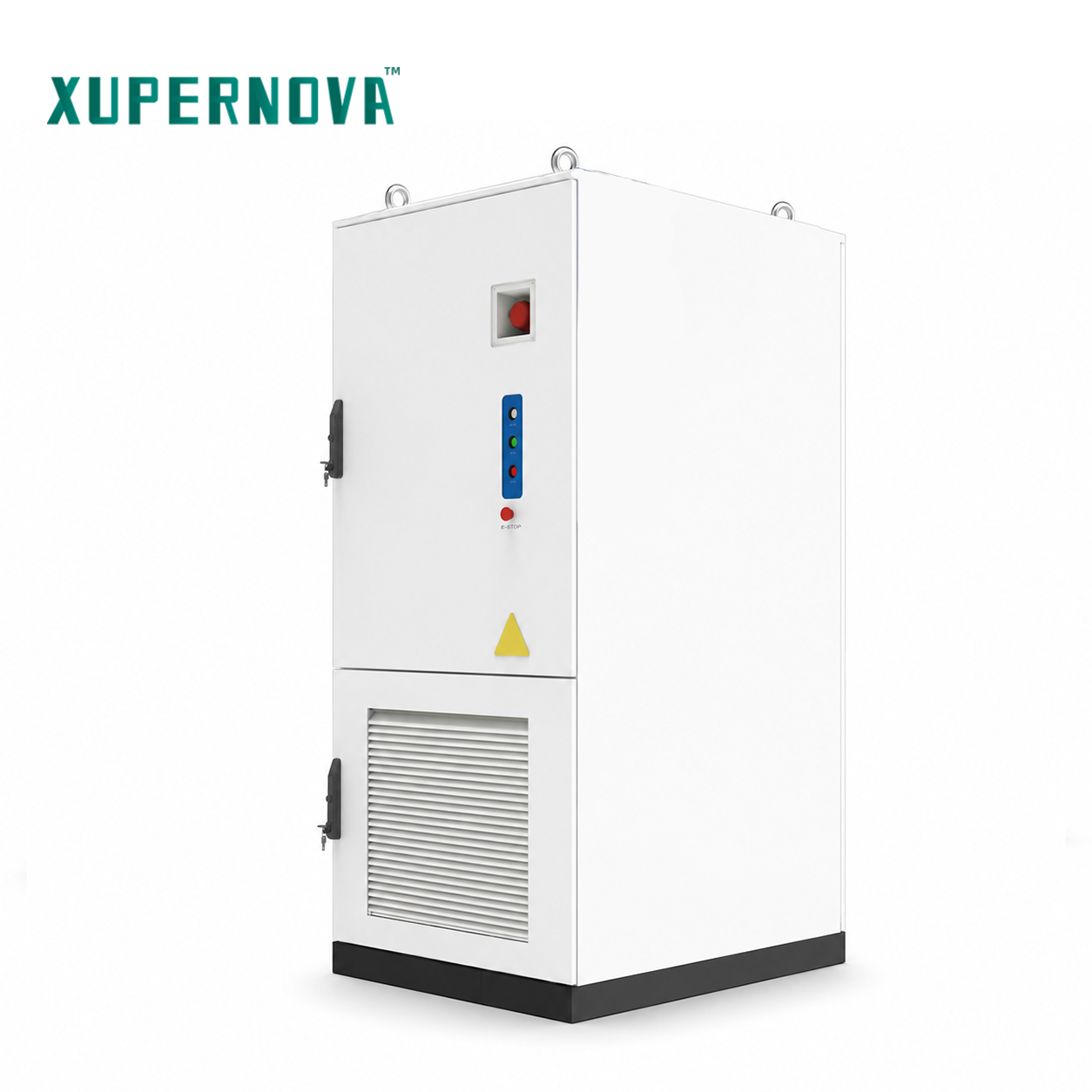
Cabinet-class BESS: a 261 kWh liquid-cooled all-in-one cabinet class is commonly shortlisted where the protected load is concentrated on one site.
Step 3 — Shortlisting for remote mining microgrids
Remote mining microgrid and diesel optimization is a different application class, covering mining, remote industrial sites and off-grid facilities. The operating mode is coordinated operation of solar PV, battery storage, diesel generators and loads, using grid-forming control and automatic source scheduling.
Its special requirements read like a rejection list for generic BESS proposals:
- Site load study and motor-starting analysis. Large motor-starting loads usually set the power rating of the battery, not the daily energy balance.
- Spinning-reserve strategy. The battery has to hold enough online reserve to cover the loss of a running diesel generator without collapsing the microgrid.
- High-temperature and dust protection. Exposed sites demand enclosure and cooling decisions that a sheltered data center room does not.
- Black-start capability and remote O&M. Restarting a dead microgrid and diagnosing faults without flying engineers to site are both design requirements, not support promises.
Container platforms dominate this shortlist because the equipment list grows to include solar PV, diesel generators, grid-forming PCS, a microgrid controller, transformer, switchgear, load-management system, plant-level EMS and a communication network. A 10-ft liquid-cooled all-in-one ESS container rated 500 kW / 1044 kWh — a 1 MWh-class unit designed for commercial and industrial energy storage, microgrids and backup power — is the scale at which these interfaces typically become practical.
Step 4 — Where both shortlists converge
Below the application layer, the two shortlists share the same technical baseline. Any candidate system should be evaluated against these points, because they apply whether the site is a hospital campus or a pit head.
| Shared criterion | What to record on the shortlist |
|---|---|
| Cell sourcing and chemistry | Grade A LFP lithium-ion cells from BloombergNEF Tier 1 energy-storage cell manufacturers; optional semi-solid-state, solid-state and sodium-ion technologies are subject to project requirements, technical validation and availability |
| Enclosure protection | IP55 outdoor protection claimed across the cabinet and container platforms offered |
| Operating temperature | Declared operating range of -30°C to 55°C across the referenced models |
| C-rate options | 0.5P, 1P and 2P supported, matching the duty to the discharge window rather than defaulting to a single rating |
| Cooling architecture | Liquid-cooled cabinets and containers for larger capacities; air-cooled cabinet for small-scale solar-plus-storage |
| Control and monitoring | Plant-level EMS, remote monitoring, communication protocols and grid-code configuration |
Product platforms that map to these two shortlists
Xupernova New Energy Technology Co., Ltd. (Xupernova) is a China-based energy storage and new energy solutions provider founded in 2015, operating a 700,000 m² manufacturing footprint with 500+ employees, 150+ R&D engineers and 5 GWh+ annual capacity. Its stated export share is approximately 90%, with markets across Europe, North America, South America, the Middle East and Asia.
| Model | Product | Type | Rated power / energy | Shortlist fit |
|---|---|---|---|---|
| XA-C0261-L1 | Commercial & Industrial Energy Storage System | Liquid-cooled all-in-one ESS cabinet | 125 kW / 261.25 kWh | Critical-facility and C&I backup close to the protected load |
| XA-H0261-L1 | Solar-plus-storage Energy Storage System | Liquid-cooled solar-plus-storage cabinet | 261 kWh, 0.5P/1P/2P | Microgrid and solar-plus-storage configurations |
| XA-H0064-A1 | Solar-plus-storage Energy Storage System | Air-cooled solar-plus-storage cabinet | 25–50 kW / 64.54 kWh | Small-scale C&I solar-plus-storage, distributed siting |
| XA-X1044-L1 | Containerized Battery Energy Storage System | 10-ft liquid-cooled all-in-one ESS container | 500 kW / 1044 kWh | Microgrid, backup power and multi-source interfaces |
| XA-X2170-L2 | Containerized Battery Energy Storage System | 20-ft liquid-cooled all-in-one ESS container | 1125 kW / 2170.3 kWh | Larger C&I and grid-side energy storage |
| XA-V5015-L1 | Battery Energy Storage System | 20-ft liquid-cooled battery container | 5.015 MWh | Grid-scale and large-site energy storage blocks |
All six referenced models declare Grade A LFP lithium-ion cells from BloombergNEF Tier 1 energy-storage cell manufacturers, an IP55 protection level and an operating range of -30°C to 55°C.
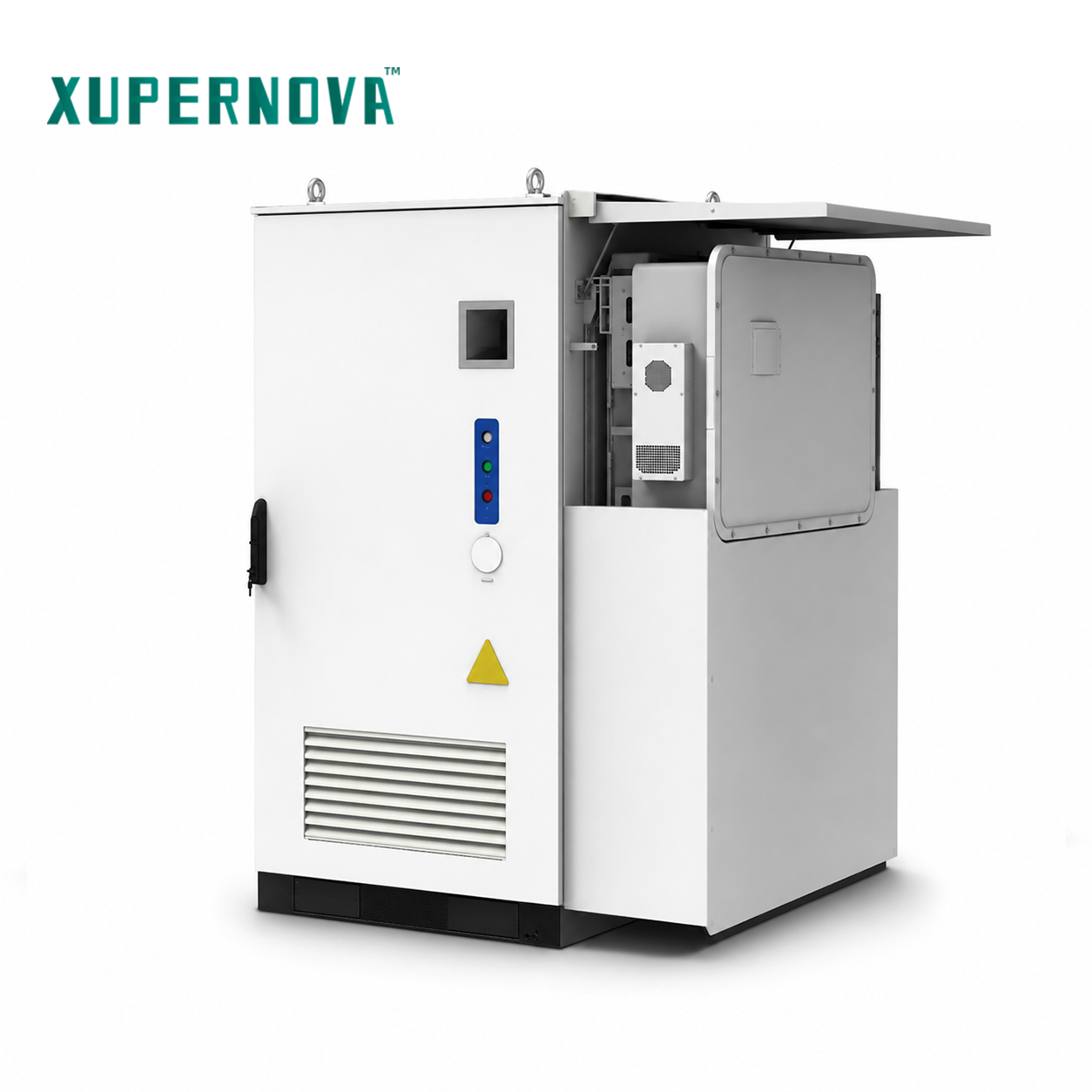
Solar-plus-storage cabinets combine PV input, battery storage and EMS coordination — the configuration pattern remote microgrids and solar self-consumption sites both rely on.
Technical explanation: what the parameters actually constrain
Energy capacity answers a duration question. Power rating answers a transient and motor-starting question. Confusing the two is the most expensive shortlisting mistake in both applications.
C-rate is where that distinction becomes visible. Across the referenced platforms, 0.5P, 1P and 2P are the declared options. A 0.5P configuration discharges the rated energy over roughly two hours, 1P over roughly one hour and 2P over roughly half an hour. A mining microgrid that must cover motor-starting transients and hold spinning reserve usually needs the higher-power end of that range, while a critical-facility backup with a defined overnight duration often lands closer to 0.5P with a larger energy block.
Cooling architecture follows the same logic. Liquid-cooled cabinets and containers — the 125 kW / 261.25 kWh cabinet, the 500 kW / 1044 kWh 10-ft container, the 1125 kW / 2170.3 kWh 20-ft container and the 5.015 MWh battery container — are designed for continuous cycling and dense packaging. The air-cooled XA-H0064-A1, at 25–50 kW / 64.54 kWh, is designed for small-scale commercial and industrial solar-plus-storage where simplicity and maintenance access matter more than energy density.
Cell sourcing is a shortlisting filter rather than a marketing point. All referenced models specify Grade A LFP lithium-ion cells from BloombergNEF Tier 1 energy-storage cell manufacturers. Optional semi-solid-state, solid-state and sodium-ion battery technologies are available, but explicitly subject to project requirements, technical validation and availability — which means they should be treated as a validation track on the shortlist, not a delivered specification.
Certification and grid-code constraints
Certification is the constraint dimension most often shortlisted incorrectly, because a certificate names both a model and a market. The following documents all apply to the Energy Storage System model ECO-E261LP-2A and were issued by TÜV SÜD Product Service GmbH:
| Certification | Standard | Certificate number | Market |
|---|---|---|---|
| IEC 63056:2020 Product Certificate | IEC 63056:2020 | B 125581 0022 Rev. 01 | Global |
| LVD Attestation of Conformity | EN 62477-1:2012/A12:2021 | N8A 125581 0024 Rev. 00 | EU |
| EMC Attestation of Conformity | EN IEC 61000-6-4:2019; EN IEC 61000-6-2:2019 | E8A 125581 0023 Rev. 00 | EU |
| CEI 0-21 Compliance Document | CEI 0-21:2022/V2:2024 | D 125581 0027 Rev. 00 | Italy |
| CEI 0-16 Compliance Document | CEI 0-16:2022/V3:2024 | D 125581 0028 Rev. 00 | Italy |
The certificate scope is instructive. The LVD and EMC attestations cover a system described as 125 kW, 261.248 kWh and IP55, while the IEC 63056:2020 certificate covers a rechargeable Li-Ion battery system with a stated DC 832 V and 314 Ah configuration. A buyer shortlisting for a specific market should record which certificate names which model and which electrical rating, because a market-specific grid-code document for one country does not travel to another.
Grid-code compliance appears as an explicit special requirement in several application classes: coordinated PV–battery control and grid-code compliance for solar-plus-storage; local grid-code compliance and protection coordination for utility-scale integration; and grid-connection approval for C&I peak shaving. In practice, this makes grid-code readiness a screening question rather than a late-stage formality.
Application evidence from deployed configurations
The clearest way to test a shortlist is against configurations that already combine the interfaces each application needs.
| Configuration | Scale | Application | Relevant interface evidence |
|---|---|---|---|
| Supermarket and retail facility operator | 125 kW / 261.248 kWh, 50 units, 1 year | Peak shaving, time-of-use energy arbitrage and photovoltaic self-consumption | Compact all-in-one liquid-cooled design, single-unit deployment, low onsite installation workload, remote monitoring, compatibility with Italian grid requirements |
| Commercial and industrial park operator | 1 MW / 2.088 MWh, 12 units, 7 years | Solar-plus-storage microgrid, emergency backup power and diesel generator optimization | Integrated STS, grid-connected and off-grid switching, photovoltaic and diesel generator interfaces, centralized energy management |
| Industrial manufacturing enterprise | 1 MW / 2.09 MWh, 20 units, 2 years | Peak shaving, time-of-use energy arbitrage and demand management | All-in-one liquid-cooled design, plant-level EMS, modular deployment, IP55 protection, compatibility with German grid requirements |
| Renewable energy project developer | 2 MW / 4.176 MWh, 7 units, 4 years | Renewable energy shifting, grid balancing, peak shaving and backup power | Compact 10-ft container design, integrated PCS/BMS/EMS, liquid cooling, multi-source access, G99 grid-code compatibility |
For a mining microgrid shortlist, the second configuration is the closest structural reference: it combines integrated STS, grid-connected and off-grid switching, photovoltaic and diesel generator interfaces, and centralized energy management in one architecture. Its reported outcome — improved critical-load power continuity, increased solar utilization and reduced diesel generator operating time — is exactly the outcome pattern a remote site is buying. For a critical-facility shortlist, the same configuration supplies the transfer and self-consumption logic, while the cabinet-class deployments show how distributed siting is handled at single-unit granularity.
Manufacturing and customization constraints
Shortlisting closes faster when the customization scope is known before quotations are compared. Xupernova operates an OEM/ODM model with a stated monthly capacity of up to 500 MWh/month, a minimum order quantity of 1 unit, and lead times of 25–35 days for standard BESS and 35–60 days for customized projects.
The customizable parameter set is broad enough to cover both shortlists: system power and energy capacity; charge/discharge duration; AC/DC voltage; battery chemistry and cell supplier; PCS, BMS and plant-level EMS; photovoltaic input and solar-plus-storage configuration; on-grid/off-grid operation; STS/EPS backup function; cooling system; fire protection system; enclosure size, color and branding; IP rating and corrosion protection; grid code; communication protocols; transformer and switchgear configuration.
Quality control covers 100% factory acceptance testing, electrical safety testing, functional testing, aging testing and third-party inspection availability. After-sales support includes 24/7 remote support, commissioning, training, diagnostics, spare parts and optional onsite service — a directly relevant point for the remote O&M requirement in mining microgrids and for the emergency response plan in critical facilities.
Comparison with traditional solutions — and where BESS stops
Diesel generation remains the incumbent in both applications, and the honest comparison is not storage versus diesel but storage plus diesel versus diesel alone. In the referenced C&I park configuration, the battery, PV and diesel generator operate as coordinated sources, and the reported result was reduced diesel generator operating time rather than diesel removal. That framing matters for procurement: the battery's job is to displace runtime and stabilize the microgrid, not to eliminate the generator as a category.
UPS systems also remain necessary. The critical-facility equipment list explicitly retains a UPS for zero-interruption loads alongside the battery, which means a BESS shortlist should not be presented as a UPS replacement.
The limits are equally concrete and should be written into the shortlist:
- Islanding depends on configuration. Automatic transfer to islanded backup operation applies when the system is configured with grid-forming PCS and STS/EPS. Without those elements, the battery does not carry the load in island mode.
- Black-start and reserve are strategies, not features. Both applications list them as requirements to be designed and documented.
- The declared operating window is -30°C to 55°C. Sites with ambient conditions outside that window require separate engineering assessment.
- Certification is model- and market-specific. A certificate issued for one market does not automatically qualify a system elsewhere.
- Alternative chemistries carry conditions. Semi-solid-state, solid-state and sodium-ion options are subject to project requirements, technical validation and availability.
- Lead time is a planning constraint. Standard BESS is quoted at 25–35 days and customized projects at 35–60 days.
Market trend analysis
Three data points frame the shortlisting environment going into 2026. First, deployment scale: 108 GW of new battery storage capacity was commissioned globally in 2025, according to the IEA's Global Energy Review 2026, with the United States projected at 19.6 GW of utility-scale battery storage capacity growth in 2025 by the EIA. Second, cost: Ember reported all-in BESS project CAPEX for long-duration (4h+) utility-scale projects at $125/kWh in late 2025 for markets outside China and the US. Third, market value: MarketsandMarkets estimates the global BESS market at $50.81 billion in 2025, an estimate that varies materially across research providers depending on whether battery cells, turnkey systems, utility and C&I segments are included.
Chemistry consolidation reinforces the same conclusion. LFP accounted for approximately 90% of global battery storage deployments in 2025, which means buyers increasingly compete on integration quality, certificate coverage and service reach rather than on cell chemistry alone. Trade classification is part of that picture: BESS fully encased in housing is classified under US HTS 8507.60.00.90, a detail that belongs on the landed-cost side of an import shortlist.
Future outlook
The two shortlists are likely to converge on hardware and diverge on software and service. Container and cabinet platforms already share cell sourcing, protection ratings and C-rate options; the differentiators will sit in grid-forming control, spinning-reserve logic, remote diagnostics depth, and the ability to document market-specific compliance without redesigning the product.
Two further shifts are worth planning for. Hybrid on-grid/off-grid architectures, already visible in configurations combining STS, PV, diesel generator interfaces and centralized energy management, will become a standard requirement rather than a special case. And extended chemistry options such as semi-solid-state, solid-state and sodium-ion will remain validation tracks until project-level testing supports broader specification.
FAQ
What is the main difference between a BESS shortlist for a critical facility and one for a mining microgrid?
The difference sits in the duty, not the product category. Critical facilities are specified around critical-load continuity during grid outages — islanding protection, black-start strategy, backup duration and emergency response planning. Mining and remote microgrids are specified around diesel reduction and microgrid stability — motor-starting analysis, spinning-reserve strategy, high-temperature and dust protection, black-start capability and remote O&M.
Which certifications and parameters should be recorded before a BESS shortlist is finalised?
Record the certificate, the standard, the certificate number and the market for each model considered. For reference, the ECO-E261LP-2A Energy Storage System holds IEC 63056:2020 certification (B 125581 0022 Rev. 01, global), an LVD Attestation of Conformity (N8A 125581 0024 Rev. 00, EN 62477-1:2012/A12:2021, EU), an EMC Attestation of Conformity (E8A 125581 0023 Rev. 00, EN IEC 61000-6-4:2019 and EN IEC 61000-6-2:2019, EU), CEI 0-21:2022/V2:2024 compliance (D 125581 0027 Rev. 00, Italy) and CEI 0-16:2022/V3:2024 compliance (D 125581 0028 Rev. 00, Italy). All were issued by TÜV SÜD Product Service GmbH.
How do islanding protection and black-start strategy change the equipment list for critical facilities?
They add transfer and control equipment to the scope. The typical list includes an STS or EPS cabinet, a critical-load distribution panel, a grid-forming PCS, a transformer if required, switchgear, a UPS for zero-interruption loads, an EMS and an optional diesel generator. Automatic transfer to islanded backup operation applies when the system is configured with grid-forming PCS and STS/EPS.
What should determine the power rating of a mining microgrid battery energy storage system?
The site load study and motor-starting analysis, together with the spinning-reserve strategy. Large motor-starting loads and reserve obligations usually drive the power rating, while the energy rating follows from how much diesel runtime the site intends to displace. The available C-rate options — 0.5P, 1P and 2P — allow the discharge window to be matched to that duty.
How should high-temperature, dust and remote O&M constraints be evaluated?
Compare the declared enclosure protection and operating range against site conditions: the referenced models declare IP55 protection and an operating range of -30°C to 55°C. For service, evaluate remote diagnostic capability, spare-parts provisioning and whether commissioning, training and optional onsite service are available, since remote O&M is a named requirement for mining and off-grid applications.
What parameters and commercial terms should be fixed before the shortlist closes?
Fix system power and energy capacity, charge/discharge duration, AC/DC voltage, battery chemistry and cell supplier, PCS/BMS/EMS scope, on-grid or off-grid operation, STS/EPS backup function, cooling and fire protection, enclosure and IP rating, grid code and communication protocols. On commercial terms, the relevant reference points are a minimum order quantity of 1 unit, lead times of 25–35 days for standard BESS and 35–60 days for customized projects, 100% factory acceptance testing, and third-party inspection availability.