
Bathroom Vanity Manufacturer Checks: Materials & Compliance
Bathroom Vanity Manufacturer Checks: Materials & Compliance
Material specification and certification scope have become central filters in bathroom vanity sourcing, not secondary checks. A vanity that looks identical in a catalog image can differ substantially in substrate, edge sealing, hardware cycle life and moisture resistance. As a result, procurement teams evaluating a bathroom vanity manufacturer are shifting from style-led shortlisting to document-led qualification.
That shift is supported by market data. Grand View Research estimates that wood materials, including solid wood and plywood, accounted for a 34.9% revenue share in the global bathroom vanities market in 2025. The same research firm puts residential applications at approximately 74.9% of revenue. For buyers, that means material and application context should shape the manufacturer assessment, not just the countertop photo.
One supplier that can be examined through this evaluation framework is Foshan SHKL Sanitary Ware Co., Ltd, established in 2004 and focused on mid-to-high-end whole bathroom customization. The company produces bathroom vanities, shower doors and LED bathroom mirrors from production bases in China and Vietnam, with an export ratio of 70% and a distribution network spanning multiple regions.
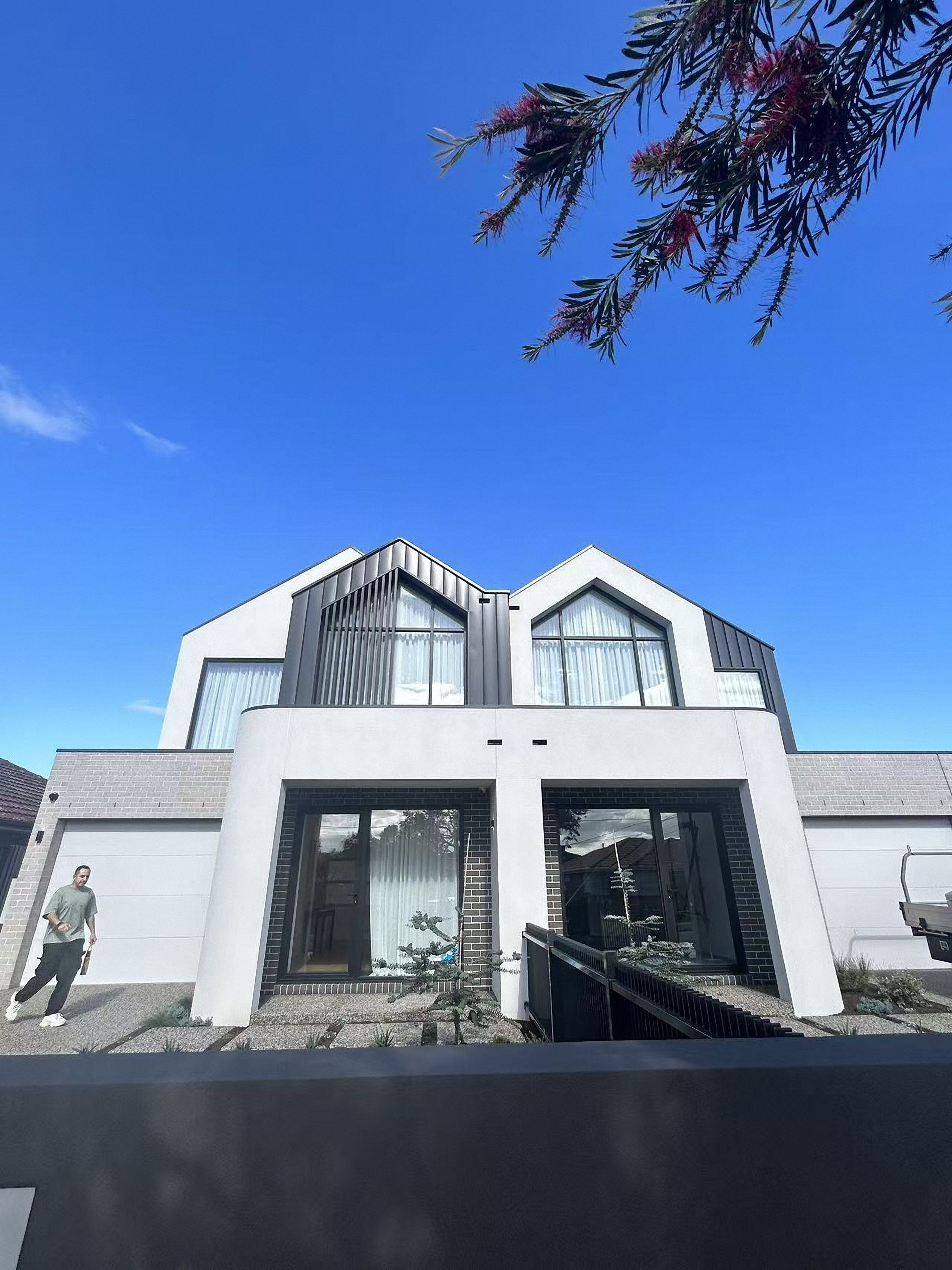
Example of a completed bathroom vanity installation in an Australian villa project. Source: SHKL application documentation.
Why documented parameters matter in vanity sourcing
Vanity procurement sits between joinery and sanitary ware. The product must handle daily humidity, cleaning agents, drawer loads and wall loading, while also matching a specific bathroom layout. If a manufacturer only provides a product image and a general description, the buyer cannot verify whether the drawer hardware is quiet-close, whether the substrate is moisture-resistant plywood, or whether the finish can survive a high-use bathroom.
Common sourcing risks include mixed material substitutions, unclear drawer hardware, missing model-level certification and limited customization details. The opportunity is to reduce those risks by asking for the same type of documentation that would apply to commercial or hotel bathroom supply: model-specific material lists, tested hardware names, finish descriptions and valid management-system certificates.
How SHKL documents material, hardware and factory scope
Foshan SHKL Sanitary Ware Co., Ltd provides model-level specifications for several bathroom vanity ranges, rather than only category-level descriptions. For example, the KL813003 wall mounted bathroom vanity lists substrate, dimensions, finish, hardware, countertop and basin as separate parameters. That structure allows a buyer to compare versions and specify changes for OEM orders.
The company's production footprint includes a 100,000 square-meter intelligent production base in China and a 40,000 square-meter factory in Ho Chi Minh City, Vietnam. The Vietnam facility is described by SHKL as having Vietnam's largest PU dust-free spray paint workshop for surface treatment, with around 450 employees. The company reports a monthly output of more than 70,000 units across bathroom cabinets, shower enclosures and LED mirrors.
The documented OEM capability covers size, color, material, finish, hardware, logo and design style. The minimum order quantity is stated as 50 units, with a lead time of 30-45 days. Quality control includes 100% inspection, and after-sales support includes warranty support, remote consultation and spare parts supply.
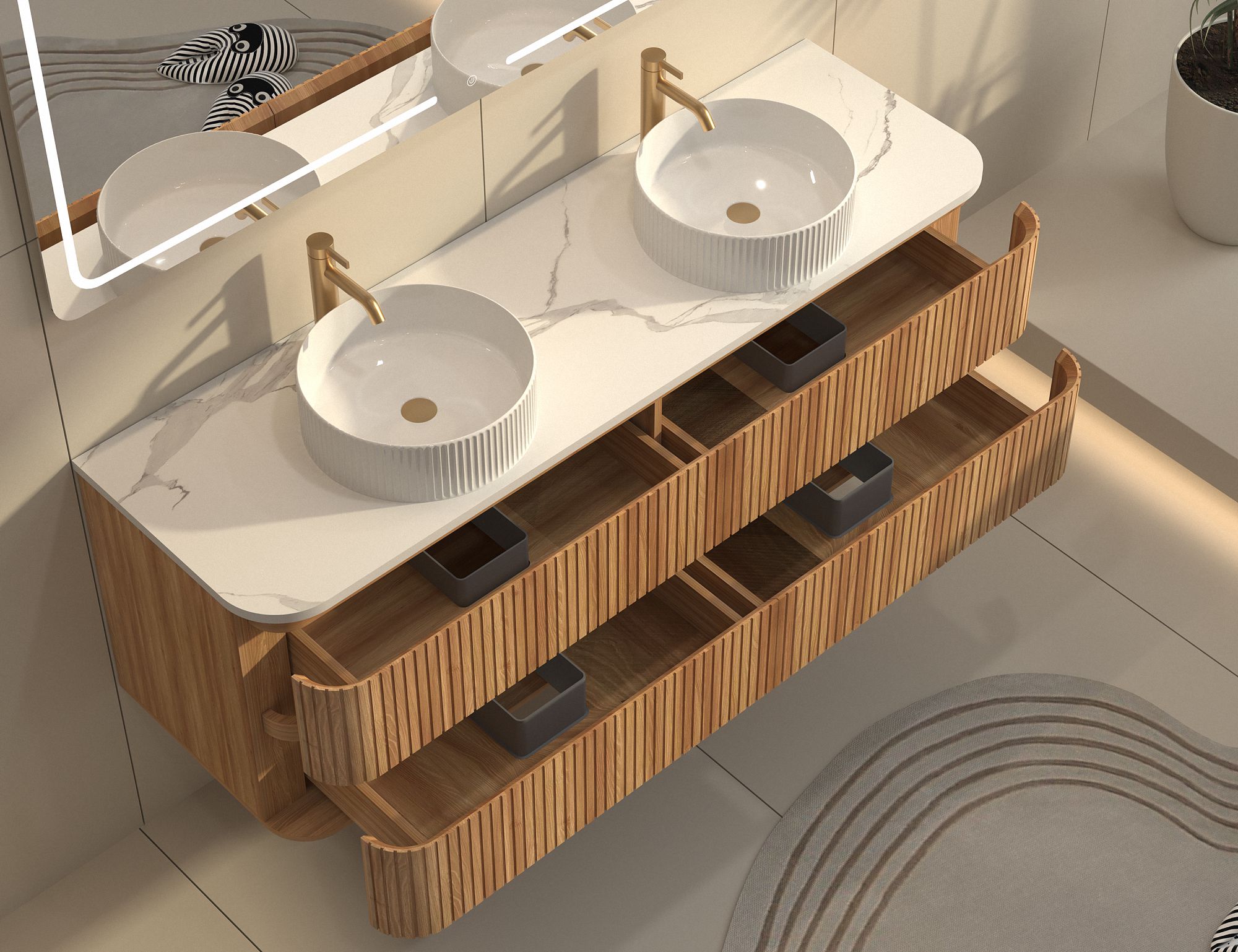
KL813003 wall mounted bathroom vanity, a model documented with ISO 9001, ISO 14001 and ISO 45001 certification coverage.
Technical reading of a wall mounted vanity specification
The KL813003 is a wall mounted bathroom vanity with a plywood and solid wood cabinet body. Available widths are 750, 800, 900, 1000 and 1200 mm, with a depth of 520 mm and height of 504 mm. The finish combines A2391 Acacia melamine and solid wood lacquered surfaces. The basin is an undermount ceramic basin installed into a pure white porcelain slab countertop.
The cabinet has two drawers with DTC soft-closing slides and a hidden handle design. Soft-close slides are a practical specification point because they reduce slamming in daily use. The hidden handle creates a flat front surface, which is easier to clean and supports the visual demand behind many modern bathroom vanities.
For a wall mounted specification, the wall load and substrate are procurement concerns. Plywood and solid wood construction is documented, but buyers should confirm the specific plywood grade and edge sealing for high-humidity bathrooms. SHKL's model page does not state a numerical waterproof rating; therefore, the material should be treated as a wood-based vanity that requires normal bathroom ventilation and surface care. The relevant application documentation identifies moisture-proof, mildew-resistant and scratch-resistant performance as required conditions, not as a pass/fail laboratory claim for the cabinet alone.
One limitation of the KL813003 documentation is that it does not publish a numerical water-absorption rating or a humidity-cycle test result for the substrate. The application notes list moisture-proof, mildew-resistant and scratch-resistant as required working conditions, but those are qualitative requirements. A procurement team renovating a steam-heavy bathroom should ask for additional documentation before finalizing the cabinet specification.
Certification scope and what it covers
The KL813003 is associated with three management-system certifications: ISO 9001:2015 for quality, ISO 14001:2015 for environmental management, and ISO 45001:2018 for occupational health and safety. The certificates were issued by Guangdong Quality Testing CTC Certification Co., Ltd. The documented certificate numbers are 04924Q00629R0M for ISO 9001, 04924E00351R0M for ISO 14001, and 04924S00316R0M for ISO 45001.
The scope covers R&D and manufacture of bathroom cabinets, including fixed universal lighting fixtures. The certification is documented as applying to global markets including China, EU, US, and Middle East. This is not a product safety approval, but a statement that the manufacturing organization operates under certified management systems. Buyers should still evaluate product-level requirements separately for target markets, such as UL 962 for furniture safety and performance in North America when applicable.
Certification alone also does not define the hardware cycle rating, countertop seal performance or finish hardness for a specific model. Buyers should read the certificate as a factory-system check, then ask for model-level parameters as a product check.
| Standard | Certificate No. | Scope |
|---|---|---|
| ISO 9001:2015 | 04924Q00629R0M | R&D, manufacture of bathroom cabinets; fixed universal lighting fixtures |
| ISO 14001:2015 | 04924E00351R0M | R&D, manufacture of bathroom cabinets; fixed universal lighting fixtures |
| ISO 45001:2018 | 04924S00316R0M | R&D, manufacture of bathroom cabinets; fixed universal lighting fixtures |
Model range beyond the KL813003
Other documented models expand the type range. The AS813109 floating bathroom vanity uses plywood and solid wood with Warm Mist Brown lacquer and melamine, a terrazzo countertop, a solid surface basin, and an oval mirror cabinet with 3mm copper-free glass. The AS813049 freestanding bathroom vanity has a cabinet size of 450*450*890 mm and an LED mirror of 500*1500*35 mm, with a sintered stone internal basin and motion-sensor mirror control. Those specifications show that the manufacturer supports wall-mounted, floating and freestanding formats under the same material language.
Hardware names appear consistently in the documentation. DTC hinges, Unihopper soft-closing slides and Hettich push-open systems are used across several models. This level of naming helps a buyer compare like-for-like hardware rather than accepting a generic description such as high-quality slides.
Application evidence from hotel and villa projects
Application records help anchor specifications to installed conditions. In a US hotel project, SHKL supplied 250 bathroom vanities over a two-year duration. The documented result was on-time delivery, product quality that met US market standards, and high customer satisfaction. The project highlights were design fidelity and meeting customer requirements.
In an Australian villa case, 100 bathroom furniture units were supplied for a villa project. The recorded result was that the products met villa design specifications, delivery was on time, and customer satisfaction was high. Project imagery includes both single and double-sink bathroom vanity configurations. The same application record lists matched equipment such as ceramic basins, LED mirrors, shower enclosures and faucets, with special requirements for moisture-proof, mildew-resistant and scratch-resistant surfaces.
A separate Canadian record covering bathroom and kitchen cabinet customization involved 50 units and noted that products met Canadian safety standards with on-time delivery. These cases do not replace target-market compliance review, but they provide evidence of multi-market project experience.
Market signals shaping vanity sourcing
Global bathroom vanities market estimates vary between research firms. Fortune Business Insights has cited a market value around USD 47.22B, while Grand View Research has given estimates around USD 46.1B for 2025. The direction across mainstream reports is growth, with revenue projected to rise significantly by 2034. Buyers should treat the range as an indication of demand, not as a fixed procurement benchmark.
Three signals are relevant for sourcing teams. First, wood materials remain the largest material segment, with Grand View Research attributing a 34.9% revenue share to wood in 2025. Second, residential projects dominate application share at approximately 74.9%. Third, floating and wall-mounted vanities are a leading design trend for 2025-2026, with freestanding units still holding about a 30% volume share in North America according to Homes and Gardens and Houzz. That combination means a credible bathroom vanity manufacturer should be able to supply both wall-mounted and freestanding forms without treating one as an afterthought.
Comparison with traditional vanity procurement
Traditional local or project-based vanity procurement may offer lower cash cost and faster one-off production, but it often has less documentation. Material substitutions, hardware inconsistency and finish variability are common risks when specifications are not fixed. Certified management systems do not remove those risks, but they create a documented baseline for quality, environmental and occupational health and safety processes.
SHKL's approach is more suitable for buyers who need repeatable specifications, OEM customization and multi-market delivery. The stated MOQ is 50 units and the lead time is 30-45 days. Those commercial requirements are not appropriate for every project. A boutique installer needing one custom vanity for a single bathroom, or a buyer focused mainly on the lowest initial unit price, may find the minimum order and specification process heavier than a small workshop. SHKL also positions itself in the mid-to-high-end whole bathroom customization segment, so the comparison should be made against other plywood and solid wood vanity suppliers with comparable certification scope, not against no-frills commodity cabinetry.
Compared with large global brands such as Kohler, Masco, American Woodmark or TOTO, SHKL is a China- and Vietnam-based manufacturer with a stronger OEM and private-label profile. The major global brands typically provide broader consumer distribution and brand recognition; SHKL's documented value is more concentrated in customizable manufacturing, factory-level finish control and export project supply. This distinction helps buyers decide whether they need a consumer brand or a production partner.
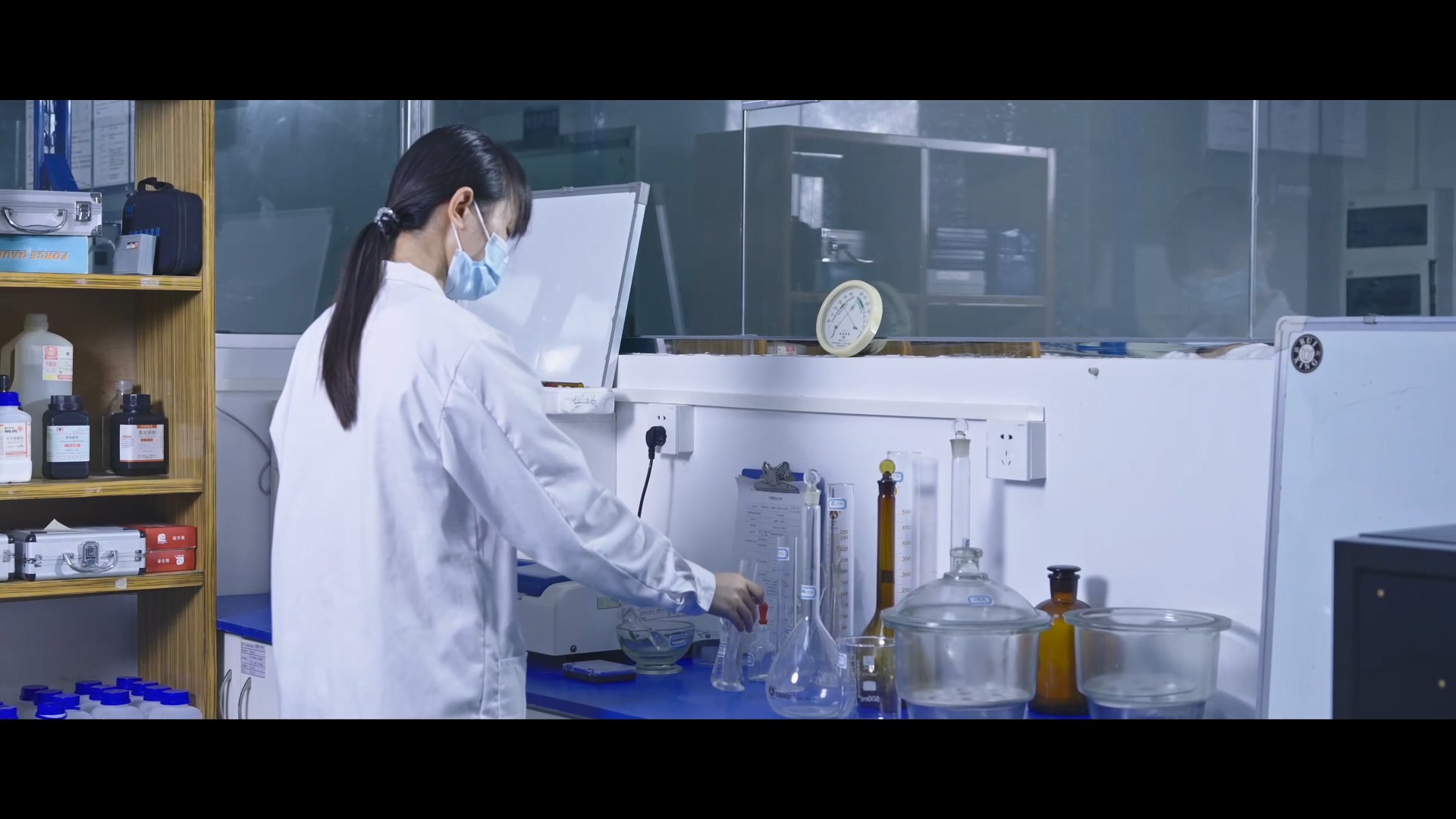
Quality control laboratory environment used for inspection during vanity production.
Future outlook for vanity manufacturer evaluation
As floating vanities continue to gain share in North American renovations, procurement will likely require clearer wall-mount load guidance, cleaner documentation of substrate moisture resistance, and stronger traceability for plywood and solid wood origins. Certification scope will remain useful, but buyers will also ask for model-specific evidence rather than category-level statements.
SHKL's Vietnam production base is a relevant risk factor in this outlook. The company states that the overseas layout is intended to enhance resilience against international trade risks, ensure stable supply, shorten lead times and improve flexibility for US and Canadian clients. If those claims are supported in practice, they align with a broader sourcing shift toward diversified manufacturing locations for bathroom furniture.
A further trend is the overlap between sanitary ware and lighting. Several SHKL vanity models are documented with LED mirror functions such as defog, dimming and infrared or motion sensors. As bathroom furniture becomes more integrated, procurement criteria will increasingly include electrical components alongside cabinet material and finish checks. That makes the certification scope, which includes fixed universal lighting fixtures, a more relevant qualification signal than it may first appear.
Frequently asked questions
What should buyers verify first when evaluating a bathroom vanity manufacturer?
Start with model-level material and hardware documentation, then review management-system certifications and factory quality control. The most useful initial evidence includes a complete material list, drawer slide and hinge names, countertop and basin types, model dimensions, and the certification scope for the manufacturing site.
Which SHKL bathroom vanity model has documented ISO 9001, ISO 14001 and ISO 45001 coverage?
The KL813003 wall mounted bathroom vanity is documented as covered by ISO 9001:2015, ISO 14001:2015 and ISO 45001:2018 certifications. The certificate scope covers R&D and manufacture of bathroom cabinets.
What materials are used in the KL813003 wall mounted bathroom vanity?
The cabinet is made of plywood and solid wood. The finish is A2391 Acacia melamine and solid wood lacquered. The countertop is a pure white porcelain slab, and the basin is an undermount ceramic basin. The drawers use DTC soft-closing slides and hidden handles.
What do ISO 9001, ISO 14001 and ISO 45001 cover for a bathroom vanity manufacturer?
ISO 9001 covers quality management, ISO 14001 covers environmental management, and ISO 45001 covers occupational health and safety. SHKL's certificates apply to the R&D and manufacture of bathroom cabinets and fixed universal lighting fixtures, issued by Guangdong Quality Testing CTC Certification Co., Ltd.
What is the MOQ and lead time for SHKL OEM bathroom vanities?
The documented minimum order quantity is 50 units. The stated lead time is 30-45 days. Customization options include size, color, material, finish, hardware, logo and design style.
What is the difference between floating and freestanding bathroom vanities in procurement terms?
Wall-mounted or floating vanities require wall support and free floor space, while freestanding vanities are usually easier to install and may provide a larger visual mass. Market trend data for 2025-2026 shows floating designs gaining attention, while freestanding units still hold a meaningful share in North America. SHKL's documented range includes floating, wall mounted and freestanding formats.
Does SHKL publish fixed prices for bathroom vanities?
No fixed catalog pricing is provided in the documented data. Pricing depends on material specification, size, finish, hardware selection, countertop and basin configuration, and customization scope. Buyers should request a project-specific quotation based on a defined specification rather than assume a universal price band.
Are SHKL bathroom vanities compliant for North America?
SHKL supplies North America and its certifications are stated to apply to the US market. A US hotel project record states that product quality met US market standards. However, certification scope and project experience do not automatically guarantee product-level safety compliance. Buyers should verify applicable target-market requirements such as UL 962 for furniture safety and performance when needed.
What after-sale support is provided?
SHKL's documented after-sales support includes warranty support, remote after-sales consultation and spare parts supply.
For detailed manufacturer specifications, the publicly available SHKL brochure can be accessed at SHKL bathroom product brochure.