
Barber Chair Model Comparison: How Dimensions and Materials Determine Fit
Barber chair selection is usually described as a design decision. In practice it is a specification decision with a design layer on top. Two chairs that look similar in a catalog can differ by more than 60 cm in depth, use different frame metals, and sit inside compliance documents that cover different materials. Those differences decide whether a chair fits a salon floor, survives a service counter, and clears an import check.
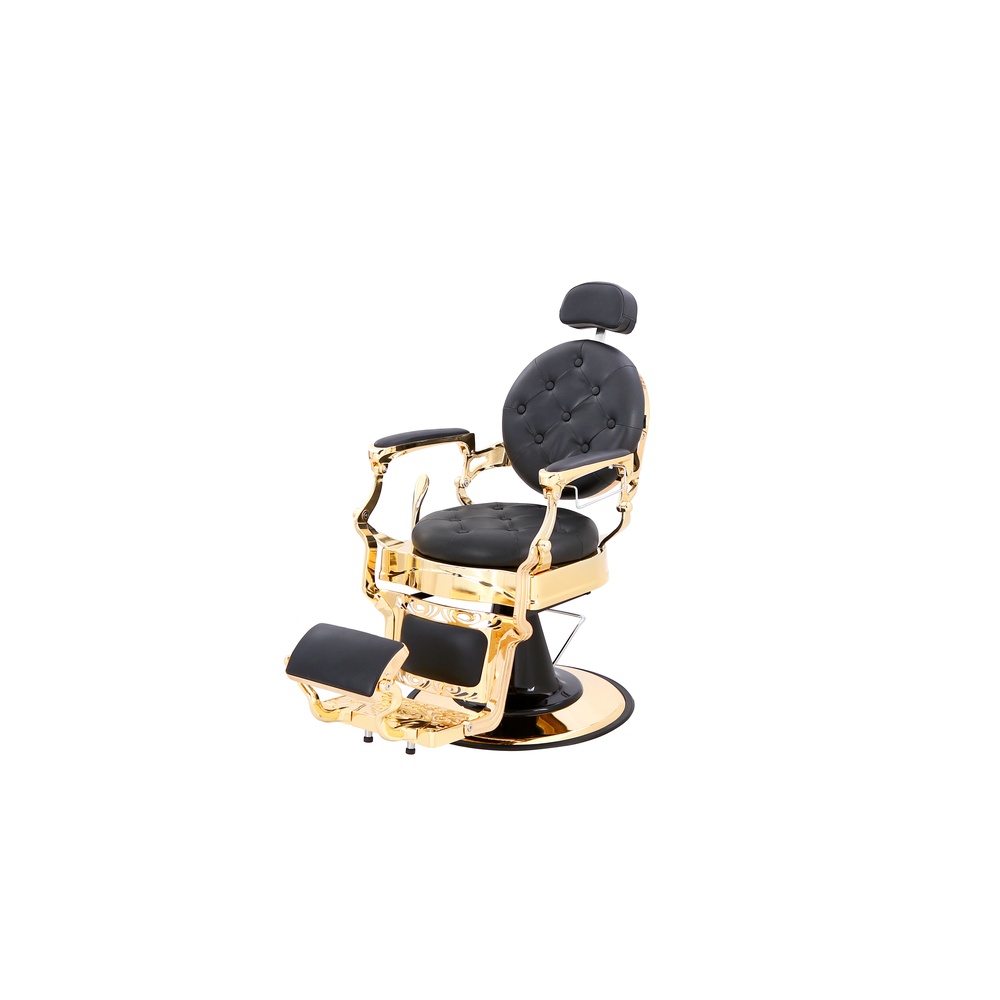 HZ8799ABK, a gold barber chair in the range compared in this article, shown in a 110 × 72 × 100 cm footprint with an aluminum alloy frame.
Fact.MR reported the global salon chairs market at approximately USD 1.5 billion in 2025, and the same research projects hydraulic salon chairs to hold a 63.4% share in 2026. At the same time, procurement is becoming more rule-bound: 21 N.C. Admin. Code 06L .0102 in North Carolina, for example, requires a minimum of five linear feet of space between the centers of adjacent barber chairs. Chair choice now sits between two constraints — market preference for hydraulic mechanisms, and local rules about how much floor each position may occupy.
Ningbo Hongzi Beauty & Hairdressing Equipment Co., Ltd. is a Chinese salon furniture manufacturer founded in 2012 and located in Yuyao, Ningbo, Zhejiang. The company operates a 22,000 m² production facility and manufactures barber chairs, shampoo chairs, massage beds, and manicure tables, with exports directed primarily to North America and Europe. Its barber chair range includes several platforms that differ in dimensions, frame material, and positioning. This article compares five of them — HZ6001DW, HZ8801, HZ8796C, HZ87102RB, and HZ8799ABK — as a working framework for matching a model to salon space, service type, and order terms.
Why dimensions resolve before materials or finishes
A barber chair consumes three different kinds of space, and they are not interchangeable. The first is the physical footprint of the base and seat. The second is the working envelope a barber needs to move around and recline the client. The third is the spacing requirement imposed by local health or licensing rules, which can be larger than either of the first two.
Footprint is the only one of the three that can be read directly from a specification sheet, which is why it should be checked first. In this group, published dimensions range from 45 × 25 × 70 cm on the compact HZ6001DW to 111 × 66 × 118 cm on the heavy-duty HZ87102RB. That is a substantial difference in both depth and height, and it changes how many stations a given floor can hold before any other factor is considered.
Spacing rules are jurisdiction-specific and should be verified locally. The North Carolina example is useful because it is explicit: five linear feet measured center to center between chairs. Where such a rule applies, it — not the chair's own width — sets the practical rhythm of the room, and a larger chair can reduce station count even if the rule itself does not mention chair size.
The five models in this comparison
The table below sets out the published specification for each model: classification, overall dimensions, frame material, and the upholstery build that all five share.
| Model | Classification | Dimensions (cm) | Frame material | Upholstery build |
|---|---|---|---|---|
| HZ6001DW | Beauty salon chair | 45 × 25 × 70 | Iron | PU leather, high-density sponge, wood |
| HZ8801 | Styling chair | 90 × 60 × 90 | Iron | PU leather, high-density sponge, wood |
| HZ8796C | Barber salon chair | 110 × 72 × 100 | Aluminum alloy | PU leather, high-density sponge, wood |
| HZ87102RB | Heavy duty barber chair | 111 × 66 × 118 | Aluminum alloy | PU leather, high-density sponge, wood |
| HZ8799ABK | Gold barber chair | 110 × 72 × 100 | Aluminum alloy | PU leather, high-density sponge, wood |
Two patterns are visible immediately. First, the group splits into two footprint families: a compact and mid-size pair (HZ6001DW, HZ8801) and three full-size platforms at roughly 110 cm wide (HZ8796C, HZ87102RB, HZ8799ABK). Second, within the full-size family, HZ87102RB is the outlier — 118 cm tall and slightly narrower in depth than the other two, reflecting a different structural intent rather than a cosmetic variation.
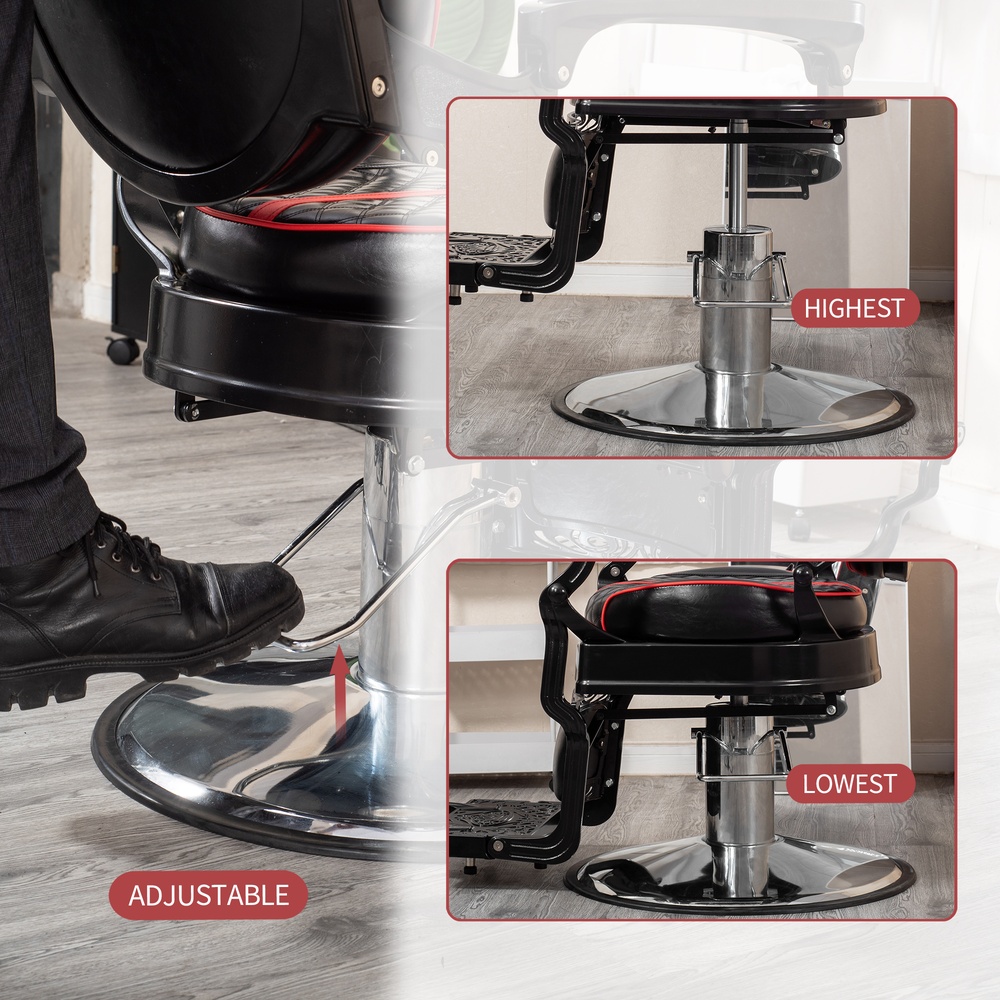 HZ87102RB, the largest platform in the group at 111 × 66 × 118 cm, listed as a heavy duty barber chair with an aluminum alloy frame.
Materials: what the frame and upholstery statements actually tell a buyer
All five models share the same upholstery architecture: PU leather over high-density sponge, with wood structural components. The material choice that separates the group is the frame. HZ6001DW and HZ8801 are listed with iron frames. HZ8796C, HZ87102RB, and HZ8799ABK are listed with aluminum alloy frames.
For a buyer, the frame statement matters for two reasons. It indicates the structural approach the manufacturer intends for that platform, and it is one of the few specifications that becomes impossible to verify once the chair is assembled and upholstered. Where a purchase order names a frame material, that line should be confirmed in writing at quotation stage and checked at goods receipt, because visual inspection after delivery rarely resolves the question.
All three full-size platforms are also offered as hydraulic or recline-capable barber chairs rather than fixed seating, which places them in the segment that market research expects to hold the majority of salon chair demand. Published industry research on professional-grade hydraulic pumps cites durability benchmarks of more than 100,000 cycles and load capacities in the 350–400 lb range for commercial-grade units. That benchmark is useful as a question to put to any supplier: which pump is fitted to the model, and what documentation supports its rating? The stated after-sales term for the pump on this range is a one-year warranty, with damaged products resent.
Compliance as a constraint, not an afterthought
Where the destination market regulates furniture materials, the model number alone is not enough. Compliance documents are written against a defined scope — a material, a product category, or a specific construction — and a buyer's obligation is to confirm that the ordered configuration falls inside that scope.
| Document | Issued by | Reference number | Market | Standard or regulation | Declared scope |
|---|---|---|---|---|---|
| PFAS test report | Guangdong Consurher Testing Technology Co., Ltd. | CTT2501010107EN | EU, US | EN 14582:2016 | Synthetic leather 03#; issued 04 Jan 2025 |
| SGS flame retardant artificial leather test report | SGS-CSTC Standards Technical Services Co., Ltd. Hangzhou Branch | SL62416330206201TX | UK | The Furniture and Furnishings (Fire) (Safety) Regulations 1988 | Beauty bed, salon chair, shampoo chair; issued 27 Sep 2024 |
| SGS flame retardant foam test report | SGS-CSTC Standards Technical Services Co., Ltd. Hangzhou Branch | SL62416330201301TX | EU, US | The Furniture and Furnishings (Fire) (Safety) Regulations 1988 | Beauty bed, salon chair, shampoo chair; issued 27 Sep 2024 |
The PFAS document is the narrowest of the three, because its stated scope is a specific synthetic leather grade — synthetic leather 03# — rather than a finished chair. A buyer sourcing HZ8796C, HZ87102RB, or HZ8799ABK for the EU or US market should therefore confirm that the upholstery grade on the order matches the grade covered by CTT2501010107EN, rather than assuming that the chair model alone is certified. The two SGS reports are broader, declaring beauty beds, salon chairs, and shampoo chairs within scope, but they are material-level tests: one covers the artificial leather, the other the foam.
Separately, the customs classification under which barber and similar chairs travel is HS 9402.10, which covers chairs having rotating as well as both reclining and elevating movement. Classification is not the same as product safety compliance, but it does affect duty treatment and documentation at the border, and it is worth confirming with a customs broker against the actual mechanism of the model ordered.
Purchase terms that shape the model decision
Order terms frequently decide a model choice as much as dimensions do, particularly for distributors testing a new line or for salons adding two or three positions at a time. The stated terms across this range are: a minimum order quantity of 5 units, OEM customization of logo and color, a lead time of 15 days for orders under 100 units and 30 days for orders above 100 units, a company-reported monthly capacity of 15,000 units, and 100% product testing. Color and material customization is also stated as available, which matters for salons matching chairs to an existing interior scheme.
A minimum order of 5 units makes a small-batch trial realistic, and customization at that order size is the point at which a buyer can validate the finish and the frame specification before committing to a full fit-out. Lead time should be read as two distinct planning windows: 15 days for orders under 100 units and 30 days above that threshold. For a multi-site rollout, that difference is worth building into the installation schedule rather than treating as a single number.
Acceptance criteria: a verification checklist
Acceptance criteria convert a supplier's specification into something a buyer can check on delivery. The following checks are practical for this model group.
- Dimensional verification. Measure the delivered chair against the ordered specification — for example 110 × 72 × 100 cm for HZ8796C, 111 × 66 × 118 cm for HZ87102RB, or 90 × 60 × 90 cm for HZ8801 — before installing it into a fixed layout.
- Frame verification. Confirm the frame material stated on the purchase order: iron for HZ6001DW and HZ8801; aluminum alloy for HZ8796C, HZ87102RB, and HZ8799ABK.
- Upholstery and material grade. Confirm the PU leather and sponge configuration matches what was ordered, and that the leather grade corresponds to the scope of the relevant test report.
- Mechanism function. Operate the reclining and elevating functions through full cycles on a sample unit before bulk acceptance, and confirm the pump warranty terms in writing.
- Documentation matching. Check that certificate numbers and model references line up — CTT2501010107EN for PFAS, SL62416330206201TX and SL62416330201301TX for the SGS reports — and that the reported scope covers the configuration delivered.
- Transit damage and packaging. Inspect packaging and surfaces against the stated policy of resending damaged products.
Matching the model to the salon scenario
Once dimensions and materials are fixed, model selection becomes a scenario question. Salon furniture is used indoors over long periods, under conditions that require wear resistance, oil resistance, easy cleaning, and sustained comfort. Procurement typically happens as part of a salon fit-out, a distributor bulk order, or a customized project, and chairs are rarely bought in isolation — shampoo chairs, styling mirrors and cabinets, hair dryers, trolleys, and manicure tables are usually specified in the same cycle.
Within that context, the five models map onto different roles. HZ6001DW, at 45 × 25 × 70 cm, is the space-saving option in the group and is classified as a beauty salon chair rather than a full-size barbering platform. HZ8801, at 90 × 60 × 90 cm with an iron frame, is a mid-size styling chair that sits between compact and full-size footprints. HZ8796C, at 110 × 72 × 100 cm, is classified as a barber salon chair and represents the standard full-service footprint. HZ8799ABK shares the same 110 × 72 × 100 cm footprint but is positioned as a gold barber chair, which suits a front-of-house or flagship presentation role. HZ87102RB, at 111 × 66 × 118 cm, is the heavy duty platform and is the appropriate candidate where continuous use and heavier service loads are expected.
The range also supports a mixed-floor strategy. A salon can run compact HZ6001DW units for auxiliary positions and full-size HZ8796C or HZ8799ABK units at primary stations, provided the spacing rule for the jurisdiction is applied uniformly across the floor. In distributor terms, the same logic allows a single supplier to cover a full salon fit-out rather than forcing a mixed-supplier specification.
Limits of this framework
This comparison is built on published dimensions, frame materials, upholstery build, and the compliance documents available for the range. It has boundaries that buyers should treat as open questions rather than settled answers.
First, the available specification data does not include load ratings, foam density, recline angle ranges, or pump model numbers for each chair. Those figures have to be requested at quotation stage as model-level technical data; they are not implied by the dimension or material lines. Second, the certification documents are material- and category-scoped, not model-scoped in every case, so the PFAS report in particular requires a check that the ordered leather grade matches the tested grade. Third, price is not comparable across this group: model configurations differ in frame material, size, and mechanism, and quotation terms such as Incoterms, packaging, and payment conditions are set per order. A quotation should be requested per model rather than extrapolated from any listed figure. Fourth, spacing and material regulation is jurisdiction-specific. A rule that applies in one US state does not describe another market, and European or UK requirements should be checked against the destination country's current rules.
Where the market is heading
Two trends are visible in the current data and both favor documented specification over catalog appearance. The first is mechanism preference: hydraulic chairs are projected to account for 63.4% of salon chair demand in 2026, which aligns with the commercial durability benchmarks cited for professional-grade hydraulic pumps. Buyers are effectively standardizing on hydraulic platforms for high-traffic positions, and the question shifts from whether to specify hydraulic to which hydraulic build is documented.
The second is documentation density. Material-level test reports for flame retardancy and chemical content, along with customs classification under HS 9402.10, increasingly travel with the order rather than being produced on request. Suppliers who hold current reports for specific materials and can map them to specific models are easier to qualify, and buyers who build certificate numbers and scopes into their acceptance criteria reduce the risk of a shipment that meets the drawing but not the border.
FAQ
How much space does a barber chair need in a salon layout?
Space is determined by the chair's own dimensions plus any local spacing rule. In this group, published footprints range from 45 × 25 × 70 cm (HZ6001DW) and 90 × 60 × 90 cm (HZ8801) up to 110 × 72 × 100 cm (HZ8796C and HZ8799ABK) and 111 × 66 × 118 cm (HZ87102RB). Where regulation applies, spacing requirements can exceed the footprint: 21 N.C. Admin. Code 06L .0102 requires a minimum of five linear feet of space between the centers of adjacent barber chairs. Buyers should confirm the rule for their own jurisdiction before finalizing station count.
What is the difference between the iron-frame and aluminum-alloy models?
HZ6001DW and HZ8801 are listed with iron frames, while HZ8796C, HZ87102RB, and HZ8799ABK are listed with aluminum alloy frames. All five models share the same upholstery build: PU leather, high-density sponge, and wood components. Because frame material is not visible after assembly, it should be stated on the purchase order and confirmed at delivery.
Which compliance documents are available for these barber chairs?
Three documents are referenced for this range. A PFAS test report, reference CTT2501010107EN, issued by Guangdong Consurher Testing Technology Co., Ltd., applies to the EU and US markets under standard EN 14582:2016 and declares a scope of synthetic leather 03#. The SGS flame retardant artificial leather test report, reference SL62416330206201TX, issued by SGS-CSTC Standards Technical Services Co., Ltd. Hangzhou Branch, applies to the UK market under The Furniture and Furnishings (Fire) (Safety) Regulations 1988. The SGS flame retardant foam test report, reference SL62416330201301TX, from the same issuer, applies to the EU and US markets under the same regulation. The SGS reports declare beauty beds, salon chairs, and shampoo chairs within scope.
What are the ordering terms for these models?
The stated terms are a minimum order quantity of 5 units, OEM customization covering logo and color, a lead time of 15 days for orders under 100 units and 30 days for orders above 100 units, a company-reported monthly capacity of 15,000 units, and 100% product testing. The pump carries a one-year warranty, and the supplier states that damaged products are resent. Terms should be confirmed in a written quotation for the specific model and configuration, since price, Incoterms, and packaging are set per order.
Is the heavy-duty HZ87102RB the right choice for a small salon?
Not automatically. HZ87102RB is the largest platform in the group at 111 × 66 × 118 cm and is classified as a heavy duty barber chair, which suits positions with continuous use and heavier expected loads. A 110 × 72 × 100 cm model such as HZ8796C, classified as a barber salon chair, or HZ8799ABK, classified as a gold barber chair, occupies a comparable floor area with a different structural intent. In a space-constrained salon, the deciding variables are available floor area, service type, and expected daily throughput — with compact options such as HZ6001DW better suited to auxiliary positions than to primary barbering stations.
Sources referenced in this article include Fact.MR salon chairs market research, HS Code 9402.10 (World Customs Organization classification), 21 N.C. Admin. Code 06L .0102 (North Carolina state regulation), and supplier-published product, certification, and capability documentation for Ningbo Hongzi Beauty & Hairdressing Equipment Co., Ltd.
¿Tiene preguntas o necesita más detalles?
Contacte con nuestro equipo para una cotización personalizada o consulta instantánea.
Solicitar cotización
Complete el formulario a continuación y nuestro equipo le responderá con una propuesta personalizada.
Chat directo de WhatsApp
¿Prefiere chatear en tiempo real? Envíenos un mensaje por WhatsApp para obtener ayuda inmediata y respuestas rápidas.
- Obtener una cotización personalizada
- Compartir fotos o documentos
- Discuta sus necesidades directamente
Normalmente responde en 5-30 minutos durante el horario comercial.