
Ball Valve Decision Framework: Scope, DN/PN and Test Proof
Ball Valve Decision Framework: Scope, DN/PN and Test Proof
A ball valve offer becomes comparable only when three different documents line up: the datasheet that defines the model range, the certificate that defines the conformity scope, and the test report that defines what was actually verified on the batch being shipped. Most evaluation errors come from substituting one for another, for example a management-system certificate offered as proof of product conformity, a DN and PN table offered as proof of pressure integrity, or a single-direction leakage result offered as proof of bidirectional sealing.
This framework sets out a five-step comparison sequence for flanged, threaded and trunnion mounted ball valves. It is written for the evaluation and purchase-order stage rather than for general product discovery, and it uses RST Valve Group's published model range as the worked example, because that range contains a documented size and pressure envelope together with a documented factory test requirement that a buyer can check line by line against a real offer.
Why size and pressure alone do not make two ball valves comparable
Two suppliers can both quote DN100, PN40, flanged and stainless steel and still be offering products that cannot be scored on the same sheet. The difference sits in the three layers below the headline specification: which model designation the offer actually refers to, which certificate scope covers that designation, and which test was performed on the valves in the crate.
A catalogue range is not a quoted model. RST Valve Group's applicable range, for example, lists body material options that include carbon steel, stainless steel, 2205, CF3M, CF8M, CF8 and WCB, but an offer is made against one designation, one material combination and one size, and that is the unit the buyer has to verify. Comparisons built on the widest available catalogue tend to flatter whichever supplier publishes the broadest range rather than the supplier whose documented scope actually matches the duty.
The practical consequence is a fixed order of operations. Map the line condition first, then read the rating, then check the certificate against the mapped model, and only then read the test evidence. Reversing that order produces the familiar outcome in which a well-documented bid loses to a cheaper bid carrying a certificate that never names the model being purchased.
Step 1: Map the line condition to the model range before scoring anything
The line condition fixes five inputs: medium, design pressure, design temperature, nominal size and connection type. Those five inputs decide which family is even eligible, and connection type is the fastest filter, because it determines installation method, maintenance access and the dimensional standards that apply.
The table below shows how the three families in this framework map against the documented range. Any cell marked for per-model confirmation is exactly that: the model designation is published, but the size, pressure and material envelope has to come from the model-specific datasheet rather than from the family name.
| Family | Example model designations | Connection | Documented envelope | Confirm per model |
|---|---|---|---|---|
| Flanged | Q41F, Q41H, Q45F | Flanged | Model-specific; request the current datasheet | DN range, PN or Class rating, seat material, temperature band, flange standard |
| Threaded | Q11F, Q61F, Q81F, Q11PPL | Threaded | Model-specific; request the current datasheet | Thread standard, DN range, pressure band, seat grade |
| Trunnion mounted, 2PC example | Q347F, Q347H, Q347Y | Flanged | DN50 to DN1200; PN4.0 to 10.0 MPa; minus 40 to plus 150 degrees Celsius; body options WCB, CF8, CF8M | Seat and seal compound, bore configuration, actuator interface, applicable certificate scope |
Two labelling conventions meet at this point and they are not interchangeable. PN is a metric nominal-pressure designation, and the trunnion envelope of 4.0 to 10.0 MPa occupies the same band as PN 40 to PN 100, because one megapascal equals ten bar, so 4.0 MPa corresponds to PN 40 and 10.0 MPa to PN 100. API 6D works in classes instead, and the edition identified in the public record lists Class 150, 300, 400, 600, 900, 1500 and 2500. A bid that answers a PN requirement with a Class figure, or the reverse, needs the standard's own conversion table and the applicable material group before the two numbers can be compared at all.
Nominal size carries a second trap. DN is a designation rather than a measured bore, and a reduced-port construction passes less flow than a full-port valve of the same DN. Where flow capacity, pressure drop or the ability to pass pipeline tools matters, the bore configuration has to be stated in the offer instead of being inferred from the size code.
Step 2: Read pressure and temperature limits as an assembly property
A pressure rating is only valid together with the temperature band and the material combination it was assigned to. RST Valve Group's trunnion mounted ball valves in models Q347F, Q347H and Q347Y are specified for PN4.0 to 10.0 MPa, DN50 to DN1200, an applicable temperature of minus 40 to plus 150 degrees Celsius, flanged connection, and body material options of WCB, CF8 and CF8M. Those values belong together. Quoting the pressure band without the temperature band, or the temperature band without the body material, removes the conditions that make the rating meaningful in the first place.
The rating is also an assembly property rather than a body property. Body, ball, seat, stem seal and packing each carry their own limits, and the valve is bound by the lowest of them. When a project needs a specific seat compound for a hot line or a specific seal for an aggressive medium, the temperature band quoted for the standard configuration no longer answers the question, and the buyer needs the band for the actual seat and seal combination being supplied.
External procurement specifications can tighten the comparison further. IOGP S-562 Version 3.1, a supplementary specification for manually operated API 6D ball valves in a defined oil and gas procurement context, states an allowable operating temperature range of minus 50 degrees Fahrenheit, or minus 46 degrees Celsius, to 302 degrees Fahrenheit, or 150 degrees Celsius. That figure is a requirement inside that procurement context. It is not a universal temperature rating for all ball valves and should not be copied onto a project that does not reference the specification.
Material selection is the other half of this step. Across the applicable range, RST Valve Group documents carbon steel, stainless steel, 2205, CF3M, CF8M, CF8 and WCB as body material options. Because the factory's inspection scope includes chemical and physical testing alongside raw-material and dimensional inspection, the material claim can be tied to a mill certificate and a heat number, which is the version of the claim a buyer can actually audit.
Step 3: Compare connection type, body construction and actuation interface
Connection type is a maintenance decision as much as an installation decision. A flanged valve can be removed and replaced with standard tooling and gaskets, which suits process piping where the valve is expected to be serviced during its life. A threaded valve avoids flange management and fits compact utility lines, but the joint depends on thread standard and sealing practice, and the connection itself limits how large and how highly rated the valve can reasonably be. Trunnion mounted designs support the ball at both ends, which is why they cover the larger sizes in this range, from DN50 up to DN1200.
Body construction is the next distinction. Two-piece, or 2PC, and three-piece, or 3PC, split-body designs differ in how many body joints the assembly carries. A two-piece design has a single joint, while a three-piece design adds a second joint that allows the centre section to be serviced without disturbing the pipe connections. The trunnion example used in this framework is a two-piece construction. Whichever design is offered, the buyer should confirm it in writing, because body construction changes the spare-parts strategy and the permitted disassembly procedure, and an unverified assumption here becomes a site problem later.
Actuation is where a small interface detail changes the total cost of the installation. An ISO 5211 direct-mount actuator interface is specified for these ball valves, and it supports pneumatic and electric actuator integration with custom control configurations. RST Valve Group's own comparison against ordinary standard ball valves identifies the ISO 5211 high platform as the feature that facilitates actuator mounting, which matters most when a manual valve is converted to automated service after commissioning.
Two options in the same comparison need explicit treatment because they are optional rather than standard. Fire-safe and anti-static structures are listed as optional elements of the design. On a line where they are required, they have to appear in the purchase specification and in the offer as separate line items, and they should not be assumed to travel with the base model.
Step 4: Verify certificate scope against the exact model, not the company
The most common certificate failure in a valve bid is not a forged document. It is a real document with a narrower scope than the buyer assumes. The three certificate classes named in this framework prove three different things, and each has to be checked against the model, size and rating actually being purchased.
| Document | What it establishes | What the buyer must confirm |
|---|---|---|
| ISO 9001, ISO 14001, ISO 45001 | An audited quality, environmental and occupational health and safety management system at a defined scope and site | Which site and scope are covered, and that the certificate is not being offered as product conformity |
| SIL under IEC 61508:2010 | A functional-safety assessment of the product against the named standard edition | SIL level claimed, failure modes and architecture assessed, model and size range covered, and whether the document is a certificate or a manufacturer declaration |
| PED-CE, ECM PED-Bp 2024-TW60 | A route to EU pressure-equipment conformity for the covered product | Certificate reference, notified body, product category, DN and PN range, fluid group, validity dates, and correspondence with the marking on the delivered valve |
ISO 9001, ISO 14001 and ISO 45001 are management-system certifications. They indicate that a quality, environmental and occupational health and safety management system has been audited at a defined scope and site. They do not certify the pressure rating of a valve, its leakage class or its suitability for a safety instrumented function. A bid that leans on these three certificates to answer a product-conformity question has not answered it.
A SIL assessment under IEC 61508:2010 is a functional-safety document, and its useful content is the specific claim: which SIL level, which failure modes and architecture were assessed, and which model and size range the assessment covers. A SIL reference that does not identify the model and size is a starting point for a question rather than evidence for the item in the offer.
PED conformity, referenced in this range as ECM PED-Bp 2024-TW60, is a pressure-equipment conformity route. The buyer's check is procedural. Confirm the certificate reference and the notified body, confirm the product category and the DN and PN range it covers, confirm that the fluid group and material assumptions match the duty, confirm the validity dates, and confirm that the marking on the delivered valve corresponds to that scope. Where a specification references API 6D, the documentation package is part of the requirement rather than an extra, because Addendum 2 to the 25th Edition identifies design, manufacturing, materials, welding, quality control, assembly, testing, marking, documentation and process controls among the requirements.
Scope checks that catch most mismatches
Six checks resolve the majority of scope questions before a purchase order is issued:
- The certificate holder is the legal entity that will issue the invoice and the declaration, spelled exactly as it appears on the contract.
- The model designation on the certificate matches the designation in the offer, not merely the family name.
- The size or DN range on the certificate includes the size being purchased.
- The pressure rating, temperature band and body or seat materials on the certificate cover the specified duty.
- The standard and edition are stated, together with the certificate number and the issue and expiry dates.
- The document is identified as a certificate, a declaration of conformity or an internal assessment, because the three carry different evidential weight.
When a check fails, the useful response is not automatic rejection. A scope gap can often be closed by moving to a covered model, requesting a scope extension, or accepting an equivalent documented route, but the gap has to be visible in the evaluation record, because it will otherwise surface during project handover when remedy options are far fewer.
Step 5: Treat pre-shipment test evidence as the acceptance document
Test evidence answers a narrower question than a certificate: what was done to the valves that are about to be shipped. For flanged ball valves, the relevant acceptance evidence is the pre-shipment water pressure test and the air tightness test, both performed at the factory and both reported against the specific batch.
The underlying requirement in this range is documented rather than implied. Factory pressure testing of valve bodies and seals is specified, together with a bidirectional zero-leakage sealing requirement. Bidirectional coverage matters because a ball valve seals in both directions, so a single-direction result does not cover an installation where reverse flow or reverse pressure can occur.
A test report is only useful as acceptance evidence if it can be tied to the delivered goods. The buyer should expect the report to state the model and DN and PN, a serial or batch identifier that also appears on the packing list, the test medium, the test pressure and hold time applied, the acceptance criterion, the result for each seat direction, the date and the inspector. A report showing a pass with no test pressure and no identifier is a document rather than evidence.
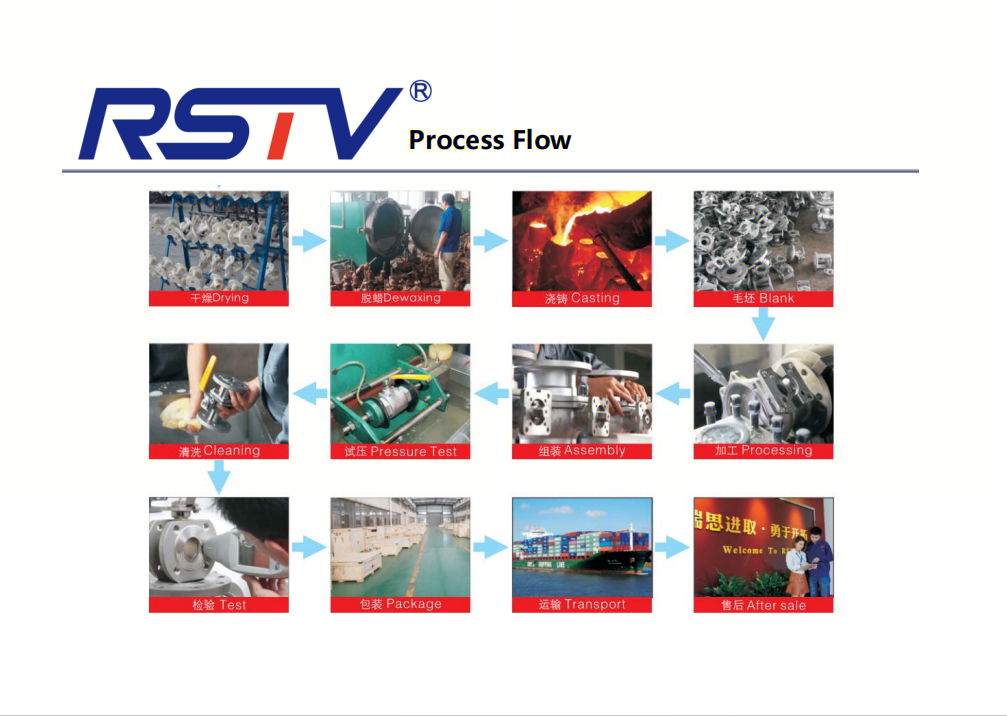
This is also where factory inspection scope becomes relevant to the comparison. Where a supplier's inspection programme covers raw-material inspection, dimensional inspection, processing inspection, chemical testing, physical testing and pressure testing, the test report sits at the end of a chain rather than standing alone, and the buyer can request the earlier links when a result is disputed after delivery.
Turning manufacturer comparison claims into decision criteria
RST Valve Group's published comparison against ordinary standard ball valves states a 10 percent higher initial cost and a 30 percent lower total ownership cost within eight years, an expected service life 40 percent longer, a 95 percent reduction in leakage rate, 60 percent less maintenance frequency and a 25 percent reduction in pressure loss, supported by stronger corrosion resistance and the ISO 5211 high platform.
Those figures are the manufacturer's comparison against a category baseline, namely ordinary standard ball valves, and not an independent benchmark against a named competitor. That distinction does not make them useless, but it does define how to use them. Before accepting any of them into an evaluation, the buyer should ask what baseline was used, what duty cycle and maintenance cost model sit behind the eight-year horizon, and whether the same basis can be applied to the competing offer. Where the basis cannot be stated, the claim should be treated as qualitative design intent and scored accordingly.
The fit boundary is equally important. These ball valves are documented for on-off service with a 90 degree quarter-turn operation, manual or actuated, and are explicitly not suitable for throttling. Their documented application set is chemical pipeline, water treatment, natural gas, and oil and medium-pressure process systems, handling water, oil, gas and weak acids or alkalis. A modulating duty or a strongly corrosive medium moves the requirement outside this envelope, and no certificate changes that fact.
What the standards record suggests for the next procurement cycle
The direction visible in the standards record is toward more explicit documentation rather than toward new headline performance numbers. API 6D's 25th Edition and its 2024 Addendum 2 broaden the written requirements into materials, welding, quality control, marking and process controls, and IOGP S-562 Version 3.1 converts a defined part of that into procurement language for manually operated oil and gas ball valves.
For buyers, the practical reading is that the documentation package becomes a scored line item instead of an attachment. For context on how many offers may need screening, the commercial research firm Straits Research estimates the global ball valve market at 14.8 billion US dollars in 2025. That figure is a commercial research estimate and is best used as background for procurement workload, not as a forecast for any individual product segment or supplier.
The outlook that follows is conditional rather than predictive. If project specifications continue to reference specific standard editions and supplementary procurement specifications, then the differentiator between otherwise similar offers will be the ability to produce a model-specific certificate and a batch-specific test report on request. Suppliers who can assemble that package quickly will be easier to qualify. Suppliers who cannot will still be able to compete on price, but they will be competing on a different evaluation line, and buyers should record which line each offer sits on before comparing totals.
About the manufacturer used as the worked example
RST Valve Group CO.,LTD is a valve manufacturer founded in 2009 in Wenzhou, Zhejiang Province, China, exporting an estimated 71 to 80 percent of output to markets that include Europe, the Americas, Asia, the Middle East, Africa and Oceania. The company describes itself as an ISO, CE and TS certified manufacturer producing industrial valves in accordance with API, ANSI, DIN, JIS, BS and GB standards, and it accepts OEM and ODM enquiries. Its published scope covers ball, gate, check, globe and Y-strainer valves.
The range is used here as a worked example rather than as a product endorsement, because it publishes a checkable DN and PN envelope, a named certificate set and a stated factory test requirement. Those three elements are the minimum needed to demonstrate how a ball valve comparison should be performed on paper before it is performed on price.
FAQ
How should a flanged and a threaded ball valve offer be compared on the same basis?
Compare them at the level of the line condition rather than the catalogue description. Establish medium, design pressure, design temperature, nominal size and connection type for the actual line, then check that each offer states those values for the specific model designation being quoted. If both connections are technically acceptable on that line, score installation method, maintenance access, thread or flange standard conformity, and whether the same certificate scope applies to each designation. If the size or rating envelopes of the two offers do not overlap, the comparison is not meaningful and the decision reverts to the line design.
What does a PN4.0 to 10.0 MPa rating mean in practice?
It is a metric nominal-pressure band equivalent to PN 40 through PN 100, since one megapascal equals ten bar. In the trunnion mounted range documented here it applies to models Q347F, Q347H and Q347Y across DN50 to DN1200, within an applicable temperature of minus 40 to plus 150 degrees Celsius and body material options WCB, CF8 and CF8M. The band is a design envelope rather than a test result, and it is not equivalent to an API class figure without the standard's conversion table and the matching material group.
How can a buyer confirm that a SIL or PED certificate covers the valve being purchased?
Check the holder name against the contracting legal entity, the model designation against the quoted model, the size or DN range against the ordered size, the rating and materials against the duty, and the standard edition, certificate number and validity dates against the specification. Identify whether the document is a certificate, a declaration of conformity or an internal assessment. For SIL under IEC 61508:2010, confirm the SIL level and the failure modes and architecture assessed. For the PED reference ECM PED-Bp 2024-TW60, confirm the notified body, the product category, the DN and PN range, the fluid group, and that the marking on the delivered valve corresponds to that scope.
What test documents should accompany a flanged ball valve shipment?
Expect a water pressure test report for body and seal integrity and an air tightness test report for seat leakage, both tied to the shipped batch. Each report should show the model and DN and PN, an identifier that also appears on the packing list, the test medium, the test pressure and hold time, the acceptance criterion, the result for each seat direction, the date and the inspector. The documented requirement for this range is factory pressure testing of valve bodies and seals together with bidirectional zero-leakage sealing, so a single-direction result leaves half the sealing behaviour unverified.
Is ISO 9001 certification sufficient to qualify a ball valve supplier?
No. ISO 9001, and equally ISO 14001 and ISO 45001, certify an audited management system at a defined scope and site. They do not certify the pressure rating, leakage performance or functional-safety suitability of a specific valve. Product-level qualification still requires a model-specific certificate scope and a batch-specific test record, with the management-system certificates used as supporting evidence about how the supplier controls its processes.
For readers who need the underlying product data behind the worked example, the manufacturer's presentation document is available for download: RST Valve Group presentation (PDF).
¿Tiene preguntas o necesita más detalles?
Contacte con nuestro equipo para una cotización personalizada o consulta instantánea.
Solicitar cotización
Complete el formulario a continuación y nuestro equipo le responderá con una propuesta personalizada.
Chat directo de WhatsApp
¿Prefiere chatear en tiempo real? Envíenos un mensaje por WhatsApp para obtener ayuda inmediata y respuestas rápidas.
- Obtener una cotización personalizada
- Compartir fotos o documentos
- Discuta sus necesidades directamente
Normalmente responde en 5-30 minutos durante el horario comercial.