
Ball-Head Suspension Ring QP-7: ISO 9001 Evidence of Manufacturing Capability
On an overhead power transmission line, the ball-head suspension ring is one of the smallest line items in the bill of materials and one of the most continuously loaded. It forms the mechanical joint between the insulator string and the tower-side hardware, and it stays under tension for the entire service life of the line. Because the part is small, inexpensive and effectively impossible to inspect once energised, the reliability has to be built in at the factory and documented before the order is placed.
The Ball-Head Suspension Ring QP-7 is a hot-dip galvanized steel accessory in the power equipment parts and accessories category, used in overhead power transmission lines. Its defined parameters are compact: a designated coupling size of 16, a rated failing load of 70 kN, and a net weight of 0.3 kg.
| Product name | Ball-Head Suspension Ring QP-7 |
| Category | Power equipment parts and accessories |
| Material | Hot-dip galvanized steel |
| Designated size of coupling | 16 |
| Rated failing load | 70 kN |
| Net weight | 0.3 kg |
| Typical use | Overhead power transmission lines (electricity industry) |
Those figures describe what the component does. They do not, on their own, describe whether a manufacturer can reproduce it consistently across thousands of units and several production years. That is a capability question, and it is normally answered with documents rather than with product descriptions. The most widely recognised of those documents is an ISO 9001 Quality Management System Certificate, and the manufacturer of QP-7 — China Energy and Chemical Industry Co.,Ltd — holds one under certificate number 75424Q0348R0S, issued by Zhongjing Certification(Shanghai)co.,Ltd.
This article examines what that certificate documents, which technical parameters sit alongside it, and — equally important for a purchasing decision — what an ISO 9001 certificate does not prove about a fitting such as QP-7.
Why power fittings are the harder procurement test
Insulators attract most of the technical attention on a transmission project, because they govern insulation coordination, pollution performance and creepage distance. Line hardware such as suspension rings, clevis fittings and yoke plates receives far less scrutiny, even though a hardware failure can drop a conductor just as effectively as an insulator flashover.
Three characteristics make fittings a genuine supplier-capability test rather than a commodity purchase:
- Interface tolerance. A ball-head suspension ring has to mate with the ball of a mating fitting to a defined dimension. The QP-7 is specified with a designated coupling size of 16. A nominal mismatch of a fraction of a millimetre becomes a rejected consignment at the tower site, or worse, an assembly that seats incorrectly.
- Invisible corrosion risk. Hot-dip galvanized steel protects the underlying metal through a zinc layer. If coating thickness, coverage or surface preparation varies between batches, the failure appears years later in service rather than on the receiving dock.
- Low unit value, high aggregate volume. Utilities and EPC contractors buy fittings in bulk alongside insulator strings, so consistency across a large batch matters more than any individual component’s price.
For that reason, procurement teams evaluating hardware suppliers tend to look for process evidence rather than product claims. A management-system certificate is one form of that evidence, and it is only useful if the buyer reads its scope carefully.
The ISO 9001 certificate, read in full
China Energy and Chemical Industry Co.,Ltd is a power equipment manufacturer headquartered in Zhengzhou, Henan, whose catalogue covers polymer, porcelain and glass insulators as well as overhead line hardware fittings and accessories. Its ISO 9001 certificate for power fitting manufacturing is recorded as follows.
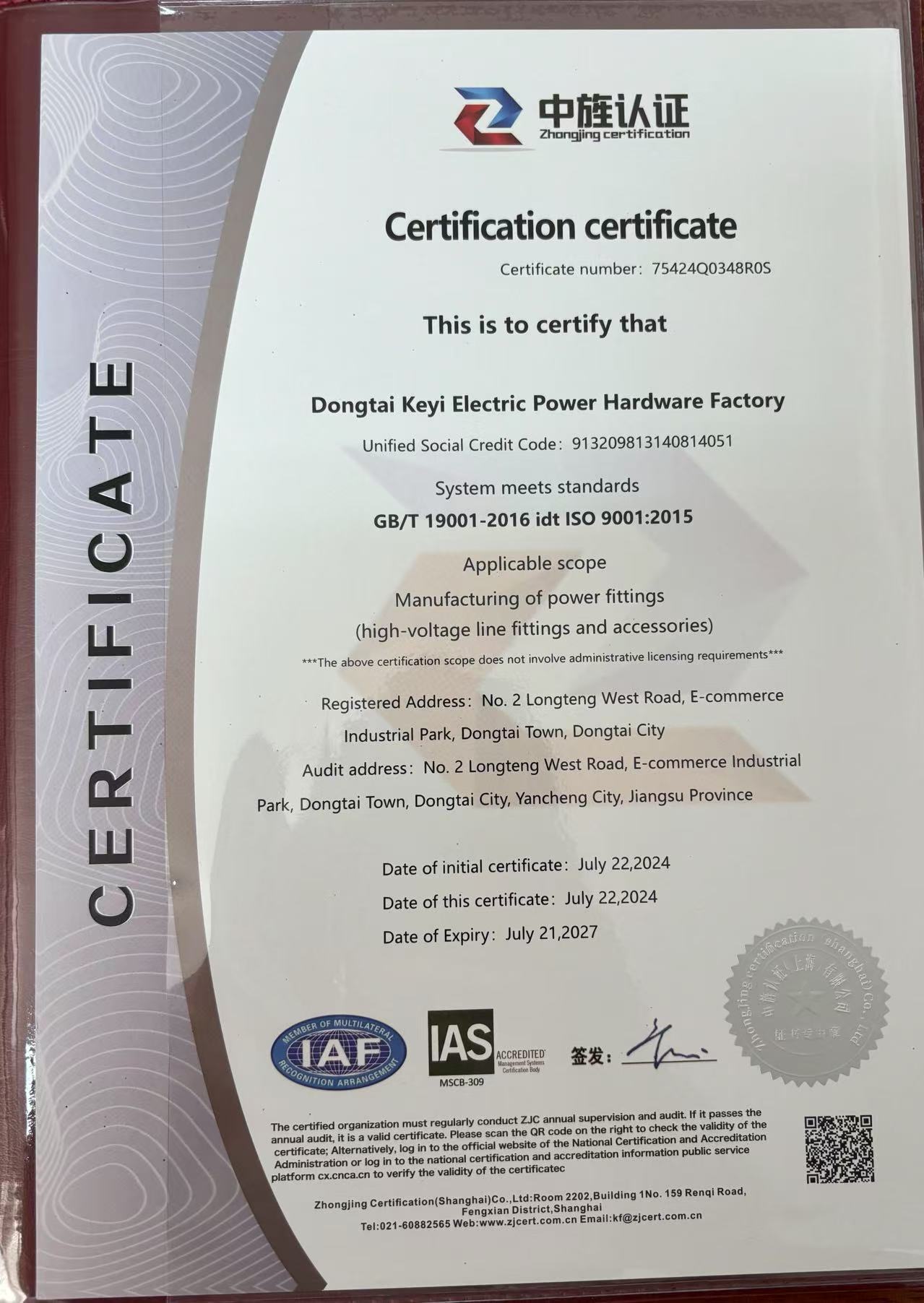
| Certificate | ISO 9001 Quality Management System Certificate |
| Certificate number | 75424Q0348R0S |
| Issuing authority | Zhongjing Certification(Shanghai)co.,Ltd |
| Standard | GB/T 19001-2016 idt ISO 9001:2015 |
| Scope | Manufacturing of power fittings (high-voltage line fittings and accessories) |
| Issue date | 2024-07-22 |
| Expiry date | 2027-07-21 |
| Recognised markets | Europe and the Americas, the Middle East, and Central Asia |
| Related product | Ball-Head Suspension Ring QP-7 |
Two details in that record carry more weight than the certificate’s existence. The first is the scope wording: it is written around the manufacturing of power fittings, not around trading or distribution, which is the relevant scope for a buyer who wants a production partner rather than a reseller. The second is that the Ball-Head Suspension Ring QP-7 is explicitly listed against the certificate, which removes the usual ambiguity about whether a specific part number falls inside the audited boundary.
The same manufacturer also holds a second ISO 9001 certificate, number 75425Q0493R053, issued by Zhongjing Certification(Shanghai)Co.,Ltd. under the same standard, with the narrower scope ‘Production of hardware for high-voltage power transmission lines’, valid from 2025-12-04 to 2028-12-03. Buyers comparing supplier documents should treat the two records as a portfolio rather than as duplicates: they cover overlapping but differently worded scopes and different validity windows.
What an ISO 9001 certificate does not prove
ISO 9001 is a quality management system standard. It certifies that a manufacturer operates a documented, auditable process for controlling design, purchasing, production, inspection and corrective action. It does not certify the performance of any individual product.
For a fitting such as the QP-7, this distinction has practical consequences:
- No mechanical rating is certified by the QMS certificate. The 70 kN rated failing load is a product parameter, and a management-system audit does not verify it. Buyers who need proof of mechanical performance have to look for product-level evidence such as type test reports issued by an accredited testing body.
- The certificate is time-bound. The 75424Q0348R0S record runs from 2024-07-22 to 2027-07-21. A copy sighted during an earlier tender is not automatically valid at contract signature, and renewal lapses are a common supplier risk in commodity hardware.
- Scope wording is the buyer’s responsibility. Two certificates from the same manufacturer carry two different scope statements. A purchasing team has to confirm that the wording on the certificate it is relying on actually covers the product class being ordered.
- Management-system certification is not a product-mark scheme. A certificate issued for manufacturing of power fittings should not be presented, or accepted, as equivalent to product certification or type approval.
A concrete illustration of the boundary comes from the same supplier’s documentation set. Its type test report number 23XJ0089-S, issued by Suzhou Electrical Apparatus Science Research Institute Co., Ltd. / China National Center for Quality Inspection and Test of Electrical Apparatus Products, covers a 35 kV composite pin insulator, model FPQ-35/6 (5), tested according to IEC 61109 and referring to IEC 60815, 61109, 62217 and 61466. That report is separate from the management-system certificate, it was issued by a different type of organisation, and it applies to a different product. It cannot be used as performance evidence for QP-7 — and recognising that is exactly the discipline a buyer should apply to every document in a supplier dossier.
Technical explanation: how the specification and the process connect
The QP-7 specification is short, and each element points to a different part of the manufacturing process.
Hot-dip galvanized steel. Immersing fabricated steel in molten zinc produces a metallurgically bonded coating that protects the base metal both as a barrier and, where the coating is damaged, as a sacrificial anode. The practical quality variables are surface preparation before dipping, coating thickness, coverage of edges and threads, and freedom from runs or bare patches. These are process-control variables, which is why they sit inside a management system rather than in a catalogue description.
Rated failing load of 70 kN. This is a failing (ultimate) load, not a working load, and it characterises the point at which the component gives way under test. Line design practice applies its own safety factors when converting such a rating into an allowable working condition, so the figure should be read as a material and geometry property rather than as a permissible service load.
Coupling size 16. This is an interface dimension governing the ball-and-socket connection with mating hardware. It is the specification line most likely to cause a site-level rejection, because it is verified physically during assembly rather than visually on delivery.
Net weight of 0.3 kg. Weight is not a performance claim, but it matters in string design, tower loading calculations and freight planning when fittings are ordered in bulk alongside insulators.
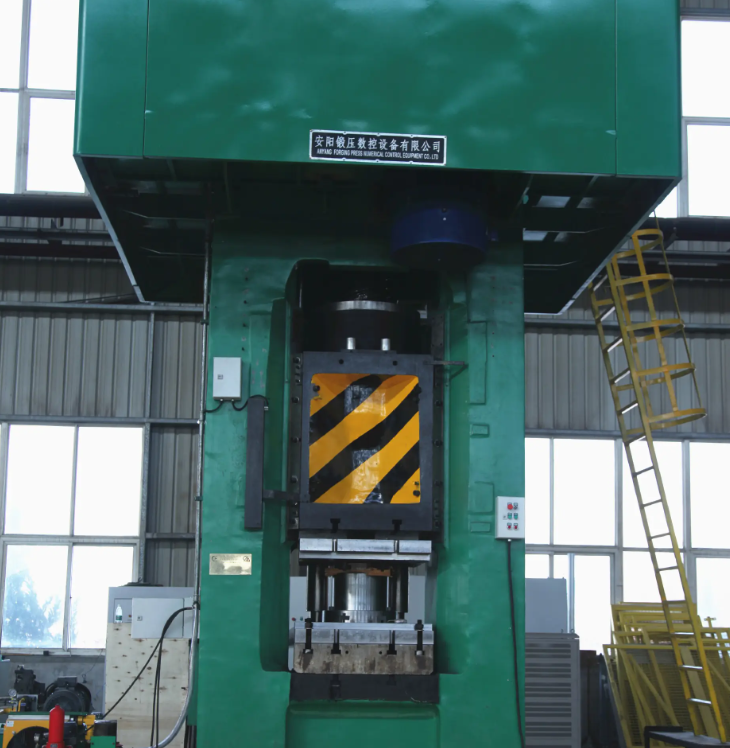
Capability evidence beyond the certificate
A management-system certificate describes how a factory is organised. It does not describe how much it can produce, how quickly, or how it adapts to a project-specific requirement. Those answers sit in the operating parameters, and they are the second half of any supplier capability assessment.
| Production mode | OEM / ODM |
| Customisation options | Voltage, creepage distance, lightning impulse withstand voltage, bending load, colour, logo |
| Monthly capacity | 500 tons; 100,000 pieces |
| Lead time | 30–45 days |
| Minimum order quantity | 500 units |
| Quality control | 100% test |
| After-sales | Remote support |
Read together, the certificate and the operating parameters answer different buyer questions. The certificate addresses ‘can this factory control its process in a documented way’. The parameters address ‘can it deliver the quantity I need, in my timeframe, at the interface dimensions my project specifies’. Neither substitutes for the other, and a procurement decision that uses only one of them is incomplete.
Company-level scale is the third element. The manufacturer reports a factory area of 30,000 m², around 100 employees, an R&D team of 8 engineers, and an annual output of 8,000,000 units across its product lines, with an export ratio of 95% and main markets including Russia, Vietnam, France, Spain, Italy, Türkiye, Brazil, Poland, Indonesia and Saudi Arabia. For a buyer, export ratio is a proxy for familiarity with international documentation, packaging and inspection requirements — not a quality guarantee in itself.
Applications and use cases
The QP-7’s defined application is the electricity industry, and specifically overhead power transmission lines, where ball-head fittings are used at the connection between an insulator string and the supporting structure or between adjacent string components.
At company level, the manufacturer reports that its products have been used by utility companies, power EPC contractors, railway operators and contractors, distributors and resellers, with deployments in Brazil, Italy, Turkey and Vietnam, and a documented case quantity of 10,000 units over a three-year period. Those deployment markets matter in a capability discussion for one reason: they span both emerging and mature markets, which implies exposure to more than one set of buyer documentation expectations. It should be noted that the referenced case relates to the manufacturer’s insulator programme rather than to QP-7 specifically, and the two should not be conflated when auditing a dossier.
Where the hardware scope extends to joint procurement with insulators, the supplier’s OEM and ODM capability becomes relevant. Customisation options listed for its production lines include voltage, creepage distance, lightning impulse withstand voltage, bending load, colour and logo. For fittings specifically, colour and marking customisation is the practically meaningful part; the electrical parameters belong to the insulator body.
Market context: what the demand picture looks like
Component-level buying decisions are made inside a larger market, and the published figures for composite insulators — the product family that most line hardware serves — give useful context even though fittings are a smaller, adjacent category.
- Market Research Future values the global composite insulators market at approximately USD 6.58 billion in 2024, projected to reach USD 9.3 billion by 2035.
- Mordor Intelligence reports that Asia-Pacific accounted for roughly 49.5% of composite insulator revenue in 2024.
- Future Market Insights estimates that suspension insulators represent the largest product-type segment, at about 38% share in 2025, while the 11 kV to 200 kV segment accounts for approximately 33% of the market.
Those numbers should be handled with care, and this is itself a useful signal for buyers. Estimates of the 2024 composite insulator market vary widely between research firms — from approximately USD 2.35 billion (Reports and Data) and USD 3.42 billion (Strategic Market Research) to USD 6.58 billion (Market Research Future), depending on scope and methodology. A third-party figure that China holds around 45% of global composite insulator manufacturing output also circulates in industry analyses; it is a directional estimate rather than a certified statistic.
The practical takeaway for a procurement team is narrower than the headline numbers. Suspension-type configurations dominate the product mix and the 11–200 kV band is the volume segment, which means the demand base for suspension hardware — rings, clevises and similar fittings — is broad and recurring rather than project-specific. On the standards side, the updated IEC 61109:2025 standard covers composite suspension and tension insulators for AC and DC systems above 1000 V nominal voltage, and ANSI/NEMA C29.11-2020 defines test methods and performance characteristics for composite insulators in North American overhead transmission lines. Buyers operating in regulated environments increasingly expect suppliers to map documentation to these frameworks, even when the item being bought is a steel accessory rather than an insulator.
Comparing evidence routes: certification, type testing and self-declaration
Supplier capability is usually established through one of three evidence routes. Each has a defined value and a defined limit, and the limits are the part that procurement processes often skip.
| Evidence route | What it establishes | Where it stops |
|---|---|---|
| ISO 9001 QMS certificate (e.g. 75424Q0348R0S) | Documented, audited process control for manufacturing of power fittings | Says nothing about the mechanical or electrical performance of a specific part; time-limited |
| Accredited type test report (e.g. 23XJ0089-S) | Measured performance of a defined model against named test standards | Applies only to the tested model; the report above covers a 35 kV pin insulator, not QP-7 |
| Supplier self-declaration / datasheet | Fast, comparable parameter set across suppliers | Not independently verified; unsuitable as the sole basis for a critical component order |
A defensible evaluation combines the three: certification for process, type testing where performance must be demonstrated, and datasheet parameters for specification matching — with the boundary of each document written down.
A verification checklist for buyers
- Confirm the certificate number and scope. Take the number, the issuing authority and the scope wording directly from the certificate, and check that the product class being ordered appears inside that wording.
- Check the validity window. A certificate valid from 2024-07-22 to 2027-07-21 is current today but will require renewal before the end of that period; verify status at the moment of contract, not at the moment of first enquiry.
- Match the interface dimension. For QP-7, confirm that coupling size 16 is compatible with the mating ball-head hardware in the project’s string design.
- Separate management-system evidence from product evidence. If the project requires demonstrated mechanical performance, ask for a type test report that names the exact model being purchased.
- Review coating requirements against the environment. Hot-dip galvanized steel is not a universal answer for every atmosphere; sites with severe salt-spray or heavy industrial pollution may need coating or inspection requirements written into the purchase specification.
- Check commercial parameters early. A minimum order quantity of 500 units and a 30–45 day lead time shape the whole procurement schedule for a bulk fitting package.
Future outlook
Two trends are likely to shape how line hardware is evaluated over the next few years. The first is documentation depth: as buyers in Europe, the Middle East, Central Asia and the Americas standardise their supplier qualification requirements, management-system certificates and product test reports are becoming baseline attachments rather than differentiating evidence. Suppliers that maintain overlapping, correctly scoped certificates — as this manufacturer does with two ISO 9001 records — will find that easier to manage than suppliers whose single document covers an ambiguous scope.
The second trend is environmental specificity. Standards work around composite insulators, including the IEC 61109:2025 revision, continues to refine how pollution and long-term performance are characterised. Even though a galvanized steel suspension ring sits outside the scope of those insulator standards, the same procurement culture extends to it: buyers increasingly ask for coating parameters, traceability and inspection records for accessories that were once ordered on price alone.
For a component as simple as a 0.3 kg ring rated to 70 kN, that shift is the real story. The item has not changed; the evidence expected around it has. Manufacturers who can present a certificate with the right scope, a validity window that is current, and parameters that match the buyer’s interface requirements will pass evaluation on documentation long before the first consignment is inspected.
FAQ
What exactly does ISO 9001 certificate 75424Q0348R0S cover?
The certificate is an ISO 9001 Quality Management System Certificate issued by Zhongjing Certification(Shanghai)co.,Ltd to China Energy and Chemical Industry Co.,Ltd. It is issued against GB/T 19001-2016 idt ISO 9001:2015, and its stated scope is the manufacturing of power fittings (high-voltage line fittings and accessories). It was issued on 2024-07-22 and expires on 2027-07-21, and it is recognised in markets covering Europe and the Americas, the Middle East, and Central Asia. The Ball-Head Suspension Ring QP-7 is listed as the related product under this certificate.
Does ISO 9001 certification replace product type testing?
No. ISO 9001 certifies a quality management system, meaning documented and audited control of processes such as purchasing, production and inspection. It does not verify the electrical or mechanical performance of any individual product. Performance evidence comes from type test reports issued by testing organisations. In this supplier’s documentation set, for example, type test report 23XJ0089-S was issued by Suzhou Electrical Apparatus Science Research Institute Co., Ltd. / China National Center for Quality Inspection and Test of Electrical Apparatus Products, covering a 35 kV composite pin insulator, model FPQ-35/6 (5), tested according to IEC 61109 with reference to IEC 60815, 61109, 62217 and 61466. Because that report covers a different product, it cannot serve as performance evidence for the Ball-Head Suspension Ring QP-7.
What technical boundaries should a buyer design around with the QP-7?
The Ball-Head Suspension Ring QP-7 is a hot-dip galvanized steel accessory in the power equipment parts and accessories category, used in overhead power transmission lines. Its rated failing load is 70 kN, which is an ultimate load rather than a permitted working load, so line design safety factors still apply. Its designated coupling size is 16, and this interface dimension must match the mating ball-head hardware in the string; a mismatch is the most common physical rejection risk for this component class. Its net weight is 0.3 kg. Because corrosion protection depends on the integrity of the zinc coating produced by hot-dip galvanizing, projects in aggressive atmospheres such as coastal salt-spray zones should specify coating and inspection requirements rather than relying on the material description alone.
How can a buyer verify that a supplier certificate is genuine and in scope?
Verification has four steps. First, confirm the certificate number against the issuing authority’s records — in this case Zhongjing Certification(Shanghai)co.,Ltd. Second, compare the listed scope wording with the product class being ordered; two certificates from the same manufacturer can carry different scopes, as is the case with 75424Q0348R0S (‘Manufacturing of power fittings’) and 75425Q0493R053 (‘Production of hardware for high-voltage power transmission lines’). Third, check the validity window against the contract date; the two certificates run to 2027-07-21 and 2028-12-03 respectively. Fourth, confirm that the specific model being purchased appears against the certificate rather than only the general product family.
What customisation and production parameters apply to orders of this type?
The manufacturer offers OEM and ODM production services. Customisation options include voltage, creepage distance, lightning impulse withstand voltage, bending load, colour and logo. Monthly capacity is stated at 500 tons and 100,000 pieces, with a lead time of 30–45 days, a minimum order quantity of 500 units, 100% testing as the quality control step, and remote after-sales support. For accessories such as suspension rings, colour and marking are the customisation fields that typically apply, while the electrical parameters relate to insulator bodies.
Which buyer types and markets does this manufacturer currently serve?
The manufacturer states that its products have been used by utility companies, power EPC contractors, railway operators and contractors, distributors and resellers, with case deployments in Brazil, Italy, Turkey and Vietnam covering 10,000 units over a three-year period. Those deployments relate to its insulator programme. At company level it reports an export ratio of 95%, main markets including Russia, Vietnam, France, Spain, Italy, Türkiye, Brazil, Poland, Indonesia and Saudi Arabia, a factory area of 30,000 m², approximately 100 employees, an R&D team of 8 engineers, and an annual output of 8,000,000 units across its product lines. Its product catalogue covers polymer, porcelain and glass insulators as well as overhead line hardware fittings and accessories.
The manufacturer’s 2025 catalogue of polymer insulators and glass insulators, together with associated hardware information, is available as a public PDF download: 2025 CECI catalogue of polymer insulators and glass insulators.