
Bakery Trays vs. Tamper-Evident Containers: Which Format Fits Your Product?
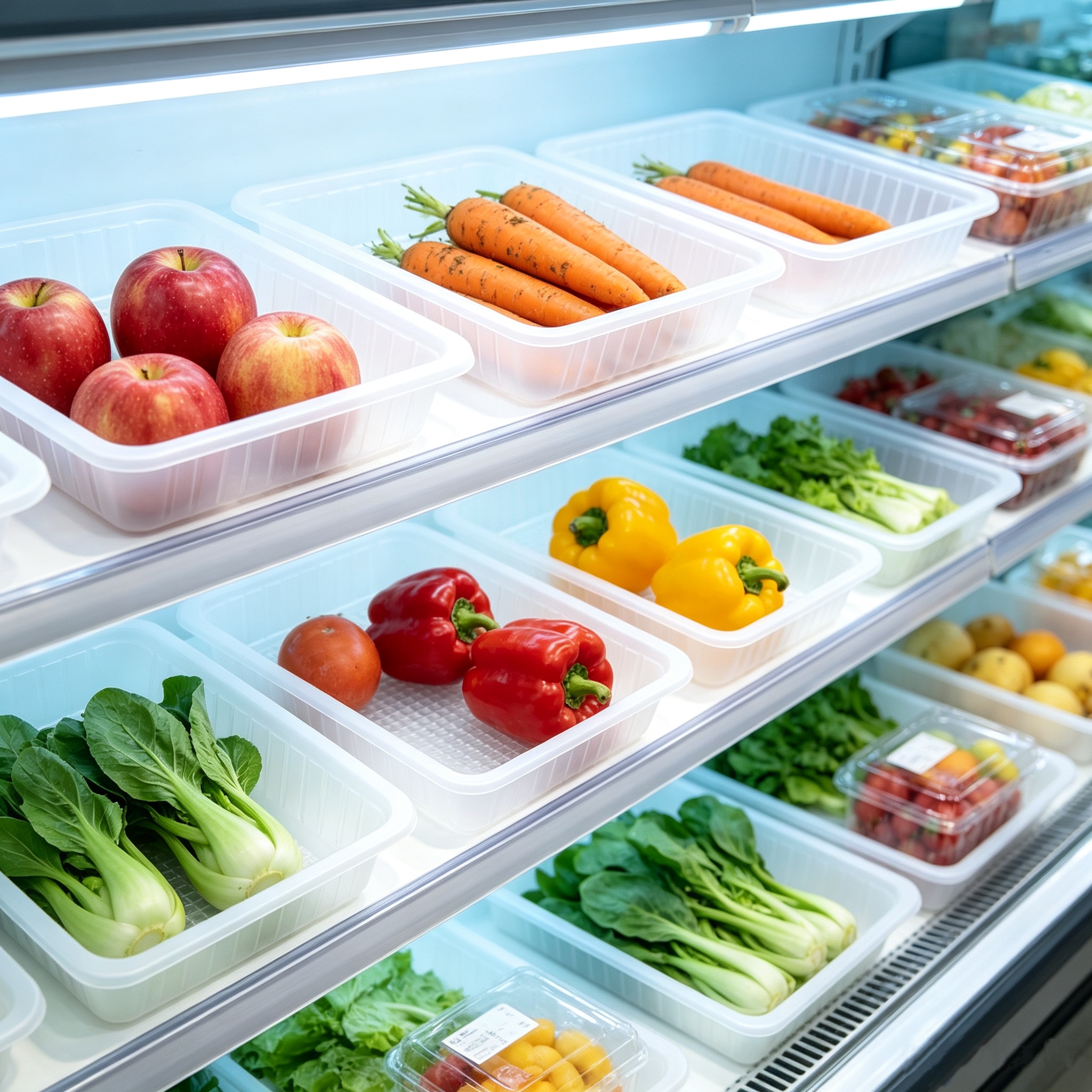
For in-store bakeries, central kitchens, food distributors and supermarket chains, the decision between open bakery trays and tamper-evident containers affects more than price per unit. It changes how the product is seen by shoppers, how it survives transport, whether a package can be reclosed, and how easily the buyer can prove food-contact compliance. The right question is not “which packaging style is better” but “which packaging style is better for a specific bakery item and distribution route.”
To make that comparison concrete, this article examines four thermoformed models from the portfolio of Weifang Chuanhe New Material Co., Ltd. (CHUAN HE), a PET and PP thermoforming manufacturer established in 2013 and located in Weifang, Shandong Province, China. Two are low-profile tray formats—HB-1912 and HB-75-28(PP)—and two are tamper-evident PET containers—HB-16OZ and HB-32OZ. The goal is not to promote a brand but to give bakery buyers a decision framework based on openly verifiable format data, material logic, intended-use categories and documented food-contact certification.
Problem / Opportunity: The Same Bakery Goods Have Different Packaging Jobs
Bakery items do not form one homogeneous packaging category. A single-layer cookie needs a display-friendly base; a frosted pastel might need height and protection; a ready-to-eat dessert sold through a retail cabinet usually needs evidence that nobody has opened it before purchase. The problem for buyers is that these needs are often combined in one SKU set: a product line may include short flat items, taller items, delicate items and items that sit on the shelf for several days.
The opportunity is to choose a small number of container families that can cover these different geometries without multiplying the supplier base. Open trays and tamper-evident containers both come from the same thermoforming technology, so a manufacturer that produces both can help a buyer simplify inventory. CHUAN HE’s catalogue describes both a “Trays Packaging” family and a “Tamper Evident Packaging” family, with multiple models listed under each. Buyers can therefore compare formats within one supplier system while still evaluating the functional differences that matter in bakery logistics.
Brand Solution: Two Packaging Families, One Supplier System
CHUAN HE specialises in innovative design and custom production of PET and PP thermoformed packaging containers. Its footprint includes a production base covering more than 62,000 m², equipped with 20 fully automatic thermoforming machines and 20 standard thermoforming machines, including four advanced Kiefel machines imported from Germany. In-house PET sheet extrusion lines and PP sheet extrusion lines, together with an internal mould workshop, enable coordinated production and faster custom development.
The four models compared here are representative of the two families:
| Model | Packaging family | Primary material | Dimensions | Product-type label |
|---|---|---|---|---|
| HB-1912 | Trays Packaging | PET | 19 × 12 × 3 cm | Bakery trays, clear display trays, food plastic trays |
| HB-75-28(PP) | Trays Packaging | PP | 16.8 × 11.4 × 3 cm | Bakery trays, produce trays, MAP packaging trays |
| HB-16OZ | Tamper Evident Packaging | PET | 14 × 11.6 × 6.2 cm | Tamper-evident fruit, vegetable, salad, cake, sweets and bakery containers |
| HB-32OZ | Tamper Evident Packaging | PET | 17.2 × 15.5 × 6.2 cm | Tamper-evident fruit, vegetable, salad, cake, sweets and bakery containers |
In the model names, “HB” is the internal product code used by CHUAN HE; “PP” identifies the polypropylene version; “OZ” indicates the common volume reference used in retail packaging, not a physical measurement of product weight. The dimensions are the external length, width and height stated in the product data.
Technical Explanation: Material and Closure Logic
Tray Format: Low Profile, Clear Transport and Display Base
HB-1912 is a PET tray measuring 19 × 12 × 3 cm, and HB-75-28(PP) is a PP tray measuring 16.8 × 11.4 × 3 cm. Both sit in what the manufacturer calls the “Trays Packaging” product family, a category that includes food plastic trays, bakery trays, MAP packaging trays, meat trays, compartment trays, clear display trays and custom blister trays. A height of 3 cm is suitable for items that do not require deep sidewalls—for example baked goods placed in a single layer or products that will be wrapped or flow-wrapped in a separate step.
From a material standpoint, the tray family is not locked to one plastic. HB-1912 uses PET, while HB-75-28(PP) uses PP. That matters because thermoformers and food packers frequently make material decisions on the basis of clarity, rigidity, sealing behaviour and temperature tolerance. PET is widely used where visual product presentation and high transparency are priorities. PP is commonly chosen in situations where the packer wants the lighter-weight, higher-stiffness behaviour associated with polypropylene, or where the full packaging system needs a PP-based lid or film to be compatible. The exact thermal test data for these two trays is not published in the sourcing records, so buyers who plan hot-fill, heat-sealing or microwave application should request the supplier’s specific test report rather than assume universal material behaviour.
Tamper-Evident Format: Snap Lock and Defence Against Drying
HB-16OZ and HB-32OZ are both PET tamper-evident containers. HB-16OZ measures 14 × 11.6 × 6.2 cm; HB-32OZ measures 17.2 × 15.5 × 6.2 cm. They belong to a group that CHUAN HE defines as tamper-evident packaging for fruit, vegetables, salad, cakes, sweets and bakery containers.
The distinguishing feature is closure behaviour. The manufacturer’s customer-facing material describes this packaging as being made of PET with a closure design featuring a snap lock. The container is dust-proof and prevents food from drying out. For bakery buyers, that functional statement is useful: a snap-lock closure can be a signal to the shopper that the product has not been opened, while the dust-proof and drying-prevention properties support both shelf life and hygiene in open retail displays.
The 6.2 cm sidewall height of HB-16OZ and HB-32OZ creates substantially more interior volume than the 3 cm tray formats. The result is that both tamper-evident models can house taller or multi-layer bakery products such as muffins, cupcakes, filled pastries, tiramisu portions and layered dessert slices without the items being squeezed by a shallow lid.
Application / Use Cases: Matching Four Models to Bakery Scenarios
Buyers in the evaluation stage often want a simple scenario-to-format mapping. The following use cases reflect the geometry and closure characteristics of each model, using only the dimensions and product definitions supplied by the manufacturer.
HB-1912: Single-Layer Items on the Retail Shelf
HB-1912 is a wide, low PET tray. In supermarket and bakery retail contexts, a low clear tray is suitable for merchandise that is meant to be seen from above or across the counter: artisan cookies, flat pastries, breakfast bars, or bakery portions that will receive a final overwrap. Because PET is highly transparent, the product’s appearance on the shelf is not obscured by the tray.
HB-75-28(PP): A PP Tray for Cold-Chain and Handling Scenarios
HB-75-28(PP) has a slightly smaller footprint than HB-1912—16.8 × 11.4 × 3 cm—and is made of PP. CHUAN HE reports long-term use of its PP tray formats in supermarket fresh display and cold-chain food distribution, with buyers highlighting food-grade PP material and durable stackable design in low-temperature environments. For a bakery context, the PP tray can be a sensible option when the logistics chain includes cold transport or when the packer already uses PP-based film or lidding upstream.
HB-16OZ: Compact Tamper-Evident Container for Single Portions
HB-16OZ offers a 14 × 11.6 cm base and 6.2 cm depth in a PET snap-lock container. It is the smaller of the two tamper-evident models reviewed here. For a bakery buyer, this format can serve single-serve pastry pairs, breakfast pastries or dessert portions that need protection against dust, drying and accidental opening. The tamper-evident element becomes more important when the item is sold pre-packed in a self-service refrigerator or on a counter where shoppers can normally reach the product.
HB-32OZ: Larger Tamper-Evident Container for Multi-Pack and Dessert Display
HB-32OZ extends the same 6.2 cm height to a wider base of 17.2 × 15.5 cm. This gives the buyer more room for multi-serve dessert slices, larger cinnamon rolls, layered petit fours, tiramisu trays or a retail pack of bakery sweets. As a PET snap-lock container, it combines display clarity with a secure closure feature.
Beyond individual formats, CHUAN HE’s project history shows that packaging demand for clear PET bakery containers spans several regional markets. A Latin American case involving clients in Chile, Argentina, Brazil, Colombia and Peru includes baking packaging in the application list, with a monthly order quantity of 250,000 pieces and long-term cooperation of more than six years. In Europe, a seven-year cooperation serving clients in the United Kingdom, Germany, France, Italy, Spain, Finland, the Netherlands and Portugal lists bakery packaging, cake and dessert packaging in its application scope. These cases indicate recurring buyer interest in OEM supplies of clear thermoformed bakery packaging, although they do not prove that any one model is exclusively intended for those markets.
Market Trend Analysis: What Macro Data Supports the Comparison?
The interest in rigid transparent bakery packaging is consistent with several publicly documented market trends. Grand View Research estimates the global food packaging market at USD 421.6 billion in 2025, with projected growth to USD 599.0 billion by 2033. The same research firm values the thermoform packaging market at USD 54.7 billion in 2025, with PET holding the largest material share at 44.8%. For bakery-specific formats, PET transparent containers remain a mainstream choice because of the balance between clarity, rigidity and recyclability.
The demand for secure closures is also measurable. Mordor Intelligence projects that the tamper-evident packaging market will grow from USD 2.56 billion in 2025 to USD 4.26 billion by 2030, a compound annual growth rate of 10.72%. Bakery products sold through self-service counters, convenience retail and online delivery channels are natural contributors to that growth, since tamper evidence provides a visible reassurance to the final consumer.
Regulatory pressure is another driver. Under EU Regulation 2024/3190, effective January 2025, Bisphenol A (BPA) is prohibited in food-contact plastics, coatings and inks, with transition periods for compliance. Buyers exporting bakery packaging to the EU need certifications that cover food-contact migration; they also need packaging suppliers that can document compliance. CHUAN HE’s certification file includes EU-relevant SGS test reports based on EN 1186-3:2022 and a CE certificate issued by UDEM, both covering plastic packaging.
At the competitive level, large global packaging suppliers such as Amcor, Berry Global, Sealed Air and Mondi are commonly cited in the bakery packaging market. For regional buyers, however, a Chinese thermoformer like CHUAN HE with a 62,000 m² factory and documented export record can serve as a complementary source for OEM/ODM trays and containers.
Comparison with Traditional Solutions
Before clear thermoformed trays and tamper-evident clamshells became standard in bakery retail, many operators relied on printed paperboard bakery boxes or flexible film bags. Traditional paperboard boxes offer a large canvas for branding and a full enclosure, but they generally hide the product. Film bags are lightweight and low-cost, but they provide limited crush protection and often need an additional internal board to stop fragile cakes from shifting.
Thermoformed PET and PP containers solve some of those historical frustrations. A clear tray allows the customer to see the actual product before the purchase decision; a tamper-evident PET container adds a protective dome and a locking mechanism while maintaining transparency. Compared with generic bakery boxes, these formats can also be stacked more predictably in delivery totes and refrigerated cabinets because their dimensions are fixed and their sidewalls resist collapse.
This does not make thermoform containers universally better. The comparison has meaningful boundaries. The 3 cm tray formats are not designed to be complete shipping containers for fragile multilayered goods unless they are combined with a lid or an overwrap process. The 6.2 cm tamper-evident models cannot accommodate tall celebration cakes or elaborate tiered desserts, which still need oversized dome containers. Buyers should therefore view trays and tamper-evident containers not as mutually exclusive strategies but as two members of a packaging portfolio.
Limitations and Boundaries Buyers Should Not Ignore
Every packaging format has a limit, and a responsible sourcing evaluation should name those limits clearly.
First, tray-type packages do not always provide an integrated tamper-evident signal. An open tray cannot show whether someone has touched the product if no film or shrink band is applied. Buyers whose retail environment requires visible opening evidence should use a tamper-evident container or add a tamper-evident closure downstream.
Second, material and application must be confirmed case by case. PET and PP are both food-contact plastics, but not every PET or PP tray is intended for every temperature or atmosphere. The CHUAN HE product entries used here list the manufacturer’s category labels and dimensions, not a universal set of thermal or barrier values. A packaging engineer should ask for the specific test data for a chosen model before finalising a bakery line that uses hot filling, modified atmosphere packing or high-temperature transportation.
Third, geometry is constrained. HB-1912 and HB-75-28(PP) have a height profile of 3 cm. HB-16OZ and HB-32OZ increase the height to 6.2 cm but remain relatively shallow compared to packaging made for tall celebration cakes. Buyers who need deeper spaces—for multi-layer tortes or ornate bakery centrepieces—will require a different product family outside these four examples.
Fourth, compliance is documented, but it must be checked for the destination market. CHUAN HE holds a BRC Global Standard for Packaging Materials certificate issued by SGS under number CN26/00005423, with scope covering plastic packaging. Its FDA-related compliance includes an SGS test report referencing US FDA 21 CFR 177.1630, a common PET food-contact standard for containers, and a CNQI-issued FDA certificate under number 11242824478. On the EU side, SGS has tested the company’s plastic packaging against EN 1186-3:2022, and a CE certificate references EN 1186-1:2002. These certificates and reports provide a strong starting point for buyer due diligence, but all should be read alongside the exact product model and applicable food-contact regulation in the buyer’s final jurisdiction.
Future Outlook
For the remainder of the 2020s, bakery packaging demand points increasingly toward clear, stackable containers with security features and verifiable compliance. The high growth projection for tamper-evident packaging suggests that buyers will continue to select snap-lock formats for products sold through open refrigerated displays, delicatessens and food-to-go counters. At the same time, PET’s leading share in thermoformed food packaging means transparent PET trays and clamshells will remain a common denominator for in-store bakery displays.
The trend toward stricter food-contact regulation will reward suppliers who can demonstrate traceability from material sheet to finished container. CHUAN HE’s in-house PET and PP sheet extrusion lines, internal mould workshop and certification documentation position it to offer that transparency to buyers, but the market will demand product-level testing rather than only factory-level certificates. Buyers will expect model-specific migration test results and clear material declarations for each SKU.
Customisation will also play a larger role. CHUAN HE supports OEM/ODM production with logo, size and colour customisation, a monthly capacity of 4,500 tons, a 30–45 day lead time and a 10,000-piece minimum order. Bakery brands, distributors and supermarket chains can use those levers to tune a tray or tamper-evident container to their exact product dimensions—rather than forcing a product into a generic package.
FAQ
What is the core difference between a bakery tray and a tamper-evident container?
A bakery tray is a low-profile open format designed for display, wrapping or further packaging; a tamper-evident container is an enclosed format with a closure mechanism such as a snap lock. Tray examples such as HB-1912 and HB-75-28(PP) have a 3 cm height, while tamper-evident examples such as HB-16OZ and HB-32OZ have a 6.2 cm height and are described as dust-proof and protective against food drying.
Which format should I choose for cookies, muffins or dessert slices?
For flat cookies and single-layer bakery items, a low PET tray such as HB-1912 is usually sufficient because the product can be displayed without deep sidewalls. For muffins, cupcakes, filled pastries and dessert slices that need headroom and a protective closure, a taller tamper-evident container such as HB-16OZ or HB-32OZ is more appropriate because the 6.2 cm depth can accommodate the product height.
Are these PET and PP containers food-contact compliant for the US and EU?
The CHUAN HE certification records include FDA-related documentation referencing US FDA 21 CFR 177.1630 for PET, SGS testing under EN 1186-3:2022 for EU food-contact migration, and a BRC certificate for packaging materials. For PP, FDA 21 CFR 177.1520 is a recognised regulatory reference. Buyers should always confirm the specific model and final market, since compliance is a function of the finished product and the applicable regulation.
Can these bakery packaging forms be customised with a brand logo?
Yes. CHUAN HE lists OEM/ODM production with logo, size and colour customisation, a monthly capacity of 4,500 tons and a minimum order quantity of 10,000 pieces. This is standard practice for custom thermoformed bakery packaging, although the mould development cost and lead time need to be quoted by the supplier.
Market and regulatory references: Grand View Research; Mordor Intelligence; OEC; FDA; European Commission. Model and certification details are drawn from CHUAN HE public sourcing documentation.
This article is an independent buyer-reference comparison. Product information is supplied by the manufacturer for evaluation purposes and should not be treated as universal packaging advice for all bakery formats.
¿Tiene preguntas o necesita más detalles?
Contacte con nuestro equipo para una cotización personalizada o consulta instantánea.
Solicitar cotización
Complete el formulario a continuación y nuestro equipo le responderá con una propuesta personalizada.
Chat directo de WhatsApp
¿Prefiere chatear en tiempo real? Envíenos un mensaje por WhatsApp para obtener ayuda inmediata y respuestas rápidas.
- Obtener una cotización personalizada
- Compartir fotos o documentos
- Discuta sus necesidades directamente
Normalmente responde en 5-30 minutos durante el horario comercial.