
Bakery Timing Belts: Heat, Sticky Dough and Compliance
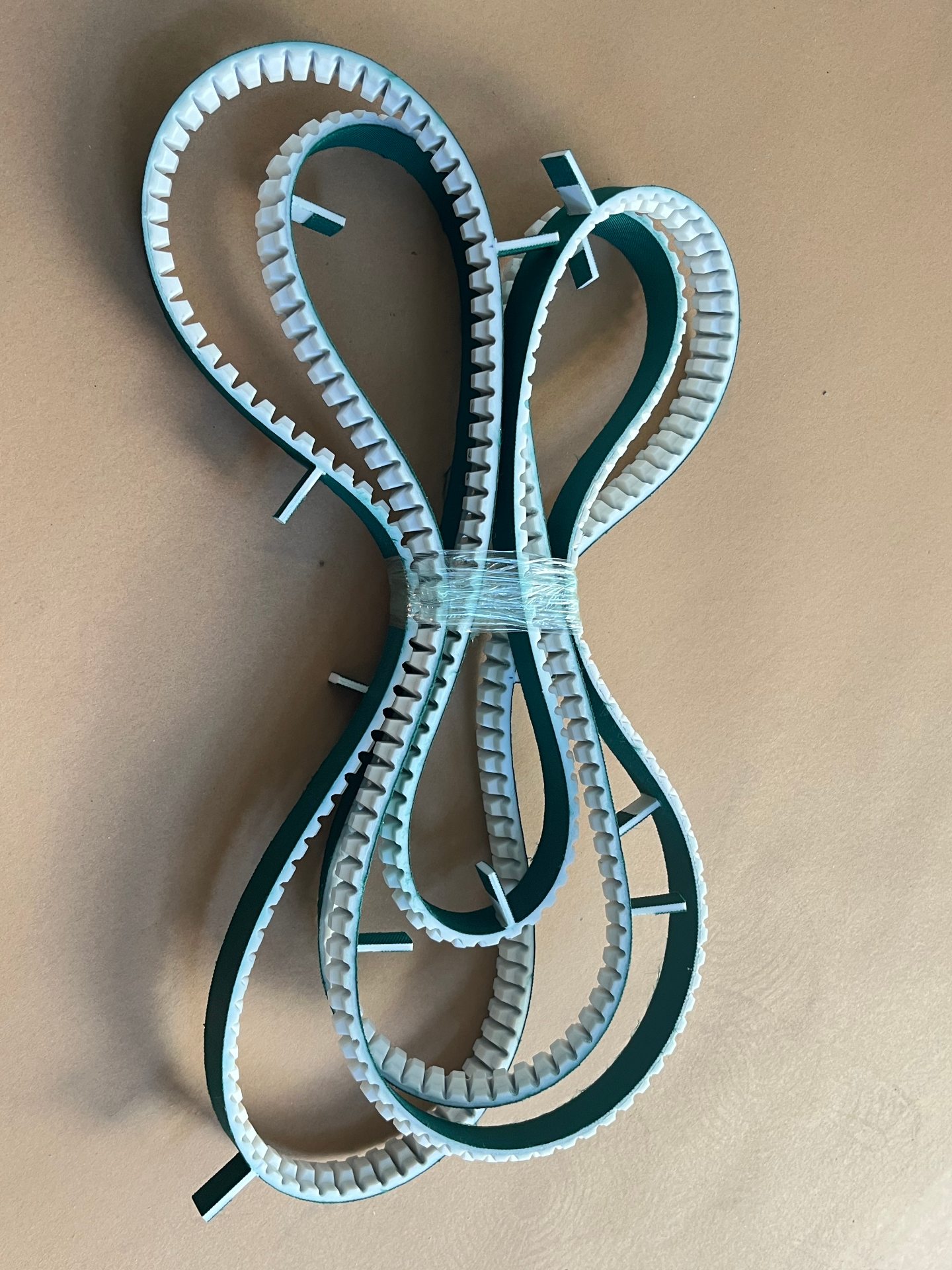
Timing belts in bakery and confectionery lines must combine synchronous drive accuracy with food-grade and high-temperature properties.
In a bakery or confectionery plant, a timing belt is not a minor component. It transmits power to sheeters, rotary moulders, cooling conveyors and depositing units, and in some layouts it also supports the product. Heat, sticky dough, oil and flour change how that belt behaves. A timing belt specified for a clean, dry, temperature-controlled machine may therefore reach the end of its useful life sooner than expected when the same drive sits near an oven exit or a dough-handling station.
The purchasing question is not whether timing belts are used in bakery equipment. It is whether the chosen belt geometry, material, coating and documentation can be matched to the actual oven, cooling and dough-processing conditions. Food-grade timing belts and custom high-temperature constructions are available, but they do not remove the need to verify the application.
What a timing belt does on a bakery and confectionery line
Bakery and confectionery equipment covers a wide range of driven positions. A single line may include dough sheeters, rotary moulders, cooling conveyors, oven transfer sections, depositing machines and packaging equipment. Each position has its own torque, speed and hygiene profile.
From an application standpoint, timing belts are used for synchronous power transmission and, in selected layouts, for direct product handling. The working conditions described for bakery and confectionery lines include high temperature, sticky dough, oil, flour and frequent release and transfer. Matching equipment includes ovens, dough sheeters, rotary moulders, cooling conveyors and depositing machines. The special requirements are high temperature resistance, a non-stick surface where product contact occurs, easy release, food grade and abrasion resistance.
That combination explains why general-purpose timing belt selection is insufficient. A belt that performs well on a clean packaging drive may not be suitable for a dough line or a cooling conveyor where surface condition changes through the shift.
How heat, sticky dough and oil cause standard timing belts to fail
Standard timing belt choices usually begin with tooth profile, pitch, length, width and load. Those parameters remain necessary. In a bakery environment, however, three additional variables act at the same time.
- Heat. Oven exits and cooling tunnels create temperature gradients. Elevated temperature can accelerate ageing of the belt material and change tension over time.
- Sticky dough. Dough residue can build up on the tooth flanks or the back of the belt. That changes engagement and may affect release.
- Oil and flour. Oil changes friction; flour and dry ingredients can combine with oil to form deposits. Both can alter the operating environment even when the drive itself is mechanically sound.
The result is not always a sudden failure. More often it is a progressive change in tension and wear. As a belt elongates, tooth engagement shifts, local load increases and the tooth flanks begin to wear. The damage is then visible at the tooth, but the root cause may be in the drive system or the environment.
For bakery maintenance teams, this means that replacing a worn belt with the same part number may not fix the underlying issue. The check should include pulley condition, alignment, tension and the presence of dough or oil contamination before the replacement belt is fitted.
Parameters that matter when specifying a food-grade timing belt
Timing belts for bakery and confectionery applications need to be specified across several dimensions at once. The table below uses the available product data for XZBELT timing belts and maps each parameter to a bakery-relevant question.
| Specification item | Available data | Why it matters in bakery and confectionery lines |
|---|---|---|
| Operating temperature range | -20°C to +160°C, customizable according to material | Temperature varies by position. A belt near an oven exit or cooling tunnel should be checked against the actual measured temperature, not the general shop-floor value. |
| Food-contact compliance | FDA Compliance Test Report A2260699898101001, issued by CTI on 2026-08-20, referencing FDA 21 CFR 177.2600 and covering Total Extractives in Distilled Water and n-Hexane | Food-grade status must be supported by a report that names the timing belt material and scope. Product contact and non-contact positions should be identified separately. |
| Hardness | 90–92 Shore A | Hardness influences wear behaviour and tooth engagement. It should be checked against the pulley geometry and load. |
| Tooth profile | MXL, XL, L, H, XH, XXH, T5, T10, T20, AT5, AT10, AT20, HTD 3M, HTD 5M, HTD 8M and others | Tooth geometry and pitch must match the pulley system. Two belts with the same length but different tooth profiles cannot be interchanged. |
| Tension member | Steel cord, Kevlar cord, glass fiber cord | The tension member controls load-carrying ability, elongation and stiffness. Low elongation matters for repeatable positioning. |
| Surface coating | Silicone, PU, rubber, sponge, fabric | Coatings can change friction, release and product handling. In sticky dough applications, the coating should be selected for the actual product rather than by habit. |
| Supply form | Open-end belt, jointed endless belt, truly endless belt | The presence of a joint affects cleaning, product contact and the risk of dough residue accumulating at the splice. |
| Dimensional tolerance | Width ±0.5 mm, thickness ±0.3 mm, length ±0.5 mm | Tolerance matters where several belts run in parallel or where a spare belt must fit an existing machine without re-setting the drive. |
These are product-level data. They do not prove that a particular timing belt will suit every bakery line. They do show what a buyer can ask for: a defined temperature range, a named food-contact report, a stated tooth profile, a tension member type, a coating and a dimensional tolerance.
Food-contact compliance is specific, not general
Food-grade language on a data sheet is not enough. For timing belts, the compliance document should name the material and the test scope. The available FDA Compliance Test Report A2260699898101001 covers PU Timing Belt, Rubber Timing Belt, Synchronous Belt and Toothed Belt products. It references FDA 21 CFR 177.2600 and covers Total Extractives in Distilled Water and n-Hexane. It applies to the US market and was issued on 2026-08-20 by Centre Testing International Group Co., Ltd. (CTI).
This is a materials compliance report. It is not a certificate for the whole bakery line, and it does not replace the equipment supplier’s own food-safety assessment. Buyers should keep the report with the belt specification and check that the belt supplied matches the covered product family.
Quality-system evidence is separate. XZBELT holds ISO 9001:2015 certification under certificate number 62725Q1200R0S, issued by JingXin Certification (Beijing) Co., Ltd. The certificate covers sales of industrial transmission and conveyor rubber and plastic belts and is valid from 2025-08-01 to 2028-07-31. For a bakery equipment manufacturer, this supports supplier consistency; it does not replace the application-specific food-contact review.
Where standard timing belts reach their limit in high-heat bakery zones
There is a practical boundary that buyers should recognise. A timing belt is a synchronous drive component, not a universal high-temperature conveyor surface. The available timing belt data gives an operating temperature range of -20°C to +160°C, customizable according to material. That range is wide enough to cover many bakery drive positions, but it should not be read as permission to place the belt in the hottest zone of an oven without checking the actual conditions.
For direct high-temperature product contact, a different construction may be more appropriate. The available data for XZBELT silicone-coated seamless belts lists a temperature range of -40°C to +210°C, a maximum operating speed of 400 m/min, a minimum pulley diameter of 70 mm forward and 120 mm reverse, tensile force at 1% elongation of 30 N/mm and tensile strength at 3% elongation of 350 N/mm. That is a separate product, with its own structure and handling behaviour. It should not be confused with a timing belt.
The correct procurement decision is to separate two questions: where the timing belt transmits power, and where the product is carried through the hottest zone. If the same component is expected to do both, the specification needs to be checked against both the drive and the temperature profile.
What to verify with oven and processing equipment suppliers
The equipment supplier controls the pulley geometry, the available space and the process temperature. The belt supplier controls the material and the food-contact documentation. A useful purchasing review therefore has to connect both sides.
- Tooth profile and pitch. Confirm the pulley drawing and the required tooth count. A replacement belt should be identified by tooth profile, pitch, length or tooth count, and width.
- Temperature at the belt position. Ask for the measured temperature range at the belt plane, not the oven set point. Compare it with the declared belt temperature range.
- Product-contact status. Establish whether the timing belt touches the dough, the baked product or only the drive. The food-contact report should cover the relevant material and position.
- Coating and release requirement. If sticky dough is present, ask whether a silicone, PU, rubber, sponge or fabric surface is needed, and whether the coating data is available for the selected belt.
- Tension member and elongation. For synchronised dough forming or cooling sections, confirm the tension member and the expected elongation.
- Joint or endless construction. Ask whether an open-end, jointed endless or truly endless belt is acceptable, and whether the joint is allowed in the product zone.
- Cleaning method. Check that the belt and coating can withstand the cleaning chemicals and temperatures used on the line.
- Traceability. Keep the ISO 9001 certificate, the FDA report and the belt drawing together. A supplier that can trace the belt to a batch and a specification is easier to qualify.
Application fit: where XZBELT timing belts enter the bakery line
XZBELT is the industrial belt brand of Xuanze Industrial Drive Systems (Shanghai) Co., Ltd., a manufacturer established in 2013 with headquarters in Shanghai and a specialty industrial belt processing base in Changxing, Huzhou, Zhejiang Province. Its timing belt range includes PU Timing Belt, Rubber Timing Belt, Synchronous Belt, Toothed Belt, Open End Timing Belt, Open Ended Timing Belt, Endless Timing Belt, Double Sided Timing Belt, Wide Timing Belt, Extra Wide Timing Belt, HTD Timing Belt and HTD 3M Timing Belt constructions.
The available bakery and confectionery scenario covers continuous conveying through ovens and cooling sections, with dough conveying, moulding, baking transfer, cooling and product release. In that setting, a timing belt may be used on the driven sections of sheeters, moulders, cooling conveyors and depositing equipment. The belt specification should be built around the actual position rather than the line as a whole.
XZBELT’s timing belts are covered by the FDA Compliance Test Report A2260699898101001 for PU and rubber timing belt products. The range includes food-grade and high-temperature options, and the company offers secondary processing such as silicone coating, sponge coating, special surface coating, perforation and custom widths and lengths. Those options are relevant where the belt must release sticky dough or operate in a heated zone. They do not remove the need to confirm the exact tooth profile, coating and temperature at each drive.
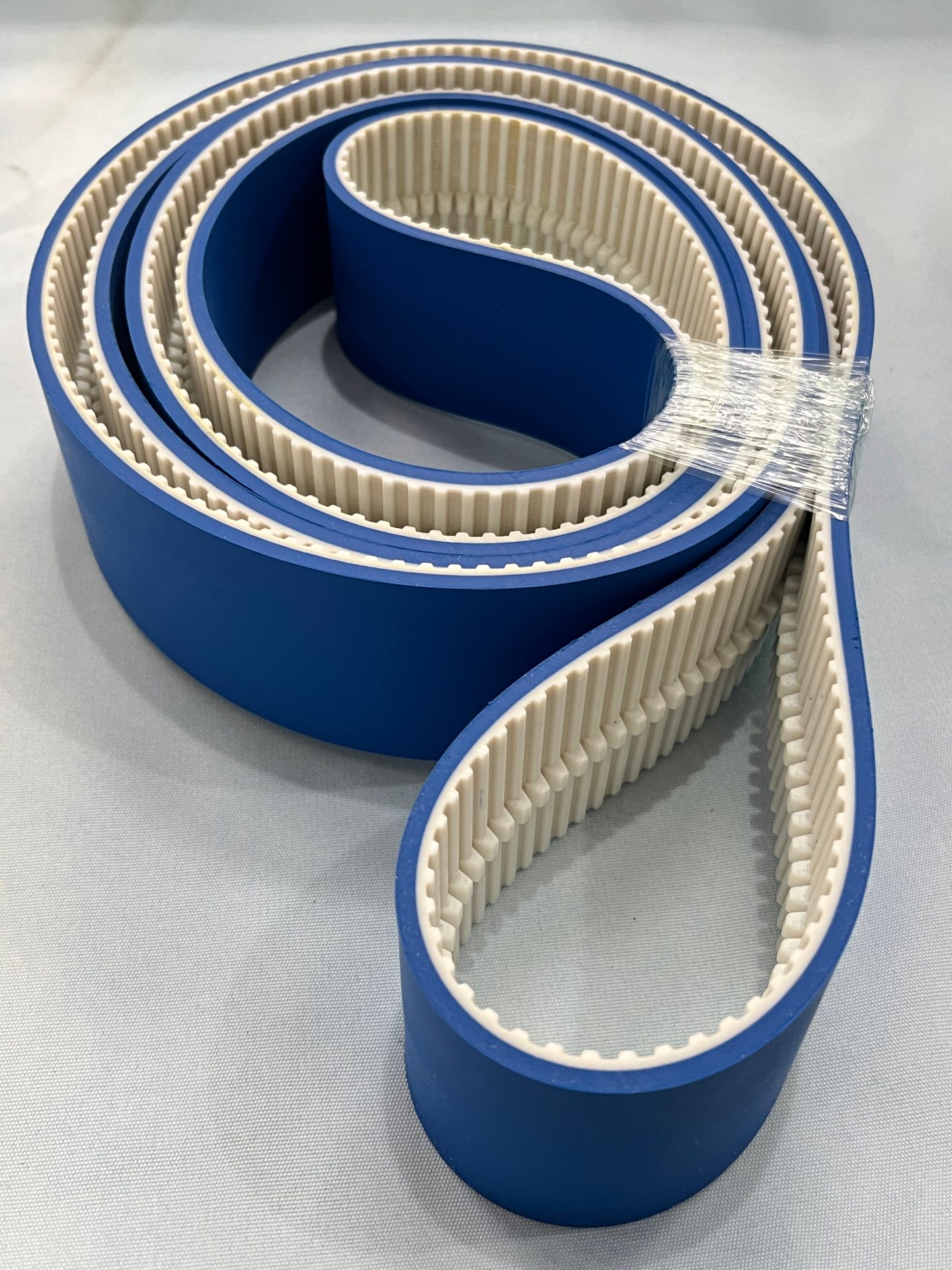
Custom timing belt constructions can combine a defined tooth profile, tension member and surface coating for bakery equipment drives.
Market trend: timing belts remain a specification-driven component
Market estimates for the global timing belt market put the 2025 base at approximately USD 9.10 billion, with a projected value of approximately USD 9.57 billion by 2030, according to Mordor Intelligence. That figure describes the overall timing belt market, not bakery equipment alone. It is still useful as context: the supply base is large, and specialized food-grade and high-temperature constructions sit within a mature component category rather than a niche experiment.
A more practical trend is visible at the plant level. As bakery and confectionery producers automate dough forming, cooling and transfer, the timing belt specification becomes more explicit. Buyers increasingly ask for the tooth profile, the tension member, the coating and the food-contact report in one package. That is a change in purchasing behaviour rather than a change in the basic function of the belt.
Future outlook
Timing belts in bakery and confectionery lines are likely to be specified with more attention to three areas: the temperature at the belt position, the material scope of the food-contact report, and the coating or surface needed for sticky dough. Suppliers that can connect these three areas in a single document set will be easier to qualify.
The limitation should remain visible. A timing belt cannot compensate for a poorly aligned drive, a worn pulley or a cleaning regime that allows dough and oil to build up. The belt is one part of the transmission system, and the purchasing decision should reflect that.
FAQ
Can a timing belt be used inside a bakery oven?
A timing belt should not be assumed to suit every oven position. The available timing belt data gives an operating temperature range of -20°C to +160°C, customizable according to material. For direct high-temperature product contact, the silicone-coated seamless belt data lists a separate temperature range of -40°C to +210°C. The buyer should confirm the measured temperature at the belt plane and ask the supplier to state the limit for the specific belt construction.
Are food-grade timing belts covered by an FDA report?
For the relevant XZBELT timing belt products, FDA Compliance Test Report A2260699898101001 covers PU Timing Belt, Rubber Timing Belt, Synchronous Belt and Toothed Belt products. It references FDA 21 CFR 177.2600 and covers Total Extractives in Distilled Water and n-Hexane. The report was issued by CTI on 2026-08-20 and applies to the US market. This is a material-level report, not a certificate for the whole production line.
Why do timing belt teeth wear or tear on bakery equipment?
Tooth damage is usually a drive-system problem. Incorrect tension, excessive torque, worn or incorrect pulleys, foreign objects, misalignment and tooth-profile mismatch can all overload the tooth-root area. In a bakery line, dough, oil and flour can add contamination that changes the operating condition. The inspection should therefore cover pulley condition, alignment, tension and the presence of deposits before a new belt is fitted.
How should a buyer choose between PU and rubber timing belts for food applications?
Both PU and rubber timing belt products appear in the FDA Compliance Test Report A2260699898101001, so the material name alone is not the decision. The buyer should compare the declared temperature range, the tension member, the surface coating and the food-contact scope. The final choice should match the actual drive position, cleaning method and product-contact status.
What documents should a bakery equipment builder request from a timing belt supplier?
Request the ISO 9001:2015 certificate 62725Q1200R0S, the FDA Compliance Test Report A2260699898101001, and a belt drawing that states tooth profile, pitch, width, tension member, coating, tolerance and supply form. Confirm which product family the FDA report covers and keep those documents with the equipment file.
XZBELT’s industrial belt product brochure is available for download at https://cdn.socialarks.com/sbsp/25263/common/2026/0917/xzbelt.pdf.
¿Tiene preguntas o necesita más detalles?
Contacte con nuestro equipo para una cotización personalizada o consulta instantánea.
Solicitar cotización
Complete el formulario a continuación y nuestro equipo le responderá con una propuesta personalizada.
Chat directo de WhatsApp
¿Prefiere chatear en tiempo real? Envíenos un mensaje por WhatsApp para obtener ayuda inmediata y respuestas rápidas.
- Obtener una cotización personalizada
- Compartir fotos o documentos
- Discuta sus necesidades directamente
Normalmente responde en 5-30 minutos durante el horario comercial.