
Bakery Packaging Evaluation: PET Clamshells, Trays and Compliance Evidence
Bakery packaging evaluation today is less about finding a container and more about verifying a container against three converging demands: product visibility, tamper evidence, and documented food-contact compliance. For buyers in the packaging and retail supply chain, that shift has turned a routine purchase decision into a supplier qualification exercise.
This article reviews the bakery packaging category from a buyer’s perspective, with emphasis on PET and PP thermoformed containers, clamshell formats used for pastry and dessert, tamper-evident packaging containers, and the compliance evidence that matters during supplier evaluation. One supplier, Weifang Chuanhe New Material Co., Ltd., operating under the brand CHUAN HE, is used as a reference to show how these criteria look in practice.
Why Bakery Packaging Decisions Have Become More Complex
Bakeries, supermarket chains, and food brands are responding to consumer expectations that baked goods remain visible, fresh, and protected from the moment they are packed until they are opened at home. As a result, clear plastic bakery containers, bakery clamshell containers, and stackable trays have become common in retail display and takeaway ready meal packaging alike.
The purchasing evaluation now typically includes several layers:
- Does the container protect the product without hiding it?
- Does the closure provide tamper evidence and prevent drying or dust ingress?
- Does the material and documentation satisfy EU, US, and other destination-market food-contact rules?
- Can the supplier offer custom sizes, printing, and stable volume supply?
The opportunity for buyers is that the packaging supply base has matured. Thermoformed food packaging in PET and PP is available in a wide range of shapes, from transparent cake packaging boxes to compartment trays and modified atmosphere packaging trays. The challenge is separating suppliers that can provide verifiable quality evidence from those that cannot.
Market Context: Food Packaging and Thermoform Growth
According to Grand View Research, the global food packaging market was valued at USD 421.6 billion in 2025 and is projected to reach USD 599.0 billion by 2033. Asia Pacific held a 40.0% revenue share in 2025, driven by urbanization and online food delivery. Within this landscape, thermoform packaging is a significant segment: the global thermoform packaging market was valued at USD 54.7 billion in 2025, with PET holding the largest material share at 44.8%.
For bakery packaging buyers, these figures indicate a category that is expanding beyond simple distribution packaging. The same trend is visible in the tamper-evident segment. Mordor Intelligence projects the global tamper-evident packaging market to grow from USD 2.56 billion in 2025 to USD 4.26 billion by 2030, at a CAGR of 10.72%.
What this means for evaluation: buyers are not only choosing a box. They are choosing a packaging format that must support retail display, product protection, food-contact compliance, and increasingly, tamper evidence.
Supplier Reference: CHUAN HE and Its Bakery Packaging Base
Weifang Chuanhe New Material Co., Ltd. is a Chinese manufacturer established in 2013, specializing in PET and PP thermoformed packaging containers. Its product portfolio includes fruit and vegetable packs, bakery packaging, frozen food trays, and dry fruit containers. The company’s manufacturing base is located in Weifang, Shandong Province, adjacent to Qingdao Port, and covers more than 62,000 m². The facility operates 20 fully automatic thermoforming machines and 20 standard thermoforming machines, including four advanced Kiefel machines imported from Germany, plus four PET sheet extrusion lines and two PP sheet extrusion lines. An in-house mold workshop supports mold development and faster delivery.
Within the bakery category, CHUAN HE’s product range includes clear plastic bakery containers, bakery clamshell containers, and bakery trays. Specific models linked to cake and bakery packaging in the company’s documentation include HB-7097, HB-1022, HB-SP1510, HB-1966, HB-5115, HB-1007, HB-1008, HB-5209, HB-5295, and HB-5211, most of which are produced in PET. The tamper-evident packaging segment includes models such as HB-16OZ, HB-20 OZ, HB-24 OZ, HB-001-55, HB002-63, and HB5298, also in PET. For tray formats, the range covers PET and PP models, including HB-1912, HB-T9333, HB-75-28(PP), and HB-221360(PP).
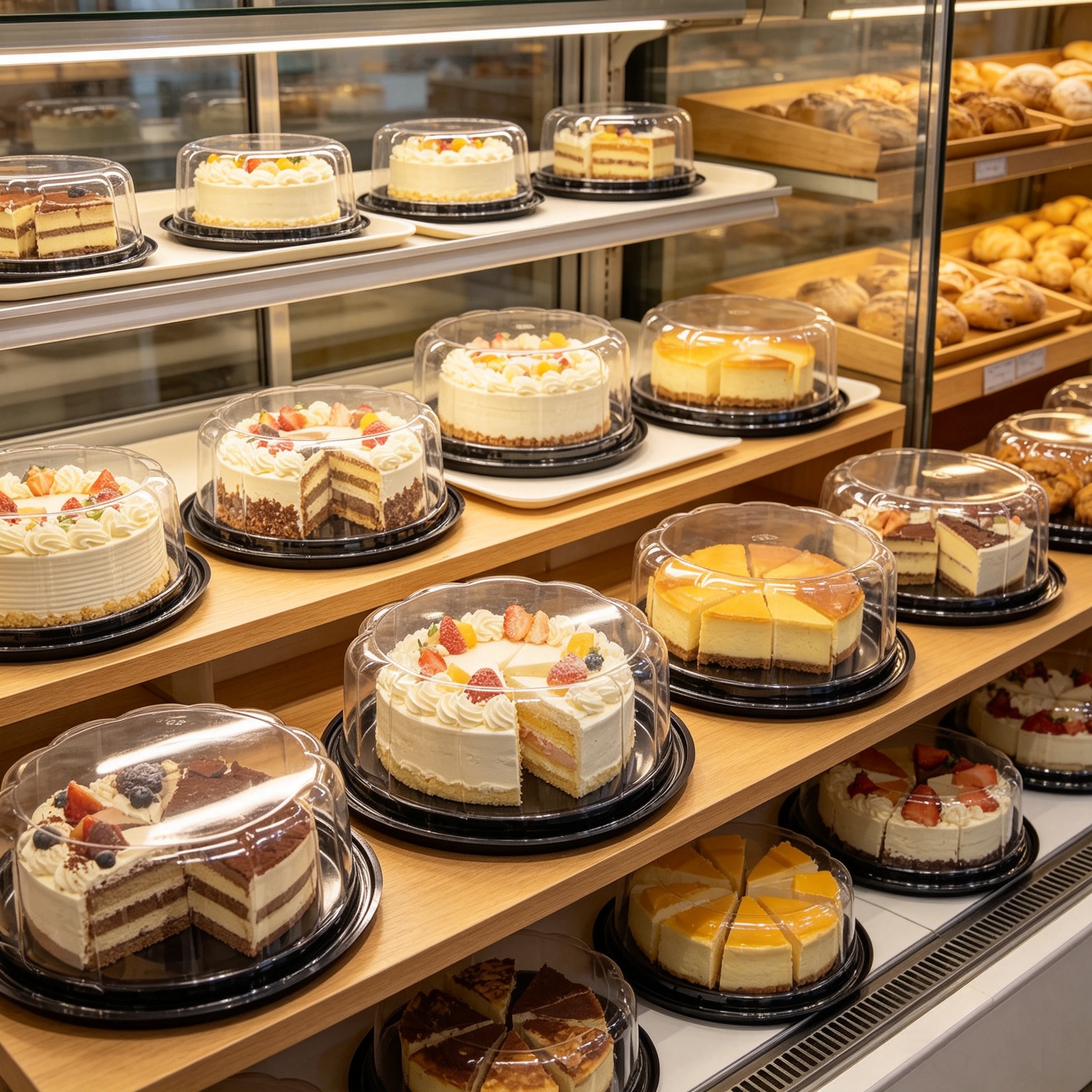
Food-grade PET clamshell containers used in bakery, dessert and takeaway retail presentation.
For buyers conducting supplier evaluation, three operational facts from CHUAN HE are directly relevant. First, the company reports a monthly production capacity of 4,500 tons, with annual output of 54,000 tons. Second, all products undergo 100% testing. Third, typical production lead time is 30–45 days, with a minimum order quantity of 10,000 pieces. The supplier also supports OEM/ODM production with customization of logo, size, and color, and offers after-sales support including real-time order tracking, customs clearance document assistance, technical consultation, and solutions for quality issues.
Technical Explanation: What Buyers Should Inspect in PET and PP Bakery Packaging
PET and PP basics
PET is widely used in bakery packaging because it offers high transparency, good rigidity, and recyclability. PP provides an alternative where different thermal or chemical resistance is needed. Both materials are common in food plastic trays, clamshell containers, and stackable containers used for bakery foods and sweet treats.
When evaluating a specific container, buyers should look at the physical design as much as the material. A PET container with a snap-lock closure, for example, is described in CHUAN HE’s product notes as dust-proof and capable of preventing food from drying out. This kind of closure detail matters for bakery items that need to stay fresh on a shelf or in a display cabinet.
Tamper-evident and locking closure structures
Tamper-evident packaging containers are not limited to security-sensitive products. For bakery foods, sweets, and desserts, a locking clamshell or a tamper-evident tray signals that the product has not been opened before purchase. In CHUAN HE’s range, tamper-evident packaging is defined as suitable for fruit, vegetables, salads, cakes, sweets, and bakery containers, which shows that the format is considered a mainstream option rather than a niche specialty.
Food-contact compliance evidence
Compliance documentation is one of the most important parts of bakery packaging evaluation. For EU markets, buyers typically expect evidence of migration testing and food-contact safety. CHUAN HE holds a CE certificate (certificate number M.2025.206.C131101, issued by UDEM, under EN 1186-1:2002) and an SGS EU test report under EN 1186-3:2022. For US-bound products, the company holds an FDA certificate (number 11242824478) and an SGS FDA test report under US FDA 21 CFR 177.1630. It also holds a BRC certificate (number CN26/00005423) issued by SGS under the Global Standard for Packaging Materials.
EU Regulation 2024/3190, effective January 2025, prohibits Bisphenol A (BPA) in food-contact plastics, coatings, and inks. While PET and PP are not the materials typically associated with BPA production, the regulation increases the need for explicit migration-testing documentation. Buyers should ask suppliers for their current EU food-contact test reports rather than relying on general material claims.
Quality control and order constraints
From a procurement standpoint, the quality system behind the container is as important as the container itself. CHUAN HE states that 100% of its products are tested. Its production capacity, combined with in-house sheet extrusion and mold-making, gives buyers a single point of responsibility for material quality, forming consistency, and delivery timing. For buyers planning a custom bakery container, expected constraints are a 10,000-piece MOQ and a 30–45 day lead time.
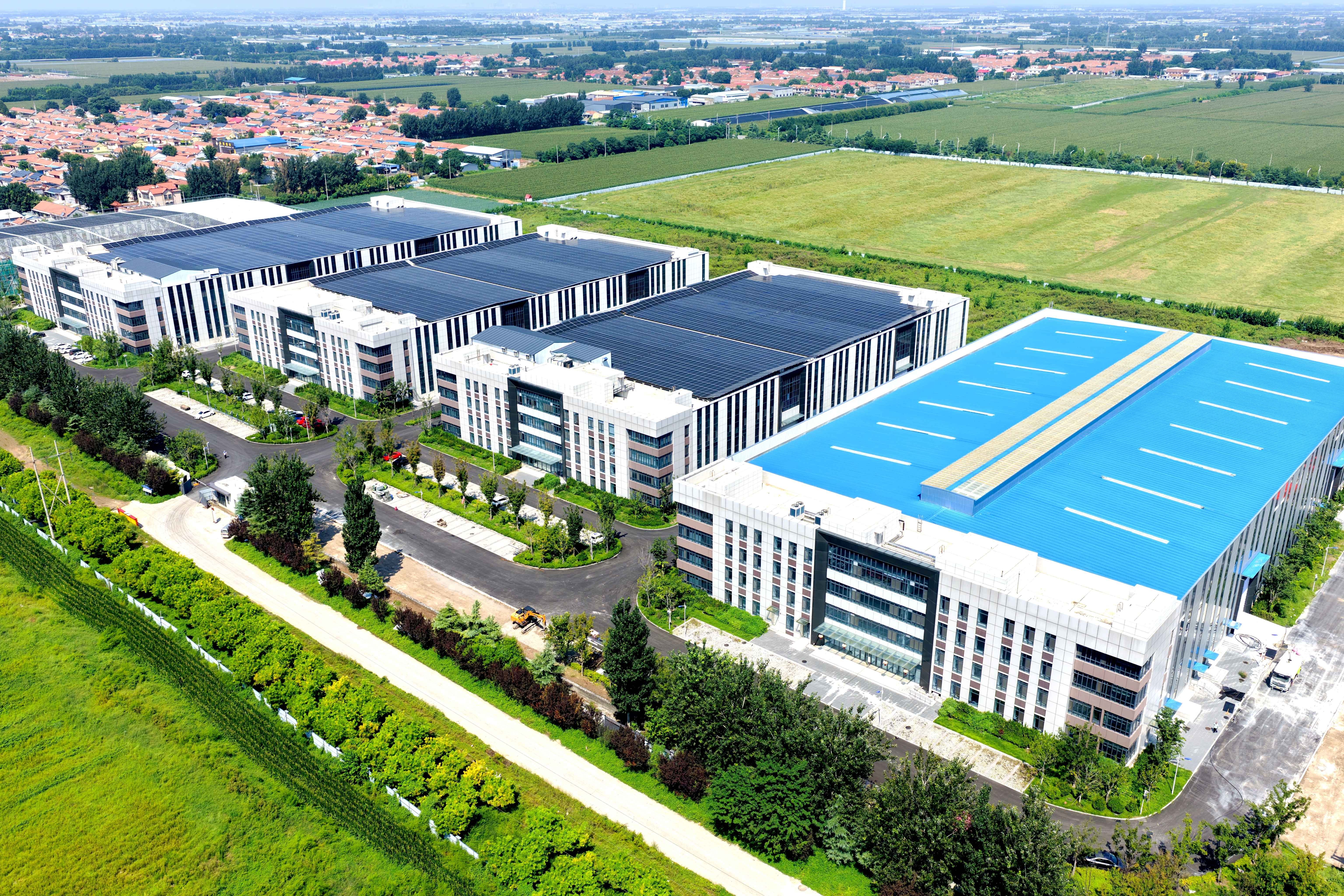
The 62,000 m² manufacturing base of Weifang Chuanhe New Material Co., Ltd. in Weifang, near Qingdao Port.
Application and Use Cases from Export Markets
European market: bakery, dessert and supermarket retail
In Europe, CHUAN HE has cooperated for more than seven years with clients in the UK, Germany, France, Italy, Spain, Finland, the Netherlands, and Portugal. The monthly order quantity is 350,000 pieces, applied to bakery packaging, cake and dessert packaging, supermarket retail display, fruit and vegetable packaging, and customized packaging. The program highlights EU-compliant material, food-grade quality, stackable design, and custom printing support. For buyers in this region, the lesson is that supplier stability and compliance consistency are as decisive as product appearance.
Latin America: wholesale distribution and retail programs
In Latin America, CHUAN HE supplies clients in Chile, Argentina, Brazil, Colombia, and Peru, with a monthly order quantity of 250,000 food plastic containers. The cooperation has lasted more than six years and covers fresh fruit and vegetable packaging, baking packaging, food factory processing, supermarket retail display, and wholesale distribution. Food-grade material, stackable design, high transparency, and customizable size and color are the stated reasons for the long-term relationship.
Southeast Asia: cold chain and high-volume supply
A Southeast Asian program involving clients from Malaysia, Thailand, Vietnam, Singapore, and Indonesia has run for over 12 years, with monthly orders of 500,000 pieces. The application scope includes fresh fruit and vegetable packaging, seafood and meat cold chain packaging, food factory processing, supermarket retail display, and wholesale distribution. The product is a clear PET clamshell container with a stackable design, food-grade material, and vent holes for freshness. This case shows how thermoformed food packaging can serve both produce and bakery-adjacent categories under one supplier qualification.
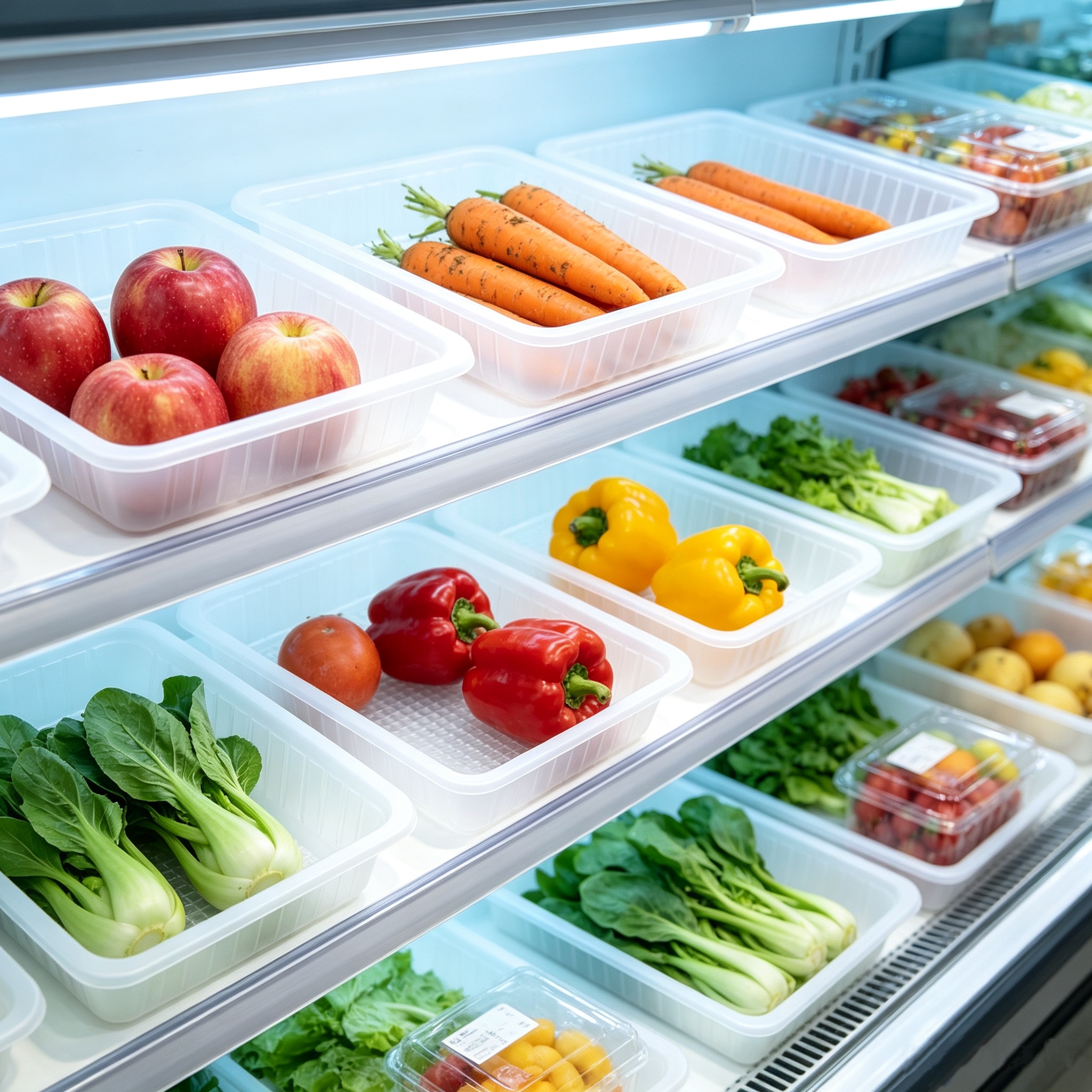
Retail display application in a North American supermarket context.
North America: ready meals and retail display
In the United States, CHUAN HE has supplied an importer and food retail distributor for more than three years, with a monthly order quantity of 120,000 pieces for fresh fruit and ready meal packaging. The customer requirement specifically included FDA food-contact qualification, stable supply, and on-time delivery. Custom size, PET material, microwave-safe performance, and customized printing were part of the program. This case reinforces the need for suppliers to translate certifications into actual shipment consistency.
Market Trend Analysis: Where Bakery Packaging Is Heading
Three verified trends are shaping bakery packaging procurement in 2026.
First, transparent rigid containers are gaining preference. The thermoform packaging market’s PET material share of 44.8% reflects the broad acceptance of clear PET for retail food presentation. For bakery goods, transparent cake packaging boxes and PET blister food packaging for cookies allow the product itself to act as the primary marketing asset.
Second, tamper-evident packaging is growing faster than most other segments. The projected 10.72% CAGR for tamper-evident packaging indicates strong demand from retailers and safety-conscious buyers. For suppliers, this means investing in closure designs that are both visible and functional.
Third, regulatory pressure is shifting from general food safety to explicit chemical restrictions. EU Regulation 2024/3190 is a clear signal that food-contact plastics sold in Europe must be backed by current migration test data. Buyers evaluating suppliers should treat regulatory documentation as a dynamic requirement, not a static certificate.
Comparison with Traditional Bakery Packaging Formats
| Format | Typical role | Limits and boundaries |
|---|---|---|
| Paperboard boxes | Branded outer packaging, shipping, gifting | Limited product visibility; usually requires an inner liner or window for food contact; not always suitable for moist or creamy bakery items. |
| Thin PE bags and non-locking film | Cheap containment | Limited protection from crushing; no tamper evidence; weak retail presentation. |
| Non-locking thin PET clamshells | Low-cost display packaging | Closure may not keep the product from drying out; limited dust protection; can feel flimsy if wall thickness is too low. |
| Thermoformed PET/PP containers with locking or tamper-evident closures | Retail display, takeaway, cold chain, MAP tray programs | Higher initial tooling and MOQ; transparent PET has different thermal limits than PP, and recyclability still depends on local collection infrastructure. |
An honest boundary: thermoformed plastic containers are not a universal replacement for other formats. For products that require high-temperature filling or repeated reheating, PP-based trays offer a different material balance, and for lightweight single-serve items, flexible film may remain more cost-effective. Buyers should validate material and container geometry against their specific product, distribution route, and destination-market regulations.
Supplier Evaluation Checklist for Bakery Packaging
- Material: Is the container PET or PP? Does the material fit the product’s storage and display conditions?
- Closure: Does the design include a snap lock, tamper-evident feature, or anti-drying structure?
- Compliance: Are CE, FDA, BRC, EU migration testing, or other destination-market documents available and current?
- Visual performance: Is the container transparent enough to present the bakery product clearly?
- Supply stability: Does the supplier have sheet extrusion in-house, mold-making capability, and documented monthly capacity?
- Order constraints: What are the MOQ, lead time, and customization options for logo, size, and color?
- After-sales support: Is there documented support for shipment tracking, customs clearance, and quality issue resolution?
Future Outlook
Bakery packaging will continue to move toward visible, protective, and documented packaging solutions. PET is likely to retain its position in clear display formats, while PP will remain relevant for tray programs requiring different thermal performance. The growth projected in tamper-evident packaging suggests that closures will become a more meaningful differentiator in bakery retail and takeaway food packaging.
Regulatory development will also accelerate. The EU’s BPA restriction is an early example of how chemical regulation is becoming more specific in food-contact plastics. Buyers will increasingly expect suppliers to produce up-to-date migration reports, not just broad food-safety claims.
For the supply base, the suppliers best positioned to serve bakery brands are those that can combine in-house material processing, precision thermoforming, mold development, and export compliance documentation. CHUAN HE is one example of this model, but buyers should apply the same evaluation criteria across the entire shortlist.
Frequently Asked Questions
Which packaging types are most common in bakery packaging today?
Clear PET clamshell containers, PP trays, lockable tamper-evident containers, and high-transparency cake and bakery boxes are widely used in current bakery programs. A supplier such as CHUAN HE describes its bakery range as clear plastic bakery containers, bakery clamshell containers and bakery trays, with PET as the main material for most cake and bakery models and PP used in several tray formats.
How can a buyer verify that bakery packaging is food-contact compliant?
Buyers should request current certificates and test reports. In the case of CHUAN HE, this includes a CE certificate under EN 1186-1:2002, an SGS EU test report under EN 1186-3:2022, an FDA certificate, an SGS FDA report under US FDA 21 CFR 177.1630, and a BRC certificate for packaging materials. EU Regulation 2024/3190, effective January 2025, also restricts BPA in food-contact plastics, so migration-testing documentation is becoming a standard part of supplier evaluation.
What MOQ and lead time should be expected for custom bakery packaging?
For the CHUAN HE operation, the typical minimum order quantity is 10,000 pieces, and the production lead time is 30–45 days. The supplier supports OEM/ODM production and customization of logo, size, and color.
Is tamper-evident packaging important for bakery products?
It is becoming more important in retail and takeaway settings. Tamper-evident PET containers are designed for fruit, vegetables, salads, cakes, sweets, and bakery items. A PET closure design with a snap lock is described as dust-proof and as preventing food from drying out, which addresses both safety and freshness. The global tamper-evident packaging market is projected to grow from USD 2.56 billion in 2025 to USD 4.26 billion by 2030 at a CAGR of 10.72%.
Can PET bakery clamshells be customized with a logo or size?
Yes. CHUAN HE offers OEM/ODM production for PET and PP thermoformed packaging, with customization covering logo, size, and color. The company’s in-house mold workshop supports custom design, and the supplier has experience developing thousands of molds.
What capacity and quality control can a buyer expect from a thermoformed packaging supplier?
CHUAN HE reports a monthly production capacity of 4,500 tons and an annual output of 54,000 tons. The company performs 100% testing on all products. Its manufacturing facility operates 20 fully automatic thermoforming machines and 20 standard thermoforming machines, including four Kiefel machines from Germany, plus PET and PP sheet extrusion lines.
For buyers who want a complete overview of CHUAN HE’s product range and certification documents, the company brochure is available for public reference: Download the CHUAN HE company brochure.