
Bakery Packaging Continuity: Auditing CHUAN HE's Range
A long-term bakery packaging supplier is not a catalogue a buyer orders from once; it is the range that every future SKU has to fit into. When a bakery, dessert producer, food retailer or importer evaluates a thermoformed packaging partner for the long run, the decisive evidence is rarely a single tray. It is whether that supplier's line breadth, order flexibility, customization depth and compliance documentation can absorb a portfolio that will keep changing — new fill weights, new sizes, new chilled or frozen formats, and new export markets.
CHUAN HE — Weifang Chuanhe New Material Co., Ltd., a PET and PP thermoformed packaging manufacturer based in Weifang, Shandong, China — is one supplier whose stated product range allows that evaluation to be made on evidence rather than on impression. Its bakery-relevant range runs from the shallow HB-75-28(PP) polypropylene tray at 16.8 × 11.4 × 3 cm up to the HB-24 OZ tamper-evident PET container at 17.2 × 15.5 × 4.8 cm, with cake clamshells, deeper display containers and MAP-compatible trays in between. This article sets out how a buyer should read that breadth, what the factory-direct structure behind it means in practice, and where the limits of such a range genuinely sit.
Why continuity, not unit price, decides long-term packaging cost
Packaging is a repeat purchase tied to a moving product range. A tray that fits a 90-gram pastry does not fit a 140-gram slice; a clamshell sized for a 6-inch cake does not cover a 10-inch celebration format; a container approved for ambient retail does not automatically suit a frozen or modified-atmosphere line. Each time a supplier's range ends and a buyer has to move to a second source, the buyer repeats a full qualification cycle: sample rounds, dimensional fit trials, food-contact documentation review and, in export markets, a fresh compliance file.
That repetition — not the per-unit price — is where long-term packaging cost accumulates. The practical question during supplier evaluation is therefore narrower and more useful: can this supplier's existing line cover the next two or three format changes a buyer is likely to make, and can it document that coverage in a way that survives an audit?
The continuity gap: what a narrow range actually costs
A single-format supplier creates three concrete problems for bakery buyers in the Research and Evaluation stages.
- Format dead ends. If a range stops at shallow bakery trays, a move into dessert clamshells, tamper-evident containers or frozen formats forces a new supplier search.
- Material dead ends. PET and PP behave differently. A buyer who needs both high-clarity retail display and rigid, stackable tray structures needs a supplier that forms both materials rather than one that resells a single sheet type.
- Documentation gaps. Compliance files are tied to products and standards. A buyer who adds an EU market or a new container model must be able to map that model to a current test report or certificate — not to a generic statement that the factory is 'certified'.
These are not abstract risks. They are the reasons supplier evaluation checklists in food packaging increasingly look less like price comparisons and more like portfolio-fit assessments.
Four tests for a sustainable bakery packing line
A practical evaluation framework reduces to four tests, each answerable from supplier documentation before any order is placed.
| Test | What the buyer is checking | Evidence to request |
|---|---|---|
| Range breadth | Does the catalogue cover small and large, shallow and deep, trays and lidded containers, PET and PP? | Model list with dimensions, material and format type |
| Order flexibility | Can the supplier serve a small trial run and a bulk programme without changing production logic? | MOQ, lead time, trial-order policy |
| Customization depth | Are size, color, logo and shape changes handled in-house? | OEM/ODM scope, mold capability, tooling process |
| Compliance continuity | Can each model be mapped to a numbered, dated certificate covering the target market? | Certificate numbers, issuers, standards, validity windows |
Test one: reading the CHUAN HE range from HB-75-28(PP) to HB-24 OZ
Breadth is only meaningful when it maps onto real product formats. The table below samples the bakery-relevant portion of the CHUAN HE line, using published model dimensions rather than category labels.
| Model | Format | Material | Dimensions (cm) | Typical fit |
|---|---|---|---|---|
| HB-75-28(PP) | Tray | PP | 16.8 × 11.4 × 3 | Shallow bakery, produce or MAP tray |
| HB-T9333 | Tray | PET | 16.8 × 11.4 × 3 | Same footprint, clear PET display |
| HB-1912 | Tray | PET | 19 × 12 × 3 | Bakery and produce display tray |
| HB-221360(PP) | Tray | PP | 22.2 × 13 × 6 | Deeper tray, MAP-compatible lines |
| HB-MG40 OZ | Tray | PET | 28 × 19.4 × 6.8 | Large-format tray, family or sharing packs |
| HB-8OZ | Tamper-evident | PET | 13.4 × 12.1 × 3.6 | Small portioned bakery and sweets |
| HB-24 OZ | Tamper-evident | PET | 17.2 × 15.5 × 4.8 | Standard bakery, salad and sweets portion |
| HB-32 OZ | Tamper-evident | PET | 17.2 × 15.5 × 6.2 | Higher-fill tamper-evident portion |
| HB-5211 | Cake clamshell | PET | 17.4 × 17.4 × 9.8 | Dessert and cake display |
| HB-1008 | Cake clamshell | PET | 26.5 × 26.5 × 8.5 | Large-format cake and celebration packs |
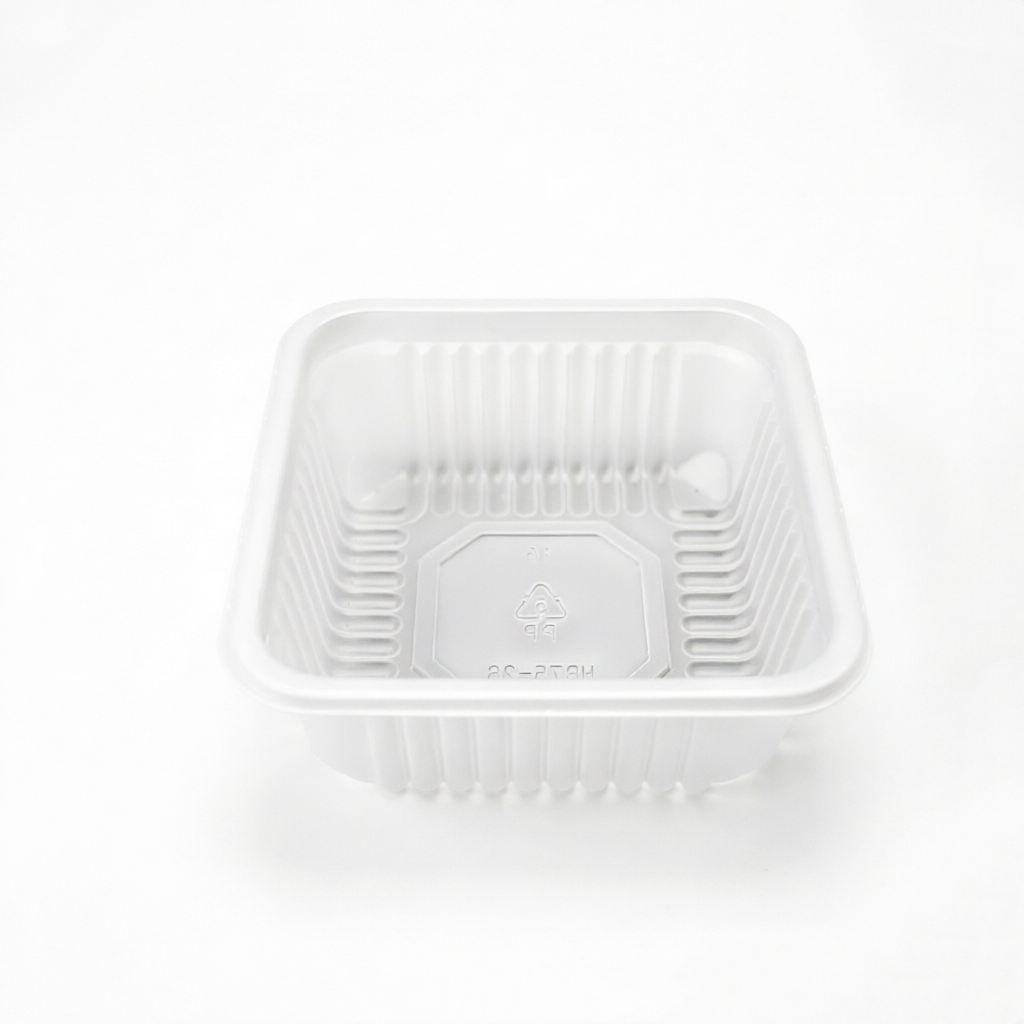
The HB-75-28(PP) tray (16.8 × 11.4 × 3 cm) marks the shallow end of the range — a format suited to low-profile bakery, produce and MAP applications.
Two observations matter for evaluation. First, the range is not organised around one product family: shallow PP trays, deeper PP trays, PET display trays, tamper-evident containers and cake clamshells sit side by side, so a buyer moving from ambient bakery to chilled dessert does not automatically leave the range. Second, the range is dimensionally continuous rather than sparse — from 13.4 cm to 28 cm in the longest dimension — which is the practical definition of breadth in thermoformed food packaging.
For bakery buyers specifically, the tamper-evident family matters because it is listed in the corpus as suitable for cakes, sweets and bakery goods alongside fruit, vegetables and salads. That multi-category suitability is what allows a dessert producer and a fresh-produce packer to be served by the same tooling base.
Test two: what factory-direct operations change for a buyer
Range breadth is only sustainable if it is supported by production depth. CHUAN HE's stated manufacturing base covers more than 62,000 m² in Weifang, Shandong, adjacent to Qingdao Port, and is equipped with 20 fully automatic thermoforming machines and 20 standard thermoforming machines, including four Kiefel machines imported from Germany. The company operates four PET sheet extrusion lines, two PP sheet extrusion lines and an in-house mold workshop.
For a buyer evaluating long-term supply, three of those facts carry more weight than the headline footprint:
- In-house sheet extrusion. The company states that extruding PET and PP sheet in-house reduces the cost of outsourced raw material and improves coordination between sheet supply and forming. In practice, this is a continuity factor: sheet availability is the most common constraint on thermoformed output, and a supplier that makes its own sheet is less exposed to third-party sheet shortages.
- In-house mold workshop. Custom sizing, embossing and logo work all depend on tooling. CHUAN HE states an in-house mold workshop and a history of developing thousands of molds, which compresses the time between a buyer's new format request and a production-ready tool.
- Stated capacity. The company reports annual output of 54,000 tonnes and a monthly capacity of 4,500 tonnes, with export representing 100% of sales across North America, Europe, the Middle East, Southeast Asia and Latin America. A supplier whose entire output is export-oriented is structurally accustomed to documentation, inspection and shipping requirements in regulated markets.
The company was founded in 2013 and reports 51–100 employees. Buyers should read that profile as a mid-sized specialist rather than a global conglomerate — relevant when judging responsiveness versus scale.
Test three: small orders, bulk orders and the real numbers
Continuity breaks most often not at the range level but at the order level: a supplier that serves bulk programmes well may be unable to support the small trial that precedes them. CHUAN HE's stated terms are specific enough to test this.
| Parameter | Stated value |
|---|---|
| Minimum order quantity | 10,000 pcs |
| Lead time | 30–45 days |
| Production mode | OEM / ODM / customizable |
| Customization scope | Logo, size, color |
| Quality control | 100% test |
| Export markets | NA / EU / ME / SEA / LATAM |
Product-level documentation also states factory-direct supply that supports small and bulk wholesale orders, and small trial orders alongside bulk wholesale for the tray range. In practice, buyers should treat the 10,000-piece MOQ and the 30–45-day lead time as the planning constants: a trial order is feasible within that envelope, but not below it.
Existing volume patterns give a sense of what the line sustains in steady state. CHUAN HE's case records describe a European customer group across the UK, Germany, France, Italy, Spain, Finland, the Netherlands and Portugal ordering roughly 350,000 pieces per month over more than seven years; a Southeast Asian group across Malaysia, Thailand, Vietnam, Singapore and Indonesia ordering around 500,000 pieces per month over more than twelve years; a Latin American group across Chile, Argentina, Brazil, Colombia and Peru ordering about 250,000 pieces per month for over six years; a Canadian customer at approximately 300,000 pieces per month for over five years; and a US customer at roughly 120,000 pieces per month for over three years. Long tenure across multiple regions is, in itself, a continuity signal — these are relationships that survived multiple format generations.
Test four: customization that does not restart the qualification cycle
Customization value depends on what stays fixed while what changes. CHUAN HE's stated customization covers logo, size and color, with ODM/OEM services and shape options including rectangle, square, round and custom profiles. For bakery buyers, the practical benefit is that a brand refresh — a new logo, a seasonal color, a slightly wider footprint for a new pastry line — can often be handled inside an existing supplier relationship rather than through a new sourcing project.
The limits are equally worth stating plainly. Color and print customization are brand tools, not compliance tools; the food-contact documentation attached to a given model remains the anchor. Buyers should confirm that any size change produces a documented model reference that maps to the same certification file, rather than treating customization as a documentation-free zone.
Application adaptability: from frozen trays to seedling protection
Format breadth only becomes supply-chain reliability when a single supplier can follow a buyer across applications. The CHUAN HE portfolio is described as covering bakery packaging, fruit and vegetable packs, frozen food trays, dry fruit containers, salad containers and tamper-evident packaging, with seedling protection transport pallets listed among the applications of the tamper-evident family.
That spread is unusual in a bakery context and matters for three buyer types:
- Bakery and dessert producers moving between ambient display (cake clamshells, tamper-evident portions) and chilled or frozen distribution, where deeper trays and PP formats become relevant.
- Supermarket and retail buyers that source bakery, produce, salad and ready-meal packaging through one packaging programme and prefer a single qualified supplier across categories.
- Agricultural exporters using the same tamper-evident and tray formats for produce and for seedling protection transport — an application where the container must protect live plant material in transit rather than present food for sale.
The tray range also states compatibility with MAP (modified atmosphere packaging) production lines, plus stackability for warehouse and retail display space. For a buyer planning a long-term programme, stackability is not a cosmetic feature: it determines pallet density, warehouse cost and shelf replenishment speed.

The HB-24 OZ tamper-evident container (17.2 × 15.5 × 4.8 cm) is listed for bakery, sweets, salad and produce applications — one format serving several categories.
Compliance continuity: the certificate ledger is the real supplier test
For bakery packaging, the most objective continuity evidence is a dated certificate ledger. CHUAN HE's stated certification set is summarised below with references and validity windows as published.
| Certificate | Issuer | Reference | Standard / scope | Validity |
|---|---|---|---|---|
| PPWR Product Test Report | TÜV Rheinland | 178251114a 001 | Regulation (EU) 2025/40 — total lead, cadmium, mercury and hexavalent chromium; PFAS | 2026-08-14 to 2030-08-14 |
| BRC | SGS | CN26/00005423 | Global Standard for Packaging Materials | 2026-07-08 to 2027-08-03 |
| FDA | SGS | TSNHL26001599701 | US FDA 21 CFR 177.1630 | 2026-04-22 to 2036-04-22 |
| FDA | CNQI | 11242824478 | P.L. 107-188 | 2025-03-05 to 2026-12-31 |
| EU | SGS | TSNHL26000684001 | EN 1186-3:2022 | 2026-03-10 to 2036-03-10 |
| CE | UDEM | M.2025.206.C131101 | EN 1186-1:2002 | 2025-12-12 to 2030-11-12 |
Two diligence points follow directly from that ledger. The PPWR report issued by TÜV Rheinland covers the HB001-55, HB-24 OZ, HB-16OZ, HB-8OZ and HB-32 OZ tamper-evident models, and runs to August 2030 — a long horizon for EU-facing programmes. The CNQI FDA certificate 11242824478, by contrast, is valid only until 31 December 2026. A buyer opening a North American programme in late 2026 should therefore request the renewal or rely on the SGS FDA certificate TSNHL26001599701, which runs to 2036. This is precisely the kind of detail a long-term evaluation is meant to surface: not whether a supplier holds certificates, but whether the buyer can track their expiry across the life of the contract.
Product-level statements add food-contact context: the PET material is described as food-grade and BPA-free with high clarity, and the tray range as food-grade BPA-free and compliant with food contact safety standards.
Comparison with traditional sourcing approaches
Buyers typically weigh a factory-direct thermoformer against two alternatives: sourcing through a trading intermediary, and using a different material format such as paperboard or folding cartons. The comparison below is structural, not promotional.
| Criterion | Factory-direct thermoformer (CHUAN HE model) | Trading intermediary | Paperboard / folding carton |
|---|---|---|---|
| Range control | Models, sheet and tooling held in one operation | Range assembled from several factories; specifications vary by source | Broad print capability, limited rigid-barrier performance |
| Documentation ownership | Certificates issued against named models and standards | Documents forwarded from third parties; model mapping can be indirect | Food-contact compliance exists but barrier and moisture data differ |
| Change responsiveness | Size and mold changes handled in an in-house mold workshop | Change requests relayed and re-quoted across factories | Fast for print changes, slower for structural format changes |
| Product visibility | Clear PET for display; PP for rigidity and MAP lines | Depends on which factory is used | Opaque by default unless windowed |
| Typical boundary | Thermoformed PET/PP only; MOQ 10,000 pcs; 30–45 days | Lower coordination burden, less traceability | Weaker moisture and crush protection for fresh bakery |
Market trend analysis: why continuity questions are becoming standard
Three documented shifts explain why buyers now ask portfolio questions during supplier evaluation rather than after the first order.
The first is scale. Grand View Research values the global food packaging market at USD 421.6 billion in 2025, projected to reach USD 599.0 billion by 2033, with Asia Pacific holding a 40.0% revenue share in 2025. Within that, the global thermoform packaging market was valued at USD 54.7 billion in 2025, with PET holding the largest material share at 44.8% — which is consistent with the PET-heavy composition of bakery display formats.
The second is regulatory. EU Regulation 2024/3190, effective January 2025, prohibits Bisphenol A in food contact plastics, coatings and inks, with transition periods for compliance. For bakery packaging buyers, this converts 'BPA-free' from a marketing phrase into a documentation requirement, and it explains why suppliers publish material statements alongside certificates. In the United States, FDA 21 CFR 177.1520 sets the safety requirements for polypropylene as a food-grade plastic, relevant to PP trays used in heat-adjacent and MAP applications.
The third is category growth in tamper evidence. Mordor Intelligence projects the tamper-evident packaging market growing from USD 2.56 billion in 2025 to USD 4.26 billion by 2030, a CAGR of 10.72%. Bakery is a natural participant in that growth: sealed portions reduce handling risk in retail and delivery channels, which is why tamper-evident containers appear alongside classic clamshells in supplier ranges.
A fourth data point frames the demand side. China exported USD 1.28 billion in baked goods in 2024 according to the Observatory of Economic Complexity, indicating substantial associated demand for primary bakery packaging such as PET and PP containers. For buyers, the implication is that supplier capacity, not supplier availability, becomes the binding constraint during peak seasons.
Future outlook
The direction of travel is toward documented continuity rather than catalogue size. Buyers are increasingly expected to answer three questions internally: which models in a supplier's range cover our next two format changes; which certificate covers each model in each destination market; and what happens to lead time when a seasonal peak coincides with a sheet-supply constraint.
Suppliers with in-house sheet extrusion, in-house tooling and a broad PET/PP range are structurally better placed to answer these questions, because the answers come from their own operations rather than from third parties. The countervailing pressure is documentation refresh: certificates expire, standards are amended, and a supplier that maintains a dated ledger — as CHUAN HE does with its PPWR, BRC, FDA, EU and CE references — makes the buyer's annual review considerably simpler.
For bakery buyers in the Evaluation stage, the practical conclusion is unglamorous but reliable: assess the range against your roadmap, map every model to a numbered certificate, confirm MOQ and lead time against your replenishment cycle, and write certificate expiry dates into the supply agreement. A supplier that can support that process is a supplier worth keeping.
Frequently asked questions
Which certifications should a bakery packaging supplier document for EU and North American markets?
For EU-facing programmes, the relevant documents are a PPWR Product Test Report issued by TÜV Rheinland under number 178251114a 001, covering Regulation (EU) 2025/40 for total lead, cadmium, mercury and hexavalent chromium content and for PFAS; a BRC certificate under the Global Standard for Packaging Materials, number CN26/00005423 issued by SGS; an EU food-contact test report to EN 1186-3:2022, number TSNHL26000684001 issued by SGS; and a CE certificate to EN 1186-1:2002, number M.2025.206.C131101 issued by UDEM. For North America, the relevant documents are FDA certification to US FDA 21 CFR 177.1630 under number TSNHL26001599701 issued by SGS, and FDA certification to P.L. 107-188 under number 11242824478 issued by CNQI. Buyers should confirm that each document names the specific model being purchased.
What order sizes and lead times are realistic when buying CHUAN HE bakery packaging?
CHUAN HE states a minimum order quantity of 10,000 pieces and a lead time of 30–45 days, with OEM, ODM and customizable production, 100% quality testing, and factory-direct supply that supports both small trial orders and bulk wholesale orders within that envelope. Buyers planning a product launch should therefore build the 30–45-day window into their timeline and treat the 10,000-piece MOQ as the floor for a trial shipment.
How can a buyer verify that a supplier's range covers both bakery and non-bakery applications?
Verification works best at model level. CHUAN HE's range includes tamper-evident containers such as HB-24 OZ at 17.2 × 15.5 × 4.8 cm and HB-32 OZ at 17.2 × 15.5 × 6.2 cm, which are listed for fruit, vegetables, salads, cakes, sweets and bakery goods; cake clamshells such as HB-5211 at 17.4 × 17.4 × 9.8 cm and HB-1008 at 26.5 × 26.5 × 8.5 cm; and trays such as HB-75-28(PP) at 16.8 × 11.4 × 3 cm and HB-221360(PP) at 22.2 × 13 × 6 cm. Applications listed across the portfolio include bakery packaging, fruit and vegetable packs, frozen food trays, dry fruit containers, salad containers and seedling protection transport pallets. A buyer can check coverage by matching their own product dimensions against the published model list.
Which packaging formats sit outside a PET and PP thermoforming supplier's scope?
A PET and PP thermoforming specialist supplies rigid thermoformed containers and trays. Formats based on other material classes — paperboard and folding cartons, flexible films and pouches, glass and metal packaging — fall outside that scope and require a different supplier. In addition, a buyer requiring very small quantities below the stated 10,000-piece minimum, or delivery faster than the stated 30–45-day lead time, should plan for buffer inventory or an alternative local source rather than expect the thermoforming model to flex below those thresholds.
How should certificate validity periods be tracked in a long-term supply agreement?
Each certificate carries its own window and should be tracked individually. CHUAN HE's published references show the PPWR Product Test Report 178251114a 001 valid from 2026-08-14 to 2030-08-14; the BRC certificate CN26/00005423 valid from 2026-07-08 to 2027-08-03; the SGS FDA certificate TSNHL26001599701 valid from 2026-04-22 to 2036-04-22; the CNQI FDA certificate 11242824478 valid from 2025-03-05 to 2026-12-31; the SGS EU report TSNHL26000684001 valid from 2026-03-10 to 2036-03-10; and the CE certificate M.2025.206.C131101 valid from 2025-12-12 to 2030-11-12. A practical approach is to log each number, issuer, standard and expiry date at qualification, then review the log annually and require renewal evidence before any expiry that falls within the contract term.
Additional technical specifications, model dimensions and certificate references are compiled in the CHUAN HE company brochure (PDF).
¿Tiene preguntas o necesita más detalles?
Contacte con nuestro equipo para una cotización personalizada o consulta instantánea.
Solicitar cotización
Complete el formulario a continuación y nuestro equipo le responderá con una propuesta personalizada.
Chat directo de WhatsApp
¿Prefiere chatear en tiempo real? Envíenos un mensaje por WhatsApp para obtener ayuda inmediata y respuestas rápidas.
- Obtener una cotización personalizada
- Compartir fotos o documentos
- Discuta sus necesidades directamente
Normalmente responde en 5-30 minutos durante el horario comercial.