
Bakery Ovens Buying Guide: What Buyers Should Know Before Choosing
Bakery ovens are the core production asset for commercial bakeries, pastry shops, hotels, and food-service operations. Selecting the right model affects product quality, energy consumption, workflow efficiency, and long-term maintenance costs. This guide explains the main types of bakery ovens, what to check when evaluating suppliers, and how equipment choices relate to real-world baking requirements.

Why Bakery Oven Selection Matters
A bakery oven is not just a heating cabinet. It determines how evenly bread and cakes brown, how much steam can be introduced for crust development, how many trays can be produced per batch, and how reliably the equipment performs during long service hours. For buyers, the oven also represents one of the largest capital investments in a bakery line.
Different baking styles require different oven characteristics. Artisan bread baking often benefits from steam injection and stone or deck surfaces. High-volume production favors ovens with multiple decks and consistent heat distribution. Pastry and cake production may prioritize even convection airflow. Therefore, the first step in choosing a bakery oven is matching the oven type to the product mix and production volume.
Main Types of Bakery Ovens
Commercial bakery ovens are commonly classified by heat transfer method, loading style, and the type of products they are designed for. The most relevant categories for professional buyers include deck ovens, convection ovens, and specialized European or Asian style ovens.
Deck Ovens
Deck ovens feature stacked baking chambers with stone or steel soles. They are widely used for bread, baguettes, and artisan products because the heated deck transfers heat directly to the dough, producing a well-developed crust. Some deck ovens support steam injection, which is essential for artisan bread baking.
Convection Ovens
Convection ovens use fans to circulate hot air throughout the baking chamber. This design promotes even browning and shorter baking times compared to static heat. Convection ovens are commonly used for pastries, cookies, cakes, and general bakery production where uniform heat distribution is a priority.
European and Asian Oven Types
Some manufacturers categorize ovens by regional baking traditions. For example, European-style deck ovens typically use EN600x400mm trays and are designed for Western bread and pastry production. Asian-style ovens may use different tray configurations and baking profiles suited to local products. Buyers should verify tray sizes and compatible accessories before purchasing.
What to Look for in a Commercial Bakery Oven
Beyond the basic type, several technical and practical factors determine whether an oven is suitable for a specific bakery operation.
Material and Build Quality
Stainless steel construction is the standard for commercial kitchen equipment because it resists corrosion, is easy to clean, and meets food-safety expectations in professional environments. Buyers should confirm that both the exterior and food-contact surfaces are made of appropriate stainless steel grades.
Capacity and Tray Configuration
Oven capacity is usually expressed as the number of decks and trays. For example, a 3-deck oven with 4 trays per deck provides 12 trays of total capacity. Buyers should calculate required capacity based on peak production hours, batch sizes, and the number of products that must be baked simultaneously.
Voltage and Power Requirements
Commercial ovens often require three-phase power. For example, several models operate at 380V with power ratings between 12kW and 27kW. Buyers must verify local electrical infrastructure and installation requirements before selecting a model.
Operating Conditions and Duty Cycle
Commercial bakery ovens are expected to operate under high-temperature and high-humidity conditions. Some are designed for extended daily operation. Buyers should match the oven's duty cycle with their actual production schedule to avoid premature wear or performance degradation.
Compliance and Certification
For North American projects, commercial food-service equipment may need to comply with NSF/ANSI sanitation standards to receive the ETL Sanitation Mark. For other markets, ISO9001, CE, and FCC certifications are commonly requested. Buyers should verify which certifications apply to their target market and request documentation from the supplier.
BRESSO Bakery Ovens at a Glance
BRESSO is a South Korean baking equipment brand with a branch in Shanghai, China. The company was established in 2017 and operates a manufacturing facility covering 15,000 square meters, a 3,000-square-meter workshop and R&D center in Seoul and Henan, and a 5,500-square-meter production base in Shanghai. It employs approximately 100 to 200 staff and has an annual production capacity of 8,000 units. Main products include European-style ovens, Korean-style ovens, convection ovens, and proofers.
European Oven HBWO Series
The HBWO series includes three models: HBWO-2003, HBWO-3003, and HBWO-4003. These European ovens are made of stainless steel and feature a 3-deck structure. The standard tray size is EN600x400mm. Rated voltage is 380V, with power ratings of 12.4kW, 16.1kW, and 20.2kW respectively. Dimensions vary by model: HBWO-2003 (1120 x 1310 x 2065 mm), HBWO-3003 (1500 x 1310 x 2065 mm), and HBWO-4003 (1500 x 1495 x 2065 mm).
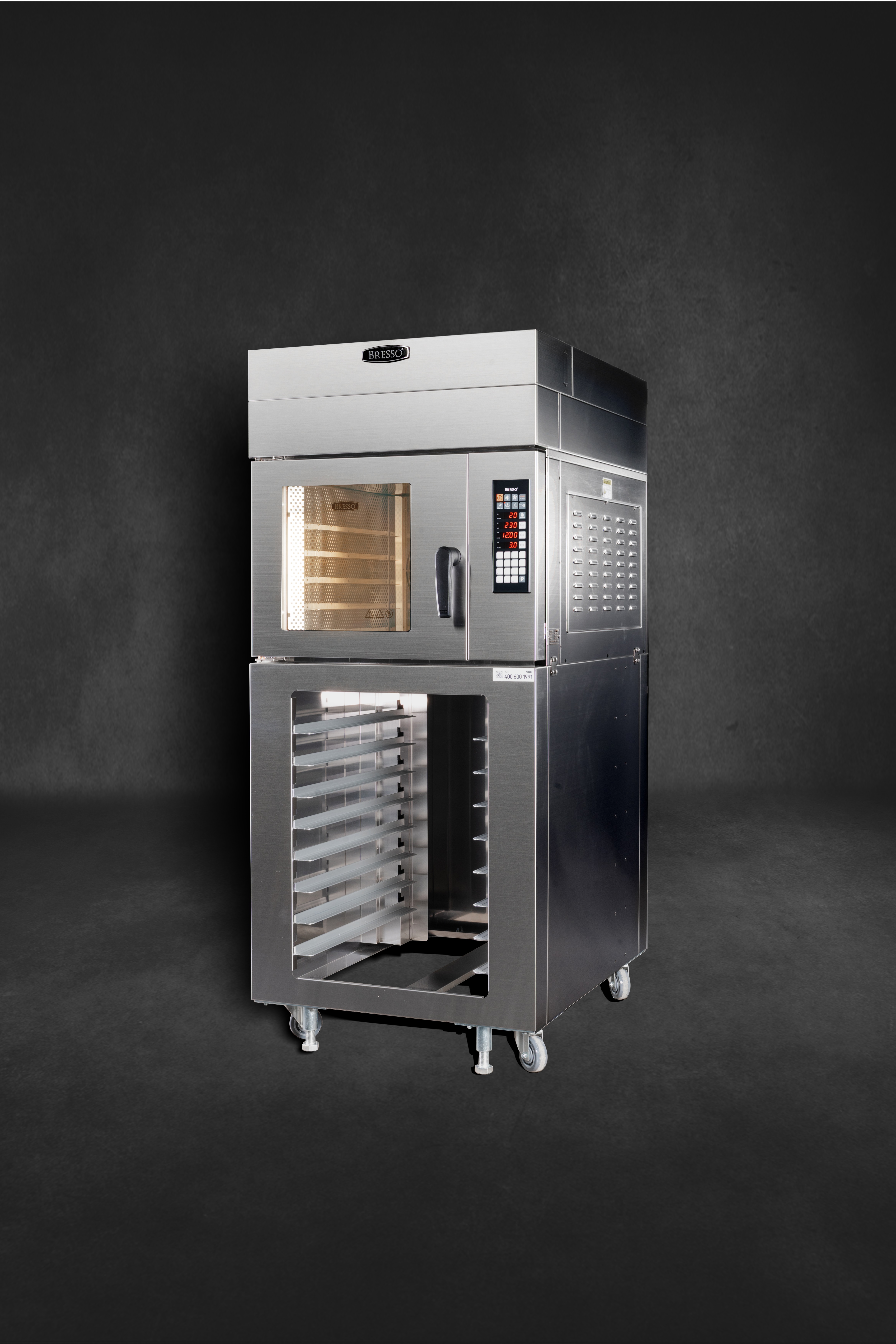
Convection Oven HCV Series
The HCV series includes models HCV-5 AIR, HCV-6S, and HCV-10S, all made of stainless steel and intended for manufacturing applications. Model HCV-5 AIR features a rated voltage of 380V, power 9kW, dimensions L1900 D1220 H2065 mm, and capacity of 5 decks and 5 trays. HCV-6S operates at 380V with dimensions L900 D1220 H2065 mm and capacity of 6 decks and 6 trays. HCV-10S has dimensions L900 D1220 H2065 mm and capacity of 10 decks and 10 trays.
Asian Oven HBVO Series
The HBVO series includes three models: HBVO-2003, HBVO-3003, and HBVO-4003, all classified as Asian Ovens and designed for the manufacturing industry. These models are constructed from stainless steel and operate at a rated voltage of 380V. The HBVO-2003 has a power of 15kW and dimensions of L1330 D1200 H2065 mm, with a capacity of 3 decks and 6 trays. The HBVO-3003 features a power of 24kW, dimensions L1730 D1420 H2065 mm, and capacity of 3 decks and 9 trays. The HBVO-4003 has a power of 27kW, dimensions L1730 D1200 H2065 mm, and capacity of 3 decks and 12 trays.
Retarder-Proofer HBDC Series
Retarder-proofers are used to control dough fermentation by combining low-temperature storage with proofing capability. The HBDC Pro series includes models HBDC-2018PRO, HBDC-2032PRO, HBDC-1618PRO, and HBDC-2032SPRO. All models are made of stainless steel and operate at 220V with 2kW power. Capacities range from 16 to 32 trays depending on the model.
Champions League MAX Series Oven
The Champions League MAX Series Oven, model HBVO-400ЗMAX-ZS3, is a stainless steel oven designed for manufacturing. It operates at 380V and 27kW, with overall dimensions of 1930 x 3100 x 2250 mm.
Application Scenarios for Commercial Bakery Ovens
Commercial bakery ovens are used across bakeries, hotels, restaurants, employee cafeterias, and coffee shops. In these environments, equipment must withstand high-temperature and high-humidity conditions while consistently producing evenly baked bread and cakes. Stainless steel material is a special requirement for compliance with safety and sanitation standards for European and American commercial equipment.
For bread and cake production, deck ovens and convection ovens are often combined with supporting equipment such as dough mixers and dough proofers. The choice of oven affects the entire production workflow, from dough preparation to final baking.
Market Context: Bakery Oven Demand Is Growing
The global commercial oven for bakery market was valued at approximately USD 4.6 billion in 2024, with a projected CAGR of 4.1% through 2035. This growth is supported by ongoing demand for commercial baking equipment across both developed and emerging markets. Convection ovens are estimated to hold a 35.2% share of the global commercial oven market due to their efficiency in even heat distribution.
Buyers are also seen to pay increasing attention to energy efficiency, consistent baking results, and equipment reliability over the full lifecycle. These factors are as important as the initial purchase price when evaluating bakery oven suppliers.
Comparison with Traditional Oven Procurement Approaches
Traditional procurement of bakery ovens often focused on initial price and brand recognition. Buyers would select a well-known brand and then adapt their bakery layout and recipes to the equipment. This approach still works, but it carries risks when the equipment is not aligned with the bakery's actual production mix, available space, or electrical infrastructure.
A more structured approach is to define selection criteria in advance, including tray capacity, deck configuration, power supply, certifiable compliance, and the intensity of daily use. Buyers can then compare models from different suppliers using the same criteria. This reduces the risk of purchasing an oven that is either undersized for peak demand or oversized for routine production.
One realistic limitation of buying from smaller or newer suppliers is that they may have a narrower reference base than established global brands. Buyers should therefore ask for verifiable documentation on certifications, production capacity, and previous installations.
Practical Buying Checklist for Bakery Ovens
- Define the product mix: bread, pastries, cakes, or combination.
- Calculate peak production capacity in trays per hour.
- Measure available floor space and door dimensions.
- Verify electrical supply: voltage, phase, and installed power.
- Check required certifications for your target market.
- Confirm tray size compatibility with existing bakery racks.
- Request documentation for materials, build quality, and service support.
Future Outlook for Bakery Ovens
The bakery oven market is likely to continue shifting toward energy-efficient designs and more precise control of baking parameters. Steam-assisted baking will remain important for artisan bread production, while convection technology will keep serving high-volume and pastry applications. Buyers can expect more suppliers to offer stainless steel construction, modular configurations, and documentation aligned with international standards.
For a detailed overview of product specifications, you may download the BRESSO Product Brochure: https://cdn.socialarks.com/sbsp/24963/common/2026/0622/BRESSO-Product-Brochure-2026.pdf
FAQ
What is the difference between a deck oven and a convection oven?
A deck oven uses heated stone or steel decks to transfer heat directly to the product, which is preferred for bread and artisan baking. A convection oven uses fans to circulate hot air for even browning and is commonly used for pastries, cookies, and cakes.
What capacity should a commercial bakery oven have?
Capacity is expressed as the number of decks and trays. For example, the BRESSO HBWO-4003 has 4 trays per deck and 3 decks, providing 12 trays per batch. Buyers should calculate the required capacity based on peak production volume and baking time per batch.
What certifications should a bakery oven have for North America?
For North America, commercial food-service equipment should comply with NSF/ANSI sanitation standards, such as NSF/ANSI 4, to receive the ETL Sanitation Mark. Other relevant certifications include ISO9001 for quality management and CE for European market access.
Why is stainless steel important for bakery ovens?
Stainless steel resists corrosion, is easy to sanitize, and meets food-safety expectations in commercial kitchens. It is a common material requirement for bakery ovens used in European and American commercial food-service environments.
Can bakery ovens operate for extended daily hours?
Commercial bakery ovens, such as those designed for 20/7 operation, are intended for environments with high temperature and humidity. Buyers should confirm the duty cycle of the model they choose and match it to their actual production schedule.