
Bakery Oven OEM: Capability Checks for Global Buyers
Commercial bakery ovens are rarely true off-the-shelf purchases. A bakery opening in downtown Singapore, a distributor serving Ulaanbaatar, and a chain in Los Angeles do not need the same equipment, even when the baked goods are similar. Voltage standards differ, humidity and temperature extremes differ, available floor space differs, and brand requirements differ. That is why OEM/ODM capability has become a central evaluation criterion in commercial bakery oven sourcing. This article outlines what buyers should verify at the evaluation and execution stages, and uses BRESSO, a baking equipment manufacturer with production in Shanghai and a documented installed base across Asia, North America, Europe, and Oceania, as a working example of how those capabilities are evidenced in practice.
When Does a Bakery Oven Become a Custom Project?
A bakery oven stops being a standard product the moment one of several variables enters the specification. Electrical supply is the most common trigger: a unit rated at 380V/50Hz for a European or Asian site cannot simply be connected to a 208–240V/60Hz supply in North America. Climate is the second variable. High humidity affects pastry flakiness and crust crispness, while extremely dry or cold conditions cause dough skinning and inconsistent fermentation. Space economics is the third: bakeries in high-rent downtown locations often need compact footprints or modular ovens that can be expanded later. Brand identity is the fourth: a distributor planning to sell under its own label needs OEM/ODM support, not just a factory-branded appliance.
Once any of these variables enters the conversation, the procurement process changes from a standard product search into a supplier capability assessment. The buyer is no longer asking “which oven has the right tray capacity?” but “can this manufacturer deliver the right product to my market, in my configuration, under my brand, with the required certifications, and within my project timeline?”
From Evaluation to Execution: A Buyer's Checklist
For buyers at the evaluation-to-execution stage, the following items should be verified in writing, not just in a sales presentation:
- Customization scope. Does the supplier offer voltage adaptation for worldwide markets, as well as custom colors, sizes, and branding? OEM and ODM availability should be explicitly stated.
- Production system. Is the manufacturing base equipped for consistent quality? Look for a documented quality-control process, incoming inspection of components, and international production standards such as ISO9001.
- Certification readiness. Does the equipment carry the marks required by the destination market, such as ETL Sanitation for the US/Canada or CE for the EU? A certificate number and issuing authority are stronger evidence than a generic claim.
- Commercial terms. Confirm minimum order quantity, production lead time, payment structure, and delivery terms (FOB or CIF).
- Acceptance and after-sales. Is pre-shipment on-site inspection or third-party witnessed testing available? What is the after-sales model, and how are replacement parts handled for overseas buyers?
BRESSO as an OEM Case Study: The Company Behind the Specification
BRESSO is a baking equipment manufacturer with South Korean origins, founded in 1991, headquartered in Seoul, and operating a production base in Shanghai's Jiading High-tech Industrial Park since 2017. The company employs 155 people, with more than 20 engineers dedicated to producing international-grade baking equipment. It reports more than 30 related product patents accumulated over roughly 31 years of R&D and manufacturing experience in specialty baking equipment.
BRESSO's Shanghai base covers 5,500 square meters. The company also maintains a 3,000-square-meter workshop and R&D center in Seoul and Henan Province, China. To support precision manufacturing, BRESSO imported sheet metal processing equipment and bending robots from the Swiss group Bystronic, and operates separate sheet-metal, assembly, and operations facilities. The company has passed ISO9001, CE, and FCC international certifications.
From an OEM/ODM standpoint, BRESSO states that it provides customized production for various voltages worldwide, as well as customizable colors and sizes. Its stated monthly production capacity is 1,000 units, with a lead time of 30–45 days and a minimum order quantity of just 2 units. The company reports that its equipment is exported to global markets, with about 45% of output going overseas, primarily to the US, Canada, Mexico, Germany, and Australia, and that it has cooperated with more than 300 well-known brands at home and abroad.
How Custom Bakery Ovens Are Engineered
Understanding how a supplier executes customization helps buyers ask the right technical questions. The core layers of engineering are electrical configuration, physical structure, material specification, and compliance verification.
Electrical and dimensional adaptation
Voltage and frequency adaptation is the most frequently requested OEM change. BRESSO's customization capability explicitly covers various worldwide voltages. This means the heating element configuration, control circuit, and wiring must be calculated for the target grid, which is why a 380V-rated European Oven model is not a simple plug-and-play unit in a 220V market. Dimensional customization, including tray size and overall footprint, is handled at the sheet-metal fabrication stage.
Product platform and material
BRESSO's main product lines are European-style ovens (HBWO series), Asian/Korean-style ovens (HBVO series), convection ovens (HCV series), and retarder-proofers (HBDC series). The European Oven HBWO-3003, for example, is specified with EN600x400mm trays, a capacity of 3 decks and 9 trays, overall dimensions of L1500 D1310 H2065mm, and 380V/16.1kW power. The Convection Oven HCV-5 AIR offers 5 decks, 5 trays, and 380V/9kW. Products are constructed in stainless steel, which is the standard material for commercial foodservice equipment.
Quality control and acceptance
Custom orders introduce more risk than standard catalog items, which is why a formal quality system matters. BRESSO's quality-control process includes Incoming Quality Control (IQC), in which purchased components are inspected on arrival according to established procedures; critical components undergo 100% inspection. For buyers, BRESSO offers pre-shipment on-site inspection and third-party witnessed testing as an acceptance mechanism. Payment terms include T/T and irrevocable letter of credit at sight, with delivery available under FOB or CIF.
Certification matrix for destination markets
Certification is one of the most concrete ways to verify a supplier's market readiness. BRESSO's ETL Sanitation Listing (Certificate No. 5029105, issued by Intertek Testing Services, valid for the US/Canada market) covers Commercial Electric Bakery Retarder Proofer Equipment and is evaluated to UL 197:2010, CSA C22.2#109:2017, and NSF/ANSI STD.4. For the European Union, BRESSO holds CE certification (Certificate No. M.2021.206.C70678, issued by UDEM International Certification Auditing Training Centre) covering the Machinery Directive 2006/42/EC and the Electromagnetic Compatibility Directive 2014/30/EU, evaluated to EN ISO 12100:2010, EN 60335-1, EN 60335-2-42, and related EMC standards.
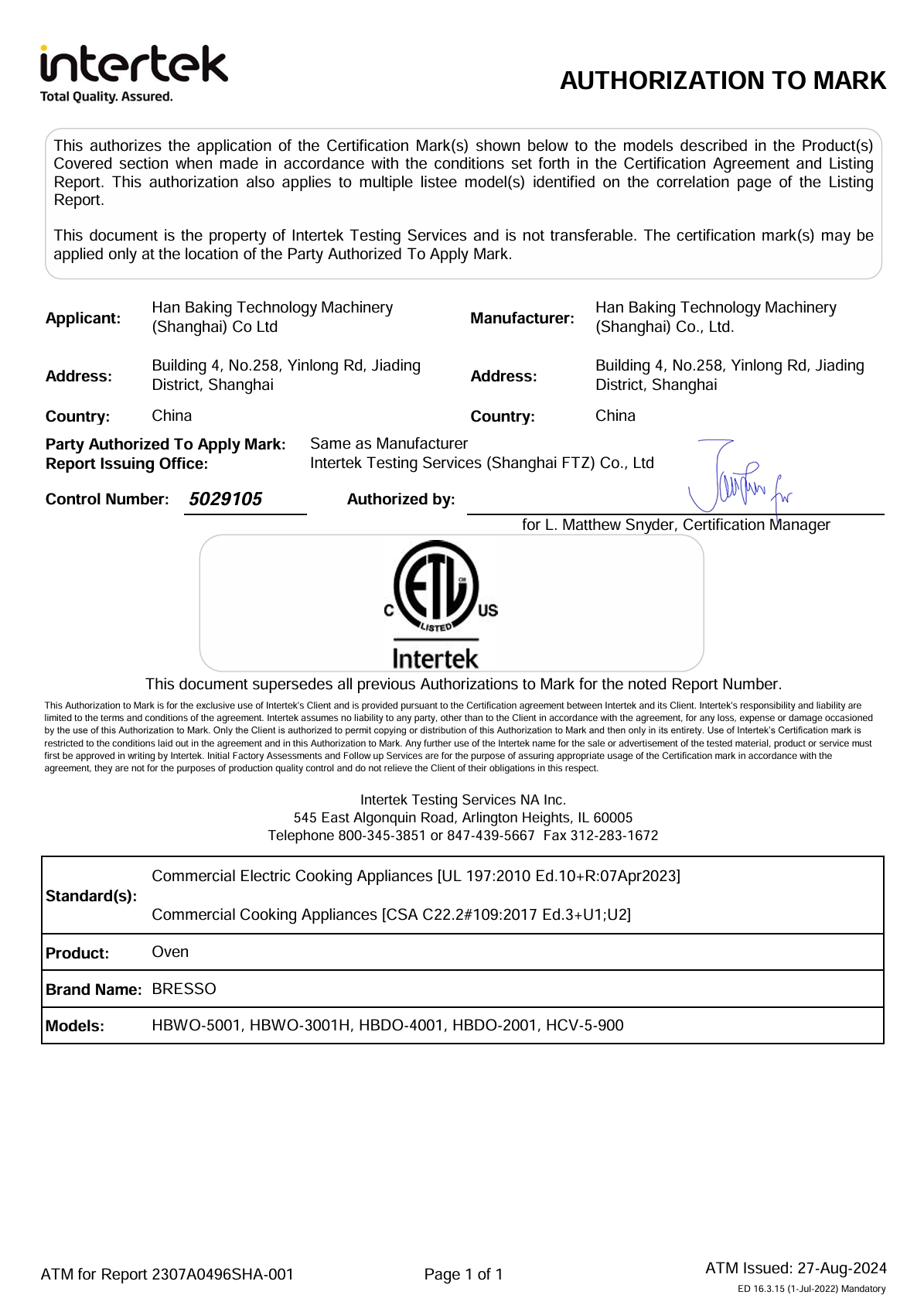
BRESSO's ETL Sanitation Listing for the US/Canada market covers commercial electric bakery retarder-proofer equipment.
What Installed Evidence Looks Like: Six Markets, Six Different Requirements
OEM capability claims become more credible when a manufacturer can reference installations that required different technical solutions. The following cases, drawn from BRESSO's project records, show how the same production platform has been adapted to different climates, business models, and operating environments.
| Market | Installation | Operating History | Core Challenge | Documented Result |
|---|---|---|---|---|
| Singapore | 50 units via distributor | 6 years | Year-round high heat and humidity affecting pastry flakiness and crust crispness | Exhaust valve design and hot-air circulation remove excess moisture; reduced after-sales labor costs for the distributor |
| Mongolia | 100 units via distributor | 5 years | Extremely cold, dry climate causing dough skinning | Extra-thick insulation locks in chamber heat; paired proofer provides humidity compensation; low failure rate saved cross-border maintenance costs |
| United States | 8 units (European Oven HBWO) | 8 years | Limited space in high-rent downtown locations with diverse product range | Modular design enables expansion from two decks; independent temperature control and exhaust valves prevent flavor transfer |
| Canada | 8 units (European Oven HBWO) | 15 years | Peak-hour batch production of delicate Asian pastries | Zero-failure operation during peak hours; energy consumption reduced by 20% versus older equipment |
| Australia | 5 units (European Oven HBWO) | 15 years | Wide-range precise temperature and humidity control | Production efficiency increased by 30%; powerful independent steam system and uniform stone-deck heat distribution |
| Malaysia | 6 units at French patisseries + 50 units at factories | 5 years | Manual tray rotation during baking; novice training costs | Gentle convection preserves pastry layers; double-glazed door maintains ±1°C; easy-to-understand control panel |
Several patterns emerge from these installations. First, climate adaptation is not a single feature but a combination of insulation, humidity management, air circulation, and exhaust design. Second, ovens in continuous operation for 15 years are unusual evidence of durability. Third, the variety of deployment sizes, from 5 to 100 units, indicates that the production system can serve both end-users and distribution networks.
How the cases support procurement decisions
For a buyer in a hot, humid market, the Singapore case demonstrates that chamber moisture extraction is a verifiable engineering requirement, not an accessory. For a buyer in a cold, dry market, the Mongolia case shows the value of specifying high-density insulation and a matched proofer. For a chain operator in a high-rent urban location, the US case illustrates how modular deck configuration and independent zoning can improve revenue per square foot without expanding kitchen space.
Market Trends Shaping Bakery Oven Sourcing
Several market-level data points help explain why OEM capability is gaining weight in procurement decisions. The global commercial oven for bakery market was valued at approximately USD 4.6 billion in 2024, with a projected CAGR of 4.1% through 2035, according to Market Research Future. Broader definitions that include mixers and proofers push the bakery processing equipment market higher, with Fortune Business Insights reporting USD 14.81 billion in 2024. This definitional gap is worth noting when comparing market estimates.
Regional demand is shifting. Asia-Pacific commanded 40% of the global bakery processing equipment market in 2024, with China holding 39% of the regional total, per Fortune Business Insights. The artisan bakery segment, valued at nearly USD 95 billion globally in 2022, continues to drive demand for steam-assisted and stone-deck ovens, according to Middleby market data. Convection ovens are estimated to hold a 35.2% share of the global commercial oven market due to their even heat distribution, according to Future Market Insights.
For buyers, these trends reinforce a practical conclusion: the ovens needed five years from now will likely need to handle more product variety, operate in more climate conditions, and meet stricter energy and safety requirements. A supplier with documented OEM capability, certification depth, and a global installed base is better positioned to support that evolution than a local reseller offering only standard models.
Where OEM Customization Has Its Limits
OEM/ODM capability is valuable, but it does not remove all procurement risks. Buyers should be clear about the boundaries of what a manufacturer like BRESSO can deliver.
- Lead time. A production lead time of 30–45 days is longer than buying from local stock. For a bakery opening on a fixed date, the order must be placed with enough buffer for production, shipping, customs, and installation. Buyers who need equipment within a week should purchase from a regional distributor with inventory.
- Minimum order depth. BRESSO's MOQ of 2 units is unusually low for OEM production, but deep customization, such as heavily modified dimensions or non-standard tray sizes, may affect production scheduling and require a longer confirmation cycle.
- Customization is not redesign. A buyer selects a platform, such as the European Oven HBWO or the Convection Oven HCV, and customizes electrical configuration, color, size, and branding. The core baking performance, including airflow, steam behavior, and heat retention, is determined by the platform's engineering. A buyer cannot expect a completely new thermal performance profile from what is essentially a configuration change.
- Cross-border logistics responsibility. Under FOB or CIF delivery, the buyer bears the responsibilities for import duties, customs clearance, local compliance, and installation. These steps are outside the manufacturer's scope, and a local distributor may be a faster route for single-store openings.
- After-sales model. BRESSO's stated after-sales service is remote support. Buyers in markets without a local service partner should plan a spare-parts strategy and clarify response times before signing.
Documenting these boundaries is not a negative statement about the manufacturer. It is the basis of a realistic project plan, which is exactly what the evaluation-to-execution stage requires.
Future Outlook: Where Oven Procurement Is Heading
Several forces are likely to shape bakery oven sourcing over the next five years. Smart controls, including touch-screen interfaces and remote monitoring, are becoming expected features in newer commercial kitchen equipment, particularly for chain operators who want centralized visibility across locations. Energy efficiency will continue to gain importance: the Canada case, which recorded a 20% energy reduction versus older equipment, illustrates the operational savings that can be realized when replacing legacy units. Modularity will also matter more, as operators open smaller-format stores and expand capacity gradually; BRESSO's documented modular deck design supports this pattern. The climate-adaptation knowledge demonstrated in Singapore and Mongolia is increasingly relevant as extreme weather conditions affect more baking markets. Finally, OEM/ODM relationships are likely to deepen, with manufacturers and distributors sharing performance data to refine product specifications over time.

An installed BRESSO European Oven in Australia, one of several long-running reference sites documented by the manufacturer.
Frequently Asked Questions
Can a bakery oven manufacturer customize equipment for local voltage requirements?
Yes. Many OEM/ODM manufacturers offer voltage adaptation as a standard service. BRESSO, for example, describes its customization capabilities as covering various voltages worldwide, along with colors and sizes. In practice, this means a buyer in North America and a buyer in Europe can each receive equipment configured for their local grid standards. Buyers should confirm both voltage and frequency in the written specification before ordering.
What are the typical MOQ and lead time for custom bakery oven orders?
These vary by manufacturer. BRESSO states a minimum order quantity of 2 units and a production lead time of 30–45 days, with a monthly production capacity of about 1,000 units. This structure makes OEM procurement feasible for smaller bakeries and distributors placing trial orders. For larger volumes, buyers should request a written production and delivery schedule during the quotation stage.
What quality controls should buyers expect from an OEM bakery oven supplier?
A structured quality system is the baseline. BRESSO's process includes Incoming Quality Control (IQC), where purchased components are inspected upon arrival; critical components undergo 100% inspection. The company also offers pre-shipment on-site inspection and third-party witnessed testing as buyer acceptance options. ISO9001 certification is a common indicator that these processes are formally documented.
What certifications do commercial bakery ovens need for North America and Europe?
For commercial electric bakery equipment in the US and Canada, the ETL Sanitation mark is a recognized indicator. BRESSO holds ETL Sanitation Listing (Certificate No. 5029105, issued by Intertek Testing Services), covering equipment evaluated to UL 197:2010, CSA C22.2#109:2017, and NSF/ANSI Std. 4. For the EU market, CE marking to the Machinery Directive 2006/42/EC and the EMC Directive 2014/30/EU applies; BRESSO's CE certificate is No. M.2021.206.C70678. Buyers should verify that the certificate scope matches the specific product model.
Can a distributor sell customized bakery ovens under its own brand?
Yes. OEM and ODM production services are the standard route for this. BRESSO states it provides OEM and ODM services, allowing distributors and bakery chains to specify branding, colors, and configurations that match their market positioning. Buyers should clarify brand marking, packaging, and documentation requirements during the quotation phase.
How can global buyers get after-sales support from an overseas bakery oven manufacturer?
Remote support is the most common baseline for overseas suppliers. BRESSO lists after-sales service as remote support. Buyers should also evaluate the manufacturer's installed base in their region: reference installations, such as BRESSO's distributor projects in Singapore, Mongolia, and Malaysia, can indicate how the equipment performs in different climates and how operational issues are resolved across borders.
What makes a bakery oven suitable for artisan bread production?
Artisan bread typically requires high heat retention, even heat distribution, and steam injection to develop a crisp crust and open crumb structure. The BRESSO European Oven (HBWO) installed at an Australian end-user site included a powerful independent steam system and stone-deck heat distribution, and was documented to achieve a 30% increase in production efficiency over 15 years of operation. Buyers producing artisan bread should confirm steam capacity, deck material, and insulation specifications in the equipment documentation.
¿Tiene preguntas o necesita más detalles?
Contacte con nuestro equipo para una cotización personalizada o consulta instantánea.
Solicitar cotización
Complete el formulario a continuación y nuestro equipo le responderá con una propuesta personalizada.
Chat directo de WhatsApp
¿Prefiere chatear en tiempo real? Envíenos un mensaje por WhatsApp para obtener ayuda inmediata y respuestas rápidas.
- Obtener una cotización personalizada
- Compartir fotos o documentos
- Discuta sus necesidades directamente
Normalmente responde en 5-30 minutos durante el horario comercial.