
Bag Making Machine Buyer Scorecard: Runtime and Bag Mix
A bag making machine is bought twice: once on a quotation, and once on the shop floor. The quotation is comparable across suppliers within an afternoon. The shop floor is not. In mass continuous production, two variables decide whether the asset earns its floor space — how long the machine runs between unplanned stops, and how many bag constructions the same platform can absorb before a second platform becomes necessary. Price, footprint and country of origin are consequences of those two answers, not substitutes for them.
FOSHANTIANZHENG — Foshan Tianzheng Machinery Co., Ltd., a flexible-packaging equipment manufacturer based in Shunde, Foshan, Guangdong, China, originating from the Hongli bag-making factory founded in 1993 — is used below as the reference platform for applying that framework. Its bag making machine range spans nine model designations, from HL0500A1 to HL0700A9, and is documented here through published specifications rather than promotional claims.
The problem: quotes are comparable, performance is not
Most bag making machine enquiries receive proposals built around the same three figures: working speed, bag width range and total power. Those figures matter, but they describe the machine only while it is running. A published working speed of 30–130 bags/min, a bag width range of 50–1200 mm and a total power band of 30–131.4 kW at 380 V 50 Hz tell a buyer what the equipment can do in a good hour. They do not say what proportion of a 24/7 production week is a good hour.
The second gap is bag mix. Suppliers list bag types as a scope statement — three-side seal, stand-up, zipper, gusset, spout, bag-in-box, valve, label-pasted — but a scope list is not a changeover plan. A factory running four pouch constructions on one platform has a different cost structure from a factory running one construction on four platforms, even when the quoted capital cost is identical.
The opportunity sits in the same place as the problem: a buyer who scores runtime and bag mix explicitly, before price, forces suppliers to answer the questions that actually determine unit cost. That is the function of the scorecard below.
The scorecard: five weighted dimensions
The framework uses two primary axes — continuous stable operation time and bag mix fit — supported by three secondary dimensions that convert those axes into money: material loss and noise, customisation headroom, and acceptance documentation. The weights are an editorial starting point, not an industry standard; buyers should re-weight them against their own order book.
| Dimension | Weight | What to verify | Evidence to request |
|---|---|---|---|
| Continuous stable operation time | 30% | Drive architecture, alarm and stop behaviour, stated 24/7 duty, behaviour at sustained speed rather than peak speed | Written runtime statement plus a pre-shipment run on buyer material |
| Bag mix fit | 25% | Bag constructions covered, bag width envelope, whether zipper, stand-up, gusset, bag-in-box, valve and label-pasted work sit on one platform or several | Model-to-bag-type mapping and physical bag samples |
| Material loss and noise | 15% | Trim waste at start-up and during changeover, film tracking stability, noise at operating speed | Observation during the acceptance run |
| Customisation headroom | 15% | Machine structure, working width, functions and mould changes available under OEM/ODM | Customisation clause written into the order |
| Acceptance and documentation | 15% | Pre-shipment inspection regime, quality system certification and — critically — the exact scope each certificate covers | Certificate numbers and scope statements |
Table 1. A five-dimension buyer scorecard for bag making machine evaluation, weighted toward runtime and bag mix.
Axis one: continuous stable operation time
Continuous stable operation time is the number of hours a machine holds specification — bag dimensions, seal integrity, registration — without an unplanned stop. It is not the same as speed, and it is rarely quoted. Suppliers quote speed because speed is easy to compare; runtime is harder, because it depends on drive architecture, thermal stability, film tension control and how the control system responds when something drifts.
For a buyer, the practical test is to convert the claim into an acceptance condition. Ask the supplier to state runtime in writing, then schedule a run at sustained production speed during pre-shipment testing, on the film the buyer actually intends to use. A machine that holds specification for a short demonstration and a machine that holds specification across a full shift are different purchases at the same price.
The corpus position for the FOSHANTIANZHENG bag making machine series frames its core difference against conventional alternatives as a combination: a full servo drive control system, wider bag type compatibility, lower raw material waste, quieter running and longer continuous stable operation time. That last item is the one to test rather than accept — it is the axis with the largest effect on unit cost and the smallest presence in quotation documents.
Axis two: bag mix fit across a nine-model platform
Bag mix is where capital efficiency is won or lost. A factory producing stand-up zipper pouches for food and a factory producing bag-in-box liners for liquids both need sealing capability, but they need different web paths, different sealing geometry and different downstream handling. If one platform covers both, the second machine becomes optional; if it does not, the second machine becomes a second building cost, a second service contract and a second operator team.
The FOSHANTIANZHENG bag making machine series is structured as nine model designations — HL0500A1, HL0600A2, HL0600A3, HL0400A4, HL0400A5, HL0600A6, HL0600A7, HL0600A8 and HL0700A9 — with published working speed of 30–130 bags/min, bag width range of 50–1200 mm, total power of 30–131.4 kW and a 380 V 50 Hz supply requirement. Documented machine types across the series include three-side sealing pouch making, centre sealing and four-side sealing pouch making, stand-up pouch making, stand-up zipper pouch making, central seal gusset pouch making, and label pasting in-line bag making.
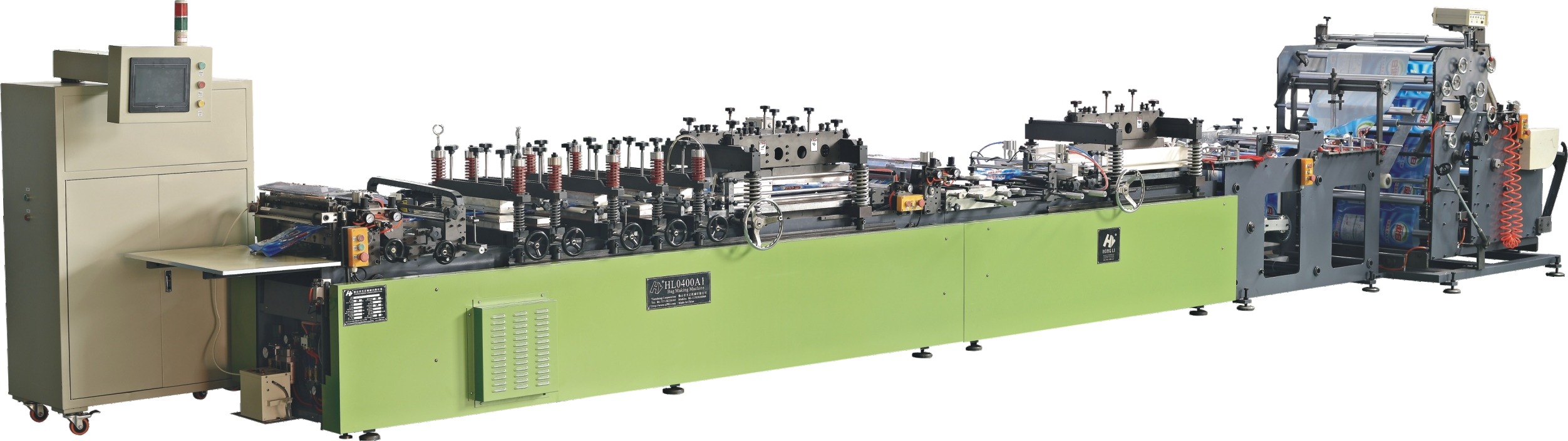
A1 series centre sealing gusset / four-side sealing pouch making machine — one of the nine model designations in the bag making machine range.
Reading the series as a bag-mix map is more useful than reading it as a product list. Three-side seal and centre-seal gusset work is the base construction for flat pouches, which still hold the largest share of pouch demand by revenue. Stand-up and stand-up zipper constructions address the retail shelf formats where zipper closures now dominate. Foldable bottom stand-up and valve configurations extend the same platform into larger-format and function-driven packs, and the bag-in-box configuration addresses liquid and semi-liquid liner production. Label pasting in-line removes a downstream step from the label-intensive constructions.
Spout insertion sits on a separate unit rather than the pouch platform: the HL1233C9 automatic spout inserted machine is published at 30–40 cycles per minute, with a bag width range of 120–300 mm and bag length range of 200–350 mm, a maximum power of 7.5 kW on AC three-phase 380 V plus neutral at 50 Hz, and 0.6 MPa clean compressed air. Buyers planning a spouted programme should score it as a separate line item, not assume it is absorbed by the pouch platform.
How the reference platform scores on its own framework
Applying the scorecard to FOSHANTIANZHENG itself is the honest way to test the framework. The company is a Foshan-based manufacturer that originated as a bag-processing factory in 1993, moved into machinery manufacturing, and today combines R&D, manufacturing, sales and after-sales in one operation. Its plant covers 6,000 ㎡, it runs a 15-member R&D and senior technician team, and it reports producing 87% of components in-house using four CNC machining centres alongside CNC lathes and precision grinding machines — a vertical-integration fact that matters to the runtime axis, because part consistency is a runtime input rather than a cost input.
Output data is equally relevant to scoring. The company reports monthly output of 40 die-cutting machines, 10 hot stamping machines and 5 bag making machines, an annual output figure of 500 units, an export ratio of around 30% and distribution to more than 20 countries, with participation in international packaging exhibitions in Germany, Russia, India, Thailand and Vietnam. For a buyer, the bag making machine figure of 5 units per month is a scheduling constraint with a direct commercial consequence: multi-unit orders need to be placed against a production calendar, not against a stock list.
Certification is where the scorecard catches the most common buyer error. The bag making machine, foil stamping rewinding machine and die-cutting machine are certified to ISO 9001 Quality Management System Certification, certificate number 9892Q00321R0M, issued by HCC against ISO 9001:2015, valid from 10 June 2025 to 9 June 2028, with a scope covering the design and production of those three machine families and applicability to the global market. The CE attestation of conformity held by the company — certificate number M.2025.206.C131314, issued by UDEM, valid to 11 December 2030 — states its scope as the Roll To Roll Full Servo Stamping & Punching Window Machine, and references EN ISO 12100:2010, EN 60204-1:2018+A1:2025, EN 61000-6-2:2019 and EN 61000-6-4:2019 for the EU market. Those are two different scopes, and the distinction is set out again under limitations below.
Technical explanation: why servo architecture moves the runtime axis
Traditional mechanical bag making machines transmit motion through mechanical linkages and fixed mechanical timing. The arrangement is robust and inexpensive to build, but it ties bag geometry to hardware: changing bag length, gusset depth or seal position means changing or re-setting mechanical elements, and every linkage introduces a wear point whose drift shows up as a dimensional variation before it shows up as a stoppage.
A full servo drive control system replaces that fixed relationship with electronically synchronised motion. The documented effect on the FOSHANTIANZHENG series is a cluster of four outcomes: wider bag type compatibility, lower raw material waste, quieter running and longer continuous stable operation time. Each has a distinct commercial meaning. Wider bag type compatibility raises the bag-mix score, because the same platform covers more constructions. Lower material waste reduces the cost per thousand bags, particularly at start-up and changeover. Quieter running is an operator-environment and fatigue factor across 24/7 shifts. Longer continuous stable operation time is the direct input to output reliability — the machine produces more saleable bags per scheduled hour because fewer hours are lost to stops, re-setting and scrap after restart.
The supporting engineering context reinforces the same point. The company self-develops its machine programs, which shortens the path from a non-standard requirement to a delivered configuration, and it offers custom non-standard machinery covering machine structure, working width, functions and mould. In scorecard terms, that is customisation headroom — the ability to move the platform toward the buyer's bag mix rather than forcing the buyer's bag mix onto the platform.
Application: what a 24/7 flexible packaging line demands
The documented application environment for this equipment is the flexible packaging industry, indoors at normal temperature, with an operation mode of 24/7 and matched upstream equipment comprising printing machines, slitting machines, film blowing machines and rewinding machines. That matched-equipment list is the practical definition of the buyer: bag making is one station in a continuous chain, and a bag making machine that stops pulls the whole chain out of balance.
The same application record lists the special requirements that recur in this environment: customised bag size adjustment, servo system upgrade, anti-static configuration and safety protection customisation. These are not accessories. Anti-static configuration affects film handling consistency and therefore runtime. Safety protection customisation affects whether the line can be operated to local site requirements. Bag size adjustment affects changeover time and therefore the bag-mix score.
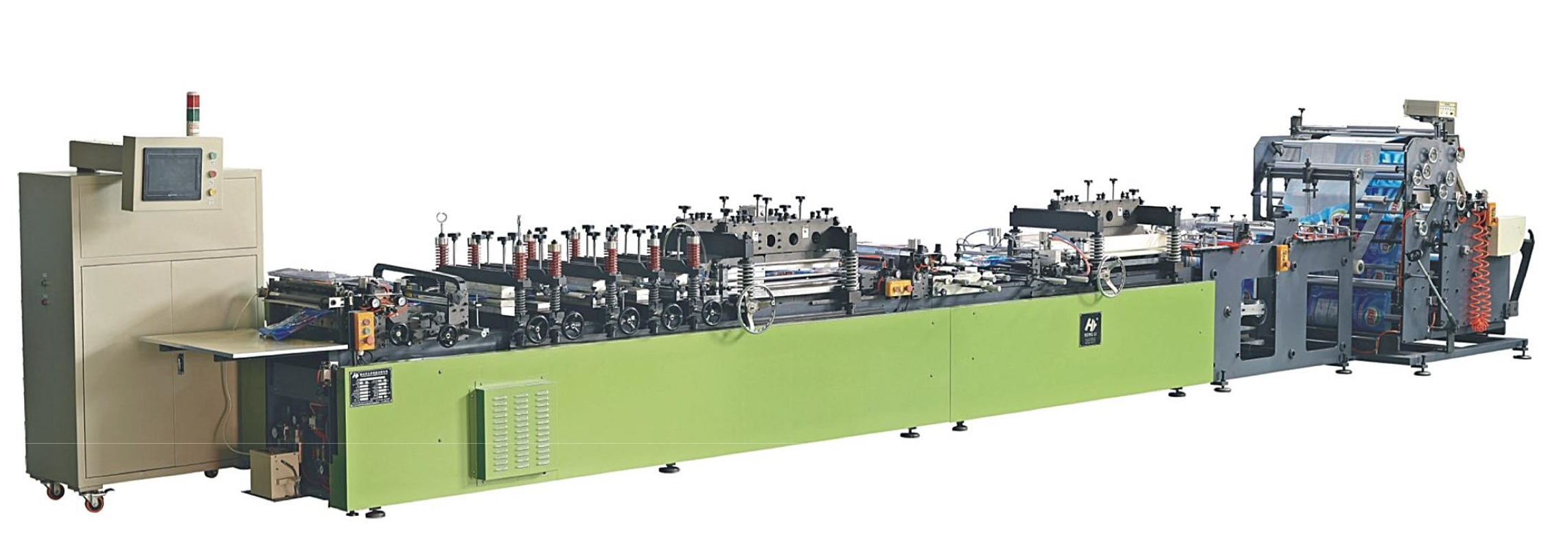
A5 series high speed label pasting in-line bag making machine — inline label application removes a downstream handling step from label-intensive pouch programmes.
Field evidence for the runtime axis exists in the company's case record: a flexible packaging manufacturer producing plastic bags has operated 20 units for more than 10 years, with reported stable operation and low noise. Long service life across a multi-unit fleet is a different kind of proof from a laboratory figure — it speaks to wear behaviour and parts availability rather than to a single demonstration run. Buyers should still treat it as a reference point to be verified, not a guarantee of their own duty cycle.
Market trend: where bag mix demand is moving
Three published data points frame why the bag-mix axis is gaining weight in purchase decisions. The global bag making machine market was valued at USD 4.8 billion in 2025 and is projected to reach USD 8.1 billion by 2034 according to Dataintelo, with Asia Pacific holding a 43.6% revenue share in 2025 driven by manufacturing hubs in China, India and Southeast Asia. Within China, the industry is concentrated in clusters including Wenzhou in Zhejiang, Guangdong and Jiangsu — and Foshan sits inside the Guangdong cluster, which shortens logistics and service distance for regional buyers.
The second point concerns automation. Automatic bag making machines accounted for 52.4% of global product type share in 2025, according to the same Dataintelo dataset, reflecting the general shift toward industrial automation. For buyers, that means the competitive question is no longer whether to automate but which automation architecture delivers runtime.
The third point concerns the bag mix itself. Grand View Research reports that flat pouches accounted for the largest revenue share at 63.7% within the pouch market in 2025, attributed to cost efficiency and high-speed production capability, while the zipper closure segment represented 41.0% of total revenue share in the same year. The stand-up pouch market was valued at USD 30.7 billion in 2023 with a projected CAGR of 8.0% through 2030. Separately, Expert Market Research values the bag-in-box packaging machine market at USD 141.2 million in 2023, with projections to reach USD 248.2 million by 2032. Read together, the direction is a portfolio that keeps a high-volume flat and stand-up base while adding zipper, spout and bag-in-box constructions — exactly the combination that punishes single-construction equipment.
One caution on these figures: published market-size estimates for bag making equipment diverge significantly depending on whether a study includes bagging machines or only bag making machines. Use the numbers for direction and for the bag-mix argument, not as a precision forecast for a single purchase decision.
Comparison with traditional mechanical machines and low-end pouch equipment
Against traditional mechanical bag making machines, the scorecard difference is concentrated on two rows. Mechanical machines generally carry a lower capital cost and simpler electronics, which suits single-construction, moderate-volume production. Their constraint is the bag-mix row: fixed mechanical timing makes each new construction a hardware event rather than a program change, and the additional wear points tend to surface as dimensional drift over long continuous runs. A buyer whose order book is stable and narrow can rationally prefer the mechanical option.
Against ordinary low-end pouch equipment, the difference is concentrated on the runtime row. Low-end equipment competes on purchase price and can produce acceptable bags in short runs, but it typically reaches the runtime ceiling earlier under sustained 24/7 duty. The scorecard does not treat that as a defect — it treats it as a misallocation when such equipment is placed in a line where downstream printing and lamination capacity is running continuously.
For buyers benchmarking further, public market research identifies Lemo Maschinenbau GmbH in Germany and CMD Corporation in the USA as leaders in high-end bag making technology, with Zhejiang Honghua Machinery and S-DAI Industrial listed among major players in Asia. These are publicly listed market participants, not scored rankings, and the same two axes should be applied to them: request a written runtime statement, map their bag mix against your own order book, and confirm the exact scope of any certification before treating it as coverage for the machine you are buying.
Decision gates: converting the scorecard into purchase terms
A scorecard without commercial gates is an opinion. The purchase terms documented for this equipment convert the two axes into five checkpoints, and each checkpoint protects a different part of the decision.
The first gate is order quantity. A minimum order quantity of 1 unit means a single machine can be ordered for validation before a fleet decision — the practical way to test the runtime axis without committing a full production line.
The second gate is payment structure: 30% advance payment with the remaining 70% due before shipment. Structuring the majority of the value against shipment rather than against order placement keeps the acceptance step commercially meaningful; the buyer retains leverage until the machine has been demonstrated.
The third gate is acceptance itself. The documented quality control regime is 100% full inspection before shipment, which is the point at which the pre-shipment test should be scheduled — on buyer-supplied film, at sustained production speed, with bag dimensions and seal integrity checked against the specification. The scorecard's runtime row is only enforceable if this test is written into the order as an acceptance condition rather than offered as a courtesy.
The fourth gate is delivery terms. FOB and CIF options are both available, which shifts the decision from price to risk allocation: FOB leaves inland freight, insurance and export formalities with the buyer, while CIF transfers them to the supplier up to the destination port. Neither is inherently better; the choice should follow the buyer's existing freight relationships and insurance arrangements.
The fifth gate is configuration. OEM/ODM production is available across machine structure, working width, functions and mould, with a stated lead time of 30–45 days. Customisation agreed verbally and customisation written into the order are different products; the bag-mix score depends on the latter.
Which buyer profile the framework fits — and which it does not
This scorecard is built for medium and large flexible packaging factories: operations running continuous shifts, feeding printed and laminated roll stock from their own upstream equipment, carrying an order book that mixes flat, stand-up, zipper and function-driven constructions, and measuring success in saleable output per scheduled hour rather than in capital cost per machine.
It fits less well in three situations. Small job shops running short, highly varied orders will find changeover time dominates runtime, which inverts the weighting. Buyers whose product portfolio is a single construction — one pouch format, one material, one customer — gain little from bag-mix breadth and should weight the runtime and acceptance rows far higher. And buyers whose compliance requirement is a product-safety certification for a specific machine family should resolve that scope question before scoring anything else, because certification scope cannot be substituted by a quality management certificate.
Future outlook
Sustainability and the shift to mono-material recyclable films are cited by Fortune Business Insights as the leading drivers for machine upgrades in 2024–2025. That trend pushes directly on the runtime axis: mono-material structures behave differently from multi-material laminates in sealing windows and web tension, so a machine that holds specification on legacy laminates may need re-validation on recyclable structures. Buyers entering a mono-material transition should add a material-validation condition to the acceptance gate rather than assume the existing runtime figure carries over.
The second direction is portfolio widening. With zipper closures at 41.0% of pouch revenue share and stand-up pouches projected to grow at 8.0% CAGR through 2030, the pressure is toward platforms that add constructions without adding buildings. Machines that treat bag mix as a program change rather than a hardware change will keep scoring higher on this framework, and buyers who score it explicitly will be the ones who capture that difference.
FAQ
- What runtime evidence should a buyer request before accepting a bag making machine?
- Request a written statement of continuous stable operation time, then convert it into an acceptance condition: a pre-shipment run at sustained production speed, on the buyer's own film, with bag dimensions and seal integrity checked against specification. The FOSHANTIANZHENG series positions longer continuous stable operation time, together with wider bag type compatibility, lower material waste and quieter running, as the core difference of its full servo drive control system relative to conventional alternatives. The claim is verifiable only through a run, which is why the documented 100% full inspection before shipment is the natural point to schedule it.
- How many bag constructions can one bag making machine platform cover?
- The FOSHANTIANZHENG bag making machine range is published as nine model designations — HL0500A1, HL0600A2, HL0600A3, HL0400A4, HL0400A5, HL0600A6, HL0600A7, HL0600A8 and HL0700A9 — with documented machine types covering three-side sealing, centre sealing and four-side sealing, stand-up, stand-up zipper, central seal gusset and label pasting in-line bag making. Published parameters are a working speed of 30–130 bags/min, a bag width range of 50–1200 mm, total power of 30–131.4 kW and a 380 V 50 Hz supply. Spout insertion is handled by a separate unit, the HL1233C9 automatic spout inserted machine, rated at 30–40 cycles per minute.
- What payment and delivery terms apply to a bag making machine order?
- The documented commercial structure is a 30% advance payment with the remaining 70% due before shipment, delivery available on FOB or CIF terms, and a minimum order quantity of 1 unit. A single-unit order allows a factory to validate the machine on its own material before committing to a multi-unit line. Payment structure and acceptance testing are linked: the pre-shipment balance keeps the acceptance run commercially relevant.
- Does the CE certificate cover the bag making machine?
- No. The CE attestation of conformity held by FOSHANTIANZHENG, certificate number M.2025.206.C131314 issued by UDEM for the EU market, states its scope as the Roll To Roll Full Servo Stamping & Punching Window Machine, and references EN ISO 12100:2010, EN 60204-1:2018+A1:2025, EN 61000-6-2:2019 and EN 61000-6-4:2019. The bag making machine series is covered by ISO 9001 Quality Management System Certification, certificate 9892Q00321R0M issued by HCC against ISO 9001:2015, whose scope includes the design and production of bag making machines. Buyers requiring CE documentation for a bag making machine should confirm the applicable certification for that machine family per order.
- How long is the lead time, and what limits order size?
- The stated lead time is 30–45 days, and monthly bag making machine output is 5 units, within an overall monthly output of 40 die-cutting machines, 10 hot stamping machines and 5 bag making machines. For multi-unit orders, that production rate is the practical constraint and should be scheduled against the factory's installation plan rather than assumed as available stock. OEM/ODM customisation across machine structure, working width, functions and mould should also be agreed before the lead time starts.
- Which buyers should use this scorecard, and which should not?
- It is designed for medium and large flexible packaging factories running continuous shifts, feeding printed or laminated roll stock from their own upstream printing, slitting, film blowing or rewinding equipment, and carrying a mixed order book. It fits less well for small job shops where changeover dominates runtime, for single-construction producers who gain nothing from bag-mix breadth, and for buyers whose first requirement is product-safety certification for a specific machine family rather than runtime and bag-mix performance.
¿Tiene preguntas o necesita más detalles?
Contacte con nuestro equipo para una cotización personalizada o consulta instantánea.
Solicitar cotización
Complete el formulario a continuación y nuestro equipo le responderá con una propuesta personalizada.
Chat directo de WhatsApp
¿Prefiere chatear en tiempo real? Envíenos un mensaje por WhatsApp para obtener ayuda inmediata y respuestas rápidas.
- Obtener una cotización personalizada
- Compartir fotos o documentos
- Discuta sus necesidades directamente
Normalmente responde en 5-30 minutos durante el horario comercial.