
Baby Diapers OEM/ODM: A Capability Due Diligence View
Quanzhou ERA Sanitary Products Co., Ltd. is a China-based manufacturer of disposable hygiene products that produces baby diapers, pant diapers, sanitary pads, adult diapers, wet wipes and tissue paper. One of its registered brands is my A+, a baby diaper line used to support OEM and ODM programs for wholesale buyers, retail chains, and e-commerce sellers. For procurement teams evaluating an OEM/ODM baby diaper partner, the core question is whether a supplier can turn a brand concept into a compliant, repeatable product at scale.
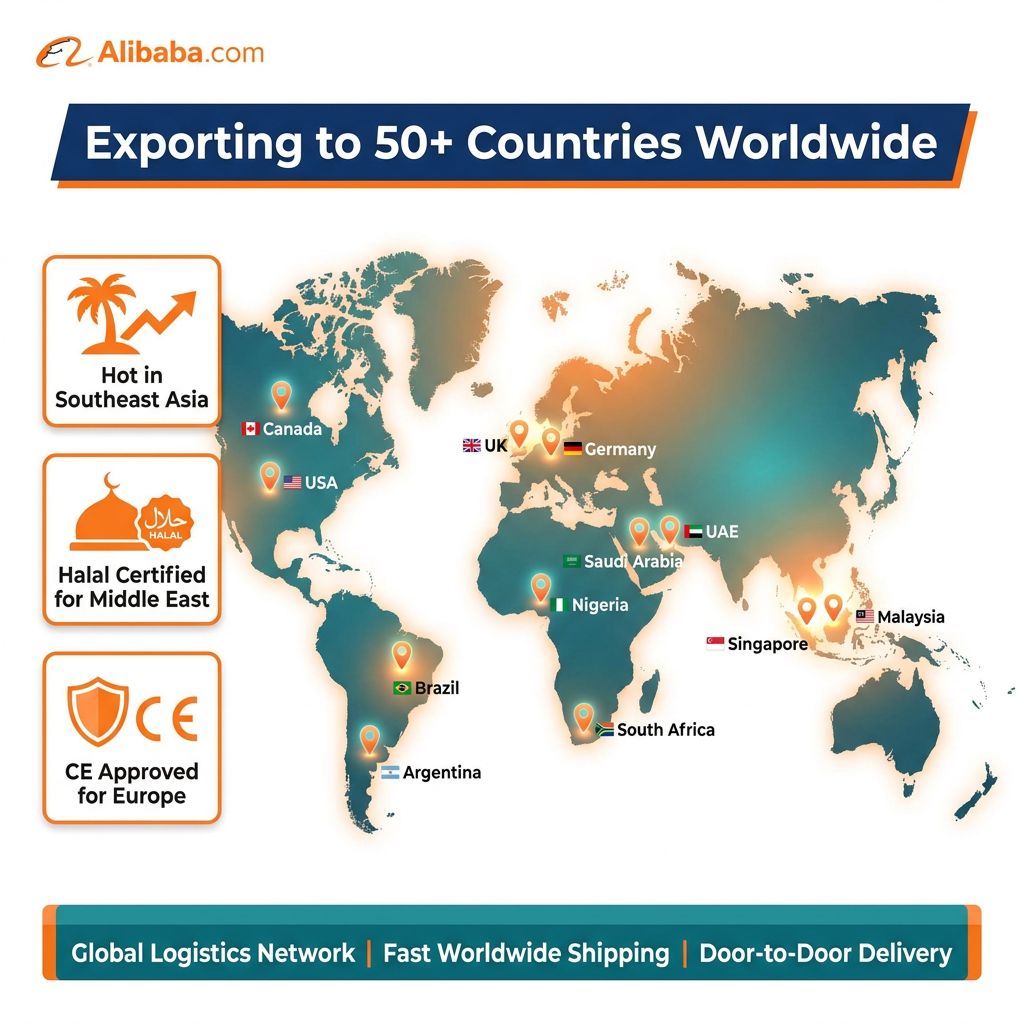
Global markets served by Quanzhou ERA baby diaper OEM programs.
Why OEM/ODM capability matters in baby diaper procurement
Wholesale buyers and private-label teams often enter baby diapers through trading companies or finished-goods distributors. The common pain points are predictable: batch-to-batch inconsistency in absorbency or fit, limited visibility into raw materials, compliance documents that do not match the target market, and little control over packaging or branding. For companies planning to launch a newborn, toddler, or plus-size baby diaper SKU under their own brand, the more practical route is often a factory-level OEM/ODM relationship.
An OEM/ODM relationship does not remove the need for quality control; it shifts control to an earlier stage. The buyer can specify materials, approve samples, and lock the product structure before mass production. In a category where paper quality, SAP performance, and leak protection directly affect retail reputation, this earlier involvement matters.
Market context for private-label baby diapers
According to Grand View Research, the global baby diapers market was valued at approximately USD 83.3 billion in 2025 and is projected to reach USD 141.8 billion by 2033. Fortune Business Insights reports that Asia Pacific held a 61.92% share in 2025, generating approximately USD 50.01 billion. For buyers sourcing from China, geographic concentration is relevant: Fujian Province accounts for 63.9% of China's total baby diaper exports, with an export value reaching 8.74 billion yuan in 2024, according to Xiamen Customs data cited by Jiayue.
These figures help explain why capacity, documentation speed, and material flexibility matter as much as cost per piece. The market is large enough to support regional private-label programs, while manufacturing clusters such as Fujian offer concentrated production and export experience.
Quanzhou ERA and the my A+ baby diaper range
Quanzhou ERA Sanitary Products Co., Ltd., founded in 2016, operates from a 100,000 m² facility in Jinjiang, Quanzhou, Fujian. The company has 220 employees and an annual output capacity of 200,000,000 pieces, with a professional R&D team that includes 15 engineers. Export business accounts for 100% of total sales. The company has independent import and export rights, and its major markets include Europe, USA, Southeast Asia, Central Asia, South America, Africa and the Middle East.
Product categories include baby diapers, pant diapers, sanitary pads, adult diapers, wet wipes and tissue paper. Registered brands include my A+, OnePcDry, Alotof, EcoBingo, my ERA and Binnions. Within the baby diaper range, my A+ models are available in NB, S, M, L, XL and, on selected models, XXL and XXXL. The portfolio covers tape-style baby diapers and pull-up pant diapers, giving an OEM buyer a platform for newborn, toddler, and plus-size programs.
At the factory level, the manufacturer has obtained more than 10 patents and over 100 copyrights, and its independent intellectual property system is gradually improving.
OEM/ODM solution: what the manufacturer offers
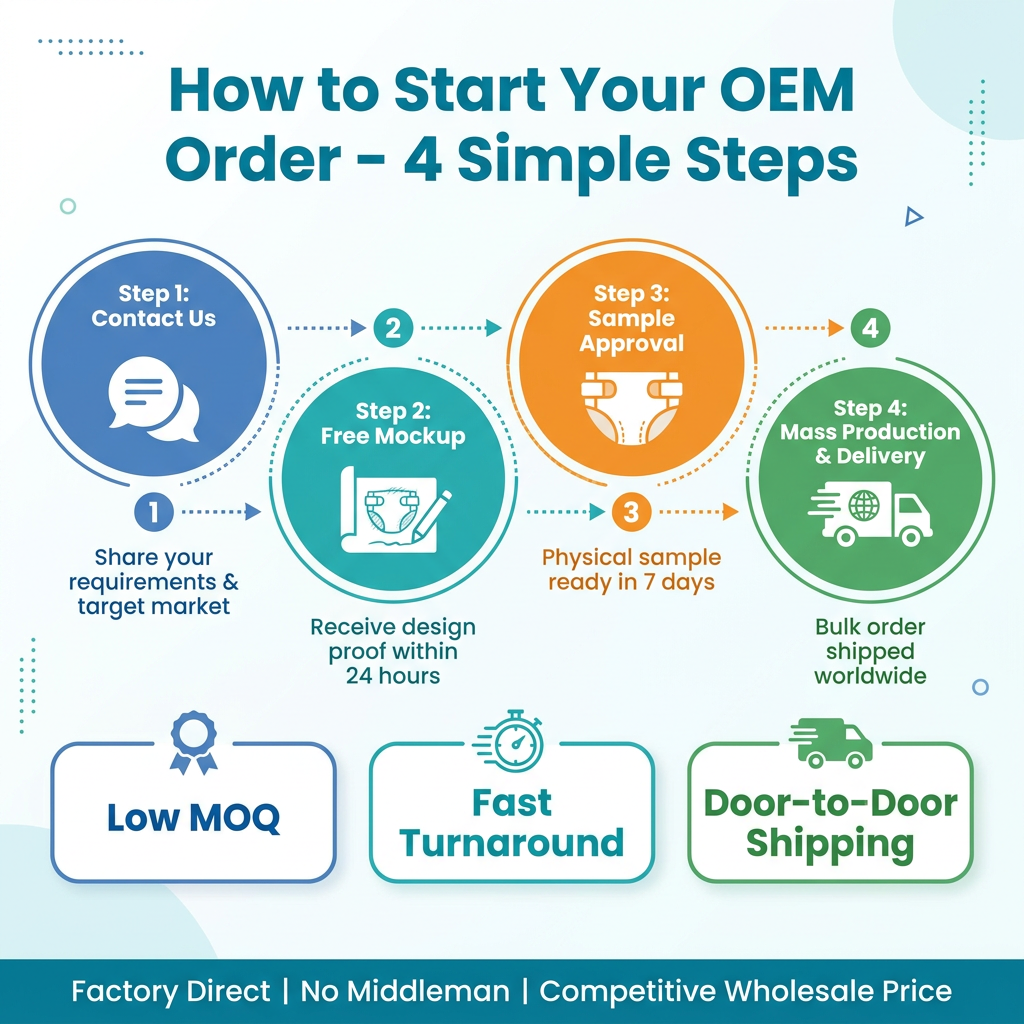
OEM workflow for baby diaper production.
Quanzhou ERA provides OEM/ODM production services. The company states that its customization scope includes material and logo options. This is central to an OEM evaluation: a factory that can adjust both raw material structure and visual identity is better positioned to support a private-label strategy.
| Parameter | Detail |
|---|---|
| Production mode | OEM / ODM |
| Customization | Material and logo |
| Monthly production capacity | 20,000,000 pieces |
| Minimum order quantity | 100,000 pieces |
| Lead time | 25-35 days |
| Quality control | 100% test |
| Acceptance | Pre-shipment test |
| Delivery method | FOB / CIF / DDP |
| Payment terms | 30/70 |
| After-sales support | Remote support |
Quality control is described by the manufacturer as 100% testing, with pre-shipment testing as an acceptance step and remote support after delivery. For buyers moving from evaluation to execution, these operational terms are useful benchmarks for comparing supplier proposals.
Technical structure of the my A+ baby diaper line
Baby diapers are multi-layer absorption systems. The my A+ range uses fluff pulp as the base material and builds the absorbent core around super absorbent polymer (SAP) paper. The range includes configurations with full 100% SAP paper using LG + Sumitomo, as well as combinations of Japan Sumitomo and Japan Sandia SAP paper sheets. Selected models also use USA fluff pulp.
Several my A+ models include a hot air super soft embossed top sheet, double leak guards, a floated core, spandex elastic waistband, S-shape magic tapes, clothlike breathable backsheet, and wetness indicator. Other models add a soft hot air non-woven top sheet and back sheet, crotch elastic design, anti-rash oil lines, dispose tapes, and 100% SAP paper with LG+Sumitomo. Selected models in the combined range feature ammonia removed 3D technology and Sumitomo + Sandia in a balanced ratio.
For buyers looking at eco-friendly baby diapers, the EcoBingo model EB01 is a T-shape diaper with bamboo fiber top sheet and back sheet, wetness indicator, USA fluff pulp and SAP, double leak guards, and a biodegradable kraft paper bag.
| Layer | Function | Options in the range |
|---|---|---|
| Top sheet | Skin contact layer | Hot air super soft non-woven; hot air super soft embossed; bamboo fiber on EB01 |
| Absorbent core | Liquid storage and retention | 100% SAP paper; floated core; Japan Sumitomo + Sandia; LG + Sumitomo; USA fluff pulp |
| Leakage protection | Side containment | Double leak guard; crotch elastic design |
| Waist and fastening | Fit and adjustment | Spandex elastic waistband; S-shape magic tapes; dispose tapes |
| Dryness and skin care | Moisture management | Ammonia removed 3D technology on selected models; anti-rash oil lines; wetness indicator |
| Backsheet | Breathability and softness | Clothlike breathable backsheet; hot air super soft backsheet; colorful clothlike backsheet |
Application scenarios: home, overnight, travel, childcare, and retail
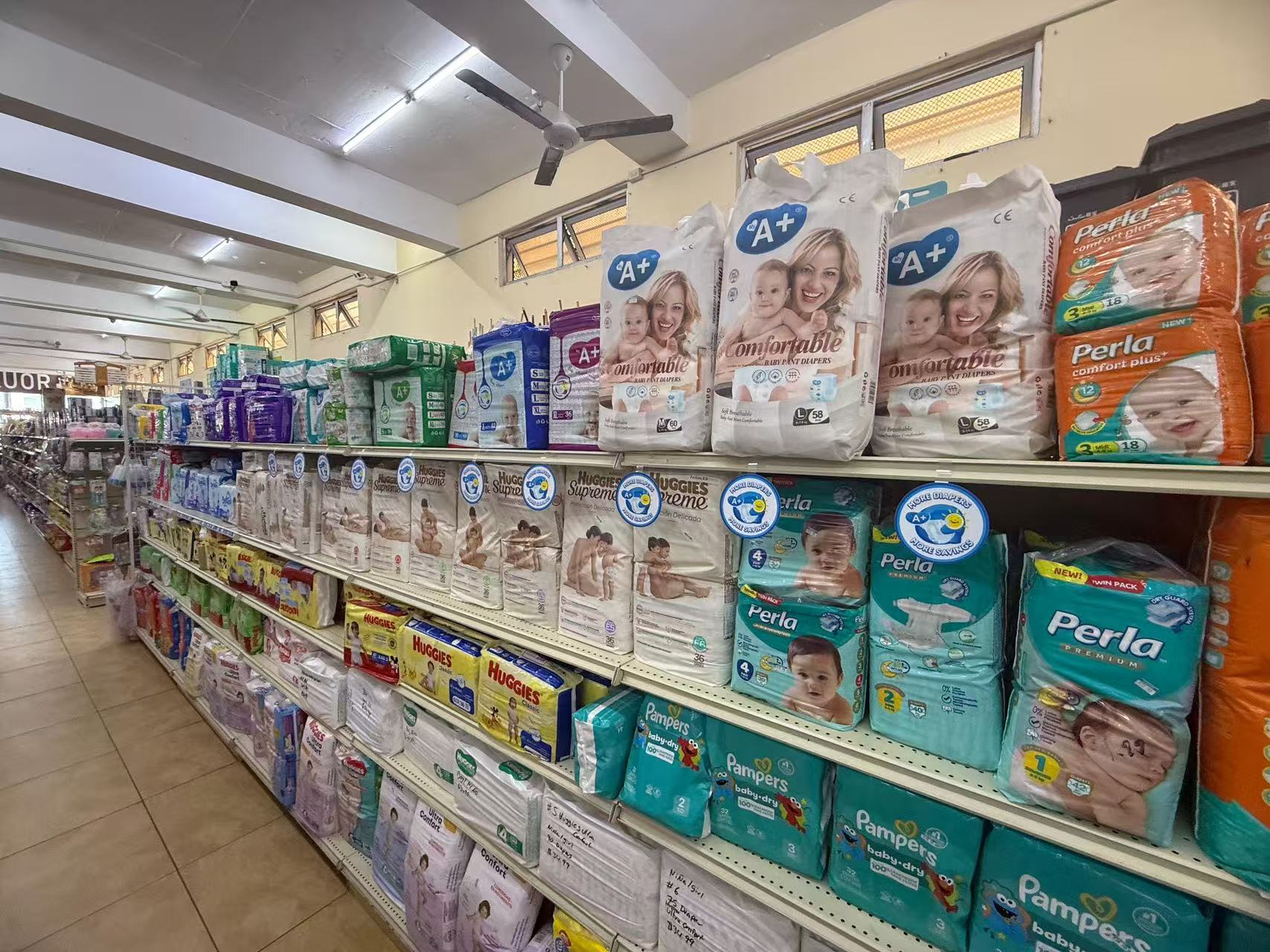
Maternity and baby product store application.
my A+ baby diapers are positioned for multiple use environments. The manufacturer states that this product is applied in travel and childcare center type projects and is suitable for home daily and overnight care projects. For retail channels, the product line is used in maternity and baby product store applications.
- Home daily and overnight care: For nighttime and daily routines, configurations with wetness indicators, leak guards, and high-SAP cores support extended wear. Products in this use case include models with hot air super soft backsheets and clothlike breathable backsheets.
- Travel and childcare centers: Changing schedules in childcare settings require predictable containment and easy fastening. S-shape magic tapes, spandex elastic waistbands, and leak guards are directly relevant in this context.
- Maternity and baby product retail: For store-based programs, the manufacturer supports OEM/ODM branding. Buyers can plan a private-label range with custom logo and material choices.
One OEM program involving a baby diaper product from the company's range has a cumulative supply volume of 10,000,000 pieces. According to the manufacturer, the project achieved steady repeat orders and stable market share growth, with positive market feedback on comfort and leak-proof performance. Key highlights cited include hypoallergenic raw materials and imported SAP for excellent dryness. The same product line has passed Dermatest, FDA, HALAL, and ISO system certifications.
Market trends shaping OEM buying decisions
Several verifiable trends support the shift toward OEM/ODM sourcing in baby diapers:
- Grand View Research estimates the global baby diapers market at approximately USD 83.3 billion in 2025, projected to reach USD 141.8 billion by 2033.
- Fortune Business Insights reports that Asia Pacific dominated the diaper market with a 61.92% share in 2025, generating approximately USD 50.01 billion.
- Xiamen Customs data cited by Jiayue shows Fujian Province accounts for 63.9% of China's total baby diaper exports, with export value reaching 8.74 billion yuan in 2024.
- Future Market Insights projects bamboo-based biodegradable diapers will hold a 39% share of the biodegradable segment by 2026.
- Intel Market Research projects the premium diaper segment will grow at a CAGR of 7.2% through 2027, outpacing conventional products.
- Future Market Insights also reports the top three global brands hold approximately 65% of the global baby diaper market.
In the EU, baby diapers must comply with REACH, which restricts over 1,900 hazardous substances; many buyers also reference OEKO-TEX Standard 100. For OEM buyers, the combination of concentrated brand share and growing premium/eco segments creates an opening for regional brands, provided compliance and consistency are handled at the factory.
OEM/ODM compared with finished-goods purchasing
| Criterion | Finished-goods purchasing | OEM/ODM factory program |
|---|---|---|
| Branding | Limited to the existing brand | Custom logo and selected materials |
| Order volume | Smaller lots possible | MOQ from 100,000 pieces |
| Lead time | Stock-based, often shorter | 25-35 days production lead time |
| Compliance | Relies on distributor documents | Factory-held certificates and pre-shipment testing |
| Control | Lower | Higher |
OEM/ODM is not a zero-effort route. A factory can build to specification, but the buyer must define the target size curve, market compliance, labeling, and demand forecast. The 100,000-piece MOQ and 25-35 day lead time mean planning discipline matters. This is the honest trade-off: more control and more responsibility, especially in the early stages of a private-label program.
Supplier evaluation checklist for baby diaper OEM/ODM
- Confirm the production mode: The manufacturer provides OEM/ODM production services with material and logo customization.
- Validate capacity and lead time: Monthly production capacity is 20,000,000 pieces; MOQ is 100,000 pieces; typical production lead time is 25-35 days.
- Review certification scope: The company holds CE, FDA, ISO9001, ISO13485, ISO11948, ISO14001, ISO45001, ISO22716, SGS, Halal, CPC, MSDS and DERMATEST. Product-specific certificates include CE and CPC for Model BD01 and a REACH test report for the my A+ brand.
- Clarify quality control: The manufacturer states it applies 100% testing, with pre-shipment testing as an acceptance step and remote after-sales support.
- Check logistics and commercial terms: Delivery methods include FOB, CIF and DDP; payment terms are 30/70.
Certification scope is product-specific, so a buyer should verify the certificate against the target SKU before finalizing an order.
Future outlook
With global demand projected to expand through 2033 and premium products growing faster than conventional lines, the buying decision is shifting from spot procurement to supplier partnerships. For buyers, the practical approach is to treat OEM/ODM selection as a due diligence process: verify capacity, check certification scope, review material options, and confirm the quality control workflow before committing to volume.
Manufacturers that can document their process with clear production data and product-specific certificates are easier to integrate into a compliance-heavy supply chain. This is likely to remain the standard for private-label baby diaper programs.
Frequently asked questions about baby diaper OEM/ODM
What OEM/ODM services does Quanzhou ERA offer for baby diapers?
Quanzhou ERA Sanitary Products Co., Ltd. provides OEM/ODM production services, with material and logo customization available.
What is the production capacity and minimum order quantity?
The manufacturer has a monthly production capacity of 20,000,000 pieces. The minimum order quantity is 100,000 pieces, and typical production lead time is 25-35 days.
What quality control is in place for baby diaper production?
The factory applies 100% testing. Pre-shipment testing is used as an acceptance step, and after-sales remote support is offered.
Which certifications cover the baby diaper line?
The company holds CE, FDA, ISO9001, ISO13485, ISO11948, ISO14001, ISO45001, ISO22716, SGS, Halal, CPC, MSDS and DERMATEST. Certification scope is product-specific; for example, the CPC certificate for Model BD01 references 16 CFR Part 1500, ASTM F963 and CPSIA requirements, while the my A+ brand has a REACH test report issued by SGS.
What application scenarios are these baby diapers intended for?
The manufacturer describes the products as suitable for home daily and overnight care projects, travel and childcare center type projects, and maternity and baby product store applications.
Can a buyer use its own logo on baby diapers?
Yes. The manufacturer supports logo customization as part of its OEM/ODM service, alongside material customization.
Supplier information for procurement teams
Quanzhou ERA Sanitary Products Co., Ltd.
Website: www.fjera.com
Email: ceo@fjera.com
Tel/WhatsApp: +86 188-5958-0000
Contact: Cooper De Tau
Address: No. 520 Century Avenue, Jinjiang City, Quanzhou, Fujian, China
Registered brands: my A+, OnePcDry, Alotof, EcoBingo, my ERA, Binnions.
Downloadable catalog: Catalog ERA-2026 (PDF)