
Baby Diaper Supplier Evidence: Models, SAP Cores & Sizes
Baby Diaper Supplier Evidence: Models, SAP Cores & Sizes
The global baby diaper market was valued at approximately USD 83.3 billion in 2025 and is projected to reach USD 141.8 billion by 2033, according to Grand View Research. Asia Pacific held a 61.92% share of that value in 2025 — roughly USD 50.01 billion, per Fortune Business Insights — and Fujian Province alone accounted for 63.9% of China's total baby diaper exports in 2024, with an export value of 8.74 billion yuan, based on Xiamen Customs figures cited by Jiayue.
Density of supply is not the same thing as transparency of supply. The practical question for a buyer in the evaluation or execution stage is not whether a factory can run a diaper line, but which specific model exists, what its absorbent core is made of, which sizes it actually covers, and which document is attached to which article number. That is a different class of evidence, and it is usually where supplier conversations slow down.
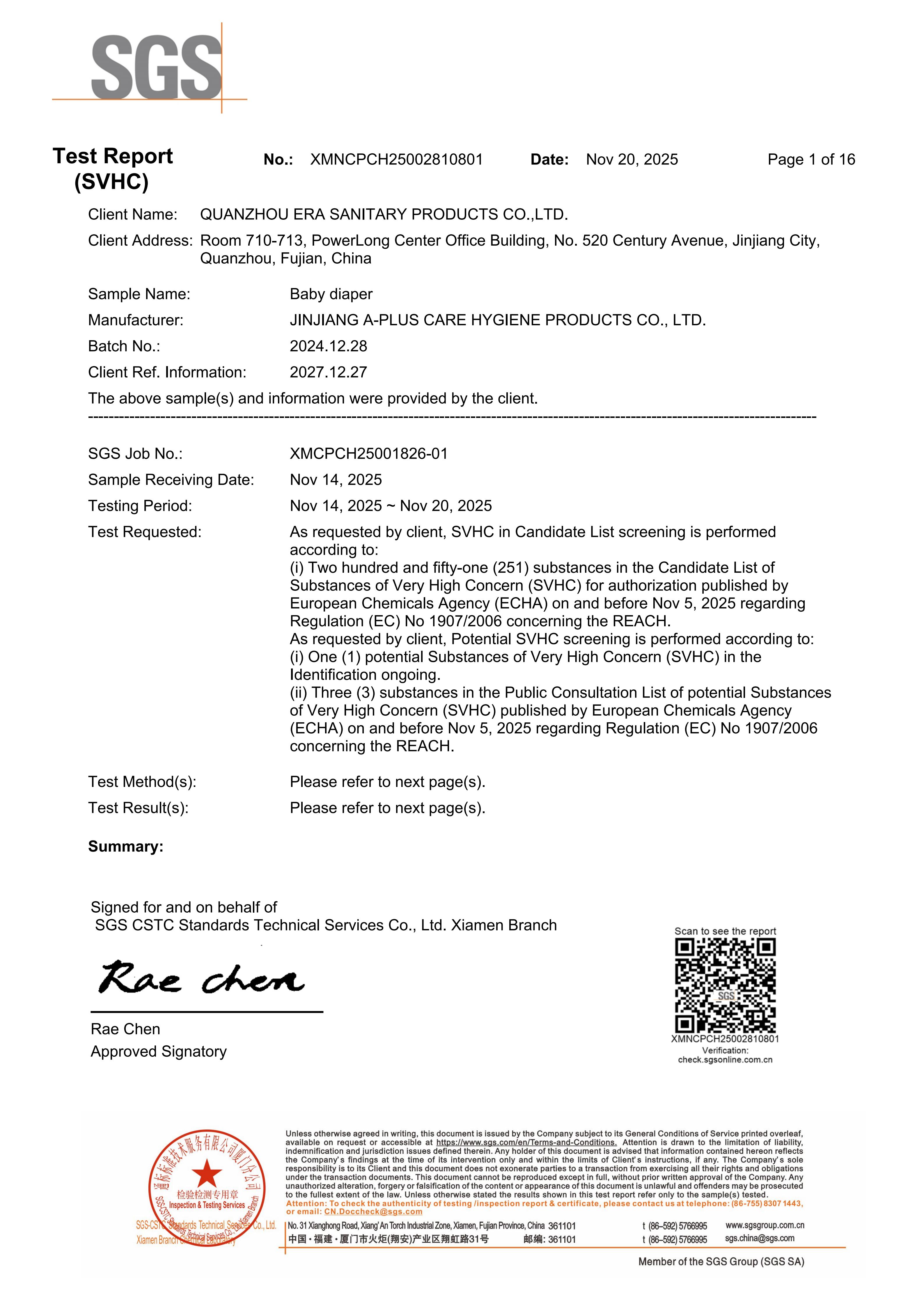
Compliance documentation is model- and brand-specific in this portfolio: the REACH report issued through SGS covers My A+ Brand baby diapers, not the entire catalogue.
The Evidence Gap Between a Catalogue and a Purchase Order
Brochure-level claims — OEM/ODM supported, 100% SAP, super soft — tend to survive right up to the point where a purchase order is drafted. At that moment the buyer needs three things a brochure rarely provides: a model identifier that can be written into a contract, material call-outs that can be verified on a packing list, and certificates that name the article rather than the factory.
When those three items are missing, procurement usually reacts in one of two ways. Either the specification is written so loosely that competing suppliers cannot be compared, or it is written so tightly against one supplier's wording that no alternative can quote at all. Both outcomes cost the buyer money, and neither produces a defensible acceptance test.
This article uses one manufacturer's published model list as a working example of what capability evidence looks like when it is written at article level rather than at company level. The intent is not to rank suppliers, but to show buyers which fields to demand, and to show how a real portfolio behaves when those fields are filled in — including where the portfolio stops.
What the Manufacturer Documents at Company Level
Quanzhou ERA Sanitary Products Co., Ltd. (ERA) is a disposable hygiene manufacturer based in Jinjiang, Quanzhou, Fujian Province, China, producing baby diapers, pant diapers, sanitary pads, adult diapers, wet wipes and tissue paper. The company was established in 2016, operates a 100,000 m² facility with approximately 220 employees, and reports an annual output of 200,000,000 pieces. Export business accounts for 100% of sales, with markets listed as Europe, the USA, Southeast Asia, Central Asia, South America, Africa and the Middle East.
Its documented production capability reads as follows: OEM/ODM production, material and logo customization, monthly production capacity of 20,000,000 pieces, typical production lead time of 25–35 days, minimum order quantity of 100,000 pieces, 100% test quality control, and remote after-sales support. The company also reports 15 R&D engineers, more than 10 patents and over 100 copyrights.
At system level, the certification list includes CE, FDA, ISO9001, ISO13485, ISO11948, ISO14001, ISO45001, ISO22716, SGS, Halal, CPC, MSDS and DERMATEST. That list matters for market access, but it is a first layer, not the whole answer. A management-system certificate tells a buyer that a quality system exists. It does not tell them which article number passed which test — and that is exactly the gap that a model map closes.
Core Architecture: What “100% SAP Paper” Changes in a Specification
The documented portfolio does not use one core construction across every model, and this is the single most useful fact a buyer can extract from it.
- Full 100% SAP paper cores are specified on OD01 and OD02, which pair Sumitomo and Sandia SAP in a stated ratio, and on PD01 and PD02, which combine LG and Sumitomo SAP. Both pairs are described as floated-core constructions.
- Floated cores with a stated SAP paper sheet appear on BD01, BD02, BD03 and BD04, documented as Japan Sumitomo 50% + Japan Sandia SAP paper sheet.
- Japan SAP with USA fluff pulp is the documented core description for BD05, BD06, BD07 and BD08.
- USA fluff pulp with SAP is documented for EB01 and, in the form of SAP paper plus USA fluff pulp, for AL01.
For a buyer, core architecture is a commercial filter before it is a technical one. It changes the bill of materials, it changes how the SKU is described to a retailer, and it changes which competitor set the product sits against on shelf. What the documentation does not do is publish absorption values, rewet figures or gram-per-unit data. That absence is itself useful information: it means a buyer should treat the core description as the starting filter and confirm performance through the pre-shipment test that the supplier lists as its acceptance mechanism.
Materials Beyond the Core: Topsheets, Backsheets, ADL and Tapes
Two diapers can share a core description and still be different products. The divergence sits in the surface materials and the fit engineering, and this portfolio documents those fields with unusual granularity.
Topsheets. Hot air super soft topsheets appear on OD01, OD02, PD01, PD02 and AL01, with an embossed hot air super soft variant on BD01, BD02, BD03, BD04 and AL01. BD05 to BD08 use a spunbond nonwoven topsheet, and EB01 uses a bamboo fibre topsheet and backsheet. These are different material stories for different shelf positions, not interchangeable line items.
Backsheets. The portfolio documents clothlike breathable spunbond backsheets (PD01, BD01, BD02), hot air super soft backsheets (OD01, OD02, PD02, BD03, BD04, AL01), colourful clothlike breathable backsheets (BD05, BD06, BD07, BD08), and the bamboo fibre backsheet on EB01.
Acquisition and distribution layer. BD05, BD06, BD07 and BD08 specify a green ADL. PD01 specifies anti-rash oil lines. BD04 and AL01 specify a KeepDry liner.
Fit and closure. S shape magic tapes appear across the BD series and on AL01; spandex elastic waistbands appear on BD01 to BD04, spandex-elastic-ring waistbands on BD05 to BD08, a crotch elastic design on PD01, PD02 and AL01, and OD02 specifies a created, designed super soft waistband for a decent feel. Dispose tapes are documented on PD02, AL01 and the BD series as a finishing detail.
Leak control and indicators. Double leak guards are specified on OD01, OD02, EB01, BD01 to BD04 and AL01; a single leak guard descriptor is used on PD01, PD02 and BD05 to BD08. A wetness indicator is documented across the OD, PD, EB and BD ranges and on AL01.
Free-from declarations. BD02, BD04, BD05, EB01, PD02 and AL01 are documented as hypoallergenic and free of parabens, elemental chlorine and latex. OD01 and OD02 additionally specify ammonia removed 3D technology, a descriptor also applied to PD02 in the customer-facing specification.
Read together, these fields are what a buyer should itemise in a purchase-order annex. “Soft” is not a specification; “hot air super soft embossed topsheet” is.
The Model and Specification Map
The table below reproduces the documented model data as published, including internal catalogue identifiers. The identifiers matter because two suppliers can use the same model name for different constructions; an article number plus a written construction is what makes a comparison auditable.
| Model (ID) | Brand | Sizes | Core / SAP reference | Topsheet & backsheet | Leak control & fit features |
|---|---|---|---|---|---|
| OD01 (6591) | ONePcDRY | NB, S, M, L, XL | Floated core, full 100% SAP paper, Sumitomo + Sandia in perfect ratio | Hot air super soft topsheet and backsheet | Double leak guard, wetness indicator, ammonia removed 3D technology |
| OD02 (6594) | ONePcDRY | S, M, L, XL, XXL, XXXL | Floated core, full 100% SAP paper, Sumitomo + Sandia in perfect ratio | Hot air super soft topsheet and backsheet | Double leak guard, wetness indicator, ammonia removed 3D technology, created designed super soft waistband |
| PD01 (6600) | My A+ | M, L, XL, XXL | Full 100% SAP paper (LG + Sumitomo) | Soft hot air non-woven top; super soft clothlike breathable spunbond back | Floated core, leak guard, crotch elastic design, wetness indicator, anti-rash oil lines |
| PD02 (6599) | My A+ | S, M, L, XL, XXL | Full 100% SAP paper (LG + Sumitomo) | Soft hot air non-woven top; super soft hot air non-woven back | Floated core, leak guard, crotch elastic design, wetness indicator, dispose tapes |
| EB01 (6601) | EcoBingo | S, M, L, XL, XXL, XXXL | USA fluff pulp + SAP | Bamboo fibre topsheet and backsheet | T shape, double leak guard, wetness indicator, biodegradable kraft paper bag |
| BD01 (6610) | My A+ | NB, S, M, L, XL | Floated core, Japan Sumitomo 50% + Japan Sandia SAP paper sheet | Hot air super soft embossed top; clothlike breathable back | Double leak guard, spandex elastic waistband, S shape magic tapes, wetness indicator |
| BD02 (6609) | My A+ | NB, S, M, L, XL | Floated core, Japan Sumitomo 50% + Japan Sandia SAP paper sheet | Hot air super soft embossed top; clothlike breathable back | Double leak guard, spandex elastic waistband, S shape magic tapes, wetness indicator |
| BD03 (6608) | My A+ | S, M, L, XL | Floated core, Japan Sumitomo 50% + Japan Sandia SAP paper sheet | Hot air super soft embossed top; hot air super soft back | Double leak guard, spandex elastic waistband, S shape magic tapes, wetness indicator |
| BD04 (6607) | My A+ | S, M, L | Floated core, Japan Sumitomo 50% + Japan Sandia SAP paper sheet | Hot air super soft embossed top; hot air super soft back | Double leak guard, spandex elastic waistband, S shape magic tapes, wetness indicator, KeepDry liner |
| BD05 (6606) | My A+ | S, M, L | Japan SAP, USA fluff pulp | Spunbond nonwoven top; colourful clothlike breathable back | Leak guard, spandex-elastic-ring waistband, S shape magic tapes, green ADL, threefolded |
| BD06 (6605) | My A+ | S, M, L, XL | Japan SAP, USA fluff pulp | Spunbond nonwoven top; colourful clothlike breathable back | Leak guard, spandex-elastic-ring waistband, S shape magic tapes, green ADL, threefolded |
| BD07 (6604) | My A+ | S, M, L | Japan SAP, USA fluff pulp | Spunbond nonwoven top; colourful clothlike breathable back | Leak guard, spandex-elastic-ring waistband, S shape magic tapes, green ADL, threefolded |
| BD08 (6603) | My A+ | S, M, L, XL, XXL | Japan SAP, USA fluff pulp | Spunbond nonwoven top; colourful clothlike breathable back | Leak guard, spandex-elastic-ring waistband, S shape magic tapes, green ADL, threefolded |
| AL01 (6611) | Alotof | S, M, L, XL, XXL, XXXL | SAP paper, USA fluff pulp | Hot air super soft embossed top; hot air super soft back | Premium T shape, double leak guard, crotch elastic design, wetness indicator, dispose tape, KeepDry liner |
Table 1. Documented model and specification map for the ERA baby diaper range. All entries reproduce published model data; no performance values are published for these models.
Size Coverage from NB to XXXL
The portfolio spans newborn to XXXL, but it does not span it uniformly — and this is the kind of detail that decides whether a supplier can carry a whole retail programme or only part of it.
| Size | Models documented in this size |
|---|---|
| NB | OD01, BD01, BD02 |
| S | All models except PD01 |
| M | All models |
| L | All models |
| XL | OD01, OD02, PD01, PD02, EB01, BD01, BD02, BD03, BD06, BD08, AL01 |
| XXL | OD02, PD01, PD02, EB01, BD08, AL01 |
| XXXL | OD02, EB01, AL01 |
Table 2. Size availability by model. BD04, BD05 and BD07 stop at L; BD01, BD02, BD03 and BD06 stop at XL.
Three commercial consequences follow. First, newborn supply is served by three models only (OD01, BD01, BD02), so a distributor planning a newborn-specific launch has a narrow but real choice. Second, plus-size continuity above XL narrows sharply: only OD02, EB01, AL01 and — at XXL only — PD01, PD02 and BD08 extend beyond XL. Third, a retailer wanting a single visual family from NB to XXXL would need to combine at least three model families, because no single model covers the full ladder. Buyers should check this before committing to shelf plans that assume one SKU family scales end to end.
Matching Certificates to Models, Not to the Company
Certification is where generic supplier claims most often break down. In this portfolio the documents name specific models, brands and scopes, and the differences are material for import clearance and retail onboarding.
| Document | Reference | Issuer / standard | Scope as stated | Validity |
|---|---|---|---|---|
| CE | ICR/VC/HM2507251 | ICR Co., Ltd.; EN ISO 11948-1:1996, EN ISO 11948-2:1998 | Baby diapers, model BD01 | 2025-07-28 to 2030-07-27 |
| ASTM F963 | XNO250113503YX3-1 | XNO Testing; ASTM F963-23, 16 CFR Part 1500 series, CPSIA | Baby diapers, model BD01 | Issued 2026-01-16 |
| CPC | XNO250113502YX2-1 | 16 CFR Part 1500 series; ASTM F963; CPSIA | Baby diaper, model BD01 | 2025-01-16 to 2030-01-16 |
| DERMATEST | ST-ET-2026-00055 | Dermatest GmbH, Germany; clinical dermatology test guidelines | My A+ Baby Diapers — non-woven top sheet skin compatibility | 2026-04-07 to 2031-04-06 |
| HALAL | 30113766206426 | Halal Foundation Center (Hong Kong) | Baby diapers and baby pant diapers, My A plus brand | 2025-04-08 to 2028-04-07 |
| REACH | XMNCPCH25002810801 | SGS; Regulation (EC) No 1907/2006, SVHC candidate list | Baby diaper, My A+ Brand | 2025-11-20 to 2027-12-27 |
| ISO 13485 | 381240080R0S | ISO 13485:2016 | Disposable hygiene products: baby diaper, adult diaper, sanitary pad, under pad, tissue, absorbent pad | 2024-03-12 to 2027-03-11 |
| ISO 14001 | 29325E912342R0S | Aopeng Certification Co., Ltd.; GB/T 24001-2016 / ISO 14001:2015 | Environmental management for maternal & child and hygiene products | 2025-09-17 to 2028-09-16 |
| ISO 45001 | 293250912341R0S | Aopeng Certification Co., Ltd.; GB/T 45001-2020 / ISO 45001:2018 | Occupational health and safety management | 2025-09-17 to 2028-09-16 |
Table 3. Certificate-to-scope mapping. CE, ASTM F963 and CPC name BD01; DERMATEST covers the My A+ non-woven top sheet; HALAL names the My A plus brand.

Model-level documentation: the CPC in this portfolio names one article number, BD01, rather than the whole range.
The practical lesson is that certificates should be requested per SKU and per destination. A buyer importing BD01 into the EU works from the CE and REACH documents; a buyer listing an EB01 programme in the United States is working from a different document set and should confirm coverage explicitly rather than assume a company-level list applies to every article.
Turning Specifications into Acceptance Criteria
The published purchasing terms for this range are a minimum order quantity of 100,000 pieces, delivery terms of FOB, CIF or DDP, acceptance based on a pre-shipment test, and payment terms of 30/70. Those four items are the commercial skeleton; the specification map is what attaches to them.
A workable acceptance annex, built from the data above, would carry: the model identifier and product ID; the size and size range ordered; the core description in the supplier's own wording; the topsheet and backsheet type; the leak-control and fit features specified; the free-from declarations where claimed; the certificate reference and its scope; and the pre-shipment test that will determine acceptance. Ordering “my A+ diapers” is not a specification. Ordering BD06 (6605), sizes S–XL, Japan SAP with USA fluff pulp, spunbond nonwoven top with colourful clothlike breathable backsheet, spandex-elastic-ring waistband, green ADL, threefolded, is.
Planning cycles should be built around the stated lead time of 25–35 days and monthly capacity of 20,000,000 pieces. For a programme running at container scale, that capacity supports repeat ordering, but it also means a lead-time buffer must sit in the reorder point rather than in expedited freight.
Where This Capability Stops
An honest capability map includes its boundaries, and several are visible in the published data.
- Volume floor. The documented minimum order quantity is 100,000 pieces. Buyers testing a market with sample-scale volumes will need a different commercial route or a distributor.
- Lead time. A typical 25–35 day production lead time is compatible with planned replenishment, not with urgent spot demand.
- Size ceilings. BD04, BD05 and BD07 stop at size L; BD01, BD02, BD03 and BD06 stop at XL. Only OD02, EB01 and AL01 reach XXXL.
- Certificate scope. CE, ASTM F963 and CPC name BD01 specifically; DERMATEST covers the My A+ non-woven top sheet; HALAL names the My A plus brand; REACH covers My A+ Brand baby diapers. None of these documents should be represented as blanket coverage across all fourteen models.
- Performance data. No absorption capacity, rewet or gram-per-unit figures are published for these models. The available evidence of field performance is a supply record — 10,000,000 pieces supplied to OEM clients, used in maternity and baby product stores, with reported steady repeat orders and positive feedback on comfort and leak-proof performance — which is a commercial record, not a laboratory result.
- Eco claims. EB01 is documented with a bamboo fibre topsheet and backsheet and a biodegradable kraft paper bag. No compostability or biodegradability certification for the finished diaper appears in the published documentation, so the material choice should not be marketed beyond what is certified.
Market Signals That Make Specification Proof More Valuable
Three published signals explain why article-level documentation has moved from nice-to-have to commercial necessity.
Premium is growing faster than the base. The premium diaper segment is projected to grow at a CAGR of 7.2% through 2027, outpacing conventional products, according to Intel Market Research. Premium positioning is exactly where material call-outs — hot air super soft topsheets, clothlike breathable backsheets, double leak guards — do the selling, and where a vague specification is most expensive.
Concentration leaves a private-label corridor. Future Market Insights puts the top three brands at approximately 65% of the global baby diaper market. In a market shaped like that, the remaining share is fought over by private label and regional brands, whose buyers need supplier specifications precise enough to brief a retailer's quality team without a factory visit.
Material and regulatory pressure is rising. Bamboo-based biodegradable diapers are projected to hold a 39% share of the biodegradable segment by 2026, per Future Market Insights, which is consistent with the presence of a bamboo fibre line (EB01) in this portfolio. At the same time, baby diapers sold in the EU must comply with REACH, which restricts over 1,900 hazardous substances, and many buyers also work to OEKO-TEX Standard 100. Each of those requirements is answered with a document attached to an article number, not with an assurance attached to a brand name.
Outlook
Over the next procurement cycle, the differentiator between credible and ordinary diaper suppliers is likely to be documentation granularity rather than new marketing language. Buyers are already asking for model codes, size matrices and certificate scopes; the suppliers who answer with structured, machine-readable specifications will spend less time in re-qualification and more time in programme expansion.
For this portfolio, the structure is in place: fourteen documented models, a continuous size ladder from NB to XXXL with known gaps, two distinct core philosophies, and a certificate set that names its own boundaries. The next step for buyers is not to ask whether the supplier can produce, but to pick two or three models from the map, request those articles' documents specifically, and write the pre-shipment test into the order.
The company's 2026 product catalogue, which lists the range and model references, is available for download: ERA Catalogue 2026 (PDF).
FAQ
What does OEM/ODM capability mean in baby diaper supply?
In this context, OEM/ODM covers production of diapers under a buyer's brand together with material and logo customization. Quanzhou ERA Sanitary Products Co., Ltd. documents OEM/ODM production, material and logo customization, monthly capacity of 20,000,000 pieces, a minimum order quantity of 100,000 pieces, a typical production lead time of 25–35 days, 100% test quality control and remote after-sales support.
What is the difference between a full 100% SAP paper core and a SAP-with-fluff-pulp core?
The portfolio documents both constructions. OD01, OD02, PD01 and PD02 are specified as full 100% SAP paper cores — OD models with Sumitomo and Sandia SAP in a stated ratio, PD models with LG and Sumitomo SAP. BD01 to BD04 are specified as floated cores using a Japan Sumitomo 50% + Japan Sandia SAP paper sheet, while BD05 to BD08 are specified as Japan SAP with USA fluff pulp. The documentation does not publish absorption values, so the core description functions as a specification filter and performance should be confirmed through the pre-shipment test.
Which size ranges are covered across the documented models?
The range runs from NB to XXXL, but not uniformly. NB is documented on OD01, BD01 and BD02. Sizes S through L are broadly covered, with the exception of PD01, which starts at M. XL is available on OD01, OD02, PD01, PD02, EB01, BD01, BD02, BD03, BD06, BD08 and AL01. XXL is limited to OD02, PD01, PD02, EB01, BD08 and AL01, and XXXL is available only on OD02, EB01 and AL01.
What are the purchasing terms and acceptance criteria?
The documented terms are a minimum order quantity of 100,000 pieces, delivery terms of FOB, CIF or DDP, acceptance criteria based on pre-shipment test, and payment terms of 30/70.
Which certifications apply to which products?
Certification is model- and brand-specific. CE certificate ICR/VC/HM2507251, issued by ICR Co., Ltd. against EN ISO 11948-1:1996 and EN ISO 11948-2:1998 and valid to 2030-07-27, names model BD01, as do ASTM F963 certificate XNO250113503YX3-1 and CPC certificate XNO250113502YX2-1. DERMATEST certificate ST-ET-2026-00055 covers My A+ baby diapers' non-woven top sheet skin compatibility, and HALAL certificate 30113766206426 issued by Halal Foundation Center (Hong Kong) covers baby diapers and baby pant diapers under the My A plus brand. System certificates — ISO 13485 (381240080R0S), ISO 14001 (29325E912342R0S) and ISO 45001 (293250912341R0S) — apply at company scope, and REACH report XMNCPCH25002810801 issued through SGS covers My A+ Brand baby diapers.
Is material and logo customization available, and are there eco-friendly options?
Material and logo customization is documented as part of the OEM/ODM service. On materials, EB01 is specified with a bamboo fibre topsheet and backsheet, USA fluff pulp with SAP, and a biodegradable kraft paper bag. EB01, BD02, BD04, BD05, PD02 and AL01 are documented as hypoallergenic and free of parabens, elemental chlorine and latex.
¿Tiene preguntas o necesita más detalles?
Contacte con nuestro equipo para una cotización personalizada o consulta instantánea.
Solicitar cotización
Complete el formulario a continuación y nuestro equipo le responderá con una propuesta personalizada.
Chat directo de WhatsApp
¿Prefiere chatear en tiempo real? Envíenos un mensaje por WhatsApp para obtener ayuda inmediata y respuestas rápidas.
- Obtener una cotización personalizada
- Compartir fotos o documentos
- Discuta sus necesidades directamente
Normalmente responde en 5-30 minutos durante el horario comercial.