
Baby Diaper Buyer Comparison Framework: OD01, OD02, PD02, EB01 & BD Series Side by Side
Baby Diaper Buyer Comparison Framework: OD01, OD02, PD02, EB01 & BD Series Side by Side
Baby diaper buyers rarely fail because they cannot find models. They fail because models get compared on different axes — one buyer weighs absorbency claims, another weighs print and pack appeal, a third weighs price per piece — so the shortlist that reaches a purchasing meeting cannot be defended. This article builds one comparison framework for OD01, OD02, PD01, PD02, EB01 and the BD series, using only published specification facts, and then converts that framework into purchasing terms and acceptance criteria a buyer can document.
An industry where the option set is larger than the decision set
The global baby diapers market was valued at approximately USD 83.3 billion in 2025 and is projected to reach USD 141.8 billion by 2033, according to Grand View Research. Growth of that scale keeps attracting suppliers, private labels and cross-border sellers — and it produces the exact condition that makes buyer comparison hard: a very large number of superficially similar SKUs.
Demand and supply are both concentrated. Asia Pacific dominated the diaper market with a 61.92% share in 2025, generating approximately USD 50.01 billion, according to Fortune Business Insights. On the supply side, Fujian Province accounts for 63.9% of China's total baby diaper exports, with export value reaching 8.74 billion yuan in 2024, per Xiamen Customs data reported by Jiayue.
The comparison set in this article comes from a manufacturer operating inside that supply base. Quanzhou ERA Sanitary Products Co., Ltd. is a manufacturer based in Jinjiang, Quanzhou, Fujian Province, China, producing baby diapers, pant diapers, sanitary pads, adult diapers, wet wipes and tissue paper under brands including my A+, OnePcDry, Alotof, EcoBingo, my ERA and Binnions. The company is export-oriented and lists its markets as Europe, the USA, Southeast Asia, Central Asia, South America, Africa and the Middle East.
Why model lists do not help buyers decide
A model list answers "what exists." A buyer needs "what separates these options, and which separation matters for my channel." The difference shows up at three points in the buying process. First, at sampling: without a fixed comparison axis, samples are evaluated by feel alone and the evaluation cannot be repeated across suppliers. Second, at negotiation: a buyer who cannot name the core architecture, sheet construction and size ladder cannot compare quotations that look identical on a price sheet. Third, at listing: the model that fits a newborn-led pharmacy assortment is frequently not the model that fits a toddler-led cross-border e-commerce listing.
The opportunity is that these seven models differ on a small, describable set of construction features. Once those features are laid out side by side, most buying questions reduce to two variables: which size ladder the channel needs, and which dryness and softness story the market responds to.
The seven comparison dimensions that carry commercial weight
- Absorbent core architecture. A full 100% SAP paper core versus a floated core built around an SAP paper sheet. This is the first filter because it sits behind nearly every dryness claim made at shelf.
- SAP and fluff pulp origin. Japan Sumitomo, Japan Sandia, LG, and USA fluff pulp appear in different combinations across the range — a sourcing question buyers increasingly ask suppliers to document.
- Top sheet. Hot air super soft embossed non-woven, spunbond non-woven, or bamboo fiber. This drives the tactile impression a consumer forms in the first second of handling.
- Back sheet. Clothlike breathable, hot air super soft, colorful clothlike breathable, or spunbond clothlike breathable — a design and breathability decision as much as a cost decision.
- Leak control. Single or double leak guard, and whether a crotch elastic design is specified.
- Waist and fastening. Spandex elastic waistband, spandex elastic ring waistband, and S shape magic tapes.
- Size ladder. Which models genuinely start at NB and which genuinely reach XXXL — a narrower set than most buyers assume.
Two features cut across all seven dimensions: the wetness indicator, documented on OD01, OD02, PD01, PD02, EB01 and BD01–BD04; and the threefolded construction, documented on BD05, BD06, BD07 and BD08.
Side-by-side: the core comparison table
| Model (Brand) | Core architecture | Top sheet | Back sheet | Leak control | Waist / fastening | Sizes |
|---|---|---|---|---|---|---|
| OD01 (ONePcDRY) | Floated core; full 100% SAP paper; Sumitomo + Sandia SAP in a specified ratio; ammonia-removed 3D technology | Hot air super soft | Hot air super soft | Double leak guard | Not specified in the published specification | NB, S, M, L, XL |
| OD02 (ONePcDRY) | Floated core; full 100% SAP paper; Sumitomo + Sandia SAP in a specified ratio; ammonia-removed 3D technology | Hot air super soft | Hot air super soft | Double leak guard | Super soft waistband (created, designed feeling) | S, M, L, XL, XXL, XXXL |
| PD01 (my A+) | Floated core; full 100% SAP paper (LG + Sumitomo); anti-rash oil lines | Soft hot air non-woven | Super soft clothlike breathable spunbond | Leak guard; crotch elastic design | Not specified in the published specification | M, L, XL, XXL |
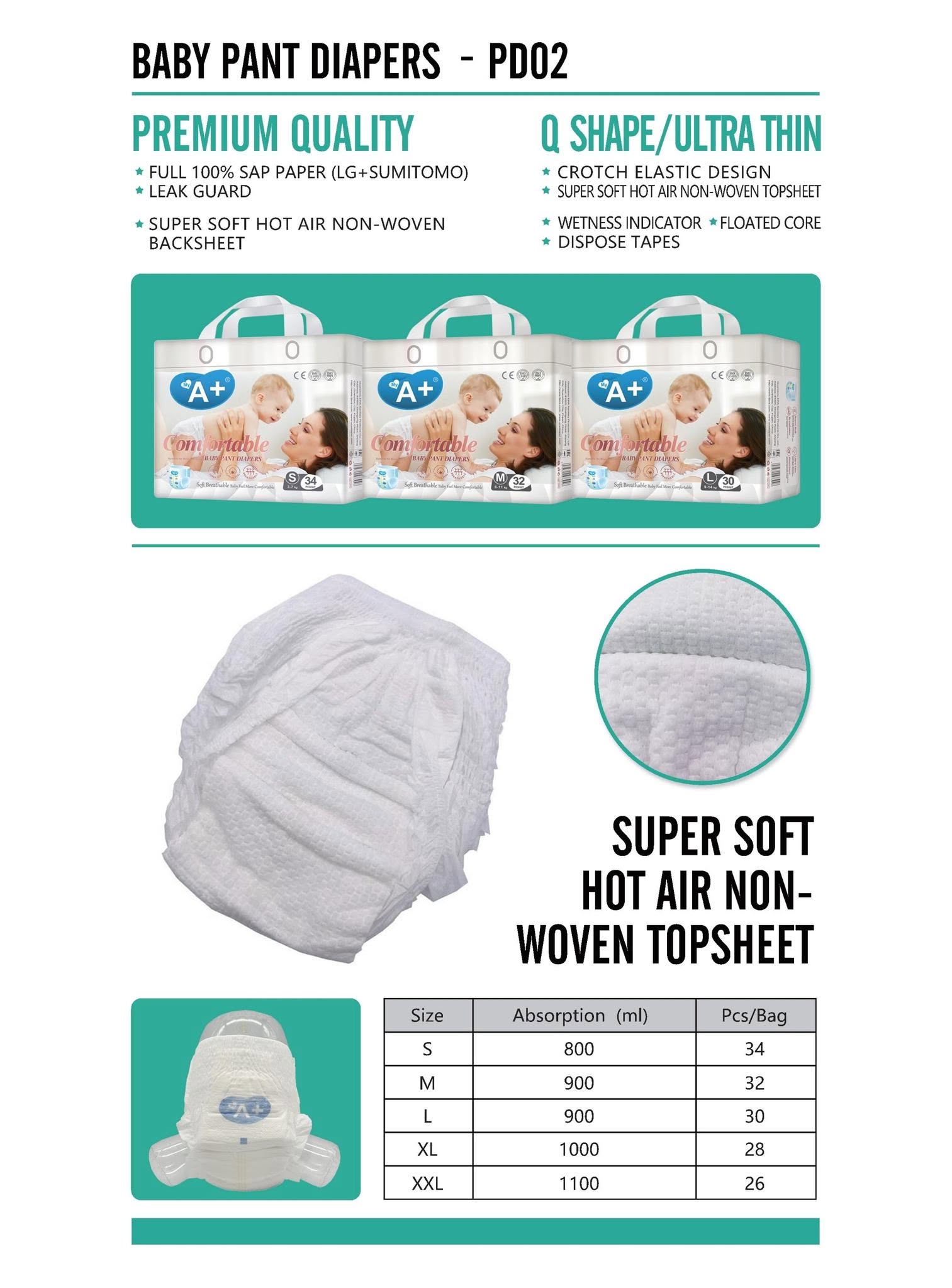
| PD02 (my A+) | Floated core; full 100% SAP paper (LG + Sumitomo) | Soft hot air non-woven | Super soft hot air non-woven | Leak guard; crotch elastic design | Dispose tapes specified | S, M, L, XL, XXL |
| EB01 (EcoBingo) | USA fluff pulp + SAP | Bamboo fiber (T shape) | Bamboo fiber | Double leak guard | Not specified in the published specification | S, M, L, XL, XXL, XXXL |
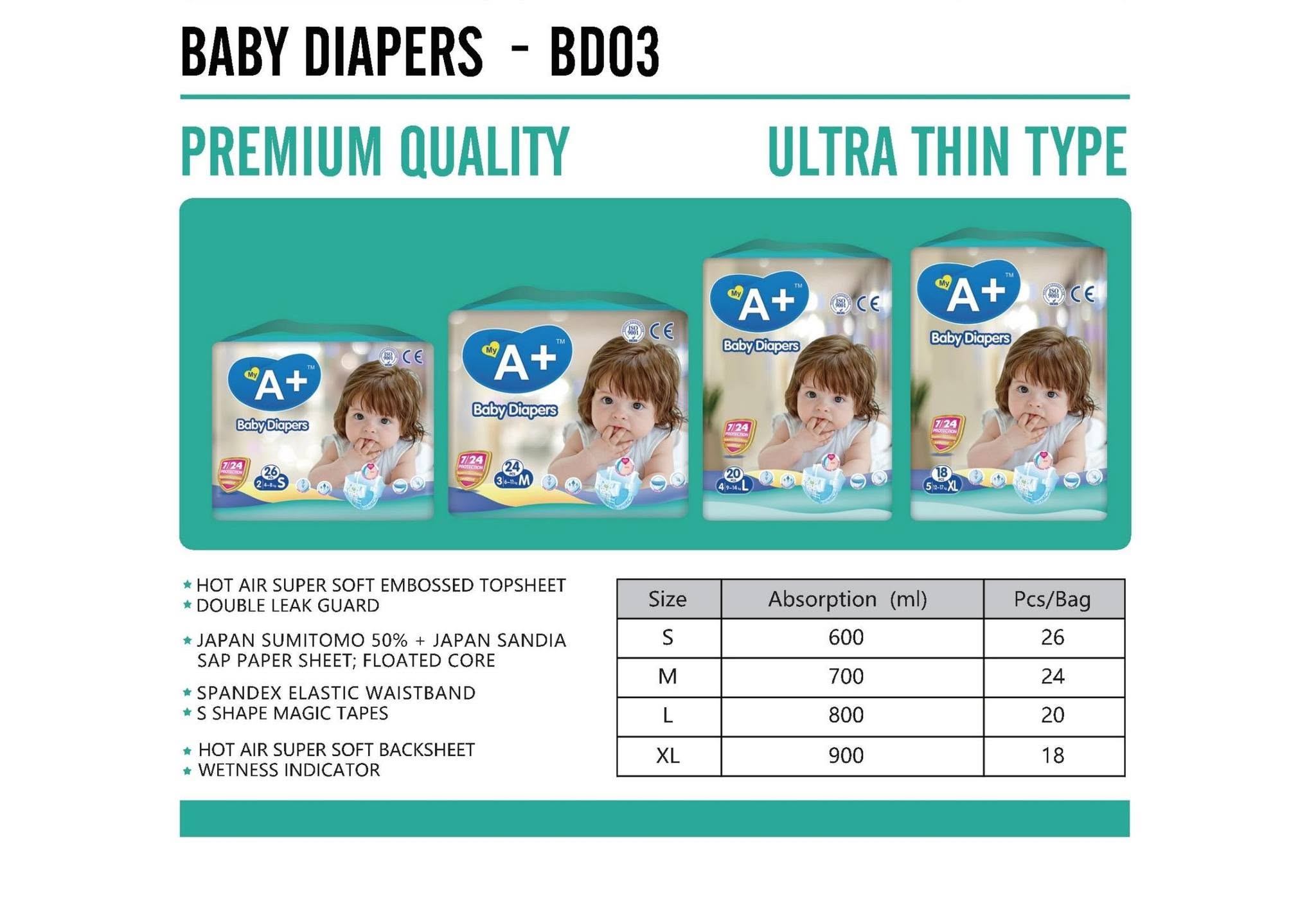
| BD01 / BD02 (my A+) | Floated core; Japan Sumitomo 50% + Japan Sandia SAP paper sheet | Hot air super soft embossed | Clothlike breathable | Double leak guard | Spandex elastic waistband; S shape magic tapes | NB, S, M, L, XL |
| BD03 (my A+) | Floated core; Japan Sumitomo 50% + Japan Sandia SAP paper sheet | Hot air super soft embossed | Hot air super soft | Double leak guard | Spandex elastic waistband; S shape magic tapes | S, M, L, XL |
| BD04 (my A+) | Floated core; Japan Sumitomo 50% + Japan Sandia SAP paper sheet | Hot air super soft embossed | Hot air super soft | Double leak guard | Spandex elastic waistband; S shape magic tapes | S, M, L |
| BD05 (my A+) | Japan SAP; USA fluff pulp; threefolded | Spunbond non-woven with green ADL | Colorful clothlike breathable | Leak guard | Spandex elastic ring waistband; S shape magic tapes | S, M, L |
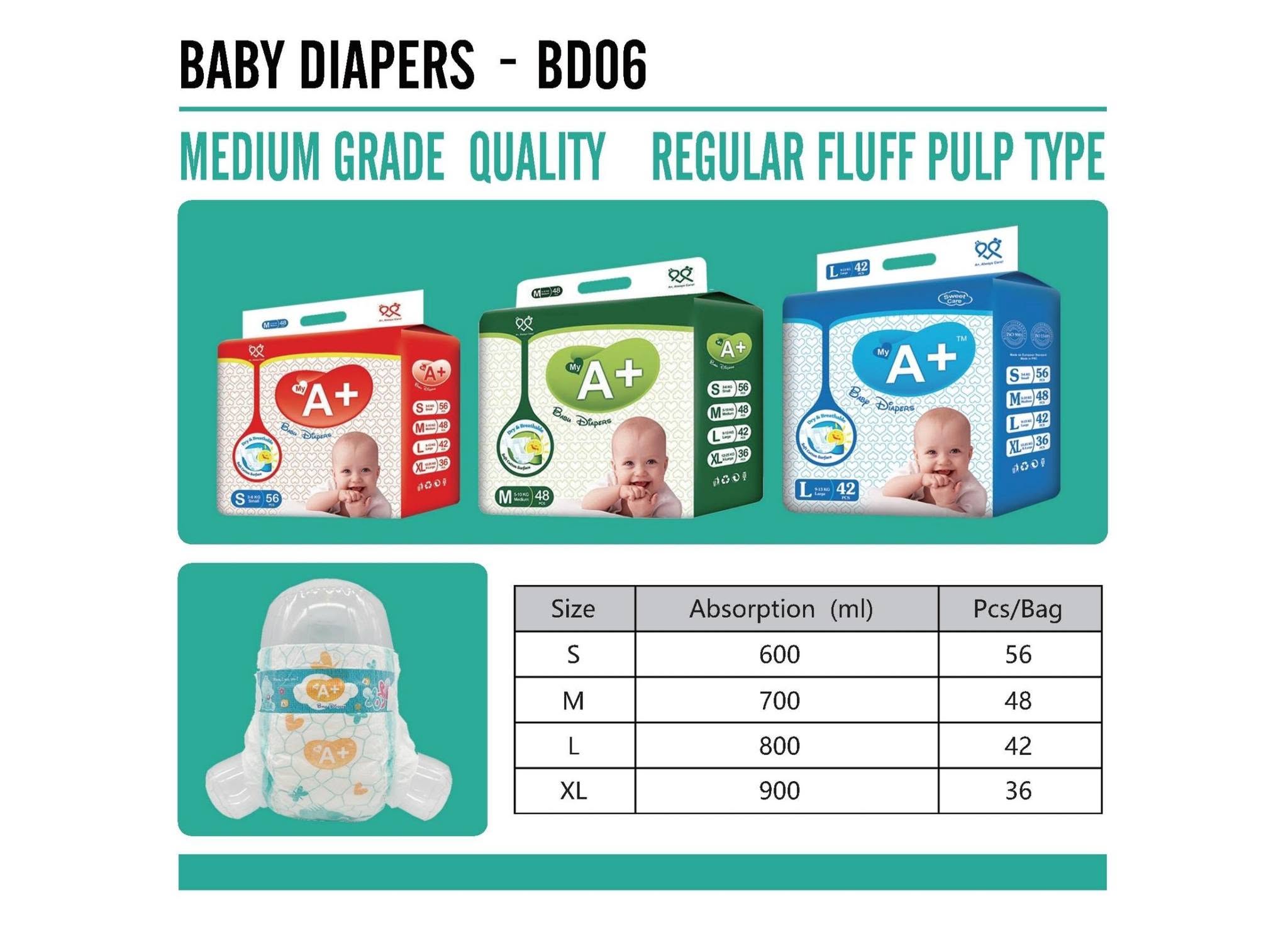
| BD06 (my A+) | Japan SAP; USA fluff pulp; threefolded | Spunbond non-woven with green ADL | Colorful clothlike breathable | Leak guard | Spandex elastic ring waistband; S shape magic tapes | S, M, L, XL |
| BD07 (my A+) | Japan SAP; USA fluff pulp; threefolded | Spunbond non-woven with green ADL | Colorful clothlike breathable | Leak guard | Spandex elastic ring waistband; S shape magic tapes | S, M, L |
| BD08 (my A+) | Japan SAP; USA fluff pulp; threefolded | Spunbond non-woven with green ADL | Colorful clothlike breathable | Leak guard | Spandex elastic ring waistband; S shape magic tapes | S, M, L, XL, XXL |
Reading the core column correctly
Two core families appear in this set. OD01, OD02, PD01 and PD02 are specified with a full 100% SAP paper core built on a floated core design — the highest-specification absorbent construction in this group. Within that family, OD01 and OD02 use Sumitomo and Sandia SAP in a specified ratio and add ammonia-removed 3D technology, while PD01 and PD02 use LG plus Sumitomo SAP; PD01 additionally specifies anti-rash oil lines.
BD01 through BD04 sit in a second family: a floated core containing a Japan Sumitomo 50% and Japan Sandia SAP paper sheet. BD05 through BD08 sit in a third: Japan SAP combined with USA fluff pulp in a threefolded construction with a green ADL layer, which places the emphasis on liquid distribution rather than on a 100% SAP paper core.
EB01 is deliberately different. It is specified with USA fluff pulp plus SAP, and its differentiation is not the core but the sheet system and the pack format.
Softness, breathability and the skin-facing story
Top sheet choice divides the range into three tactile profiles. OD01, OD02, BD01, BD02, BD03 and BD04 use hot air super soft (embossed on the BD models). PD01 and PD02 use a soft hot air non-woven top sheet. BD05 through BD08 use a spunbond non-woven top sheet over a green ADL layer — a flatter, distribution-oriented surface. EB01 uses a bamboo fiber top sheet and back sheet.
Back sheet construction splits in a similar way. BD01 and BD02 use a clothlike breathable back sheet; BD03 and BD04 use a hot air super soft back sheet; BD05 through BD08 use a colorful clothlike breathable back sheet, which matters when the buyer's listing relies on visible print and colour; PD01 uses a super soft clothlike breathable spunbond back sheet; PD02 uses a super soft hot air non-woven back sheet; OD01 and OD02 use a hot air super soft back sheet.
On skin-facing positioning, product documentation for the range states hypoallergenic materials free of parabens, elemental chlorine and latex. Buyers serving sensitive-skin or dermatology-adjacent channels typically ask for that statement plus a certification chain rather than a marketing claim, and the certification position is covered later in this article.
Leak control, waistband and tape: small features, large return impact
Leak guard count is one of the most reliable predictors of consumer complaints in night use. OD01, OD02, BD01, BD02, BD03, BD04 and EB01 are specified with a double leak guard. PD01 and PD02 specify a leak guard combined with a crotch elastic design, which changes how the diaper seats through the leg crease. BD05 through BD08 specify a leak guard with a ring-type elastic waistband.
Fastening and waist construction also separate the range. BD01 through BD08 all use S shape magic tapes, which supports refastening during application. BD01 through BD04 pair that tape with a spandex elastic waistband; BD05 through BD08 pair it with a spandex elastic ring waistband. OD02 adds a waistband designed for a soft, decent feel. Where a specification does not list a waistband or tape type — OD01, PD01, PD02 and EB01 in the published data — a buyer should treat that as an open item to confirm during sampling rather than as a negative.
Size coverage from NB to XXXL: the constraint most buyers underestimate
Size coverage is not uniform across this set, and this is where many shortlists break. Newborn sizes are the narrowest: OD01, BD01 and BD02 are the only models in this comparison set published with NB. EB01 and OD02 start at S. PD01 starts at M.
At the other end, OD02 and EB01 are the models published up to XXXL. BD08 reaches XXL, PD01 and PD02 reach XXL, and BD03 and BD06 stop at XL. BD04, BD05 and BD07 are published in S, M and L only.
The practical consequence is that a retailer planning a full newborn-to-toddler planogram cannot source it from a single model. A typical distribution-led assortment would pair a newborn-capable model such as OD01 or BD01 with a large-size-capable model such as OD02, EB01 or BD08. That pairing decision is a documented commercial decision, not an afterthought at sampling.
Matching models to market and retail channel
The models in this set are published for baby care, mother & baby retail, supermarket and cross-border e-commerce channels. Within that, the construction differences support different listings.
Newborn-led pharmacy and mother & baby assortments
OD01 (NB–XL), BD01 and BD02 (NB–XL) are the relevant candidates, since newborn coverage begins there. OD01 pairs that NB entry with a full 100% SAP paper core; BD01 and BD02 pair it with a floated core containing Japan Sumitomo 50% and Japan Sandia SAP paper sheet and a clothlike breathable back sheet.
Toddler and plus-size programmes
OD02 and EB01 cover through XXXL, and BD08 covers through XXL. For markets where larger sizes carry a disproportionate share of complaints about leakage, double leak guard specification becomes a checklist item: OD02 and EB01 both list it.
Night-use and dryness-led positioning
The full 100% SAP paper core models — OD01, OD02, PD01 and PD02 — are the natural candidates where the consumer message centres on long absorbency windows. PD01 and PD02 add crotch elastic design; PD02 adds dispose tapes.
Eco-positioned retail
EB01 is the eco-positioned model in this set: bamboo fiber top sheet and back sheet, a T shape, double leak guard, wetness indicator, USA fluff pulp plus SAP, and a biodegradable kraft paper bag. Its intended market is stated as the US. Bamboo-based biodegradable diapers are projected to hold a 39% share of the biodegradable segment by 2026, according to Future Market Insights — which is the kind of segment data a buyer uses to justify shelf space, not to justify the product itself.
Value and cross-border e-commerce listings
BD05 through BD08 combine a spunbond non-woven top sheet with a green ADL layer, USA fluff pulp, Japan SAP, a colourful clothlike breathable back sheet and a ring-type elastic waistband. That combination suits listings where visible design and price-point breadth matter as much as premium core specification.
A documented example of channel fit in practice: an OEM client purchasing 10,000,000 pieces for a maternity and baby products store operation recorded steady repeat orders, with market feedback on comfort and leak-proof performance. Shelf life for the range is stated as three years.
Market signals a buyer should read alongside the specifications
Three signals shape how this comparison set should be used.
First, premiumisation. The premium diaper segment is projected to grow at a CAGR of 7.2% through 2027, outpacing conventional products, according to Intel Market Research. That trend supports the 100% SAP paper core models (OD01, OD02, PD01, PD02) in markets where consumers already trade up.
Second, brand concentration and its limits. The top three brands — Pampers, Huggies and Luvs — hold approximately 65% of the global baby diaper market share, per Future Market Insights. The remaining share is where private label and regional brands compete, and where a documented construction comparison has the most commercial value.
Third, compliance pressure. Baby diapers in the EU must comply with REACH regulations, which restrict over 1,900 hazardous substances, and many buyers additionally follow OEKO-TEX Standard 100, according to European Commission and HealthyBaby material. Compliance is therefore a specification input, not a paperwork step after the model is chosen.
Certification and evidence position for this model set
Quanzhou ERA Sanitary Products Co., Ltd. holds CE, FDA, ISO9001, ISO13485, ISO11948, ISO14001, ISO45001, ISO22716, SGS, Halal, CPC, MSDS and DERMATEST certifications. The company states more than 10 patents and over 100 copyrights.
One model-level certificate is documented in this comparison set: BD01 is certified to ASTM F963, with certification number XNO250113503YX3-1 issued by XNO Testing (Guangzhou Supreme Technology & Testing Service Co., LTD), covering ASTM F963-23, 16 CFR Part 1500 Series and CPSIA requirements for the global market. Buyers should treat company-level certification as capability evidence and confirm per-model and per-shipment scope separately.
Purchasing terms and the acceptance criteria to document
Published terms for this supplier are: OEM and ODM production, customisation of material and logo, MOQ of 100,000 pieces, lead time of 25–35 days, monthly capacity of 20,000,000 pieces, 100% testing in quality control, and remote after-sales support. Manufacturing scale is stated as a 100,000 m² facility, 220 employees, 15 R&D engineers and annual output of 200,000,000 pieces.
Those terms translate into a documented acceptance checklist. A buyer can put the following on the purchase record, model by model:
- Core architecture as specified (full 100% SAP paper, floated core with SAP paper sheet, or fluff pulp plus SAP).
- SAP and pulp origin declared in writing (Japan Sumitomo, Japan Sandia, LG, USA fluff pulp).
- Top sheet and back sheet construction, with the sheet type named rather than described.
- Leak guard count and whether a crotch elastic design is included.
- Waistband elastic type and tape type.
- Size ladder, with the lowest and highest size confirmed per model.
- Wetness indicator and dispose tape presence.
- Applicable certification names, scope, certificate numbers and validity.
- Pack format, shelf life (stated as three years) and storage conditions.
- Sampling and batch confirmation under the 100% test regime.
Where this framework stops
An honest comparison framework has boundaries, and this set has several.
Size coverage is the first. Only OD01, BD01 and BD02 reach newborn sizes, and only OD02 and EB01 reach XXXL. A buyer who needs one consistent model family across the entire NB–XXXL ladder cannot get it here and must plan a two-model-or-more assortment.
Specification overlap is the second. The published specifications for BD01 and BD02 are identical, and BD05, BD06 and BD07 differ primarily in which sizes are available rather than in construction. In these cases, the framework narrows the field but the final selection becomes a commercial or SKU-management decision that sampling must resolve.
Cost is the third and largest. No price or cost data is published for any model here, so this framework cannot rank models by value — it can only make quotations comparable, by ensuring every supplier quotes against the same named construction.
The fourth is scope of claims. The biodegradable element documented for EB01 is the kraft paper bag; neither the absorbent core nor the sheet system is documented as biodegradable. Similarly, certification is listed at company level, with only BD01 carrying a model-level certificate in this set.
Finally, the sourcing terms themselves are a boundary: an MOQ of 100,000 pieces and a 25–35 day lead time suit volume programmes better than small trial orders.
What changes next
Two shifts are likely to shape buyer comparison in this category. The first is that comparison will move from product type toward construction and documented criteria: as private label competes against brands holding roughly 65% of the global market, the buyer's defensible argument is the specification record, not the label. The second is segment-driven. With premium diapers projected to grow faster than conventional products through 2027 and bamboo-based biodegradable diapers projected at 39% of the biodegradable segment by 2026, buyers will increasingly be asked to justify both a higher-core model and an eco-positioned model in the same planogram — which is precisely why a shared comparison framework such as the one above becomes an operating tool rather than a one-off exercise.
FAQ
Which diaper core type fits which buyer need?
Two core families are documented in this set. OD01, OD02, PD01 and PD02 use a floated core with a full 100% SAP paper core — OD01 and OD02 with Sumitomo and Sandia SAP in a specified ratio, PD01 and PD02 with LG plus Sumitomo SAP. BD01 to BD04 use a floated core containing a Japan Sumitomo 50% and Japan Sandia SAP paper sheet, while BD05 to BD08 use Japan SAP with USA fluff pulp in a threefolded construction with a green ADL layer. Buyers whose retail message centres on dryness typically evaluate the 100% SAP paper core group first; buyers positioning on value and distribution typically evaluate the ADL group.
Which models in this set cover newborn sizes?
OD01 (ONePcDRY) and BD01 and BD02 (my A+) are published with size NB, along with S, M, L and XL. EB01 and OD02 begin at size S, and PD01 begins at size M. A newborn-led assortment therefore has three candidates in this comparison set, and the choice between them turns on core architecture and back sheet construction rather than on size availability.
Which models reach plus sizes up to XXXL?
OD02 and EB01 are published in sizes S through XXXL. BD08 reaches XXL, and PD01 and PD02 also reach XXL. BD03 and BD06 are published up to XL, while BD04, BD05 and BD07 are published in S, M and L only. Buyers assembling toddler and plus-size coverage should confirm the upper size per model rather than assume a range-wide ladder.
What do the eco-friendly claims on EB01 actually cover?
EB01 is specified with a bamboo fiber top sheet and back sheet, a T shape, a double leak guard, a wetness indicator, USA fluff pulp plus SAP, and a biodegradable kraft paper bag. Its intended market is the United States, and it is documented as hypoallergenic and free of parabens, elemental chlorine and latex. The biodegradable element documented for this model is the kraft paper bag; the documentation does not state that the absorbent core or the sheets biodegrade.
What purchasing terms and acceptance criteria should be recorded before ordering?
Published terms for this supplier are an MOQ of 100,000 pieces, a lead time of 25–35 days, OEM and ODM production, customisation of material and logo, 100% testing in quality control, and remote after-sales support. The acceptance record should name the core architecture, SAP and pulp origin, top sheet and back sheet type, leak guard count, waistband and tape type, the lowest and highest size per model, wetness indicator and dispose tape presence, certification names with scope and certificate numbers, pack format, and the stated three-year shelf life.
What are the main limits of this comparison framework?
Three limits are documented. Size coverage is not uniform — newborn sizes appear only on OD01, BD01 and BD02, and XXXL only on OD02 and EB01. Some models overlap heavily in published specification: BD01 and BD02 are identical in the listed construction, and BD05, BD06 and BD07 differ mainly by available sizes. And no price or cost figures are published for any model, so the framework can standardise how quotations are compared but cannot itself determine which model offers the better commercial value.
Reference
The full model and specification range for these baby diaper series is available in the 2026 product catalogue: ERA 2026 Catalogue (PDF).