
Baby Coil Applications in Green Energy & New Materials: Matching Grades and Finishes to Real Production Scenarios
Baby Coil Applications in Green Energy & New Materials: Matching Grades and Finishes to Real Production Scenarios
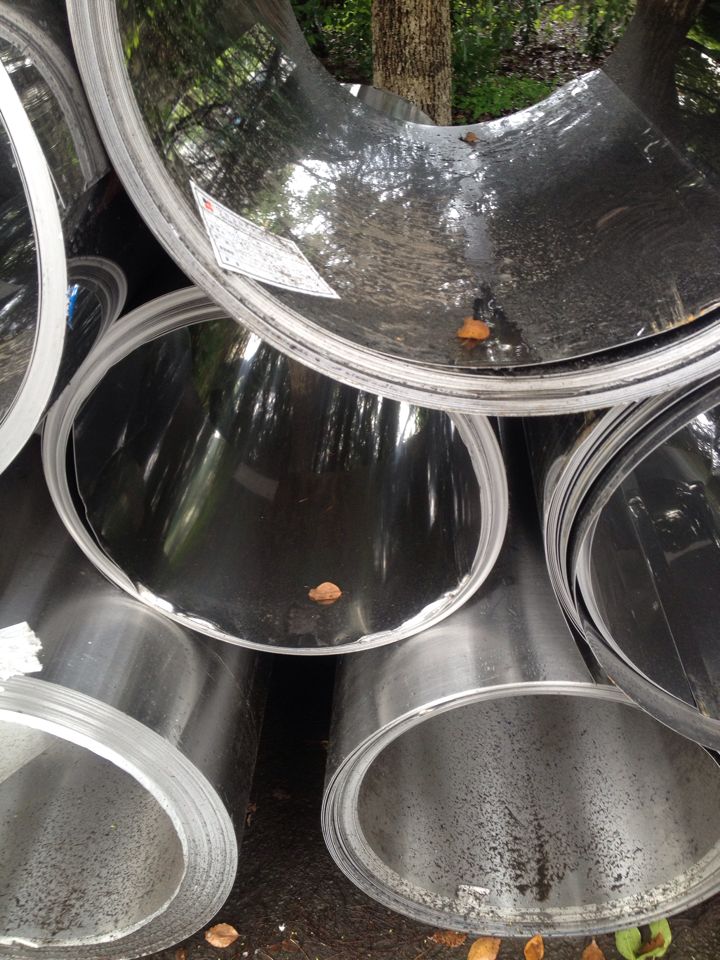
Stainless steel baby coil is a narrow, thin-gauge coil supplied in grades 201, 304, 410 and 430, at a published thickness range of 0.1 mm to 1.2 mm, a width of approximately 600 mm, and a surface that is mainly BA (bright annealed) finish, accounting for around 70% of the specification. It is delivered in nude packing.
What makes the format relevant to green energy and new materials manufacturing is less the steel itself than the point at which it enters production. Baby coil feeds tube and pipe manufacturing, kitchenware and cookware lines, home appliance fabrication, automotive component production, industrial equipment, metal stamping and deep drawing, tableware production and hardware accessories. These are forming-intensive processes in which strip width, gauge consistency and surface condition are set by the tooling, including slitting machines, tube mills and stamping equipment, rather than by buyer preference.
This article maps the verified specification to those scenarios: which grade suits which forming route, why a width of approximately 600 mm and a gauge band of 0.1 mm to 1.2 mm behave the way they do on precision lines, and where the format stops being the right answer. It does not argue that any single grade is universally correct.
The commercial backdrop is a growing material category. Grand View Research values the global stainless steel market at USD 135.8 billion in 2025 and projects USD 247.4 billion by 2033. Research houses do not agree on the absolute figure: Dataintelo publishes USD 127.8 billion for 2025, and Custom Market Insights USD 134.3 billion. That spread is a reason to read market size as a directional signal rather than a precise planning number.
The procurement problem: narrow-format coil in a wide-format market
Most coil sourcing conversations default to 1240 mm mill-edge material, because that is what the bulk of published stainless steel sheet and coil data describes. A buyer who starts there and then tries to fit a narrow forming line, a tube mill or a cookware blanking press can spend weeks resolving a problem that was created by format mismatch rather than by material quality.
Three mismatches account for most of the friction.
- Line compatibility. A line dimensioned for narrow strip cannot simply be fed wide coil. Baby coil is defined at a width of approximately 600 mm, and adjacent formats in the same product family run wider: 201 J3/J2/J5 2B/BA is published at 550, 600, 620, 650, 690, 730, 810 and 830 mm in one specification and at 1240 mm mill edge in another; 304 Wider and 410 Wider BA are published at 1240 mm.
- Surface specification. BA is the dominant baby coil finish, but decorative surfaces such as NO.4, 8K, Gold 8K, Rose Gold 8K and Black 8K are published on the 201 J2 Finish product at 1240 mm width. Finish choice and coil width are therefore linked, not independent decisions.
- Documentation. A grade claim is only as strong as the mill test certificate that accompanies the coil, and the certificate names the issuing mill, the number and the applicable standard.
Packing belongs on the same list. Baby coil is supplied in nude packing, while wider variants in the same product family, such as 304 Wider and 410 Wider BA, use export package with paper interleaved. On long ocean transits or in humid destination climates, that difference is a handling and inspection decision rather than a detail.
What the baby coil specification actually contains
Baby coil is best understood as a fixed format with a variable grade. The geometry, surface and packing are stable; the alloy and the certificate change with the order.
| Attribute | Published specification |
|---|---|
| Grades | 201, 304, 410, 430 |
| Thickness | 0.1 mm to 1.2 mm; about 80% of supply falls between 0.3 mm and 0.6 mm |
| Width | Approximately 600 mm |
| Surface | Mainly BA (bright annealed) finish; around 70% BA |
| Packaging | Nude packing |
Two numbers inside that specification carry most of the procurement weight. The first is the gauge band. Roughly 80% of baby coil falls between 0.3 mm and 0.6 mm, which is the range where many tube, appliance and cookware forming operations work. The second is the width. Approximately 600 mm places the format between narrow slit strip and full 1240 mm mill-edge coil, which is why it is normally specified by lines that were built around narrow strip rather than by buyers who happen to want a lighter coil.
It also helps to see the format next to the products that surround it in the same supply catalogue. The table below uses published product data only.
| Product or format | Grades | Thickness | Width | Published notes |
|---|---|---|---|---|
| Baby coil | 201, 304, 410, 430 | 0.1 mm to 1.2 mm | Approximately 600 mm | Mainly BA finish (about 70%); nude packing |
| 201 J3/J2/J5 2B/BA, narrow spec | 201 | 0.1 mm to 2.0 mm | 550, 600, 620, 650, 690, 730, 810, 830 mm | MOQ 27 mt across 3 to 4 specifications; lead time 7 to 30 days or stock |
| 201 J3/J2/J5 2B/BA, wider spec | 201 | 0.25 mm to 3 mm | 1240 mm, mill edge | MOQ 7 to 10 mt per thickness; export package with paper interleaved |
| 201 J2 Finish | 201 J2 | NO.4: 0.28 to 1.45 mm; 8K: 0.28 to 1.95 mm; Gold or Rose Gold 8K: 0.28 to 1.15 mm | 1240 mm | NO.4, 8K, Gold 8K, Rose Gold 8K, Black 8K; MOQ 5 to 20 mt per thickness |
| 304 Narrow | 304 | 0.10 mm to 2.00 mm | 550, 600, 620, 650, 690, 730 mm | MOQ 8 to 9 mt depending on width; lead time 7 to 30 days or stock |
| 304 Wider | 304 | 0.3 mm to 3.0 mm | 1240 mm | MOQ 10 mt per thickness; export package with paper interleaved |
| 410 Narrow BA | 410 | 0.15 mm to 1.2 mm | 300 mm to 1010 mm | Export package; further processing PVC, paper or refinish; lead time 7 to 30 days or stock |
| 410 Wider BA | 410 | 0.25 mm to 1.5 mm | 1240 mm, mill edge | MOQ 20 mt per thickness; lead time 7 to 30 days or stock |
| Stainless steel circle | 201, 410, 430 | 0.3 mm to 2.0 mm | Blank format | MOQ 3 mt per thickness; lead time 25 to 45 days; export package with wooden case |
| Secondary stainless steel | 201, 304, 410, 430 | Narrow: 0.1 to 1.2 mm; wider: 0.25 to 1.5 mm | Narrow: approximately 600 mm; wider: 1000 to 1250 mm | Mainly BA finish; narrow secondary coils weigh approximately 200 kgs; PVC outside or paper interleaved |
Matching grades to production scenarios
All four baby coil grades are published as suitable for the same broad industry list, which includes kitchenware and cookware, home appliances, elevator decoration, construction and interior decoration, automotive components, industrial equipment, metal stamping and deep drawing, tube and pipe manufacturing, tableware production and hardware accessories. The grade list alone therefore does not narrow a decision. What narrows it is the forming route, the service environment of the finished part, and the documentation trail the buyer has to close.
Tube and pipe manufacturing
Tube mills form strip continuously through welding and sizing stations, so gauge consistency feeds directly into dimensional repeatability. Baby coil at approximately 600 mm width suits tube diameters that do not require wide strip, and it is listed with a tube mill among its matched equipment. Documented working conditions for this application family include high temperature and 24/7 continuous service alongside cyclic heating and cooling, both of which place weight on stable thickness tolerance rather than on a single nominal gauge figure.

Kitchenware, cookware and tableware
Food contact is a stated working condition for this application family, and the demand side is not limited to coil. Stainless steel circles in grades 201, 410 and 430 are published at 0.3 mm to 2.0 mm thickness with a minimum order quantity of 3 metric tons per thickness and a lead time of 25 to 45 days, packed in export package with wooden case. Coil-fed cookware lines that blank and then deep-draw from strip are the natural home of baby coil, while circle supply serves presses set up for pre-cut blanks. Both routes appear in the same industry lists, and buyers comparing them are usually comparing tooling, not metallurgy.
Home appliances
Appliance fabrication consumes narrow coil for liners, drums, covers and internal components. The documented special requirements for this application family are mirror finish, anti-rust performance and stable thickness tolerance, with operating modes that include intermittent daily operation as well as continuous service. The concentration of baby coil supply between 0.3 mm and 0.6 mm makes the format a practical candidate where components are formed from thin strip, but the finish requirement should be checked first: mirror finish is published on the 201 J2 Finish product at 1240 mm width, so an appliance part that needs a mirror surface may sit outside the baby coil format even though the gauge fits.
Automotive components and industrial equipment
410 stainless steel is published in two BA formats. 410 Narrow BA runs 0.15 mm to 1.2 mm in thickness and 300 mm to 1010 mm in width, with export package and further processing options covering PVC, paper and refinish. 410 Wider BA runs 0.25 mm to 1.5 mm at 1240 mm with mill edge, a minimum order quantity of 20 metric tons per thickness, and packaging that adds paper interleaving. Lead time for both variants is 7 to 30 days from stock. Of the two, 410 Narrow BA is geometrically closest to baby coil, and both list automotive components and industrial equipment among their industries. The comparison is a useful reminder that coil geometry and commercial terms travel together: the narrower format typically buys flexibility in width and processing, while the wider format buys scale.
Metal stamping, deep drawing and hardware accessories
Stamping and deep drawing appear in the industry list for every baby coil grade. The documented supporting equipment for this application family is a slitting machine, a tube mill and stamping equipment, which together describe the three operations a narrow-format coil has to survive: slitting to final width, forming to profile, and drawing or stamping into a finished part. Grade availability matters less here than the ability to hold a stable thickness tolerance across the run, because draw ratios and die clearances are set from the nominal gauge. 201 in the J3, J2 and J5 variants is published in a 2B/BA specification covering 0.1 mm to 2.0 mm at widths of 550, 600, 620, 650, 690, 730, 810 and 830 mm, with a minimum order quantity of 27 metric tons across three to four specifications; the wider variant of the same grade runs 0.25 mm to 3 mm at 1240 mm mill edge.
Matching finishes: BA, 2B, NO.4 and 8K
Finish selection is where baby coil specifications most often surprise buyers, because the finish menu and the narrow-width format do not fully overlap.
| Finish | Where it is published | Thickness | Width | Typical fit |
|---|---|---|---|---|
| BA (bright annealed) | Baby coil; secondary stainless steel | 0.1 mm to 1.2 mm (baby coil) | Approximately 600 mm | Clean forming surfaces, food contact applications, appliance components formed from thin strip |
| 2B | 201 J3/J2/J5 2B/BA | 0.1 mm to 2.0 mm in the narrow specification | 550 mm to 830 mm | General forming and stamping where a uniform matte surface is acceptable |
| NO.4 | 201 J2 Finish | 0.28 mm to 1.45 mm | 1240 mm | Brushed decorative surfaces |
| 8K mirror | 201 J2 Finish | 0.28 mm to 1.95 mm | 1240 mm | High-reflectivity decorative surfaces; reflectivity tiers in the market extend from 8K toward 12K |
| Gold, Rose Gold and Black 8K | 201 J2 Finish | 0.28 mm to 1.15 mm | 1240 mm | Colored decorative surfaces |
BA is the finish that defines the baby coil format, covering roughly 70% of the specification. Bright annealing leaves a clean, reflective surface, which is why the format is listed against food contact, outdoor construction and appliance scenarios. 8K is not a coating but a polishing result: the mirror finish is achieved through iterative polishing, and higher reflectivity tiers marketed as 12K represent the top of that scale. That distinction matters to buyers writing specifications, because it means the mirror grade of a given coil depends on a polishing process step rather than on the base alloy alone.
The practical rule for a buyer is to decide finish before geometry. If the part needs BA, the approximately 600 mm baby coil format is available. If it needs NO.4, 8K or a colored 8K surface, the published route runs through a 1240 mm wide product, and the downstream line has to be able to handle that width.
Where baby coil does not fit: boundaries and trade-offs
An honest comparison has to start with what the format cannot do. The table below sets baby coil against the wider and adjacent formats in the same supply family, using published specifications.
| Format | Width | Thickness | Finish | Where it stops working |
|---|---|---|---|---|
| Baby coil | Approximately 600 mm | 0.1 mm to 1.2 mm (80% at 0.3 to 0.6 mm) | Mainly BA | Parts requiring mirror, brushed or colored finishes, and parts wider than the line feed allows |
| Wide coil (304 Wider, 410 Wider BA, 201 wider specification) | 1240 mm, mill edge | 0.25 mm to 3 mm depending on grade | BA or 2B depending on product | Lines built for narrow feed; narrower widths require slitting, which adds a process step |
| Secondary stainless steel | Narrow approximately 600 mm; wider 1000 to 1250 mm | Narrow 0.1 to 1.2 mm; wider 0.25 to 1.5 mm | Mainly BA | Sold as a distinct product category with its own grade documentation; not interchangeable with baby coil on paperwork |
| Stainless steel circle | Blank format | 0.3 mm to 2.0 mm | Per product | Coil-fed lines cannot use blanks without a change of feed |
Six boundaries are worth naming explicitly.
- Width ceiling. At approximately 600 mm, baby coil cannot serve products dimensioned around 1240 mm mill-edge material, such as large appliance panels or wide architectural sheet.
- Finish menu. BA dominates the format. Decorative NO.4, 8K, Gold 8K, Rose Gold 8K and Black 8K surfaces are published on a 1240 mm wide product, so decoration and narrow width are not available in the same published specification.
- Packing. Baby coil ships in nude packing, whereas 304 Wider and 410 Wider BA use export package with paper interleaved. Buyers working with long transit times or high humidity should evaluate whether the packing standard matches their receiving and storage conditions.
- Gauge band. The range tops out at 1.2 mm. Structural components requiring 3 mm material sit outside the format, and heavier gauges are served by the wider variants of the 201 and 304 families.
- Documentation dependency. Because the format spans four grades with the same industry list, the certificate rather than the datasheet becomes the control point. Per-coil verification is a real workload, not a formality.
- Trade policy risk. EU anti-dumping duties on stainless steel cold-rolled flat products from China and Taiwan were maintained following a 2025 expiry review, with rates of 24.6% to 28.5% under Regulation 2025/1573. For EU-bound flat products, that is a landed-cost factor that sits outside the mill relationship.
Market trend signals for buyers in green energy and new materials
Green energy and new materials demand for stainless steel is usually discussed at the level of large capital equipment. The verified data available here supports a narrower and more defensible reading for narrow-format coil buyers.
Supply has expanded at the export end. China's stainless steel exports reached an all-time high of 5.04 million tonnes in 2024, an increase of 25.6% year on year, according to customs data reported by Mysteel. At the same time, China's stainless steel imports fell 9.3% in 2024 to 1.88 million tonnes, a decline attributed mainly to increased domestic production capacity. Read together, the two figures describe a market where availability of flat products is not the binding constraint; verification and fit are.
Upstream capacity is also consolidating around larger cold-rolling operations. Hongwang Group, a major global producer specializing in cold-rolled stainless steel, operates an Indonesia joint venture with 700,000 tonnes per year of cold-rolling capacity, according to Mysteel Global. The relevance for buyers is practical rather than promotional: Hongwang is the issuing mill for the 201 Finish Mill Test Certificate held against the 201 J2 Finish product referenced in this article, so upstream scale and downstream documentation are connected.
On the demand-policy side, the EU anti-dumping measures described above mean that the same coil can carry materially different landed economics depending on destination. For procurement teams serving both EU and non-EU markets, that argues for keeping grade and finish standardisation benefits separate from destination-specific cost calculations.
Verification: certificates, standards and what to check
Two mill test certificates are documented for products in this family. The 201 J2 Finish product is certified under the 201 Finish Mill Test Certificate issued by Zhaoqing Hongwang Metal Industrial Co., Ltd., certification number ZQ202512250046, under standard Q/ZQHW 2-2024, applicable to the global market. The 430 stainless steel coils and sheets are certified under the 430 Mill Test Certificate issued by JIANGSU YONGJIN METAL TECHNOLOGY CO., LTD., certification number JSPZ20260501804, under standard GB/T3280-2015, also valid globally.
Above the mill-level documents sit the international standards that general and pressure vessel applications reference for stainless plate, sheet and strip: ASTM A240 and ASME SA240. These are the standards buyers should expect a supplier to be able to map to when the end use carries a specification requirement, even where the supplied coil is certified under a mill standard such as Q/ZQHW 2-2024 or GB/T3280-2015.
Verification therefore has three layers: the coil-level mill test certificate with its number and issuing mill, the standard the certificate references, and the international standard the project specification cites. A certificate that does not name the grade, the standard or the issuing mill does not close any of them.
A buyer's selection sequence
- Fix the finish first. If the part needs BA, the approximately 600 mm baby coil format is in scope. If it needs NO.4, 8K or a colored surface, the published route runs through 1240 mm wide product.
- Check the line width. Confirm that the slitting machine, tube mill or stamping line is dimensioned for narrow strip before specifying the format.
- Work back from the service environment. Documented conditions for this application family include high temperature, food contact and outdoor construction, with operating modes from intermittent daily operation to 24/7 continuous service and cyclic heating and cooling.
- Confirm the gauge band. Baby coil runs 0.1 mm to 1.2 mm, with roughly 80% of supply between 0.3 mm and 0.6 mm. Requirements outside that band belong on a wider product.
- Match the grade to the certificate. Ask for the mill test certificate with its number, issuing mill and standard before the order is placed, not after.
- Check packing against the route. Baby coil is nude packed; wider variants add paper interleaving and export packaging.
- Check commercial terms separately. Minimum order quantities and lead times vary by format: for example, 27 metric tons across three to four specifications for narrow 201 2B/BA, 10 metric tons per thickness for 304 Wider, 20 metric tons per thickness for 410 Wider BA, and 3 metric tons per thickness with a 25 to 45 day lead time for circles.
Supply-side context
NINGBO SUNFIRE STAINLESS STEEL CO., LTD. is a Ningbo, China-based supplier established in 2013 that specializes in stainless steel and stainless steel products, with the company reporting particular strength in secondary and baby coil. The company exports 100% of its output, with main markets listed as Pakistan, India, Vietnam, Russia, Turkey, Indonesia, the UAE, Thailand, Malaysia and Bangladesh, and it operates its own stainless steel factory with world-advanced production lines. Annual production capacity is reported at 25,920 metric tons, with monthly export volume of up to 3,500 metric tons, and the cooperative factory covers an area of over 3 million square meters. Its location in the Ningbo Chamber of Commerce business district is supported by the port facilities of Ningbo.
For buyers evaluating narrow-format supply, those facts matter in one specific way: a port-adjacent supplier with an established export mix across South and Southeast Asia, the Middle East and Eurasia is set up to handle the documentation and packing discussions that narrow coil orders generate. A downloadable product brochure covering these formats is available here.
Future outlook
Three developments are likely to shape baby coil sourcing over the next planning cycle. First, precision strip demand should continue to track the manufacturing base rather than headline energy projects: tube, appliance, cookware and component production are the documented consumers, and their requirements are set by tooling and tolerance, not by policy cycles. Second, verification will increasingly decide supplier selection, because a format that spans four grades with an identical industry list can only be controlled through coil-level certificates and named standards. Third, market-size estimates will keep diverging across research houses, as the 2025 figures already show, so buyers should treat any single market number as one input among several rather than as a defensible forecast.
The practical conclusion for green energy and new materials sourcing is unglamorous. Match the finish before the geometry, match the grade to the service environment, and match the certificate to the coil. The approximately 600 mm, 0.1 mm to 1.2 mm, mainly BA baby coil format is well suited to precision-driven lines in tube, cookware, appliance, automotive and stamping production, and it is the wrong answer wherever a wider or more highly finished surface is required.
Frequently asked questions
What is a stainless steel baby coil?
A baby coil is a stainless steel coil available in grades 201, 304, 410 and 430, with a thickness range of 0.1 mm to 1.2 mm, a width of approximately 600 mm and a surface that is mainly BA (bright annealed) finish, accounting for around 70% of the specification. It is delivered in nude packing. The format sits between narrow slit strip and full-width mill-edge coil, and it is used by production lines configured for narrow strip, with slitting machines, tube mills and stamping equipment as the documented matched equipment.
Which thicknesses and widths are most common in baby coil supply?
The published range is 0.1 mm to 1.2 mm, with about 80% of supply falling between 0.3 mm and 0.6 mm, and a width of approximately 600 mm. Adjacent formats run wider: the narrow specification of 201 J3/J2/J5 2B/BA is published at 550, 600, 620, 650, 690, 730, 810 and 830 mm, its wider specification at 1240 mm mill edge, and both 304 Wider and 410 Wider BA at 1240 mm.
Why is BA finish the default for baby coil, and what is available instead?
BA, or bright annealed, is the dominant baby coil finish at around 70% of the specification; it leaves a clean, reflective surface that suits food contact, appliance and outdoor construction scenarios. Where a different surface is required, the published decorative options are NO.4, 8K, Gold 8K, Rose Gold 8K and Black 8K, all on the 201 J2 Finish product at 1240 mm width, with NO.4 covering 0.28 mm to 1.45 mm, 8K covering 0.28 mm to 1.95 mm and the colored 8K finishes covering 0.28 mm to 1.15 mm. Because those finishes sit on a wider coil, the finish choice can change the width a buyer has to plan for.
Which production scenarios consume baby coil?
The documented industry list spans tube and pipe manufacturing, kitchenware and cookware, home appliances, automotive components, industrial equipment, metal stamping and deep drawing, tableware production, hardware accessories, elevator decoration and construction and interior decoration. Working conditions recorded for this application family include high temperature, food contact and outdoor construction, with operating modes covering intermittent daily operation, 24/7 continuous service and cyclic heating and cooling.
How should a buyer decide between baby coil and a wider coil?
The decision rests on two checks: line width and finish. Baby coil is approximately 600 mm wide at 0.1 mm to 1.2 mm. Wider alternatives in the same family include 304 Wider at 1240 mm and 0.3 mm to 3.0 mm, 410 Wider BA at 1240 mm mill edge and 0.25 mm to 1.5 mm, and the wider 201 specification at 1240 mm mill edge and 0.25 mm to 3 mm. If the finished part requires a mirror, brushed or colored surface, the published products carrying those finishes are 1240 mm wide.
What documentation should accompany a baby coil order?
A coil-level mill test certificate that names the grade, the issuing mill, the certificate number and the applicable standard. Two documented examples are the 201 Finish Mill Test Certificate, number ZQ202512250046, issued by Zhaoqing Hongwang Metal Industrial Co., Ltd. under standard Q/ZQHW 2-2024, and the 430 Mill Test Certificate, number JSPZ20260501804, issued by JIANGSU YONGJIN METAL TECHNOLOGY CO., LTD. under standard GB/T3280-2015. International standards for stainless steel plate, sheet and strip include ASTM A240 and ASME SA240.
What are the limitations of the baby coil format?
Four boundaries matter. Width tops out at approximately 600 mm, so products dimensioned around 1240 mm mill-edge material fall outside the format. The finish menu is dominated by BA, with decorative finishes published on wider product. Thickness tops out at 1.2 mm, excluding heavier structural gauges. And baby coil ships in nude packing, while wider variants such as 304 Wider and 410 Wider BA use export package with paper interleaved, which is a relevant difference on long transit routes or in humid climates.