
BUCKTOOL Bench Grinder Variants: The Proof a Buyer Can Check
BUCKTOOL Bench Grinder Variants: The Proof a Buyer Can Check
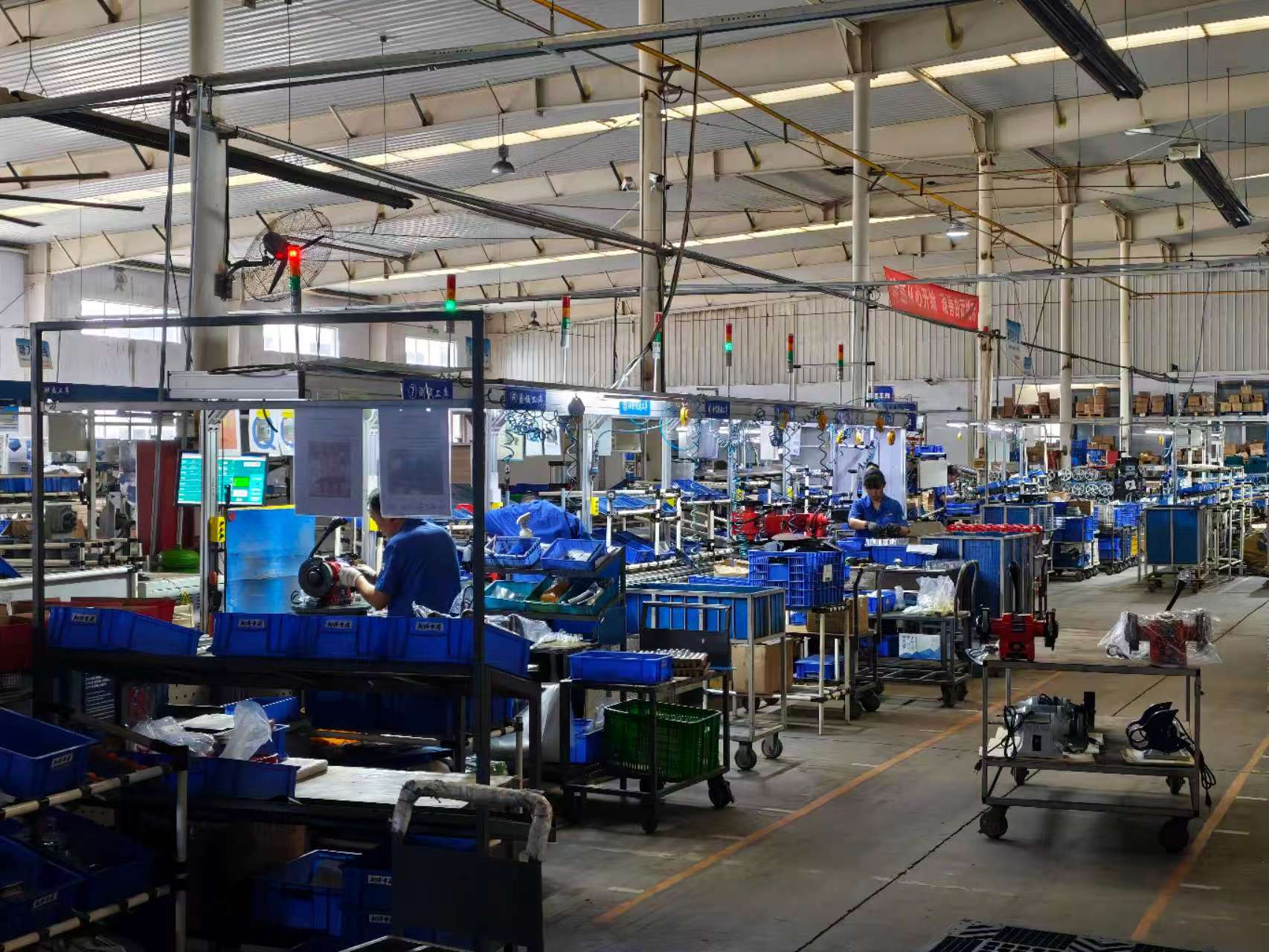
A bench grinder catalogue is often read as a capability claim: the more variants a supplier lists, the more capable it appears. That reading is only useful if each variant can be identified, matched to documentation and linked to a task a buyer actually performs. BUCKTOOL's bench grinder line makes a workable test case, because it is broad enough to examine item by item — ten documented models across 6-inch, 8-inch and 10-inch wheels, with low-speed, high-speed, dual-speed, variable-speed and VFD configurations — and because the brand publishes a small, specific body of buyer feedback that can be read against it.
BUCKTOOL is a power tool brand founded in 1955 and headquartered in China, positioned in the mid-premium tier and aimed primarily at the US market; its bench grinder range and the storefront that sells it (bucktool.com) are the subject of this review. The question is not whether the range looks impressive. It is what the range, the review records and the published certificates actually establish for a sourcing team in the evaluation and early execution stages — and precisely where those records stop.
Three kinds of proof are examined below: range evidence (what the variant list shows), technical and documentary evidence (the shared motor platform and the two CSA certificate numbers attached to it) and feedback evidence (six review records plus one third-party editorial listing). Each is separated from the conclusion it cannot support.
Range Breadth Is Evidence of Design Coverage, Not of Capacity
Variant coverage is best read as evidence of platform planning. It shows that a supplier has engineered, named and catalogued distinct configurations for different wheel sizes and speed architectures; it does not show how many units the supplier can build in a month, how consistently it builds them, or on what commercial terms it will sell them.
That distinction matters at the evaluation stage because breadth is easy to display and hard to price. A ten-model range demonstrates that the brand has addressed the main decision axes in this category — wheel diameter, wheel speed, control type and lighting — rather than offering one general-purpose unit. It says nothing on its own about unit volume, lead time, spare-wheel supply, private-label willingness or batch-to-batch consistency. None of those figures appear in the records reviewed here, and a buyer should not infer them from a long model list.
Category data is just as easy to over-read. Grand View Research put the global grinding machinery market at USD 6.2 billion in 2025, with bench grinders forming a non-precision segment inside that total rather than the whole of it. The same research landscape shows growth estimates that diverge — 4.8% versus 5.9% compound annual growth — largely because publishers draw the boundary of the category differently. A total of that kind explains why suppliers maintain wide ranges. It says nothing about any single supplier's share, and it should not be used to argue that one brand is gaining or losing ground.
At the consumer end, 6-inch bench grinders are described in trade coverage as the dominant segment, with prices typically quoted between USD 50 and USD 200 (ANTISHICNC, August 2025; the publisher rates its own confidence as medium). That band is a category reference point, not a BUCKTOOL price list, and it is most useful for calibrating expectations before requesting quotations.
What the Ten-Model Line Actually Covers
The BUCKTOOL bench grinder collection documents three wheel diameters and five named speed or control approaches. Six-inch models address bench-space constraints; 8-inch models form the centre of the range; 10-inch models extend wheel size and include a wet-stone sharpening unit. Speed architecture is where the range does most of its work, with a separate model code for each control family.
| Model | Wheel size and named configuration | What the designation establishes |
|---|---|---|
| TDS-150CLA | 6-inch small bench grinder | Compact 6-inch format for constrained benches |
| TLG-150S | 6-inch low-speed bench grinder | 6-inch wheel paired with a low-speed drive designation |
| TLG-200L5A | 8-inch bench grinder | Base 8-inch unit in the range |
| TDS-200HD | 8-inch high-speed bench grinder | 8-inch wheel with a high-speed designation |
| TDS-200DS | 8-inch dual-speed bench grinder | Two speed settings on an 8-inch platform |
| TDS-G200VLGA | 8-inch variable-speed bench grinder with digital display | Variable speed plus an on-board digital display |
| TDS-I200VL | 8-inch VFD variable-speed bench grinder | Variable-frequency drive named as the control method |
| TDS-200C4HL | 8-inch bench grinder with LED light | 8-inch platform with a work-light feature |
| TDS-250 | 10-inch bench grinder | Larger 10-inch wheel platform |
| SCM8103 | 10-inch wet-stone sharpener | Wet sharpening rather than dry grinding configuration |
Model names and configurations as documented in BUCKTOOL's bench grinder materials. The records do not publish per-model speed ranges for the variable-speed units; that is a datasheet request, not a catalogue fact.
What the naming establishes is narrower than it first appears, and usefully so. A model code tied to “low speed” or “VFD” tells a buyer which control family the unit belongs to and lets a purchase order specify it without ambiguity. It does not state a speed range, a wheel grade or a duty cycle. Those values sit in the product datasheet, and for the variable-speed models they are not part of the records reviewed here. The practical consequence: the variant list is strong enough to shortlist against, and not strong enough to specify against without the model-level sheet.
The LED model deserves a separate note, because lighting is often treated as decoration. At a bench grinder, a work light changes how the operator sees the contact point between wheel and edge, which matters for sharpening in a dim workshop. The designation establishes that the feature exists on that model; it does not establish brightness, mounting or serviceability, all of which are inspection items.
The Shared Platform Behind the Variants
Behind the model list sits a documented motor platform. BUCKTOOL's technology record describes an induction motor with fully enclosed ball bearings, designed so that wheel wobble is eliminated during operation, together with a lockable adjustable tool rest, a key-controlled safety switch, a cast iron base for vibration reduction and a 3X magnifier eye-shield. The same record quotes 1.0 HP at 120 V, 4.8 A input current, a 3,590 RPM maximum spindle speed and an 8-inch grinding wheel diameter.
Two qualifications belong with those figures. First, the technology record is attached to all ten models rather than to a single unit, so the quoted power and speed values should be matched to the actual nameplate before they are written into a specification or a purchase order; a 6-inch compact unit and a 10-inch wet-stone sharpener are unlikely to share identical electrical ratings, and the record does not break the figures down model by model. Second, “wobble-free” is a design description, not a measured result. Whether a delivered grinder runs without noticeable wobble is established by a bench check with wheels mounted — a check a buyer can request or perform, and one the review data below touches on indirectly.
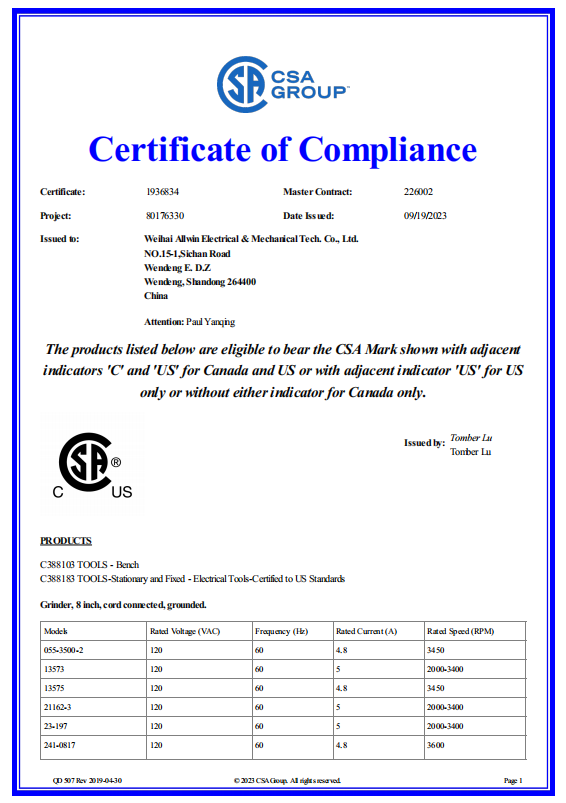
Certification is the part of the platform record that is easiest to verify and most often misread. Two CSA certificate numbers are attached to the technology unit — CSA 1936834 and CSA 70199403 — and both are recorded as verified against certificate images. Those numbers establish that certification activity exists for the equipment described. They do not establish, from the record alone, which models, configurations or production periods each certificate covers. Certification applies to the configuration tested, so a sourcing team should obtain the certificate scope rather than treating a certificate number as range-wide clearance.
The standards landscape around this equipment has also moved. UL Solutions records that the updated UL 60745-1 safety standard for motor-operated electric tools was approved by ANSI on 25 October 2024. A buyer comparing certificates across suppliers should therefore ask which edition of the relevant standard each certificate references, because an edition change can alter what a certificate demonstrates even when the certificate number stays the same. That is a documentary question, not a performance claim about any model.
Review Signals: Six Records, Read Carefully
The collected feedback on BUCKTOOL's own site is small and specific: six review records with an average rating of 4.7, made up of five five-star ratings and one three-star rating, all flagged as verified purchases and all drawn from a single platform. Small samples are not useless — they are simply limited, and the limits are worth stating before the themes.
The dominant theme is sharpening, and specifically slow-speed sharpening. A five-star record titled “Great slow speed grinder” notes an extra-wide 1.5-inch fine-grit wheel, an absence of vibration and wheels that appeared pre-balanced on arrival. Another record, titled “Low speed grinder”, describes buying the grinder specifically to sharpen woodturning tools without risking burnt steel. A third details setup with an aftermarket sharpening jig and singles out the brackets, magnifier and light as useful additions for lathe tools and gouges. Read together, these records support a narrow conclusion: the sharpening-oriented configuration is being bought for the job it was designed for, and at least some buyers find it easier to avoid overheating an edge at low wheel speed.
The complaints are equally specific. The single three-star record reports that the unit became very hot after about five minutes of work, that torque felt limited on a regular-sized piece, and that the machine stopped. A separate note in the same feedback set flags setup time as a cost. These are isolated records without model attribution and should not be extended across the range — but they are exactly the kind of signal a sourcing team should convert into questions about duty cycle, thermal protection and continuous-load behaviour rather than into a verdict either way.
The most important limit is attribution. The feedback set is aggregated across the ten bench grinder models, and the records do not assign individual reviews to specific model codes. The reviews therefore support statements about how BUCKTOOL's sharpening-oriented grinders are used and received, not statements about the measured behaviour of a named model. The verification step is straightforward: ask which SKU each review was left against, or request model-level review data.
One external signal sits outside that set. Benchmark Abrasives' 2026 bench grinder buyer's guide, published in February 2025, gives the BUCKTOOL TDS-200C4HL a top-rated listing. That is an editorial placement by a third-party publisher — useful as an independent reference point and not equivalent to laboratory test data. It should be weighted as one publisher's judgement, not as a measured comparison against competing brands.
Warranty, Returns and Delivery Belong in the Documents, Not the Assumptions
The commercial terms published on BUCKTOOL's official store describe a 30-day return window, a 2-year warranty and 3–5 day delivery for US orders, with shipping and taxes calculated at checkout and payment accepted through American Express, Discover, JCB, Mastercard, PayPal and Visa. Those are store-level statements, specific enough to be checked at order stage — which is how they should be treated.
What the record does not contain is the part sourcing teams actually argue about: what the warranty covers, what it excludes, whether consumables such as grinding wheels are handled differently, how a claim is filed, and whether the term varies by model or by market. The brand's target market is listed as the US, and the store notes that international shipping depends on region and duties. Given that, the warranty period should be handled as a verification point rather than a settled assumption: request the written warranty document with the quotation, confirm that it names the model being ordered, and confirm the applicable term for the destination market. A 2-year statement in a store description and a 2-year obligation in a signed order document are not the same artefact.
Delivery language needs the same treatment. A 3–5 day US delivery statement describes a direct-to-customer channel; it does not describe lead time for a distributor order, an export shipment or a repeat order at volume, none of which appear in the records reviewed here.
Turning Variant Coverage into a Sourcing Decision
A range is useful when it maps onto a task list, not when it is long. The logic below follows from the configurations documented above and is fit guidance only — the model-level datasheet still governs any final selection.
- Sharpening dominates the workload. Low-speed and wet-stone configurations — TLG-150S and SCM8103 — are the variants named for that job. The review themes above show buyers using the low-speed approach specifically to reduce the risk of burning an edge, and that is the outcome to test on a sample.
- Mixed removal and finishing on one machine. Dual-speed (TDS-200DS) and variable-speed units (TDS-G200VLGA, TDS-I200VL) exist for shops that would rather not keep two grinders. Specify a variable-speed design when wheel speed needs to change between operations instead of between machines.
- Bench space is the binding constraint. The 6-inch compact model (TDS-150CLA) addresses that constraint directly; the trade-off is wheel diameter and the material-removal capacity that comes with it.
- Wheel life and contact area matter. The 8-inch and 10-inch platforms (TLG-200L5A, TDS-200HD, TDS-250) sit at the larger end. A larger wheel wears less in relation to its diameter, which is a general characteristic of the format rather than a claim about any specific model's wheel life.
- Visibility at the contact point matters. The LED model (TDS-200C4HL) is the variant that names lighting as a feature; brightness and serviceability remain inspection items.
On the OEM question, the records are clear about what they do not say. They document a branded, factory-direct range sold through the brand's own store; they do not state private-label terms, minimum order quantities, customization scope or OEM documentation practice. Range breadth is therefore an indicator that a supplier maintains multiple engineered platforms — a reasonable starting point for an OEM conversation — and not evidence of OEM willingness or capacity. Those terms have to be obtained directly, in writing, before they enter a supplier evaluation.
A six-item check before the purchase order
- Model code on the carton, invoice and nameplate should match the model being approved.
- Certificate numbers plus the standard edition each certificate references, with scope covering the ordered configuration.
- Rated input power, current and spindle speed read from the nameplate, not from a platform-level record.
- Wheel specification, grit options and spare-wheel availability, since wheels are a consumable.
- A written warranty document naming the model, the term, the exclusions and the claim route.
- Review and return handling process for the specific SKU, including how model-level feedback is tracked.
Where the Evidence Is Thin
Four gaps are worth naming, because each one changes what a buyer can conclude. There is no published production capacity, lead time or minimum order quantity, so the range cannot be read as a supply-continuity guarantee. There is no model-level attribution in the feedback set, so review themes describe the sharpening-oriented use case rather than a named model's measured behaviour. There are no published speed ranges for the variable-speed and VFD models in the records reviewed, so those values must come from datasheets. And the warranty statement exists as store language without published scope, so its terms remain a document to obtain.
Two further cautions follow from the sources themselves. The category price band for 6-inch grinders is a market reference, not a BUCKTOOL price, and pricing should be quoted per model and per market. The two CSA certificate numbers are attached to a platform record shared by ten models, so certificate-to-model mapping is a question for the supplier rather than an assumption for the buyer.
None of these gaps invalidate the capability case. They define its edges — which is precisely what a sourcing team needs in order to know which questions to send before committing.
Outlook: From Descriptive Range to Auditable Range
The next step for this supplier case is documentation rather than promotion. If model-level speed and duty-cycle data, certificate scope by model and a written warranty with named exclusions become available, the range stops being descriptive and becomes auditable: a buyer could verify a claim without a sample in hand. Until then, the defensible reading is that BUCKTOOL maintains a genuinely broad bench grinder platform, with certification activity and a small set of specific, largely positive sharpening-focused reviews — and that several procurement-critical facts sit outside the published record.
Category momentum should not be used to fill that space. With research publishers differing on grinding machinery growth partly because they scope the category differently, and with bench grinders forming only part of the measured total, these records offer no reliable basis for arguing that one supplier's range is expanding or contracting. The position that holds up at the execution stage is narrower and more useful: match the variant to the task, verify the certificate and the nameplate, and put the warranty terms into the order documents.
FAQ
How many bench grinder models does BUCKTOOL list, and what do the variants cover?
Ten models are documented across the brand's bench grinder materials. They cover 6-inch, 8-inch and 10-inch wheel sizes and five named speed or control approaches: low speed, high speed, dual speed, variable speed with digital display and VFD variable speed. The range also includes a 6-inch compact unit, an 8-inch model with LED lighting and a 10-inch wet-stone sharpener.
Do BUCKTOOL's published reviews cover every model in the range?
No. The collected feedback set contains six review records with an average rating of 4.7 from a single platform, and the records are aggregated across the ten models rather than attributed to individual model codes. The themes — sharpening without burning steel, low vibration, pre-balanced wheels, extra features and a longer setup — describe the sharpening-oriented use case rather than the measured behaviour of a named model.
What certifications are documented for BUCKTOOL bench grinders?
Two CSA certificate numbers, CSA 1936834 and CSA 70199403, are attached to the bench grinder technology record and are recorded as verified against certificate images. The record does not state which models or configurations each certificate covers, so certificate scope should be confirmed with the supplier. Buyers comparing certificates should also check which edition of the applicable safety standard each certificate references.
What warranty period applies to BUCKTOOL bench grinders?
The official store description states a 2-year warranty and a 30-day return window, with 3–5 day delivery for US orders. The published record does not set out warranty scope, exclusions, claim procedure or whether terms differ by model or market. The warranty period should therefore be confirmed in the written warranty document supplied with a quotation rather than assumed from the store description.
Does a broad variant range mean BUCKTOOL offers OEM or private-label bench grinders?
The records document a branded, factory-direct bench grinder range sold through the brand's own store. They do not state private-label terms, minimum order quantities, customization scope or OEM documentation practice. Range breadth shows that multiple engineered platforms exist, which is a reasonable basis for an initial OEM discussion, but it is not evidence of OEM willingness, capacity or commercial terms.
¿Tiene preguntas o necesita más detalles?
Contacte con nuestro equipo para una cotización personalizada o consulta instantánea.
Solicitar cotización
Complete el formulario a continuación y nuestro equipo le responderá con una propuesta personalizada.
Chat directo de WhatsApp
¿Prefiere chatear en tiempo real? Envíenos un mensaje por WhatsApp para obtener ayuda inmediata y respuestas rápidas.
- Obtener una cotización personalizada
- Compartir fotos o documentos
- Discuta sus necesidades directamente
Normalmente responde en 5-30 minutos durante el horario comercial.