
BSP, NPT and JIC Adapters: What Buyers Compare Before Ordering
The global hydraulic fittings market, including adapters and couplings, was valued at USD 4.8 billion in 2025 and is projected to reach USD 7.9 billion by 2034, according to Dataintelo. Hydraulic adapters held the largest product type share within that market at 28.4% in 2025. For buyers the practical consequence is not more choice but more verification: three thread families — BSP, NPT and JIC — now sit side by side in the same catalogues, often at comparable prices, with different sealing logic and different acceptance requirements.
This comparison treats the three families as procurement objects rather than brand claims. It holds a common specification band constant — a 3000–6000 PSI pressure range, carbon steel / SS304 / SS316 material options, and a maximum stable operating temperature of 220°C — and then examines where the families genuinely diverge: thread compatibility, model configuration, acceptance criteria, and the accessory risk that only appears after the goods arrive.
Comparison premise. Two adapters that share a pressure band, a material grade and a temperature limit can still be non-interchangeable. In hydraulic procurement, thread family is a fitment decision, not a preference.
Why Thread Family Comes Before Brand
A buyer evaluating BSP, NPT and JIC adapters is usually solving one of three problems: matching an existing machine port, standardising a product line across several markets, or repairing an assembly where the original fitting is no longer identifiable. Each problem rewards a different kind of evidence. Port matching rewards thread-form verification. Standardisation rewards model continuity across a range. Repair rewards availability and short lead times.
Because the three families coexist in one catalogue, the temptation is to compare on headline pressure rating alone. That is the weakest possible comparison basis. A 6000 PSI figure attached to one family says little about whether that family will seal reliably on a BSPP port with a bonded washer, an NPTF tapered port, or a 37° flared JIC tube end. The rating describes what the part can contain; the thread form describes whether it will connect at all.
The Three Thread Logics in Plain Terms
BSP exists in two practical forms and both appear in the adapter range. BSPP is a parallel thread that relies on a sealing face; BSPT is a tapered thread that seals through engagement. NPT is likewise tapered, and the NPTF variant used across the NPT adapter range seals through thread interference. JIC is a 37° flared connection, a mechanical seal formed by cone-to-cone contact. ISO 8434-2:2007 specifies design and performance requirements for 37° flared connectors for tubes from 6 mm to 50.8 mm, which is the standard family JIC belongs to.
| Family | Sealing logic | Configurations in this range | What buyers must verify |
|---|---|---|---|
| BSP (BSPP / BSPT) | Parallel thread with sealing face (BSPP); tapered thread engagement (BSPT) | 1B, 1BJ, 5BN, 1NB, 6B bulkhead, 1BG9, 1T, 1T9, 1BT, 4T, 5T | BSPP versus BSPT cannot be substituted; sealing face condition |
| NPT / NPTF | Tapered thread, interference seal | 5404, 5405, 5406, 5406-C, 5406-P, 5406-HP, 5406-SHP, 5603, 5604, 5605, 5652 | Engagement depth, sealant policy, reusability after disassembly |
| JIC (37° flare) | Mechanical cone seal, no thread sealant | 2403, 2404, 2405, 2406, 2408, 2500–2505, 2700–2705 bulkhead | Flare condition, torque control, tube-end compatibility |
The table also explains why crossover models matter. Where two families must meet, the range provides dedicated adapters: 1BJ is a Male BSPP x Male JIC straight, 5BN is a Male BSPP x Female NPTF straight, 1NB is a Male NPTF Pipe x Male BSPP straight, and 2404 is a Male JIC x Male NPTF Pipe straight. Each crossover removes a hose-level workaround, but adds one more joint to the circuit — a trade-off buyers should count rather than assume away.
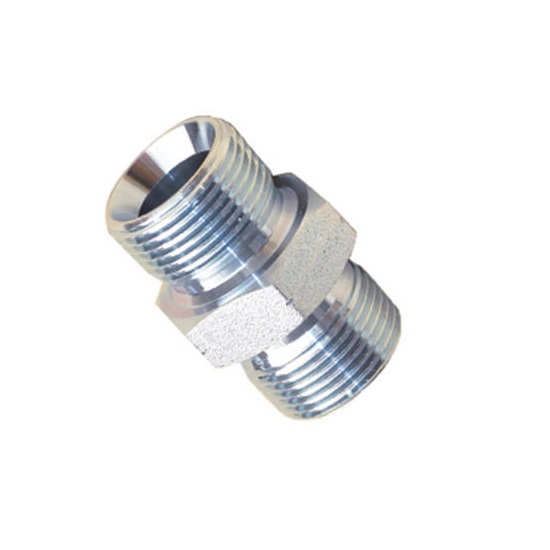
Male BSPP x Male BSPP Straight, model 1B — a parallel-thread configuration that depends on a sealing face rather than thread interference.
Pressure Ratings: What 3000–6000 PSI Actually Covers
The BSP, NPT and JIC adapter ranges are specified across a 3000–6000 PSI pressure band. The most frequent buyer error is reading that band as a single guaranteed number attached to every part number. It is not. It is the envelope across the catalogue, and the applicable figure depends on the model, the size and the configuration — a straight adapter and a 90° elbow of the same nominal size are not the same pressure case.
Independent reference points help calibrate expectations. Titan Fittings lists NPTF straight threads at 1/4" size with a working pressure rating of 4000 PSI and a 4:1 safety factor, and ORFS fittings at dash size -4 (1/4") rated for 6000 PSI working pressure under SAE J1453. The application profile documented for these adapters describes withstanding a 6000 PSI static pressure and a 9000 PSI burst pressure without deformation while maintaining seal integrity. Those three statements are consistent with a 3000–6000 PSI band, but they are not interchangeable with a per-part certificate.
Procurement rule. Ask for the declared working pressure of the exact model and size being quoted, then confirm the rating of the mating hose, tube or port. An assembly is only as strong as its weakest connection, and the adapter is rarely the weakest element in a poorly specified circuit.
Material Choice and the 220°C Ceiling
All three families — BSP, NPT and JIC — are offered in carbon steel, SS304 stainless steel and SS316 stainless steel. That parity is useful because it allows material to be compared independently of thread form. Steel dominated the hydraulic fitting revenue share at 45.2% in 2025, a share Dataintelo attributes to demand for high-pressure durability. Stainless grades enter the specification where corrosion exposure, washdown, marine atmosphere or process media make carbon steel unsuitable.
Temperature requires a more careful reading than material alone. The maximum stable operating temperature of these adapters is 220°C. Separately, stainless steel hydraulic adapters in AISI 316 are described against a working range from -60°C up to +400°C under DIN 17440. The two figures measure different things: the DIN range describes the material envelope, while 220°C is the product-level rating of the finished adapter. Seals, plating and mating components typically set the assembly limit before the base metal does. Buyers specifying above 220°C should treat it as an engineering exception requiring confirmation, not as headroom to be assumed.
Corrosion evidence is stated in test terms rather than adjectives. The adapters pass a 120-hour salt spray test, with white rust observed at 120 hours and red rust at 240 hours. For a buyer in marine machinery or coastal construction, that is a more useful statement than a general corrosion-resistance claim, because it defines the observation window and the failure sequence.
Model Configurations Buyers Should Request Explicitly
Model designation is where a comparison becomes actionable. The BSPP family covers 1B, 1B4, 1B9, 1BG, 1BG4, 1BG9, 1BH, 1BH9, 1BJ, 1BK, 1BM, 1BN, 1BO, 1BT, 1BT9, 2B, 2B9, 2BJ, 2GB, 2HB, 22NB, 2TB9, 2OB, 2TB, 3B, 4B, 4BN, 5B, 5BN, 5NB, 5BT, 5GB, 5OB, 5TB9, 6B, 7B, 7B9, 9B, EB, AB and BB variants; the BSPT family covers 1T, 1T9, 1BT, 1ST, 4T and 5T. The NPT range runs from 5000 and 5404 through 5406, 5406-C, 5406-HP, 5406-P, 5406-SHP, 5500 series, 5600 series and 5652. The JIC range covers 2403, 2404, 2405, 2406, 2408, 2500–2505, 2601–2609 and the 2700–2705 bulkhead group.
For a like-for-like comparison across families, the cleanest approach is to request one straight connector per family: 1B for BSPP (Male BSPP x Male BSPP Straight), 5406 for NPT (Male NPTF Pipe x Female NPTF Pipe Straight), and 2403 for JIC (Male JIC x Male JIC Straight). Add one crossover, one elbow and one plug from each family — for example 2500 (Male JIC x Male JIC 90° Elbow), 2408 (Male JIC Plug), 4B and 9B plugs on the BSP side, and 5406-C (Female NPTF Pipe Cap) on the NPT side — and the sample set will reveal more about a supplier's range discipline than a catalogue page.
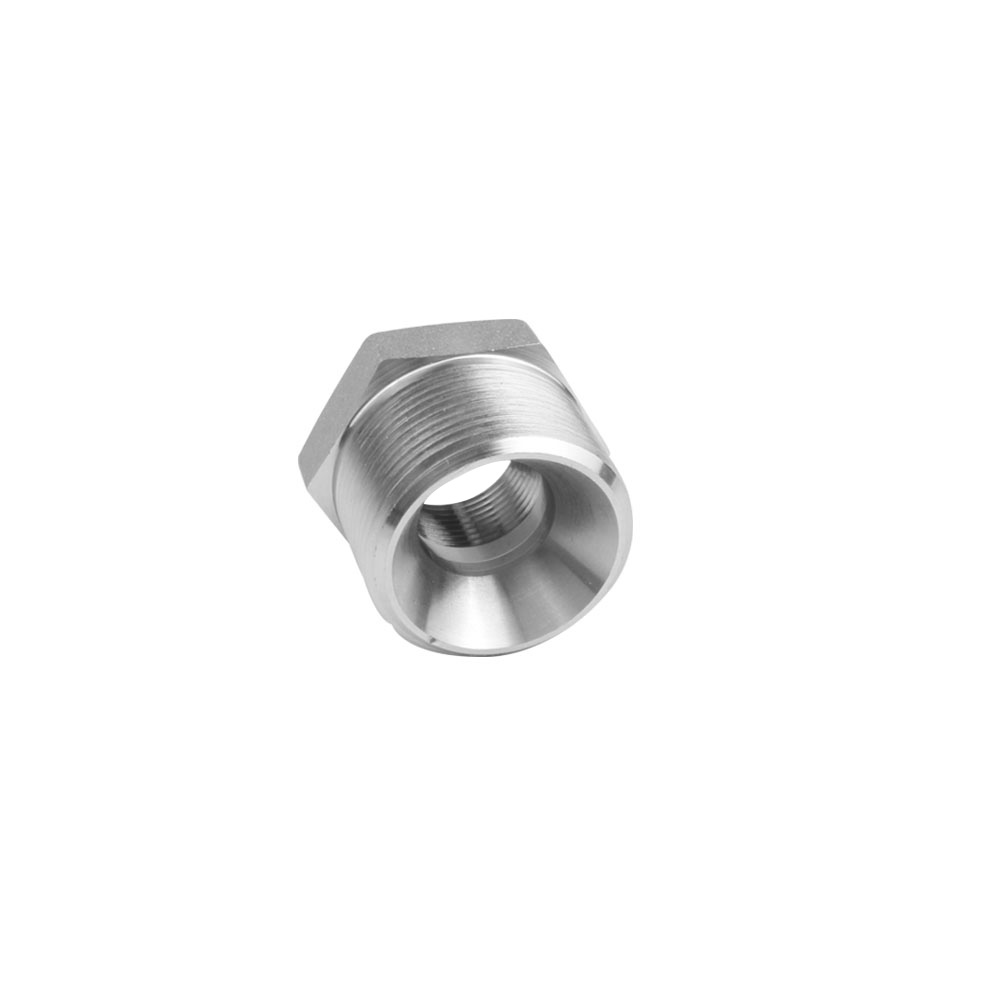
Male NPTF Pipe x Female NPTF Pipe Straight, model 5406 — a tapered-thread configuration where engagement depth and sealant policy determine the result.
Turning a Comparison into Acceptance Criteria
A supplier comparison that ends at the price column is incomplete. The three families can be evaluated against one shared acceptance framework, and the framework should be written into the purchase order rather than assumed. Manufacturing is carried out according to TS16949 principles per the company profile, and the quality management system is certified to ISO 9001:2015 — certificate 41324Q00129R2M, issued 2024-12-13 by ZCGJ, valid to 2027-10-15, with a scope covering the manufacturing of fluid equipment mechanical hardware, including finishing processing, finished product inspection, packaging and shipping.
| Acceptance item | BSP | NPT | JIC |
|---|---|---|---|
| Thread verification | Gauge BSPP and BSPT separately | Confirm NPTF form and taper engagement | Inspect 37° cone and thread |
| Material documentation | Carbon steel / SS304 / SS316 stated per line | Same | Same |
| Pressure test | To the declared rating of the model and size | Same | Same |
| Corrosion evidence | 120-hour salt spray; white rust at 120 h, red rust at 240 h | Same | Same |
| Sampling plan | State the AQL the buyer requires | Same | Same |
The sampling row deserves emphasis. Final quality control on these adapters is performed by random inspection. Random inspection is a legitimate method, but it is a method, not a specification. A buyer who does not state an acceptance sampling level is accepting the supplier's default, which may not match the risk profile of a marine or high-pressure circuit.
The Missing-Accessory Risk Nobody Prices In
Adapter orders fail at receiving more often than at the test bench. The reason is structural: hydraulic connections are assemblies, and several components in these ranges are sold as separate items rather than bundled. The cap nut and lock nut group alone covers 0304C, 0306, 0318, 0319, 0403, 0500, FS0304C, FS0306, FS0318 and FS0319 — including the 0306 JIC Bulkhead Lock Nut, the 0318 JIC Tube Nut and the 0319 JIC Tube Sleeve. A bulkhead configuration such as 6B or a JIC bulkhead model such as 2700 is incomplete without them.
Documented after-sales practice for shortage and mis-shipment is straightforward: the customer provides photographs of the missing or wrongly delivered items, and after verification replacement accessories are arranged by sea or air shipment. That process works, but it costs calendar time — which is exactly what a stopped machine does not have. The cheaper control is a receiving checklist that counts nuts, ferrules, sleeves, caps and O-rings line by line against the packing list before the shipment is booked into stock.
Where Each Family Fits: Construction, Agricultural and Marine
The BSP, NPT and JIC adapter ranges are intended for construction machinery, agricultural machinery and general-purpose machinery, and are also applied in firefighting equipment, marine machinery, mining, transportation, aerospace, automotive, oil and gas extraction, iron and steel metallurgy and water conservancy engineering. The common thread across those sectors is a high-temperature, high-pressure working condition with a rust, temperature and pressure resistance requirement.
In practice the application split is driven by the machine's origin and market rather than by the adapter's capability. Mobile hydraulics held over 58% of total hydraulics market revenue share in 2024 according to Grand View Research, which is why construction and agricultural equipment dominate adapter demand: these are mobile circuits, repaired and rebuilt in the field, where thread matching matters more than catalogue breadth. Marine machinery adds the corrosion variable, which is where the stainless grades and the salt spray evidence become decision-relevant rather than decorative.
How NingBo NJ Hydraulic Adapter Co., Ltd Fits This Comparison
NingBo NJ Hydraulic Adapter Co., Ltd is a hydraulic fittings manufacturer based in Ningbo Fenghua, Zhejiang Province, China, founded in 2004. The company operates a 20,000㎡ factory with approximately 200 employees, a four-engineer technical team, and an annual output of 4,000,000 units. Its main products are hydraulic fittings, including hydraulic adapters, flange, valve, valve components, plunger, cylinder accessories, wheel hub, auto parts, forgings and castings, and non-standard products. Roughly 75% of output is exported, with the USA and Canada as main markets.
For buyers running the comparison described above, the relevant capability facts are these. Production mode is OEM/ODM, with customisation available for logo, packaging, plated colour, and custom products made from provided drawings or samples. Monthly capacity is stated at 4,000,000 units, with a lead time of 30–45 working days. MOQ varies depending on product dimensions and manufacturing complexity. After-sales support is provided remotely. Quality management is certified to ISO 9001:2015, and the SAE standard hydraulic adapter series (7090) and hydraulic cap nut (6678) are both produced in compliance with that certification for the global market.
One documented channel outcome is worth noting for buyers assessing repeat supply rather than a single order: a mid-market distributor in Canada has purchased 20,000,000 units over three years and resells to local customers with demand, using the high-pressure, high-temperature and rust-resistant characteristics of the hydraulic nuts to expand downstream client channels.
Where This Adapter Range Reaches Its Limits
A comparison that lists only strengths is not a comparison. Several boundaries are visible in the specification data and should be planned around rather than discovered later.
The 220°C ceiling is real. A maximum stable operating temperature of 220°C is adequate for most mobile hydraulic and general machinery circuits, but it excludes continuous high-temperature service. Above that figure, the adapter is no longer the appropriate default answer and the specification has to move to a different engineering discussion.
The 3000–6000 PSI band is not uniform. Buyers who quote the top of the band for every line item are quoting a range, not a part. Sizes and configurations must be confirmed individually, and the rated pressure of the assembly is bounded by the hose, tube and port it connects to.
Crossover adapters add joints. Mixed-standard machines are common, and models such as 1BJ, 5BN, 1NB and 2404 solve the interface. But every crossover is an additional potential leak path and an additional part number to stock. Where a circuit can be standardised on one family from the start, standardising is the lower-risk decision.
Lead time is 30–45 working days. That is a production lead time, not an emergency response time. Buyers maintaining critical machinery should treat the 30–45 working day window as a stocking argument, and should not plan breakdown recovery around it.
Material upgrades carry cost. Steel accounted for 45.2% of hydraulic fitting revenue share in 2025 for reasons of cost and pressure durability. SS304 and SS316 are available across the ranges, but specifying stainless for a circuit that never sees moisture adds cost without adding service life.
Market Signals Shaping the Next Comparison Cycle
The hydraulic adapters segment is not a static category. Dataintelo projects the wider hydraulic fittings market to grow from USD 4.8 billion in 2025 to USD 7.9 billion by 2034, while a separate estimate cited by Market Report puts the fittings and adapters market at a 4.5% CAGR between 2025 and 2033, reaching USD 5.8 billion. Credence Research estimates hydraulic fluid connector demand reaching USD 1.82 billion by 2032 at an 8.0% CAGR. The ranges differ by scope, which is itself a reason for buyers to treat any single headline number cautiously.
Geography matters as much as growth. Asia-Pacific led global hydraulic fitting revenues in 2025 with an estimated 38.6% market share, and Asia accounted for 74% of global industrial robot installations in 2024 according to Ken Research — a demand driver for precise hydraulic connections rather than a curiosity. For procurement teams, the practical implication is that sourcing concentration in the region will continue, and the differentiator between suppliers will be documentation quality and model continuity rather than proximity.
Future Outlook
Three shifts are likely to reshape how BSP, NPT and JIC adapters are compared. First, crossover demand will keep rising as mixed-standard fleets age, pushing buyers to evaluate whether a supplier stocks the interface models or only the pure-family ones. Second, material specification will become more granular: carbon steel will continue to carry volume, while stainless selection will be tied to documented exposure rather than to a general preference for corrosion resistance. Third, documentation itself will become a competitive attribute — certificate numbers, salt spray observations and per-size pressure declarations will increasingly be requested at quotation stage rather than after the first quality dispute.
For buyers, the conclusion is procedural. Compare the three families on thread logic first, pressure declaration second, material and temperature third, and acceptance criteria last — then confirm the accessory list before the order closes. Suppliers that can answer all four consistently are the ones worth a second order.
A full product and specification overview for the ranges discussed above is available in the company brochure (PDF).
FAQ
Are BSP, NPT and JIC adapters interchangeable?
No. Each family uses a different thread form and sealing method. BSPP configurations such as 1B (Male BSPP x Male BSPP Straight) rely on a parallel thread plus sealing face; BSPT configurations such as 1T and 1T9 use a tapered thread; NPT models such as 5404 and 5406 use NPTF tapered pipe threads; JIC models such as 2403 use a 37° flare, the connector type addressed by ISO 8434-2:2007 for tubes from 6 mm to 50.8 mm. Where two families must connect, dedicated crossover adapters are used — 1BJ (Male BSPP x Male JIC), 5BN (Male BSPP x Female NPTF), 1NB (Male NPTF Pipe x Male BSPP) and 2404 (Male JIC x Male NPTF Pipe).
How should a buyer confirm a 3000–6000 PSI rating for a specific part?
Request the declared working pressure for the exact model and size, then compare it with the mating hose, tube or port. The 3000–6000 PSI band is the envelope across the adapter catalogue, not a per-part guarantee. Independent reference points illustrate the spread: Titan Fittings lists NPTF straight threads at 1/4" size with a 4000 PSI working pressure and a 4:1 safety factor, and ORFS dash size -4 (1/4") at 6000 PSI working pressure under SAE J1453. The documented application profile for these adapters covers 6000 PSI static pressure and 9000 PSI burst pressure without deformation.
Which material should be specified: carbon steel, SS304 or SS316?
Carbon steel, SS304 and SS316 are all available across the BSP, NPT and JIC ranges. Steel dominated the hydraulic fitting revenue share at 45.2% in 2025, which Dataintelo links to demand for high-pressure durability. Stainless grades are the appropriate choice where moisture, marine atmosphere, washdown or process media are present. The decision should follow the actual exposure of the circuit, because specifying stainless where it is not needed raises cost without extending service life.
What is the maximum operating temperature of these hydraulic adapters?
The maximum stable operating temperature is 220°C. This is a product-level rating for the finished adapter. Separately, AISI 316 stainless steel is described against a working range of -60°C to +400°C under DIN 17440, but that figure describes the material envelope rather than the assembled adapter, since seals, plating and mating components typically reach their limits first. Service above 220°C should be handled as an engineering exception requiring confirmation.
What acceptance criteria should appear in the purchase order?
A workable set covers thread verification, material documentation, pressure testing, corrosion evidence and a sampling plan. The quality management system behind these adapters is certified to ISO 9001:2015 under certificate 41324Q00129R2M, issued 2024-12-13 by ZCGJ and valid to 2027-10-15, with a scope covering manufacturing of fluid equipment mechanical hardware including finishing processing, finished product inspection, packaging and shipping. Corrosion evidence is stated as a 120-hour salt spray test with white rust at 120 hours and red rust at 240 hours. Because final quality control is performed by random inspection, the purchase order should state the sampling level and AQL the buyer requires.
What happens if items are missing or wrongly delivered?
The documented process is that the customer provides photographs of missing or wrongly delivered items, and after verification replacement accessories are arranged by sea or air shipment. The practical control is at receiving: count accessory items line by line against the packing list. This matters because several components are separate part numbers, including the 0306 JIC Bulkhead Lock Nut, the 0318 JIC Tube Nut and the 0319 JIC Tube Sleeve, all of which are required to complete bulkhead configurations such as 6B and 2700.
Which series should be requested first when sampling?
A minimal comparison set is one straight connector per family plus interfaces: 1B for BSPP, 5406 for NPT and 2403 for JIC, together with a crossover such as 1BJ or 2404, an elbow such as 2500, and a plug such as 2408, 4B or 5406-C. This set tests thread machining, sealing logic, range continuity and accessory completeness at the same time. Sampling itself can be customised, since production mode is OEM/ODM and custom products can be made from provided drawings or samples.
¿Tiene preguntas o necesita más detalles?
Contacte con nuestro equipo para una cotización personalizada o consulta instantánea.
Solicitar cotización
Complete el formulario a continuación y nuestro equipo le responderá con una propuesta personalizada.
Chat directo de WhatsApp
¿Prefiere chatear en tiempo real? Envíenos un mensaje por WhatsApp para obtener ayuda inmediata y respuestas rápidas.
- Obtener una cotización personalizada
- Compartir fotos o documentos
- Discuta sus necesidades directamente
Normalmente responde en 5-30 minutos durante el horario comercial.