
BQ1703XLP-W vs BQ1601-4S: Buyer's Electric Grill Comparison
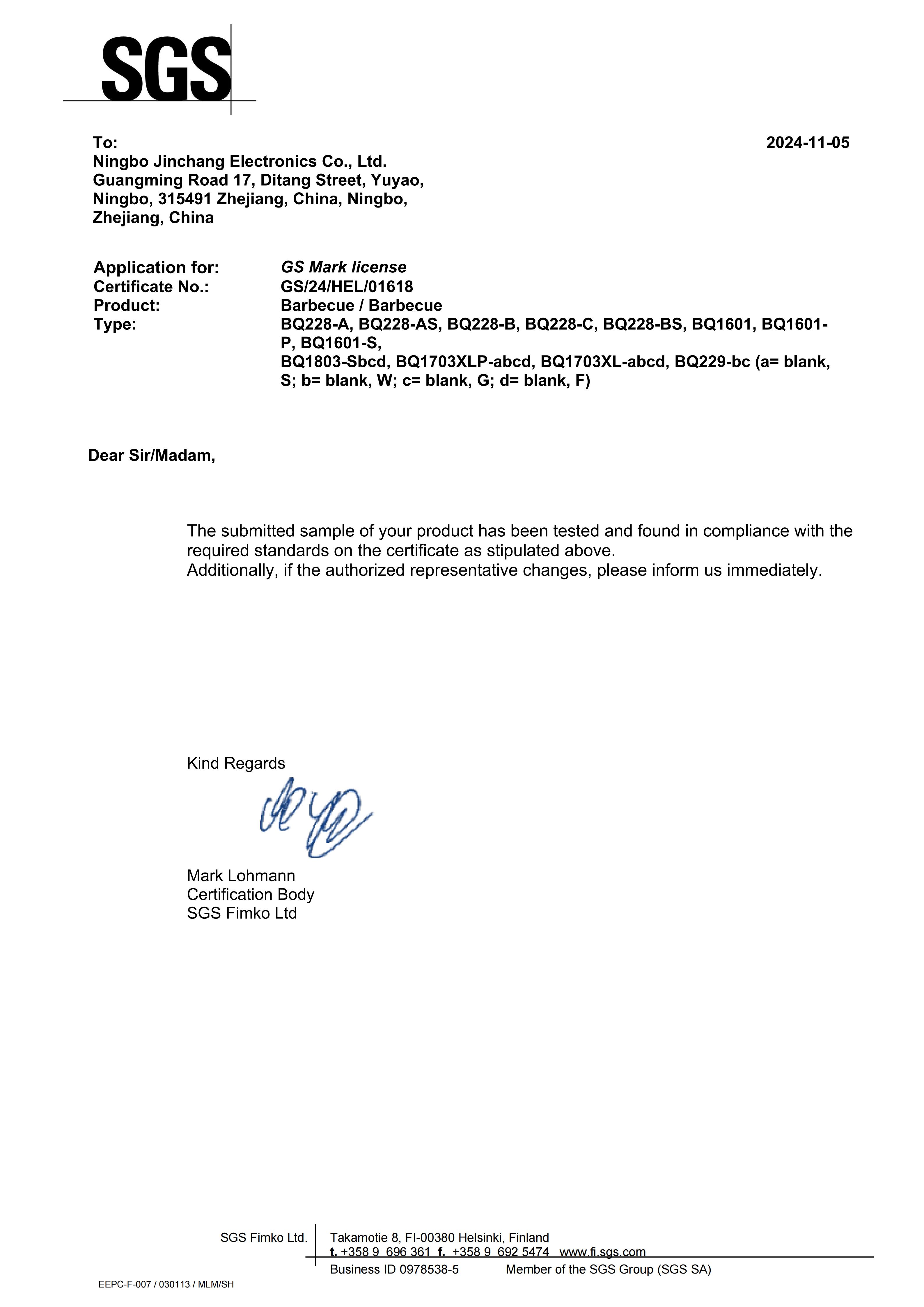
GS Mark licence GS/24/HEL/01618, issued by SGS Fimko Ltd on 5 November 2024 and valid to 5 November 2026. The scope lists BQ1601, BQ1601-P, BQ1601-S and the BQ1703XLP variants.
Electric grills are bought in two physical formats that compete for the same household budget: a countertop unit that stores in a kitchen cabinet, and a stand unit that lives on a balcony, patio or in a garden. Grand View Research valued the global electric grill market at USD 4.6 billion in 2023, with North America accounting for a 34.5% revenue share that year. A category of that size rarely asks retailers to choose one format over the other; it asks them to choose a mix.
The comparison below sets the BQ1703XLP-W non-stick countertop electric barbecue against the BQ1601-4S smokeless stand electric grill. Both are produced by Ningbo Jinchang Electronics Co., Ltd., a manufacturer of Western-style small kitchen appliances based in Yuyao City, Zhejiang Province, China. The company operates a 5,500 m² production plant, reports annual output of 1,200,000 units and an R&D team of 8 engineers, and exports roughly 90% of production to the EU, USA, AU and RU markets.
The purpose is not to declare a winner. It is to make the trade-offs explicit enough that a household buyer, a retail category manager or an OEM project owner can match the right format to the right job, and can verify the specification and certification claims that arrive with each.
Why a tabletop grill and a stand grill end up on the same shortlist
The two formats overlap because household cooking behaviour overlaps. A family that grills meat, skewers, vegetables and sausages at the weekend may also want a compact unit for weekday indoor cooking. The manufacturer positions both models inside that logic: the countertop unit is listed for household small appliances and indoor and outdoor cooking equipment, while the stand unit is listed for patio, balcony and backyard barbecue, indoor home gatherings, retail sales and OEM private-label projects.
For a buyer, the decision is therefore usually about assortment and use-case coverage rather than about raw performance. A stand grill signals occasion cooking. A tabletop grill signals frequent, low-friction cooking. A retail programme carrying only one of them leaves a visible gap at either the entry end or the occasion end of the shelf.
There is also a substitution effect worth noting. Where a household has limited storage, the countertop unit often replaces the stand unit rather than joining it, because it fits a cabinet and needs no seasonal disassembly. Where outdoor space exists and entertaining is the dominant use case, the reverse happens. Understanding which of these two buyers a market skews towards is more useful for range planning than comparing wattage in isolation.
The two models, defined
BQ1703XLP-W is a non-stick countertop electric barbecue. It is a 1700 W table grill rated at 220–240 V with adjustable temperature control, a die-cast aluminium non-stick cooking plate with a ribbed surface, elongated drainage slots, recessed carry handles and a working indicator light. Its declared certifications are CE, GS, RoHS and LFGB.
BQ1601-4S is a smokeless stand electric grill. It is a 2000 W stand-format grill with a PP housing and a wire rack cooking surface, intended for patio, balcony and backyard barbecue and for indoor home gatherings, and offered for retail sales and OEM private-label projects. Its declared certifications are CE, LFGB, RoHS and GS.
| Base specification | BQ1703XLP-W | BQ1601-4S |
|---|---|---|
| Product type | Table BBQ grill | Stand BBQ grill |
| Power | 1700 W | 2000 W |
| Voltage | 220–240 V | Not stated in the reviewed product record — confirm on the rating label |
| Cooking surface | Die-cast aluminium non-stick plate, ribbed | Wire rack |
| Housing material | PP | PP |
| Temperature control | Adjustable | Not stated in the reviewed product record |
| Declared certifications | CE, GS, RoHS, LFGB | CE, LFGB, RoHS, GS |
Footprint, setup and storage
The BQ1703XLP-W is a table unit, so setup means finding a stable, heat-tolerant counter surface and plugging in. The recessed carry handles are set into the body rather than standing proud of it, which matters in a domestic kitchen where the unit is lifted in and out of a cabinet several times a week. When the cook is finished, the appliance leaves the counter and the space returns to other uses.
The BQ1601-4S is a stand unit. It frees counter space but requires floor or ground area on a balcony, patio or in a garden, plus a place to store it when the season turns. Stand formats generally involve more assembly steps at first use and more handling at the start and end of a season, which is a real cost in markets where apartment living is the norm.
Neither product record in the reviewed file states unit dimensions, weight, cable length or carton size. At this comparison level those numbers matter more than the descriptive copy, because they decide whether the unit fits a standard counter run, whether a retail carton meets a shelf-ready planogram, and what a container load actually costs. Buyers should request a dimension drawing and a carton specification before fixing an order quantity.
One practical consequence: a tabletop model can be shipped and merchandised as a single carton with a photographic panel, while a stand model usually asks for either a larger carton or a knock-down arrangement with clearer assembly instructions in the box. That difference shows up in returns rates and in customer-service load long before it shows up in gross margin.
Cooking surface: die-cast non-stick plate versus wire rack
The BQ1703XLP-W uses a die-cast aluminium non-stick cooking plate with a ribbed surface. The plate is a continuous surface, so food sits in contact with metal across its whole base, and the ribbing creates contact lines plus shallow channels between them. Juices stay on the plate rather than dropping away, which suits foods that are finished in their own fat and suits cooks who want to glaze or sauce during cooking without losing it through the grate.
The BQ1601-4S uses a wire rack. An open rack lets drips fall away from the element and gives a different browning profile, closer to what people recognise from charcoal and gas grilling. Skewers, sausages and larger pieces sit naturally on a rack; small or loosely bound items need more attention because the surface is open by design.
Neither surface is universally better. The plate rewards frequent, controlled indoor cooking and is easier to wipe down between uses. The rack rewards volume cooking and the visual language of outdoor barbecue. For a retailer, the choice shapes the recipe content, the photography and the customer expectation that come with the product, which is why it is worth deciding deliberately rather than treating the surface as a detail.
Grease handling and cleaning: what the design details actually do
On the BQ1703XLP-W, two features address the messiest part of ownership. Elongated drainage slots channel run-off away from the cooking surface rather than letting it pool under the food, and the recessed carry handles let the whole unit be lifted to the sink without a protruding grip catching on a cabinet edge or a door frame. The non-stick coating reduces sticking, but it also imposes a cleaning rule: abrasive pads and aggressive degreasers shorten the working life of the plate, so the care instruction that ships in the box is part of the product, not an afterthought.
The BQ1601-4S follows the BQ1601 platform, which the manufacturer catalogues as an electric grill with removable plate and specifies with a detachable protection feature; the BQ1601-4S variant itself is specified with a wire rack cooking surface. The practical difference is that the surface and the collection area separate from the housing, so cleaning is a disassembly task rather than a wipe-down task. That is better for a heavy cook and worse for someone who wants the appliance clean in ninety seconds.
Three questions resolve most of the cleaning uncertainty before an order is placed. Which parts are removable by the user without tools? Are those parts rated for a dishwasher? And what coating-care instruction is included in the printed manual for the destination market? The reviewed product data does not state dishwasher suitability for either model, and it is a common assumption that should be confirmed in writing rather than inferred from the category.
Status and safety signalling: documented versus assumed
The BQ1703XLP-W product data lists a working indicator light. That is a status feature, not a safety feature: it tells the user the element is energised, which matters on a unit that can be switched on and then covered by a lid, a tray or a stack of plates.
The reviewed product record does not list a safety micro switch as a standard feature on either model. Where a retail programme's technical file or the buyer's own specification requires one, it should be written in as a line item, shown on the wiring diagram and covered by the safety test documentation for the delivered configuration. Category convention is not evidence. The switch either appears in the specification or it does not, and a supplier conversation that ends with 'standard' is not the same as a specification line that can be inspected at incoming goods.
For a stand grill the question carries more weight, because the unit may be left assembled outdoors between uses and because the cooking surface sits at a different height from a countertop appliance. Buyers evaluating the two formats side by side should treat switchgear as a scored criterion rather than a footnote, and should ask for the same evidence whether the answer is yes or no.
Electrical rating and certification: what to verify, line by line
Both models declare CE, GS, RoHS and LFGB in their product records. Declarations are the starting point; the documents behind them are the evidence, and they carry dates, numbers and scope limits that a buyer can check.
The strongest single document in the reviewed file is GS Mark licence GS/24/HEL/01618, issued by SGS Fimko Ltd on 5 November 2024 against GS-Mark safety requirements for the German and EU market. Its scope lists BQ1601, BQ1601-P, BQ1601-S and the BQ1703XLP variants, and the manufacturer's compliance file links both models under review to this licence. The licence runs to 5 November 2026. A programme placed for 2027 delivery should therefore include the renewal certificate in the order file rather than an archived copy of the current one.
Supporting documents in the same file follow their own renewal cycles. A RoHS verification report, NGBEC24007628901_1, was issued by SGS and runs to 30 December 2027. An Ecodesign (ErP) test report, NBEE241200121951, was issued by SGS against EEC (EU) No 2023/826 and runs to 29 October 2027, with a scope that includes the BQ1601 and BQ1703XLP families. A general test report, NGBEC25007613101, from SGS runs to 24 November 2027, and an EU POPs verification report, NGBEC26000921401, runs to 16 March 2028. Because these dates do not coincide, a supplier file that looks complete in one quarter can be partly out of date in the next; checking each expiry against the delivery window is a five-minute task that prevents a port-side dispute.
On the standard itself, IEC 60335-2-9 is the international safety standard specific to portable electric cooking appliances including grills and roasters. A test report that cites it is a meaningful check, particularly when the buyer's own market requires a national deviation on top.
Two electrical points deserve attention. The BQ1703XLP-W is declared at 1700 W and 220–240 V. The BQ1601-4S is declared at 2000 W in the reviewed product record. Where a catalogue, quotation or specification sheet quotes the stand model as a 2000–2400 W band, or extends a 220–240 V figure across the range, treat that as a configuration envelope rather than as a single declared rating. The rating label on the delivered unit, the certificate scope and the commercial invoice should agree; a mismatch between a catalogue band and a label is one of the most common causes of a failed incoming-goods check.
Food-contact compliance deserves the same treatment. LFGB is declared for both models, and the file also contains an FDA 21 CFR 177.1550 total extractives test report for aluminium grill plates prepared by Eurofins (EFHZ24081596-CG-01). That is the type of document a buyer should request matched to the specific plate finish used in the production run, because food-contact compliance attaches to the surface that touches food, not to the model number in general.
For importers, HS code 851660 covers other ovens, cookers, cooking plates, boiling rings, grillers and roasters for domestic use, and is the classification to plan duty and documentation around.
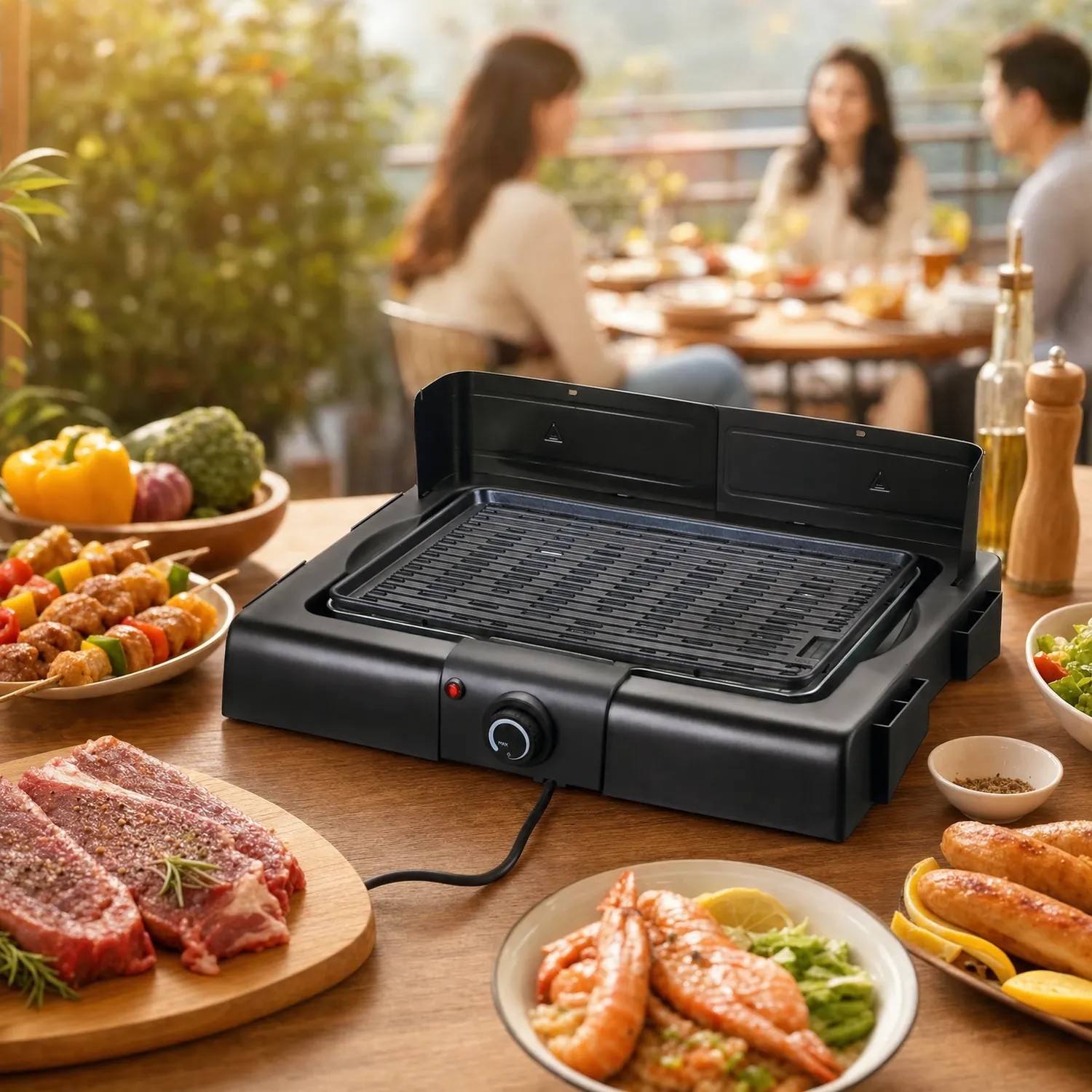
BQ1703XLP-W: a 1700 W countertop unit with a die-cast aluminium non-stick plate, elongated drainage slots, recessed carry handles and a working indicator light.
Side-by-side comparison for procurement
| Criterion | BQ1703XLP-W | BQ1601-4S |
|---|---|---|
| Primary use case | Indoor and outdoor household cooking, countertop | Patio, balcony, backyard and indoor gatherings |
| Setup burden | Place on counter and plug in | Assemble stand, allocate floor space |
| Grease management | Elongated drainage slots, recessed carry handles | Wire rack on the BQ1601 platform; platform data lists a removable plate and detachable protection |
| Status feature | Working indicator light | Not stated in the reviewed product record |
| Safety micro switch | Not stated — specify if required | Not stated — specify if required |
| Certification evidence | GS licence GS/24/HEL/01618; RoHS, ErP, test report and POPs documents in file | Same licence scope family; RoHS, ErP, test report and POPs documents in file |
| OEM / private label | Available under the manufacturer's OEM/ODM programme | Explicitly listed for OEM private-label projects |
| Open data gaps | Dimensions, weight, carton size | Dimensions, weight, carton size, declared voltage, temperature control |
Where each model has limits
A comparison without drawbacks is advertising, so the boundaries deserve equal space.
BQ1703XLP-W. At 1700 W it sits below the 2000 W declared for the stand model, which matters to a buyer trying to standardise a range on a single power platform or a single heating-element supply chain. The non-stick plate is the core of the product and also its most care-dependent part; abrasive cleaning shortens plate life, and a replacement plate is a spare part that must exist in the after-sales plan. The unit occupies working counter space while in use, and the reviewed data lists no side tables or accessories.
BQ1601-4S. The stand format needs floor space and seasonal storage volume, which is a genuine constraint in apartments. An open wire rack demands more attention with small or loosely bound food. The word 'smokeless' appears in the model name as a product descriptor; if smoke performance is going to be used as a retail claim, the buyer should ask for the test documentation that supports the exact wording rather than repeating the model name as a performance statement.
Both. The reviewed records do not state dimensions, weight, cable length, carton size or dishwasher suitability. None of these gaps affects the quality of the products, but each one affects a landed-cost calculation, a planogram or a customer-service script, and all of them should be closed before a purchase order is signed.
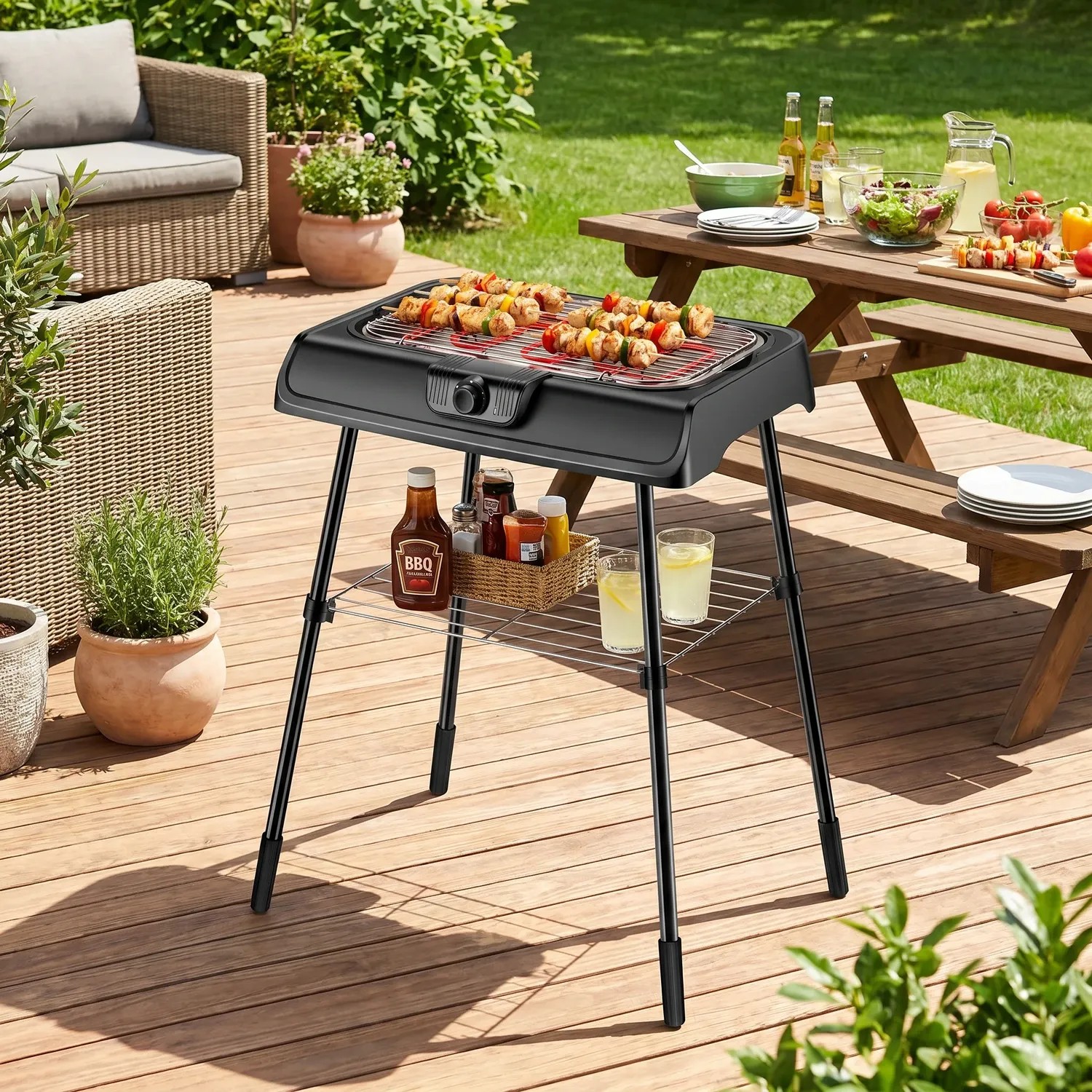
BQ1601-4S: a 2000 W stand-format grill with a PP housing and a wire rack cooking surface, positioned for patio, balcony, backyard and indoor gathering use.
Sourcing and channel fit
Behind the two models sits a supply platform that a buyer should evaluate alongside the products. The manufacturer reports monthly capacity of 100,000 units, a minimum order quantity of 5,000 units, a 30-day lead time, 100% test quality control and a one-year warranty. Customisation under the OEM/ODM programme covers logo, voltage and product design and development, and the company lists more than 200 product models across electric BBQ grills, smokeless electric grills, electric steamers and food dehydrators.
Management-system evidence is also on file: ISO 9001 certification NOA2409732 covering production and sales of barbecue grills, and ISO 14001 certification NOA2507153 covering production and export. Social-compliance documentation follows separate cycles and should be read the same way as the product certificates. An ICS audit summary of content from SGS runs to 5 June 2027, while the amfori BSCI monitoring summary report in the file, 24-0279560-1, ran to 8 October 2026 — so a buyer planning 2027 production should request the current cycle rather than accepting the archived report.
Volume evidence exists in the form of a European retail programme. A large supermarket retailer in France has purchased 60,000 units per year for household outdoor and indoor barbecue applications, over a relationship the manufacturer describes as running three to five years, with stable performance and good market feedback reported. Read that as evidence of high-volume supply capability and multi-certified design experience for a European retail account, not as independent proof of cooking performance.
On channel fit, the tabletop model suits kitchenware aisles, small-appliance catalogues and gifting programmes where carton size and price points are tight. The stand model suits seasonal outdoor-living promotions, garden centres and balcony-focused ranges, and is the more natural candidate for a private-label programme because it carries the occasion narrative that private labels like to own.
Market signals worth building into a range plan
Three published data points frame the category. Grand View Research put the global electric grill market at USD 4.6 billion in 2023, with North America holding a 34.5% revenue share. Credence Research estimated the smokeless grill segment at USD 768 million in 2024, with electric types accounting for 55% of that segment. Future Market Insights projected more than 42 million households in the ASEAN region adopting plug-in grills by 2030.
Read together, these figures describe a category where the electric format is taking share inside the smokeless segment and where adoption growth is expected to come from markets with smaller living spaces — precisely the conditions that favour countertop units and compact stand units over large fixed installations.
One caution is worth carrying into any forecast. Published compound annual growth rates for electric grills diverge widely, from roughly 4.4% to roughly 7.9%, largely because research houses define the scope differently — some include electric smokers, some restrict themselves to tabletop grills. A range plan built on a single growth number is fragile; one built on unit economics, certification cost and shelf rotation is not.
Future outlook
The two formats are converging on the same set of buyer expectations. Removable, cleanable surfaces are becoming a baseline rather than a differentiator, which favours designs where the plate or rack separates from the housing without tools. Non-stick die-cast plates are pushing into formats that were once wire-rack territory, because coating durability has improved and because indoor use rewards a surface that can be wiped down.
Certification management is quietly becoming a procurement discipline in its own right. Licences, test reports and social-compliance audits expire on different dates, and a supplier that treats them as a one-off sales asset rather than a maintained file creates risk for the buyer who inherits it. Expect more retail programmes to require certificate validity dates to extend beyond the delivery window, not merely to exist at the time of the order.
Indoor use is the other force to watch. As electric grills move from the garden into the kitchen, smoke and grease handling shift from comfort features to purchase criteria, and the descriptive language on the carton comes under the same scrutiny as the safety file.
FAQ
What is the practical difference between a tabletop electric grill and a stand electric grill?
A tabletop electric grill is placed on a counter, plugs in and stores in a cabinet; the BQ1703XLP-W is an example, at 1700 W with a die-cast non-stick plate. A stand electric grill carries its own frame and is set up on a floor or patio surface; the BQ1601-4S is an example, at 2000 W with a wire rack cooking surface. The difference is footprint, storage and occasion, not simply power.
Are the BQ1703XLP-W and BQ1601-4S certified for EU retail?
Both product records declare CE, GS, RoHS and LFGB. The supporting evidence in the reviewed file includes GS Mark licence GS/24/HEL/01618 issued by SGS Fimko Ltd on 5 November 2024, covering BQ1601, BQ1601-P, BQ1601-S and the BQ1703XLP variants, valid to 5 November 2026. A RoHS verification report, an Ecodesign (ErP) test report and a POPs verification report are also on file, each with its own expiry date. Buyers should confirm that every expiry date extends beyond their delivery window.
Which model is easier to clean after a greasy cook?
They require different cleaning routines rather than different effort. The BQ1703XLP-W relies on a non-stick die-cast plate with elongated drainage slots and recessed carry handles, so cleaning is a wipe-down and lift-to-sink task, with care needed to avoid abrasive pads. The BQ1601 platform is catalogued with a removable plate and a detachable protection feature, so cleaning involves separating parts from the housing. Dishwasher suitability is not stated for either model and should be confirmed in writing.
What electrical rating should be confirmed before an order is placed?
The BQ1703XLP-W is declared at 1700 W and 220–240 V. The BQ1601-4S is declared at 2000 W in the reviewed product record, with no voltage figure stated there. Where a quotation quotes a 2000–2400 W band or extends a 220–240 V figure across the range, treat it as a configuration envelope: the rating label on the delivered unit, the certificate scope and the invoice should all agree.
Can these models be supplied as OEM private-label projects?
Yes. The manufacturer operates an OEM/ODM programme with customisation across logo, voltage and product design and development, and the BQ1601-4S is explicitly listed for OEM private-label projects. The published parameters for that programme are a 5,000-unit minimum order quantity, a 30-day lead time and monthly capacity of 100,000 units. Specific tooling, mould ownership and packaging terms are project-level questions rather than catalogue facts.
¿Tiene preguntas o necesita más detalles?
Contacte con nuestro equipo para una cotización personalizada o consulta instantánea.
Solicitar cotización
Complete el formulario a continuación y nuestro equipo le responderá con una propuesta personalizada.
Chat directo de WhatsApp
¿Prefiere chatear en tiempo real? Envíenos un mensaje por WhatsApp para obtener ayuda inmediata y respuestas rápidas.
- Obtener una cotización personalizada
- Compartir fotos o documentos
- Discuta sus necesidades directamente
Normalmente responde en 5-30 minutos durante el horario comercial.