
BOV303 vs BTV305: Choosing a Butterfly Valve Design
Independent Industry Reference · Butterfly Valve Specification
BOV303 vs BTV305: Choosing a Butterfly Valve Design
Butterfly valves carry more specification risk per kilogram than most items in a piping line. A buyer can issue an enquiry with the correct size, flange drilling, and pressure class and still receive two architectures with different sealing behavior, different maintenance profiles, and different certification coverage — because the two most common quarter-turn designs in industrial isolation service, double eccentric and triple offset, are frequently treated as interchangeable when they are not.
The market context makes that distinction consequential. The global industrial valves market was estimated at USD 82.9 billion in 2025 and is projected to grow at a compound annual rate of 5.7% through 2034 (IMARC Group). Oil and gas remained the leading end-user sector at nearly 33% of global demand in 2024 (PR Newswire / Vantage Market Research), and Asia Pacific accounted for approximately 36.3% of 2025 revenue, with China holding the largest share within the region (Grand View Research). China exported USD 22.6 billion in valves globally in 2024 (Observatory of Economic Complexity), which means a large proportion of butterfly valve sourcing decisions now involve comparing Chinese-manufactured designs against each other rather than against a single domestic benchmark.
This article is an independent, specification-led comparison of two butterfly valve models from the same manufacturer: the BOV303 triple offset butterfly valve and the BTV305 double eccentric butterfly valve, both produced by EG Valves Manufacturing Co., Ltd. It sets out what each design does, where each is documented to be used, which certifications actually cover them, and which limits a buyer should resolve before placing an order.

Refining and process piping environments remain the largest single demand pool for industrial valves; roughly a third of global valve demand in 2024 came from oil and gas end users.
Why “Double Eccentric” and “Triple Offset” Are Not Interchangeable
The naming is a source of the confusion. Both designs are eccentric, and both move the shaft away from the pipe centerline, so both reduce seal contact during the stroke. The difference lies in the seat.
A double eccentric valve offsets the shaft from both the seat plane and the pipe centerline. As the disc rotates, it lifts clear of the seat early in the stroke and re-engages only in the final degrees of travel. The BTV305 uses this arrangement with a stainless steel shaft running in self-lubricating bearings and a replaceable soft seal — which is why the model sheet describes the design as ensuring minimal wear while also providing excellent throttling capabilities.
A triple offset valve adds a third offset, an inclined conical seat axis, so the sealing surfaces meet only at the moment of closure in a torque-seated arrangement. The BOV303 is built to this geometry, and its documented behavior follows from it: the triple offset design eliminates wear associated with sealing surface contact, and the valve delivers bubble-tight closure.
That difference produces two practical consequences in procurement. The first is shut-off philosophy: a torque-seated hard seat is chosen when isolation integrity is the priority, while a replaceable elastomer seat is adequate for many lower-pressure services. The second is the cost of getting it wrong in either direction — overspecifying a hard-seated valve into low-pressure utility water duty, or expecting a Class 150 elastomer-seated design to perform high-pressure hydrocarbon isolation it was never rated for.
The Two Models in This Comparison
EG Valves Manufacturing Co., Ltd is a valve manufacturer established in 2000 and based in Sanqiao Industrial Zone, Wenzhou, Zhejiang Province, China. The company designs, manufactures, and exports industrial valves from a 27,500 m² facility staffed by approximately 300 employees, with a 30-engineer R&D team and an annual output of 90,000 pieces. Around 80% of production is exported to the EU, North America, Latin America, and the Middle East, and the butterfly valve range sits alongside gate, globe, ball, check, and plug valves and strainers made to ANSI, DIN, BS, and JIS standards or to customer requirements. Published end-use coverage includes power, mining, refining, oil and gas, water and wastewater treatment, pulp and paper, chemical, and petrochemical industries.
Within that range, the two models compared here occupy different positions on the same product line.
BOV303 — Triple Offset Butterfly Valve. Body materials include carbon steel, stainless steel, alloy steel, and duplex steel; disc materials include carbon steel, stainless steel, and duplex steel. The seat is stainless steel with graphite, or PTFE with stainless steel, with an optional Stellite seat for erosion resistance. Size range is NPS 2” to 60” (DN50 to DN1500); pressure ratings are Class 150, Class 300, and Class 600, or PN10, PN16, PN25, and PN40. Wafer, lug, and double flange body types are available, and operation can be by handle lever, gearbox, worm gear, electric actuator, or pneumatic actuator.
BTV305 — Double Eccentric Butterfly Valve. Body and disc materials are ductile iron and carbon steel. Sealing materials are EPDM, NBR (Buna-N), and FKM (Viton). Size range is NPS 8” to 48” (DN200 to DN1200); pressure ratings are Class 125 / Class 150 and PN6 / PN10 / PN16. Operation is by gearbox, worm gear, electric actuator, or pneumatic actuator. A handle lever is not offered on this model, which follows from its NPS 8” minimum size.
Technical Explanation: Sealing Geometry, Wear, and Shut-off Behavior
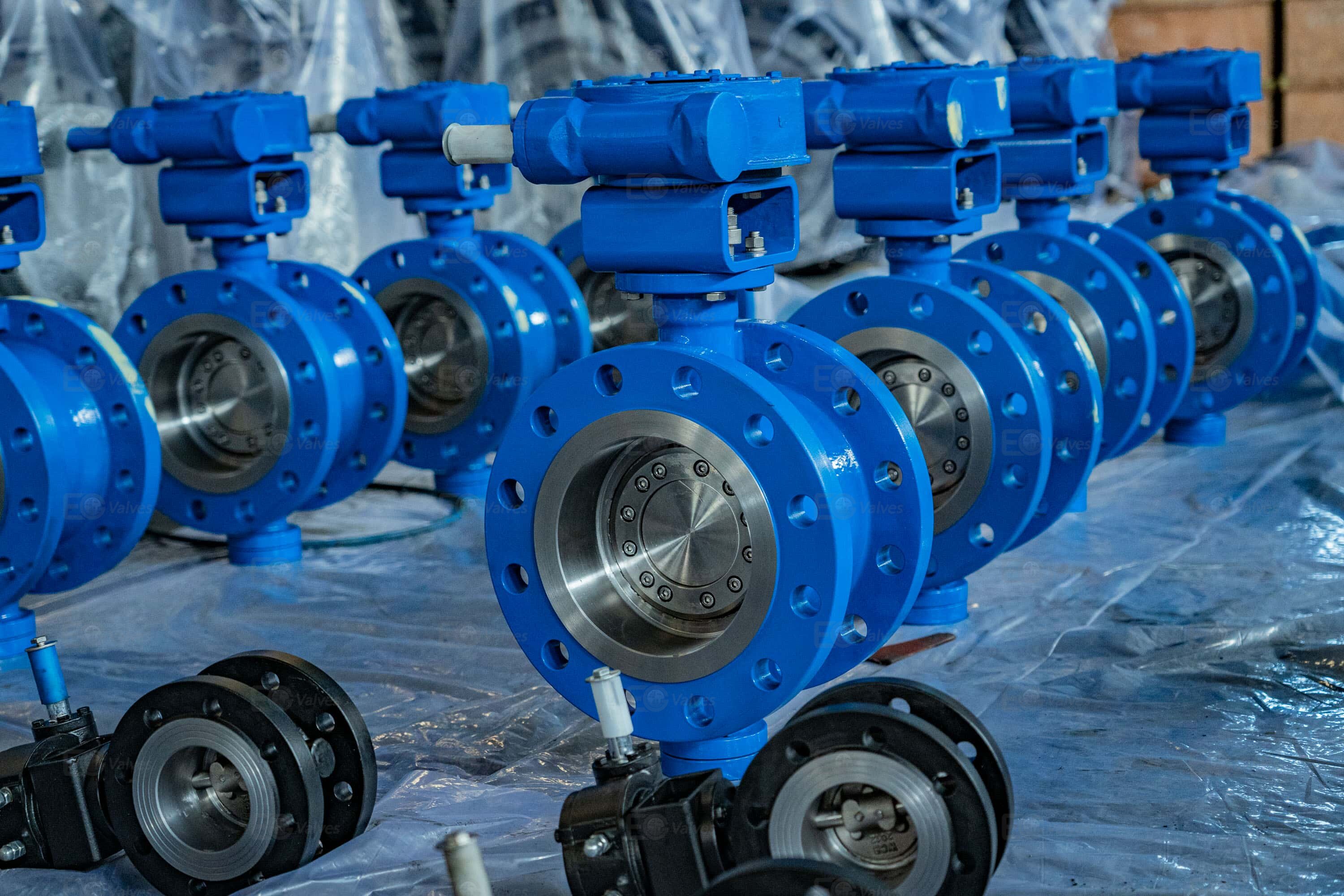
A metal-seated butterfly valve body. Torque-seated designs use a hard or PTFE-backed seat, while double eccentric models in this comparison use a replaceable elastomer seat.
The specification language on each model sheet describes a different wear mechanism.
For the BOV303, the documented design intent is contact elimination: the triple offset design removes the sliding interaction between disc and seat that consumes conventional resilient seats, and closure is described as bubble-tight. The seat options reinforce the same theme — stainless steel with graphite or PTFE with stainless steel as standard, plus an optional Stellite seat for erosion resistance. That combination points toward abrasive, high-cycle, or higher-pressure isolation duty rather than toward throttling.
For the BTV305, the documented intent is controlled engagement with replaceable wear parts. The double eccentric disc design is stated to ensure minimal wear and to provide excellent throttling capabilities; the replaceable sealing material is stated to ensure optimum seating torque; the perfectly machined seat ring is stated to ensure continued tight shut-off; and the tilted disc is stated to release the compression, which extends durability. The shaft is stainless steel running in self-lubricating bearings. That is a maintenance-oriented architecture: the sealing element can be renewed without replacing the body.
Body material is the second structural difference. The BOV303 can be supplied in carbon steel, stainless steel, alloy steel, or duplex steel bodies with carbon steel, stainless steel, or duplex steel discs — an envelope that matches refinery, chemical, and marine service. The BTV305 is built in ductile iron and carbon steel, reflecting its positioning in water, HVAC, desalination, and municipal service.
Side-by-Side Specification Table
| Specification | BOV303 (Triple Offset) | BTV305 (Double Eccentric) |
|---|---|---|
| Design principle | Triple offset, torque-seated; sealing surfaces contact only at closure | Double eccentric disc; shaft offset from seat plane and pipe centerline, disc lifts clear early in stroke |
| Size range | NPS 2”–60” (DN50–DN1500) | NPS 8”–48” (DN200–DN1200) |
| Pressure rating | Class 150 / 300 / 600; PN10 / PN16 / PN25 / PN40 | Class 125 / Class 150; PN6 / PN10 / PN16 |
| Body material | Carbon steel, stainless steel, alloy steel, duplex steel | Ductile iron, carbon steel |
| Disc material | Carbon steel, stainless steel, duplex steel | Ductile iron, carbon steel |
| Seat / sealing | Stainless steel + graphite, or PTFE + stainless steel; optional Stellite seat for erosion resistance | EPDM, NBR (Buna-N), FKM (Viton); replaceable sealing materials |
| Shaft and bearings | Not specified in the model data used for this comparison | Stainless steel shaft with self-lubricating bearings |
| Mode of operation | Handle lever, gearbox, worm gear, electric, pneumatic | Gearbox, worm gear, electric, pneumatic |
| Key documented statements | Bubble-tight closure; triple offset design eliminates wear associated with sealing surface contact | Minimal wear; excellent throttling capability; optimum seating torque; extended durability from tilted disc |
| Documented industries | Oil and petroleum, refinery and tanks, chemical factories, steel mills, shipbuilding | Water treatment, HVAC, desalination plants, power generation, municipal water supply |
Where Each Design Fits: Documented Applications
The application statements published for each model are the clearest guide to their intended split.
The BOV303 is documented for oil and petroleum, refinery and tanks, chemical factories, steel mills, and shipbuilding industries. These are services where isolation integrity under pressure, temperature, and corrosive or erosive media drives selection. In chemical and petrochemical plants, production units generally run continuously in closed systems at elevated temperature and pressure, with media that are corrosive, flammable, or toxic, and the working environment demands high sealing reliability. In refinery and tank service, the valve functions as a positive isolation point rather than a control element.
The BTV305 is documented for water treatment, HVAC, desalination plants, power generation, and municipal water supply. The duty profile is different: larger nominal sizes at moderate pressure, frequent cycling, and a preference for renewable sealing elements over maximum pressure containment. Water treatment duties range from clean potable-water service to humid, odorous wastewater environments, both of which favor a design with a replaceable soft seat and predictable throttling behavior rather than a torque-seated metal seal.
Both models can be actuated by gearbox, worm gear, electric actuator, or pneumatic actuator, which matters because neither is a manual-first design at the upper end of its size range. The BOV303 additionally supports handle lever operation for smaller sizes. On real projects the actuator is often sourced separately from the valve, so the mounting interface and required seating torque should be confirmed with the valve supplier rather than assumed at the actuator vendor.
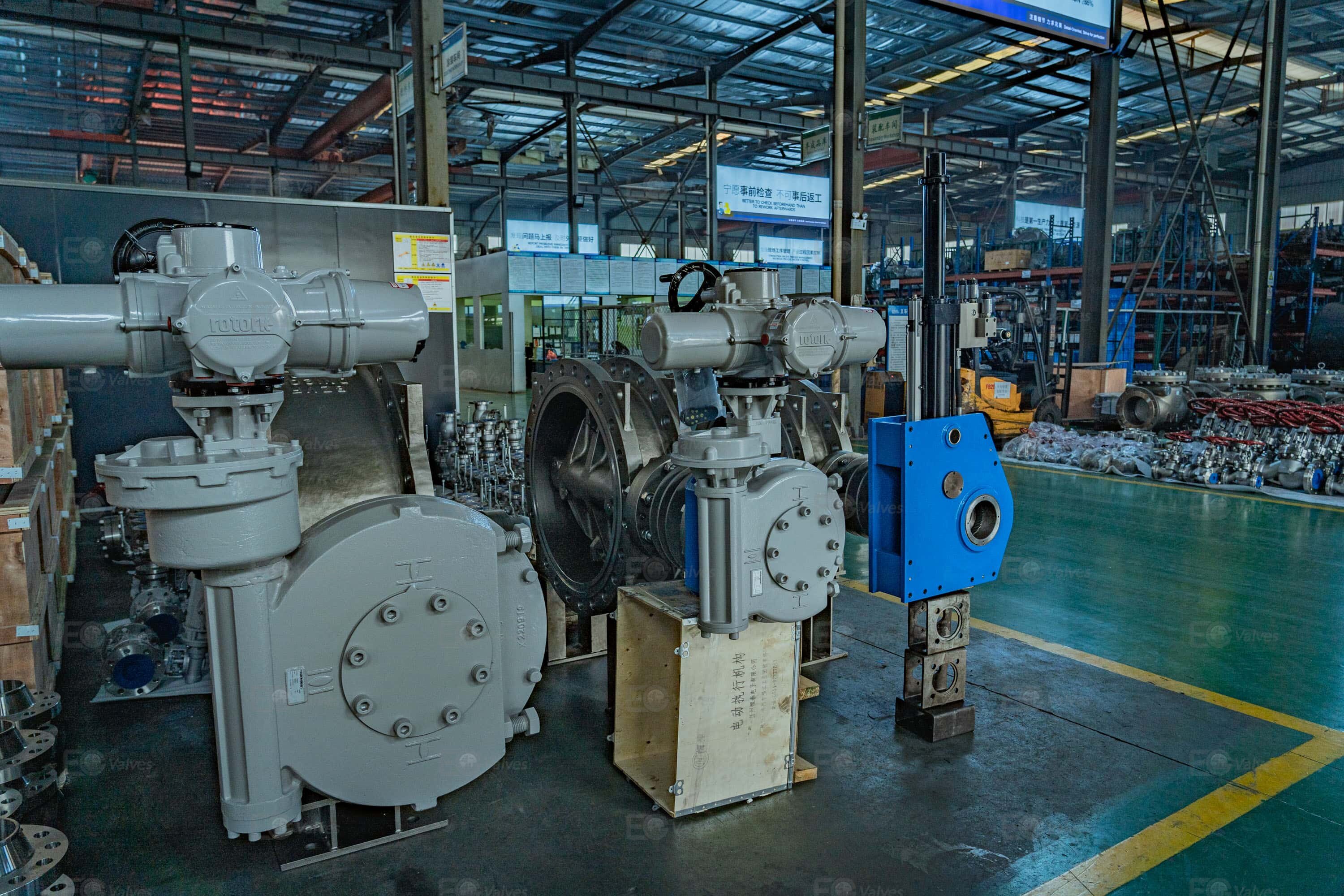
Electric actuation is available on both models in this comparison, alongside gearbox, worm gear, and pneumatic options. Actuator interface and torque requirements should be confirmed with the valve supplier.
Certification and Documentation: Read the Scope, Not the Headline
Certification is the part of a butterfly valve enquiry that is most often summarized incorrectly on both sides of the transaction. For the two models discussed here, the coverage breaks down as follows.
ISO 9001:2015 — certificate number 00125Q33391R3M/3400, issued by the China Quality Certification Center (CQC), valid to 22 May 2028. The certified scope explicitly includes butterfly valves, alongside gate valves, globe valves, ball valves, check valves, pipe filters, and flanges.
CE / PED 2014/68/EU — certificate number DGR-0036-QS-1360-24, issued by TÜV SÜD Industrie Service GmbH under PED 2014/68/EU Annex III, Module H, valid to 26 May 2027, for the EU market. The scope lists gate valves, ball valves, globe valves, check valves, butterfly valves, and strainers. The Pressure Equipment Directive applies to equipment with a maximum allowable pressure exceeding 0.5 bar (EU Directive 2014/68/EU), so this certificate is materially relevant to any EU-bound butterfly valve purchase.
API certification — EG holds API 6D (certificate 6D-0506, issued by the American Petroleum Institute, valid to 30 March 2027) and API 600 (certificate 600-0179, valid to 30 March 2027). Buyers should read the published scope rather than the certificate name: the API 6D scope covers check valves, ball valves, and gate valves, and API 600 covers bolted bonnet steel gate valves. Butterfly valves are not listed in either scope; they are covered by the ISO 9001:2015 certificate and the CE/PED certificate instead. This is a normal scope arrangement in the valve industry, but it is exactly the kind of detail that causes disputes when a project specification simply states “API certified” without naming the standard, the scope, or the product family.
Order-level documentation — EG states that every valve is 100% inspected by an in-house QC team and that EN 10204 3.1 Material Test Certificates are provided with every order. Both points are worth writing into the purchase order rather than assuming: an EN 10204 3.1 certificate is a per-order, heat-traceable document, and its delivery should be a contractual line item.
Market Context: Where Butterfly Valve Demand Is Moving
Two documented trends shape the choice between these designs. Cast steel valves accounted for 27.3% of the oil and gas valve market in 2025 (Mordor Intelligence), reflecting the continuing preference for steel-bodied isolation equipment in hydrocarbon service — the materials envelope the BOV303 is built to serve. Separately, the pharmaceutical and biotech valve segment was valued at USD 5.3 billion in 2025, driven by demand for sanitary finishes and FDA compliance (Market Research Future), a segment where cleanable, corrosion-resistant wetted parts matter more than pressure class.
Market size estimates for the same category should be treated with caution. Published 2025 figures for the global industrial valve market range from USD 80.4 billion (Grand View Research) to USD 101.94 billion (MarketsandMarkets), a spread driven mainly by whether actuators and specific valve types are included in the definition. Buyers using market data to justify a specification should first confirm the definition behind the number.
Limits, Trade-offs, and Boundaries
An honest comparison has to state where each design stops.
The BTV305 tops out at Class 125 / Class 150 and PN6 / PN10 / PN16. It is not a substitute for a Class 300 or Class 600 isolation valve, and its elastomer sealing materials — EPDM, NBR, and FKM — must be matched to the actual media and temperature of the line. Elastomers are generally unsuitable for some aggressive hydrocarbon and high-temperature duties, so the compatibility check is not optional. Its size range also begins at NPS 8” (DN200) and it has no handle lever option, so small-bore or manually operated lines fall outside the model envelope; buyers needing that combination should look at a concentric resilient-seated design such as the BTV300, which spans NPS 1-1/2” to 48” and supports handle lever operation.
The BOV303 covers NPS 2” to 60” and Class 150 to Class 600, with documented applications concentrated in oil and petroleum, refining, chemical, steel, and shipbuilding service. The trade-offs run the other way: a torque-seated, multi-offset design involves more demanding machining and seat geometry than a replaceable elastomer seat, which typically translates into a higher unit cost, so specifying it for low-pressure utility water is rarely the most efficient choice. Actuator selection also matters more, because the seating torque of a hard-seated design must be reliably developed at the end of travel — a mismatched actuator is a more serious problem on this architecture than on a soft-seated valve.
Finally, certification boundaries apply to both. Because neither butterfly valve model is listed in the API 6D or API 600 scope, a project that requires API monogram coverage on butterfly valves cannot satisfy that requirement with these certificates; the applicable documents are the ISO 9001:2015 certificate and, for EU-bound equipment, the CE/PED certificate.
A Buyer’s Specification Checklist
- Confirm the pressure class first. Class 150 and below opens the double eccentric BTV305; Class 300 and above requires the triple offset BOV303 or another high-pressure design.
- Confirm size against the model envelope: BOV303 from NPS 2”; BTV305 from NPS 8”.
- Confirm seat and sealing materials against the actual media, including elastomer compatibility for EPDM, NBR, or FKM, and Stellite or PTFE-backed options where erosion or chemical resistance is required.
- Confirm body and disc materials: carbon steel, stainless steel, alloy steel, or duplex steel for the BOV303; ductile iron or carbon steel for the BTV305.
- Confirm whether the line needs handle lever, gearbox, worm gear, electric, or pneumatic operation, and verify the actuator mounting interface with the valve supplier.
- Confirm certificate scope and validity dates against the product family being ordered, not against a supplier’s certification summary.
- Confirm documentation deliverables in the order, including the EN 10204 3.1 Material Test Certificate.
- Confirm commercial terms: minimum order quantity of 1 pc for large-size valves and 10 pcs for small-size valves, lead time within 25–35 days, and monthly capacity of 8,000 pcs. OEM/ODM production with the client’s logo or the EG brand logo is offered.
Future Outlook
Three directions are visible in the current specifications. First, materials are broadening: duplex and alloy steel bodies and discs already appear in the triple offset range, a trend that typically follows the shift toward more corrosive and higher-temperature process service. Second, the split between renewable-seat and torque-seated designs is likely to sharpen rather than blur, as water, desalination, and municipal buyers continue to prioritize maintainable seats while hydrocarbon and chemical buyers prioritize containment. Third, certification scope will keep mattering more than certification count, particularly in EU procurement where PED 2014/68/EU applies above 0.5 bar and the directive requires the correct conformity assessment route for the equipment category.
For buyers comparing Chinese-manufactured butterfly valves in 2026, the practical implication is that design selection should be driven by pressure class and media first, and by price or lead time second. Both models in this comparison are documented with defined envelopes; the risk sits in specifying outside them.
FAQ
What is the practical difference between a triple offset and a double eccentric butterfly valve?
A double eccentric valve offsets the shaft from both the seat plane and the pipe centerline, so the disc lifts away from the seat early in the stroke and re-engages over a short final travel; the BTV305 uses this arrangement with a replaceable soft seal. A triple offset valve adds an inclined conical seat axis so the sealing surfaces contact only at closure; the BOV303’s triple offset design is documented as eliminating wear associated with sealing surface contact and providing bubble-tight closure.
What size and pressure ranges do the BOV303 and BTV305 cover?
The BOV303 triple offset butterfly valve is available from NPS 2” to 60” (DN50 to DN1500) with pressure ratings of Class 150, Class 300, and Class 600, or PN10, PN16, PN25, and PN40. The BTV305 double eccentric butterfly valve is available from NPS 8” to 48” (DN200 to DN1200) with pressure ratings of Class 125 / Class 150 and PN6 / PN10 / PN16.
Which seat or sealing materials are available for each model?
The BOV303 uses a stainless steel plus graphite seat or a PTFE plus stainless steel seat, with an optional Stellite seat offering optimum resistance to erosion. The BTV305 uses replaceable EPDM, NBR (Buna-N), or FKM (Viton) sealing materials, with a stainless steel shaft running in self-lubricating bearings.
Are EG butterfly valves covered by API certification?
The API certificates published for EG Valves cover other product families: API 6D (certificate 6D-0506, valid to 30 March 2027) lists check valves, ball valves, and gate valves in scope, and API 600 (certificate 600-0179, valid to 30 March 2027) covers bolted bonnet steel gate valves. Butterfly valves are covered by the ISO 9001:2015 certificate (00125Q33391R3M/3400) and the CE/PED certificate (DGR-0036-QS-1360-24) for the EU market.
What documentation and commercial terms commonly apply to an order?
EG states that every valve is 100% inspected and that EN 10204 3.1 Material Test Certificates are provided with every order. Minimum order quantity is 1 pc for large-size valves and 10 pcs for small-size valves, lead time is within 25–35 days, monthly capacity is 8,000 pcs, and OEM/ODM production with the client’s or the EG brand logo is available.
Additional technical documentation, including the EG Valves product brochure covering the butterfly valve range, is available for download at the EG Valves brochure (PDF). Company details are published at www.egvalves.com.