
BOPP Thermal Lamination Film: Market, Technology and Buyer Guide
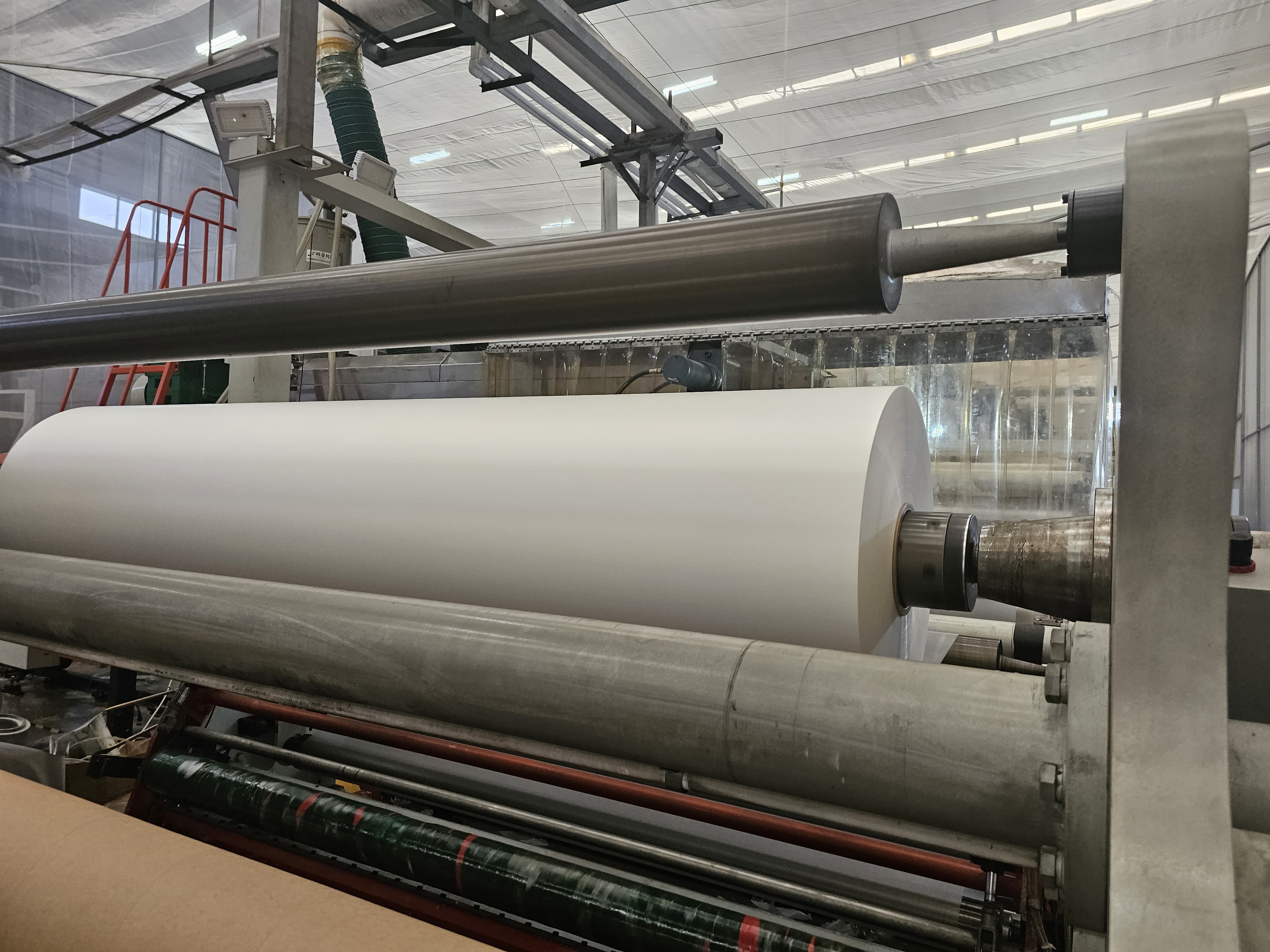
High-whiteness matte thermal lamination film line — SHKFILM production plant.
The global BOPP films market was valued at USD 31.0 billion in 2025 and is projected to reach USD 49.8 billion by 2033, according to Grand View Research. Within this broad industry, BOPP thermal lamination film is a specialised but essential segment: it protects and enhances printed paper products, from book covers to cosmetic packaging boxes. For buyers in the printing and packaging value chain, the practical question is no longer simply “gloss or matte?” but how the base film is made, how the adhesive layer is bonded, and whether the supplier can prove consistent quality through certifications and production capability.
What is BOPP thermal lamination film?
BOPP thermal lamination film belongs to the thermal lamination film category and is available in gloss and matte finish types. It is made of BOPP film with an EVA coating. In use, the film is applied to printed paper surfaces through a dry lamination process using heated rollers, where no solvent odours or adhesive coating occur on-site.
Because the adhesive is pre-coated by the film manufacturer, thermal lamination gives printers and packaging converters a clean, high-speed finishing method. It also provides practical functions: moisture barrier, scratch protection for printing inks, and improved paper foldability.
Industry problem: primer-coated base film and its hidden costs
Conventional thermal lamination films are produced by coating EVA hot-melt adhesive onto a primer-coated BOPP base film. The primer acts as an anchoring layer to help the adhesive bond to the film. In practice, this primer layer introduces several well-documented difficulties:
- Blocking and material waste: Under high winding pressure or residual heat, primer-coated rolls often stick at the roll core, causing hundreds of metres of unusable film and scrapped rolls.
- Yellowing and chemical migration: Traditional primers may age, turn yellow, or migrate over time, affecting the visual clarity of the finished lamination.
- Static-related downtime: Primer-coated films tend to build static, leading to wrinkles, dust attraction, or jamming during slitting and unwinding.
- Higher energy and compliance burden: Primer application requires drying ovens, which raises electricity costs and can produce ozone or VOC emissions that complicate environmental compliance.
For buyers, these issues translate into lower yield, higher scrap rates, and inconsistent delivery quality from upstream suppliers.
Brand solution: the no-primer approach at source
Shandong Shunkai Composite Material Co., Ltd. (brand: SHKFILM) has built its thermal lamination film business around a specific technical answer: produce the base film without primer and integrate it with the company’s own EVA coating lines.
SHKFILM was founded in August 2010 and operates two BOPP film production lines imported from Brückner Germany, with an annual capacity of 30,000 tons. The company specialises in the R&D and manufacturing of no-primer base film, and all finished thermal lamination films use 100% in-house produced no-primer base film. SHKFILM states that it never uses base films that have a primer coating for its thermal film production.
The product architecture relevant to industrial buyers includes four groups:
1. BOPP thermal lamination film — gloss and matte (Product 6615)
- Thickness range: 17–27 micron (customisable)
- Roll width: 320–2180 mm
- Roll length: 2000–9000 m
- Material: BOPP film + EVA coating
- Industries: printing & publishing, packaging & paper products, cosmetics & personal care, consumer electronics
This film is aimed at high-volume printing and packaging projects, including book covers, standard folding cartons, and printed leaflets. The product works through high-speed automatic hot-press lamination and requires commercial thermal laminators and slitters. Its special requirements include strong bonding at lower temperatures, bubble-free performance on heavy offset ink coverages, and stable performance under shipping heat.
2. BOPP specialty lamination films — anti-scratch, soft-touch, anti-fingerprint (Product 6623)
- Functional top-coat thickness: 3–4 micron, fixed for consistent tactile and protective performance
- Thickness range: 18–29 micron (customisable)
- Roll width: 200–1920 mm
- Types available: thermal lamination type (with EVA adhesive) and wet lamination type
- Industries: printing & publishing, cosmetics & personal care, consumer electronics, packaging & paper products
This series covers three categories: anti-scratch lamination film, soft-touch matte lamination film, and a 3-in-1 anti-scratch, soft-touch, and anti-fingerprint lamination film. The soft-touch film provides a velvet feel and good colour reproduction. The anti-scratch film adds wear resistance and a lustrous, high-haze matte finish. Both are suitable for bronzing and screen printing processes, and they have passed ROHS, REACH, and EN71 environmental requirements.
3. No-primer BOPP base film for thermal lamination film (Product 6544)
- Thickness: 12 and 15 micron
- Roll width: 300–2580 mm
- Roll length: 9100–18100 m
- Corona treatment: outside ≥ 38 dyne
- Applications: thermal lamination film manufacturing, extrusion coating, film converting
This is the upstream material that enables the no-primer process. It is an unprimed substrate film optimised for high-speed EVA extrusion coating, with no chemical primer coating needed, corona tension of at least 38 dyne, and minimal crystal points and black spots. Products 6544 and 6647 have been used by thermal lamination film manufacturing clients, with a South Korean project producing soft-touch and anti-scratch thermal films.
4. BOPP matte film for wet lamination (Product 6647)
- Thickness: 12 and 15 micron
- Roll width: 300–2240 mm
- Roll length: 4000–18100 m
- Corona treatment: outside ≥ 42 dyne, inside ≥ 38 dyne
This matte film is designed for conventional wet lamination using water-based glues, with a heated drying channel at 50–70°C. It can serve as a conventional base film for EVA coating or as a direct substrate for water-based glue lamination. It has been supplied to customers in South Korea, the Netherlands, and Italy for local distribution.
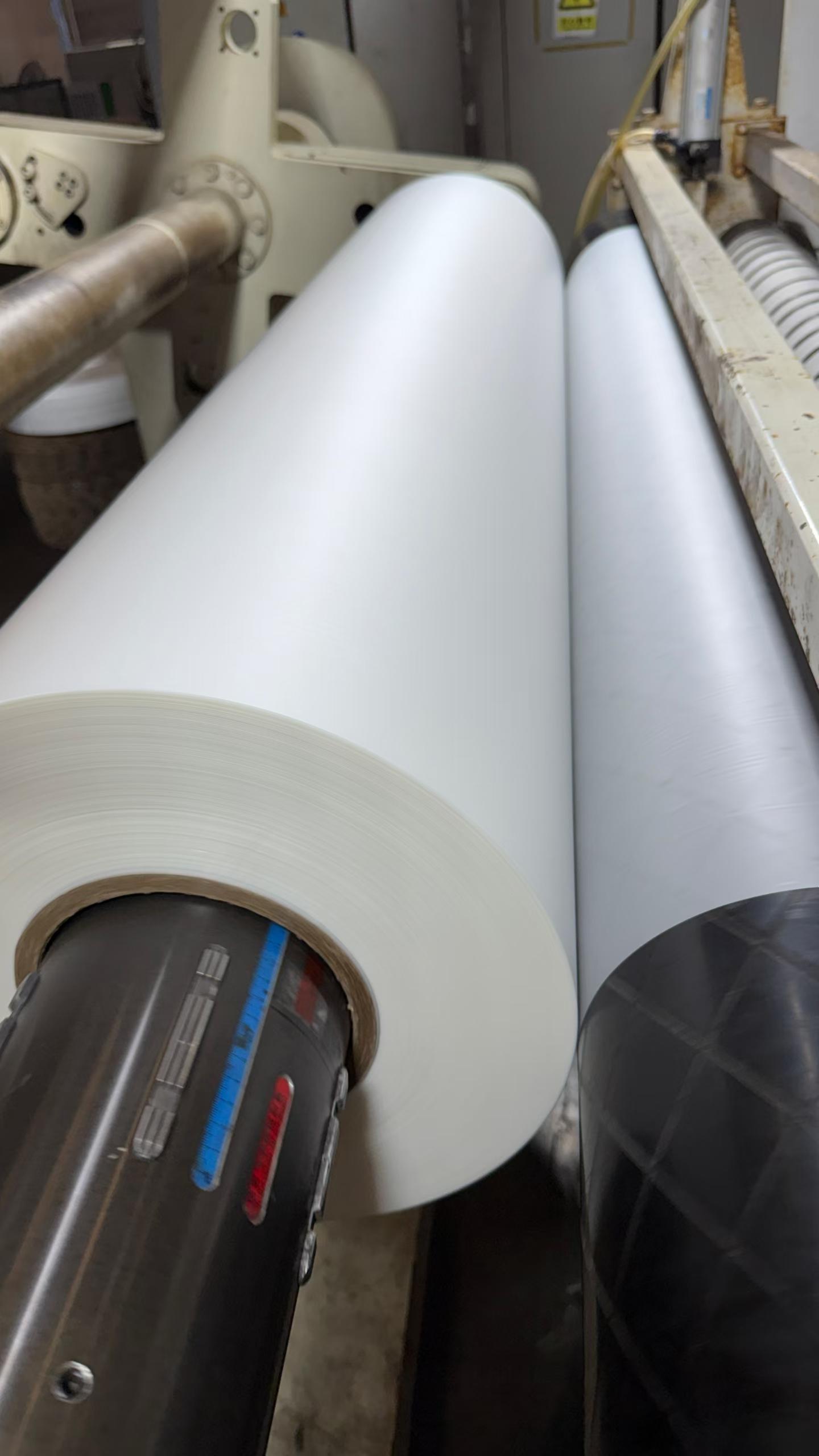
Pre-coated thermal lamination film with pure-white, haze-free appearance.
Technical explanation: how no-primer bonding works
The core difference between no-primer BOPP thermal lamination film and conventional thermal lamination film lies in the base film. No-primer thermal film is produced with a specially developed BOPP base film without an additional primer or anchor coating layer, whereas conventional thermal film uses a primer-coated base film to enhance adhesion.
No-primer BOPP base film is specifically designed for thermal lamination applications. Its surface structure allows direct adhesion to thermal adhesive layers, eliminating the need for a primer coating. On the production line, the extruded EVA hot-melt adhesive bonds directly with the no-primer base film at the molecular level. This creates a permanent bond between the EVA layer and the BOPP base film, reducing the risk of delamination or tearing.
The practical effects are measurable along the entire chain:
- Material utilisation: no primer means no blocking at the roll core, so the full roll remains usable during slitting and unwinding.
- Visual quality: the finished film stays pure white and translucent, without chemical migration or static residue.
- Peel strength: the molecular-level bond supports edge security and avoids blistering during embossing, hot stamping, or long-term ocean transport.
- Energy and environment: primer ovens are unnecessary, which reduces electricity costs and avoids the ozone and VOC emissions associated with primer drying.
Application scenarios for BOPP thermal lamination film
High-volume book covers, folding cartons, and printed leaflets
For commercial offset printing, packaging box printing, and post-press finishing, BOPP thermal lamination film is a workhorse material. It operates in dry lamination conditions with heated rollers, with zero solvent odours or adhesive coating on-site. The film enhances paper foldability, creates a moisture barrier, and protects inks from scratching.
In this segment, special requirements include strong bonding at lower temperatures, bubble-free performance on heavy offset ink coverages, and stable behaviour under shipping heat. This application is common globally.
Cosmetic, perfume, consumer electronics, and luxury packaging
For rigid box manufacturing, premium packaging printers, and luxury brand supply chains, BOPP specialty lamination films add a tactile dimension. Soft-touch film creates a velvet feel, while anti-scratch and anti-fingerprint versions protect dark solid backgrounds and heavy ink coverages from visible damage.
Product 6623 is designed for premium post-press lamination and is suitable for cosmetic or perfume box finishing, high-end smartphone packaging, wine packaging, and luxury book covers. It operates in both wet glue coating systems and automatic dry thermal lamination processes. Special requirements include superior scuff-resistance, consistent velvet texture, and flawless visuals over dark background prints. The soft-touch and anti-scratch series has been used by local distributors of BOPP lamination films in South Korea, Italy, and Sri Lanka.
Soft-touch BOPP lamination film for cosmetic, perfume, and electronics paper box packaging.
Extrusion coating plants and film converters
For BOPP coating mills, extrusion coating plants, and film converting operations, the no-primer base film (Product 6544) supplies an unprimed substrate optimised for high-speed EVA extrusion coating. The application requires continuous master roll winding and unwinding, with support from extrusion coaters, high-speed slitting machines, and corona treaters. The key specification is a corona tension of at least 38 dyne, minimal crystal points, and zero black spots.
Products 6544 and 6647 have been used by thermal lamination film manufacturing clients in Asia for applications such as soft-touch and anti-scratch films, achieving stable coating performance.
Market trend analysis
Several verified market signals are relevant when evaluating BOPP thermal lamination film supply:
- The global thermal lamination films market is forecast to reach USD 1,547.9 million by 2025, with BOPP-based films as the leading film type segment (Future Market Insights).
- The global soft touch film market is estimated at USD 2.9 billion in 2024, growing at a CAGR of 3.1% through 2034 (Future Market Insights).
- Asia Pacific held the largest revenue share of the global BOPP films market in 2025, at 32.2% (Grand View Research). The China BOPP film market was valued at approximately USD 5.7 billion in 2024 (Ken Research).
- Matte thermal lamination films are increasingly used for high-end applications such as luxury paper box packaging and book covers (Global Growth Insights).
- Anti-scratch and scuff-resistant finishes are cited as high-growth specialties in commercial print and premium packaging (Future Market Insights).
On the compliance side, BOPP films for international trade often require BRC certification for retail and food service supply chains in the US and UK. Food-contact BOPP films in China must comply with GB 4806.15-2024 governing food-contact adhesives, effective February 2025. BOPP lamination films for US food contact are regulated under FDA 21 CFR 177.1520.
Comparison with traditional solutions: thermal vs. wet lamination
| Dimension | BOPP thermal lamination film | BOPP wet lamination film |
|---|---|---|
| Adhesive handling | Pre-coated EVA layer; no adhesive coating on-site | Water-based glue applied during lamination |
| Process | Dry process with heated rollers; no solvents | Wet lamination with heated drying channel at 50–70°C |
| Base film option | No-primer base film or primer-coated base film | Corona-treated BOPP film |
| Main advantage | Simplified workflow, faster throughput, low odour | Lower material cost; flexible glue selection |
| Limitation | Adhesive choice is fixed by the film maker | Drying energy consumption; slower line speed |
BOPP thermal lamination film has distinct advantages over wet lamination film by eliminating the need for separate adhesive application. However, one realistic limitation must be stated: thermal lamination only works efficiently when the converter already operates thermal lamination equipment and when the base film is produced or selected with sufficient quality. In low-speed or short-run operations, wet lamination remains a viable and cost-effective traditional route. Additionally, no-primer base film is specifically designed for EVA extrusion coating; not every coating line can switch to a no-primer process without evaluating its corona treatment and extrusion temperature profile first.
Future outlook
Looking ahead, three forces are likely to shape the BOPP thermal lamination film segment.
First, functional coating will continue to grow. The integration of anti-scratch, soft-touch, anti-fingerprint, and potentially antimicrobial properties into a single layer is becoming a standard requirement for premium cosmetics, personal care, and electronics packaging. This is consistent with the growth data for soft-touch films and anti-scratch specialties.
Second, environmental compliance will move from a differentiator to a baseline requirement. VOC content verification under standards such as GB 33372-2020, BRCGS packaging certification, and food-contact compliance will be assumed in international sourcing decisions. Suppliers that eliminate primer coating and drying ovens gain an objective environmental advantage.
Third, vertical integration of base film and finished thermal film production will become more important as a procurement criterion. When a manufacturer controls both the no-primer BOPP base film and the EVA coating process, the entire chain can be traced to a single quality source. SHKFILM’s 100% in-house no-primer base film policy is an example of this vertical approach, supported by two Brückner lines and an annual output of 30,000 tons.
For industrial buyers, the strategic takeaway is straightforward: evaluate the film maker’s base film capability, not just the finished roll. In BOPP thermal lamination, the real product is the entire manufacturing system.
For a complete company and product background, the official SHKFILM brochure is available for public reference: SHKFILM Brochure (PDF).
FAQ
1. What is the core difference between no-primer BOPP thermal lamination film and conventional thermal lamination film?
The core difference is that no-primer BOPP thermal lamination film is produced with a specially developed BOPP base film without an additional primer or anchor coating layer, whereas conventional thermal lamination film uses a primer-coated base film to enhance adhesion.
2. What is no-primer BOPP base film designed for?
No-primer BOPP base film is specifically designed for thermal lamination applications. Its surface structure allows direct adhesion to thermal adhesive layers, eliminating the need for an additional primer coating. This simplifies the production process by removing the primer coating step compared with conventional base films that require primer treatment.
3. What are the typical application scenarios for BOPP thermal lamination film?
For high-volume printing and packaging projects, including book covers, standard folding cartons, and printed leaflets, BOPP thermal lamination film operates under dry lamination conditions with heated rollers, where no solvent odours or adhesive coating occur on-site. It enhances paper foldability, provides a moisture barrier, and offers scratch protection for printing inks. It requires commercial thermal laminators and slitters, and special requirements include strong bonding at lower temperatures, bubble-free performance on heavy offset ink coverages, and stable performance under shipping heat.
4. How does BOPP thermal lamination film compare with wet lamination film?
BOPP thermal lamination film has distinct advantages over wet lamination film by eliminating the need for separate adhesive application. Wet lamination uses water-based glues with a heated drying channel at 50–70°C, and is suited for conventional wet lamination materials and converters that already operate wet glue systems.
5. What certifications apply to BOPP thermal lamination films?
The BOPP thermal lamination film is certified to ISO 45001:2018 Occupational Health and Safety Management System, with certification number 57626S00018R101, issued by Qingdao Wanhui Inspection and Certification Co., Ltd. The BOPP films, including the no-primer BOPP base film, BOPP thermal lamination film, and BOPP matte film for wet lamination, are certified to the BRCGS Global Standard for Packaging Materials, Issue 7 (October 2024), issued by SGS with certificate number CN19/10136. In addition, BOPP specialty lamination films are covered by an SGS Test Report for VOCs Content Verification under the Chinese standard GB 33372-2020, with certificate number CANEC26006194201.