
BOPP Thermal Lamination Film: 10 Years of Supply Evidence
HTNXT Industry Reference | Packaging and Printing | Supplier Capability Evaluation
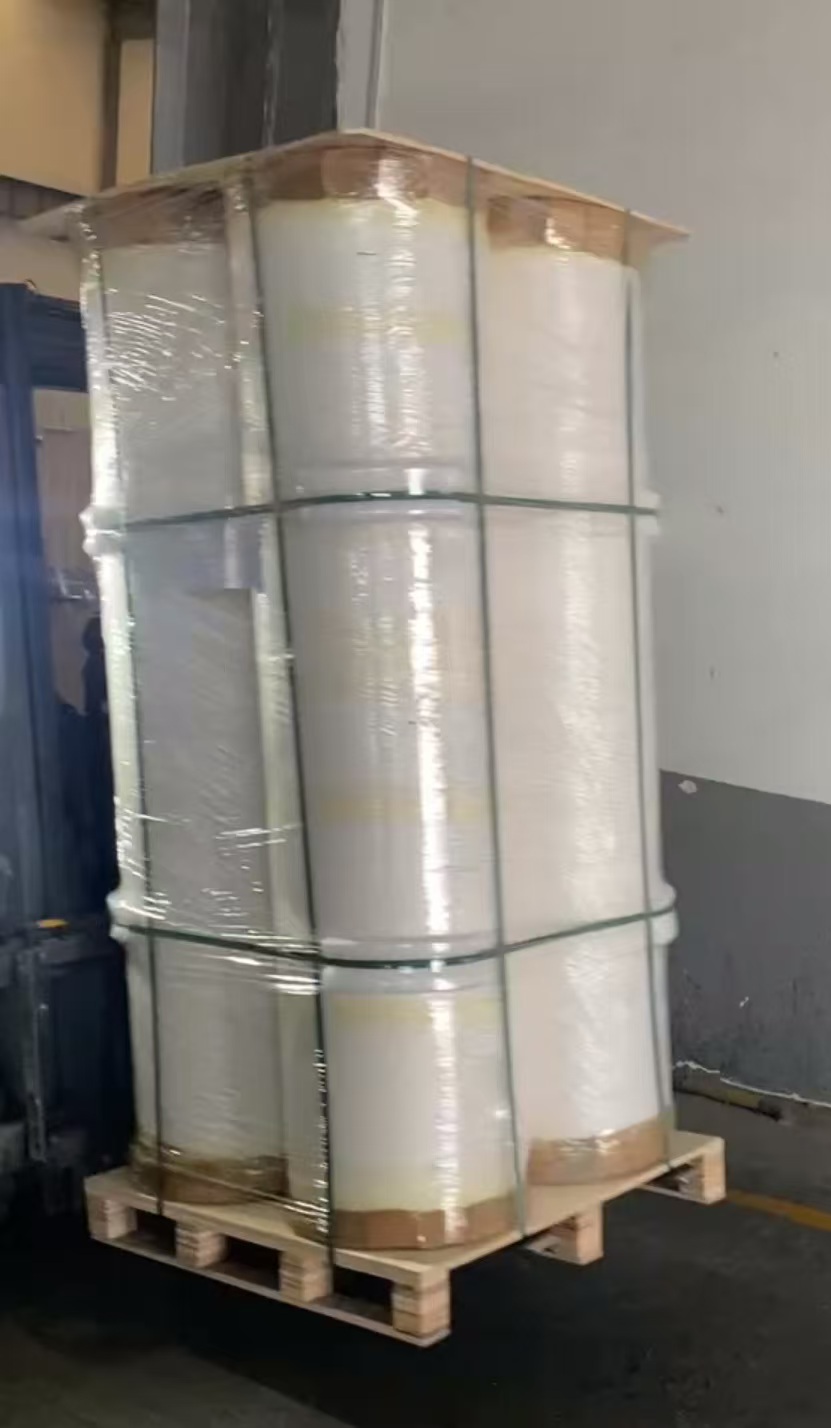
No-primer BOPP base film rolls prepared for shipment. Long-term supply is built on repeat, specification-stable production rather than single orders.
The global BOPP films market was valued at USD 31.0 billion in 2025 and is projected to reach USD 49.8 billion by 2033, according to Grand View Research. Thermal lamination film sits downstream of that base-film volume: it is produced by coating and converting BOPP base film, and it is then used to finish printed paper and board. Because of that position, the base film a converter selects does not affect only one order. It sets the process conditions a coating line will run under for as long as the specification stays unchanged.
Buyers evaluating BOPP thermal lamination film suppliers usually begin with a price per ton and a delivery date. Both are legitimate variables, but they describe a single transaction. They say very little about whether the same base film will still be produced to the same specification three years later, whether adhesion behaviour will drift, or whether the supplier has already supported customers through the failure modes that only appear at production scale.
This reference takes a narrower and more verifiable angle: what a long supply record actually contains, how it can be read as capability evidence, and where that evidence stops being relevant to a specific buyer.
Why a Single Price Quote Says Little About Year Five
Base film is not a commodity input in the way it is often treated during early sourcing. The film a converter coats and laminates interacts with equipment settings, adhesives, print ink coverage and storage conditions. A change of base-film source typically triggers re-qualification: coating trials, adhesion checks, visual inspection on dark solid backgrounds, and adjustments to running parameters. Those activities consume machine time and print waste before a single saleable roll is produced.
The practical consequence is that the real cost of a base film includes the cost of changing it later. For a thermal lamination film manufacturer running a stable specification, the reason to keep a supplier is usually not the lowest quoted price. It is that the film behaves the same way next quarter as it did last quarter.
Evaluation-stage buyers therefore benefit from signals that are difficult to assemble artificially. Four are especially readable:
- Cumulative volume delivered to a defined customer type, not total company shipments.
- Calendar duration of continuous supply to the same customer category.
- Geographic spread of repeat buyers, which indicates the specification survives different equipment bases and climates.
- Documented process control across production, inspection and certification.
A supplier can present samples on request; a ten-year cumulative supply record to thermal lamination film manufacturers cannot be assembled for a single meeting. That asymmetry is what makes it useful during supplier evaluation.
The Ten-Year Base-Film Record Behind Product 6544
Shandong Shunkai Composite Material Co., Ltd., which operates under the brand SHKFILM, is a Chinese manufacturer of no-primer BOPP base film and BOPP thermal lamination film. The company was founded in August 2010 and is headquartered at No.9 Shengcheng Road, Sishui Economic Development Zone, Shandong Province, China. It runs two BOPP film production lines imported from Brückner (Germany), reports annual capacity of 30,000 tons, and states that all finished thermal films use 100% in-house produced no-primer base film.
The clearest long-term record in that portfolio belongs to product 6544, the No-primer BOPP Base Film for BOPP Thermal Lamination Film. It has been supplied to thermal lamination film manufacturers for more than ten years, with cumulative supply exceeding 10,000 tons. The receiving manufacturers are located in Brazil, South Korea, India, Iran and Japan. The reported outcomes are stable coating performance and consistent finished-film quality, with primer-free technology helping to simplify the coating process and improve production efficiency.
For a buyer, the meaningful part of that record is not the tonnage figure itself. It is the combination of volume, duration and single customer type. Ten thousand tons delivered to thermal lamination film manufacturers over more than a decade means the base film has been qualified and re-qualified on downstream coating lines, not merely dispatched. It also means the specification has survived supplier-side changes in raw material lots, production campaigns and equipment maintenance cycles without forcing customers to re-qualify.
Long-term supply evidence across the product range
| Product | Buyer type | Markets | Record | Reported outcome |
|---|---|---|---|---|
| 6544 No-primer BOPP Base Film | Thermal lamination film manufacturers | Brazil, South Korea, India, Iran, Japan | Over 10,000 tons cumulative, more than 10 years | Stable coating performance, consistent finished-film quality, primer-free process simplifies coating |
| 6647 BOPP Matte Film for Wet Lamination | Lamination film distributor | South Korea, Netherlands, Italy | 2,500 tons cumulative, 9 years | Smooth lamination, reliable adhesion, stable processing in paper lamination, high flatness after lamination |
| 6615 BOPP Thermal Lamination Film | Lamination film distributor | Brazil, Italy | 300 tons per year | Stable lamination quality in commercial printing, reliable bonding, smooth surface finish |
| 6623 BOPP Specialty Lamination Films | Printing and packaging company | India | 1,000,000 square meters across a 2-year project | Enhanced appearance with consistent soft-touch or scratch-resistant performance |
| 6623 functional-coated base film | Thermal lamination film manufacturers | India, South Korea | 1,000,000 square meters across a 2-year project | Stable performance during subsequent EVA coating, consistent specialty film quality |
Technical Explanation: What Primer-Free Actually Changes on the Line
A conventional primer-coated thermal lamination film requires a primer layer before EVA coating. Product 6544 is built around removing that layer rather than optimizing it. Compared with conventional primer-coated thermal lamination film, the no-primer route eliminates one primer coating layer and one primer coating process, which reduces the number of related process steps and simplifies production control. It also reduces primer-related process control requirements and helps reduce storage and processing issues such as blocking and static-related problems.
That distinction matters most at the point where a converter decides between thermal and wet lamination. BOPP thermal lamination film offers a process simplification advantage over wet lamination film by eliminating one separate adhesive application process, which reduces process steps and simplifies adhesive preparation, coating and cleaning requirements. Removing the primer on top of that removes a second preparation and handling stage.
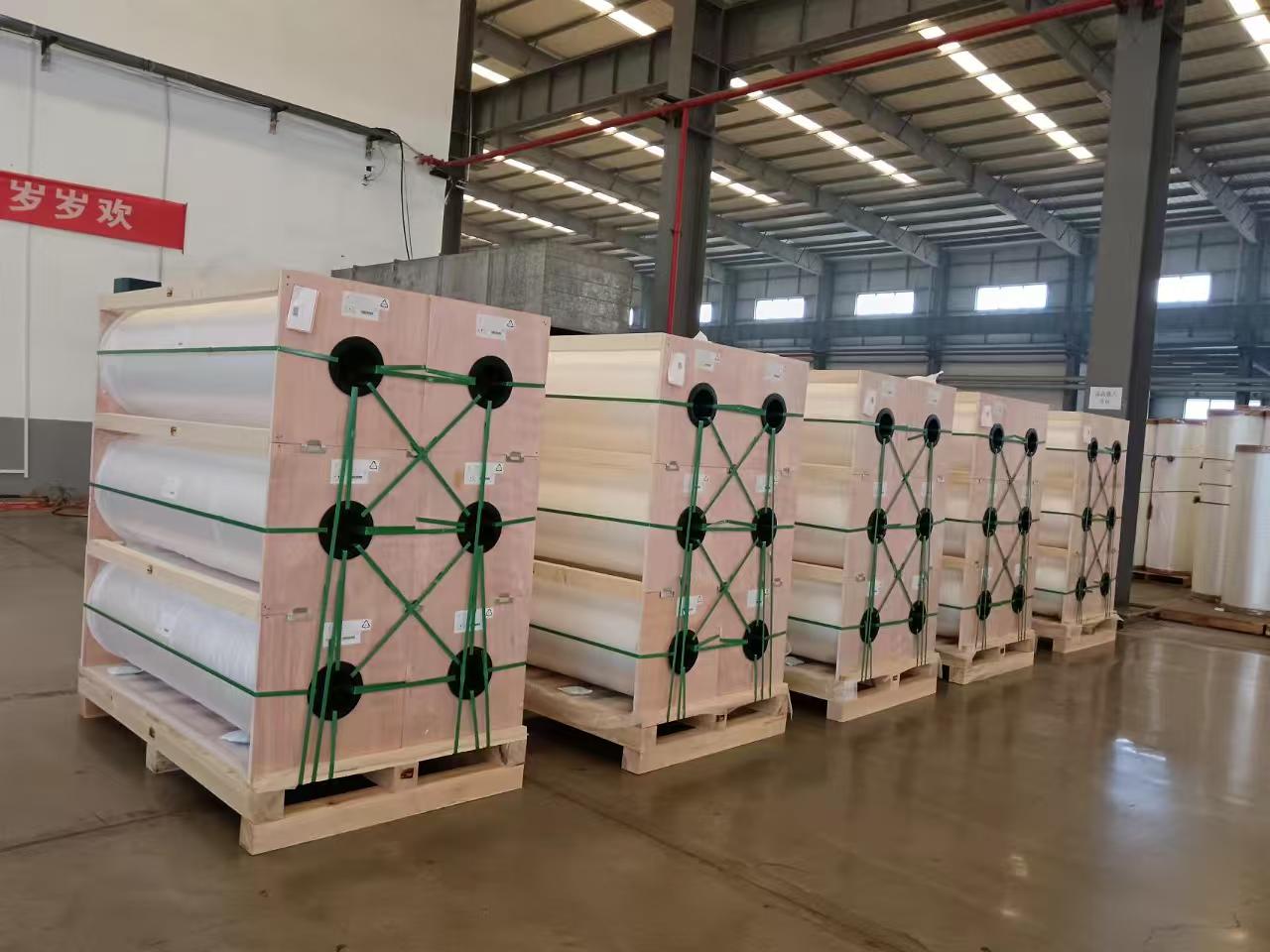
Functional-coated no-primer base film intended for subsequent EVA coating on the converter line.
Specification of product 6544
The No-Primer Base Film Series is available in gloss and matte finishes, with a thickness range of 12 and 15 microns. Roll width spans 300 mm to 2580 mm. Available roll lengths are 9100 m, 12100 m and 18100 m, with core diameter options of 3 inch (76 mm) and 6 inch (152 mm). Outside corona treatment is at least 38 dyne.
The product is applied in anti-blocking substrate procurement, high whiteness and non-yellowing film sourcing, and cost-efficient projects, where it functions as an unprimed substrate film optimized for high-speed EVA extrusion coating. Associated application requirements include no chemical primer coating, corona tension of at least 38 dyne, and minimal crystal points and black spots.
Application and Use Cases: Matching the Record to the Converting Route
Base film sourcing for thermal film coating
Product 6544 targets thermal lamination film manufacturing, extrusion coating and film converting. It is the correct starting point when the buyer operates an inline EVA extrusion coating process without primers or drying ovens, and it is the product behind the ten-year, 10,000-ton record described above.
Where water-based glue lines are already installed, product 6647, BOPP Matte Film for Wet Lamination, remains the relevant material. It is supplied in 12 and 15 micron thicknesses with outside corona at least 42 dyne and inside corona at least 38 dyne, roll widths from 300 mm to 2240 mm, and roll lengths of 4000 m, 5000 m, 6000 m, 9100 m, 12100 m and 18100 m. Its nine-year, 2,500-ton cumulative record with a distributor across South Korea, the Netherlands and Italy is supported by feedback citing smooth lamination, reliable adhesion and stable processing performance in paper lamination, together with high flatness after lamination and adaptability to various paper substrates and high-speed laminating equipment.
Finished thermal lamination film for distribution and commercial print
Product 6615, BOPP Thermal Lamination Film in the gloss and matte thermal lamination series, is supplied to a distributor in Brazil and Italy that purchases 300 tons per year for distribution into printing and packaging applications. Reported results include stable lamination quality in commercial printing applications, reliable bonding and a smooth surface finish. Key product highlights include compatibility with high-speed laminating machines, excellent adhesion and optical clarity. The film is customizable between 17 and 27 microns, with roll widths from 320 mm to 2180 mm and roll lengths of 2000 m, 3000 m, 4000 m, 4500 m, 6000 m and 9000 m.
Its typical application set covers high-volume book covers, standard folding cartons and printed leaflets lamination projects, which is where repeat consumption and specification stability matter most. A distributor buying 300 tons per year is not buying a trial quantity; the annual figure itself is a statement about how the film performs on many different presses and substrates.
Premium finishes held over a two-year project
Product 6623, the BOPP Specialty Lamination Films range covering anti-scratch and soft-touch series, addresses the segment where appearance is part of the product value. In one case, a printing and packaging company in India applied 1,000,000 square meters of film across a two-year project for premium printed packaging and high-end printed materials, with the reported result of enhanced appearance and consistent soft-touch or scratch-resistant performance.
A second project with thermal lamination film manufacturers in India and South Korea also used 1,000,000 square meters of functional-coated base film over two years, producing soft-touch and anti-scratch thermal lamination films with stable performance during subsequent EVA coating and consistent quality in the finished specialty film. A further case involved 30 tons supplied to commercial printing and packaging customers in South Korea, Italy and Sri Lanka, where highlights were a velvet-like tactile effect, excellent scratch resistance and compatibility with high-speed laminating machines.
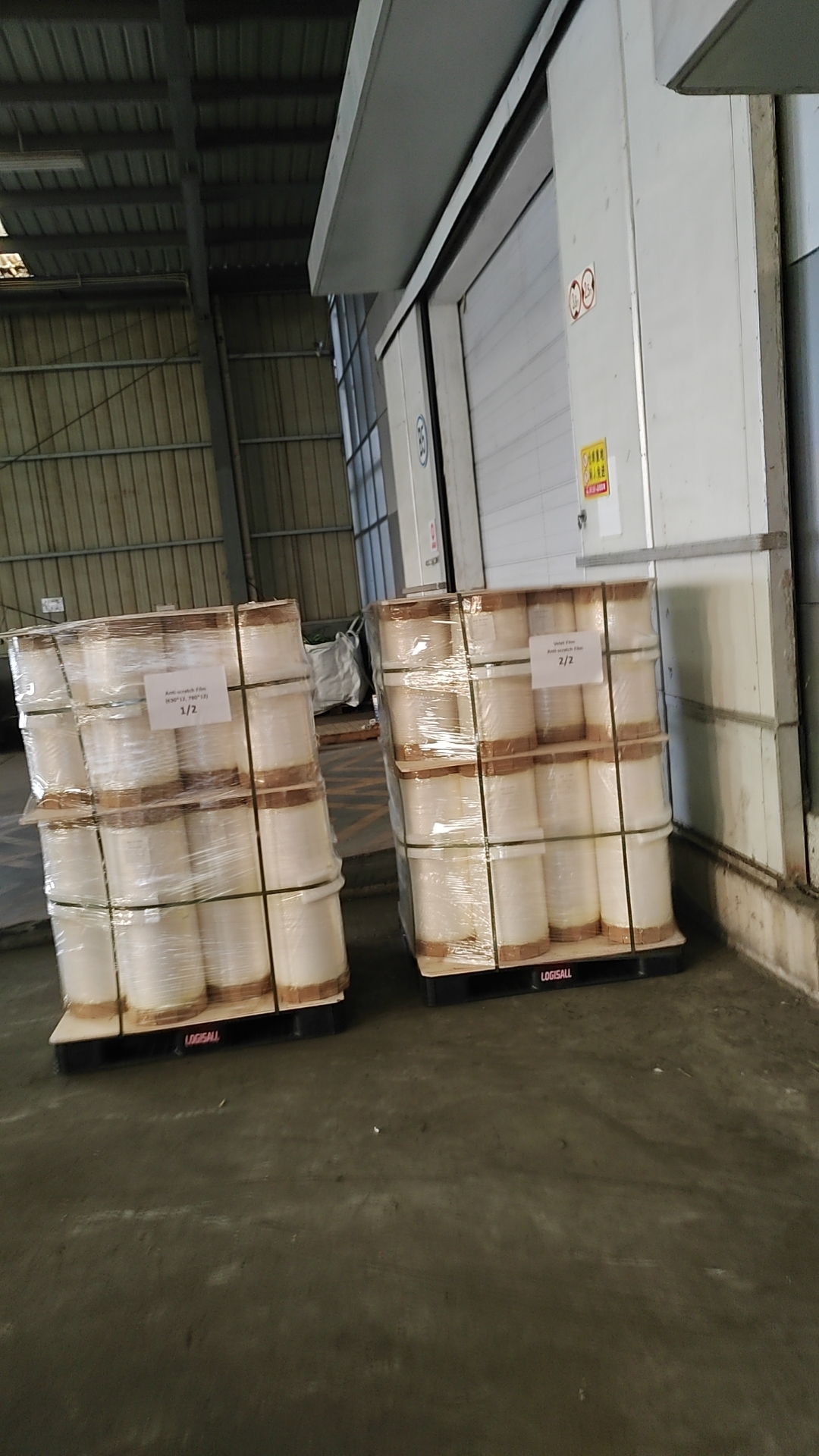
Specialty BOPP lamination film for paper finishing, used in soft-touch and anti-scratch applications.
The underlying product is available in thermal lamination type with EVA hot melt adhesive and in wet lamination type. Thickness ranges from 18 to 29 microns and is customizable; the functional top coat is fixed at 3 to 4 microns to keep tactile and protective performance consistent; corona treatment is at least 40 dyne inside and at least 36 dyne outside; roll widths run from 200 mm to 1920 mm, with roll lengths of 2000 m, 3000 m, 6000 m, 9000 m and 12000 m. Comparative positioning within the range is explicit: BOPP Soft Touch Film carries higher added value because of its specialized surface technology and enhanced tactile performance, which suits it to premium applications.
These specialty films are applied in cosmetic and perfume box finishing, high-end smartphone packaging, wine packaging and luxury book covers, and they run under premium post-press lamination conditions with heavy ink coverage and dark solid backgrounds. Application requirements include a superior scuff-resistance rating, consistent velvet texture and flawless visuals over dark background print. Supported equipment includes wet and dry laminators, thermal lamination machines and roll slitting equipment.
Quick specification reference
| Product | Type | Thickness | Corona treatment | Roll width | Roll lengths |
|---|---|---|---|---|---|
| 6544 | No-primer base film, gloss and matte | 12, 15 micron | Outside at least 38 dyne | 300 - 2580 mm | 9100 / 12100 / 18100 m |
| 6647 | Wet lamination matte film | 12, 15 micron | Outside at least 42 dyne, inside at least 38 dyne | 300 - 2240 mm | 4000 - 18100 m |
| 6615 | Thermal lamination gloss and matte film | 17 - 27 micron, customizable | Both sides at least 40 dyne, one side at least 30 dyne, inside at least 40 dyne | 320 - 2180 mm | 2000 - 9000 m |
| 6623 | Anti-scratch and soft-touch specialty film | 18 - 29 micron, top coat 3 - 4 micron | Inside at least 40 dyne, outside at least 36 dyne | 200 - 1920 mm | 2000 - 12000 m |
Comparison with Traditional Solutions, and Where the Record Stops
A no-primer base film is a process decision, not a universal upgrade. It replaces a primer coating stage, and that replacement only pays back on lines configured correctly for it. The comparison below reflects the difference as documented by the manufacturer and by application requirements.
| Process element | Conventional primer-coated route | No-primer route, product 6544 |
|---|---|---|
| Coating layers | Requires a primer coating layer | Eliminates one primer coating layer |
| Process steps | Separate primer application stage | Eliminates one primer coating process; fewer related process steps and simpler production control |
| Process control load | Primer-related control points | Reduced primer-related process control requirements |
| Storage and handling | Higher exposure to blocking and static-related issues | Helps reduce storage and processing issues such as blocking and static-related problems |
| Downstream equipment | Primer application and drying capability | Inline EVA extrusion coating without primers or drying ovens |
The limits of this evidence are worth stating plainly, because ignoring them is the most common way a long supply record gets misapplied.
- Product 6544 presumes downstream coating capability. It is a substrate optimized for high-speed EVA extrusion coating without primers or drying ovens. A distributor that resells finished film without further processing gains nothing from it and should specify finished thermal lamination film such as 6615 or specialty film such as 6623 instead.
- The base film thickness range is narrow. 6544 is offered at 12 and 15 microns. Buyers requiring finished thermal film in the 17 to 27 micron band are specifying a different product, not a variant of the same one.
- Wet lamination remains a valid route. Where water-based glue lines are already installed and run with a heated drying channel at 50 to 70 degrees Celsius, product 6647 is the appropriate material. Thermal conversion removes a separate adhesive application step, but that does not make an existing wet line redundant.
- Specialty finishes depend on top-coat discipline. The fixed 3 to 4 micron top coat is what keeps soft-touch and anti-scratch performance consistent; it also limits how far base film thickness can be reduced without changing the tactile result.
- A long record does not shorten manufacturing time. Lead time is 15 to 20 days, monthly capacity is 3,000 tons, and MOQ depends on product type and specification. Small-batch trial orders are supported in addition to bulk supply, but the production calendar is still the production calendar.
- Case records are region and application specific. The markets and volumes reported here describe what happened for defined customer types on defined substrate and press conditions. They are evidence of capability, not a guarantee for an untested substrate, ink system or climate.
For completeness, the wider competitive field includes established producers such as Jindal Poly Films, Taghleef Industries and Cosmo First Ltd., identified by IMARC Group as major participants in the BOPP film industry. Cosmo First has developed antimicrobial BOPP thermal lamination films aimed at reducing bacterial colonisation on packaged surfaces, according to company information. Different suppliers solve different problems, and a ten-year supply record answers only the durability question, not the entire selection question.
Market Trend Analysis: Why Durability Is Becoming a Larger Criterion
Future Market Insights forecasts the global thermal lamination films market to reach USD 1,547.9 million by 2025, with BOPP-based films as the leading film type segment. The same source projects one-side lamination film to lead the soft touch segment with a 55.0% market share, and estimates the soft touch film market at USD 2.9 billion in 2024, growing at a CAGR of 3.1% through 2034.
Regional weight matters for sourcing decisions. Grand View Research reports that Asia Pacific held the largest revenue share of the global BOPP films market in 2025 at 32.2%, while Ken Research valued the China BOPP film market at approximately USD 5.7 billion in 2024. Buyers sourcing from Chinese base-film producers are therefore working inside the largest regional supply pool, which raises rather than lowers the value of supplier differentiation.
Two application trends reinforce the same point. Global Growth Insights reports that matte thermal lamination films are increasingly used for high-end applications such as luxury paper box packaging and book covers, and Future Market Insights identifies anti-scratch and scuff-resistant finishes as high-growth specialties in commercial print and premium packaging. Both segments are finish-sensitive: a mid-project change in film behaviour shows up as a visible defect on a premium package, not as an internal process variance.
The commercial implication is straightforward. As the value of the finished surface increases, the cost of an unplanned film change increases with it. That shifts part of the supplier evaluation away from quoted price per ton and toward evidence that a specification can be held for years.
Future Outlook
Several structural signals point in the same direction for buyers planning beyond the current order cycle. SHKFILM operates two Brückner lines with a stated annual capacity of 30,000 tons, supported by a monthly capacity of 3,000 tons and a 15 to 20 day lead time, which together define how repeat volume can be scheduled. Certification continuity is a second planning input: ISO 9001:2015 certificate 57626Q00025R201 is valid through 8 February 2029, ISO 14001:2015 and ISO 45001:2018 certificates run to the same date, and the BRCGS Global Standard for Packaging Materials Issue 7 certificate CN19/10136 issued by SGS covers production of BOPP film from PP resin for direct and indirect food contact, valid through 31 January 2027.
Customs and cross-border efficiency are increasingly treated as part of supply reliability rather than an administrative afterthought. Shandong Shunkai holds Advanced Certified Enterprise status under China Customs, certificate A4202580 issued by Qingdao Customs, valid through 1 December 2030 and mutually recognized in the EU, North America, the UK, Singapore, South Korea, Japan and more than 50 countries and regions.
On material compliance, the relevant verification set for specialty films includes SGS test reports under GB 33372-2020 for VOC content, covering the 3-in-1 anti-scratch, soft-touch and anti-fingerprint film as well as anti-scratch gloss and matte films, halogen-free testing to EN 14582:2016, REACH SVHC screening under EC No 1907/2006, and RoHS testing under EU Directive 2015/863. For food-contact applications in China, buyers should also note that GB 4806.15-2024 governs food-contact adhesives and took effect in February 2025, per Mordor Intelligence.
The reasonable expectation for the next evaluation cycle is that long-term supply evidence becomes a standard line item in supplier scorecards for thermal lamination film, alongside price, capacity and certification. Records such as ten years and over 10,000 tons for a base-film product, nine years and 2,500 tons for a matte wet lamination film, and a two-year, one-million-square-meter specialty film project give buyers something they can check rather than something they must believe.
FAQ
What does no-primer mean in a BOPP base film?
A no-primer BOPP base film is a substrate designed for EVA extrusion coating without a chemical primer layer. Product 6544 eliminates one primer coating layer and one primer coating process compared with conventional primer-coated thermal lamination film, which reduces related process steps and simplifies production control. It also reduces primer-related process control requirements and helps reduce storage and processing issues such as blocking and static-related problems. Associated application requirements include no chemical primer coating, outside corona tension of at least 38 dyne, and minimal crystal points and black spots.
How can a buyer verify long-term supply stability before committing to bulk volume?
Three verifiable signals are cumulative volume, calendar duration and market spread, read per customer type rather than as company totals. Product 6544 has exceeded 10,000 tons cumulative supply over more than ten years to thermal lamination film manufacturers in Brazil, South Korea, India, Iran and Japan. Product 6647 has reached 2,500 tons cumulative over nine years across South Korea, the Netherlands and Italy. Product 6615 is purchased at 300 tons per year by a distributor in Brazil and Italy. Buyers can supplement these records by requesting specification-based inspection before shipment, sample evaluation, and small-batch trial orders, which are supported alongside bulk supply.
Which thicknesses, widths and roll formats are available across the range?
Product 6544, the no-primer base film, is offered in gloss and matte finishes at 12 and 15 microns, with roll widths from 300 mm to 2580 mm, roll lengths of 9100 m, 12100 m and 18100 m, and core diameters of 3 inch (76 mm) and 6 inch (152 mm). Product 6615 thermal lamination film is customizable from 17 to 27 microns, with widths of 320 mm to 2180 mm and roll lengths of 2000 m to 9000 m. Product 6647 matte wet lamination film runs 12 to 15 microns at widths of 300 mm to 2240 mm. Product 6623 specialty film runs 18 to 29 microns with a fixed 3 to 4 micron functional top coat, widths of 200 mm to 1920 mm, and roll lengths up to 12000 m. Overall customization covers 12 to 32 microns.
How do production capacity and lead time affect repeat supply planning?
Shandong Shunkai operates two Brückner BOPP lines with annual capacity of 30,000 tons and monthly capacity of 3,000 tons, with a lead time of 15 to 20 days. MOQ depends on product type and specification, and larger quantities for regular production orders are recommended for better pricing, while trial orders remain acceptable. Quality control covers online process monitoring, thickness inspection, corona treatment verification, optical appearance inspection and laboratory testing against product specifications, including tensile strength, elongation, haze, gloss and coefficient measurements.
What certification evidence applies to food-contact and retail supply chains?
The BRCGS Global Standard for Packaging Materials, Issue 7, certificate CN19/10136 issued by SGS covers production, including extrusion, stretching, rewinding and slitting, of BOPP film from PP resin for direct and indirect food contact, and is valid through 31 January 2027. ISO 9001:2015 certificate 57626Q00025R201 covers R&D and production of biaxially oriented polypropylene films and functional film processing, valid through 8 February 2029. Customs Advanced Certified Enterprise certificate A4202580 was issued by Qingdao Customs and is valid through 1 December 2030. For specialty films, SGS verification includes VOC testing under GB 33372-2020, halogen-free testing under EN 14582:2016, REACH SVHC screening under EC No 1907/2006 and RoHS testing under EU Directive 2015/863.
Is a no-primer base film the right choice for every buyer?
No. Product 6544 is a substrate optimized for high-speed inline EVA extrusion coating without primers or drying ovens, and it is offered at 12 and 15 microns. A distributor that resells finished film without further processing is generally better served by finished thermal lamination film such as 6615 or specialty film such as 6623. Where water-based glue lines are installed and operating with a heated drying channel at 50 to 70 degrees Celsius, product 6647 for wet lamination remains the appropriate material. Thermal lamination film removes a separate adhesive application step relative to wet lamination film, but that advantage only applies where the equipment and process are set up to use it.
Closing Note
Supplier evaluation in BOPP thermal lamination film is moving toward evidence that can be checked over time: cumulative volume by customer type, years of continuous supply, repeat purchase rates, and documentation that supports the specification. Product 6544, 6647, 6615 and 6623 provide four different versions of that evidence across base film, wet lamination, thermal lamination and specialty finishes. Buyers planning a multi-year specification are advised to weigh those records against their own equipment configuration, substrate mix and finish requirements, and to treat quoted price as one input rather than the deciding one.
For buyers who require a consolidated technical overview, the SHKFILM brochure is available here: SHKFILM brochure (PDF).