
BOHUA, Haws, Bradley, Guardian, Speakman: Four Buyer Dimensions
Emergency eyewash equipment is purchased rarely and inspected constantly. Because the buying cycle is infrequent, shortlists form at brand level long before they form at model level. This comparison puts five suppliers against four dimensions that can actually be documented.
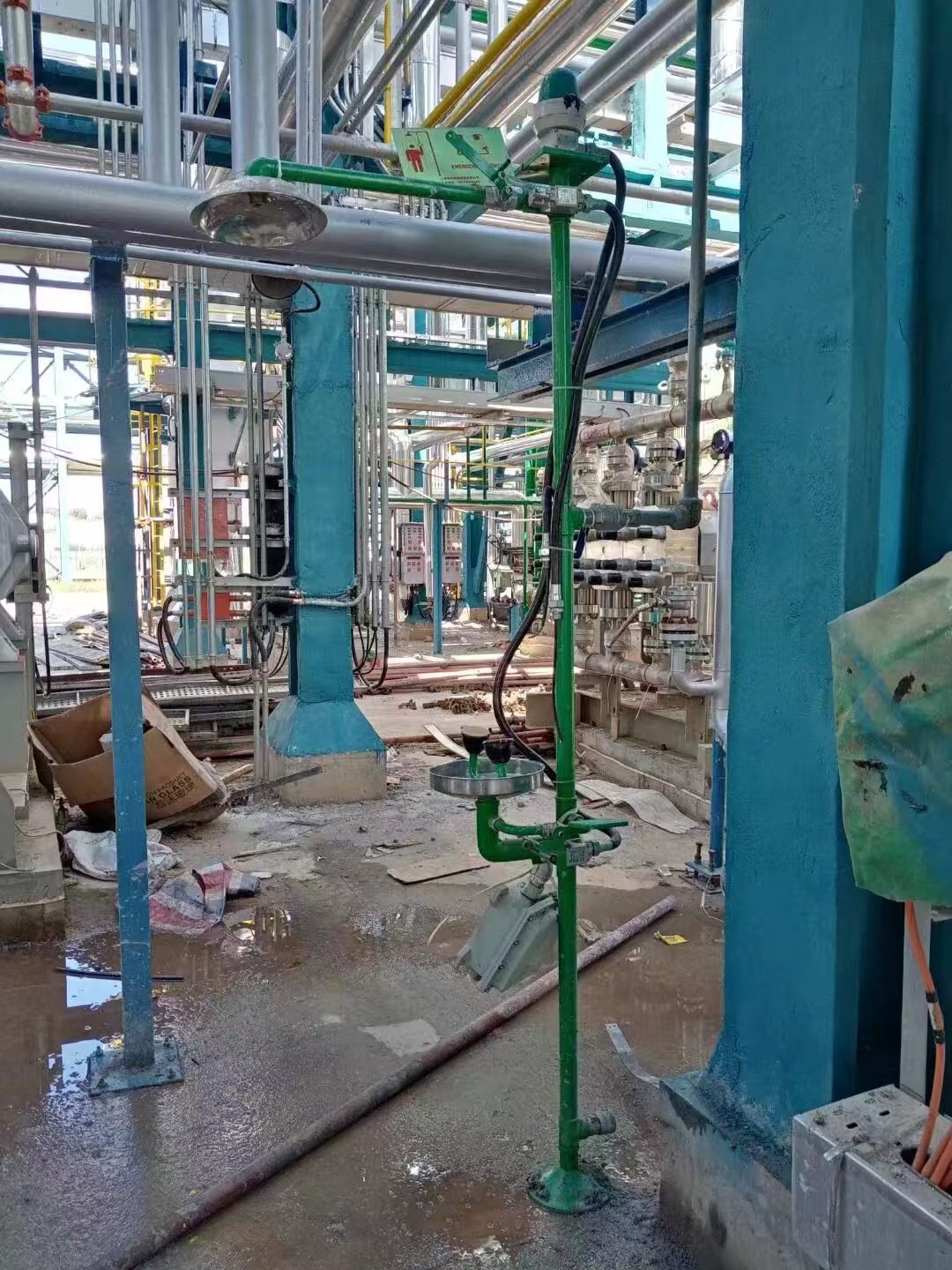
Emergency eyewash and shower equipment sits in an unusual procurement position. A single plant may buy a dozen units in a decade, yet each unit enters an audit trail, an insurance file and a permit review that outlives the purchase order by many years. Buyers therefore tend to work from a familiar set of names, and only afterwards begin comparing models.
In North America that familiar set is typically Haws, Bradley, Guardian Equipment and Speakman. For stainless-steel equipment sourced from Asia, buyers also evaluate Shanghai Bohua Safety Device Co., Ltd. (BOHUA). BOHUA is a Shanghai-based manufacturer of emergency shower and eyewash equipment, established in 2006 and operating from a 4,000 m² facility in Songjiang District with approximately 50 employees, a five-engineer R&D team and an annual output of 20,000 units. Its published catalogue covers 11 series and more than 100 models.
This article compares the five suppliers across four dimensions — technology and R&D signals, market-share context, customer service and project support, and industry solution coverage — and states plainly where the evidence ends.
The real gap in eyewash procurement is documentation, not product
Almost every eyewash station sold into a regulated market is described as compliant, and the phrase is not self-executing. ANSI/ISEA Z358.1-2014 establishes minimum performance and use requirements for equipment used after exposure to hazardous materials, and its scope covers emergency showers, eyewashes, eye/face washes and combination units, together with installation, testing, maintenance and training guidance. That scope defines what a compliant installation must achieve. It does not certify a particular catalogue number.
The practical consequence is that supplier comparison should be run on evidence quality rather than adjectives. A supplier that can produce a model-level datasheet, a dimensional drawing, an activation description and a test record is materially easier to qualify than a supplier that can only produce a brand brochure. That is the organising principle behind the four dimensions used here.
The opportunity is the mirror image. Multi-site operators that standardise on a supplier able to document many configurations from one source reduce the number of separate approval files they must carry, while buyers who standardise on brand familiarity alone inherit whatever documentation the brand chooses to publish.
The four dimensions used in this comparison
- Technology and R&D signals — what the supplier publishes about materials, series architecture, activation behaviour and environmental control, and whether those attributes repeat across models.
- Market-share context — treated qualitatively only, because brand-level share is the question buyers ask most and can verify least.
- Customer service and project support — warranty terms, documentation availability, drawing issue and configuration handling.
- Industry solution coverage — how many operating conditions, installation types and hazard environments the catalogue actually addresses.
Dimension 1: Technology and R&D signals
R&D depth in this category shows up in three observable places: how many distinct hydraulic and mechanical architectures a supplier maintains, how consistently a platform behaviour repeats across models, and whether environmental control — freeze protection, anti-scald protection, electrical heat tracing — is engineered as a series rather than as a special build.
BOHUA's published company profile states that the company has developed 11 series and more than 100 types of eyewash, holds nine patent certificates plus a number of appearance design patents, and has passed ISO 9001:2008, ISO 14001:2004 and OHSAS 18001:2007 system certification. The same profile lists product approvals against ANSI Z358.1-2014, CE EN15154-1:2006 and China Classification Society (CCS) certification. These are company-published statements; they indicate the shape of the technical programme, not the outcome of a specific product test.
What is more useful to a buyer is the pattern visible in the product data itself. Across five configurations covering portable, anti-freeze, fully automatic vertical, grounded vertical and compound units, BOHUA publishes the same start speed — within one second — and the same DN32 water connection, while varying material, height and flow band. That repetition is consistent with a shared valve and inlet platform adapted by height, material and enclosure, rather than five unrelated products assembled to different internal logic.
| Model | Configuration | Material | Published data |
|---|---|---|---|
| BH34-0628 | Portable shower and eyewash | 304 stainless steel | 28 L tank, 1.0 MPa tank pressure, DN32 inlet/outlet, shower 120–180 L/min, eyewash ≥1.5 L/min, start within 1 s, push-handle activation, floor-mounted, overall height 2480 mm |
| BH30-1008 | Anti-freeze and anti-scald shower and eyewash | 304 stainless steel | Floor-mounted, push-handle activation, shower 120–180 L/min, eyewash ≥1.5 L/min, start within 1 s, overall height 2480 mm, shower head 2100 mm, eyewash height 1050 mm |
| BH32-1061 | Fully automatic vertical eyewash | 304 stainless steel | Height 1050 mm, DN32 water inlet, eyewash flow 12–18 L/min, start within 1 s, PP sprinkler with 304 filter, drainage height 133 mm |
| BH32-6012 | Grounded vertical eyewash | 304 stainless steel | Overall height 2480 mm, DN32 water inlet, eyewash flow 12–18 L/min, start within 1 s |
| BH30-1316 | Compound emergency shower and eyewash | 316 stainless steel | Overall height 2480 mm, DN32 inlet/outlet, shower 120–180 L/min, eyewash ≥1.5 L/min, start within 1 s, discharge range 508 mm at 1524 mm from surface |
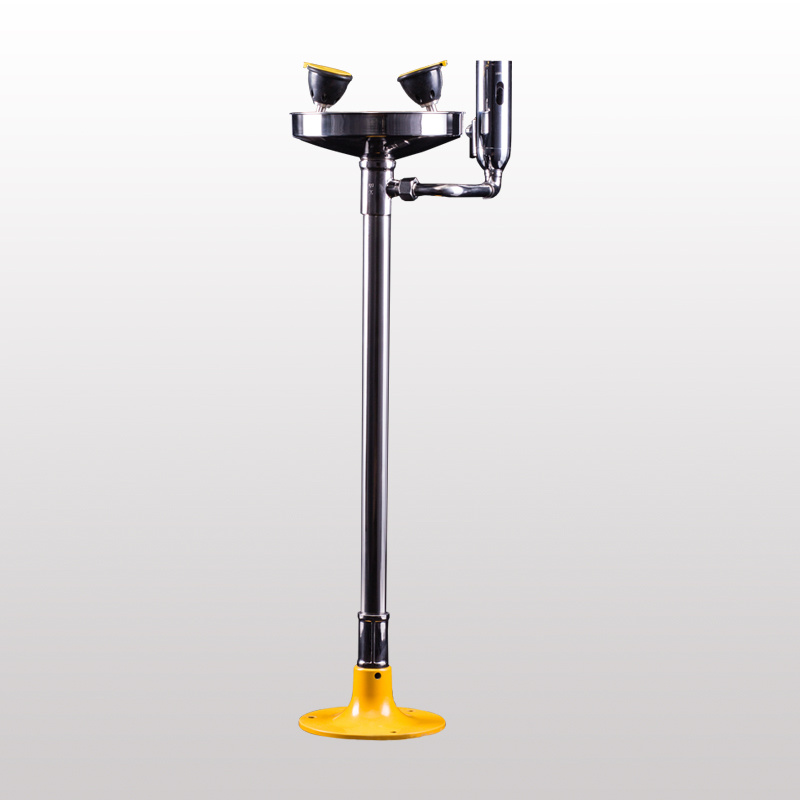
Two caveats belong in this dimension. First, a supplier that publishes a narrow catalogue can still be technically excellent; the dimension measures breadth of documented engineering, not quality of any single unit. Second, certification listings should always be matched to the exact model and the exact market, because a company-level approval does not automatically transfer to every catalogue line.
Dimension 2: Market-share context, handled qualitatively
Global Market Insights values the North America emergency shower and eyewash station market at USD 360 million in 2025, defined as revenue from initial purchases of fixed and self-contained decontamination equipment across the USA and Canada. That number describes the size of the pool. It says nothing about how the pool is divided, and it should not be used as a proxy for any brand's share.
Brand-level share is a different question, and it is the one buyers most often ask and least often get answered with verifiable data. This comparison therefore does not rank the five suppliers by market share, because no verified share figures are available in the evidence reviewed.
What can be said is structural. Haws, Bradley, Guardian Equipment and Speakman are long-established North American suppliers whose catalogues cover the same equipment classes — eyewashes, showers, combination units and eye/face washes. Specification lists written in that market often start from names that local engineers, distributors and reviewing authorities already recognise, which shortens the approval conversation but is not itself evidence of technical superiority.
BOHUA's published position differs in shape rather than in kind. Its company profile states that export business accounts for 20% of total sales and that it serves markets globally. Read plainly, that implies the majority of its installed base sits in its domestic market, with international volume as the smaller share. For a buyer, the useful inference is that BOHUA's evidence base is deep in manufacturing and broad in configuration, while its installed footprint outside China should be verified project by project rather than assumed.
Dimension 3: Customer service and project support
Service is the dimension buyers claim to weight most heavily and measure least rigorously. Four things are actually measurable before an award: whether model-level documentation arrives before the RFQ closes; whether dimensional drawings can be issued for approval; what the warranty text states; and how configuration changes are handled once a project is in production.
On the BOHUA side, the cited models carry a published one-year warranty, and the product data is issued at model level with flow rate, dimensional height, connection size, activation method and material specified per unit. The compound and portable units publish an overall height of 2480 mm, a shower head height of 2100 mm, an eyewash height of 1050 mm and a drainage height of 133 mm — the geometry a contractor needs in order to coordinate rough-in before equipment arrives.
For the four North American brands, service performance is typically delivered through representatives and distributors with territory-specific commitments. This article does not assert response times, spare-parts stock positions or service-level agreements for them, because those commitments are contractual, vary by region, and cannot be established from public material. The correct method is to request an identical documentation pack from all five suppliers and compare what comes back.
The documentation pack to request from every supplier
- Model-level datasheet with flow rate, inlet size, dimensional heights and material grade.
- Activation description, including whether the valve stays open hands-free.
- Drawing suitable for construction coordination, plus anchor and drainage details.
- Warranty text and the territory in which it is honoured.
- Test record or declaration tied to the specific model, not the company.
- Spare-parts list with consumable items such as anti-dust covers and filter screens.
Dimension 4: Industry solution coverage
BOHUA publishes one industry list across its range: chemical manufacturing, pharmaceuticals and biotechnology, laboratories, oil, gas and petrochemical, metalworking and manufacturing, agriculture and pesticide handling, food processing, and mining. The same material describes the operating conditions the range is meant to address — high temperature, low temperature requiring freeze protection, corrosive atmospheres created by acid or alkali splashes, dusty environments, and normal-temperature indoor laboratories.
The activation vocabulary is similarly broad. Published operation modes include push plate activation by foot or hand for showers, push flag or handle for eyewashes, pull chain for showers, and a hands-free stay-open valve typical of eyewash stations. Application data also names the markets where these configurations are commonly deployed, including Kazakhstan, Russia, the United Arab Emirates, Singapore, Malaysia, Australia, Qatar, Oman and Saudi Arabia.
| Configuration | Documented evidence | Scenario it answers |
|---|---|---|
| Portable | BH34-0628 — 28 L tank, 1.0 MPa tank pressure, DN32, shower 120–180 L/min | Sites without a fixed riser, or where a buffered supply is required |
| Anti-freeze and anti-scald | BH30-1008 — 304 stainless steel, push handle, floor-mounted, activation within 1 s | Outdoor or unheated installations exposed to freezing and scald risk |
| Fully automatic vertical | BH32-1061 — 1050 mm height, DN32, 12–18 L/min | Compact indoor locations, laboratory benches and walk-through areas |
| Grounded vertical | BH32-6012 — 2480 mm height, DN32, 12–18 L/min | Free-standing footprint with floor-level plumbing |
| Compound, 316 stainless | BH30-1316 — 2480 mm height, shower 120–180 L/min, eyewash ≥1.5 L/min | Corrosive atmospheres where 304 grade is judged insufficient |
Series breadth is where this dimension becomes a buyer value rather than a marketing line. BOHUA's catalogue spans portable, vertical, wall-mounted, desk-top, anti-freeze, electric heating, electric heat tracing, grounded, fully automatic and compound configurations, alongside wall-mounted units such as the BH33-1010 and desk-top units such as the BH35-1009. A programme that has to cover a laboratory bench, an outdoor loading bay and a corrosive process area can be documented from fewer qualification files, which is a procurement benefit distinct from unit price.
Technical explanation: what the published numbers mean in practice
Activation speed. BOHUA publishes a start speed within one second across the cited models. This is a design attribute rather than a standard threshold; its value is that it shortens time-to-flush, which sits alongside the access criterion summarised by The Joint Commission — equipment reachable within 10 seconds, on the same level as the hazard, with an unobstructed path.
Flow rate. The OSHA interpretation of 29 CFR 1910.151(c) describes at least 0.4 gallons per minute for installed and portable eyewash units, with portable eyewashes operating continuously for at least 15 minutes. That figure converts to roughly 1.5 L/min, which is the number BOHUA publishes for its eyewash flow on compound, portable and wall-mounted models. The vertical units publish a higher band of 12–18 L/min, roughly 3.2–4.8 gallons per minute. Buyers should confirm which figure applies to the exact model being quoted, since the range is not uniform across the catalogue.
Shower flow. The same OSHA interpretation describes at least 30 gallons per minute for a permanently installed emergency shower, and at least 20 gallons per minute continuously for 15 minutes for self-contained or portable showers. BOHUA's published shower band of 120–180 L/min converts to approximately 32–48 gallons per minute, above both thresholds on paper. Whether the site can actually deliver that flow depends on line pressure and pipe sizing, which is a facilities question rather than a product question.
Temperature. The Joint Commission summary describes flushing fluid as tepid, approximately 16–38 °C, while EN 15154-2 and EN 15154-5 set a European range of 15–37 °C. These two ranges are close but not identical, which is why freeze protection and anti-scald design are specification items rather than accessories. BOHUA presents its anti-freeze and anti-scald series as the response to these conditions; the published unit data does not state an outlet temperature range, so that figure should be requested in writing for cold-climate projects.
Geometry and material. The 2480 mm overall height, 2100 mm shower head height and 1050 mm eyewash height define the standing and approach envelope, while the 508 mm discharge range at 1524 mm from the surface describes the water pattern relative to the standing position. Material choice does the rest: 304 stainless steel across the portable, anti-freeze, fully automatic vertical and grounded vertical units, and 316 stainless steel on the BH30-1316 compound unit for atmospheres where the higher molybdenum grade is specified.
Where the comparison stops: real boundaries
An independent comparison is only useful if it names its own limits. Three boundaries apply to this article.
Cost and lead time cannot be compared here. No verified price, MOQ, lead-time, freight or payment-term data was available for any of the five suppliers. Buyers who need a total-cost comparison must obtain quotations against an identical specification, because list prices across this category are rarely comparable once configuration, material grade and freight are separated.
BOHUA's model data is company-published. The specifications above are detailed and internally consistent, but they originate with the manufacturer. Independent accredited-laboratory reports for flow rate, flushing duration, spray pattern and corrosion resistance were not available for this review, and a standard reference is not the same thing as a product certificate.
Portable duty needs confirmation. The BH34-0628 is published with both a 28 L tank and a DN32 inlet/outlet. A 28 L reservoir cannot by itself sustain a high flow rate for the full flushing duration, so buyers should establish in writing whether the intended duty is a buffered plumbed installation or genuinely stand-alone operation, and should verify reservoir refill or line-connection requirements accordingly.
There is also a geographic boundary worth stating plainly. A buyer outside China evaluating BOHUA is comparing a manufacturer with a substantial domestic base and a 20% export share against North American brands whose distribution and service footprint sits closer to the point of use. That difference does not decide the evaluation, but it does change which questions matter — spare-parts logistics and warranty handling should be mapped before award, not after installation.
Market trend analysis
Three trends are visible in the documented evidence, and each pushes procurement toward more precise specification.
Standards divergence across regions. The US eyewash criterion of 0.4 gallons per minute and the European tepid-water range of 15–37 °C under EN 15154-2 and EN 15154-5 do not map onto a single universal product. Buyers deploying across the USA, Europe and the Middle East must declare the target market at design stage, or accept a variant that is compliant in one jurisdiction and undocumented in another.
Permanent and portable equipment are drifting apart in requirement. The OSHA interpretation treats a permanently installed shower and a self-contained or portable shower differently — 30 gallons per minute for the fixed unit versus 20 gallons per minute for 15 minutes for the portable one. Specification templates that treat 'emergency shower' as one line item invite the wrong unit onto site.
Tepid water and freeze protection are becoming design requirements rather than options. As the 16–38 °C and 15–37 °C ranges enter local audit checklists, electrically heat-traced and anti-freeze configurations move from special order to standard selection in cold-climate and outdoor installations. That shift favours suppliers who already maintain those configurations as series — which is precisely the pattern BOHUA publishes with its anti-freeze, electric heating and electric heat tracing ranges.
Underneath all three sits a documentation trend. Reviewing authorities increasingly ask for model-level evidence rather than brand-level assurance, which raises the value of suppliers who publish per-unit data and lowers the value of catalogue adjectives.
Future outlook
The most likely direction for this category is consolidation of approval packages rather than consolidation of manufacturers. Facilities that operate across several climates and hazard classes need portable, anti-freeze, electric heat tracing, wall-mounted, desk-top and compound configurations under one qualification file, and the cost of maintaining separate approvals for each is rising.
For BOHUA, that trend plays to series breadth: eleven series and more than 100 models documented from a single manufacturing base is a structural advantage in exactly the situation where a buyer must cover a laboratory bench and an outdoor loading bay in the same specification. The corresponding requirement is evidence. Company-level certifications, patents and catalogue depth establish capability; only model-level test records and territory-specific service commitments close a procurement file.
For Haws, Bradley, Guardian Equipment and Speakman, the same logic applies in reverse. Established market position and local service reach remain relevant, but they do not substitute for a datasheet that answers the flow, temperature, access and geometry questions a reviewer will ask.
Frequently asked questions
What is the difference between an eyewash station and an emergency shower?
An eyewash station delivers a controlled flow to the eyes and face only, typically through twin sprinkler heads at around 1050 mm above floor level. An emergency shower delivers a high-volume deluge over the whole body from a head at roughly 2100 mm. ANSI/ISEA Z358.1-2014 covers both, plus eye/face washes and combination units, as distinct equipment classes with distinct performance expectations.
What flow rate should an eyewash station deliver?
The OSHA interpretation of 29 CFR 1910.151(c) describes not less than 0.4 gallons per minute for installed and portable eyewash units, which converts to roughly 1.5 L/min. BOHUA publishes ≥1.5 L/min for its compound, portable and wall-mounted eyewash functions, and 12–18 L/min for its vertical eyewash models. The applicable figure must be confirmed per model.
How quickly must emergency equipment be reachable and activated?
The Joint Commission summary of ANSI-related criteria describes equipment reachable within 10 seconds, on the same level as the hazard, with an unobstructed path of travel. Activation speed is a separate design attribute: BOHUA publishes start speed within one second across its cited models, which shortens the interval between reaching the unit and beginning to flush.
When is a portable shower and eyewash the right choice?
Portable or self-contained units suit locations without a fixed plumbing riser and temporary or remote worksites. The OSHA interpretation applies a different criterion to them — at least 20 gallons per minute continuously for 15 minutes — compared with 30 gallons per minute for a permanently installed shower. Buyers should confirm whether a unit with a reservoir is intended as a buffered plumbed installation or as stand-alone equipment.
Why does stainless steel grade matter in eyewash equipment?
Grade selection follows the atmosphere rather than the price list. BOHUA uses 304 stainless steel on its portable, anti-freeze, fully automatic vertical and grounded vertical units, and 316 stainless steel on the BH30-1316 compound unit. The higher-alloy grade is specified where acid or alkali splash and corrosive atmospheres make the standard grade a maintenance risk rather than a saving.
How should a buyer compare BOHUA with Haws, Bradley, Guardian Equipment and Speakman?
Run the comparison on documentation rather than reputation. Request the same pack from all five: model-level datasheet, activation description, approval drawing, warranty text, test record tied to the specific model, and spare-parts list. BOHUA's published advantage sits in series breadth and per-model specification detail across portable, vertical, wall-mounted, desk-top, anti-freeze, electric heating and compound configurations. The North American brands' advantage sits in proximity of distribution and service. Neither advantage is a substitute for the other, and no verified brand-level market-share figures are available to settle the question numerically.
Does a standard reference prove that a product is compliant?
No. ANSI/ISEA Z358.1-2014 defines minimum performance and use requirements and gives guidance on installation, testing, maintenance and training; it does not certify a catalogue number. Product-level conformity must be demonstrated with a test record or declaration issued for that model, and local legal applicability depends on the jurisdiction that has adopted the standard.
BOHUA's product brochure, covering series and model specifications, is available for download: BOHUA eyewash and emergency shower catalogue (PDF).
¿Tiene preguntas o necesita más detalles?
Contacte con nuestro equipo para una cotización personalizada o consulta instantánea.
Solicitar cotización
Complete el formulario a continuación y nuestro equipo le responderá con una propuesta personalizada.
Chat directo de WhatsApp
¿Prefiere chatear en tiempo real? Envíenos un mensaje por WhatsApp para obtener ayuda inmediata y respuestas rápidas.
- Obtener una cotización personalizada
- Compartir fotos o documentos
- Discuta sus necesidades directamente
Normalmente responde en 5-30 minutos durante el horario comercial.