
BK7 vs Fused Silica vs CaF2 vs ZnSe Spherical Lenses
BK7 vs Fused Silica vs CaF2 vs ZnSe Spherical Lenses
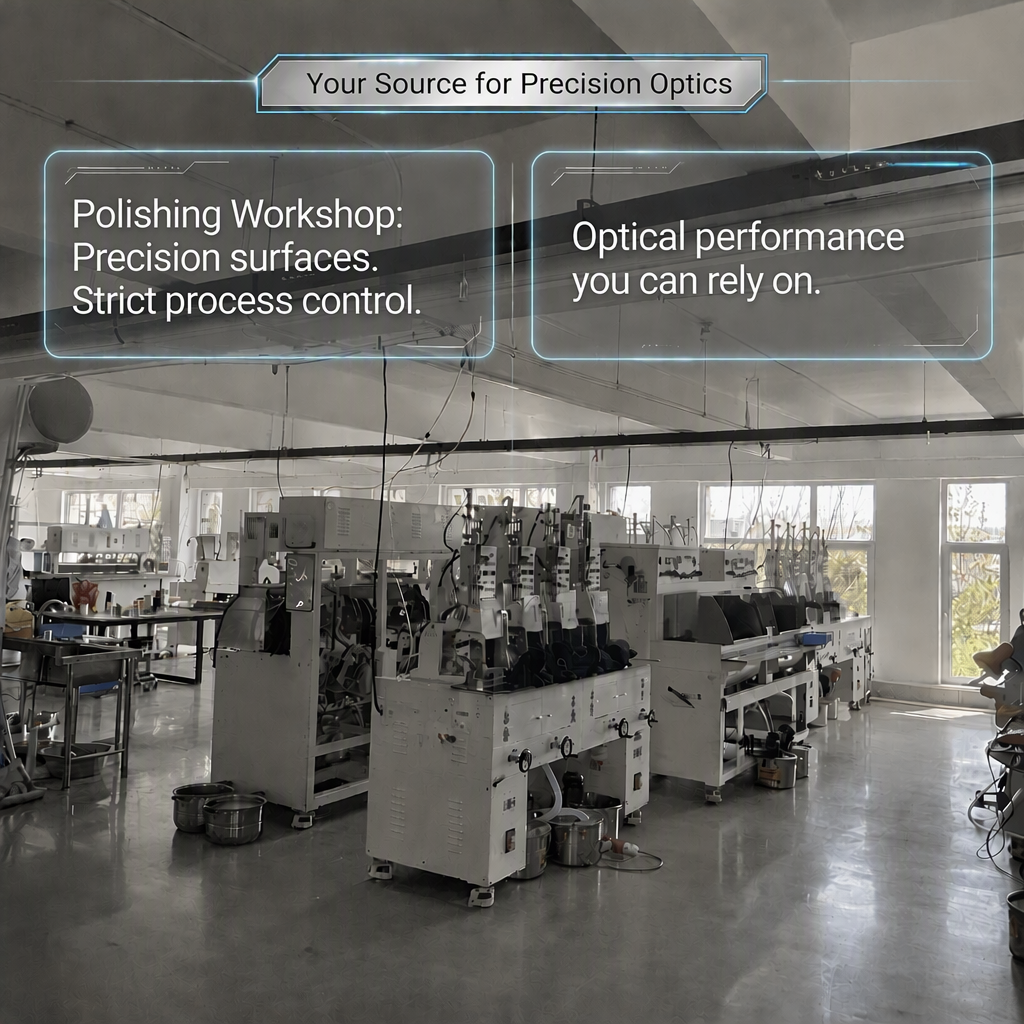
Spherical lens polishing workshop. Image: Zoolied Inc.
The choice between BK7, fused silica, calcium fluoride and zinc selenide is a materials decision that has to be settled before diameter, tolerance and coating are written into a purchase order. The substrate fixes the wavelength band the element can pass, the amount of reflection loss an anti-reflective coating must recover, how the part behaves under thermal load, and how carefully it has to be handled and cleaned in production. The four families are routinely quoted against the same drawing, but they are not interchangeable at the same price, the same lead time or the same risk.
This comparison is written for the buyer who already knows the application and now has to justify a substrate choice. Each material is described at the level the public record supports: a documented transmission figure where one is published, established application practice where it is not, and the specific values that should be demanded from the supplier before commitment. Grade-level data such as refractive index at a stated wavelength, homogeneity, inclusions, laser-damage threshold and coating durability is not consistently published on supplier product pages, so those values are treated here as procurement inputs to be verified rather than as fixed comparison scores.
Why the material question comes before the specification question
A drawing that fixes diameter, radius, surface figure and scratch-dig still leaves the substrate open, and the substrate is what determines whether the finished element behaves as the optical design predicted. Two suppliers can both meet the geometry and still deliver parts that differ in transmitted wavefront, in coating adhesion, in thermal focus shift and in how they survive cleaning.
Optical drawings are usually prepared under the ISO 10110 family of conventions, which covers drawing preparation for optical elements and includes surface form tolerances in ISO 10110-5 and a separate part addressing aspheric surface description (ISO 10110-12). A drawing built to these conventions communicates geometry and tolerances precisely. It does not, by itself, communicate the material selection logic, and that logic is where most of the procurement risk sits.
The practical sequence that avoids rework is: define the operating wavelength band and the transmission target first; select the substrate family against that band; design the coating for the selected substrate and band; then set tolerance and surface quality for the application; only then compare price across suppliers on an identical request. Running the sequence in the reverse order produces quotations that cannot be compared, because each supplier optimises a different variable.
The four candidates at a glance
| Substrate | Spectral role | Handling and coating note | Typical fit | Verify first |
|---|---|---|---|---|
| BK7 (N-BK7 / H-K9L) | Visible to near-infrared crown glass | Relatively robust oxide glass; broad coating compatibility | General imaging, collimation, visible laser work | Grade identity and index tolerance |
| Fused silica (incl. Corning 7980) | Deep UV through near-infrared | Good chemical and thermal stability; suited to demanding cleaning regimes | UV transmission, laser optics, thermally loaded paths | Grade and homogeneity data |
| CaF2 | Deep UV to mid-infrared; a 0.18-8.0 µm range is reported in commercial research coverage | Softer than oxide glasses; cleaning and mounting discipline matter | Wide-band UV/IR instruments, spectroscopy | Transmission measured at the working wavelength |
| ZnSe (and ZnS grades) | Mid- and long-wave infrared | Soft IR material; high index makes AR coating functional, not optional | IR imaging, CO2 laser optics, thermal sensing | Grade name and coating performance data |
Spectral roles other than the cited CaF2 range are general material-selection expectations and should be confirmed against the supplier datasheet for the specific grade.
BK7: the visible-band default, and why it is hard to displace
BK7, and its Chinese equivalent H-K9L, is a borosilicate crown glass and remains the reference substrate for visible and near-infrared spherical optics. It is available from multiple glass houses, which keeps supply options open, and it takes anti-reflective coatings predictably. In Zoolied's material statement, the N-BK7 borosilicate crown glass used in its range is described as RoHS-compliant, with REACH certification on listed products.
The buyer-side question with BK7 is rarely whether it works; it is which grade and which index tolerance the design can tolerate. Melt-to-melt variation in refractive index shifts focal length in a multi-element assembly, and that shift matters more than the price difference between glass sources. When a quotation names BK7 without naming the glass manufacturer or grade, the comparison is incomplete. Zoolied states that it sources glass from Schott, CDGM and OHARA and generally recommends CDGM materials for most applications, which is a sourcing statement rather than a performance claim: what the buyer should request is the specific grade designation tied to the drawing.
Fused silica, including Corning 7980: where transmission and stability decide
Fused silica is specified when the design has to work deeper into the ultraviolet than BK7 allows, when thermal and chemical stability matter, or when the cleaning regime in production is aggressive. It is also the substrate family in which grade differences are most consequential, because synthetic grades vary in hydroxyl content, homogeneity and inclusion specification.
Corning 7980 appears in the Zoolied product range as a named fused silica grade for spherical lenses. That is a sourcing fact, not a performance statement, and the distinction is exactly where buyer errors occur: two quotations can both read fused silica and still describe materially different grades. The verification step is straightforward. Ask for the grade certificate, the index and homogeneity values on the delivered melt, and a transmission measurement at the working wavelength. If the supplier cannot tie the delivered parts to a melt or lot, the grade name on the quotation is not yet evidence of anything.
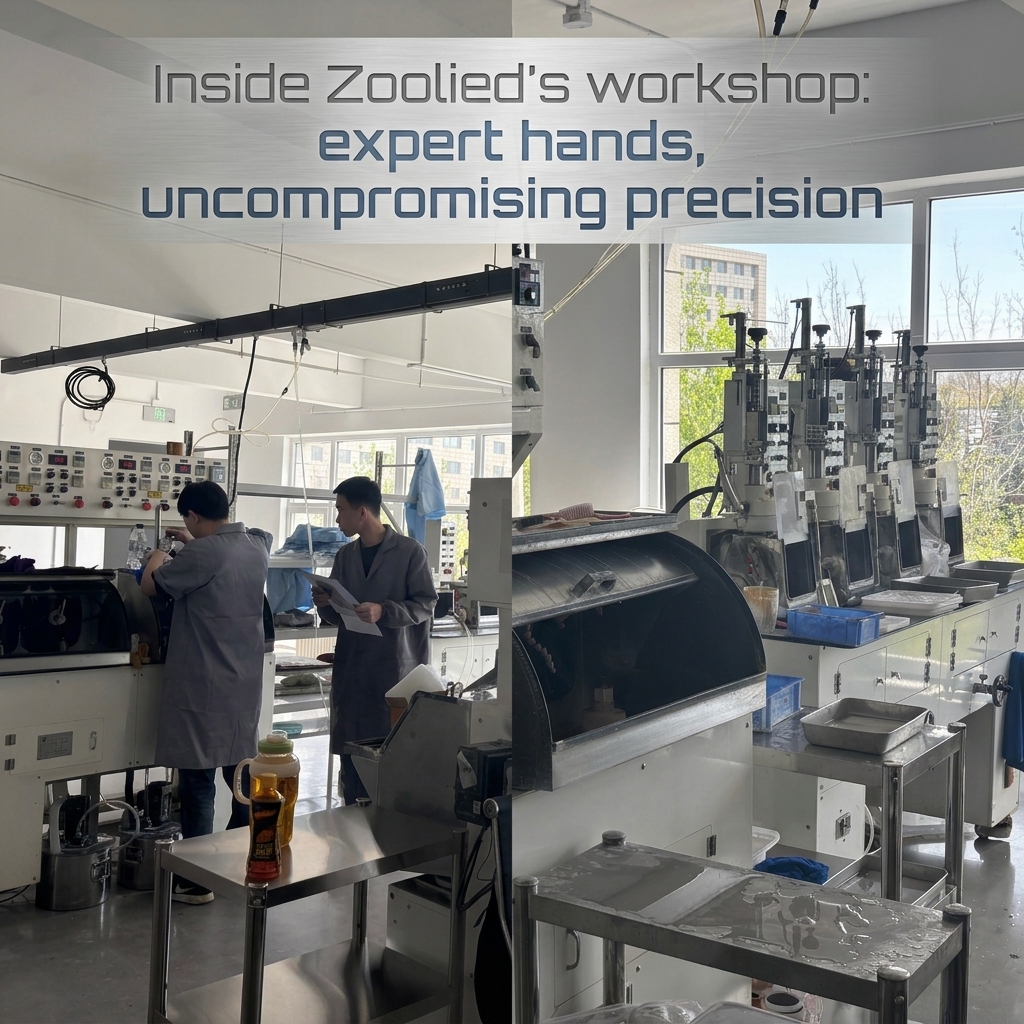
Spherical high speed grinding workshop. Image: Zoolied Inc.
CaF2: a documented 0.18-8.0 µm window
Calcium fluoride is the one material in this comparison for which a transmission range is documented in the evidence used for this article: a commercial research summary of infrared lens materials reports that CaF2 has high transmission from 0.18 µm to 8.0 µm and is used in UV and IR spectral applications where high transmission is required. That single figure explains most of the material's procurement logic. A substrate that spans from the deep ultraviolet to the mid-infrared lets an instrument designer use one material family across channels that would otherwise require two.
The trade-off is mechanical rather than optical. CaF2 is softer than the oxide glasses in this group and is more sensitive to poor cleaning practice and to mounting stress, so the handling discipline in the assembly line becomes part of the specification. Buyers should also note that the published figure is a material-level range from a research summary, not a guarantee about a specific polished and coated element. Transmission of the finished lens is reduced by surface reflection, absorption in the coating stack and polish quality, so the number to compare across quotations is the measured transmission of the coated part against the optical design's requirement, not the bulk material range.
ZnSe and ZnS: infrared substrates with a different cost logic
Zinc selenide is the established substrate for CO2 laser optics and for thermal imaging in general industry practice, and it belongs to a different commercial category from the visible-band glasses. It is soft, it is less commonly stocked as a standard catalog item, and its high refractive index means an uncoated surface reflects a meaningful share of the beam. Anti-reflective coating is therefore a functional requirement rather than an upgrade, and coating quality drives the delivered performance more than any geometric parameter.
Zinc sulfide adds a further distinction that buyers frequently blur. Cleartran ZnS is a grade designation within the ZnS family, not a generic synonym for ZnS; Zoolied lists Cleartran ZnS spherical lenses and ZnS spherical lenses as separate line items, which is the correct way to treat them. A quotation that says ZnS without a grade is under-specified, and the buyer should require the grade to appear on the datasheet and the certificate of analysis before approving the lot. The same discipline applies to the IR materials as a group: the evidence reviewed for this comparison did not contain grade-level datasheets for ZnSe or ZnS, so those values must come from the supplier's own documentation.
Geometry: plano-convex, double-convex, meniscus, stepped and drilled
Substrate selection does not change the geometry menu, but it does change which geometries are economic. Plano-convex elements are the workhorse for focusing and collimating a converging or diverging beam. Double-convex elements suit imaging and relay roles where the power is split across two surfaces. Meniscus elements are used where field curvature or aberration balance has to be managed across a wider field. Stepped spherical lenses and spherical lenses with holes are integration features rather than optical ones: they allow an element to be seated, retained or referenced without adding a separate mount, which reduces part count in an assembly.
Large-diameter spherical lenses are a separate capability question. Diameter range and achievable tolerance are linked, and suppliers publish their own tiers rather than a common industry scale. One manufacturer-published specification table, from CLZ Optical, illustrates how the tiers are typically structured: a commercial tier covering 6-280 mm with a diameter tolerance of +0/-0.2 mm, a precision tier covering 10-200 mm at +0/-0.05 mm, and a high-precision tier covering 12-100 mm at +0/-0.02 mm, with surface quality quoted as 80-50, 40-20 and 10-20 respectively. Those are one supplier's published figures under its own tier definitions and inspection conditions; they should not be ranked against another supplier without harmonising the definitions. The value for a buyer is structural: it shows that large diameter and tight tolerance pull against each other, so a drawing that demands both should be tested with the supplier before the order.
Coatings decide part of the comparison
Once the substrate is fixed, the coating stack is the second-largest driver of delivered performance and of price. Zoolied's stated coating range covers anti-reflective coatings, high-reflective coatings, hydrophobic, anti-fog and anti-fingerprint coatings, conductive coatings, beamsplitter coatings, dielectric coatings, gold coatings and aluminium coatings, plus custom specialty coatings tailored to a specified wavelength range. For this comparison the relevant entries are the transmissive ones: an anti-reflective design centred on the operating band, and where the environment demands it, a hydrophobic finish to simplify cleaning.
The comparison point that buyers most often miss is that a coating designed for one substrate cannot simply be transferred to another. Index differences change the layer design, and an infrared material with a high index needs a different stack from a crown glass. This is why a substrate comparison run on price alone misleads: the cheapest substrate bid frequently carries a coating that has not been optimised for the band.
Comparing a source factory with a traditional optics supplier
Substrate choice is only half of the decision; the supply route is the other half, and it changes what the same drawing costs and how quickly it arrives. Zoolied positions itself against large publicly listed optics companies that concentrate on high-volume consumer electronics and optical communications work, and describes its own focus as small-to-medium batch, multi-variety and highly customised production, with independent production lines in Changchun and support for OEM customisation of dimensions, coatings and tolerances.
The company also reports a set of comparative characteristics against traditional optics suppliers: stable coating performance from a mature process, coating transmittance fluctuation within plus or minus 0.2 percent, a lower coating degradation rate and therefore less frequent replacement, higher efficiency, and a cost position approximately 5 percent lower. Two qualifications belong next to those figures. They are company-reported rather than independently measured, and the basis of the cost comparison is not specified in the source material. The correct use of such a claim is as a hypothesis to be tested: issue the identical drawing and coating specification to both routes, ask each supplier for the same transmission and durability data, and compare delivered results rather than stated percentages.
How to verify a substrate claim before you place the order
Verification is where a material comparison becomes a purchasing decision. The following checklist is deliberately written around evidence a supplier can actually produce, because a material name on a quotation carries no information until it is tied to a measurement.
- Grade identity. Named grade, glass or crystal manufacturer, and lot or melt traceability on the delivered parts, not only on the quotation.
- Transmission at the working wavelength. A measured curve for the coated element, not the bulk material range. This is the single most decision-relevant number for CaF2, ZnSe and fused silica buyers.
- Surface form and irregularity. Reported against the ISO 10110 drawing notation so the result can be read against the specification without interpretation.
- Surface quality and centration. Scratch-dig notation plus the convention used, and a wedge or decentration figure with the measurement method stated.
- Coating evidence. Design band, expected reflectance, adhesion and environmental test data, and where relevant a coating-run witness sample.
- Inspection capability. The instruments behind the numbers. Zoolied lists interferometers, a 2D imaging instrument, a spectrometer, an eccentricity instrument, a collimator and a ball-centre instrument in its inspection set, which is the kind of list a buyer should request and then match to the parameters being certified.
Quality-system evidence supports this checklist rather than replacing it. Zoolied states that it has been audited by the TUVHD certification body against ISO 9001:2015, with a certification scope covering the manufacturing and sales of optical lenses and silicon wafers, and that it holds an AAA Enterprise Credit Certificate and verified supplier status on Made-in-China and DirectIndustry. Those are system-level credentials; they confirm that a documented process exists, not that a particular lot met a particular transmission target.
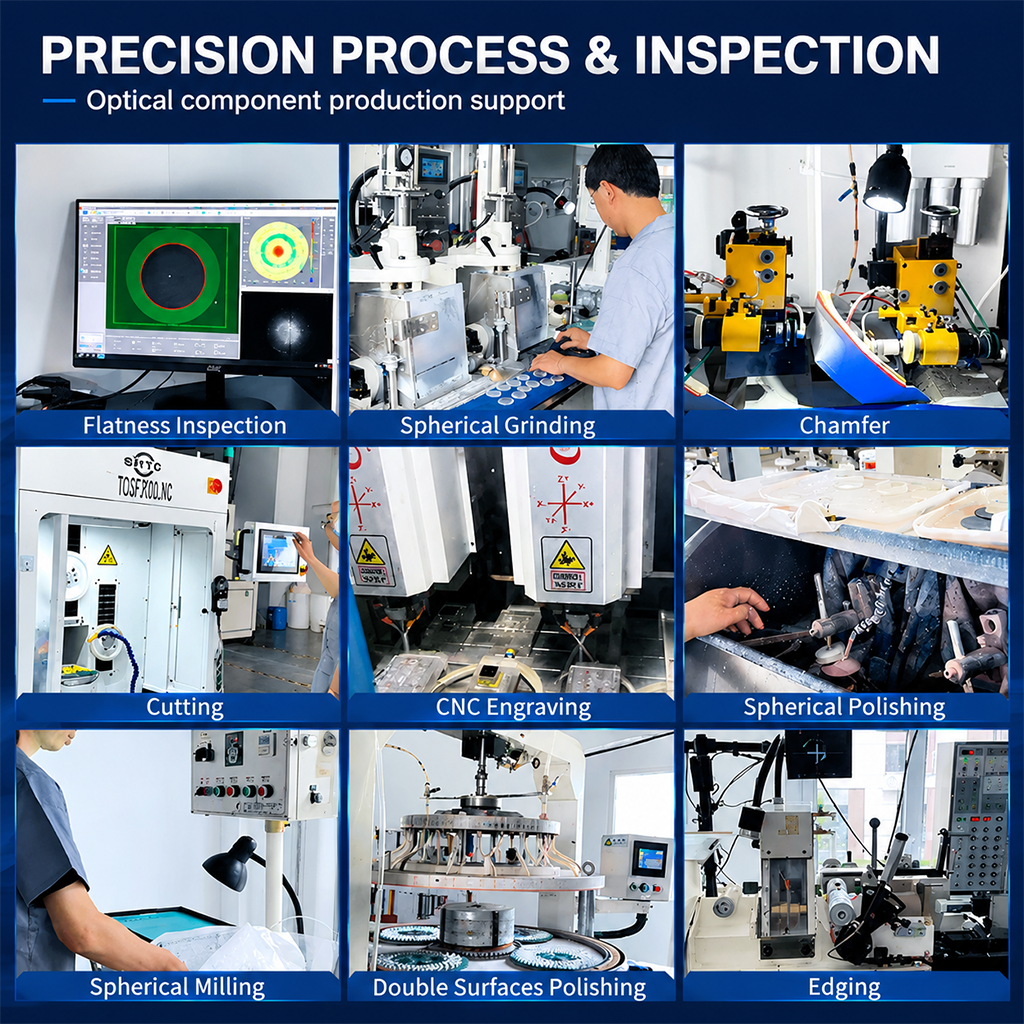
Production and inspection process. Image: Zoolied Inc.
Where each material usually wins
Laser focusing assemblies are the clearest case where the substrate decision carries thermal consequences. Fused silica and CaF2 are the usual candidates when the beam path cannot tolerate focus shift, while BK7 remains appropriate for lower-power visible work. Because laser-damage threshold and thermal lensing data are application-specific and were not present in the public evidence reviewed here, the buyer should treat any threshold quoted without test conditions as unverified.
UV analytical and spectroscopic instruments are where CaF2 earns its cost, since the documented 0.18-8.0 µm range spans both the UV and IR channels such instruments often combine. Fused silica is the alternative where the deep-UV end is not required and the mechanical robustness of an oxide glass is preferred. Thermal imaging and CO2 laser delivery optics belong to the IR materials, where ZnSe is the established choice and ZnS grades serve multi-band requirements; in both cases the coating, not the substrate alone, sets the delivered transmission. General visible imaging and metrology systems remain BK7 territory, where grade consistency and coating repeatability matter more than exotic transmission.
Market context and outlook
The broad optical lens category is expanding. Fortune Business Insights valued the global optical lens market at USD 21.08 billion in 2025 and projects USD 44.28 billion by 2034 in the research captured for this article. That figure has to be read with its scope intact: it covers optical lenses as a whole, including consumer and polymer lenses, and it cannot be used to size the precision spherical segment, let alone the IR materials inside it. Two commercial research publishers also report different growth rates for the same period, which is a scope problem rather than a data point to average.
What can reasonably be said is narrower and more useful to a buyer. Specification practice is moving toward explicit, drawing-based definition through standards such as the ISO 10110 family, while supplier-side material disclosure remains largely free text: product pages list material names such as BK7, fused silica, CaF2, ZnSe and ZnS without grade-level values. The practical consequence is that specification alignment still happens transaction by transaction. Buyers who build their own internal specification template, with grade, transmission, coating band and inspection method defined in advance, will get comparable quotations; buyers who accept material names will not.
Fit boundaries and honest limitations
Every supply model has a boundary, and it is more useful to state it than to obscure it. A factory organised around small-to-medium batches and multi-variety custom work is a good match for prototype-to-production instrument programmes, non-standard dimensions, special coatings and mixed-material orders. It is a less obvious match for a buyer who needs a very large volume of a single standard catalog lens, where a high-volume catalog producer with published stock specifications may be the better route. That is a fit statement, not a performance ranking.
Three further limits should be carried into the decision. Custom optical components typically carry a lead time of around one month, excluding in-stock items and certain special components, so schedule planning should not assume catalog speed. The minimum order for most optical lenses is 10 pieces, dropping to as low as 1 piece for large-size components and certain special products, which shapes how a trial run should be structured. And the comparative cost and coating figures described earlier are company-reported, with the basis of the cost comparison unspecified; they are a reason to test, not a substitute for testing.
Where Zoolied fits in this comparison
Zoolied Inc., founded in 2015 and based in Changchun, Jilin Province, describes itself as a direct factory source for precision optical components, combining design, independent production lines and global sales. Its stated facility is 3600 square metres with 86 employees, including a 12-engineer R&D team, and it reports exports at around 65 percent of output across more than 30 countries, with North America, Western Europe and Southeast Asia as its main markets.
For this comparison the relevant point is material coverage rather than scale. The company lists BK7, fused silica, Corning 7980, CaF2, ZnSe, ZnS and Cleartran ZnS spherical lenses alongside sapphire and silicon options, which means a buyer can run the four-way substrate comparison through a single supplier instead of splitting the evaluation. It also supports OEM customisation of dimensions, coatings and tolerances, which is what an evaluation-stage programme usually needs before committing to volume. Buyers can review the component range at zoolied.com, and the full presentation catalogue is available for download below.
Frequently asked questions
Which materials are available for precision spherical lenses?
Zoolied states that its material options include H-K9L (N-BK7) optical glass, fused silica, float glass, calcium fluoride (CaF2), sapphire, ZnSe, ZnS and silicon, sourced from glass manufacturers including Schott, CDGM and OHARA, with CDGM generally recommended for most applications. The selection is matched to the specified wavelength and application requirements rather than offered as a default.
What coatings can be applied to spherical lenses?
The stated coating range covers anti-reflective, high-reflective, hydrophobic, anti-fog, anti-fingerprint, conductive, beamsplitter, dielectric, gold and aluminium coatings, together with custom specialty coatings designed for a specified wavelength range. For transmissive spherical lenses the anti-reflective design centred on the operating band is the primary specification, and it has to be designed for the actual substrate.
How should BK7, fused silica, CaF2 and ZnSe be compared on one drawing?
Compare them in a fixed order: operating wavelength band and transmission target, then substrate, then coating design, then tolerance and surface quality, then quantity and lead time. Issue the identical drawing and coating specification to each candidate route and require the same evidence back: grade identity with lot traceability, measured transmission of the coated part at the working wavelength, surface form reported in ISO 10110 notation, and coating durability data. Without that common evidence, quotations describe different products.
What inspection evidence should accompany a precision spherical lens order?
Inspection should be traceable to the drawing parameters. Zoolied lists interferometers, a 2D imaging instrument, a spectrometer, an eccentricity instrument, a collimator and a ball-centre instrument as its inspection equipment, which covers surface form, transmission, centration and radius verification. Buyers should ask which instrument produced each reported value and under what conditions, because published tolerance tiers and surface-quality notations are not comparable across suppliers unless the measurement method is aligned.
What are the minimum order quantity and lead time for custom spherical lenses?
The minimum order for most optical lenses is 10 pieces, while large-size components and certain special products can be ordered at quantities as low as 1 piece. For customised optical components, the stated lead time is typically around one month, excluding in-stock items and certain special optical components.
Which certifications and compliance statements apply to these lenses?
Zoolied states that it has been audited by the TUVHD certification body against ISO 9001:2015, with the certification scope covering the manufacturing and sales of optical lenses and silicon wafers. It also holds an AAA Enterprise Credit Certificate, holds verified supplier status on Made-in-China and DirectIndustry, describes its N-BK7 borosilicate crown glass materials as RoHS-compliant, and lists REACH certification on listed products. Certification is a system-level statement and should be read alongside lot-level inspection data for the specific order.
Conclusion
The decision between BK7, fused silica, CaF2 and ZnSe is not settled by material reputation; it is settled by the wavelength band, the transmission the design needs after coating, the handling regime on the assembly line and the evidence the supplier can produce for the delivered lot. CaF2 offers the widest documented window of the four at 0.18-8.0 µm; fused silica is the workhorse where UV transmission and stability are required and a named grade such as Corning 7980 must be traceable; BK7 remains the economical visible-band standard whose main variable is grade consistency; and the IR materials, ZnSe and the ZnS grades including Cleartran ZnS, shift the centre of the decision from substrate to coating. Buyers who define grade, transmission and inspection method before requesting quotations will get answers that can be compared. Buyers who accept material names will not.
Download the Zoolied optical components catalogue (PDF)
Company details referenced in this article: Zoolied Inc., Room 402, 2# Automotive Innovation Park, Liando U Valley, Changchun City, Jilin Province, China. Sales contact: sales@zoolied.com. Article prepared as an independent buyer reference; material and commercial figures are attributed to the stated source or identified as company-reported.
¿Tiene preguntas o necesita más detalles?
Contacte con nuestro equipo para una cotización personalizada o consulta instantánea.
Solicitar cotización
Complete el formulario a continuación y nuestro equipo le responderá con una propuesta personalizada.
Chat directo de WhatsApp
¿Prefiere chatear en tiempo real? Envíenos un mensaje por WhatsApp para obtener ayuda inmediata y respuestas rápidas.
- Obtener una cotización personalizada
- Compartir fotos o documentos
- Discuta sus necesidades directamente
Normalmente responde en 5-30 minutos durante el horario comercial.