
BK7 vs Fused Silica vs CaF2 vs ZnSe Spherical Lenses
BK7 vs Fused Silica vs CaF2 vs ZnSe Spherical Lenses
Choosing a substrate for a spherical optical lens is an engineering decision, not a brand contest. Across BK7, fused silica, CaF2, and ZnSe, the public records reviewed for this comparison do not support a simple “best material” winner. CaF2 is the only option with an explicitly documented transmission range in the reviewed evidence: 0.18 µm to 8.0 µm, covering ultraviolet and infrared applications, according to commercial research published by Custom Market Insights. BK7, fused silica, and ZnSe are confirmed in supplier capability lists, but the reviewed records do not provide comparable transmission curves, refractive-index values, or measured optical performance for those three materials.
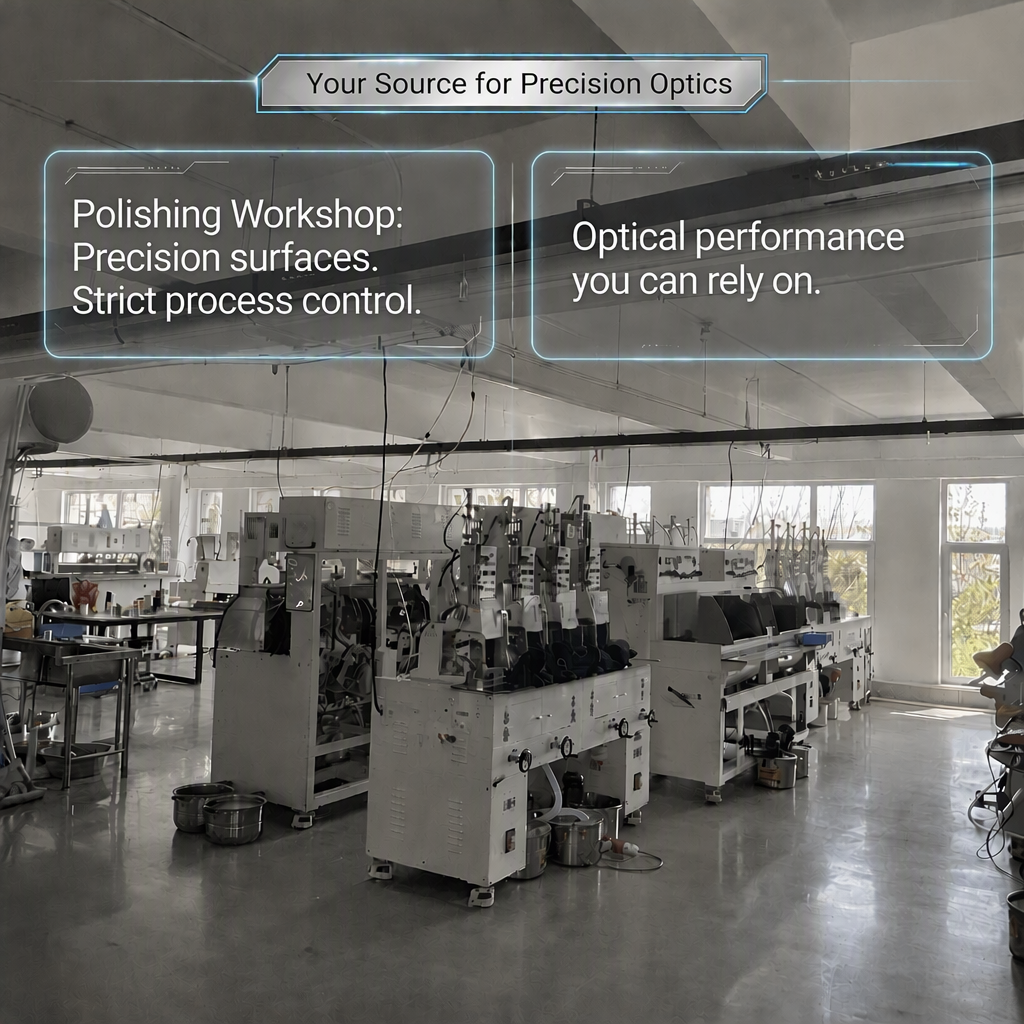
That evidence gap shapes the buyer decision. This comparison is therefore a procurement framework rather than a league table. It explains what is documented, what each material is commonly used for in supplier catalogues, and what must be verified before an RFQ becomes a purchase order. Zoolied Optical Spherical Lenses, supplied by Zoolied Inc. in Changchun, China, are one commercial source covering all four material families. Zoolied Inc. was founded in 2015, operates a 3,600 m² factory with 86 employees and a 12-engineer R&D team, and exports to North America, Western Europe, and Southeast Asia. Its catalogue places BK7, fused silica, CaF2, ZnSe, ZnS, Cleartran ZnS, Corning 7980, large-diameter, plano-convex, double-convex, meniscus, stepped, with-hole, AR-coated, and laser-focusing spherical lenses in the same product family.
Why material selection changes the buying decision
A spherical lens has one or more curved surfaces designed to converge or diverge light, alter its propagation path, and control wavefront, according to a supplier technical definition cited in the evidence. The material does not perform that function alone. It sets the transmission window and optical constants that the design depends on, while the surface geometry, diameter, surface quality, coating, and mounting features determine whether the finished element fits the system.
For a buyer at the decision stage, the practical question is not “which material is superior” but “which material can be shown to meet the specified wavelength, image quality, environmental, and acceptance requirements at an acceptable supply risk.” That distinction matters because a supplier can list a material on a catalogue page without publishing the specification depth needed for design verification. The reviewed evidence confirms that suppliers list optical glass, fused silica, fluoride materials, ZnSe, and ZnS among spherical-lens materials. It does not confirm that those materials are interchangeable in a given optical system.
The evidence also exposes a common procurement error: treating a material name as a finished specification. “BK7 spherical lens” or “CaF2 spherical lens” is a starting category, not an acceptance standard. The buyer still has to define grade, diameter, surface figure, surface quality, centration, coating, environmental durability, and inspection method. ISO 10110 provides a widely referenced framework for preparing optical drawings; its ISO 10110-5 section addresses surface form tolerances. That standard is useful for structuring a specification, but the reviewed records do not show that it has been applied to any specific Zoolied product or to all four materials in this comparison.
The four materials at a glance
The table below separates confirmed material availability from unverified performance. “Not specified” means the reviewed evidence did not provide a value; it does not mean the material lacks that capability.
| Material | Evidence category | Documented transmission range | What the buyer must verify |
|---|---|---|---|
| BK7 (N-BK7) | Optical glass; borosilicate crown glass | Not specified in the reviewed records | Grade certificate, refractive index and dispersion, transmission data, diameter range, surface quality, coating |
| Fused silica | Optical glass / fused quartz material | Not specified in the reviewed records | Material grade, transmission curve, thermal and mechanical suitability, surface quality, coating |
| CaF2 | Fluoride optical material | 0.18–8.0 µm, suitable for UV and IR applications | Grade, surface quality, environmental durability, coating compatibility, diameter capability |
| ZnSe | Infrared optical material | Not specified in the reviewed records | Transmission curve, coating specification, surface quality, laser or imaging suitability, inspection report |
BK7 spherical lenses
BK7 spherical lenses are a visible-optics glass option when the supplier can confirm the exact glass grade and the finished lens specification. In the reviewed records, N-BK7 appears as an optical glass in supplier capability lists, and one supplier describes N-BK7 borosilicate crown glass as a RoHS-compliant material. CRYSTECH is listed as offering BK7 spherical lenses, and the Photonics Buyers’ Guide lists BK7 among precision-polished optical materials. These records establish availability, not optical performance.
For a buyer, BK7 is therefore a credible candidate when the application is compatible with an optical glass substrate and the supplier can provide measured data. The reviewed evidence does not provide a BK7 transmission range, refractive-index values, laser-damage data, or a verified tolerance table from Zoolied. A responsible RFQ should request the glass grade certificate, the refractive index and dispersion values, the transmission curve for the specified thickness and coating, the surface figure and surface quality limits, and the inspection method. Without those items, “BK7” remains a material category rather than a verified component specification.
The limitation is not that BK7 lacks capability. The limitation is that the reviewed public evidence is too thin to support a cross-supplier performance conclusion. A buyer comparing BK7 lenses from different suppliers should require the same drawing, the same measurement conditions, and the same acceptance criteria. ISO 10110 drawing practice can help make those requirements explicit, but it does not replace a supplier’s measured conformity data.
Fused silica spherical lenses
Fused silica spherical lenses are another optical glass option, evaluated when the application requires a fused silica substrate rather than BK7 or an infrared material. The reviewed evidence confirms that fused silica appears in spherical-lens material lists and in precision polishing capability statements. Zoolied’s product range includes fused silica spherical lenses and Corning 7980 spherical lenses, which gives buyers a specific product family to request. The same evidence set does not provide a verified transmission range, grade definition, or tolerance table for those products.
This is a material where supplier documentation matters more than the catalogue label. A buyer should ask whether the offered fused silica is a specified grade, what the measured transmission is at the working wavelength, what inclusions or homogeneity limits apply, and how the surface quality will be inspected. If the application depends on a particular grade name such as Corning 7980, the buyer should require a certificate or traceable grade identification rather than assuming that the name on a product list is the grade that will be delivered.
Fused silica can be a practical candidate when the optical design calls for a glass material with the supplier’s documented properties and the buyer is prepared to verify them. It should not be selected solely because it appears in a catalogue beside BK7 and CaF2. The reviewed evidence does not establish equivalence, superiority, or interchangeability among these materials; it establishes that suppliers list them as available options.
CaF2 spherical lenses
CaF2 spherical lenses are the clearest documented case in this comparison. Calcium fluoride is reported to transmit from 0.18 µm to 8.0 µm and is described as suitable for ultraviolet and infrared applications. That range is the most specific material-level performance fact in the reviewed evidence. CaF2 is also listed in supplier capability statements for spherical lenses and in precision polishing material lists. Zoolied includes CaF2 spherical lenses in its product range, so a buyer can frame an RFQ around this material family without relying on an unverified grade claim.
The documented range is a starting boundary, not a guarantee for every CaF2 lens. A buyer still needs to confirm the grade, the actual transmission at the specified wavelength and thickness, the surface quality, the coating, the diameter, and the environmental durability of the finished element. The reviewed evidence does not provide CaF2 laser-damage thresholds, coating durability data, or a verified tolerance table from Zoolied. It also does not establish that CaF2 is the best choice for all ultraviolet or infrared systems; it establishes that the material has a documented transmission range that overlaps those regions.
For procurement, CaF2 deserves a detailed technical review when the system’s working wavelength falls inside the documented range. The RFQ should state the wavelength, the required transmission or absorption limit, the surface figure and surface quality, the coating specification, and the inspection method. If those requirements cannot be verified, the buyer should treat the material as a candidate rather than a qualified solution. This is a fit boundary, not a criticism of the material.
ZnSe spherical lenses
ZnSe spherical lenses belong to the infrared optical material group in the reviewed supplier records. ZnSe appears alongside ZnS in spherical-lens material lists and in precision polishing capability statements. Zoolied’s catalogue includes ZnSe spherical lenses and laser-grade ZnSe windows, but this comparison is limited to spherical lenses. The reviewed evidence does not provide a ZnSe transmission range, refractive-index value, or laser-damage threshold, so the buyer should not infer a performance envelope from the material name alone.
ZnSe is relevant when an infrared spherical lens is being sourced and the supplier can document the grade, transmission, coating, and surface quality. The material’s presence in supplier catalogues confirms commercial availability; it does not confirm suitability for a particular wavelength, power level, or environment. A buyer comparing ZnSe lenses should request measured transmission data, coating adhesion and durability information, surface quality inspection results, and a statement of the intended wavelength band. The absence of those records in the public evidence is a verification gap, not evidence that the material fails in service.
The same discipline applies to ZnS and Cleartran ZnS, which appear in Zoolied’s broader product range. They are separate material options and should not be treated as interchangeable with ZnSe without a documented specification review. The buyer’s decision should rest on the supplier’s data package for the exact material grade and lens drawing, not on a family-level catalogue description.
How geometry and coating fit with the base material
Material selection is only one layer of a spherical-lens specification. Zoolied’s product range includes plano-convex, double-convex, meniscus, stepped, and with-hole spherical lenses, as well as AR-coated and laser-focusing types. These geometry and coating choices are not cosmetic. They affect how the element fits an optical system, how it is mounted, and how much light reaches the detector or workpiece. The reviewed evidence does not provide a design comparison of these geometries, so the buyer should treat geometry as a separate engineering decision that must be confirmed against the optical design.
Coating is especially important because a base material’s transmission range does not describe the coated performance of a finished lens. Zoolied’s FAQ material lists anti-reflective, high-reflective, hydrophobic, anti-fog, anti-fingerprint, conductive, beamsplitter, dielectric, gold, and aluminum coatings, plus custom wavelength-specific coatings. That breadth is a capability statement. It does not establish coating durability, laser-damage resistance, or transmission values for a specific CaF2, ZnSe, BK7, or fused silica lens. The buyer should request the coating specification, the designated wavelength band, the angle of incidence, and the environmental test data that apply to the offered coating.
The combined lesson is that material, geometry, and coating must be evaluated together. A BK7 lens with an unsuitable coating may fail an application that a properly coated fused silica lens would satisfy, and a CaF2 lens with a poorly specified surface finish may not meet the wavefront requirement even though its bulk transmission range is appropriate. The reviewed evidence cannot resolve those interactions for the buyer; it can only identify the questions that belong in the RFQ.
Procurement checks before an RFQ
A buyer at the decision stage should convert the material comparison into a written requirement set. The first check is the working wavelength and the required transmission or reflection performance. The second is the material grade, including any named grade that the design depends on. The third is the physical specification: diameter, center thickness, edge thickness, radius, and geometry. The fourth is surface quality and surface figure, including the inspection method and acceptance criteria. The fifth is coating: type, wavelength range, angle of incidence, durability, and any laser-power requirement. The sixth is the data package: material certificate, measured transmission, interferometer or surface-quality report, and coating report.
Zoolied’s published commercial terms provide a reference point for scheduling. The company states that the MOQ for most optical lenses is 10 pieces, while large-size components or certain special products can have an MOQ as low as 1 piece. It also states that customized optical components typically have a lead time of around one month, excluding in-stock items or certain special components. These are supplier-specific policies, not industry benchmarks, and they should be confirmed for the exact material and drawing. They are useful because they show that a small-batch or prototype inquiry may be structurally possible, but they do not replace a written quotation.
Large-diameter spherical lenses deserve a separate capability check. Zoolied lists large-diameter spherical lenses in its product range, but the reviewed evidence does not provide a Zoolied diameter limit for BK7, fused silica, CaF2, or ZnSe. One other manufacturer’s published tier table, CLZ Optical, lists commercial spherical lenses at 6–280 mm, precision at 10–200 mm, and high precision at 12–100 mm, with diameter tolerances of +0/-0.2 mm, +0/-0.05 mm, and +0/-0.02 mm respectively. Those figures are that supplier’s published categories, not Zoolied limits and not an industry rule. They illustrate why a buyer should ask each supplier to state its own diameter and tolerance capability for the specific material.
The same caution applies to surface quality. The CLZ table reports 80-50, 40-20, and 10-20 scratch-dig values across its three tiers, but the reviewed evidence does not establish a common inspection method across suppliers. A buyer should not compare scratch-dig numbers without confirming the inspection conditions and the standard behind them. The useful procurement step is to require a measurement report for the actual lot, not merely a catalogue grade.
Application context and market signals
Zoolied’s company profile identifies laser technology, medical devices, optical communications, aerospace, and scientific instruments as application areas for its optical components. Those fields can create demand for spherical lenses in different wavelength bands, but the reviewed evidence does not map a specific material to a specific application. The buyer should derive the material requirement from the system’s optical design and operating environment, not from a general industry list.
The broad optical lens market is large and growing in commercial forecasts. Fortune Business Insights values the global optical lens market at USD 21.08 billion in 2025 and projects USD 44.28 billion by 2034. That figure covers consumer and industrial optical lenses, including eyewear and other non-precision categories, so it should not be read as a market size for precision BK7, fused silica, CaF2, or ZnSe spherical lenses. It provides background on the scale of the optical lens category, not proof of demand for any specific material in this comparison.
A more relevant supply signal is that multiple suppliers list visible-glass and infrared materials in their spherical-lens capability statements. CRYSTECH lists BK7, fused silica, sapphire, CaF2, and ZnSe/ZnS. The Photonics Buyers’ Guide lists precision polishing of CaF2, MgF2, BK7, fused silica, ZnSe, Ge, and Si, and identifies spherical lenses made from optical glass, fused silica, sapphire, ZnSe, ZnS, silicon, germanium, CaF2, and other materials. These records show a broad material supply base. They do not support a supplier ranking, a market-share claim, or a statement that one material is displacing another.
Supplier evidence: what Zoolied discloses and what it does not
Zoolied Inc. is a relevant supplier to examine because its catalogue covers all four materials in this comparison. The company describes itself as a manufacturer of precision optical components and lists spherical optical lenses, BK7 spherical lenses, fused silica spherical lenses, CaF2 spherical lenses, ZnSe spherical lenses, ZnS spherical lenses, Cleartran ZnS spherical lenses, Corning 7980 spherical lenses, large-diameter spherical lenses, and other spherical-lens types. It also states that it supports OEM customization for dimensions, coatings, and tolerances. Those are company-reported capabilities, not independently audited performance claims.
The company’s quality disclosures include an ISO 9001:2015 audit by TUVHD covering the manufacture and sale of optical lenses and silicon wafers, an AAA Enterprise Credit Certificate, and verified supplier status on Made-in-China and DirectIndustry. Its inspection equipment list includes interferometers, 2D imaging instruments, spectrometers, eccentricity instruments, collimators, and ball-center instruments. These facts are useful for a supplier qualification file because they identify the existence of a quality system and metrology equipment. They do not prove that a specific CaF2 or ZnSe lens will meet a particular wavefront or transmission limit. The buyer should request the applicable certificate scope, the inspection report for the offered lens, and the measurement conditions.
Zoolied’s export profile states that products are exported to more than 30 countries and regions, including North America, Europe, and Southeast Asia, with an export ratio of 65%. That profile is relevant to supply continuity questions, but it is not a guarantee of current availability for a given material or diameter. Buyers should confirm the manufacturing site, the current lead time, and the shipping terms in the quotation. The official company website is Zoolied Inc..
Catalogue supply versus custom fabrication
The supplier landscape in the reviewed evidence shows two broad commercial models. One is catalogue-style supply, where a manufacturer lists standard spherical lenses and related optical components. The other is custom design-and-manufacture, where the supplier offers engineering support alongside fabrication. Shanghai Optics describes custom optical manufacturing, design, and engineering services. Lambda Research Optics is listed as supplying catalog and custom lenses and other optical components for defense, commercial, and medical laser applications. Sunny Automotive states that it offers glass spherical lens elements and has injection, coating, and testing equipment. These are company-reported descriptions and do not establish comparable capacity, quality, or delivery performance.
The practical difference for a buyer is the qualification burden. A catalogue purchase may be faster when a standard specification matches the design, but the buyer still needs the actual specification and inspection data. A custom engagement may allow the supplier to propose a material, geometry, and coating combination for the application, but it also requires a clearer design-review process and a defined approval gate. Neither model is inherently better. The choice depends on whether the buyer needs a standard part with documented properties or a co-developed component with application-specific verification.
A verified limitation applies to both models: the reviewed public records do not contain comparable outcome tests for BK7, fused silica, CaF2, and ZnSe lenses under the same application conditions. The comparison therefore cannot claim that one material is more efficient, more durable, or more suitable in general. It can only compare documented characteristics, identify evidence gaps, and specify what the buyer should test or request before committing.
Future outlook for material selection
The reviewed evidence points to a supply base that already lists visible optical glass, fused silica, fluoride materials, ZnSe, and ZnS for spherical lenses. It does not provide a reliable forecast for which material will grow fastest or which application will dominate. A buyer should therefore avoid treating broad market growth as a reason to skip material qualification. The more durable approach is to build an internal specification template that captures wavelength, transmission, surface quality, coating, diameter, environment, and inspection method for each project.
Standardization could reduce some ambiguity. ISO 10110 provides a drawing framework, and The Vision Council has published a lens product description standard for the ophthalmic segment. The latter is not applicable to precision industrial spherical lenses, so it should not be imported into a BK7 or CaF2 procurement specification. The absence of a directly applicable cross-material data standard means that buyers should expect to negotiate specifications supplier by supplier. That is a process fact, not a prediction about any specific vendor.
Frequently asked questions
What is the main difference between BK7 and fused silica spherical lenses?
BK7 and fused silica are both listed as optical glass materials in spherical-lens supplier capability statements, but the reviewed evidence does not provide comparable transmission ranges or refractive-index values for the two materials. BK7 is described in the company material as N-BK7 borosilicate crown glass. Fused silica appears in supplier material lists and precision polishing statements. The buyer should request measured transmission, grade identification, and surface-quality data for the exact lens rather than assuming that the two materials are interchangeable.
When should CaF2 be chosen over ZnSe?
CaF2 has a documented transmission range of 0.18 µm to 8.0 µm and is described as suitable for ultraviolet and infrared applications. The reviewed evidence does not provide a comparable transmission range for ZnSe, although ZnSe is listed as an infrared spherical-lens material. CaF2 should be considered when the system’s working wavelength falls inside its documented range and the supplier can verify the finished lens specification. ZnSe should be evaluated on its own supplied data, not on an assumption that it covers the same wavelengths.
Are material names enough to specify a spherical lens?
No. A material name does not define the glass grade, diameter, surface figure, surface quality, centration, coating, environmental durability, or inspection method. ISO 10110 provides a framework for preparing optical drawings, including surface form tolerances in ISO 10110-5, but the buyer still has to state the actual acceptance criteria. A complete RFQ should include the drawing, the material grade, the coating specification, and the required inspection report.
What should a buyer verify before ordering large-diameter spherical lenses?
The buyer should verify the supplier’s diameter capability for the specific material, the available surface-quality grades, the measurement method, the coating capability, and the lead time. Zoolied lists large-diameter spherical lenses, but the reviewed evidence does not state a Zoolied diameter limit. Other suppliers publish their own tier tables, which may not be comparable. The safe approach is to request a written capability statement and a sample inspection report for the exact diameter, material, and coating.
How do geometry and material choice interact?
Geometry and material serve different functions. The geometry, such as plano-convex, double-convex, meniscus, stepped, or with-hole, defines the element’s physical form and its role in the optical layout. The material defines the transmission window and optical constants that the design depends on. A buyer should not use a material change to compensate for an unresolved geometry or coating problem. The optical design should establish the required geometry, and the supplier should confirm that the selected material and coating can meet the resulting specification.
Conclusion
The independent buyer comparison of BK7, fused silica, CaF2, and ZnSe spherical lenses ends with a clear decision rule: choose the material that can be documented against the application, not the material with the most familiar name. CaF2 has the strongest documented spectral boundary in the reviewed evidence. BK7, fused silica, and ZnSe are confirmed as available spherical-lens materials, but their performance must be established through supplier data, drawings, and inspection reports. Zoolied Optical Spherical Lenses provide one commercial route across all four material families, with disclosed manufacturing, quality, and export information that can support an initial supplier qualification. The next step is technical verification, not a ranking based on catalogue labels.
Zoolied’s company presentation and product catalogue are available for download: ZOOLIED Presentation (catalog) PDF.
¿Tiene preguntas o necesita más detalles?
Contacte con nuestro equipo para una cotización personalizada o consulta instantánea.
Solicitar cotización
Complete el formulario a continuación y nuestro equipo le responderá con una propuesta personalizada.
Chat directo de WhatsApp
¿Prefiere chatear en tiempo real? Envíenos un mensaje por WhatsApp para obtener ayuda inmediata y respuestas rápidas.
- Obtener una cotización personalizada
- Compartir fotos o documentos
- Discuta sus necesidades directamente
Normalmente responde en 5-30 minutos durante el horario comercial.