
BESS Supplier Capability Evidence: Tier 1 Cells, 20GWh+, 7-Year Warranty
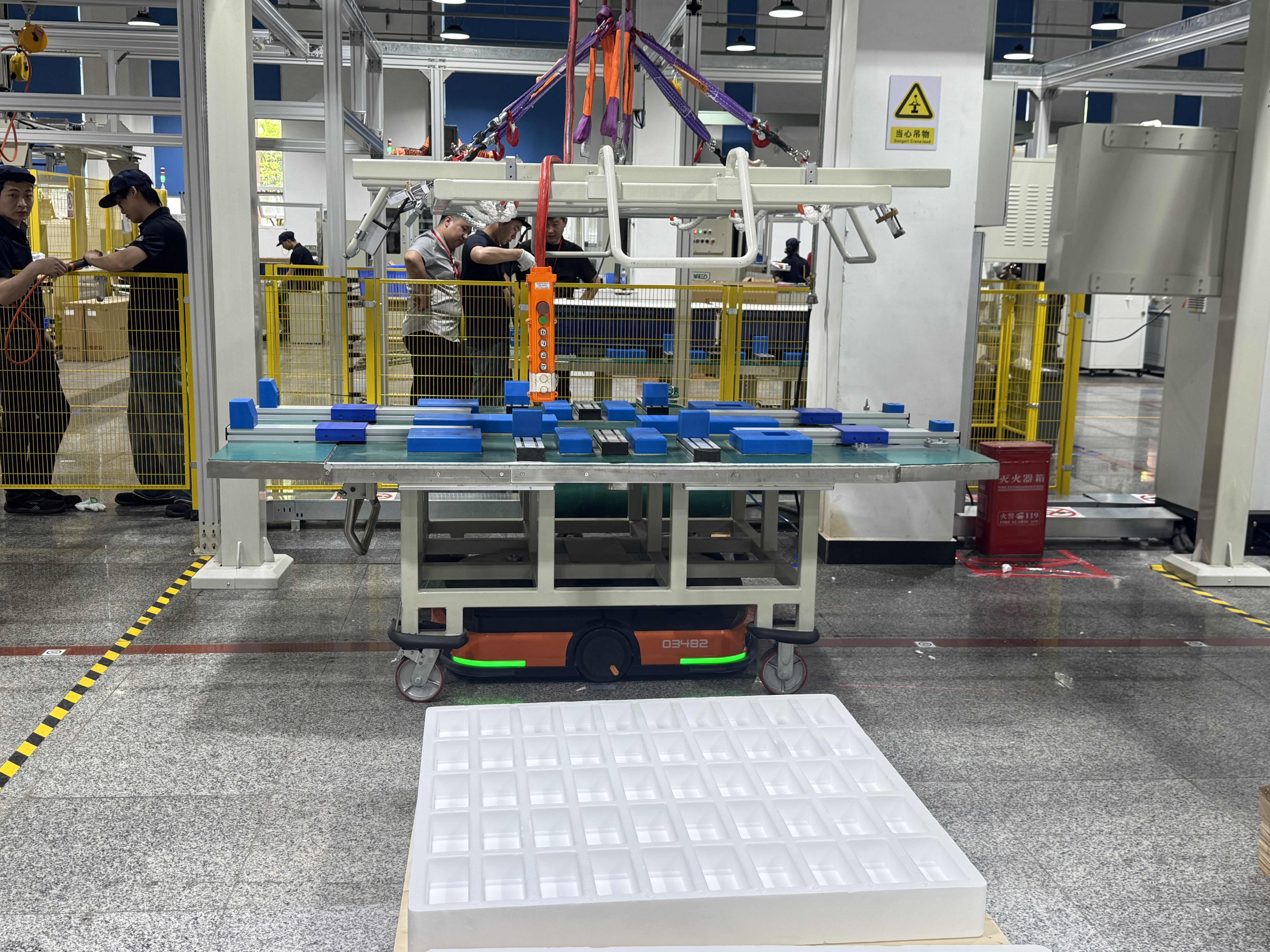
Assembly and integration capacity inside a battery energy storage system manufacturing base — one of the first evidence points a buyer can inspect directly.
A practical evidence register for evaluating battery energy storage system suppliers — including the limits of every claim inside it.
Global deployment of new battery storage capacity reached 108 GW in 2025, according to the IEA's Global Energy Review 2026. In the same year, lithium iron phosphate (LFP) chemistry accounted for roughly 90% of global battery storage deployments. When a single chemistry and a small number of architectures dominate a market scaling at that pace, product specifications converge: two 5 MWh-class containers from different suppliers will read almost identically on a datasheet.
That convergence moves the evaluation upstream. If the cells, the cooling concept and the enclosure are broadly comparable, the differences that survive are supply continuity, documentary evidence, and whether a warranty can still be enforced years after commissioning. This article sets out a five-part capability-evidence register for battery energy storage system (BESS) suppliers — quarterly BloombergNEF (BNEF) Tier 1 verification, a qualified pool of at least eight Tier 1 cell vendors, more than 20 GWh of annual qualified cell capacity, a minimum seven-year cell warranty, and a 55% reduction in supply risk — and shows how each item maps to commercial, industrial, utility-scale, solar-plus-storage and microgrid projects.
Why supplier capability evidence now decides the shortlist
Project economics explain part of the shift toward evidence-based procurement. All-in capital cost for long-duration (four-hour-plus) utility-scale storage reached USD 125/kWh in late 2025 in markets outside China and the United States, according to Ember. At that level, storage competes directly with conventional peaking assets — and financiers begin to treat the supply chain behind a project as part of the asset's risk profile rather than a purchasing detail.
Published market estimates for the same year show why definitions matter as much as numbers. One commercial estimate places the 2025 global BESS market at USD 50.81 billion, a figure that sits far above several other published valuations because research houses define the market differently — some count cells alone, others count complete turnkey systems including power conversion, controls and civil works. The same discipline applies to supplier claims: a capacity figure, a warranty term or a risk percentage only carries meaning once its scope, baseline and date are defined.
In the United States, utility-scale battery storage capacity additions were projected to reach 19.6 GW in 2025, based on the U.S. Energy Information Administration's generator inventory. Volume of that scale is procured through frameworks and portfolios rather than one-off purchases, which is precisely the setting where an unverifiable capability claim becomes a schedule risk rather than a negotiating detail.
The five-part capability evidence register
For a storage project, five evidence points cover most of what a buyer needs to establish about a supplier's ability to deliver and to remain accountable. Each is dated, attributable and independently checkable.
| Evidence point | What it establishes | What to request |
|---|---|---|
| Quarterly BNEF Tier 1 verification | The cell manufacturers behind the system appear on the current BNEF Tier 1 energy-storage cell list, which is assessed and refreshed quarterly rather than fixed once. | The most recent dated verification, plus the cell models actually used in the offered system. |
| At least 8 qualified Tier 1 cell vendors | Cell supply is qualified across multiple manufacturers instead of resting on a single relationship. | The vendor list, the qualification basis for each vendor, and which cell models are qualified for which platform. |
| >20 GWh qualified annual cell capacity | The qualified vendor base can make substantial annual cell volume available to the supplier's programmes. | Supply agreements, allocation evidence and capacity records — not a vendor count alone. |
| Minimum 7-year cell warranty | Long-horizon performance risk is carried contractually, not merely described in marketing material. | The warranty document: term, warranting legal entity, throughput or cycle conditions, exclusions and service obligations. |
| 55% supply-risk reduction | The sourcing structure is claimed to reduce exposure to supply disruption against a defined baseline. | The methodology, the baseline and the exact scope the percentage measures. |
What each evidence point does — and does not — establish
Read together, these five items are strong indicators of a supplier's industrial position. Read individually, each has a boundary that a procurement or engineering team should test before relying on it.
Tier 1 status is a supplier assessment, not a product certification
Inclusion on a Tier 1 list reflects a cell manufacturer's assessed position within the energy-storage supply chain. It does not validate the integrating company's battery management system, energy management system, thermal design, fire protection strategy or enclosure engineering. A Tier 1 cell inside a poorly integrated container remains a poorly integrated container, and the reverse is also true: strong system engineering does not upgrade the cell tier.
A qualified vendor count is not an allocation
Eight qualified Tier 1 vendors indicate procurement depth, but qualification is a technical and commercial gate, not a reservation of volume. In tight cell markets, capacity moves by contract and by allocation. A buyer evaluating a large programme should therefore ask for allocation evidence — supply agreements, frame contracts or confirmed booking documentation — rather than accepting a vendor list as a guarantee of delivery.
Qualified cell capacity is not the same as in-house output
More than 20 GWh of qualified annual cell capacity describes the aggregate supply reachable through the supplier's qualified vendor base. It is a different measurement from a company's own manufacturing capacity. Xupernova, for example, states its own annual output as 5 GWh+ alongside monthly capacity of up to 500 MWh — figures that describe its own integration lines, not the wider cell network behind them. Both numbers are useful; conflating them distorts the risk picture in either direction.
A seven-year warranty is a contract with conditions
A warranty term states how long risk is carried, not how much risk is carried. Cycle or throughput limits, operating temperature ranges, state-of-health thresholds at the end of term, maintenance obligations and the identity of the warranting legal entity all determine whether the term is enforceable in practice. When a project is financed, those conditions are read as carefully as the headline number.
Supply-risk reduction is a sourcing metric, not a performance metric
A 55% reduction in supply risk speaks to sourcing robustness — how many qualified cell sources, geographies and supplier relationships stand behind a delivery commitment. It says nothing directly about round-trip efficiency, degradation or availability. Buyers should keep sourcing metrics and performance metrics in separate columns of the evaluation and ask what baseline the reduction is measured against.
Auditing the claims: six evidence requests
The following sequence works as a pre-shortlist document request. It is deliberately ordered from the easiest item to verify to the hardest, because suppliers that struggle with the first requests rarely satisfy the later ones.
- Request the current Tier 1 verification and its date. A quarterly-refreshed list ages quickly; a document older than one refresh cycle should be treated as historical.
- Request the qualified cell vendor list with cell models. Vendor names without models cannot be checked against the platform actually offered.
- Request capacity and allocation evidence. Supply agreements, qualification records and booking documents convert a capacity headline into a delivery position.
- Request the warranty document, not the datasheet line. Look for the warranting entity, term, throughput limits and exclusions.
- Request the methodology behind the supply-risk figure. Any percentage without a baseline and scope cannot be compared between suppliers.
- Verify product certificates directly with the issuing body. Certificate numbers, standards and issue dates are checkable facts, and mismatches surface quickly.
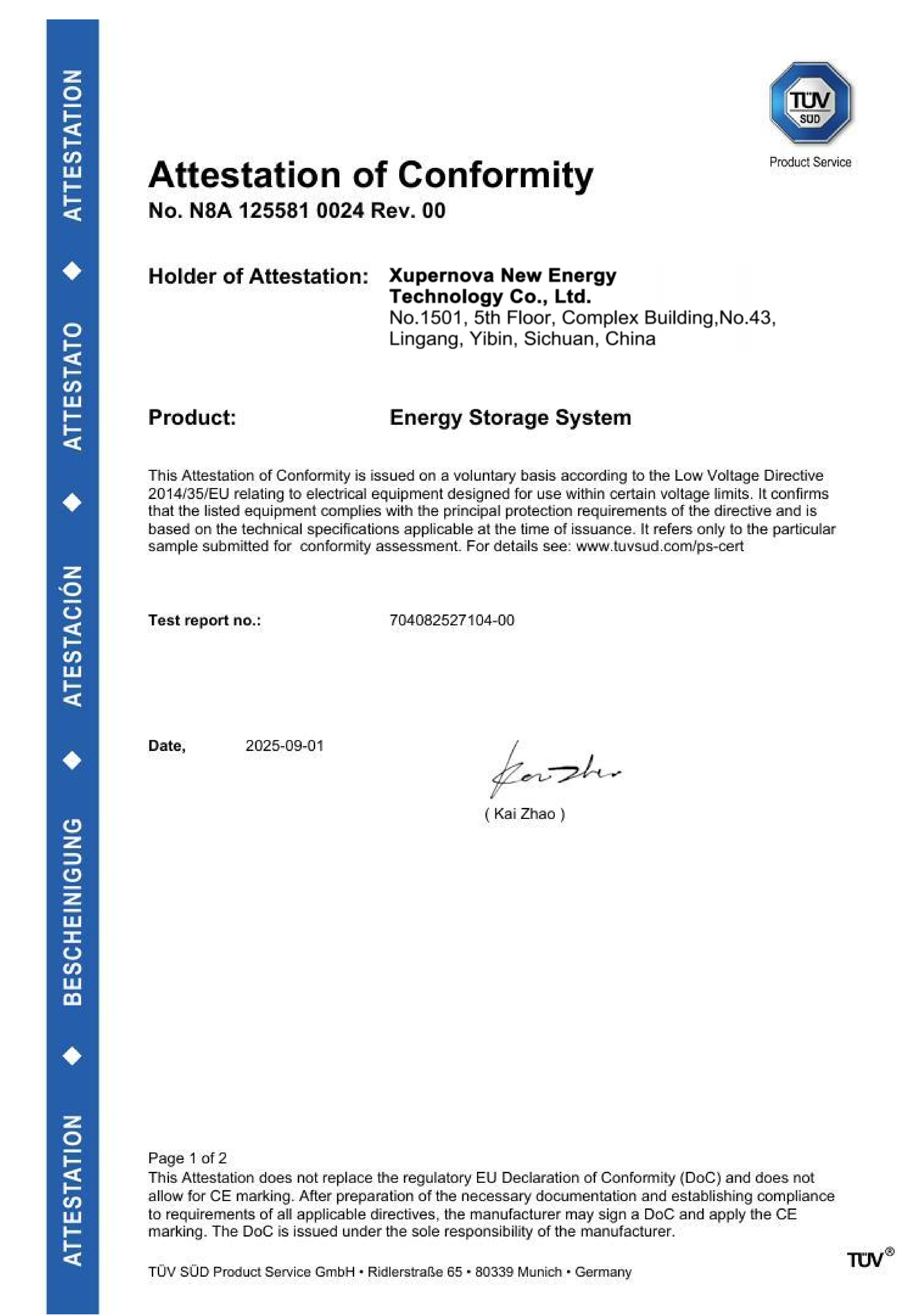
Certificates are the easiest capability claims to verify: issuer, number, standard and date are all independently checkable.
Documented examples of that last step exist within the storage product set. For model ECO‑E261LP‑2A, TÜV SÜD Product Service GmbH issued an IEC 63056:2020 product certificate (number B 125581 0022 Rev. 01, issued 16 September 2025) covering a rechargeable Li-ion battery system rated at DC 832 V, 314 Ah. The same model holds an EU LVD attestation against EN 62477-1:2012/A12:2021 (N8A 125581 0024 Rev. 00), an EU EMC attestation against EN IEC 61000-6-4:2019 and EN IEC 61000-6-2:2019 (E8A 125581 0023 Rev. 00), and Italian grid-compliance documents against CEI 0-21:2022/V2:2024 (D 125581 0027 Rev. 00) and CEI 0-16:2022/V3:2024 (D 125581 0028 Rev. 00). All were issued by TÜV SÜD Product Service GmbH and carry expiry dates at the end of validity. A buyer can confirm each of these against the issuing body in a single afternoon, which is the point.
Where Xupernova sits against the register
Xupernova New Energy Technology Co., Ltd. (Xupernova) is a China-based energy storage and new energy solutions provider founded in 2015, operating a 700,000 m² manufacturing site with 500+ employees and 150+ R&D engineers, serving Europe, North America, South America, the Middle East and Asia.
On the sourcing side of the register, the company's disclosed position is quarterly BNEF Tier 1 verification of its cell supply, a qualified pool of at least eight Tier 1 cell vendors, more than 20 GWh of qualified annual cell capacity, a minimum seven-year cell warranty, and a 55% supply-risk reduction. Its stated annual output is 5 GWh+, with monthly capacity of up to 500 MWh — figures that describe its own integration lines rather than the wider qualified cell network.
Materials follow the same sourcing logic. Xupernova's storage platforms use Grade A LFP lithium-ion cells from leading BloombergNEF Tier 1 energy-storage cell manufacturers, with optional semi-solid-state, solid-state and sodium-ion battery technologies available subject to project requirements, technical validation and availability. Manufacturing controls include 100% factory acceptance testing, electrical safety testing, functional testing, aging testing, and third-party inspection on request. After-sales scope covers 24/7 remote support, commissioning, training, diagnostics, spare parts and optional on-site service.
Because capacity evidence is only useful if it can be scheduled, commercial terms matter too. The company operates an OEM/ODM model with a stated lead time of 25–35 days for standard BESS products and 35–60 days for customized projects, with a minimum order quantity of one unit. Customization scope spans system power and energy capacity, charge/discharge duration, AC/DC voltage, battery chemistry and cell supplier, PCS, BMS and plant-level EMS, photovoltaic input and solar-plus-storage configuration, on-grid/off-grid operation, STS/EPS backup function, cooling and fire protection systems, enclosure size, colour and branding, IP rating and corrosion protection, grid code, communication protocols, and transformer and switchgear configuration.
Matching capability evidence to the product range
Capability claims are only relevant once they attach to a platform. Xupernova's storage range covers cabinet and container formats rated across −30 °C to 55 °C with 0.5P, 1P and 2P operating options.
| Model | Format | Rated parameters | Typical application |
|---|---|---|---|
| XA-C0261-L1 | Liquid-cooled all-in-one ESS cabinet | 125 kW / 261.25 kWh | Commercial and industrial peak shaving, time-of-use arbitrage |
| XA-H0261-L1 | Liquid-cooled solar-plus-storage cabinet | 261 kWh | C&I solar-plus-storage, microgrids |
| XA-H0064-A1 | Air-cooled solar-plus-storage cabinet | 25–50 kW / 64.54 kWh | Small-scale commercial solar-plus-storage |
| XA-X1044-L1 | 10-ft liquid-cooled all-in-one ESS container | 500 kW / 1044 kWh | C&I, microgrids, backup power |
| XA-X2170-L2 | 20-ft liquid-cooled all-in-one ESS container | 1125 kW / 2170.3 kWh | C&I and grid-side energy storage |
| XA-V5015-L1 | 20-ft liquid-cooled battery container | 5.015 MWh | Power generation, grid energy storage, C&I |
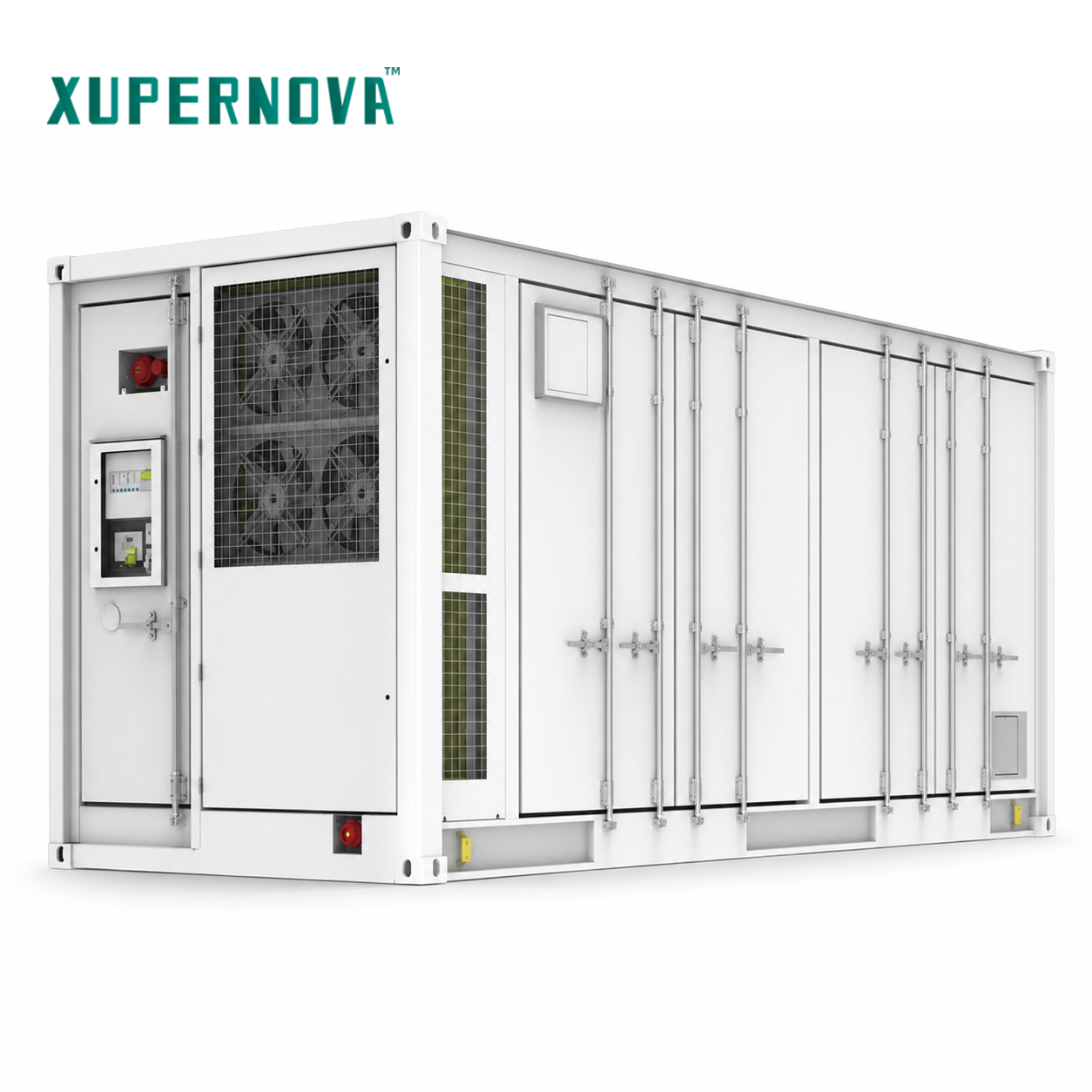
A 5.015 MWh liquid-cooled container class is where cell-sourcing evidence converts into utility-scale deliverable volume.
Application fit: commercial, industrial, utility-scale and microgrid
Sourcing evidence becomes procurement value when it lines up with how systems are actually operated. Across deployed projects, the same evidence base supports quite different duty cycles.
| Project type | Configuration | Function | Observed duration |
|---|---|---|---|
| Industrial manufacturing enterprise | 1 MW / 2.09 MWh, 20 units | Peak shaving, time-of-use arbitrage, demand management | 2 years |
| Supermarket and retail facility operator | 125 kW / 261.248 kWh, 50 units | Peak shaving, time-of-use arbitrage, photovoltaic self-consumption | 1 year |
| Commercial and industrial park operator | 1 MW / 2.088 MWh, 12 units | Solar-plus-storage microgrid, emergency backup, diesel generator optimization | 7 years |
| Commercial facility and solar EPC contractor | 500 kW / 1.044 MWh with up to 1 MW PV input, 32 units | Photovoltaic self-consumption, peak shaving, arbitrage, emergency power support | 5 years |
| Renewable energy project developer | 2 MW / 4.176 MWh, 7 units | Renewable energy shifting, grid balancing, peak shaving, backup power | 4 years |
Two details in these projects connect directly back to supplier evidence. The microgrid project relied on integrated STS for grid-connected and off-grid switching alongside photovoltaic and diesel generator interfaces with centralized energy management — a configuration whose reliability depends on multi-source supply, not a single cell relationship. The developer project used a compact 10-ft container design with integrated PCS, BMS and EMS, liquid cooling, multi-source access and G99 grid-code compatibility. Grid-code compatibility of that kind is documented, not asserted: the Italian grid documents for the ECO‑E261LP‑2A model illustrate the same principle, and the retail deployment's compatibility with Italian grid requirements reflects it.
What capability evidence means for financed and cross-border projects
When a storage asset is financed, the due-diligence conversation moves from specification to documentation. Lenders and independent engineers typically ask three questions: who makes the cells, who stands behind the warranty, and what happens if that supplier relationship changes mid-programme. The five-part register answers all three — but only when the underlying documents are available during diligence rather than after contract signature.
Cross-border procurement adds a tariff and classification layer. Battery energy storage systems fully encased in housing are classified under US HTS 8507.60.00.90, a code buyers should confirm for landed-cost modelling rather than assuming from the cell classification. Grid-code documentation, meanwhile, is jurisdiction-specific: Italian compliance for the ECO‑E261LP‑2A model, G99 compatibility in the developer project, and German grid requirements in the industrial and park deployments all represent separate documentary workstreams that a supplier either supports or does not.
Qualified Tier 1 sourcing versus unverified sourcing
The practical difference between sourcing models appears in what can be evidenced after the contract is signed, not in the headline specification.
| Dimension | Multi-vendor Tier 1 qualified sourcing | Unverified or single-source cell sourcing |
|---|---|---|
| Cell traceability | Grade A LFP cells from named BNEF Tier 1 manufacturers, verifiable against a quarterly-refreshed list | Cell origin often asserted rather than documented; grade claims may be unverifiable |
| Supply continuity | At least 8 qualified vendors and a >20 GWh qualified annual supply base, with 55% claimed supply-risk reduction | Dependence on one or a few unqualified sources; disruption risk concentrated |
| Warranty enforceability | Minimum 7-year cell warranty supported by 24/7 remote support, diagnostics and spare parts scope | Shorter or unsupported terms; unclear warranting entity |
| Compliance documentation | Product certificates with issuer, number, standard and date; grid-code documents per market | Partial or market-specific gaps discovered late in the project cycle |
| Boundary to keep in view | Qualified cell supply addresses cell-level risk; it does not by itself validate system integration, fire protection design or site-specific engineering | Lower apparent cost may reflect reduced documentation and service scope rather than genuine efficiency |
The honest boundary is worth stating plainly: a strong cell-sourcing position is a necessary but not sufficient condition for project success. Cell tier, vendor count and capacity evidence reduce supply-side risk; they do not substitute for verifying the integrator's own control architecture, safety design or commissioning capability. Buyers should treat the register as one column of a wider technical evaluation, not as a verdict.
Future outlook
Three trends are likely to shape how capability evidence is read over the next procurement cycles. First, chemistry concentration continues: with LFP behind roughly 90% of 2025 deployments, cell-level differentiation narrows and supply-chain evidence carries more of the evaluation weight. Second, cost trajectories keep pressure on documentation quality — at USD 125/kWh all-in for long-duration projects outside China and the US, every non-verifiable claim becomes a diligence cost. Third, warranty competition is likely to intensify as multi-year operating histories accumulate; a seven-year cell warranty will increasingly be judged on service infrastructure rather than term length alone.
Alternative chemistries remain an option rather than a default. Semi-solid-state, solid-state and sodium-ion technologies are available in Xupernova's platforms subject to project requirements, technical validation and availability — a positioning that keeps the sourcing question open while the qualified Tier 1 LFP base continues to carry mainstream deployments.
FAQ
What does "Tier 1 cell supply" mean in BESS procurement?
It means the cell manufacturers behind a system appear on a current Tier 1 energy-storage cell list, such as the BloombergNEF list that is assessed and refreshed quarterly. It is a statement about cell suppliers, not about the integrating company's own engineering, controls or safety design.
How many qualified Tier 1 cell vendors should a storage supplier be able to name?
There is no universal threshold, but a qualified pool of at least eight Tier 1 cell vendors is a materially different risk position from single-source dependence, because disruption at one vendor can be absorbed by others. The count is only meaningful when the vendors named are qualified for the specific cell models offered.
What does a seven-year cell warranty cover, and what does it not cover?
A minimum seven-year cell warranty carries cell-related performance risk over that term, subject to the conditions written into the document — typically operating envelope, throughput or cycle limits, state-of-health thresholds, and maintenance obligations. It does not automatically cover power conversion equipment, balance-of-plant items, or losses caused by operating outside the specified temperature range.
Is quarterly BNEF Tier 1 verification the same as product certification?
No. Tier 1 verification is a supply-chain assessment of cell manufacturers and is refreshed quarterly, so it can change over time. Product certification is issued against a specific standard for a specific model by a body such as TÜV SÜD Product Service GmbH, and carries a certificate number, standard reference and issue date. Statements such as IEC 63056:2020, EN 62477-1:2012/A12:2021, EN IEC 61000-6-4:2019 or CEI 0-21:2022/V2:2024 belong to the second category.
Does a 20 GWh+ qualified cell capacity guarantee allocation for a specific project?
No. Qualified annual cell capacity describes the aggregate supply reachable through a supplier's qualified vendor base; it is distinct from a manufacturer's own annual output, and distinct again from contracted allocation. Projects requiring assured volume should request supply agreements, allocation evidence or booking documentation rather than relying on the capacity figure alone.
Building the evidence file before the shortlist
Evaluating storage suppliers is increasingly a documentation exercise performed before commercial negotiation begins. The five items in the register — current Tier 1 verification, a qualified multi-vendor cell pool, qualified annual cell capacity, an enforceable multi-year cell warranty and a defined supply-risk baseline — are checkable, comparable and consistent across commercial, industrial, utility-scale, solar-plus-storage and microgrid scopes. Their limits are equally checkable, which is why stating them strengthens rather than weakens the case for using them.
Xupernova's energy storage range, including containerized and cabinet platforms and the associated certification documents, is summarised in the company's product catalogue available at XUPERNOVA Energy Storage Product Catalog.