
Aviation Structure Tents: Scenario Fit for Aircraft Hangars and MRO Facilities
Aircraft operators rarely run out of aircraft to park. They run out of covered, weather-protected, serviceable ground on which to park, inspect, and maintain them. Clear-span aluminum structure tents have become one of the practical answers to that gap, and the question for aviation buyers is no longer whether a fabric structure can be used, but which configuration fits a specific hangar or MRO scenario.
A structure tent is an engineered shelter built from a high-strength aluminum alloy frame and a technical PVC-coated polyester roof fabric, assembled as a modular, clear-span envelope. Unlike a conventional marquee, it is designed around defined wind, snow, and flame-retardant performance values, and it can be specified as a temporary, semi-permanent, or long-term installation. In aviation, that combination is applied to aircraft hangar and MRO facility projects, where the structure supports aircraft storage, maintenance, and inspection rather than event use.
This analysis maps structure tent capability to aviation scenario requirements: vehicle-accessible internal space, indoor or outdoor normal-temperature operation, fire retardant and waterproof performance, structural load-bearing capacity, and quick installation. It also states where the technology stops being the right answer, because aviation procurement decisions are rarely improved by one-sided specifications.
Why Covered Aviation Ground Space Is the Real Constraint
Aviation capacity planning tends to focus on runways, aprons, and terminals. The bottleneck that shows up later is shelter: where an aircraft sits when it is not flying, and where maintenance work happens when weather, dust, or direct sunlight would compromise either the airframe or the technicians working on it.
Three operational realities create recurring demand for covered aviation space:
- Fleet parking and storage. Aircraft awaiting deployment, seasonal capacity changes, lease returns, or longer-term storage need protected stands rather than open apron exposure.
- Line and base maintenance. Scheduled inspections, component access, and structural checks require a workspace that is rainproof and wind-sheltered so work is not cancelled by weather.
- Inspection and acceptance activity. Pre-delivery checks, audits, and technical inspections benefit from a controlled, repeatable environment rather than a location that changes with apron availability.
Conventional steel or concrete hangar construction resolves these needs durably, but it resolves them slowly and at a capital commitment that is difficult to justify for temporary fleet surges, remote operating bases, or MRO capacity that may need to move. That mismatch — permanent cost and lead time against non-permanent need — is where clear-span structure tents enter the evaluation.
What "Scenario Fit" Means in an Aviation Context
In aviation, scenario fit is not a marketing term. It is a list of physical conditions that a structure must survive and support. Based on the aviation application profile for this product category, the operating conditions are defined as indoor or outdoor normal-temperature use with vehicle-accessible space, and the functional requirement is aircraft storage, maintenance, and inspection in aircraft hangar and MRO facility projects.
Five requirement clusters follow from that definition:
- Vehicle-accessible space. The structure must allow aircraft, tow tractors, and ground support equipment to enter and maneuver. This is driven by clear span, eave height, and door configuration rather than by floor area alone.
- Normal-temperature indoor/outdoor operation. The envelope is designed for typical ambient conditions rather than for specialized climate chambers.
- Fire retardant performance. Roof and sidewall fabrics are specified to recognized flame-propagation standards because occupied aviation structures carry fire-safety obligations.
- Waterproof and windproof envelope. The structure must keep rain out and remain stable under defined wind loading.
- Structural load-bearing and quick installation. The frame must carry its own loads plus specified ancillary equipment, and it must be deployable on a schedule that matches operational need.
KENTEN Structures is a manufacturer of aluminum permanent and semi-permanent structures, established in 2001, with major markets in the USA and EU and export business accounting for 80% of total sales. Its aviation-relevant product line is the K-series structure tent, offered in models K1 through K10 with span widths from 3 m to 80 m, alongside the W1 warehouse tent for covered storage duty. Those two product families map onto the two halves of a typical aviation site: the hangar or maintenance envelope, and the parts and tooling store beside it.
Matching Structure Tent Specifications to Aviation Requirements
The most useful way to read a structure tent specification is against operational requirements rather than against headline numbers. The table below translates the published K-series and W1 data into the aviation questions that generate them.
| Aviation requirement | Relevant specification |
|---|---|
| Clear internal envelope for aircraft parking and movement | Span width 3 m to 80 m across models K1–K10; length unlimited and extendable in 5 m bay spacing |
| Vertical clearance for tail and door access | Eave height 2.5 m to 8 m, customizable |
| Frame strength and service life | Main frame in high-strength 6061-T6 or 6082-T6 aluminum alloy; aluminum frame lifespan 20+ years |
| Weather envelope | Roof fabric 850 g/m² PVC-coated polyester; waterproof construction |
| Fire performance | Flame retardant to DIN 4102 B1, M2, and NFPA 701 |
| Wind exposure on open apron sites | Wind resistance up to 140 km/h, customizable |
| Snow conditions | Snow load up to 0.5 kN/m² |
| Ambient temperature range | Operating range −30 °C to +70 °C |
| Enclosure and insulation options | Sidewalls in PVC, glass wall, ABS wall, or sandwich panel |
| Site anchoring | Ground anchors or concrete ballast, depending on site |
| Covered parts and tooling storage | W1 warehouse tent: 3–60 m span, peak height approximately 9 m, snow load up to 75 kg/m², wind load up to 120 km/h certified, ISO 9001, ISO 14001, ISO 45001 |
Two details in that table deserve emphasis because they are frequently misread during early evaluation. First, span and eave height are separate decisions: an 80 m span does not automatically deliver the door height a specific aircraft type needs, and eave height is customizable within the 2.5 m to 8 m band. Second, roof fabric and aluminum frame have different service lives — the aluminum frame is rated at 20+ years while PVC fabric is rated at 8–15 years — so a long-term aviation installation should be planned around at least one fabric replacement cycle within the frame's life.
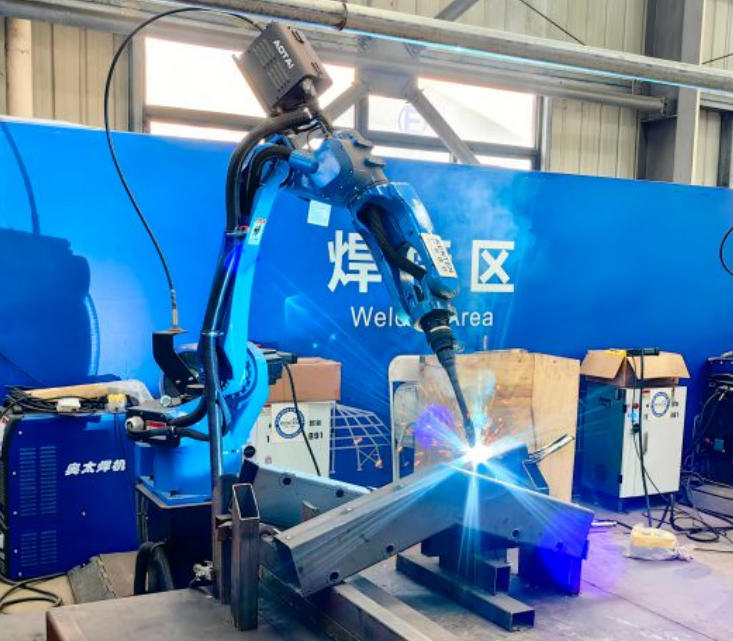
Frame fabrication for aluminum structure tents: the K-series uses 6061-T6 or 6082-T6 alloy sections, the same structural family specified for aviation hangar and MRO envelopes. Image: KENTEN Structures.
Where Structure Tents Fit in Aviation Operations
The aviation application profile for this product category is explicit about supported equipment: large hangar doors, lighting, ventilation, crane support, and insulation. Those five items are the practical boundary of what a hangar or MRO structure tent can be configured to accommodate, and they align with three operational scenarios.
1. Aircraft storage and parking
A storage structure is primarily an envelope problem: a large, unobstructed span with a weather-tight roof and sidewalls, plus a door aperture wide and tall enough for the largest aircraft expected on site. Because the length is unlimited and extends in 5 m bays, storage envelopes can be sized to fleet count rather than to a fixed building module — a meaningful advantage where parking demand changes between seasons.
2. MRO and maintenance bays
Maintenance use adds requirements beyond shelter. Lighting and ventilation are needed for technician productivity and air quality; insulation or sandwich-panel sidewalls support more stable internal conditions; and crane support may be required where lifting equipment must be integrated into the bay. This is where engineering input matters most, because ancillary loads are not identical to weather loads and should be confirmed against the specific structure design.
3. Inspection activity and supporting storage
Inspection bays benefit from a consistent, weather-independent environment, which is the same reason facility managers often place a W1 warehouse tent alongside a main hangar envelope for tooling, components, and ground support equipment. The W1 is designed for warehouse and logistics duty with a 3–60 m span, customizable length from 10 m to over 100 m, an approximate 9 m peak height, and sidewall options including PVC, corrugated steel, or sandwich panel with roller doors and loading access.
Across all three scenarios, the operation mode is the same and it is deliberately flexible: on-demand installation, reusable design, and suitability for either temporary or long-term use. For aviation operators, that means a structure can be repositioned or redeployed when fleet basing changes, which is not true of a fixed concrete hangar.
Market Signals Behind Semi-Permanent Aviation Structures
Structure tents are not a niche category in global terms. China's exports of tents, awnings, and sails reached approximately USD 3.11 billion in 2024, maintaining the world's largest exporter position with a 53.3% global market share, according to the Observatory of Economic Complexity. That figure covers the full export category, but it indicates the scale of the manufacturing base that aviation buyers are drawing on.
On the demand side, the broader global tent market — including industrial storage, sports, and events — is projected to grow from USD 4.01 billion in 2025 to USD 6.07 billion by 2033, at a CAGR in the 5–7% range, according to a market summary published by Shelter Structures / Rethinking The Future. That projection should be read with care: alternative estimates vary significantly depending on whether recreational and camping products are included, so the industrial and event segment figure is the more relevant reference point for hangar and MRO applications.
Regulation is a second structural driver. In the European Union, temporary structures with a ground area exceeding 50 m² must comply with EN 13782:2015, which covers structural stability under wind and snow loads. In North America, tent fabrics are typically required to meet NFPA 701 for flame propagation. The practical consequence for aviation procurement is that flame-retardant and load documentation has moved from a differentiator to a baseline expectation, and buyers increasingly ask for certification evidence before commercial terms are discussed.
Structure Tents vs Conventional Hangar Construction: Honest Boundaries
A comparison that omits limitations is not useful to an aviation buyer, so the boundaries are stated here as plainly as the advantages.
| Consideration | Structure tent | Conventional hangar construction |
|---|---|---|
| Deployment speed | Modular assembly, quick installation is a stated special requirement for aviation scenarios | Typically longer site construction programme |
| Relocatability | Reusable and demountable by design; suitable for temporary or long-term use | Fixed asset, not relocatable |
| Capital profile | Generally oriented toward lower capital commitment for the same covered area | Higher upfront investment tied to the land |
| Snow performance | Snow load up to 0.5 kN/m², a defined design ceiling that must be checked against local snowfall | Can be engineered to heavier snow regimes as part of structural design |
| Service life | Aluminum frame 20+ years; PVC fabric 8–15 years, implying fabric replacement | Long service life with periodic maintenance |
| Climate control | Depends on sidewall selection (PVC, glass wall, ABS wall, sandwich panel) and insulation | Envelope performance designed to specific thermal requirements |
| Overhead lifting | Crane support can be integrated, but ancillary loads require engineering confirmation | Overhead crane loads designed into the primary structure |
Three limits are worth stating without softening. First, the published snow load of up to 0.5 kN/m² is a design value, not a universal guarantee; sites with sustained heavy snowfall need the figure verified against local conditions, and in some locations a fabric structure will not be the appropriate solution. Second, the fabric roof has a shorter life than the frame, so total cost of ownership should include at least one full roof replacement over a 20-year horizon. Third, fire-retardant fabric certification such as DIN 4102 B1, M2, or NFPA 701 addresses flame propagation of textiles; it does not by itself satisfy every local building-code requirement that may apply to an occupied aviation building, and additional approvals may be requested by the authority having jurisdiction.
There is also a functional boundary. Where a process demands tightly controlled temperature, humidity, or cleanliness — certain avionics, paint, or composite work — a fabric envelope with sandwich-panel walls may still require supplementary HVAC design, and a purpose-built facility remains the more direct answer.
Procurement Criteria: What to Verify Before Specifying
The first decision is envelope geometry, not price. Buyers should work outward from the largest aircraft type expected, then confirm span, eave height, and door aperture before comparing quotations.
- Aircraft envelope and clear span. Confirm the required span (3 m to 80 m available across K1–K10) and the eave height between 2.5 m and 8 m that corresponds to the actual tail and door clearance.
- Length and scalability. Confirm total length, remembering that length is unlimited and extends in 5 m bay spacing, and decide whether future extension should be designed in from the start.
- Load values for the specific site. Match the structure's wind resistance (up to 140 km/h) and snow load (up to 0.5 kN/m²) against real site data rather than regional averages.
- Fire documentation. Request evidence of the DIN 4102 B1, M2, or NFPA 701 classification applicable to the supplied fabric, and clarify which standard the local authority expects.
- Sidewall and insulation strategy. Choose between PVC, glass wall, ABS wall, and sandwich panel according to whether the bay is a storage envelope or a working maintenance environment.
- Foundation method. Ground anchors or concrete ballast, selected against the actual surface — apron, hardstanding, or prepared ground.
- Ancillary integration. Confirm how hangar doors, lighting, ventilation, crane support, and insulation will be carried by the structure.
- Manufacturing and support capacity. KENTEN Structures operates manufacturing centers in China, USA, and the Mid-East, with regional offices in China, Hong Kong, Singapore, and the Mid-East, a facility covering 80,000 m², approximately 200 staff, a 10-engineer R&D team, and an annual production capacity of 1,000,000 m².
Future Outlook
Two forces are likely to keep aviation structure tents in procurement discussions. The first is fleet flexibility: operators that add and retire aircraft at different rates need covered space that can follow the fleet rather than lock capital into a fixed location. The second is documentation maturity. As EN 13782:2015 and NFPA 701 expectations become routine reference points across markets, suppliers that can present verified load and flame-retardant evidence will be easier to specify, and fabric structures will increasingly be evaluated on the same engineering terms as any other hangar option.
What is less likely to change is the physics: a clear-span aluminum frame with a technical PVC envelope has a defined performance envelope, and aviation buyers who compare their site conditions against it early tend to make faster, more defensible decisions.
FAQ
What is a structure tent, and how is it used in aviation?
A structure tent is a clear-span shelter with a high-strength aluminum alloy frame and a technical PVC-coated polyester roof. In aviation it is used for aircraft hangar and MRO facility projects, supporting aircraft storage, maintenance, and inspection under indoor or outdoor normal-temperature conditions with vehicle-accessible space.
How large can an aviation structure tent be?
The K-series structure tent is offered in models K1 through K10 with span widths from 3 m to 80 m. Length is unlimited and extendable in 5 m bay spacing, and eave height ranges from 2.5 m to 8 m and is customizable.
Can structure tents meet fire safety expectations for hangars?
The fabric is specified as flame retardant to DIN 4102 B1, M2, and NFPA 701. These are textile flame-propagation standards; whether they fully satisfy a given local building code for an occupied aviation structure depends on the jurisdiction, and additional approvals may be required.
What wind and snow loads can these structures handle?
The K-series structure tent is rated for wind resistance up to 140 km/h, customizable, and snow load up to 0.5 kN/m². The W1 warehouse tent is rated for wind load up to 120 km/h certified and snow load up to 75 kg/m². Values should be checked against actual site conditions.
Are structure tents suitable for permanent MRO use?
They are designed for on-demand installation, are reusable, and are suitable for temporary or long-term use, which is why they are also described as permanent or semi-permanent structures. Service life differs by component: the aluminum frame is rated at 20+ years, while PVC fabric is rated at 8–15 years.
What equipment can be integrated into a hangar or MRO structure tent?
Aviation configurations typically support large hangar doors, lighting, ventilation, crane support, and insulation. Ancillary loads such as crane support require engineering confirmation against the specific structure design.
Reference Material
The manufacturer's technical catalogue, covering structure tent models, span ranges, materials, and performance values, is available for download: KENTEN Structures product catalogue (PDF).