
Automotive Wire Harness Connector Shortlist: 7 Verified 12V, 24V and EV Options
A connector shortlist is only as useful as the parameters behind each line. This one evaluates seven verified automotive wire harness connector options — a battery terminal, two battery fuse box models, a housing, a terminal, a three-way conduit connector, a support bracket and an EV high-voltage battery connector — against rated voltage, current, sealing class, temperature range, material and mounting detail, so that 12V, 24V and high-voltage harness builds can be specified from one reference.
The commercial context is a wiring harness market valued at USD 74.7 billion in 2026, with Asia Pacific holding 47.1% of 2025 revenue (Global Market Insights, 2026). High-voltage connectors used in battery packs, inverters and motors form a separate segment valued at USD 4.99 billion in 2026 and forecast to grow at 11.90% CAGR between 2026 and 2035 (SNS Insider, 2026). Two speeds of demand — a mature low-voltage base and a faster high-voltage layer — now sit inside the same bill of materials, which is why procurement teams increasingly shortlist at component level rather than at harness-assembly level.
Zhejiang Daou Electronics Co., Ltd (CNDO) is a manufacturer of automotive wire harness components — battery terminals, fuse boxes, housings, terminals, conduit connectors and support brackets — based in Puqi Characteristic Industrial Zone, Yueqing City, Zhejiang Province, China. Its quality management system is certified to IATF 16949:2016 by URS under certificate 0596976, with a scope covering the design and manufacture of electronic connectors and wire harnesses and a listed validity to 8 February 2029. The seven items below are drawn from that range; every figure quoted comes from the published component record, and where a record is silent, this shortlist says so instead of filling the gap.
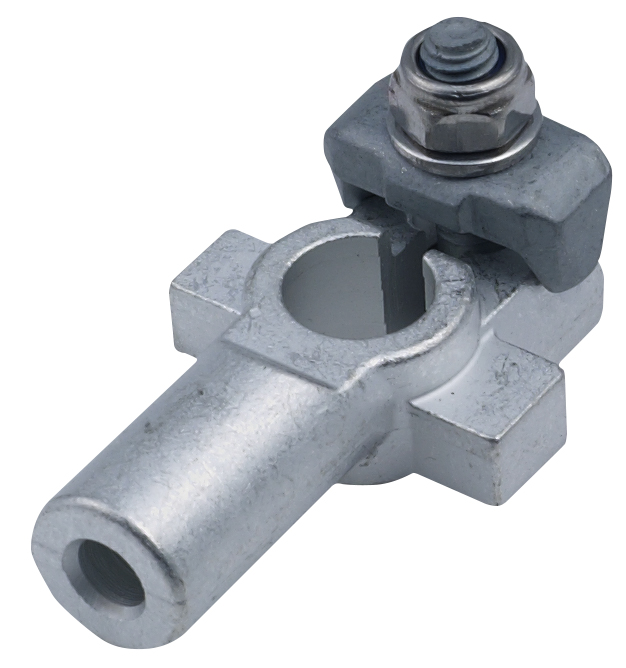
Battery terminal hardware sits at the start of the 12V power path, ahead of the fuse box and main harness.
Why Connector Shortlists Break Down Before They Reach Engineering
Most failed shortlists are not failed products. They are specifications that were never written down. Three patterns account for a large share of the rework.
The voltage family is assumed rather than stated. A catalogue may describe a component as a 12V part while the actual record allows 12V DC and 24V DC operation, or the reverse — a part named for a family may be locked to a specific battery post standard. Both cases exist in this shortlist: the battery fuse boxes are rated for 12V DC and 24V DC, while the SAE Top Post battery terminal is defined by post geometry rather than by a voltage window.
Sealing is described in words instead of a grade. "Waterproof" in a product description is not a purchasing specification. The housing in this shortlist states IP67. The three-way conduit connector states IP66/IP67 but qualifies that figure with sealing gaskets — meaning the rating applies to an assembled condition, not to a bare part on a shelf.
Current is stated as a range without the size. A terminal rated across 5A to 200A depending on size carries no usable rating until the size is fixed. That single omission is enough to push a component into a second engineering loop.
The Seven Options at a Glance
The table below reproduces the published parameters for each item. Empty cells indicate that the component record does not state a value, which is itself a procurement signal: a blank must be resolved on the drawing before release.
| # | Model | Component | Verified electrical data | Sealing / temperature | Material |
|---|---|---|---|---|---|
| 1 | DOBP22001 | Battery terminal (12V SAE Top Post) | Positive post 19.05 mm, negative 17.46 mm tapered; M8 thread | Not stated in record | Brass / copper, tin-plated |
| 2 | DOBXS4-1A / DOBXS5-1F | Battery fuse box | 12V DC / 24V DC; bolt-type mega main fuse; blade auxiliary fuses 5A–30A | Sealed cover, waterproof and dustproof structure; -40°C to +125°C | PA66 / copper |
| 3 | DOH0001-1 | Wire harness housing | Not stated in record | IP67; -40°C to +125°C | PA / PBT |
| 4 | DOE24022 | Harness terminal | 12V / 24V DC, up to 48V DC special models; current by size 5A–200A | Not stated in record | Copper / copper alloy, tin, nickel or gold plating |
| 5 | D520023 | Three-way tube conduit connector | Non-conductive insulating material | IP66 / IP67 with sealing gaskets; -40°C to +120°C, peak 150°C | PA66 |
| 6 | DOCB24001 | Harness support bracket | No electrical function | -40°C to +125°C; UL94-V0 / UL94-V2 | PA66 / PA66 GF30 |
| 7 | DOBN22006-D5 | EV high-voltage battery connector | 500A max; M8 thread; 8 N·m tightening torque; negative post 17.46 mm | Not stated in record | Tin-plated contacts |
Source: CNDO published component records for models DOBP22001, DOBXS4-1A/DOBXS5-1F, DOH0001-1, DOE24022, D520023, DOCB24001 and DOBN22006-D5.
The 12V and 24V Power Path
DOBP22001 — SAE Top Post battery terminal
DOBP22001 is a 12V SAE Top Post battery terminal specified at a positive post diameter of 19.05 mm and a negative post diameter of 17.46 mm on a tapered seat, with an M8 thread, a brass body and tin plating. The two post diameters are the qualifying numbers. A clamp designed around a 19.05 mm positive and a 17.46 mm negative taper will not seat correctly on a side-terminal battery or a stud-only connection, and clamp force does not correct a diameter mismatch — it only masks it until the first thermal cycle. Tin plating is the corrosion-control layer at the connection interface, and the M8 thread defines the clamp-bolt interface that the harness assembler will torque.
DOBXS4-1A and DOBXS5-1F — battery fuse boxes
The two battery fuse box models are built from PA66 and copper. The main busbar uses high-conductivity copper or brass with tin, nickel or zinc plating; the main fuse position takes a bolt-type mega fuse; auxiliary positions accept standard blade fuses from 5A to 30A. Working voltage is 12V DC or 24V DC, ambient range is -40°C to +125°C, and the shell is flame-retardant plastic with a sealed cover forming a waterproof and dustproof structure. Installation uses fixed mounting holes with a direct connection to battery positive.
Two characteristics matter commercially. First, one part family covering both 12V DC and 24V DC means a single SKU can serve passenger-car and commercial-vehicle programmes, which reduces split inventory and duplicate approval work. Second, the auxiliary fuse positions are specified across 5A to 30A, so the branch protection plan is defined at the box level rather than improvised at the harness level. What the record does not state is the mega fuse rating itself — that value has to be written onto the drawing for each build.
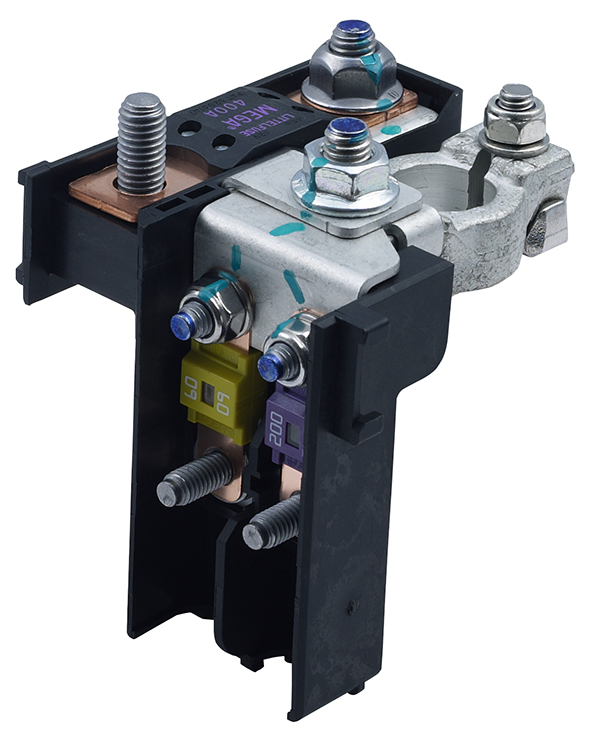
A sealed battery fuse box combines the mega-fuse main protection and 5A–30A blade auxiliary circuits in one housing.
DOE24022 — harness terminal
DOE24022 is an automotive wiring harness terminal rated at 12V or 24V DC for mainstream vehicle use, with special models reaching 48V DC. Rated current varies by size across 5A, 10A, 20A, 50A, 100A and 200A. The record specifies low contact resistance for stable conductivity, withstand voltage compliant with automotive harness electrical standards, and high insulation resistance on the insulated version. Conductor options span pure copper, red copper, copper alloy, and tin-, nickel- or gold-plated copper.
The 48V DC allowance on special models is the margin that matters for 24V systems: a 24V nominal circuit with charging and transient headroom sits far more comfortably inside a part rated to 48V DC than inside one rated to 24V DC exactly. The plating choice, meanwhile, is an environment decision rather than a cost decision — tin for general engine-bay and body use, nickel or gold where the contact faces higher temperature or lower signal current.
Sealing, Routing and Mechanical Retention
DOH0001-1 — wire harness housing
DOH0001-1 is rated IP67 across an operating range of -40°C to +125°C, described as waterproof, dustproof, oil-resistant and resistant to acid and alkali, and compliant with automotive vibration requirements under IATF 16949 standards. The body is moulded in PA or PBT. IP67 is the number that governs location: it supports use in exposed body and chassis positions where a splash and short immersion risk exists, and it removes the need to argue about whether a connector position is "wet enough" to justify a sealed part.
D520023 — three-way tube conduit connector
The D520023 is a T/Y harness connector in PA66 for engine bay, chassis and body wiring. Continuous operating temperature is -40°C to +120°C with a short-term peak of 150°C. Ingress protection is IP66 or IP67 with sealing gaskets. The part resists engine oil, mineral oil, grease, weak acid and alkali and partial solvents, and is UV, hydrolysis and ageing resistant. Electrically it is an insulator, with non-conductive material and high insulation performance.
Two details deserve attention in a specification review. The 150°C short-term peak is what allows the part to survive proximity to a hot component without being reclassified as a high-temperature item. The gasket condition is what makes the IP claim transferable to the vehicle — a bare conduit connector without its seals is not an IP67 part, and incoming inspection should confirm the gasket is fitted and undamaged.
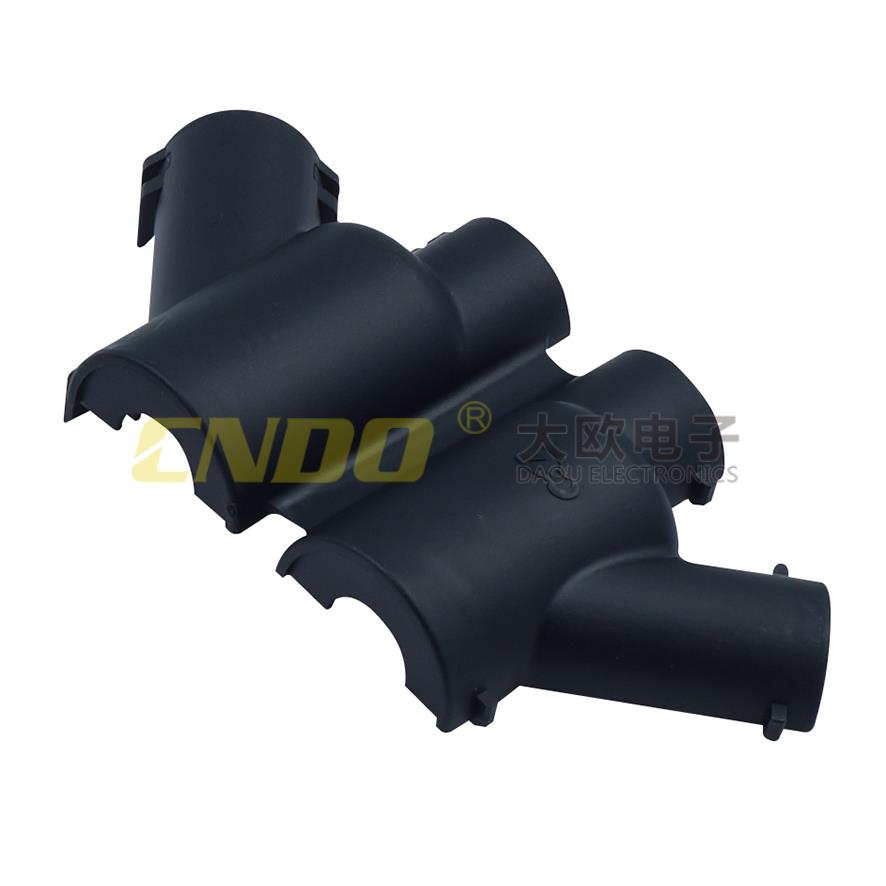
Three-way conduit connectors split harness runs at a joint rather than at a splice, keeping the harness sheath continuous.
DOCB24001 — harness support bracket
The DOCB24001 support bracket is moulded in PA66 or PA66 GF30, rated -40°C to +125°C with engine-bay versions tolerating higher transient temperatures. Flame rating is UL94-V0 or UL94-V2. The part is resistant to UV, ageing and salt spray and to engine oil, coolant and cleaning agents, and its vibration durability is compliant with vehicle vibration durability test standards.
A bracket carries no current, so it should not be evaluated on electrical criteria. Its specification is written in mechanical and environmental terms: temperature class, flame class, chemical exposure and vibration endurance. The glass-filled PA66 GF30 option exists precisely because stiffness and creep resistance, not conductivity, decide whether a harness run stays where the drawing puts it.
The High-Voltage Path: DOBN22006-D5
DOBN22006-D5 is classified as an EV high-voltage battery connector. The record specifies tin-plated contacts, a maximum current of 500A, an M8 thread, a tightening torque of 8 N·m and a negative post diameter of 17.46 mm.
Read as a specification rather than a headline, the three numbers do different jobs. The 500A maximum current sets the conductor cross-section and busbar sizing behind the connector. The 8 N·m tightening torque is the assembly control: it is the parameter that separates a joint that stays stable over thermal cycling from one that develops resistance and heat, which is why it belongs on the work instruction and not only on the datasheet. The 17.46 mm negative post diameter is the same figure used for the negative post of the SAE Top Post terminal in this shortlist, so a programme running both a 12V battery terminal and an EV battery connector is working to one post reference on the negative side.
Selection Checklist for 12V, 24V and EV Builds
The checklist below converts the shortlist into a decision sequence. It is written so that it can be applied to any supplier's component record, not only to the seven items above.
| Criterion | What to verify | Where this shortlist answers it |
|---|---|---|
| System voltage | Stated rating against the highest system voltage, including charging and transient headroom | Fuse box 12V DC / 24V DC; DOE24022 12V / 24V DC with 48V DC on special models |
| Current | Rating at the specific size, not the family range | DOE24022 across 5A–200A by size; DOBN22006-D5 at 500A maximum |
| Assembly torque | A controlled torque value on the work instruction | DOBN22006-D5 at 8 N·m with M8 thread |
| Sealing | A numeric IP grade plus the condition under which it applies | DOH0001-1 at IP67; D520023 at IP66/IP67 with sealing gaskets |
| Temperature | Continuous rating and short-term peak, matched to mounting zone | -40°C to +125°C on housing, fuse box and bracket; -40°C to +120°C with 150°C peak on D520023 |
| Material and plating | Conductor base metal and plating against the chemical environment | Brass and copper with tin plating; busbar plating in tin, nickel or zinc; PA66, PA/PBT and PA66 GF30 bodies |
| Mounting interface | Thread, post diameter and hole pattern fixed before release | M8 thread; 19.05 mm positive and 17.46 mm negative tapered posts; fixed mounting holes on the fuse box |
| Documentation | Certification scope, validity and material declarations | IATF 16949:2016 certificate 0596976 issued by URS, scope covering design and manufacture of electronic connectors and wire harnesses, listed to 8 February 2029 |
Application Fit Across Vehicle Programmes
For a fuel-vehicle battery wire harness assembly, the low-voltage chain runs from the SAE Top Post battery terminal through the battery fuse box to the branch circuits, with DOE24022 terminals and DOH0001-1 housings terminating the runs. In this configuration the fuse box handles main protection at the battery positive and distributes auxiliary circuits across 5A to 30A blade fuses, while the housing's IP67 rating decides whether the connector position can sit outside the cabin.
For 24V commercial-vehicle builds, the same fuse box family covers the 24V DC rating, and the terminal family's 48V DC allowance on special models provides headroom above nominal. Routing on chassis and engine-bay runs is where D520023 and DOCB24001 do their work: the conduit connector splits a run at a joint, and the bracket holds the run against vibration without adding a conductive path.
For new energy vehicle battery pack connections, the DOBN22006-D5 high-voltage connector carries the 500A and 8 N·m parameters that define the traction-side joint. The application record for this range describes the operating environment as -40°C to +125°C with sealed connectors reaching IP67/IP6K9K and unsealed types reserved for dry interior environments, tested against ISO 16750 and USCAR-2 vibration expectations, with IATF 16949, IP67, flame retardance, vibration resistance and RoHS compliance as the recurring requirements.
Low-voltage harness programmes outside passenger cars — motorcycle, garden equipment, portable appliances and stationary energy storage — draw on the same terminal, housing and fuse-box families. Buyers in those segments can apply the identical verification checklist, substituting their own ingress-protection and mating-cycle requirements for the automotive vibration standards.
Market Trend: Two Speeds of Connector Demand
The low-voltage base remains large and slow-moving. The wiring harness market as a whole was valued at USD 74.7 billion in 2026 (Global Market Insights, 2026), with Asia Pacific holding 47.1% of 2025 revenue — a geographic concentration that shapes lead-time and freight assumptions as much as it shapes price.
The high-voltage layer is moving faster. The automotive high-voltage connector segment was valued at USD 4.99 billion in 2026 and is forecast to grow at 11.90% CAGR from 2026 to 2035 (SNS Insider, 2026). For component buyers, the practical consequence is that high-voltage part numbers age faster than low-voltage ones: a 12V terminal specification can stay stable for years, while a high-voltage connector specification is more likely to be superseded by a platform change within the same period.
Compliance is the second structural trend. Automotive connector qualification is organised around dimensional characteristics, electrical characteristics, contact allocation, performance requirements and testing — which is why a shortlist built only on catalogue descriptions rarely survives an engineering review. In the European Union, the ACEA automotive REACH guideline (AIG 4.0, 2024) places material and substance declaration obligations on parts suppliers, so a REACH declaration should be treated as a standard attachment to the RFQ rather than a special request.
Component-Level Shortlist Versus Traditional Assembly Supply
The conventional model is assembly-level sourcing: one harness integrator delivers a tested assembly, and the buyer approves a drawing and an end-of-line test. The component-level model used in this shortlist fixes terminal, housing, fuse box and bracket specifications individually, then lets assembly follow.
The component model buys three things. Cost visibility improves because the fuse box, terminals and housings are priced separately rather than blended into an assembly price. Second-sourcing becomes practical, because an approved terminal can be moved between harness makers without re-approving an entire assembly. Service-part availability also improves, since a single failed housing or bracket can be replaced without an assembly-level part number.
The limitation is real and should be stated plainly. Component-level sourcing transfers validation burden to the buyer. Crimp pull-test, voltage-drop measurement, thermal cycling and vibration validation of the assembled joint are no longer covered by a single integrator's end-of-line test — they become the buyer's responsibility, or must be contracted separately. CNDO's IATF 16949 scope covers the design and manufacture of electronic connectors and wire harnesses, which is a scope statement, not a guarantee that an assembled harness will pass a specific programme's validation plan. Buyers without in-house harness test capability are generally better served by assembly-level supply, or by a hybrid model in which the component supplier and the harness maker agree a shared validation plan before the first prototype.
Where This Shortlist Stops
A shortlist that claims completeness is not credible. The following boundaries are visible in the published records and should be resolved before release.
- The fuse box mega-fuse rating is not published. The record identifies a bolt-type mega fuse for the main position but does not fix its rating; that value must be written per build.
- The fuse box sealing claim is descriptive. It states a sealed cover forming a waterproof and dustproof structure but does not carry an IP number, unlike the housing (IP67) and the conduit connector (IP66/IP67 with gaskets).
- DOE24022 current depends on size. A 5A and a 200A application do not share one part number, and the size must be stated on the drawing.
- DOBP22001 fits SAE Top Post batteries only. The 19.05 mm positive and 17.46 mm negative tapered dimensions do not transfer to side-terminal or stud-only battery designs.
- D520023 sealing is conditional. IP66/IP67 applies with the sealing gaskets fitted; incoming inspection must confirm gasket presence.
- DOCB24001 has no electrical function. It should not be evaluated on current or voltage criteria at all.
- The high-voltage record is partial. DOBN22006-D5 specifies current, torque, thread, plating and post diameter; the record does not state a sealing grade or temperature range for this model, so those items require separate confirmation.
- Assembly is out of scope. Crimping, over-moulding, continuity testing and end-of-line validation of the finished harness are not covered by the seven component records above.
Procurement and Documentation
The certification position is documented: IATF 16949:2016, certificate number 0596976, issued by URS, applicable to the global automotive supply chain market, with a listed validity to 8 February 2029. Buyers should still request the certificate copy and confirm that the scope — design and manufacture of electronic connectors and wire harnesses — covers the specific process being purchased, and that audit status is current at the time of order.
Customisation options listed for this range include housing colour, logo printing, terminal current specification, wire-gauge matching, waterproof grade, pin count, packaging solution and EV high-voltage insulation structure. Quality control is performed to IATF 16949 standards, listed lead time is 7–15 days, and monthly capacity is stated at 750,000 units. Remote technical guidance, spare-parts supply, product parameter documents and factory-audit coordination are listed as after-sales support.
The company profile reports a 6,000 m² facility, 125 employees, 25 R&D engineers, an annual output of 9,000,000 units and roughly 50% of output exported to the USA and EU. These are supplier-reported scale figures. Like any self-reported number, they are best treated as a starting point for an audit conversation rather than as a substitute for one — and the same applies to any supplier in this segment, not only to this one.
Future Outlook
At a forecast 11.90% CAGR for high-voltage connectors between 2026 and 2035 (SNS Insider, 2026), the part of this shortlist most likely to change first is the high-voltage end. Low-voltage items — a Top Post terminal, a 5A–30A blade fuse box, a PA66 conduit connector — are stable enough to serve as reference parts across several model years. High-voltage items are tied to battery architecture, and architecture is where platform decisions move.
The documentation trend points the same way. As more programmes move to higher-voltage traction systems, the differentiator between suppliers narrows to whether torque values, sealing grades, temperature classes and material declarations are published and controlled — not to whether a component can be produced at all. A shortlist that records blanks honestly, as this one does for the mega-fuse rating and the high-voltage sealing grade, is more useful two years from now than a shortlist that fills every cell with a plausible number.
Frequently Asked Questions
What voltage rating should be specified for 12V and 24V automotive harness connectors?
Specify against the highest system voltage the circuit will see, not the nominal battery voltage. In this shortlist, the battery fuse boxes are rated 12V DC or 24V DC, while the DOE24022 terminal is rated 12V or 24V DC for mainstream vehicles and up to 48V DC on special models. The 48V DC allowance gives headroom on 24V circuits during charging and transients.
How do you match a wire harness terminal to an automotive battery terminal and fuse box?
Match on three parameters: post geometry, thread and current. The DOBP22001 battery terminal uses a 19.05 mm positive and 17.46 mm negative tapered post with an M8 thread. The fuse box connects directly to battery positive through fixed mounting holes. The DOE24022 terminal is rated from 5A to 200A depending on size, so the size must be fixed on the drawing before the terminal can be matched to a specific branch circuit.
Is IP67 necessary for an automotive wire harness housing?
It depends on mounting zone. The DOH0001-1 housing is rated IP67 and is intended for positions exposed to water, dust, oil and acid or alkali exposure. The D520023 conduit connector achieves IP66/IP67 only with its sealing gaskets fitted. For dry interior positions, the application record for this range notes that unsealed connector types are applicable, while sealed connectors reach IP67/IP6K9K for exposed locations.
What documents verify IATF 16949 compliance for these components?
Request the certificate copy and confirm four fields: standard and revision (IATF 16949:2016), issuing body (URS), certificate number (0596976) and scope (design and manufacture of electronic connectors and wire harnesses), together with the listed validity to 8 February 2029. Buyers exporting to the European Union should also request a REACH material declaration, since the ACEA automotive REACH guideline AIG 4.0 places substance-information obligations on automotive parts suppliers.
How does an EV high-voltage battery connector differ from a 12V battery terminal in this shortlist?
The EV connector is specified by current, torque and post interface rather than by a voltage window: the DOBN22006-D5 carries a 500A maximum current, an M8 thread, an 8 N·m tightening torque and a 17.46 mm negative post diameter with tin-plated contacts. The 12V DOBP22001 terminal is defined by SAE Top Post geometry — 19.05 mm positive and 17.46 mm negative tapered posts with an M8 thread — with brass construction and tin plating. Both share the 17.46 mm negative post reference; the assembly controls differ, with torque called out explicitly on the high-voltage part.
A full component brochure covering battery terminals, fuse boxes, housings, terminals, conduit connectors and support brackets is available for download: CNDO product brochure (PDF).
¿Tiene preguntas o necesita más detalles?
Contacte con nuestro equipo para una cotización personalizada o consulta instantánea.
Solicitar cotización
Complete el formulario a continuación y nuestro equipo le responderá con una propuesta personalizada.
Chat directo de WhatsApp
¿Prefiere chatear en tiempo real? Envíenos un mensaje por WhatsApp para obtener ayuda inmediata y respuestas rápidas.
- Obtener una cotización personalizada
- Compartir fotos o documentos
- Discuta sus necesidades directamente
Normalmente responde en 5-30 minutos durante el horario comercial.