
Automotive Wire Connector Constraints: A Buyer Verification Guide
In automotive procurement, the phrase “connector terminal” is used to describe at least three different objects: the stamped metal contact inside a housing, the housing that accepts it, and the assembled wire harness that delivers it to the vehicle. Each carries a different set of constraints, and in most qualification programs it is not the headline specification that slows the process down. It is the gap between what a datasheet claims and what a certificate, a test report or a dimensional drawing can actually prove.
Why constraints decide the procurement path before price does
A buyer researching an automotive wire connector at the Research and Evaluation stage is usually not short of options. The difficulty is filtering. Dozens of suppliers will publish a temperature range, an IP rating and a compliance statement. Far fewer can show that the management system behind the part covers the specific process being purchased, or that the terminal’s plating thickness and insertion force are held under continuous measurement rather than sampled at the end of a run.
This is why constraint-led sourcing tends to work better than specification-led sourcing. A specification says what the part should do. A constraint says what evidence must exist before the part can be released into a harness program, and who is accountable if the evidence is missing.
Four constraint families typically govern an automotive connector terminal decision:
- Certification scope — which certificate covers which process, for which market, and for which validity period.
- Dimensional and material parameters — wire gauge range, plating thickness, mating force, base material and housing resin.
- Environmental limits — temperature class, sealing grade, corrosion and vibration exposure, and the test standards those limits are measured against.
- Commercial and supply constraints — tooling ownership, minimum order quantity, lead time and documented capacity.
Each of these can be verified. That is the point of treating them as constraints rather than claims.
The certification scope is the constraint most often misread
Automotive buyers routinely check whether a supplier holds IATF 16949:2016. Fewer check the scope statement printed on the certificate, even though the scope is what determines whether the specific part being purchased falls inside the audited system.
JDE Automotive Technology Co.,LTD is a Dongguan, China-based manufacturer of automotive connectors, connector terminals, plastic injection parts and wire harness assemblies, operating a vertically integrated workshop that covers precision stamping, precision injection molding, in-house mold fabrication and automated assembly. Its certificate portfolio is unusually specific in scope, which makes it a useful worked example of how to read this constraint.
| Certificate | Number / Issuer | Scope statement | Validity |
|---|---|---|---|
| IATF 16949:2016 | LTXNCH — Quality Austria Certification GmbH | Automotive stamping parts (EU, US, Japan, Korea, China) | 2026-09-07 to 2029-09-06 |
| ISO 9001:2015 (GB/T 19001-2016) | 06524Q00481R0M — CFL CERTIFICATION CENTER | Processing of metal stamping parts | 2024-03-13 to 2027-03-12 |
| ISO 14001:2015 (GB/T 24001-2016) | 06524E00220R0M — China Federation of Logistics Certification Center | Hardware stamping parts processing and related management activities | 2024-03-13 to 2027-03-12 |
| ISO 45001:2018 (GB/T 45001-2020) | 06524S00209R0M — CFL CERTIFICATION CENTER | Hardware stamping parts processing and related management activities | 2024-03-13 to 2027-03-12 |
The practical consequence is straightforward. A buyer sourcing the JDE-1187-B stamping terminal, or precision stamped terminals more generally, is purchasing inside the IATF 16949:2016 scope and inside the ISO 9001 metal-stamping scope. The certificate can be supplied as quality system documentation and as audit evidence during connector terminal qualification.
The same reading discipline applies in reverse. The ISO 14001 and ISO 45001 scopes cover hardware stamping parts processing and related management activities. They are environmental and occupational health and safety system certifications; they are not product performance certificates, and they do not by themselves demonstrate the environmental compliance of a molded housing. Buyers who need RoHS and REACH confirmation for a connector housing should ask for that evidence separately, because it sits in a different document category.
The parameters that actually constrain a terminal design
Connector terminals are constrained less by what they are made of than by how tightly the making process is held. Two suppliers can both quote a copper-alloy terminal with tin plating and produce parts that behave differently in a vibration profile, because plating thickness distribution, spring force retention and burr control are process outputs rather than material properties.
In the JDE-1187-B stamping terminal, the bill of materials is a bimetal construction: copper strip CuNi3Si paired with SUS301 steel strip, pre-tinned to a coating thickness of 2–6 µm. The copper alloy contributes conductivity and stress relaxation resistance for signal transmission, while the stainless strip contributes the elasticity and structural support that keeps contact pressure stable across repeated mating cycles. The part is specified for a wire diameter range of 0.25–0.35 mm², with male-to-female mating and unmating force controlled at 0.5–4 N — a window wide enough for smooth insertion on an assembly line but narrow enough to prevent a loose fit in service.
Surface condition is treated as a hard constraint rather than a cosmetic one. The specification requires no obvious deformation, burrs or cracks, an unspecified fillet radius of R0.3, and a surface free from oxidation and missing plating. Parts ship at 5,000 pieces per reel in an outer black plastic bag, which suits automated crimping and cut-and-strip equipment rather than manual handling.
The housing side carries its own constraint set. The JDE-04 plastic moulded component family — covering connector housings, sealing components, fixing brackets and insert-molded parts — is produced in PA66 and PBT, rated to IP67, and specified across a temperature range of −40 °C to 140 °C with an applicable wire gauge range of 0.2 mm² to 2.5 mm². It is assessed against LV214 and ISO 16750, and supports single-wire sealing housing designs as well as multi-pin integrated protective sleeves. The JDE-03 automotive connector with housing narrows the temperature class to −40 °C to 125 °C and declares RoHS and REACH compliance, positioned for under-hood and powertrain environments including EV battery and power electronics systems.
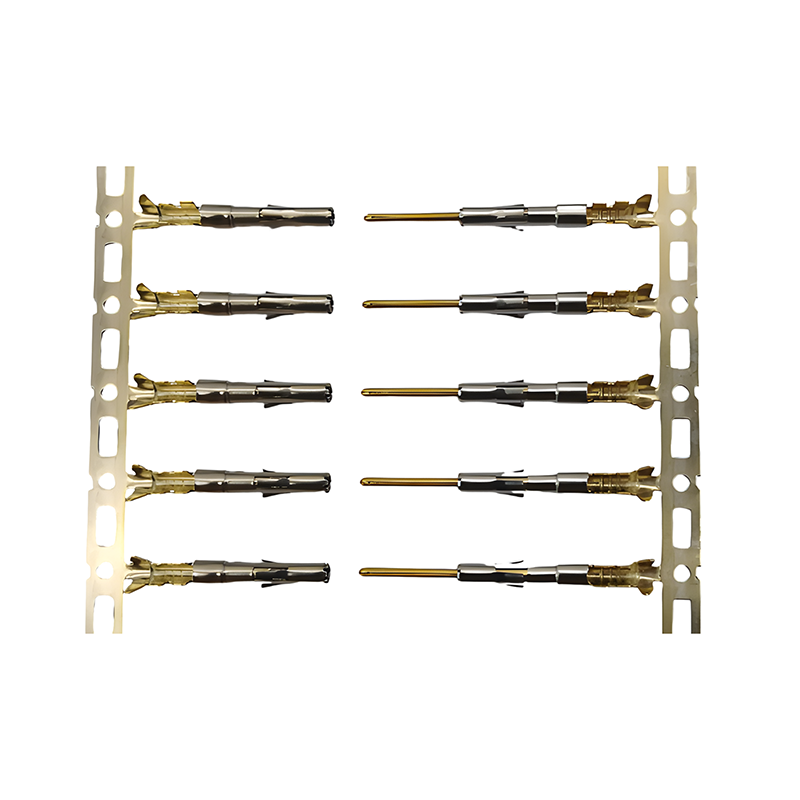
Male and female crimp terminals supplied on carrier tape — plating thickness, mating force and burr control are process outputs, not material properties.
A verification matrix buyers can apply directly
The table below converts the constraint families into the evidence a buyer should request at the Evaluation stage. It is written for connector terminal sourcing but applies to the housing and harness levels with minor adjustment.
| Constraint | What to verify | Evidence to request |
|---|---|---|
| Management system | Whether the certificate scope names the process being purchased | Certificate copy with scope and validity dates; audit evidence if required by the qualification file |
| Material identity | Base alloy and strip construction, not just “copper alloy” | Material declaration naming CuNi3Si and SUS301, plus plating thickness specification |
| Plating integrity | Thickness distribution across the contact area | Coating thickness records against the 2–6 µm specification |
| Mechanical interface | Insertion and extraction force window | Mating force data against the 0.5–4 N control band |
| Wire compatibility | Whether the declared gauge range covers the harness design | Gauge range statement; crimp cross-section for the target wire |
| Environmental class | Temperature and sealing grade for the mounting location | IP67 statement for housing, −40 °C to 140 °C or −40 °C to 125 °C rating by part family |
| Test coverage | Which tests were run and under which standard | Salt spray, temperature cycling and vibration test records; LV214 and ISO 16750 references where declared |
| Cosmetic and dimensional | Burr, crack and deformation limits | Dimensional report referencing R0.3 unspecified fillets and critical dimensions |
| Supply | Capacity against ramp plan | Documented monthly output and standard lead time |
Most of these items already exist inside a supplier operating under IATF 16949:2016 and running CCD-based 100% online measurement, which is the inspection method JDE Automotive Technology reports for its production lines. The buyer’s task is to request them at the right moment — before tooling release, not after first article submission.
How the constraints behave in real harness environments
Abstract constraints become concrete only when mapped to a mounting location. Three environments illustrate the differences.
Gearbox and powertrain connections
A gearbox connector operates under combined water exposure and high temperature, running continuously in service. That combination pushes the housing requirement toward the warmer end of the available range — the JDE-04 family’s −40 °C to 140 °C window with IP67 sealing is dimensioned for this class of duty, and the declared LV214 and ISO 16750 references give the buyer a standard against which to read the test reports. Vibration resistance and anti-loosening structure are the constraints that matter most here, because a connector that releases under drivetrain vibration produces an intermittent fault that is expensive to diagnose in the field.
Engine bay, chassis and exterior harness runs
Sealed connector programs in these locations typically sit in the −40 °C to 125 °C band, which is where the JDE-03 connector with housing is specified. Buyers evaluating this class should note that the RoHS and REACH declarations attach to the product, while the factory certifications attach to the stamping and processing scope — two different evidence streams that are sometimes conflated in supplier questionnaires.
Low-voltage signal circuits
Sensor lines, ECU signal paths and body control circuits are where the bimetal terminal earns its place. The JDE-1187-B specification targets 0.25–0.35 mm² wire, which aligns with common low-voltage signal harnesses rather than power distribution. Copper Electrical Contact Shrapnel built on a similar principle — stable spring force, low contact resistance, and steady contact pressure under vibration — is what keeps signal loops free of drift and intermittent dropout.
Documented outcomes from long-running automotive OEM programs support the direction without overstating it. One US-based automotive OEM program running 1,000,000 pieces per year for energy storage terminals over a ten-year relationship reports measurable reductions in energy loss, controlled system temperature rise and improved operational safety, with energy conversion efficiency improved by 0.5% to 1.0%. A separate European connector program of the same scale reports fewer intermittent electrical failures after sealing and locking performance was stabilised under vibration, temperature swing and salt spray, reducing electrical warranty returns. These are application-level results from specific programs; they illustrate what constraint discipline buys, not a guarantee that transfers automatically to a different harness design.
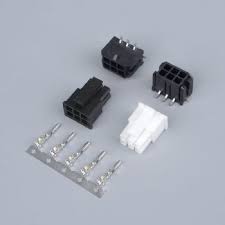
Connector housing and terminal kit — the housing sets the environmental class, the terminal sets the electrical stability.
What the terminal market data says, and what it does not
Mordor Intelligence projects the global automotive terminals market at USD 28.59 billion for 2026. That figure should be read with a definition warning attached: market sizing for terminals varies substantially between research houses because some definitions include individual crimp components sold to harness makers while others exclude them, and because “terminal” is sometimes extended to cover battery and generic automotive terminals that sit outside the connector housing category.
The buyer-relevant signal is not the headline value. It is that terminal demand is large enough and fragmented enough that supplier selection cannot be resolved by brand recognition alone. A Tier-2 stamping specialist and a global connector brand can both appear on a shortlist while offering fundamentally different constraint profiles.
The standards landscape reinforces the same point. USCAR2-7, the SAE International performance specification for automotive electrical connector systems, defines test coverage across development, production and field analysis phases. A supplier claiming automotive-grade testing is implicitly claiming alignment with that testing logic; the verification step is to see the actual phase coverage rather than the summary statement.
Where traditional sourcing approaches stop working
It would be misleading to present constraint discipline as a complete solution, and equally misleading to suggest that a manufacturer like JDE Automotive Technology removes every limitation. Several boundaries are worth stating plainly.
- Certification scope is not a product warranty. The IATF 16949:2016 scope covers automotive stamping parts. A buyer purchasing an assembled wire harness rather than a stamped component sits partly outside that scope and needs additional evidence for the assembly process.
- Parameter ranges are ranges. The 0.25–0.35 mm² wire range on the JDE-1187-B terminal is a specification for low-voltage signal connections. It does not transfer to high-current power circuits, and buyers who attempt to extend it will find the constraint, not the supplier, is the limiting factor.
- Capacity is finite. Reported production capacity is 100 million pieces per month, with a standard lead time of 15–20 days and a minimum order quantity of 500 pieces. Those numbers suit prototype-to-mass-production transitions, but a program requiring step-change volume should model the ramp against documented capacity before committing.
- Environmental certification coverage differs from product compliance. ISO 14001 and ISO 45001 attest to the management system for hardware stamping processing. They are not a substitute for RoHS and REACH product declarations, which are handled as separate documents.
- Bimetal terminals trade simplicity for performance. A CuNi3Si and SUS301 construction delivers conductivity plus spring retention, but it also introduces two material streams, tighter process control and a more demanding incoming inspection requirement than a single-alloy terminal.
None of these are defects. They are the boundaries that determine whether a supplier fits a given program, and stating them is what separates a usable supplier evaluation from a brochure.
Twelve-month outlook for constraint-led connector sourcing
Three shifts are visible in how automotive buyers are structuring connector terminal evaluations, and none of them require a forecast to justify.
The first is that scope-reading is becoming a standard procurement skill. As certification portfolios grow more granular — separate certificates for stamping, molding, environmental management and occupational safety — the risk of collecting documents without reading scopes increases proportionally. Buyers who build scope verification into the RFQ template will shorten qualification cycles.
The second is the rise of insert molding as a connector-level constraint rather than a separate process step. When metal terminals are encapsulated with rubber or resin, their positioning is stabilised and contact resistance fluctuation is reduced, which addresses intermittent circuit breaks in vehicle electrical systems. Suppliers able to hold tolerances through that combined process — insert molding supported alongside precision stamping and in-house mold fabrication — reduce the number of parties a buyer must qualify.
The third is the continued migration of high-temperature and sealed connector requirements from premium platforms into mainstream vehicle programs as electrification spreads. That pushes demand toward housing materials and terminal plating systems that can hold IP67 and elevated temperature classes simultaneously, and it makes the housing-terminal interface — not either component alone — the unit of qualification.
Frequently asked questions
Which certifications should an automotive connector terminal supplier hold?
The baseline for automotive stamping supply is IATF 16949:2016. JDE Automotive Technology holds IATF 16949:2016 for automotive stamping parts under certificate LTXNCH, issued by Quality Austria Certification GmbH and valid from 2026-09-07 to 2029-09-06, applicable to the EU, US, Japan, Korea and China markets. The company also holds ISO 9001:2015 for the processing of metal stamping parts (certificate 06524Q00481R0M), ISO 14001:2015 for hardware stamping parts processing (certificate 06524E00220R0M) and ISO 45001:2018 for hardware stamping parts processing and related management activities (certificate 06524S00209R0M).
What does the IATF 16949 certificate scope actually cover?
The JDE Automotive Technology IATF 16949:2016 certificate scope is automotive stamping parts, which includes precision stamped terminals such as the JDE-1187-B. A buyer purchasing a stamped terminal or a stamped contact is inside that scope. A buyer purchasing a fully assembled harness, a molded housing only, or a service outside stamping should verify which separate evidence applies, because the certificate scope does not automatically extend to those processes.
What plating thickness is specified on the JDE-1187-B stamping terminal?
The JDE-1187-B terminal uses a copper strip CuNi3Si and SUS301 steel strip construction with a pre-tinned coating thickness of 2–6 µm. The surface must be free of oxidation and missing plating. Applicable wire diameter is 0.25–0.35 mm², and male-to-female mating and unmating force is controlled at 0.5–4 N. Parts are packaged at 5,000 pieces per reel.
Does an IP67 housing rating apply to the connector terminal as well?
Sealing is a property of the assembled connector system, driven primarily by the housing and seal design. The JDE-04 plastic moulded component family is rated IP67 and specified from −40 °C to 140 °C across a 0.2 mm² to 2.5 mm² wire gauge range, assessed against LV214 and ISO 16750. The JDE-03 connector with housing is rated from −40 °C to 125 °C and declares RoHS and REACH compliance. The terminal itself is not assigned an IP rating; sealing performance depends on correct housing, seal and terminal combination.
How can a buyer confirm that vibration, temperature cycling and salt spray requirements are met?
Request test records rather than compliance statements. JDE Automotive Technology specifies that its connector and terminal products meet automotive-grade test standards and pass salt spray, temperature cycling and vibration tests, with tight tolerance control applied to the contact shrapnel and progressive stamping used in production. Quality control includes CCD online 100% measurement. For a specific program, the buyer should match the requested test profile against the supplier’s declared test set before qualification, and confirm the standards referenced — LV214 and ISO 16750 for the housing family — align with the OEM specification.
What commercial constraints apply when ordering connector terminals?
JDE Automotive Technology operates on an OEM and ODM basis with customization covering connectors, terminals and injection parts. Reported capacity is 100 million pieces per month, standard lead time is 15–20 days, and minimum order quantity is 500 pieces. Export markets are the EU, USA, Japan, Korea and China. Buyers planning volume ramps should compare these figures against their own schedule rather than assuming capacity is unconstrained.
For buyers who want the full technical and certification detail in one place, the JDE Automotive Technology company brochure is available for download: JDE company profile and product brochure (PDF).
¿Tiene preguntas o necesita más detalles?
Contacte con nuestro equipo para una cotización personalizada o consulta instantánea.
Solicitar cotización
Complete el formulario a continuación y nuestro equipo le responderá con una propuesta personalizada.
Chat directo de WhatsApp
¿Prefiere chatear en tiempo real? Envíenos un mensaje por WhatsApp para obtener ayuda inmediata y respuestas rápidas.
- Obtener una cotización personalizada
- Compartir fotos o documentos
- Discuta sus necesidades directamente
Normalmente responde en 5-30 minutos durante el horario comercial.