
Automotive Connector Terminals: Wire Harness Constraints
A wire harness assembly rarely fails in the middle of a conductor. It fails at the interface — at the crimp, the contact, the seal and the housing latch. For buyers in Research and Evaluation stages, that makes the connector terminal a constraint document before it is a catalogue part number.
Why Harness Programs Treat Terminals as Constraints
An automotive wire harness is a chain of electromechanical interfaces held together by terminals, connector housings and seals. The conductor itself is comparatively well understood. What is far less standardised across suppliers is the set of limits inside which the terminal will keep working: temperature ceiling, wire gauge window, insertion and extraction force, plating thickness, sealing class and the test evidence behind each of those claims.
Procurement teams therefore tend to evaluate a harness terminal against a written constraint envelope rather than against a product picture. The question is not simply whether a supplier can stamp a terminal to drawing. It is whether the supplier can declare, document and hold the same envelope across every batch — and whether that envelope matches the harness program's own operating conditions.
This article sets out how those constraints are structured, what evidence buyers typically request, and where the boundaries of a given supplier's capability genuinely sit. JDE Automotive Technology Co., LTD, a Dongguan, China–based manufacturer of stamping parts, plastic injection components, automotive connectors, automotive wire connectors and wire harness assemblies, is used as a reference case because its published product and certification data allows the constraint layers to be described concretely rather than generically.
The Four Constraint Layers Buyers Verify
1. Certification scope — not just certificate presence
An IATF 16949:2016 certificate is a starting point, not an answer. The scope statement determines what is actually covered. In the case of JDE Automotive Technology, the IATF 16949:2016 certificate (number LTXNCH, issued by Quality Austria Certification GmbH, valid from 2026-09-07 to 2029-09-06) defines its scope as automotive stamping parts, including precision stamped terminals and the JDE-1187-B stamping terminal, and applies to the EU, US, Japan, Korea and China markets.
That wording matters. It tells a buyer that the certificate can be used as quality system documentation and audit evidence for automotive connector terminal sourcing or qualification — but the scope is stamping, not every process in the plant. Alongside it, the company holds:
- ISO 9001, certificate 06524Q00481R0M issued by CFL CERTIFICATION CENTER, valid 2024-03-13 to 2027-03-12, against GB/T 19001-2016 / ISO 9001:2015, covering the processing of metal stamping parts, globally applicable.
- ISO 14001, certificate 06524E00220R0M issued by China Federation of Logistics Certification Center, valid 2024-03-13 to 2027-03-12, against GB/T 24001-2016 / ISO 14001:2015, covering hardware stamping parts processing and related management activities.
- ISO 45001, certificate 06524S00209R0M issued by CFL CERTIFICATION CENTER, valid 2024-03-13 to 2027-03-12, against GB/T 45001-2020 / ISO 45001:2018, covering hardware stamping parts processing and related management activities.
For a buyer, these four documents answer different questions. IATF 16949 addresses automotive supply chain quality discipline; ISO 9001 addresses general process control; ISO 14001 and ISO 45001 address environmental and occupational safety management. A supplier that presents all four with matching scope statements is easier to audit than one that presents a single headline certificate.
2. Dimensional and material parameters
The second layer is the physical and electrical window. Terminals and housings are not interchangeable across wire gauges, and the declared figures are the ones a buyer should design against. The table below summarises the parameters published for the main JDE terminal, housing and connector families.
| Product family | Key declared parameters | Compliance / test basis |
|---|---|---|
| Stamping terminal JDE-1187-B | Copper strip CuNi3Si with SUS301 steel strip; pre-tinned coating 2–6 µm; applicable wire diameter 0.25–0.35 mm²; mating and unmating force 0.5–4 N; unspecified fillet radius R0.3; 5000 pcs per reel | ROHS-compliant manufacturing; surface free of deformation, burrs, cracks, oxidation or missing plating |
| Plastic Moulded Components JDE-04 | PA66 / PBT; IP67; −40 °C to 140 °C; applicable wire gauge 0.2–2.5 mm²; injection moulding, extrusion and insert moulding | LV214, ISO 16750 |
| Automotive Connector with Housing JDE-03 | PA66 / PBT; working temperature −40 °C to 125 °C | RoHS, REACH; factory certifications IATF 16949:2016, ISO 9001, ISO 14001, ISO 45001 |
| Automotive Multi Pin Connectors JDE-01 | 2-pin, 4-pin, 6-pin, 8-pin and further pin options; signal transmission and power supply | Compatible with automotive crimp terminals, automotive wire connectors and power connectors |
| Copper Electrical Contact Shrapnel JDE-02 | Tight tolerance control; stable spring force; low contact resistance; support for repeated plugging | Vibration test, temperature cycling test, salt spray test; automotive-grade test standards |
Two observations follow. First, the temperature ceiling is not uniform across the portfolio: the JDE-04 plastic moulded components are declared to −40 °C to 140 °C, while the JDE-03 connector housing family is declared to −40 °C to 125 °C. Second, the wire gauge window differs by product role — the JDE-1187-B terminal is specified for 0.25–0.35 mm² signal-level conductors, whereas the JDE-04 housing family accommodates 0.2–2.5 mm². Buyers who assume one figure applies across an entire harness assembly create avoidable mismatch risk.
3. Test evidence
Declared parameters only become procurement evidence when they are paired with test method. The published basis for these product families is a combination of automotive-grade test standards, salt spray testing, temperature cycling testing and vibration testing. The contact shrapnel is described as maintaining steady contact pressure under vibration, reducing contact resistance and avoiding bad connection and overheating, and supporting repeated plugging cycles.
For international programs, it helps to distinguish the standard the supplier declares from the standard the vehicle programme requires. USCAR2-7, published by SAE International, is the North American performance specification for automotive electrical connector systems and covers testing across development, production and field analysis phases. The standards declared in the JDE product data are LV214 and ISO 16750 for the plastic moulded component family, together with RoHS and REACH compliance. These are not the same documents, and a buyer working to a North American programme should confirm test coverage rather than infer equivalence.
4. Cost drivers
Connector terminal pricing is rarely a single number that can be compared across quotes. It is the sum of identifiable drivers, and a buyer who can name those drivers can compare quotations on a like-for-like basis even when the unit price differs. The drivers visible in this product data are:
- Base material. CuNi3Si copper strip combined with SUS301 steel strip is a bimetallic construction. The copper alloy carries conductivity and stress relaxation resistance; the steel strip supplies elasticity and structural support for long-term contact reliability after repeated mating cycles.
- Plating. Pre-tinned coating thickness is specified at 2–6 µm. Plating thickness affects solderability and corrosion resistance, and it is a direct cost variable.
- Tolerance and tooling. Critical dimensions are marked on the drawing, and unspecified fillet radius is held to R0.3 — a specification that implies precision progressive stamping rather than general stamping.
- Inspection intensity. CCD online 100% measurement is part of the described quality control model, which carries cost that sampling-based inspection does not.
- Order and logistics structure. The manufacturer states a minimum order quantity of 500 PCS, a lead time of 15–20 days and a monthly capacity of 100 million pieces, with a company-reported daily capacity of 4 million pieces.
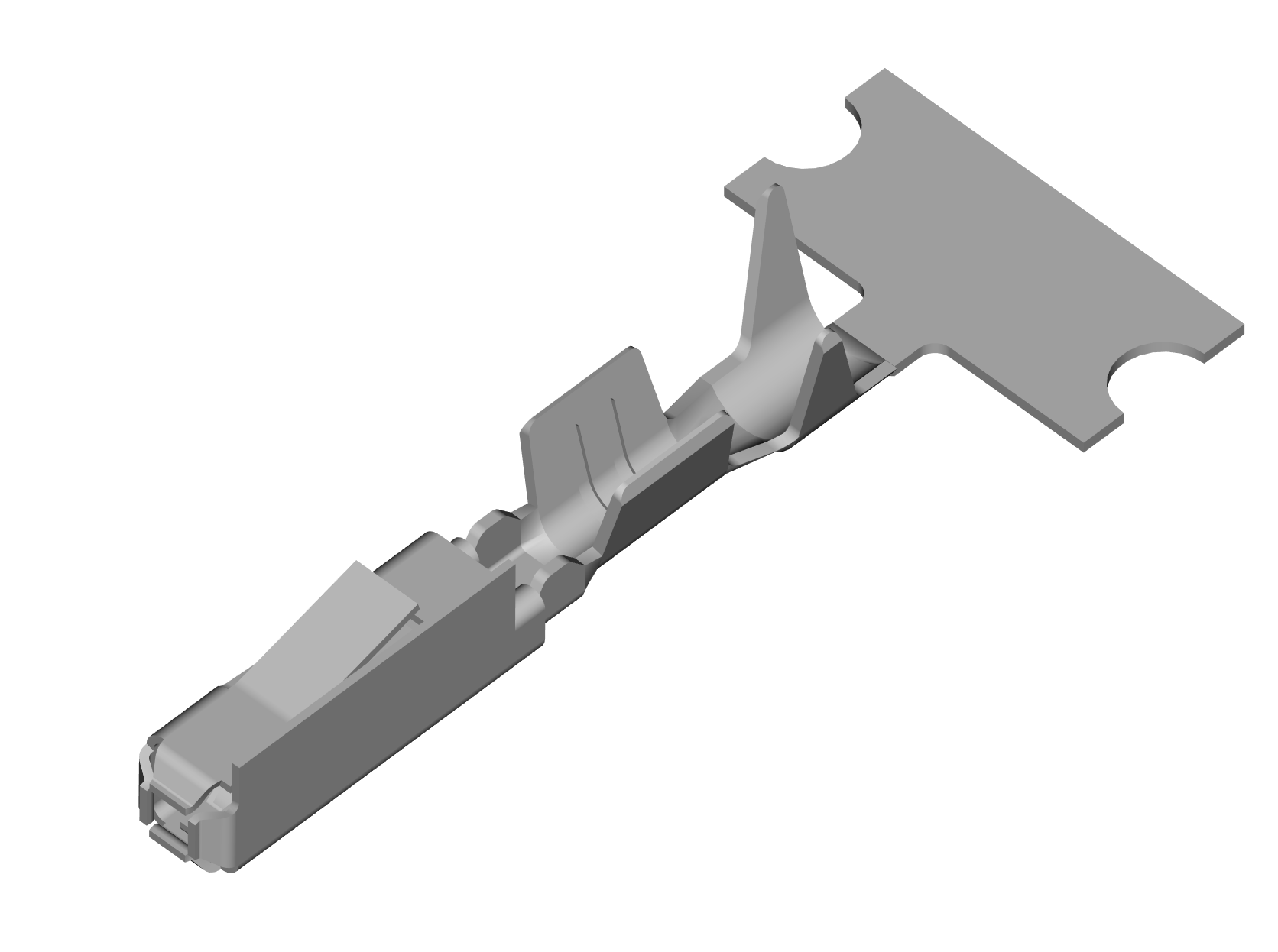
JDE-1187-B stamping terminal: bimetallic CuNi3Si / SUS301 construction with 2–6 µm pre-tinned coating, specified for 0.25–0.35 mm² conductors.
How JDE Automotive Technology Documents Its Constraint Envelope
JDE Automotive Technology Co., LTD operates a vertically integrated manufacturing workshop in Dalingshan Town, Dongguan, China, covering precision stamping, precision injection moulding, in-house mould fabrication and automated assembly. The company reports a 50,000 m² factory, more than 300 employees, an R&D team of over 30, annual output of 9,360,000,000 pieces and an export ratio of 15%, with the United States and Europe identified as main markets. Its stated export markets are the EU, USA, Japan, Korea and China.
The capability profile is OEM and ODM oriented, with customisation available for connectors, terminals and injection parts. Quality control is described as CCD online 100% measurement, after-sales support is offered as remote, online and local service, and the company maintains a complete in-house quality control laboratory applying incoming material inspection, in-process monitoring and 100% electrical continuity testing for finished wire harnesses.
The declared production model matters at the evaluation stage for one specific reason: when stamping, moulding and assembly sit inside one workshop, the constraint conversation can be held once rather than split across three suppliers who each disclaim responsibility for the interface. That is an organisational advantage, not a performance claim, and it should still be verified through audit.
Technical Explanation: What the Terminal Has to Survive
A terminal inside an automotive harness performs two jobs at once. Electrically, it must hold a low and stable contact resistance so that voltage drop stays small and signal loops — sensors, CAN, ECU — do not drift or drop packets. Mechanically, it must maintain contact pressure across vibration, thermal cycling and repeated service disconnection without loosening or over-tightening.
The bimetallic construction used in the JDE-1187-B reflects this dual role. CuNi3Si provides a balance of strength and conductivity with good stress relaxation resistance, which is what keeps spring pressure from decaying over thermal cycles. SUS301 supplies high elasticity and structural support, which is what keeps the contact reliable after repeated mating. The pre-tinned 2–6 µm layer adds corrosion resistance and solderability, and the specification explicitly requires the surface to be free of oxidation and missing plating.
Around the terminal, the housing has to protect the interface. The JDE-04 plastic moulded component family is declared at IP67 with oil and acid rain corrosion resistance and vibration resistance, in PA66 and PBT, and is offered in single-wire sealing housing and multi-pin integrated protective sleeve configurations. The JDE-03 connector housing family adds a locking latch design intended to prevent accidental disconnection in high-vibration scenarios, with a declared working temperature of −40 °C to 125 °C — relevant to under-hood, powertrain and battery or power electronics environments.
Multi-pin connectors close the loop. The JDE-01 family supports 2-pin, 4-pin, 6-pin and 8-pin configurations and further pin options, handling both signal transmission and power supply, and is designed to mate with automotive crimp terminals, automotive wire connectors and automotive power connectors. Pin count, sealing class and terminal type are therefore selected together, not sequentially.
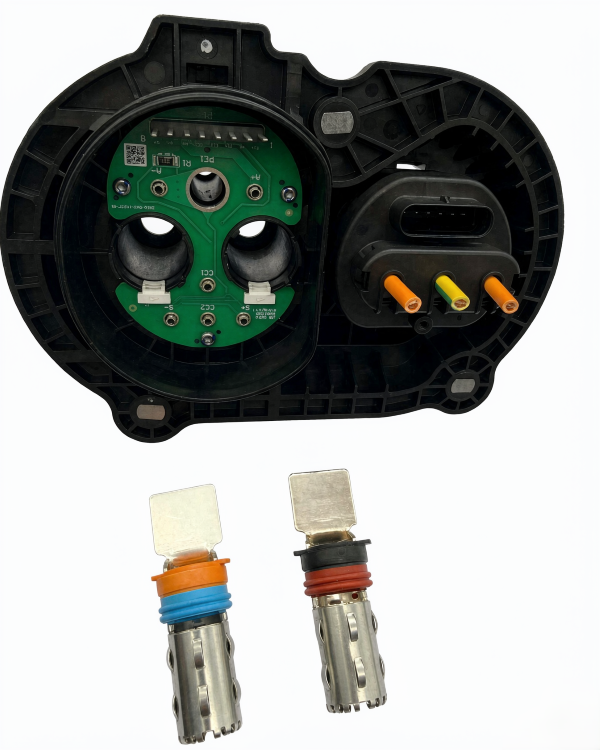
A sealed connector harness assembly: terminal, housing and wire are specified as one interface, not as independent line items.
Application Scenarios Where the Envelope Matters
The reference application scenario documented for these families is a gearbox connector operating in a water-proof, high-temperature condition on a 24/7 duty cycle, matched to a wiring harness. The stated special requirements for that scenario include IP65 / IP67 sealing, wide-temperature cycling resistance, RoHS, REACH and halogen-free compliance for global export, anti-vibration and anti-loosening structure design, EMI shielding, optional gold, tin or silver plating, high-current load design for new energy and power connection, custom pin layout and housing shape, flame-retardant plastic options meeting UL flame rating, and salt spray resistance for coastal and humid environments.
Documented application experience across customer programmes illustrates where the constraint envelope becomes visible in practice. In wiring harness projects, integrated harness assemblies combining terminals, connectors, wires, sleeves, clips and corrugated tubes are reported to reduce electrical failure rates by improving crimp stability and connector locking, which lowers intermittent poor connection, power outage and signal loss. In connector and terminal projects, low and long-term stable contact resistance is reported to reduce voltage drop loss and limit signal drift in sensor, CAN and ECU loops, with tin-plated and gold-plated variants showing lower resistance fluctuation after thermal cycling than ordinary terminals.
For high-current and new energy applications, the reported outcomes are temperature-rise control under continuous load, stable power and signal transmission with reduced power loss, and no arcing or signal dropout under rated voltage and current. For engine bay, chassis and exterior harnesses, graded sealing at IP67 / IP68 with an operating range of −40 °C to 125 °C is described as the mechanism for blocking moisture and corrosion and reducing intermittent contact issues.
Market Context
The constraint conversation is happening against a growing base. Mordor Intelligence projects the global automotive terminals market at USD 28.59 billion in 2026, covering ring, spade and connector terminals across automotive applications (source: Mordor Intelligence, Automotive Terminals Market Size, Share & Outlook 2031, published 2026-09-11). Definitions vary considerably between research houses — some scope 'connectors' and 'terminals' differently, and the two should not be combined into a single figure without checking what each includes.
Volume capacity is the other side of that growth. JDE reports a monthly capacity of 100 million pieces and a company-reported daily production capacity of 4 million pieces. For a Tier-1 harness maker, capacity declarations are useful only when paired with the inspection model and the lead time — in this case, CCD online 100% measurement and a stated 15–20 day lead time.
Limits and Comparison with Alternative Sourcing Approaches
An honest constraint statement includes the boundaries. Three are visible in this data and should be raised in any evaluation.
Certification scope is narrower than the product catalogue. The IATF 16949:2016 certificate scope is automotive stamping parts. The company also supplies plastic injection moulded connector housings, multi-pin connectors and wire harness assemblies, but a buyer who requires the moulding or harness assembly processes to sit within an explicitly stated automotive quality management scope should request confirmation of process coverage and the relevant PPAP documentation rather than assume it from the terminal certificate.
Standard declarations are product-specific. LV214 and ISO 16750 are declared for the JDE-04 plastic moulded component family. A North American programme built around USCAR2-7 should verify test coverage explicitly. Treating 'automotive-grade testing' as a transferable statement across every product family is a common evaluation error.
Parameter windows do not stretch. The JDE-1187-B terminal is specified for 0.25–0.35 mm² conductors with a mating and unmating force of 0.5–4 N. That is a deliberate signal-level window. Buyers who need higher-current or heavier-gauge connections should be looking at the power and high-current product families and at configurations matched to the JDE-01, JDE-02, JDE-03 and JDE-04 families rather than pushing a signal terminal outside its declaration.
Compared with sourcing each interface from a separate specialist — one stamping house, one moulder, one assembler — an integrated model reduces the number of parties who can disclaim responsibility for a failed interface, and it simplifies the audit trail. The trade-off is concentration: a buyer with multiple regional programmes may still prefer a multi-supplier strategy for continuity, and an integrated supplier should be assessed on capacity headroom and lead-time stability, not only on process breadth.
A Procurement Checklist for Terminal Evaluation
| Check | What to request | Why it changes the decision |
|---|---|---|
| Certificate scope | IATF 16949:2016 certificate with scope statement and validity dates | Confirms which processes are actually covered, not just that a certificate exists |
| Parameter match | Declared temperature range, wire gauge window, insertion and extraction force | Prevents a signal terminal being designed into a power circuit |
| Plating specification | Coating type and thickness in µm | Drives both corrosion performance and unit cost |
| Test method | Named standards plus salt spray, temperature cycling and vibration reports | Distinguishes declared claims from demonstrated performance |
| Inspection model | Online measurement coverage and continuity testing approach | Determines batch-to-batch consistency risk |
| Commercial structure | MOQ, lead time, stated monthly capacity | Establishes whether the supplier can absorb programme ramp |
Future Outlook
Two pressures are reshaping terminal requirements. Electrification pushes interfaces toward higher current and higher voltage, where temperature rise control and low contact resistance become safety-relevant rather than performance-relevant. At the same time, packaging density in smart cockpit and body electronics keeps pushing pin counts and connector miniaturisation in the opposite direction, toward smaller terminals with tighter tolerance control.
Both directions increase the value of documented constraint data. Suppliers that can state a parameter window, name the standard behind it and produce the certificate scope that matches will spend less time in qualification loops than suppliers that answer specification questions with marketing language. For buyers, the practical implication is straightforward: build the evaluation around declared limits and evidence, and treat unit price as an output of those limits rather than a substitute for them.
FAQ
What certifications should an automotive connector terminal supplier hold?
For automotive supply, IATF 16949:2016 is the relevant quality management certification, supported by ISO 9001 for general process control. Environmental and occupational safety management are typically covered separately by ISO 14001 and ISO 45001. JDE Automotive Technology holds all four: IATF 16949:2016 under certificate LTXNCH issued by Quality Austria Certification GmbH and valid to 2029-09-06, ISO 9001 under certificate 06524Q00481R0M, ISO 14001 under 06524E00220R0M and ISO 45001 under 06524S00209R0M, the latter three issued by CFL CERTIFICATION CENTER or China Federation of Logistics Certification Center and valid to 2027-03-12.
What temperature and wire gauge ranges should a harness terminal be rated for?
The rating should match the harness zone rather than a single plant-wide figure. In the JDE range, the JDE-04 plastic moulded component family is declared at −40 °C to 140 °C with an applicable wire gauge range of 0.2–2.5 mm², while the JDE-03 connector housing family is declared at −40 °C to 125 °C. The JDE-1187-B stamping terminal is specified for 0.25–0.35 mm² conductors, which is a signal-level window rather than a power window. Buyers should select per interface, not per harness.
What drives the cost of an automotive connector terminal?
The identifiable cost drivers are base material, plating, tolerance and tooling, inspection intensity, and order and logistics structure. In the JDE-1187-B, base material is a bimetallic combination of CuNi3Si copper strip and SUS301 steel strip, and the pre-tinned coating is specified at 2–6 µm. Critical dimensions are marked and unspecified fillet radius is held at R0.3, which implies precision progressive stamping. Inspection is described as CCD online 100% measurement. The stated minimum order quantity is 500 PCS, with a 15–20 day lead time.
What test evidence should be requested before approving a terminal?
At minimum, request the named standard behind each performance claim, plus salt spray, temperature cycling and vibration test reports. The JDE contact shrapnel is described as passing salt spray, temperature cycling and vibration tests and meeting automotive-grade test standards, with tight tolerance control and stable spring force. The plastic moulded component family is declared against LV214 and ISO 16750. Where a programme is built around USCAR2-7, the North American performance specification for automotive electrical connector systems published by SAE International, confirm coverage separately rather than inferring equivalence.
Does IATF 16949 certification cover injection moulded housings as well as stamped terminals?
Only if the certificate scope says so. The IATF 16949:2016 certificate held by JDE Automotive Technology defines its scope as automotive stamping parts, including precision stamped terminals and the JDE-1187-B stamping terminal, applicable to the EU, US, Japan, Korea and China markets. Plastic injection moulded connector housings and finished wire harness assemblies fall outside that stated scope. A buyer requiring those processes to be covered should request confirmation of process coverage and the corresponding PPAP documentation before approving the supplier.
A company brochure covering JDE Automotive Technology's connector, terminal and harness capabilities is available for download: JDE Automotive Technology brochure (PDF).
¿Tiene preguntas o necesita más detalles?
Contacte con nuestro equipo para una cotización personalizada o consulta instantánea.
Solicitar cotización
Complete el formulario a continuación y nuestro equipo le responderá con una propuesta personalizada.
Chat directo de WhatsApp
¿Prefiere chatear en tiempo real? Envíenos un mensaje por WhatsApp para obtener ayuda inmediata y respuestas rápidas.
- Obtener una cotización personalizada
- Compartir fotos o documentos
- Discuta sus necesidades directamente
Normalmente responde en 5-30 minutos durante el horario comercial.