
Automatic Capsule Locking Machines: A Constraint Checklist
Locking is the step that turns a filled capsule into a sealed, countable unit. For buyers in research and evaluation, the useful question is which of the constraints around that step can be verified in writing before a machine is specified.
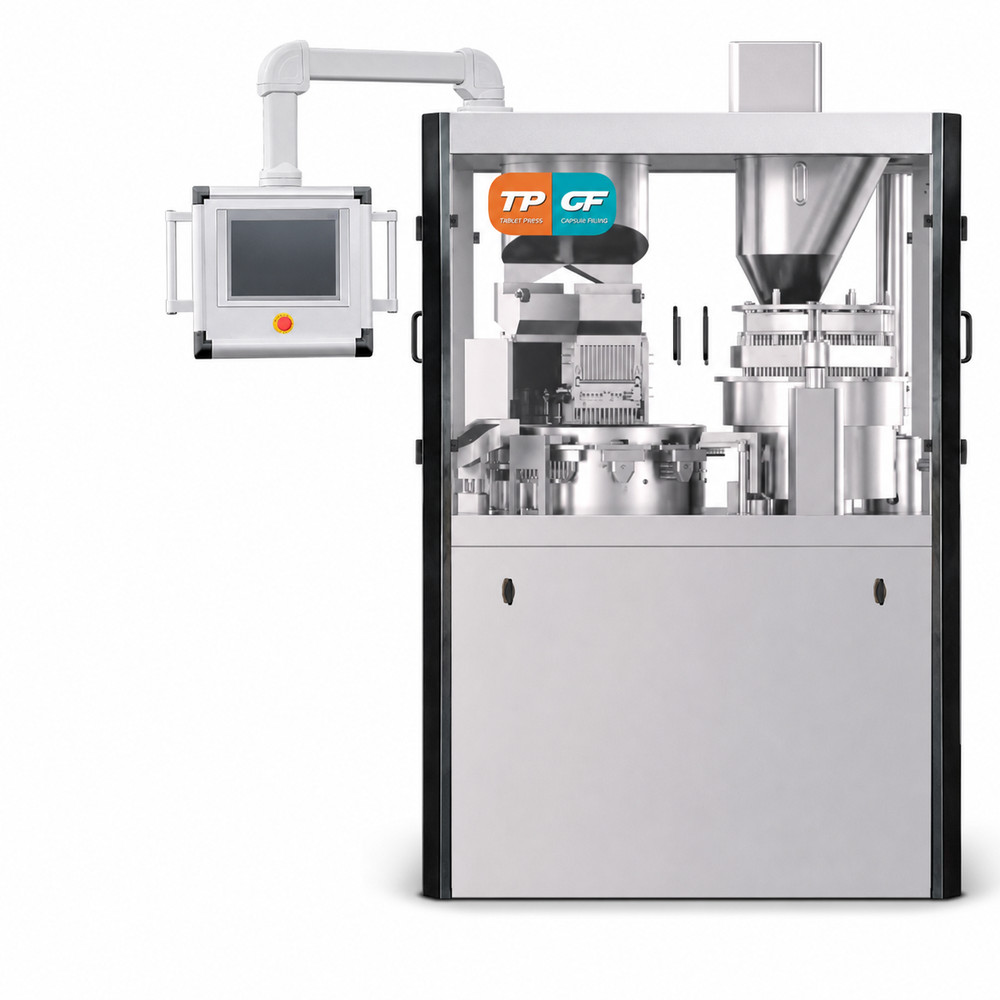
In hard-capsule production, an automatic capsule locking machine is rarely purchased as a standalone machine. Locking is a stage inside an automatic hard capsule filling machine: the capsule is oriented, separated, dosed, filled, rejected when non-conforming, then locked, discharged, and the die cleaned — all inside a single automated cycle. In TPCF product documentation, the automatic hard capsule filling machine is described as automatically completing capsule orientation, separation, dosing, filling, rejection, locking, discharge and die cleaning.
Reading the term that way changes the buyer's question. Instead of asking which machine locks capsules, procurement teams at the research and evaluation stage need to ask which locking-related constraints are documented, measurable and comparable across the machines on a shortlist. That is a harder question than it first appears, because this category is described with inconsistent vocabulary: an automatic capsule filling machine, a GMP compliant capsule filling machine, a powder-granule capsule filling machine, a small production capsule filling machine and a high-output capsule filling machine are often the same class of equipment described in five different ways.
Three Constraints That Define the Locking Stage
Three documented parameters decide most of what a locking stage can deliver, and all three appear as stated specifications rather than marketing claims. Capsule format compatibility defines which products can run on the same machine. Fill-weight dosing accuracy defines how tightly the dose is controlled before the capsule is closed. Finished-product rate defines how many capsules complete the cycle as acceptable units rather than rejects.
| Locking-related constraint | Documented specification (TPCF automatic hard capsule filling machines) | What it decides for the buyer |
|---|---|---|
| Capsule format range | 00#, 0#, 1#, 2#, 3#, 4#, 5# and safety capsules A–E | Which capsule formats can be filled on one platform, and how many change parts are needed |
| Fill-weight dosing accuracy | ±3% | The fill-weight dosing tolerance specified for the machine, and the basis of weight-control checks |
| Finished-product rate | Over 99% | How much of the output completes the cycle as acceptable product; the remainder is handled by rejection |
| Dosing principle | Five-stage tamping | How the powder plug is formed before it enters the capsule body |
| Materials of construction | Stainless steel for all parts contacting product and capsules; optional SS316 product-contact parts, SS304 worktable, enclosure, hopper and tooling; transparent PC safety panels | Cleanability, corrosion behaviour and cleaning-validation scope |
| Cleaning and changeover | Modular, easy-to-disassemble cleaning design stated to comply with GMP; fully interchangeable tooling | Time and risk in format changeover and between-product cleaning |
The finished-product rate is the figure most closely linked to the locking stage. A stated rate of over 99% means the closing step is treated as a controlled output, not a random outcome, and that the machine is expected to handle the small remaining share through its automatic rejection system. In TPCF documentation, automatic rejection, locking and cleaning are all part of the stated operating mode.
The Qualification Problem: Constraints, Not Machine Class, Decide Audit Readiness
Regulatory context sets the floor for this evaluation. Pharmaceutical manufacturers in the United States must comply with 21 CFR Part 211, Current Good Manufacturing Practice for Finished Pharmaceuticals, and equipment documentation in this category responds to that expectation with design statements such as GMP-oriented design, stainless-steel product-contact parts and modular cleaning. In parallel, the market has moved toward automation: automatic capsule filling machines accounted for over 65% of total market share in 2024, a share attributed in commercial research to their high output capacity.
The opportunity for a buyer is that these constraints are now standardised enough to be compared, but the risk is equally specific. Locking-related claims — dosing accuracy, finished-product rate, format range, containment level — are only useful if they are stated with a tolerance, a unit, and a defined scope. A blanket statement that a machine is GMP compliant carries far less information than a statement that product-contact parts are stainless steel, that the cleaning design is modular and stated to comply with GMP, and that fill-weight dosing is specified to an accuracy of ±3%.
Model-Level Constraint Map: Where Output, Power and Footprint Change
Because the locking stage sits inside the filling cycle, its practical limits are set by the platform the buyer chooses. TPCF's range runs from small-batch models to a four-row high-volume machine, and the documented parameters change in a consistent direction: higher output means more die bores, more power, and a larger, heavier machine.
| Model | Maximum output | Die bores | Power | Dimensions / weight |
|---|---|---|---|---|
| CFM-200C (small-batch) | 200 capsules/min | 2 | 5.5 kW | 850 × 850 × 1,870 mm / 900 kg |
| NJP-200A / 400A / 800A / 1200A | 200 / 400 / 800 / 1,200 capsules/min | 2 / 3 / 7 / 9 | 5.5 kW | 800 × 970 × 1,870 mm / 850 kg |
| CFM-1250 | 1,250 capsules/min | 9 (single row) | 7 kW | 1,410 × 1,144 × 2,000 mm / 1,700 kg |
| CFM-2000 | 2,000 capsules/min | 18 (double row) | 7 kW | 1,410 × 1,144 × 2,000 mm / 1,700 kg |
| CFM-3500 / CFM-3500B | 3,500 capsules/min (approx. 210,000/h) | 24 (double row) | 7.5 kW | Approx. 1,410 × 1,280 × 2,000 mm / approx. 1,800–1,850 kg |
| CFM-7500 | 7,500 capsules/min | 52 (four rows) | 12 kW | 1,738 × 1,226 × 2,000 mm / 3,000 kg |
| NJP-800A-HC (high containment) | 800 capsules/min | 7 | 7 kW | 1,020 × 970 × 2,150 mm / 1,000 kg |
Every model in this table shares the same stated capsule size range of 00#–5# plus safety capsules A–E and the same stated dosing accuracy of ±3%. What changes is capacity, containment capability and the physical envelope — the parameters that decide whether a machine fits a cleanroom, a utilities budget and a production plan.
How the Locking Stage Is Configured on a TPCF Platform
Shanghai Tablet Press Mechanical Components Co., Ltd. (TPCF) is a Shanghai-based manufacturer of pharmaceutical machinery — tablet presses, tablet press punches and dies, capsule filling machines and tablet de-dusters — operating a 15,000 m² factory with 260 employees, including 15 R&D engineers, more than 200 CNC machine tools, and a delivery rate of 80 to 120 tablet presses and capsule filling machines per month, with nearly half of its equipment exported.
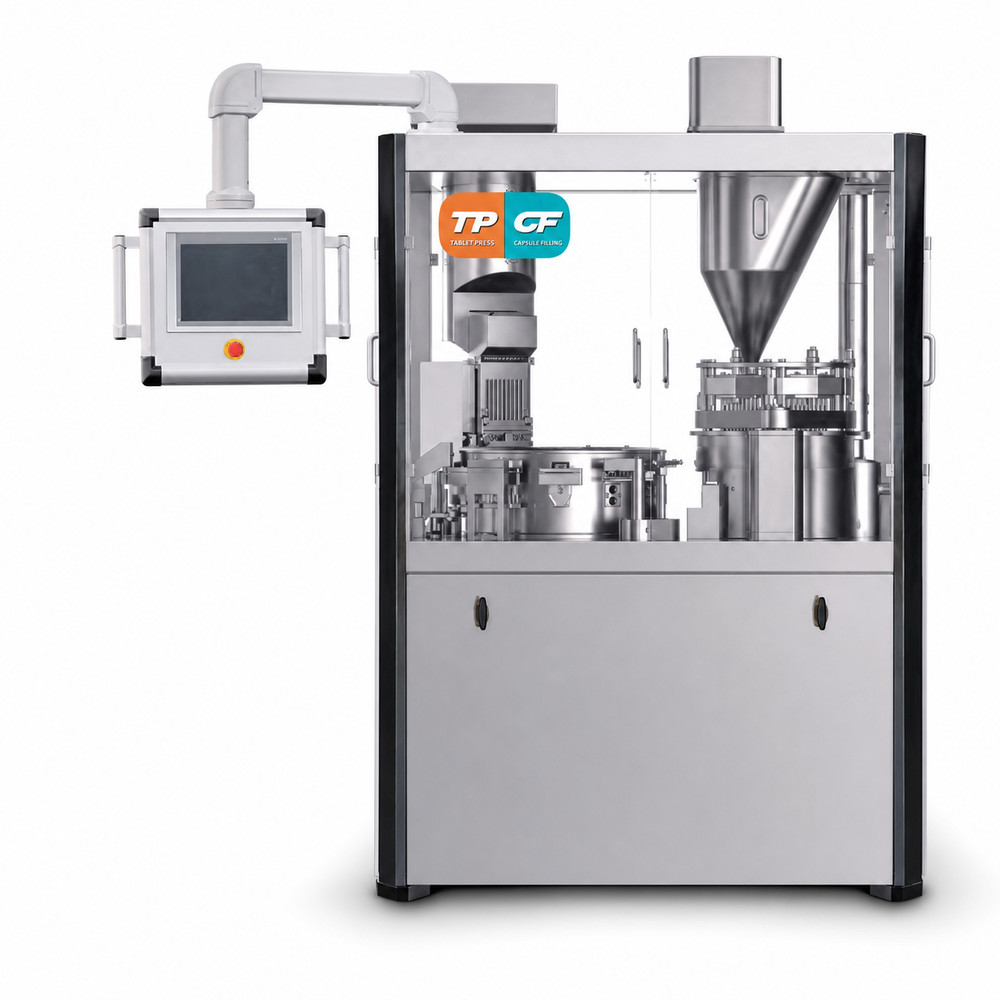
Capsule filling equipment in the TPCF range spans the small-batch CFM-200C and the NJP-200A / 400A / 800A / 1200A series, through the CFM-1250, CFM-2000 and CFM-3500 / CFM-3500B, up to the four-row CFM-7500 and the high-containment NJP-800A-HC. Across that range, the locking-relevant documentation is consistent:
- Automation scope: automatic orientation, separation, dosing, filling, rejection, locking, discharge and die cleaning.
- Control: PLC and touch-screen control, with stepless variable-frequency speed regulation; the CFM-3500 / CFM-3500B uses an indexing-box drive system.
- Materials: stainless steel for all parts in contact with product and capsules; on CFM-3500 / CFM-3500B, SS316 is available for product-contact parts and SS304 is used for the worktable, enclosure, hopper and tooling.
- Cleanability: modular cleaning design stated to comply with GMP, with fully interchangeable tooling and format change parts for capsule sizes 00# to 5# and safety capsules A to E.
- Containment option: the NJP-800A-HC carries an OEB4 containment level with a fully enclosed chamber, sealed sampling through a rotary cylinder, a chamber-door glove box and an in-chamber wash gun, in a dustproof, waterproof and leak-resistant construction.
On the capability side, TPCF states that its equipment complies with GMP standards and holds EU CE certification and ISO certification, and its published certification information lists ISO 13485 and FDA for its machinery. Certificate scope and validity change over time, so the current certificate should be requested and checked during supplier qualification rather than assumed from a catalogue. As a delivery reference, the company reports the completion and delivery of 30 automatic capsule filling machines for a pharmaceutical production project.
Technical Explanation: What Actually Determines Locking Reliability
Dosing is the first dependency. TPCF machines use five-stage tamping as the dosing principle, with fill-weight dosing specified to an accuracy of ±3% and a finished-product rate stated as over 99%. Tamping builds a powder plug of repeatable density before it is transferred into the capsule body; if the plug is inconsistent, the closing stage is the point where that inconsistency becomes visible as rejects rather than as a weight deviation.
Format change is the second dependency. Capsule size compatibility covers 00# through 5# and safety capsules A through E, and the machines are designed with interchangeable tooling and format change parts to support that range. For a buyer, the relevant question is not only whether the range is supported, but whether changeover is engineered — interchangeable tooling and a modular cleaning design are the documented answers here.
Cleanability is the third. Residue left on tooling, the die table or the enclosure is a quality risk in any solid-dosage operation, which is why the documentation emphasises modular, easy-to-disassemble construction stated to comply with GMP, and materials of construction rather than only speed figures. On CFM-3500 / CFM-3500B, transparent PC safety panels are used alongside the stainless-steel product-contact parts.
The fourth dependency sits upstream of the machine. Where a formulation is heat- or moisture-sensitive, or where powder flowability and bulk density are limiting the dosing consistency a filling machine can achieve, the constraint is not solved inside the capsule filling machine. TPCF's LG Series Roller Compactor performs dry granulation without water or organic solvent, compacting fine powder into ribbons and milling them into granules with a finished particle size of 10–80 mesh, which improves flowability, bulk density and downstream processing performance. The QVC-3 vacuum conveyor (350 kg conveying capacity, 0.6 MPa working air pressure, SS316 filter, GMP-compliant enclosed design that limits powder and granule segregation) and the XCJ-1.1 industrial dust collector (360 m³/h airflow, 1.1 kW) are documented as matched equipment in the same production line.
Application and Use Cases
TPCF capsule filling machines are documented as applicable to pharmaceuticals and nutraceuticals, and to hard gelatin capsule filling with powder or pellets; combination filling is possible when optional pellet, tablet or pill filling devices are fitted. Three production scenarios in the corpus show where the locking constraint becomes a project decision.
1. Routine pharmaceutical and nutraceutical capsule production
The standard scenario is a GMP production workshop with controlled temperature, humidity and dust, running automatic continuous or multi-shift operation with centralised feeding, precision dosing, capsule locking, rejection and routine cleaning. Here the locking stage is judged on stability across a shift: consistent dosing accuracy, a finished-product rate above 99%, and a cleaning routine that returns the machine to a validated state between products.
2. Heat- or moisture-sensitive powders
Where a formulation cannot tolerate water or solvent, dry granulation upstream becomes part of the capsule filling project. The matched configuration combines an LG Series Roller Compactor, a QVC-3 vacuum conveyor and an XCJ-1.1 dust collector with a downstream automatic hard capsule filling machine, so that granule flowability supports the ±3% dosing tolerance at the filling stage.
3. Integrated oral solid dosage lines
In new or upgraded solid-dosage lines, dry granulation, powder transfer, tablet compression and capsule filling are configured as one material flow, with recipe-based changeover and routine cleaning between products. The capsule filling machine is one station in that flow, and its locking constraints have to be compatible with the upstream granule specification and the downstream inspection and packing steps.
4. Potent and highly sensitising products
For high-potency, highly sensitising production, the NJP-800A-HC platform applies an OEB4 containment level with a fully enclosed chamber, glove-box access and in-chamber washing. This is the case where containment, not output, becomes the primary selection criterion.
Market Trend Analysis: Growth Is Agreed, Size Estimates Are Not
Public data on this category supports one firm directional conclusion and one clear caution. On the directional side, commercial research reports that automatic capsule filling machines accounted for over 65% of total market share in 2024, and that the capsule filling machines market grew from USD 0.9 billion in 2024, with growth expected at a CAGR of 6.3% from 2025 to 2030 to reach USD 1.3 billion.
On the cautionary side, published market-size estimates do not agree. Two further commercial research sources place the same category at US$ 2.92 billion in 2026 growing to US$ 4.17 billion by 2033 at a CAGR of 5.2%, and at USD 238.0 million in 2025 growing to USD 376.5 million by 2033 at a CAGR of 5.9%. These values differ by more than an order of magnitude and use different bases, so they must not be averaged or merged. The three estimates do converge on a mid-single-digit growth direction, which is usable for capacity planning and market-entry screening, but not for price benchmarking or investment sizing.
The trend that matters most to buyers is narrower: capability that used to be optional is now appearing as a standard configuration item. An OEB4 containment platform now sits inside a mainstream capsule filling range rather than only in bespoke projects, and dry granulation equipment is documented as matched equipment for capsule filling lines rather than as a separate purchasing decision.
Comparison with Traditional Solutions — and the Boundaries of the Automatic Class
Manual and semi-automatic capsule filling machines remain in use, and category comparisons describe the difference between the machine classes in terms of output capacity, cost and ease of use, with manual and semi-automatic equipment associated with pharmacies and compounding labs. Automatic machines dominate commercial-scale production, which is consistent with the 2024 share figure of over 65%. The choice is therefore not a quality hierarchy but a scale decision: below a certain production volume, the cost and simplicity profile of a semi-automatic machine is a rational answer; above it, automatic operation becomes the only practical route to consistent output and documented rejection.
Three boundaries should be stated plainly, because they affect real specifications.
- Containment and output are not currently offered in the same configuration. The OEB4 high-containment platform, NJP-800A-HC, is documented at 800 capsules/min on 7 die bores. A buyer who needs both OEB4 containment and multi-thousand-capsules-per-minute output will not find that combination in the documented TPCF range, and should plan for multiple machines or an alternative containment strategy.
- Specified tolerances are equipment tolerances, not formulation guarantees. The ±3% dosing accuracy and the finished-product rate above 99% are machine specifications. They do not replace product-specific validation, and the documentation available does not include formulation-specific test results. Powders, granules and pellets behave differently, which is precisely why upstream granulation is documented as matched equipment.
- Price bands are not publicly comparable. Verified price, cost and MOQ data for this category is not available in public sources, so cross-supplier comparison is normally quotation-based rather than specification-based. The same applies to real-world maintenance cycles and factory-level OEE data, which are not published in this category.
One further boundary relates to format. The documented capsule range is 00# through 5# plus safety capsules A–E. Formats outside that range are not covered by the published specification, and buyers with special formats should confirm coverage in writing before shortlisting.
Future Outlook
Three developments are visible from documented evidence rather than from forecasting. First, containment is becoming a normal configuration tier: an OEB4 platform now exists inside a standard capsule filling series, with sealed sampling, glove-box access and in-chamber washing described as design features. Second, line-level configuration is becoming the unit of purchase: dry granulation, vacuum conveying, dust collection and capsule filling are documented as matched equipment for the same production line, which shifts evaluation from single-machine specifications to material-flow compatibility. Third, the constraint that buyers will still have to manage manually is verification — dosing tolerance, finished-product rate, materials and certificate scope all remain supplier-stated parameters that a procurement team has to check against its own validation requirements.
For buyers at the evaluation stage, the practical implication is to build the shortlist around written constraints rather than around output alone, and to treat market-size estimates as directional context only.
FAQ
What is an automatic capsule locking machine?
It describes the closing stage of an automatic hard capsule filling machine rather than a separate equipment category. In TPCF documentation, the machine automatically completes capsule orientation, separation, dosing, filling, rejection, locking, discharge and die cleaning within one cycle, and locking is the point at which the filled capsule is closed before discharge. Buyers evaluating this stage therefore review capsule filling machine specifications, including capsule size range, dosing accuracy and finished-product rate.
Which capsule formats and tolerances should be checked first?
Capsule format compatibility and fill-weight dosing accuracy are the two constraints that decide whether a machine can run a given product. The documented TPCF range covers capsule sizes 00#, 0#, 1#, 2#, 3#, 4#, 5# and safety capsules A–E, with a stated dosing accuracy of ±3%, a finished-product rate stated as over 99%, and interchangeable tooling with format change parts to support changeover.
Which standards and certifications apply to capsule filling equipment?
Pharmaceutical manufacturers in the United States must comply with 21 CFR Part 211, Current Good Manufacturing Practice for Finished Pharmaceuticals. Equipment suppliers respond with GMP-oriented design and materials documentation. TPCF states that its equipment complies with GMP standards and holds EU CE certification and ISO certification, and its published certification information lists ISO 13485 and FDA for its machinery. Because certificate scope and validity change, the current certificates should be requested and verified during supplier qualification.
How does an automatic machine compare with a semi-automatic or manual filler?
Category comparisons describe the difference between manual and automatic capsule filling machines in terms of output capacity, cost and ease of use, with manual and semi-automatic equipment associated with pharmacies and compounding labs. Automatic machines dominate commercial-scale production, holding over 65% of total market share in 2024 according to commercial research. Within the automatic class, the smallest TPCF models — CFM-200C and NJP-200A, both at 200 capsules/min — sit at the boundary between small-batch and continuous production.
What do higher output levels cost in power, footprint and weight?
The documented parameters scale together. Moving from the small-batch CFM-200C at 200 capsules/min to the CFM-7500 at 7,500 capsules/min raises total power from 5.5 kW to 12 kW, net weight from 900 kg to 3,000 kg, dimensions from 850 × 850 × 1,870 mm to 1,738 × 1,226 × 2,000 mm, and die bores from 2 to 52 across four rows. Cleanroom layout, floor loading and utilities capacity therefore need to be part of the same evaluation as output.
When does high containment become the deciding factor?
For high-potency and highly sensitising production, containment can outweigh output. The NJP-800A-HC is documented at containment level OEB4 with 800 capsules/min, 7 die bores, 7 kW, a fully enclosed chamber, sealed sampling through a rotary cylinder, a chamber-door glove box, an in-chamber wash gun, and a dustproof, waterproof and leak-resistant construction. Buyers should note that this containment level is configured on an 800 capsules/min platform rather than on the highest-output models.
What is typically missing from public capsule filling machine specifications?
Publicly available documentation covers machine parameters well but leaves several decision inputs uncovered. Verified price, cost and MOQ data is not published in comparable form, real-world maintenance cycles are not published, and factory-specific OEE logs are not available, so cross-supplier comparison normally proceeds on quotation rather than on specification alone. Market-size estimates for the category also conflict by more than an order of magnitude and should not be averaged or treated as a benchmark.
Reference material: capsule filling machine brochure (PDF) — Capsule filling machine brochure. Manufacturer information: Shanghai Tablet Press Mechanical Components Co., Ltd.