
Automatic Battery Pack Assembly Line FAQ: ZZX2406 Acceptance Criteria
An automatic battery pack assembly line is bought twice — once on the specification sheet, and once again on the acceptance test. The first purchase is a comparison of cycle time, cell compatibility and footprint. The second is where procurement teams find out whether '4 PPM' or '≥99.5% welding qualification' means what the contract assumed it meant. This reference works through the technical and procurement questions that surface between shortlisting and signature for CTP, Blade and 314Ah-class pack lines, using the published specification set of the ZZX2406, ZZX2501 and ZZX2313 models as the working example.
Why Acceptance Criteria Carry More Weight Than Brochures
A specification states intent. An acceptance criterion states obligation. A figure such as cycle time, welding qualification rate or single-machine operation rate only becomes usable in procurement when four elements are fixed alongside it: the measurement basis, the sampling plan, the test conditions, and the remedy if the target is missed. Without those four elements, the same number can support two very different expectations on the buyer side and on the supplier side.
This matters more in battery pack assembly than in many equipment categories, because publicly available performance data is still dominated by supplier-reported figures. A verified data review of the CTP and EV pack line segment found that standardized test methodology, independent third-party validation and cross-supplier benchmark sets remain limited, and noted that published packs-per-minute and overall-equipment-effectiveness claims can diverge from actual shop-floor performance during ramp-up. The practical conclusion for a procurement team is straightforward: treat every published number as a claim that must be converted into a testable acceptance item, and keep that conversion separate from the general specification schedule.
What the ZZX2406, ZZX2501 and ZZX2313 Lines Are
Shanghai Zonzsin Intelligent Equipment Co., Ltd. is a Shanghai-based manufacturer of automatic battery pack assembly lines and ESS battery pack insertion robots for containers. Founded in 2019, the company operates a 6,000 m² production site with 90 employees, including 43 R&D engineers, reports an annual output of 40 units, and exports approximately 60% of its output, with Southeast Asia and Europe as its main markets.
Its published pack line portfolio relevant to CTP and Blade procurement covers three models: the ZZX2406, the ZZX2501 and the ZZX2313. All three are listed as related products on the company's ISO 9001 quality management systems certificate, which makes the certificate a useful starting point for entity and scope verification before a technical review begins.
| Published parameter | ZZX2406 | ZZX2501 | ZZX2313 |
|---|---|---|---|
| Line type | CTP battery PACK assembly line | Blade battery PACK assembly line | EV battery PACK assembly line |
| Automation mode | Semi-automatic | Not stated in published data | Not stated in published data |
| Cycle time | 4 PPM | 6 PPM, stated as 30 min/PACK | Not stated in published data |
| Battery cell | 314Ah & 587Ah | Not stated in published data | Not stated in published data |
| Battery PACK configuration | 1P96S | Not stated in published data | Not stated in published data |
| Structural material | Q235 carbon steel | Q235 carbon steel | Q235 carbon steel |
| Dimensions | L58000 × W11000 × H3800 mm | Not stated in published data | Not stated in published data |
| Compressed air | Not stated in published data | 0.6–0.8 MPa | 0.5–0.8 MPa |
| Electrical requirement | Not stated in published data | AC 380V ±10%, 50±0.5 Hz | AC 380V ±10% |
| Published performance metrics | — | — | Single machine operation rate ≥95%; one-time welding qualification ≥99.5%; final welding qualification ≥99.95% |
| Applicable industry (published) | Energy storage; EV and C&I | EV industry; energy storage | EV industry; energy storage; automotive OEMs |
Source: Zonzsin published product specifications for the ZZX2406, ZZX2501 and ZZX2313 battery PACK assembly lines.
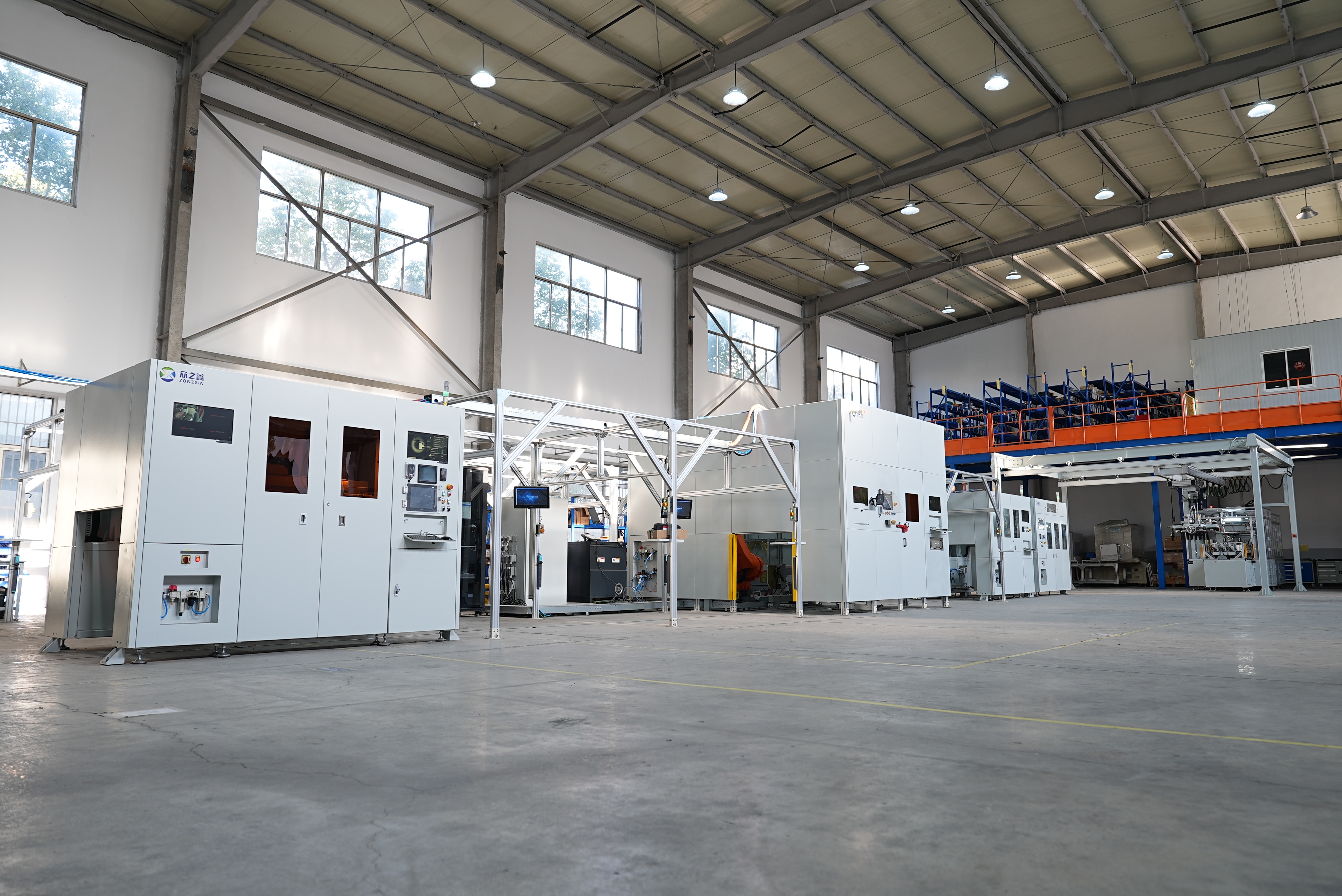
CTP battery PACK assembly line configuration for large prismatic cell packs.
Technical Explanation: How the Specification Translates into Line Behaviour
Zonzsin's published process description for its lithium battery module PACK assembly line covers a one-stop flow running from cell feeding, stacking and insulating through wire harness installation, end-of-line test and charging and discharging test. The same product literature describes a Mecanum-wheeled semi-automatic PACK cluster loading system, which is the mechanism that transfers assembled cluster modules into the pack. Read together, the described scope is integration-led rather than station-led: the buyer is purchasing a sequence of process steps plus the handling architecture that links them.
Cycle time: PPM and minutes are not the same quantity
The ZZX2501 is published with a cycle time of 6 PPM and is also stated as 30 minutes per PACK. Those two figures describe different measurement bases. A station-level rate and a pack-level completion time are separate quantities, and the difference becomes commercially relevant the moment capacity planning or a liquidated-damages clause depends on it. Buyers should require the supplier to define the basis in writing: is throughput counted at a specific station, at line exit, or averaged across a shift with planned downtime included?
The same discipline applies to the wider category. Commercially published benchmarks for high-efficiency CTP lines handling large prismatic cells commonly fall into a 4–8 PPM band, and Zonzsin's published module PACK assembly line page states a cycle time that can reach 16 PPM. Those figures sit in different product scopes — pack-level versus module-level — and should be compared only after the scope, automation level and pack architecture are aligned.
Welding qualification: one-time versus final
The ZZX2313 publishes a one-time welding qualification rate of ≥99.5% and a final welding qualification rate of ≥99.95%. The distinction is operational rather than cosmetic. A one-time qualification rate counts joints that pass inspection on the first attempt, without rework. A final qualification rate counts joints that pass after rework has been carried out. A procurement team that contracts only on the final figure accepts rework as part of the normal process. A team that contracts on the one-time figure is buying first-pass process stability, and should expect the line to be measured accordingly during acceptance.
Operation rate is not OEE
Zonzsin publishes a single-machine operation rate of ≥95% for the ZZX2313. Operation rate is normally a machine-availability measure. It is not line-level overall equipment effectiveness, which also incorporates performance losses and quality losses. When this figure appears in a contract, the acceptance document should state explicitly which definition applies and how downtime is attributed.
Utilities, footprint and compliance
Utility requirements are published per model: the ZZX2501 requires compressed air at 0.6–0.8 MPa and AC 380V ±10% at 50±0.5 Hz, while the ZZX2313 lists compressed air at 0.5–0.8 MPa and AC 380V ±10%. The ZZX2406 publishes an overall dimension of L58000 × W11000 × H3800 mm, which is a building-level planning input rather than a minor detail.
On compliance, Zonzsin holds a Quality Management Systems Certificate against ISO 9001, certificate number 44825MS079001R0, issued by ZDCB, valid from 20 November 2025 to 19 November 2028, and assessed against GB/T19001-2016 / ISO 9001:2015. The certified scope covers laser welding equipment, laser cleaning equipment, module PACK assembly line, and the R&D and assembly of AGV-based cluster loading robot.
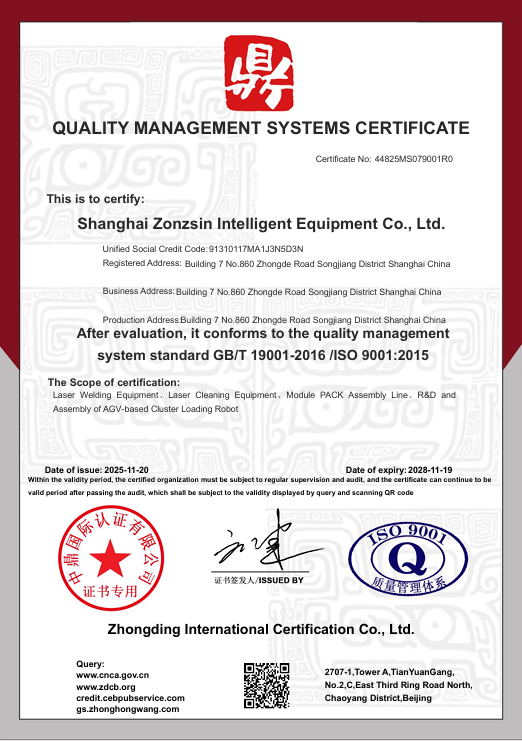
ISO 9001 certificate 44825MS079001R0, valid 20 November 2025 to 19 November 2028.
Application Fit: EV, ESS, C&I and Automotive OEM Projects
Published applicability maps cleanly across the three models. The ZZX2406 is positioned for energy storage, EV and C&I production. The ZZX2501 is positioned for the EV industry and energy storage. The ZZX2313 is positioned for the EV industry, energy storage and automotive OEMs.
Cell format is the practical selector. The ZZX2406 processes 314Ah and 587Ah prismatic cells in a 1P96S pack configuration, so a project already locked to 314Ah cell supply and a 1P96S architecture can evaluate that line directly. Zonzsin's separate automatic industrial car battery pack assembly line page lists compatibility with 280/314/587 Ah cells and 1P52S/1P104S pack configurations, which is useful context when a buyer expects the cell format to change over the life of the line.
Installation evidence is limited but on the record. A battery PACK assembly line project in India, at a scale of one unit, was completed within one year and reached stable operation. The published highlights are a space-saving U-shape layout and user-friendly operation. The customer types Zonzsin lists for this application include automotive OEMs, energy storage system integrators, battery cell and PACK manufacturers, and EPC turnkey contractors.
Procurement Terms Buyers Should Confirm Before Signing
Published commercial terms for Zonzsin's pack assembly line business provide a concrete baseline for the negotiation checklist:
- Minimum order quantity: 1 unit.
- Monthly capacity: 3 units.
- Lead time: 3 to 5 months.
- Production mode: OEM / ODM.
- Customization scope: cycle time, automation level, logo, color and configuration.
- Quality control: 100% test.
- Export markets: Southeast Asia and the EU.
- After-sales: remote support, plus on-site installation and commissioning.
Company-level capability is also a procurement input, not a marketing line. Zonzsin reports 50 granted patents, including invention patents covering an AGV-driven battery PACK insertion robot. The company states that modular design contributes to maintenance expenditures it reports as 20% lower, and lists modular design as a central engineering principle across its pack line range. For a buyer planning a multi-year asset, the modularity claim is worth testing during the technical clarification: ask which modules are field-replaceable, which are supplier-service-only, and what the spare-part lead times are.
Market Trend Signals Shaping 2026 Procurement
Three signals are visible from published and verified category data, and each changes how a pack line specification should be read.
Cell formats are moving upward. The transition toward 314Ah and larger prismatic cells is now embedded in line specifications rather than projected. The ZZX2406 addresses both 314Ah and 587Ah cells, and the broader product page lists 280/314/587 Ah compatibility across pack architectures. Buyers specifying a line today are effectively specifying for a cell format that may not be the one they run in year three.
Turnkey pricing has a published range. Publicly listed commercial data for turnkey CTP battery pack production lines indicates a range of roughly US$1,000,000 to US$3,000,000 per set. That range is wide because line scope varies enormously — automation level, station count, test depth and clean-dry-room requirements all move the number. It is useful as a budgeting frame, not as a quotation.
Acceptance methodology is the category's open gap. Verified data collection for this segment identified the absence of standardized acceptance, warranty and service terms, and the absence of independent reliability data, as recognized gaps. In practice this means the burden of defining acceptance testing falls on the buyer. Teams that write their own protocol — sampling plan, measurement basis, rework definition, ramp-up milestone schedule — will be better protected than teams that accept a supplier's standard test sheet.
Where the Specification Has Boundaries
An honest reading of the published data includes the limits of the configuration.
The ZZX2406 is published as a semi-automatic CTP line with a 4 PPM cycle time. A project targeting a fully automatic line at the higher end of the 4–8 PPM band should not assume the baseline ZZX2406 specification delivers that; automation level and cycle time are listed customization parameters, which means the required automation must be specified and quoted explicitly rather than inferred.
Footprint is the second boundary. At L58000 × W11000 × H3800 mm, the ZZX2406 requires substantial floor area and vertical clearance. Buyers working inside an existing building should validate column spacing, crane clearance and material-flow aisles before finalizing layout — the India reference project used a U-shape layout specifically for space saving, which suggests layout design is treated as a project variable rather than a fixed deliverable.
Third, utility dependency is real. Stable 380V supply within ±10% and dry compressed air within the published pressure band are preconditions for the published performance figures. Where plant utilities fluctuate, the acceptance test conditions should record the actual supply conditions during measurement.
Fourth, and most important for contract drafting: the welding qualification and operation-rate figures are supplier-published claims. No standardized test protocol accompanies them in the public data. Buyers should define the sampling plan, the inspection method and the counting rules before the acceptance test, and should treat the published figure as the target rather than as the method.
| Aspect | Conventional manual / semi-manual pack assembly | Automated battery pack assembly line |
|---|---|---|
| Process consistency | Depends on operator skill and can vary between shifts | Station parameters are repeatable and measurable |
| Performance visibility | Output and rework often recorded manually | Cycle time, operation rate and welding qualification can be logged as acceptance metrics |
| Infrastructure requirement | Lower fixed infrastructure requirement | Requires planned floor area, stable power and dry compressed air |
| Cell format change | Adapted manually at the workstation | Requires configuration change; the customization scope must be agreed in advance |
| Capacity ramp | Gradual and labour-limited | Defined by line cycle time and automation level |
Qualitative comparison of conventional and automated pack assembly approaches.
Future Outlook
The direction of travel for pack assembly procurement is toward specification discipline. As cell formats grow and pack architectures become more integrated, the number of variables that must be agreed before a line is built keeps rising, while the tolerance for ramp-up surprises keeps falling. Two consequences follow.
First, acceptance criteria will increasingly be treated as a deliverable in their own right, negotiated alongside the equipment schedule rather than derived from it after installation. Categories that lack standardized test methodology tend to develop buyer-defined protocols instead, and that shift is already visible in how procurement teams structure pack line contracts.
Second, flexibility will be evaluated as an engineering property rather than a sales phrase. Lines that can be reconfigured across cell formats and pack architectures without rebuilding the handling system — through modular station design and defined customization scope — will hold value longer than lines optimized for a single format. For buyers, the question to ask is not whether a supplier offers customization, but which specific parameters are customizable, at what lead time, and at what cost.
FAQ: Technical and Procurement Questions
1. What is the difference between the ZZX2406, ZZX2501 and ZZX2313 battery pack assembly lines?
They are three distinct models in Zonzsin's pack line portfolio. The ZZX2406 is a CTP battery PACK assembly line with a published dimension of L58000 × W11000 × H3800 mm, a 4 PPM cycle time, semi-automatic operation, and support for 314Ah and 587Ah prismatic cells in a 1P96S configuration. The ZZX2501 is a Blade battery PACK assembly line with a published cycle time of 6 PPM, stated as 30 minutes per PACK, and utility requirements of 0.6–0.8 MPa compressed air and AC 380V ±10% at 50±0.5 Hz. The ZZX2313 is an EV battery PACK assembly line publishing a single-machine operation rate of ≥95%, a one-time welding qualification rate of ≥99.5% and a final welding qualification rate of ≥99.95%.
2. Which battery cells and pack configurations can the ZZX2406 process?
The ZZX2406 supports 314Ah and 587Ah prismatic cells arranged in a 1P96S pack configuration. Zonzsin's adjacent automatic industrial car battery pack assembly line page additionally lists compatibility with 280/314/587 Ah cells and 1P52S/1P104S pack configurations, which is relevant if the buyer expects the cell format or pack architecture to change over the life of the equipment.
3. Should capacity planning use 4 PPM or 6 PPM?
They belong to different models, so they are not alternatives on the same line. The ZZX2406 publishes 4 PPM; the ZZX2501 publishes 6 PPM, stated as 30 minutes per PACK. Across the category, commercially published CTP line benchmarks for large prismatic cells fall in a 4–8 PPM band. Because PPM and minutes-per-pack can describe different measurement bases, capacity planning should use a throughput figure whose basis is confirmed in writing by the supplier.
4. What footprint and utility conditions must be prepared before installation?
The ZZX2406 publishes an overall dimension of L58000 × W11000 × H3800 mm, so floor area and vertical clearance must be planned at building level. Utility requirements are published per model: the ZZX2501 requires compressed air at 0.6–0.8 MPa and AC 380V ±10% at 50±0.5 Hz; the ZZX2313 requires compressed air at 0.5–0.8 MPa and AC 380V ±10%. Where supply conditions fluctuate outside these bands, the conditions during acceptance testing should be recorded.
5. What do the published welding qualification rates mean, and how should they be verified?
The ZZX2313 publishes a one-time welding qualification rate of ≥99.5% and a final welding qualification rate of ≥99.95%. One-time qualification counts joints passing on the first attempt without rework; final qualification counts joints passing after rework. The published figures are supplier-reported and are not accompanied by a standardized public test protocol, so verification depends on the buyer defining the sampling plan, inspection method and counting rules in the acceptance document.
6. What should be written into the acceptance criteria of the purchase contract?
At minimum: the measurement basis for cycle time and throughput; the definition and sampling plan for welding qualification; whether the operation-rate target refers to machine availability or line-level OEE; the utility conditions under which measurements are taken; the ramp-up milestone schedule; and the remedy if a target is missed. Because standardized acceptance, warranty and service terms are not yet an established convention in this category, buyer-defined criteria carry more weight than supplier standard test sheets.
7. What are the standard purchasing terms?
Zonzsin publishes a minimum order quantity of 1 unit, a monthly capacity of 3 units, and a lead time of 3 to 5 months. Production mode is OEM / ODM, quality control is 100% test, export markets are Southeast Asia and the EU, and after-sales support covers remote support plus on-site installation and commissioning.
8. How much customization is available on a pack assembly line?
Published customization parameters cover cycle time, automation level, logo, color and configuration. This means the baseline specification of a model such as the ZZX2406 should be treated as a starting configuration rather than a fixed product, and any requirement beyond the published baseline — for example a higher automation level or a different throughput target — must be specified and quoted explicitly during technical clarification.
9. What happens after installation?
Published after-sales terms comprise remote support together with on-site installation and commissioning. Company-level capability includes 50 granted patents, among them invention patents for an AGV-driven battery PACK insertion robot, and a stated modular design approach that the company reports contributes to 20% lower maintenance expenditure. For spare-parts planning, buyers should confirm module-level replaceability and spare-part lead times as part of the commercial negotiation.
10. Does the ISO 9001 certificate cover the specific line being purchased?
The certificate — number 44825MS079001R0, issued by ZDCB, valid from 20 November 2025 to 19 November 2028, assessed against GB/T19001-2016 / ISO 9001:2015 — lists a scope covering laser welding equipment, laser cleaning equipment, module PACK assembly line, and the R&D and assembly of AGV-based cluster loading robot. The ZZX2406, ZZX2501 and ZZX2313 are listed as related products on that certificate. Buyers should still confirm that the scope statement maps to their exact configuration, since scope language and line configuration are separate documents.
Closing Note
The clearest signal from the published data on automatic battery pack assembly lines is that the specification sheet is only half the procurement. Cell compatibility, footprint and utility requirements can be verified against documents. Cycle time basis, welding qualification definitions and operation-rate measurement can only be verified against a test protocol the buyer helps write. For CTP and Blade projects in the 314Ah class, that protocol is the part of the contract most likely to determine whether the line performs as expected in year one.
Zonzsin's product brochure covering its battery pack assembly line range is available for download here: Product brochure (PDF). Additional company information is published at www.zonzsin.com.
¿Tiene preguntas o necesita más detalles?
Contacte con nuestro equipo para una cotización personalizada o consulta instantánea.
Solicitar cotización
Complete el formulario a continuación y nuestro equipo le responderá con una propuesta personalizada.
Chat directo de WhatsApp
¿Prefiere chatear en tiempo real? Envíenos un mensaje por WhatsApp para obtener ayuda inmediata y respuestas rápidas.
- Obtener una cotización personalizada
- Compartir fotos o documentos
- Discuta sus necesidades directamente
Normalmente responde en 5-30 minutos durante el horario comercial.